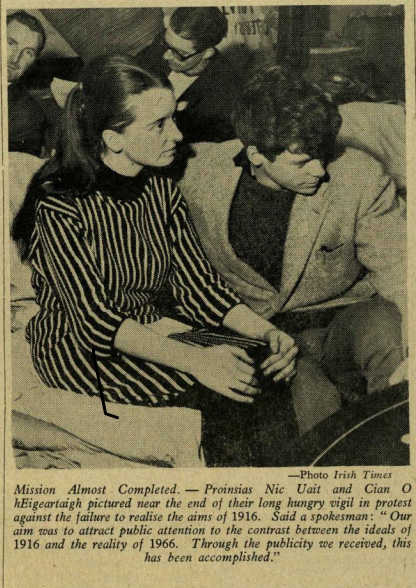
Image from front page of Trinity News (April 21st 1966)
In April 1966, the Irish state marked the fiftieth anniversary of the Easter Rising in spectacular fashion. The state laid claim to the legacy of the Easter Rising, while Republicans fought for a voice within the year of commemoration. One unusual group who protested during the commemorations were Misneach, an Irish language activist group, who voiced their anger at the “non-achievement of the aims of the signatories of the Proclamation” by going on hunger strike for a week, frequently picketing the front of the General Post Office. Their strike began, as the Easter Rising itself had, on Easter Monday. They attracted considerable media attention worldwide, with the New York Times and others covering the protest.
In March 1966, the group Misneach used a press conference in the Clarence Hotel to outline their planned hunger strike, and noted that during Easter week they would picket the G.P.O, the newly constructed Garden of Remembrance, Liberty Hall and other sites associated with the rebellion. Their statement, which was issued in the Irish language, was signed by Micheál Mac Aonghusa (the secretary of Misneach), Eoin O Murchú, Deasún Breathnach and others. In total twelve men and one woman were committed to the April hunger strike in Dublin, with others pledging similar action in Belfast.
Micheál Mac Aonghusa told The Irish Times that Misneach did not believe “those who died in that Easter Week died to have their deaths celebrated, but rather their aims be achieved.” He asked just what the Ireland of 1966 had to celebrate. “The death of the Gaeltacht, economic independence on Britain, partition or emigration?” The protest by Misneach members enjoyed support (in the form of resolutions) from a wide variety of groups, including branches of Comhaltas Ceoltoiri Éireann and the Celtic Youth Congress.

The official state commemoration marches past the General Post Office, 1966.
For the duration of the hunger strike, the members of Misneach slept in a small tenement room just off Parnell Street, and their protest attracted plenty of media coverage at home and abroad. Several men in Belfast staged a similar protest in Hawthorn Street, and pledged to “think, speak, write and read only Gaelic during the strike period.”
Those on hunger strike were described in the national media as “mostly people in their twenties, mild spoken. They use no English.” Many were students, primarily from University College Dublin and Trinity College Dublin. Pronsais Nic Uait was the only female hunger striker, and hailed originally from Boyle in Roscommon. She was a student of Trinity College Dublin, studying English. The car of one hunger striker, Deasún Breathnach, was stolen from the north inner-city during the hunger strike, but found undamaged by Gardaí soon after and returned.
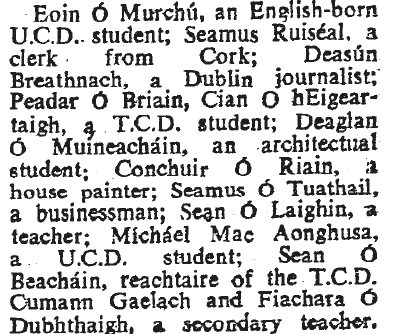
The Irish Times details the hunger strikers (April 12 1966)
















 Click on the book for more.
 Click on the book for more.
 Donal
Donal Ciarán
 Sam
Sam


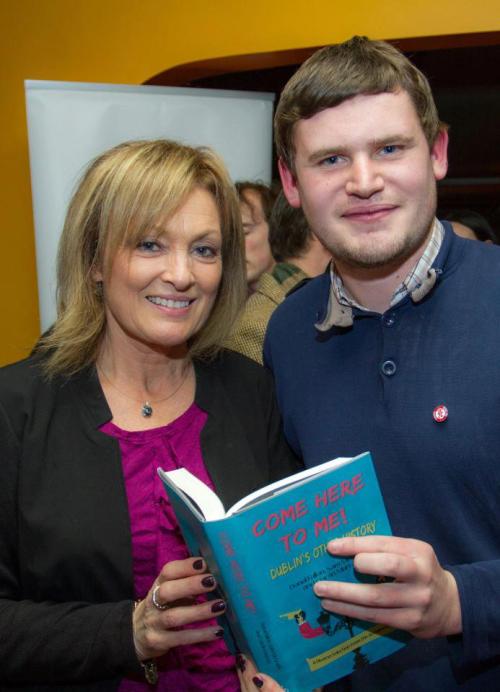
 Come Here To Me!