Feeds:
Posts
Comments

At the minute I’m reading David Boulton’s study on the Ulster Volunteer Force, UVF: An Anatomy of Loyalist Rebellion, which was published in 1973. Writing a study of anything as the story is still unfolding is a difficult task, but it’s a pretty enjoyable read. The books cover is the work of Cor Klaasen, and some of you may remember the brilliant exhibition of his work in Dublin back in 2010.

One of the key characters in the work is Major Ronald Bunting, described by Tim Pat Coogan as the “henchman” of Ian Paisley during the worst days of the troubles. Bunting had a history of service to the British Armed Forces,but is perhaps best remembered for his physical opposition to the People’s Democracy movement. Video footage of Bunting and Paisley discussing a planned People’s Democracy march in Derry in January 1969 appears on the RTE Archive website, and can be viewed here. Bunting outlined his opposition to “anarchists, revolutionary socialists and republicans” to the media.

People’s Democracy, a radical movement of socialist principles which campaigned for civil rights in the north, planned a ‘long march’ from Belfast to Derry, in the spirit of marches like the Selma to Montgomery march in the United States. This march was attacked on several occasions, most notably at Burntollet Bridge. Bunting was directly responsible for the violence at Burntollet Bridge, having encouraged loyalists who “wished to play a manly role” in stopping the People’s Democracy march to “arm themselves with whatever protective measures they feel to be suitable.” A crowd of 200 attacked the demonstration. That incident has been remembered in song by both loyalists and republicans, for example in Seamus Robinson’s ‘Democracy’:

T’was at Burntollet Bridge we bled, yet never turned to flee
As bloodied but unbowed we stayed to win democracy

Major Bunting outlines his opposition to the Peoples Democracy movement.

Of considerable embarrassment to Bunting was the manner in which his son, Ronnie, would become a committed republican-socialist. Active with the Marxist Official IRA, and later leading the Irish National Liberation Army, the son of Major Bunting was gunned down in his home in 1980. Major Bunting insisted his son be buried in a family plot, and not alongside other INLA members.

One of the most interesting anecdotes in Boulton’s book on the UVF relates to Major Bunting, when it is noted:

He became a ‘loyalist’ hero overnight in 1966 when he gate-crashed a 1916 commemoration service in Dublin to lay a wreath in memory of British troops killed in putting the rising down.

This story is also told in Patrick Marrinan’s biography of Ian Paisley, and Ed Moloney and Andrew Pollak’s biography of Paisley, where they note that at Easter 1966 “he went to St Patrick’s Cathedral in Dublin to lay a wreath in memory of British soldiers killed in the 1916 Rising.”

This interference from Bunting caused considerable embarrassment for many parties, as the Church of Ireland had sought to mark the jubilee in a fitting manner. In his remarks at the official ceremony at St. Patrick’s Cathedral, Archbishop George Simms noted:

There is much for which to give thanks on our commemorative occasion. We are grateful across the span of the last 50 years for the goodwill, tolerance and freedom expressed and upheld among and between those of differing outlooks and religious allegiances. The words of the Proclamation that guarantee ‘religious and civil liberty, equal rights and opportunities to all citizens’ have brought help and encouragement to minorities during this period. There is a rock like quality about such elements in the formation of a State.

An excellent article on the Church of Ireland and the 1966 commemorations appears in the Autumn 2012 edition of Search, A Church of Ireland journal. It can be read here.

This wasn’t to be the last time Paisley or one of his henchmen interfered with commemorations or the symbols of the Easter Rising. Almost twenty years later, at Easter 1984, Ian Paisley and some supporters postered the GPO with the message ‘ULSTER IS BRITISH’. At the time Paisley told the newspapers that the photo of him postering at the GPO would take “pride of place” in his home, and that he was “glad to stand where the 1916 proclamation was read”.

Irish Independent, May 3 1984.

“Her arse to the nation.”

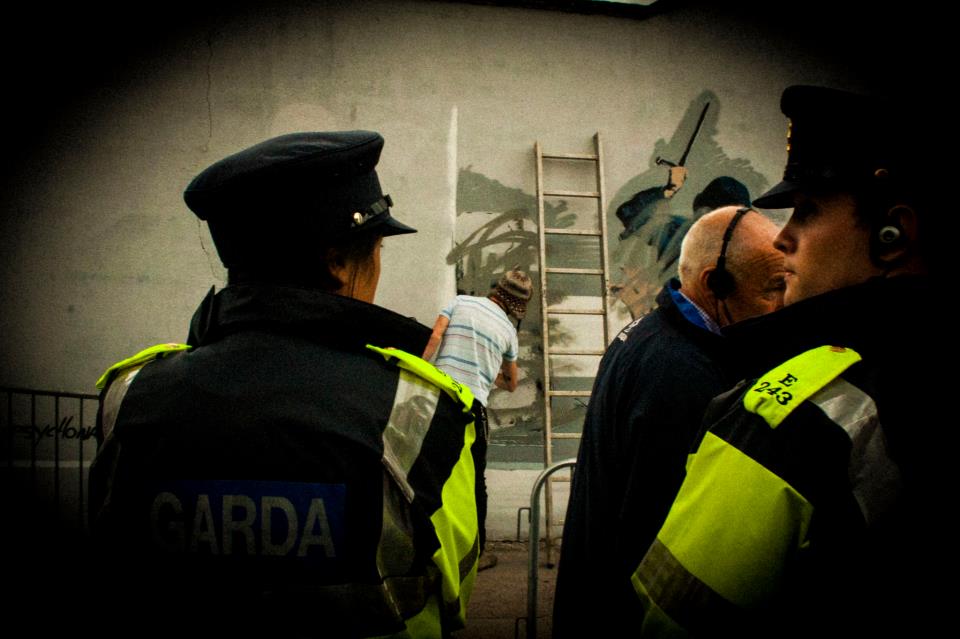
Back in August, Dublin street artist and CHTM favourite ADW ended up in hot water with the Gardaí for a piece of street art he painted as part of the Kings of Concrete Festival. In a city where Justice has always looked a little funny, (“The Statue of Justice, mark well her station, her face to the castle and her arse to the nation!”) ADW placed her over the knee of a riot-squad officer, which led to this scene:

Image by Damian Duggan, taken from ADW’s Facebook.

In the latest edition of Rabble, ADW discusses this piece and what it meant, as well as the response of the police to it:

The blindfold represents her decisions to be objective and impartial and not to be influenced by wealth, power, status or politics. In one hand she holds the scales of justice which represents her careful weighing the claims of each side. Her sword which represents her willingness to defend her decisions lies broken beside the riot shield.

Thankfully, he has repainted the piece. Here she is, in all her glory.

Regardless of what you think about Geldof today, he has been on the ball a few times down the years.

His 1980 single ‘Banana Republic’, with that great reggae bassline, summed up the country quite well and rallied against all the ills of nationalist, conservative Ireland:

And I wonder do you wonder while you’re sleeping with your whore?
Sharing beds with history is like licking runnin’ sores
Forty shades of green yeah, sixty shades of red
Heroes going cheap these days, price a bullet in the head
Banana Republic, Septic Isle Sufferin’ in the screamin’ sea, sounds like dyin’
Everywhere I go, yeah everywhere I see
The black and blue uniforms, Police and Priests

In 1985, Geldof was honoured with a civic reception go mark his African famine relief work. In front of the Lord Mayor, the City Manager and other dignitaries, he rallied against the destruction of his home town:

This city has become increasingly brutalised. The people have lost some of their openness, and I think a lot is largely due to the destruction of the city itself, which was once one of the prettiest cities in these islands and is now a shambolic mess, at best.


Tomorrow, I have to bring some of the BBC around the city to show them some of the things I remember and love about the place. Unfortunately, when I went through the list of my memories, 50 per cent of the things I liked had disappeared, to be replaced by the most mediocre, unaesthetic, architecturally inarticulate buildings I’ve ever seen in my life. They are a scandal. They can only be the product of back-handers, political corruption and moral degradation.

His words ring true today as they did then:

When a city is being destroyed by its custodians, then what are the people who live in it supposed to think? The brutalisation seeps through, in the increased use of drugs, which is epidemic in this city, the street violence and the rudeness that is almost everywhere. And I’m sorry if my image clashes with the tourist image of it, but that’s what I’ve seen over thirty-two years. As I say, it’s very nice to come home and it’s particularly nice to be honoured in this way. But please stop destroying Dublin, and please get rid of those buildings that offend us all, that make us so depressed. And, please, bring back to this city some of the life and beauty that was there when I grew up with, and make it somewhere that’s nice to come home to…

The above quote was taken from Frank McDonald’s must-read The Destruction of Dublin, published in 1985.

Front cover. Frank McDonald, The Destruction of Dublin (1985)

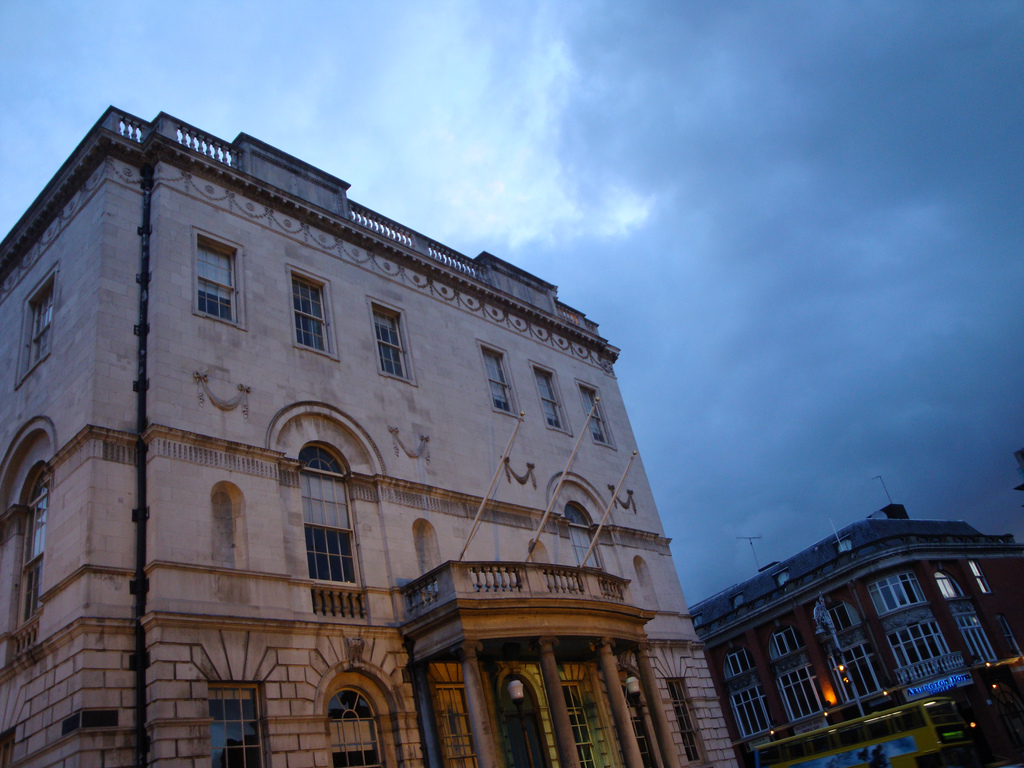
Newcomen Bank (now the Rates office), Castle Street. Credit – Flickr user milezero

Most Dubliners pass the Rates office building on Castle Street without giving it a second glance. Few know the story of scandal, bankruptcy and suicide which still haunts its corridors.

In 1722, a banker by the name of William Gleadowe married into the Newcomen family of Carriglass in Co. Longford and assumed their name. In 1781 he was knighted and elected to the Irish Parliament. Here, he  voted in favour of the Act of Union. Sir William Gleadow-Newcomen’s wife was rewarded with a peerage as thanks.

In 1778, he commissioned architect Thomas Ivory to build a new bank at 16 Castle Street next to City Hall which traded as Newcomen & co. Bank. It was completed in 1781.

At time of his death in 1807, he was in £74,000 in debt to his own bank. Hhis son Thomas Viscount Newcomen inherited his mother’s title and the management of the Bank.

Thomas followed his father’s example by borrowing £44,000 from the same source. Additionally, he borrowed elsewhere to the tune of £163,000.

He soon turned into a despondent, isolated, Scrooge like figure.

William John Fitzpatrick in his memoir 1892 memoir Secret Service Under Pitt, described how he:

For years he lived alone in the bank, gloating, it was wildly whispered, over ingots of treasure, with no lamp to guide him but the luminous diamonds which had been left for safe keeping in his hands. Moore would have compared him to ‘the gloomy gnone that dwells in the dark gold mine‘. Wrapped in a sullen misanthropy, he was sometimes seen emerging at twilight from his iron clamped abode.

From 1825, the mismanaged bank suffered a number of failures and eventually had to close.

Newcomen, then forty-eight and still unmarried, could not face the scandal. He returned home to Killester House, went into his office and turned a gun on himself.

After his death the title became extinct.

In 1831, the building was sold to the Hibernian bank and it later became the Rates office.

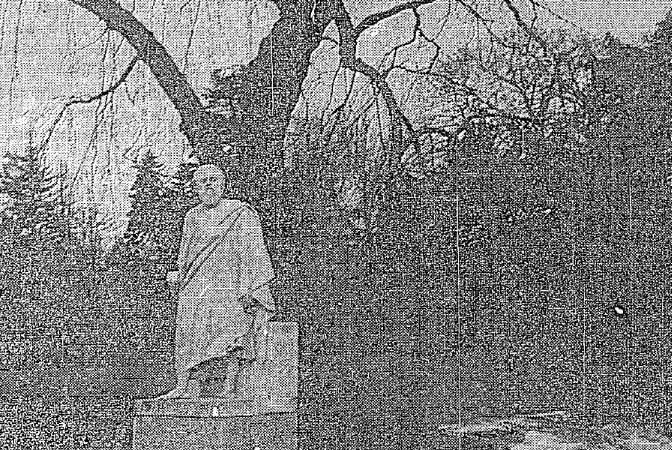
Over the years we’ve looked at many of Dublin’s brilliant and controversial statues, but one which I’d not stumbled across was the statue to the great Socrates in the Botanic Gardens. My brother was strolling through the grounds and took a photograph, and I wonder how many others are unaware of its presence in Dublin.

Socrates in the Botanic Gardens. (L.Fallon)

Not quite a signatory of the 1916 Proclamation or anything else you might expect of a man immortalised in this form in Dublin, Socrates (c. 469 BC – 399 BC) is one of the founders of Western philosophy, celebrated for his contributions in the field of ethics in particular. Does anyone have any information on the origins of this brilliant statue, and how it came to be placed in Dublin?

A friend joked it must be in honour of his time spent playing the beautiful game with UCD AFC. A brilliant joke, but that was another Socrates, and he never kicked a ball apparently.

Socrates in the Botanic Gardens (Irish Independent, January 1966)

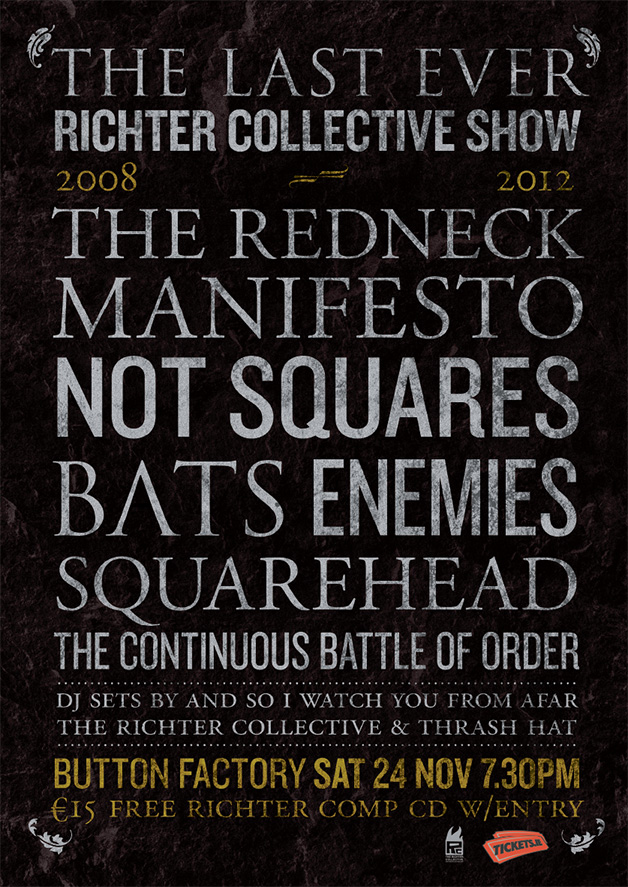
Our friends at the Richter Collective are calling it a day, after years of releasing records and touring up and down the island. It’s no doubt a hard time for small, independent record labels globally, and in four years Richter had a massive impact on the independent music scene in Dublin. Such ventures are certainly for the love and not the money, but love alone can’t run a record label or much else!

Having released some fantastic records from acts like Adebisi Shank, Squarehead, Enemies and The Redneck Manifesto, the label is now going to see itself out not in sorrow but with a final blast. Next Saturday they’ll be hosting a show at the Button Factory with many of their acts on the bill, and a Richter Collective CD compilation thrown in with the door-tax of €15.

We’ll certainly be there, and well done to the lads at Richter on four fantastic years.

One of the strangest grave markers in Dublin lies in the “Stranger’s Bank” at the old Saint Mary’s Abbey in Howth. This section of the cemetery was usually used to bury unidentified victims of disasters at sea.

During the building of the Dollymount to Howth tram line in the 1890s, a young Englishman, track-layer died suddenly on it. He left no clue as to his origins or surname.

Vincent Caprani in his book A View from the Dart (1986) fleshed out the story:

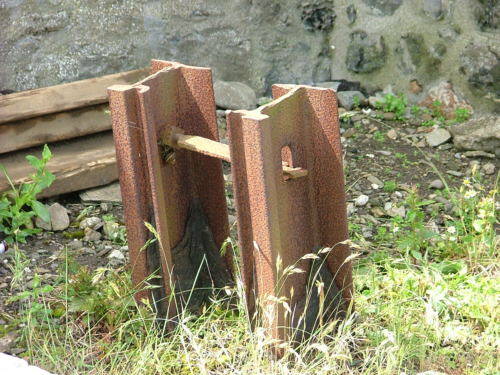
Unable to contact his family (if he had any), his tramway mates had him rest in the strangers plot and they fashioned a ‘tombstone’ for him from a piece of grooved tram rail. This humble yet enduring ‘monument’ … to my mind one of the most poignant grave markers in Ireland.

It is sill there to this day.

Grave to the ‘Unknown Tram Man’. © 2007 Bernd Biege

The Pinking Dindies

One of James Malton’s famed illustrations of eighteenth century Dublin, showing the Irish Parliament on College Green. (c.1793, NLI)

Dublin history is littered with famous gangs, from the Liberty Boys to the Animal Gangs. These gangs have entered the folklore, songs and popular history of the city. One rather unusual gang who haven’t quite received the same amount of attention are the ‘Pinking Dindies’ of the eighteenth century. The ‘Pinking Dindies’ are an interesting phenomenon in that they sprang from the upper-echelons of society, while gang violence often has its roots in lower socio-economic groups. When we think of gangs in Dublin we think of times of poverty and areas of misery, but this gang existed at a time of great prosperity in Dublin.

Margaret Leeson was Ireland’s first brothel owning ‘madam’, and a fascinating woman. Born in Killough, Co. Westmeath, she would become the most famous of Dublin’s eighteenth century madams, and even published her memoirs in 1797, opening the work by noting “I shall now commence with the most memorable epoch of my unfortunate life….”

Her first brothel in Dublin was opened on Drogheda Street, and I had read that this premises was closed owing to the vandalism of a group called the ‘Pinking Dindies’. In Leeson’s work she complains that Dublin was home to many men who “however they might be deemed gentlemen at their birth, or connexions, yet, by their actions, deserved no other appellation than that of RUFFIANS.” Researching this group, I found plenty of information within J.D Herbert’s book Irish varieties, for the last fifty years: written from recollections. Published in 1836, this book is a fascinating insight into the gangs and characters of Ireland once upon a time.

Writing about ‘Pinking Dindies’, Herbert notes that:

It is now upwards of fifty years since Dublin was infested by an organised body of dissolute characters, composed of persons; some were sons of respectable parents, who permitted them to get up to man’s estates in idle habits, without adequate means of support; others were professional students, who having tasted the alluring fruits of dissipation, abandoned their studies and took a shorter road to gain supplies, by means no matter how fraudulent.

Herbert writes about a gang of wealthy men who roamed the streets, men of “imposing appearance, being handsome and well made in general”. In a time before the establishment of the Dublin Metropolitan Police force, Herbert writes that these men were so well prepared for violence that the “ancient and quiet watchmen” who guarded Dublin were no match for them. These wealthy men would “assail passengers in the street, to levy contributions, or perhaps, take a lady from her protector, and many females were destroyed by that lawless banditti.”

The account Herbert provides of these ‘Pinking Dindies’ is grim, noting that one manner in which they would raise funds was through extorting girls who worked within brothels, “by exacting from unfortunate girls, at houses of ill-fame, their share of what they deemed booty.” The gangs would also be frequently found at a gambling house on Essex Street, which when unsuccessful they would emerge from “enraged at their loss, and repaired them, by robbing the first eligible subject they met in the streets.”

Well-dressed and presented, the standard plan of attack for the men was to jostle a victim meant for prey, and then, with their swords “just protruded, they pricked him in various parts, and if he did not throw down his watch and money,two others came and took it by force.”

What became of the Pinking Dindies? Herbert claimed that the gang were ” never finally extirpated until the police was established. That useful institution, though decried by many, was more salutary and timely to the city of Dublin than any plan that has been since devised”. He noted that “several went to London,
and became expert at gaming-tables ; two of them were enabled to obtain admission to clubs in St. James’s-street, and I have often seen them walking and conversing familiarly with high fashionables.”

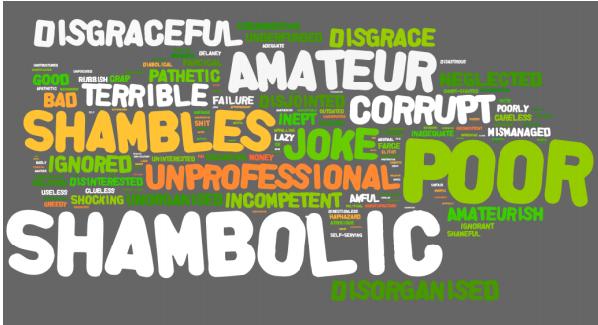
The word cloud above is a pretty shocking indictment of the state of Association Football in Ireland, and is taken from the Supporters Direct European Fans’ Survey report on the beautiful game in Ireland. Supporters were asked to give two words they felt described the running of the sport here in Ireland. Some 1,509 Irish fans took part in the survey, with almost half of these coming from Shamrock Rovers and Cork City. The report is available to read in full here. The bigger the word appears above, the more often it was listed.

Last weekend, fans from around the country met in Cork to discuss the state of the game in Ireland and the campaign to build a real Supporters Trust here. A message of support was read from President Michael D. Higgins, and in addition to Irish clubs there were fans and representatives from AFC Wimbledon, FC United of Manchester and others in attendance.

Our friends over at The True Ball have written up a report on the conference which I’d recommend reading if you’re a League of Ireland supporter, casually or religiously!

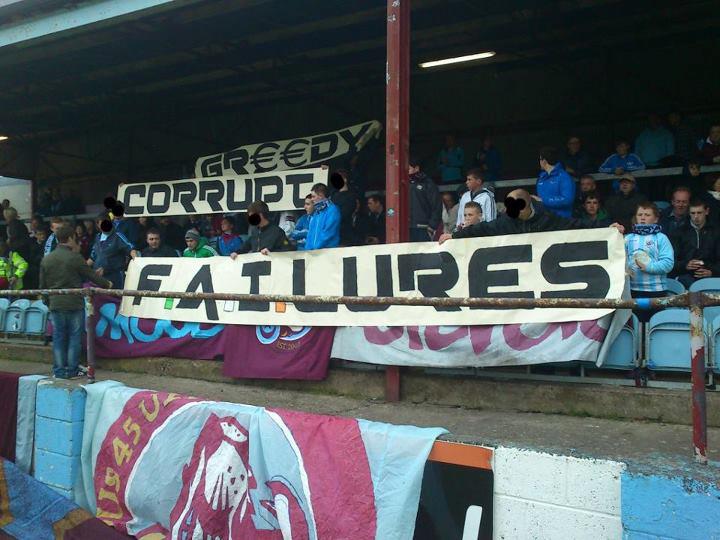
It is evident from this report that a desire to see the League of Ireland survive in a long-term sustainable fashion is foremost in fans’ minds, hardly surprising given the clubs that have come and gone in recent years. The distrust of the FAI is also evident. But so too is the sense that, certain barriers aside, these objectives are achievable and more importantly, desirable.

Drogheda United fans earlier this season.

Recently, I asked a group of friends if they could name the Lord Mayor of Dublin. Most couldn’t. While the office today doesn’t inspire or hold much of a public role in the city, historically some interesting characters have held the honour. Over the next while, we’re going to profile a few of them on the site, beginning with Mark Rainsford.

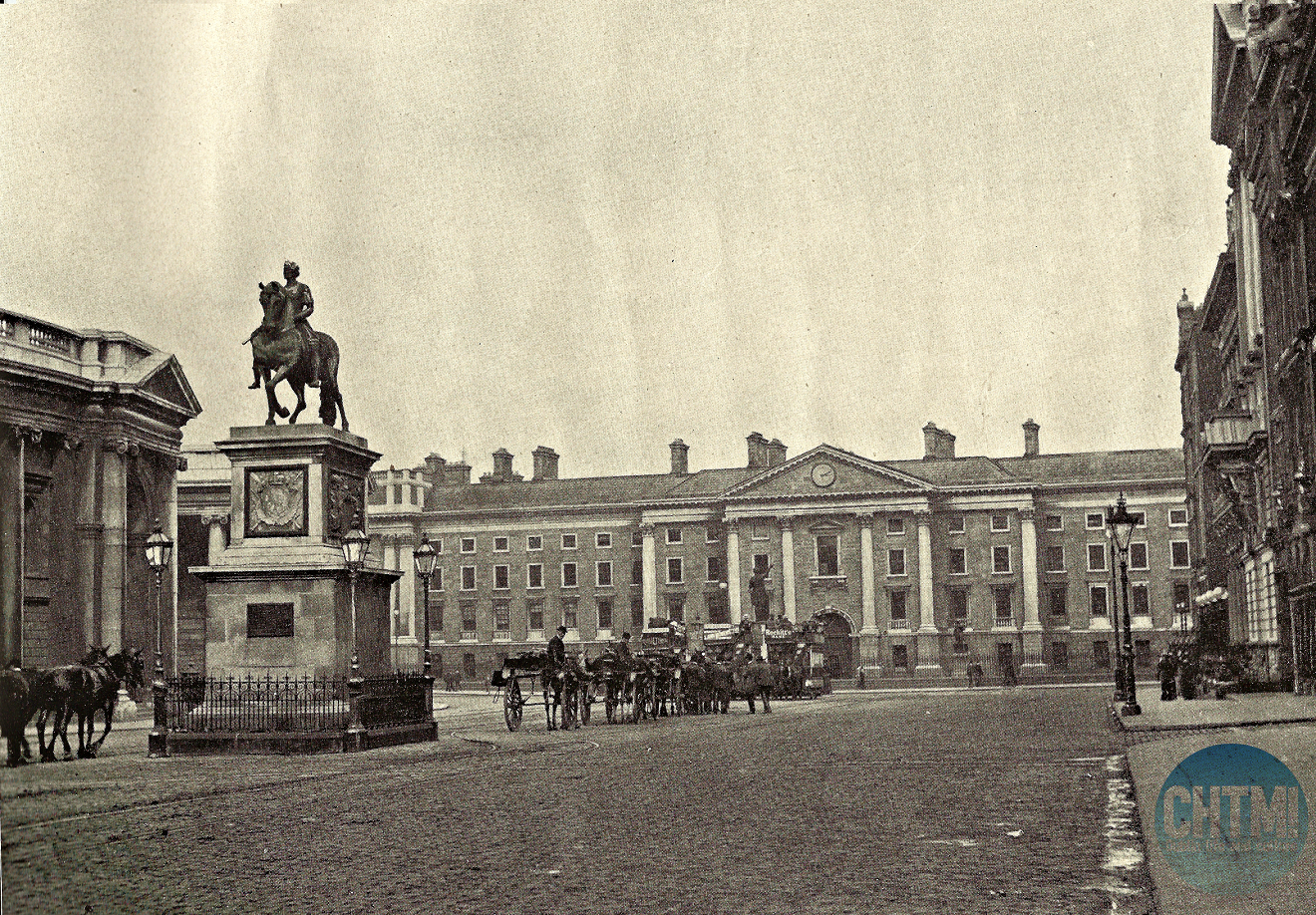
Sir Mark Rainsford was Lord Mayor of Dublin from 1700 to 1701, and to me remains one of the most interesting individuals to have held the office. Rainsford was the 36th Lord Mayor of Dublin. During this period the statue of King William of Orange on College Green was unveiled by him, a monument which would become a centre of protest and celebration for generations in the capital. Rainsford was also the original founder of the brewery at St. James’ Gate, which would later become the Guinness Brewery. Rainsford Street, next to the brewery today, is named in his honour.

From Guinness’s Brewery in the Irish Economy 1759-1876 (Cambridge, 1960), we know that the premises at St. James’ Gate which is today the celebrated Guinness Brewery was owned in 1670 by Alderman Giles Mee, who himself went on to become Lord Mayor of Dublin. On his passing, the brewery was giving to his son in law, Alderman Sir Mark Rainsford, who also inherited certain water rights in the district. Rainsford thus began brewing “beer and fine ales” in the brewery, being succeeded in this position by his son of the same name at the time of his own death. The younger Mark would lease the premises out for a term of ninety-nine years, but it did come back into the ownership and management of the Rainsford’s in 1750, 9 years before Arthur Guinness would take ownership of the site. The Rainsford’s leased the brewery to Guinness for a sum of £100, and £45 a year thereafter. The lease would run for an incredible nine thousand years!

In 1700, Sir Mark Rainsford became the Lord Mayor of Dublin, following in the footsteps of Sir Anthony Piercy. Rainsford had previously held the office of Sheriff. During his year as Lord Mayor, Rainsford would oversee the unveiling of the statue of King William of Orange on College Green.

(‘Ireland In Pictures, 1898′)

Grinling Gibbon’s statue became a magnet for both protests of dissent and commemorations of loyalty to the divisive figure. On the anniversary of King William’s victory at the Battle of the Boyle, and on his birthday in November, this statue was the location of celebrations in his honour. The statue would be cleaned, with orange lilies and ribbons placed upon it, and symbolically green ribbons and Shamrock would be placed below the horses uplifted foot (See: The Book of Days: A Miscellany of Popular Antiquities: Volume 2 London,1869). No statue in Dublin was as frequently targeted by vandals and political opponents as this one. In one episode in June 1710, the statue was robbed of its regal sword and martial baton, which led to the Corporation offering a huge reward of £100 for information which could catch the guilty party. Three students of Trinity College Dublin were charged with the act, and condemned to a harsh six months imprisonment, a fine of £100 each and forced to stand before the statue bearing the slogan “I stand here for defacing the statue of our glorious deliverer, the late King William.” Their fines were significantly reduced in the end, though the lads were expelled from Trinity College. The statue was removed from the Dublin streetscape following a bombing following independence, something we’ll be returning to on the site later.

One British publication wrote in 1898 that:

This equestrian statue of William III stands in College Green, and has stood there, more or less, since A.D 1701. We say “more or less” because no statue in the world, perhaps, has been subject to so many vicissitudes. It has been insulted, mutilated and blown up so many times, that the original figure, never particularly graceful, is now a battered wreck, pieced and patched together, like an old, worn out garment.

The plaque upon the statue noted that:

I am seeing here the Third King of Great Britain, France and Hibernia./ For the keeping of Religious Reinstated Laws. / Bring Freedom and this Statue To the eminent citizens of Dublin. / It was begun A.D 1700 Sir Anthony Percy, Lord Mayor. Charles Forrest, James Barlow – Esquires Sheriffs / Finished, A.D 1701 Sir Mark Rainsford, Lord Mayor. John Eceles, Ralph Gore – Esquires Sheriffs

The great occasion around the unveiling of the statue was the highlight of Rainsford’s year as Lord Mayor. In his personal life, he married twice, first to the daughter of Giles Mee, from whom we acquired the St.James’ Gate Brewery. He would marry for a second time in 1695 at St.Michan’s in Dublin, to a woman named Isabella Bolton.

The role of the Rainsford family in Dublin history and brewing history is evident today in the naming of ‘Rainsford Street’, next to the Guinness Brewery. Rainsford was followed by Samuel Walton, who became the 37th Lord Mayor. Rainsford passed away in November 1709, aged 57.

Almost thirty years before Paul Howard began his spoof Ross O’Carroll-Kelly column in The Sunday Tribune, Dublin born journalist Alan Bestic wrote an extremely accurate and humorous description of Dublin’s upper middle class.

He called them:

…The scampi belt, the Bacardi brigade. They own a house in Foxrock and have a Mercedes on the firm. The wife has a Mini for shopping and a swimming pool in the garden is on order. There is a cottage in Connemara – ‘I can really think down there’ – wine name-droppers, BA (pass), top convent wife with Ulysses in the handbag. Oyster festival but not Galway races. Hard tennis court, yacht in the front garden during winter … unhappy people with easy laughs and eyes that are always moving, looking for Murphy, wondering whether he is watching and whether he has a mohair suit too … blurred carbons of English suburbans from the mock stockbroker belt …

This quote is taken from Bestic’s seminal book The Importance Of Being Irish published in 1969 and described at the time as “an affectionately critical enquiry into the anatomy of modern Ireland”.

Cover of The Importance Of Being Irish (1969). Credit – antiqbook.nl

Bestic worked with The Irish Times, the Irish Press and other newspapers in Dublin from 1940 until 1950. During that time, he became the first Irish print journalist to report from Poland and East Germany after the war.

In 1950, he moved to London’s Fleet Street. Returning to his home town of Dublin in the late 1960s, he was overwhelmed by the social and economic changes that had occurred in the country and so wrote The Importance Of Being Irish.

Interestingly he was described by journalist Liam MacGaghann in the late 1970s as a “republican with respect to James Connolly’s principles, putting humanitarianism before unvarnished tribalism”.

Bestic was still writing as late as March 2001 for The Daily Telegraph.

Another footnote is that his father, Captain Albert Arthur Bestic, was the third officer on the Lusitania when she was torpedoed off the Head of Kinsale in 1915. As well as this, he was in command of the SS Isolda, when she was bombed by the Nazis off the coast of Wexford during World War Two with the loss of seven lives. He published his memoirs (see below) in 1957 and passed away in his home in Bray five years later.

Cover of Kicking Canvas (1958). Credit – Flickr user ‘Boy de Haas’

A divided Rathmines

As a poster on Boards.ie stated recently – “Rathmines has always been odd like that, in that you have … urban poverty mixed in closely with affluence.”

From the early 1900s to the late 1970s, only a couple of streets separated the gorgeous Georgian houses of Mount Pleasant Square and the poverty-stricken slum of Mount Pleasant Buildings.

Mount Pleasant Square. (Credit – Archiseek poster ‘GrahamH’)

Mount Pleasant Square, described by Susan Roundtre “as one of the most beautiful early 19th-century squares in Dublin” and by GrahamH from Archiseek as “one of the most charming enclaves of Georgian houses in the city”, was built in the 1830s. Mainly occupied by doctors and solicitors, they had squash, badminton and tennis courts as well as a private garden on their doorstep.

The two areas in Rathmines, c1907

Mount Pleasant Buildings, a stones throw away, were a block of ten large flats situated in a small area on the hill between Ranelagh and Rathmines. They later became a by-word for poverty and bad planning.

Rathmines Urban District Council started building the blocks around 1901, to provide accommodation for the “working classes” of the area. They were taken over, as was the Council by Dublin Corporation in 1930, and completed in 1931. In all there were 246 flats; 60 one-roomed, 150 two-roomed and 36 three-roomed.

Mount Pleasant Buildings, date unknown. (Dublin.ie user – woodies)

Rampant unemployment and a lack of basic sporting and community facilities led to anti-social behaviour. The former caretaker of the Buildings has said that “things really started to come apart in the late ’40s”. Petty crime and anti-social behaviour increased.  The area began to attract a bad name for itself. Journalist Maev Ann Wren summed up the situation by saying that “if all these inadequate or problem families are placed together it seems inevitable that a problem area will result”.

A documentary from the late 1960s on Dublin poverty focused on Mount Pleasant Buildings. It speaks for itself:

Former resident and author Lee Dunne published his best-selling Goodbye to the Hill in 1965. It was a fictionalised account of growing up in the area. Banned due to some sexual content, it went onto sell over a million copies.

(Another famous resident was the film star Constance Smith who lived there with her family in the 1940s)

In April 1966, Michael Vinny in The Irish Times described Keogh Square, Corporation Place and Mount Pleasant Buildings as “the three Dublin ghettos … used by the Corporation as dumping grounds for problem families.”

In January 1970, the Trinity News paper reported on its front page about a group of students in Ranelagh who were “attacked, terrorised and beaten up by hooligans” who tried to gate crash a party they were having. The students were attacked by bottles, frying pans, belts and metal bars. Two of their windows were put in. It was noted that the “attackers disappeared into the nearby Mount Pleasant Buildings, a Corporation house area popularly known as ‘The Hill’ (which) is notorious for gang violence”.

Eileen O’Brien column in The Irish Times in December 1970 was particularly harrowing. Titled ‘Living in fear in Ranelagh’, she talked to a number of frightened residents including  an old woman who after coming home from a short stay in hospital found her flat wrecked and her clothes, coal and a statue of the Sacred Heart, that had belonged to her father, robbed.

Mountpleasant Buldings 1973. (Credit – dublin.ie user Mountpleasant damntheweatherman)

In June 1973, a former resident who had recently moved into new corporation flats in Fenian Street had this to say about Mount Pleasant Buildings:

(It) was an awful place. We had only a communal toilet and wash-house. You had to go down a passage for water and the windows were getting broke all the time. It was a woeful place to live in, woeful … (It) was not too bad at first. I was there 17 years, and at first they you alone. Lately there are gangs there … You could not go out.

In the 1970s, the buildings were “deemed unfit for human habitation” and the first block was demolished in October 1972. By July 1977, only ten families remained. Six were squatting.

Continue Reading »