Feeds:
Posts
Comments

Danceteria @ McGonagles (1981)

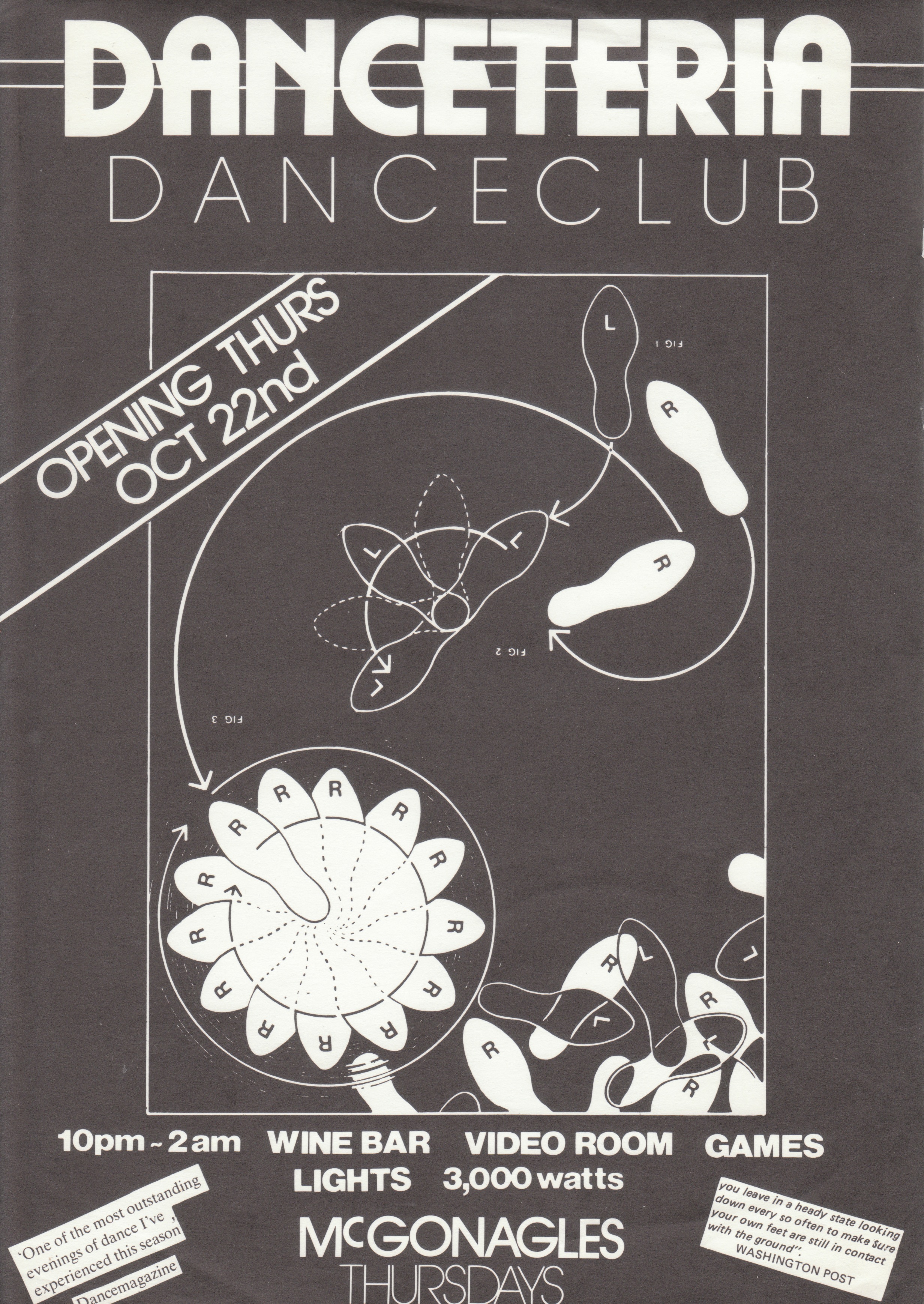
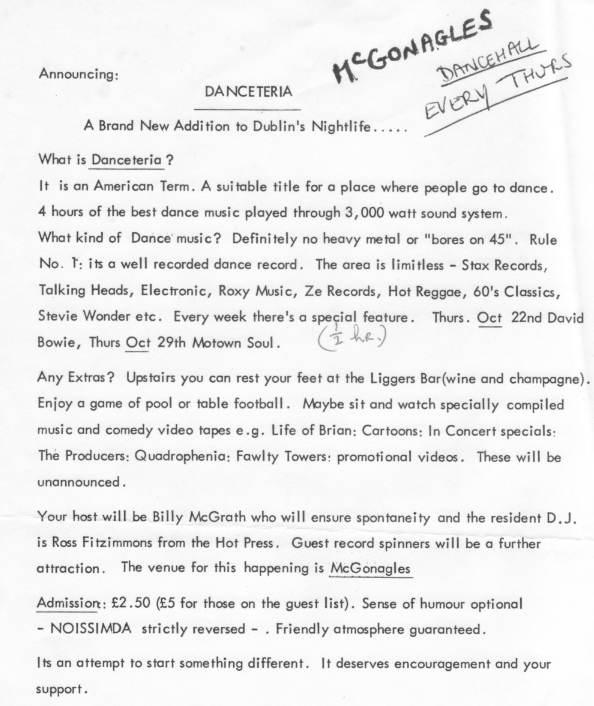
An original poster and press release for ‘Danceteria’, a night in McGonagles (previously of South Anne Street) which was launched in October 1981.

Music policy was Stax, Talking Heads, Electronic, Roxy Music, Ze Records, Hot Reggae, 60s Classics, Stevie Wonder – all on a 3,000 watt sound system. Downstairs was the dance floor while upstairs had a wine bar, pool table, football table and a T.V. showing ‘specially compiled music and video tapes’. Compere was stand up comedian Billy McGrath and resident D.J. was Ross Fitzsimons of Hot Press magazine.

It predated seminal dance nights in McGonagles like Club Voodoo and Soul On Ice which came along in the latter half of the decade.

I’m not sure how long the night itself lasted.

Danceteria at McGonagles poster. (BM Collection)

Danceteria at McGonagles press release. (BM Collection)

This aired on Sky Sports last night, and is a pretty interesting piece, an outsiders look-in at football in Ireland. Saint Patrick’s Athletic feature heavily, with an interview with Liam Buckley and footage from the recent Dublin derby between ourselves and Shamrock Rovers. Thanks to Gareth Maher for uploading this onto YouTube.

The Dublin Dons

A brief look at the attempts to bring Wimbledon F.C to Dublin in the 1990s.

Wimbledon F.C

One of the most interesting disputes in the history of ‘The Beautiful Game’ in Dublin was undoubtedly that around proposals to bring Wimbledon to Dublin in the 1990s. Backed by a number of high-profile supporters, a consortium attempted to move the team here and rebrand them as the ‘Dublin Dons’. This caused considerable anger among fans of the domestic league, and the issue featured heavily in the mainstream media.

Wimbledon Football Club spent much of their football history at Plough Lane, an old-fashioned football stadium in Wimbledon, south-west London. Wimbledon had played in the ground since September 1912, but by the 1990s the ground was lagging behind and did not meet the required standards. Crystal Palace would become the landlords of Wimbledon, as the club groundshared at Selhurst Park for a period.

Among those who backed the campaign to bring Wimbledon to Dublin were Eamon Dunphy and Paul McGuinness, manager of U2. The developer Owen O’Callaghan and Dunphy were instrumental to the plan, as the hope was for Wimbledon to play their games at a stadium O’Callaghan planned to construct in West Dublin. This stadium, located in Neilstown, was intended to hold an impressive 40,000 seats. The first meetings between O’Callaghan and the owners of Wimbledon Football Club occurred in April 1996.

When O’Callaghan first met with Sam and Ned Hammam, owners of the football club, he was joined by Dunphy and McGuinness. O’Callaghan and the consortium who wished to bring Wimbledon here found common ground and interest on the matter through O’Callaghan’s planned Neilstown stadium. The prohibitive costs of that venture, coupled with a belief it would not be used to its full potential, meant that it was seen as an ideal ‘home’ for Wimbledon to relocate to. In April 1996 it was reported the consortium were urging O’Callaghan to begin quick construction on this ground, in the hope it could be completed by the 1998 football season. Among those who backed the plan to create the ‘Dublin Dons’ was the Dublin Chamber of Commerce, who in August 1996 publicly proclaimed that English Premiership football could bring huge economic benefits to Dublin.

With the domestic game, Damien Richardson was one of the few who backed the planned move to Dublin, noting that “I feel their presence here would raise the profile of the sport in Ireland and the League would benefit”, while Brian Kerr took the opposite view, believing such a move would be devastating for the domestic game, already competing with English soccer for media coverage.
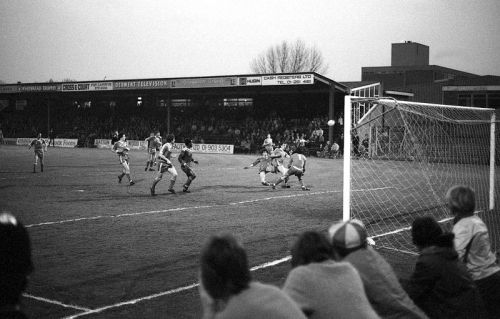
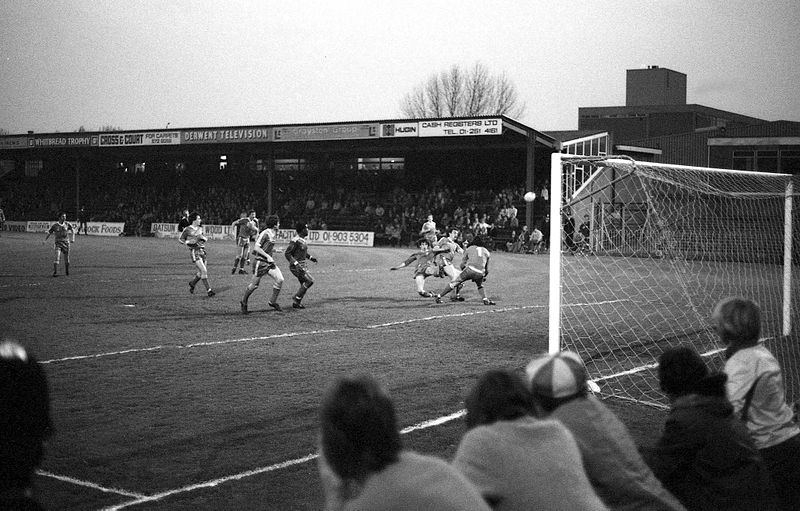
Plough Lane, the historic home of the club. (Wiki)

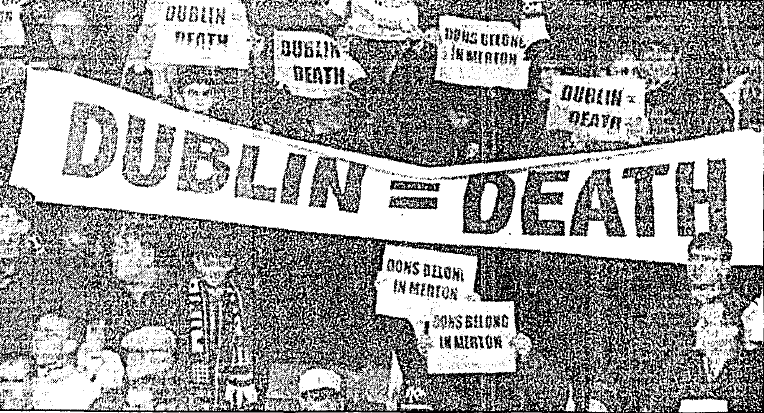
Opposition to the planned move from lovers of the domestic game was strong. Around 200 supporters packed into Wynn’s Hotel for a meeting in September 1996. At that meeting, Niall Fitzmaurice announced that the arrival of the “Wimbledon Dons” would mean the “death of the National League within five years”, and he went on to state that those behind the proposal had purely financial motivations claiming “they have no love for the game.”
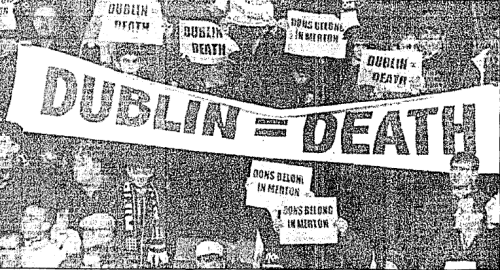
Protesting Wimbledon fans (Irish Independent, Dec. 8 1997)

The idea of moving Wimbledon to Dublin naturally upset many supporters of the club, with scenes of protest inside and outside their matches at Selhurst Park in 1997. In December of that year,Sam Hammam responded to a demonstration by Wimbledon fans following a one-nil win over Southhampton by telling the media he would “probably do the same thing” if he was a fan, but insisting that “Dublin is a fantastically sexy option, what else can I say?” Hammam even claimed that had he wanted it, he could have had the club in Dublin already, insisting that “the only reason we aren’t there is that I’ve chosen not to do it.”

A 1998 poll carried out by Lansdowne Market Research for the Irish Independent claimed that two out of three Irish adults interested in the game of football were in favour of Wimbledon moving to Dublin, but the F.A.I were among the most vocal critics of the idea, with the then Chief Executive Bernard O’Byrne insisting to the paper that all F.A.I surveys within the Irish football community told a very different story in terms of support for the proposed move.

In a brief piece on the Dublin Dons, soccer-ireland notes that:

The cost of the Dublin Dons project was estimated at £100 million (€127 million) including the stadium construction, road, rail and security infrastructure, £5 million for the FAI, £5 million for the League of Ireland clubs, and the provision of a number of football schools of excellence around Ireland.

Ultimately, the opposition of the F.A.I would prove crucial to preventing the move, with Bernard O’Byrne outlining the Associations opposition to the move in a five-page letter sent to the chairmen of every Premiership club in 1998 for example. Likewise, UEFA and FIFA opposed the idea, which proved a crippling blow. Interestingly, in one media interview Bernard O’Byrne mentioned the infamous Lansdowne Road riots of 1995 and asked “do people want 5,000 English football fans every fortnight in Dublin?”. Wimbledon were eventually moved to Milton Keynes, against the wishes of many of their supporters. This new relocation, while keeping the club in England, still ripped the club from its historic heartland. The club fell into financial crisis, and in 2004 was totally rebranded as MK Dons F.C. Out of opposition to the clubs relocation, some fans set about establishing AFC Wimbledon, who currently play in League Two of the Football League in England.
Over the weekend, Anti-Fascist Action Ireland unveiled a new plaque and mural to celebrate their 21st birthday.

The plaque above Connolly Books in Temple Bar, launched by Tom Redmond, Manus O’Riordan and Cllr. Cieran Perry, is dedicated to all those Irish who went to Spain to fight for the Republic during the Civil War.

Plaque, Connolly Books (Photo – MW)

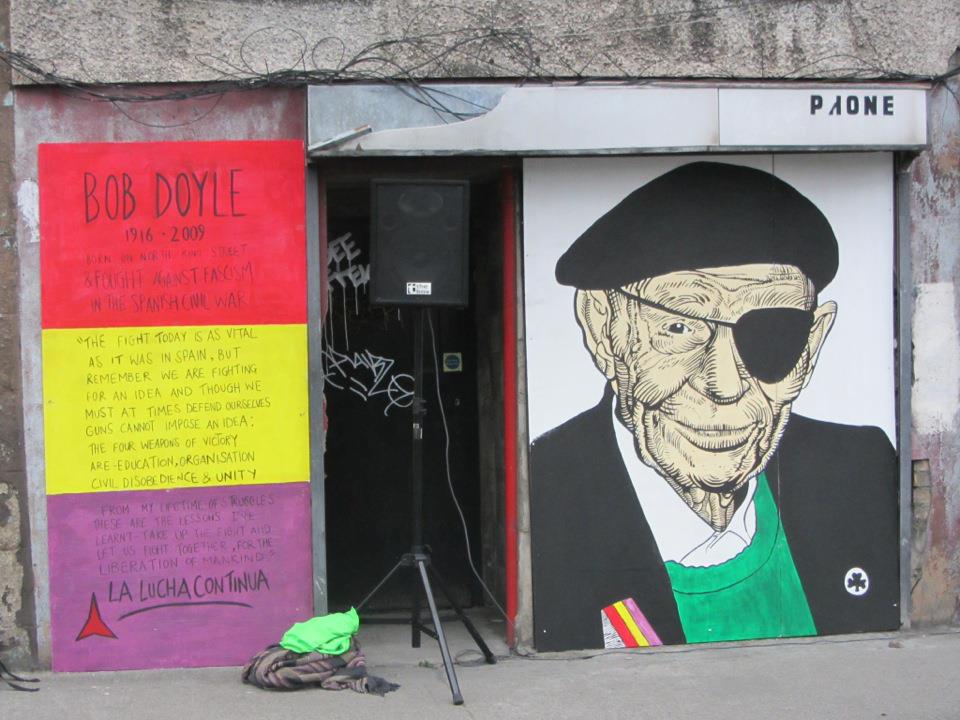
The mural at The Cobblestone pub in Smithfield, unveiled by Harry Owens and Thomas the artist, is dedicated to local Irish Republican and International Brigader Bob Doyle (1916 – 2006)

Bob Doyle mural, Smithfield (Photo – SO)

More pictures can be viewed here on their Facebook page here.

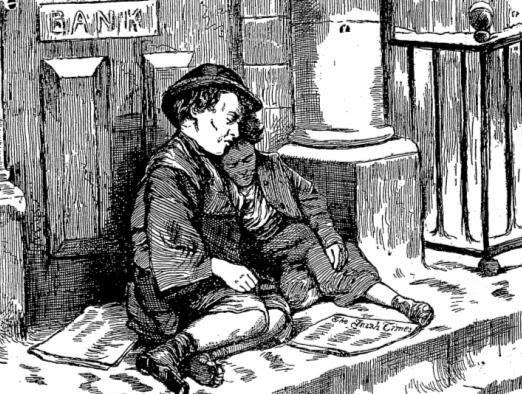
The Irish Times, December 20 1884.

I’ve always loved this illustration of two Dublin newsboys from The Irish Times, published in 1884. It is the earliest illustration of Dublin newsboys I’ve been able to find, and shows two ragged youngsters resting in the doorway of a bank premises.

While street selling is an ancient tradition, the idea of the ‘newsboy’ came to prominence in the British Isles in the 1850s, with the arrival of cheap daily and evening newspapers. Writing in The Journal of the Royal Society of Antiquaries of Ireland in 1924, George Wm. Panter noted that:

The newsboy as we know him now is quite a latter-day institution. Lai Brough, the comedian, whom, doubtless, some may still remember, used to tell how in his early manhood he became assistant publisher to the Daily Telegraph on its establishment in 1855, and that while occupying that position he originated the custom of selling newspapers in the streets by organising a staff of two hundred and forty boys for the purpose. We have seen that the custom existed of selling newspapers in the streets previously, but undoubtedly newsboys were first hired for that purpose in 1855.

References to newsboys operating in Dublin can be found in The Irish Times from the early 1880s, with a letter signed ‘Pro Bono Public’ appearing in the paper in 1882 noting the ‘many trials and hardships which the majority of the newsboys of Dublin have to contend with’ and asking ‘would it not be a truly charitable and benevolent undertaking for the citizens of Dublin to provide a Newsboys Home in a central place’ for the use of these young Dublin workers. In the 1880s, Dublin newsboys were presented in newspaper reports as being typically ragged and barefoot, with The Irish Times in 1884 producing the above illustration entitled ‘The Tired Newsboys!’ showing two young, ragged dressed youths asleep in a doorway, with a poem underneath noting that ‘they may perish! of cold or some worse fate!’

High Flying Saints

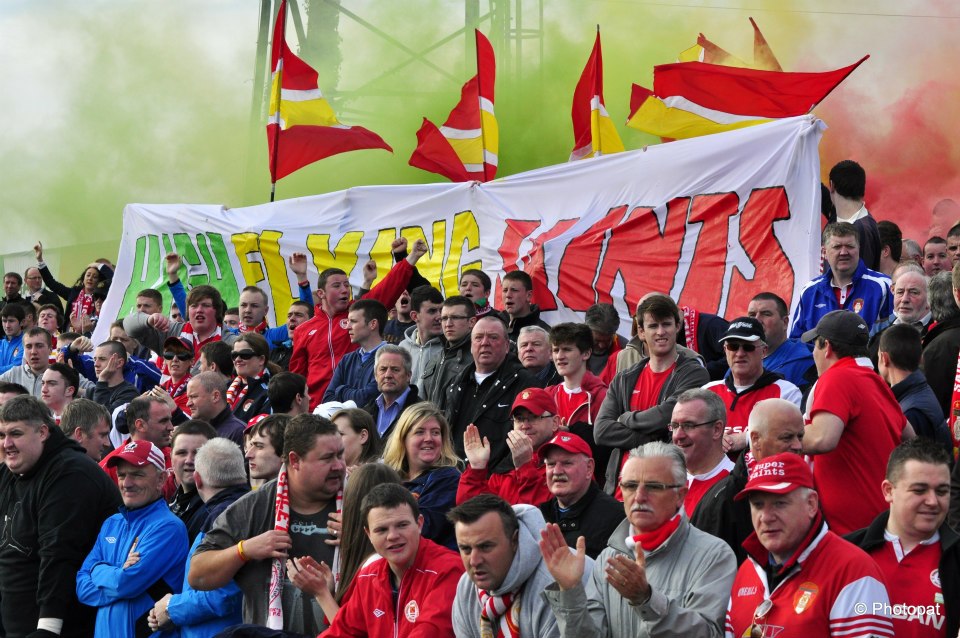
High Flying Saints! Photo: Photopat (C)

There’s nothing as painful as following a match by text updates, not least an FAI Cup Semi-Final. With work obligations, I was destined to follow Pats yeterday through a series of sporadic text messages from the brother. The first one, that “in a moment of unprecedented football history, Dundalk are two-nil up before kick-off”, raised a smile at least.

This image above, from one of the weekly club photographers Photopat, really captures it for me. Last year, the banner in the semi-final against Shelbourne told the lads to ‘Rise like lions after slumber’. This year, the lions have certainly risen.

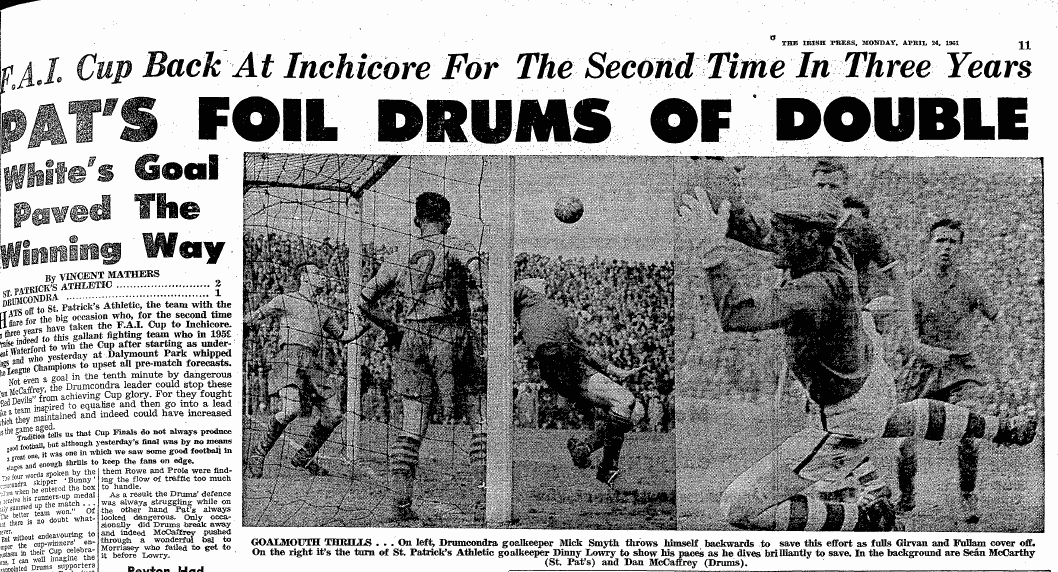
The last time we won the cup, the Irish Press was still in existence!

Image: Luke Fallon.

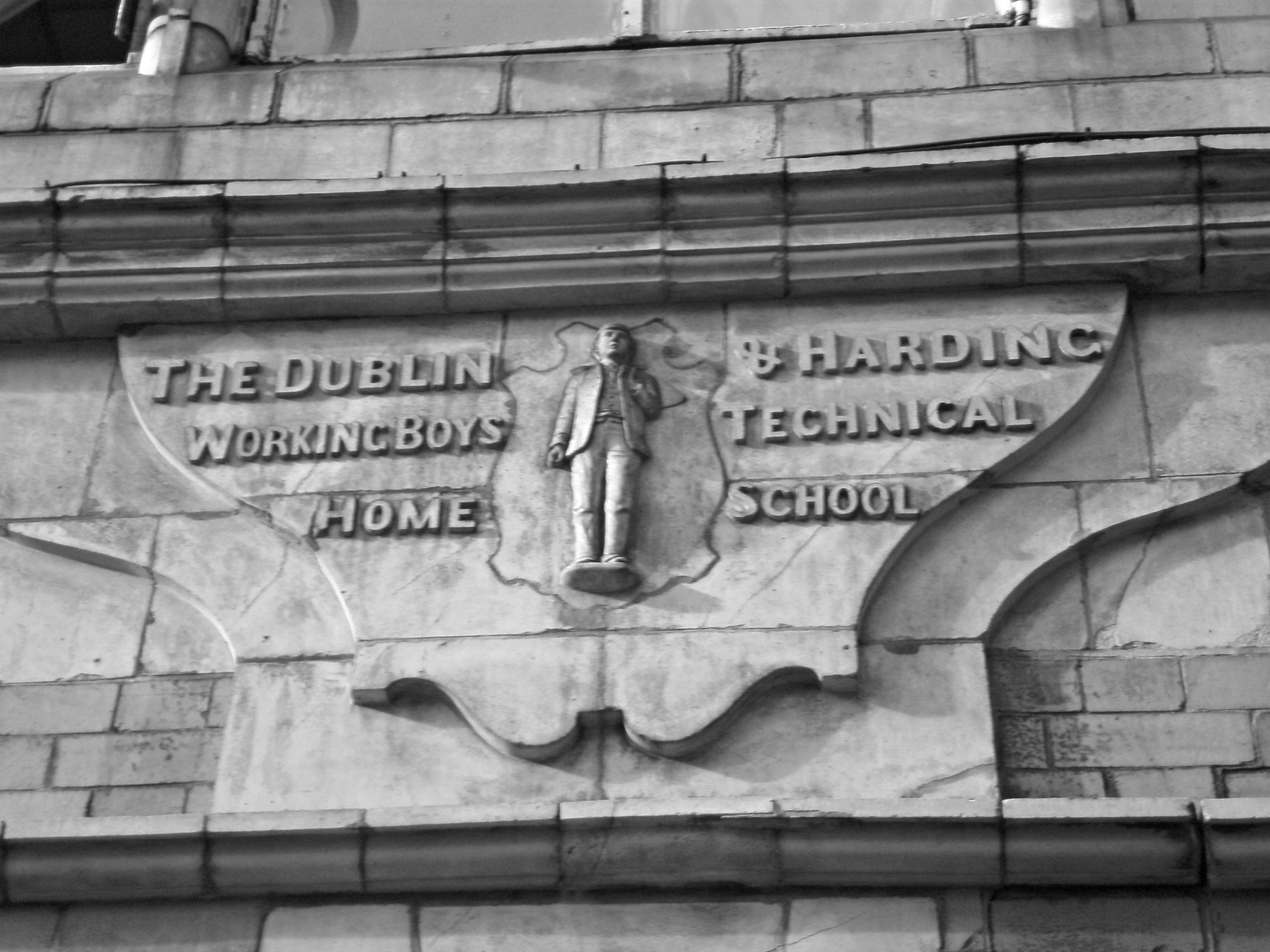
The building on the corner of Lord Edward Street and Fishamble Street, today a budget hostel, is an interesting building architecturally, dating back to 1891. Archiseek tells us it was designed by Albert E. Murray, and purpose-built as a hotel for young boys. I’d passed the building often without inspecting it closely, but a few months back a reader (Thanks Steven!) suggested taken a closer look. The magnificent stone engraving of the youngster shown below remains to this day, giving a clue to the buildings former life.

Building stonework today (Luke Fallon)

A history of the Dublin Working Boys Club and Harding Technical School appears on the Irish Deaf History page, where it is noted that a society formed to “afford comfortable and healthy lodgings at cheap rates for boys who were earning their bread” had acquired the building in 1888 for the purpose of establishing a hostel there. That hostel was opened by the Lord Lieutenant in February 1892, providing lodgings to boys below the maximum age of 19. The hostel was open to Protestant boys, and boasted a Gymnasium Club, cricket team and some residents even formed a “bell-ringing club” with Christ Church Cathedral next door! The linked article notes that “in Mount Jerome Cemetery, the Dublin Working Boys’ Home had a plot for the residents, purchased by one of the Governors, Thomas Spunner, in 1885.”

Newspaper reports from the time of the opening note that initially 41 boys were on the books, and that most of these boys were from outside the capital, employed in trades including gun making, printing and coach building. The Irish Times noted that the buildings interior was impressive, with a lecture hall capable of holding 150 boys, a spacious dining hall as well a library containing a piano and reading tables.

I found an advertisement from 1914 for the Home within The Irish Times, and it notes:

The object of the home is to provide a safe and comfortable residence for orphans and other boys (being Protestants, and of good character) who are earning small wages in junior positions, in trades, business and offices, etc., and who have no suitable home in the city. The age of admission is 13 to 16 years, but under special circumstances the limit of age may be extended.

The club closed in 1987, and today the building is home to budget accommodation for tourists, as well as the Copper Alley Bistro.

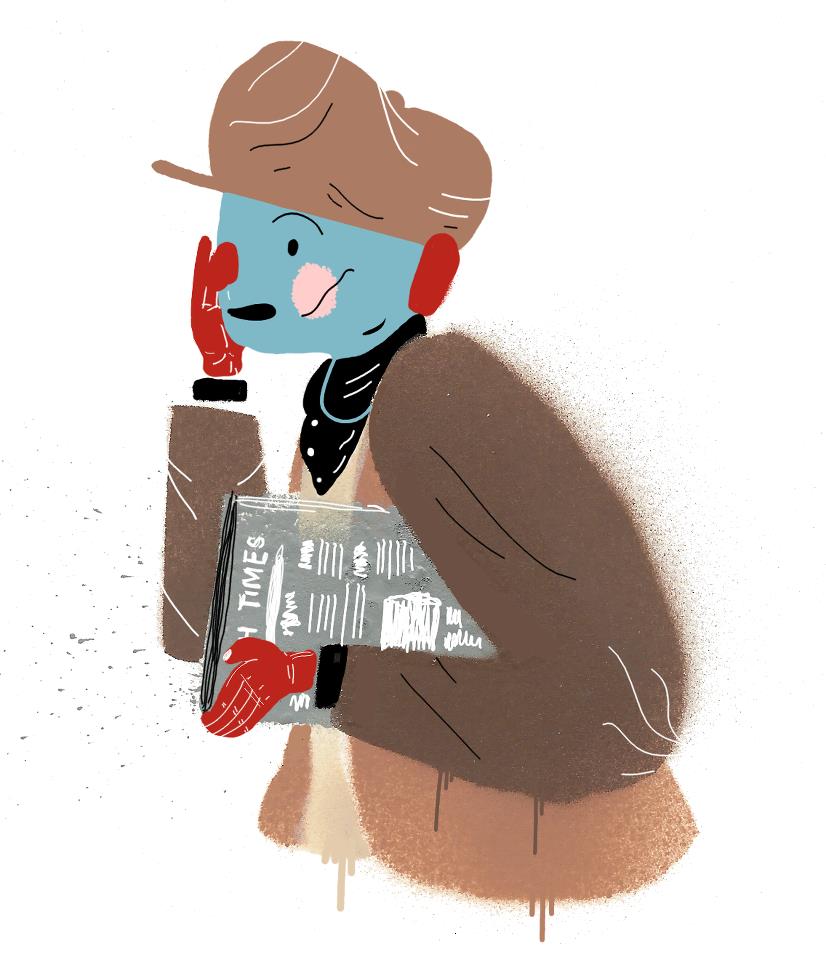
An illustration of a 1930’s Dublin newsboy by Luke Fallon (originally for a piece I wrote in Rabble magazine)

Every year, the good folks in Dublin City Library and Archives organise a series of lunch time lectures. Lasting about 40 minutes, and taking place in the unusual setting of City Hall, these lectures have a common theme. This October, there are a series of lectures running on each Tuesday, all falling within the theme of Dublin in the 1930’s.

Next Tuesday, I will be delivering one of these talks, on the subject of the infamous ‘Animal Gangs’ of the 1930’s. The title of the talk is A Social or Political Problem? Dublin’s Animal Gangs in the 1930’s. While there’s been quite a bit of work on the ‘Animals’ over the years, in the form of oral histories in particular, the issue of their political affiliations (if any) is interesting territory to explore. The ‘Animals’ emerged out a newsboys labour dispute in 1934, but the term entered Dublin folklore for many years afterwards. I’ve recently finished a thesis on the gangs, and I suppose this is a chance to share some of that, including a lot of new information.

The talk runs from 1.10 to 1.50. City Hall is certainly an unusual venue for a talk, and you’re all welcome.

Date: Tuesday 9 October 2012
Topic: A Social or Political Problem? Dublin’s Animal Gangs in the 1930’s.
Venue: Council Chamber, City Hall, Dame Street, Dublin 2
Time: 1.10-1.50 p.m.

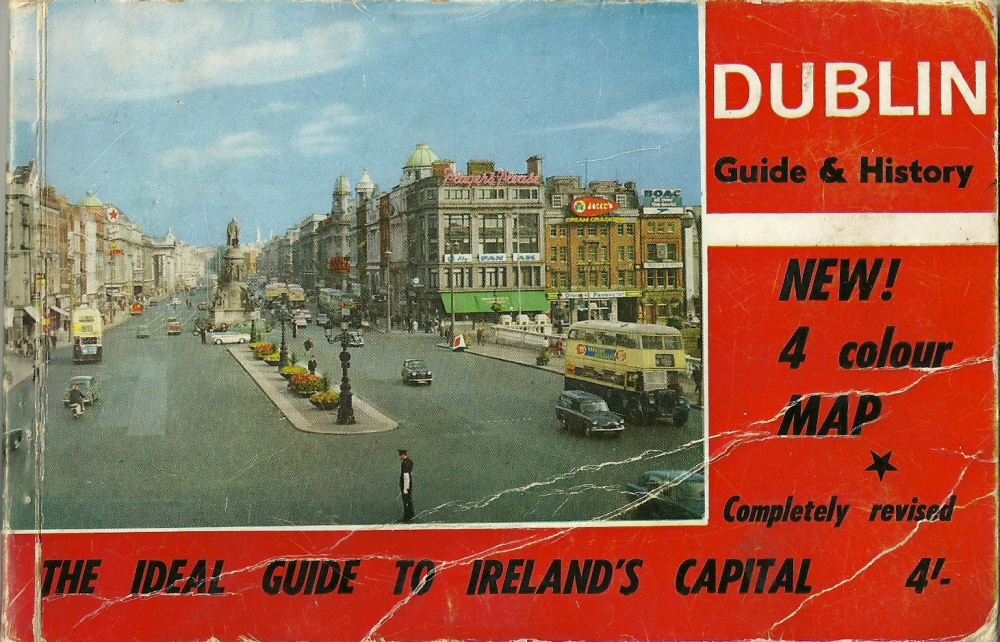
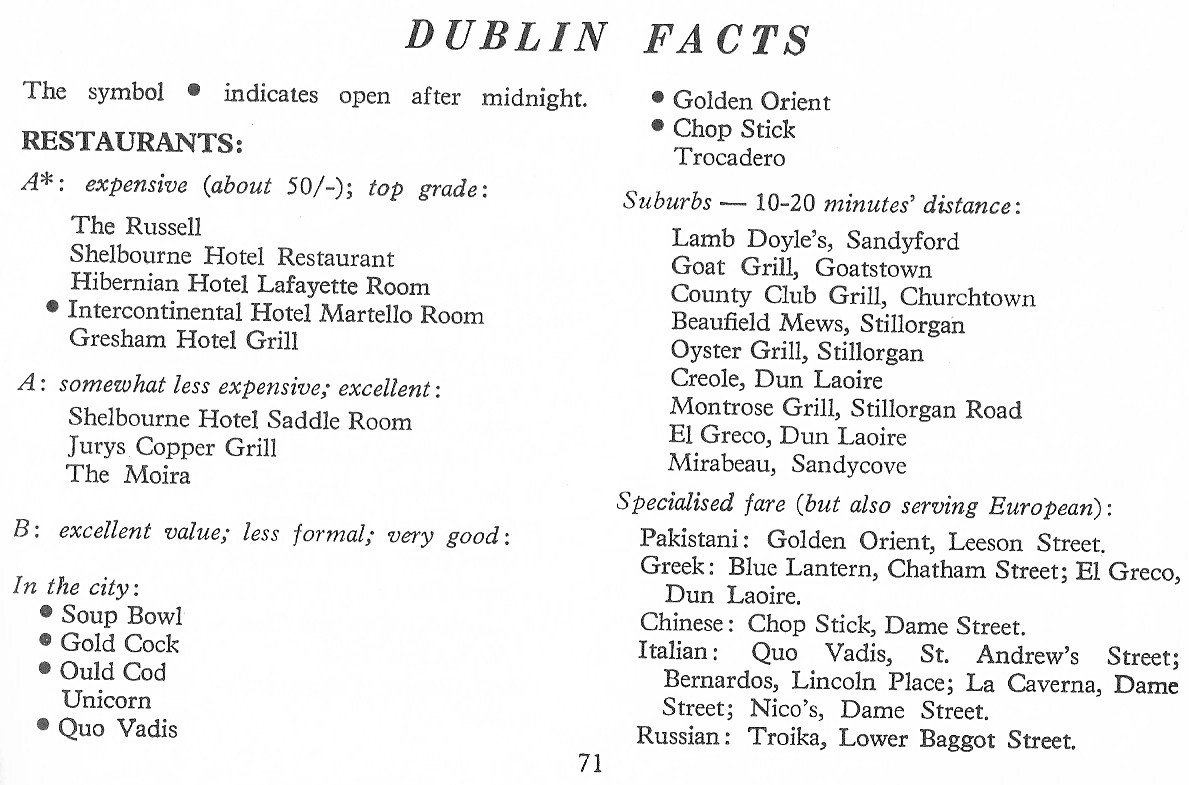
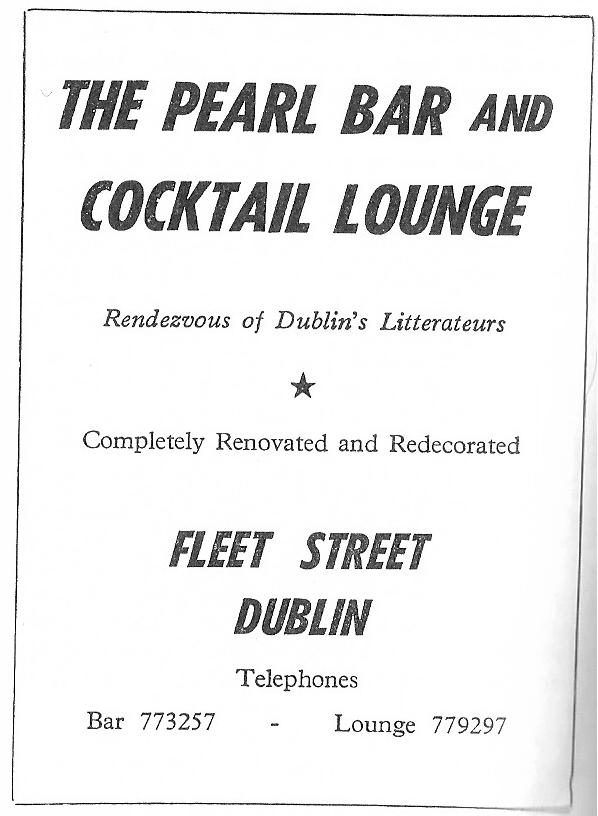
Sharing is caring, and I’m very grateful to the Irish Election Literature Blog for sending these fantastic scans our way, thinking they could be of interest. We frequently dip into guide books to Dublin on the site here, and while in some cases it’s the observations about the city which are worth posting, in other cases the advertisements are what grab you attention.

Before looking at some of the advertisements within this guidebook, its restaurant listings are also interesting. How many of these are still with us? The Troika certainly isn’t something we’d associated with fine dining anymore!

Among the advertisements, The Pearl on Fleet Street grabbed my attention. The Pearl was once popular with the writers of Dublin, and I’ve heard it said there was a sort of fight of the literature types at one stage from that establishment to The Palace, also located on Fleet Street!

Continue Reading »

Personally, I’ve never believed in ghost stories. In saying that, I do enjoy hearing some of the stories in Dublin, and any city with the history this one has is likely to have a few great tales. Browsing for something else, this November 1955 story from The Irish Times grabbed my attention. It’s a good tale, and it first appeared in the in-house Garda magazine.

Wednesday November 9 1955.

Myra House,Francis Street (Donal Fallon)

The Legion of Mary was founded in Myra House on Francis Street, in September 1921. This organisation would have a massive effect on the city of Dublin, spearheading the campaign to close the notorious Monto district. Today, the Legion of Mary has over 4 million active members and 10 million auxiliary members, in more than 170 countries across the world. It began its life in Dublin, founded by the quiet civil servant Frank Duff. Born in Dublin in 1889, and described by historian Terry Fagan in his history of Monto as a “sombre-suited civil servant”, Duff’s organisation would become a leading player in Irish life for a time, as a mass movement of Catholic action.

The Legion of Mary began life as the Association of our Lady of Mercy, born in Myra Hall, as an organisation dedicated to visitations and promoting the Catholic faith. Frank Duff’s biographer Fionla Kennedy quotes Duff as stating the first meeting of the group consisted of fifteen people, of which thirteen were women. The group had strong links to the Saint Vincent de Paul society at the time of its foundation, and intended to assist laypeople in serving and advancing the cause of the Catholic Church.

The Legion of Mary would be the forefront of the campaign to close Dublin’s infamous red-light district in the first half of the 1920s. Known in popular Dublin history as Monto, this area took its name from Montgomery Street, located just off Talbot Street. Montgomery Street, Purdon Street, Mecklenburgh Street, Mabbot Street and others were often referred to collectively as Monto, with the area notorious at the beginning of the twentieth-century not only for its shocking levels of poverty but also the levels of prostitution found there.

The reputation of this area would lead to name changes historically, and following the construction of the ill-fated Corporation Buildings in the early twentieth century, Dublin Corporation set about attempting to change the name of Montgomery Street to Corporation Street, as this 1905 proposal from the Paving Committee shows:

We believe the great improvement effected in the street by the Corporation, together with the change of name, will have the desirable effect of obliterating its evil reputation. We therefore request and pray that it may be called Corporation-Street, as the great change for the better has been effected by the Corporation.

In the end, Montgomery Street was rechristened as Foley Street, in honour of John Henry Foley, the sculptor and one of the areas most famous sons. A change of name did little to change the character of the area however, and the misfortunes of those living there.

Between 1923 and 1925, the Legion of Mary made frequent interventions into the heart of Monto. These interventions were motivated by Duff’s familiarity with the suffering of some of Dublin’s prostitutes. Diarmaid Ferriter has quoted Duff’s first recollections of visiting a brothel in his study Occasions of Sin:Sex and Society in Modern Ireland:

For a moment, I did not realise where I was. Then I saw, and I was so intimidated that I actually backed out without uttering a word. My retreat was typical of the attitude to the problem at the time. We were not without constant reminders of the problem and of the menace it afforded.

Continue Reading »

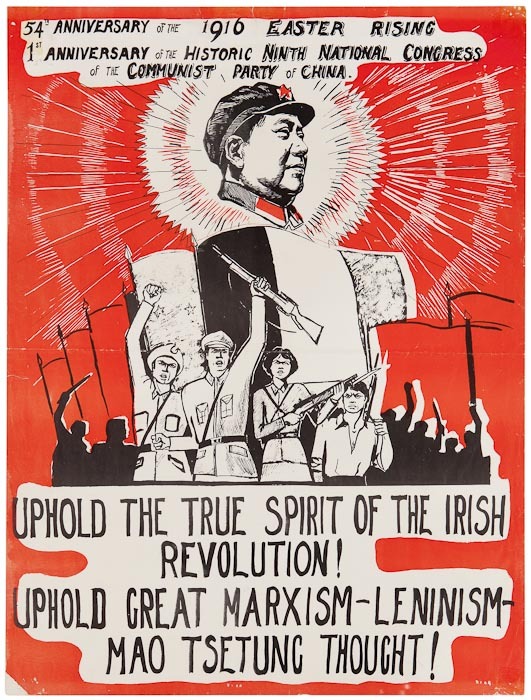
Mao and Easter Week.

As you’d likely gather from dipping into this website, I’m not the kind of person to throw anything out. Over the years I’ve built up a fairly decent collection of magazines and journals from Irish left-wing parties and movements, some of whom existed for decades and others who split before the first Ard Fhéis, so to speak. One thing we’re fascinated by here on the site is visual propaganda in the form of posters, and only yesterday a post looking at some of Jim Fitzpatrick’s work appeared on the site.

I was interested today to see the hullabaloo around this image of Chairman Mao and the men and women of Easter Week. The Irish Times, The Journal and many others have run the piece, focusing on the unusual content of the poster and asking about the origins of the poster. At first, it seemed that there was some sort of belief this poster could have originated in Communist China.

The Irish Times report for example notes:

A CHINESE propaganda poster that celebrates both the 1916 Easter Rising and Chairman Mao’s Communist Party has turned up for sale in London this week.

The Bloomsbury Auctions sale of artefacts from 20th century China includes a vivid red poster featuring a portrait of Mao above a group of armed Irish rebels, with the Tricolour flying alongside the flag of China.

The poster refers to the “54th anniversary of the 1916 Easter Rising” and the first anniversary of the “Historic Ninth National Congress of the Communist Party of China”.

Although no date is mentioned, both anniversaries occurred in 1970. It has not yet been possible to establish who produced the poster or where it was used.

The poster is being valued at around £1,000, which is the part of the story I find most interesting. It seems glaringly obvious to me that the poster is most likely the work of the Communist Party of Ireland (Marxist-Leninst), a Maoist political organisation which emerged from the Internationalists who were based around students at Trinity College Dublin in the late 1960s. Last year we posted an interesting 1969 article on the student left in Ireland which looked at the Internationalists. In that article, written by Carol Coulter, she claimed that:

The ideology of the Internationalists developed along the lines laid down by their origin. They adopted Maoism, particularly the idealistic aspects of it, those that promoted the idea that if people’s thoughts were corrected, all would be well. From this came their line of ‘cultural oppression’, which was based on an analysis of society which said that “the main aspect of the contradiction between the working class and the bourgeoisie was cultural.

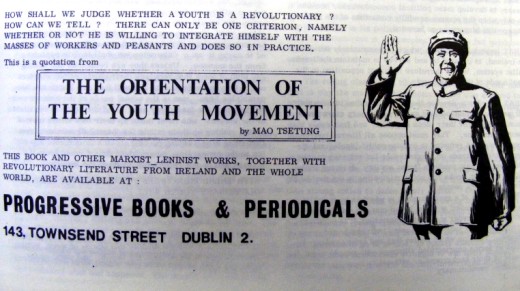
The Internationalists came to public attention in 1968 for their opposition to the visit of the Belgian King Baudouin to Trinity College Dublin. Students and Gardaí clashed on that occasion, and the incident made national headlines. The CPI-ML emerged from the Internationalists. Conor McCabe of Dublin Opinion has done excellent work on the Internationalists and the CPI-ML, and his research can be read here.

McCabe includes an image of this fantastic advertisement for their bookshop, Progressive Books, which saved me rooting out a copy of Red Patriot upstairs.

Image credit: DublinOpinion.com

The poster having its origins with a small Irish Communist grouping may not be quite as sexy a story as a Chinese propaganda team finding influence in Irish nationalist history, but it certainly seems the much more credible theory and story. Is it worth £1,000? I’d seriously doubt it. If it is, there’s a whole load of lefties across the city who’ll be cashing in on the boxes in the attic. Jokes about Michael Collins bringing the man to Ireland are being made already of course.

A 1968 Irish Times report on the opening of Dublin’s Maoist bookshop, Progressive Books.