Feeds:
Posts
Comments

Dublin’s Little Italy

Nannetti

Joseph Nannetti, Lord Mayor of Dublin 1906/7.

Little Jerusalem has a special place in the folk memory of Dublin, with the area around Portobello and the South Circular Road boasting a number of plaques and a museum which tells the story of Jewish Ireland. The story of Jewish Dublin includes names like Harry Kernoff, Leopold Bloom, Leslie Daiken and Chaim Herzog, and has been documented in memoirs like Dublin’s Little Jerusalem by Nick Harris.

One of the more curious migrant quarters that has all but disappeared from memory is Little Italy, located in the vicinity of Little Ship Street, Chancery Lane and Werburgh Street. Its story is intertwined with that of the Cervi family, who established a lodging house in the area which became popular with Italian workers in the city. In the words of Toni Cervi, son of Guisseupi Cervi (who opened Dublin’s first fish and chip shop in 1882):

The area around us – off St. Werburgh Street….was known as ‘Little Italy’. If someone came to Dublin and wanted to locate a particular Italian, he would more often than not be directed to Little Italy. The place was filled with barrel-organ men, ice-cream men who traveled the city with their barrows, and with marble men.
1911CenusItalians

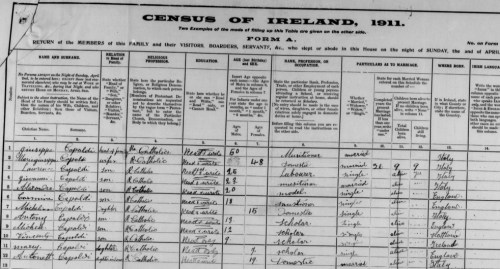
The 1911 Census returns of the Capoldi family, living in Chancery Lane. Notice the diversity of birthplaces, revealing the journey the family had undertaken before setting in Dublin (National Archives of Ireland.)

Little Italy never amounted to a community the size of Little Jerusalem. As Cormac Ó Grada has noted, Dublin by 1912 contained fewer than 400 migrants of Italian stock. What is telling was the diversity of Italian migrants living in Ireland in terms of skilled labour; workers from Italy’s Lucca region tended to be “made up of artisans, plaster workers, and woodworkers, with surnames like Bassi, Corrieri, Deghini, Giuliani and Nanetti.” Others, originating in the Val di Comino, tended to be “either street-sellers of ice cream or cafe owners.” The later included familiar names like Forte and Fuscos.

References to Dublin’s ‘Italian Colony’, as such quarters were known, are plentiful in the press of the 1880s and 1890s. The Freeman’s Journal wrote in 1886 of the contribution of Italians living in Dublin to New Years Eve traditional festivities:

 There is within the boundaries of Dublin no more extraordinary spectacle to be witnessed on New Years Eve than the annual serenade of the Italian organ-grinders and musicians in Chancery Lane. This comparatively unknown portion of the city has been for many years the headquarters of all the Italian and other itinerant foreign street musicians who migrate to Dublin.

Italian ice cream men sometimes got a hard time of it in the Irish press, with the Evening Herald lamenting how “thoughtless city children eagerly partake of the ice-creams vended by them. These delicacies are manufactured and stored in the tenements of Chancery Lane…It should interest the authorities to discover whether these dairies are registered according to law.” Still, Dubs trusted the Italians when it came to ice cream. John Simpson has noted that “the 1901 Ireland census records the Dubliners’ indebtedness to their compatriot Italians for ice-cream. Of 23 people listed as involved with the ice-cream trade as vendors or makers, all but seven were born in Italy.”

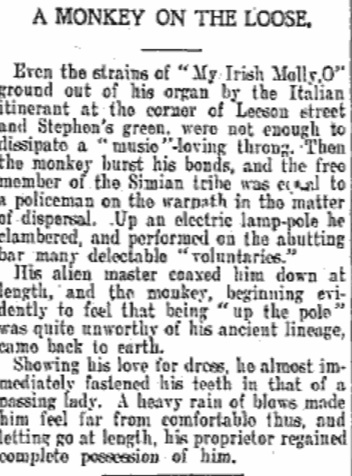
Italian organ grinders, complete with performing monkeys, became familiar sights on the streets of the capital too. The occasional escaping money made it into the press, and sometimes their owners made it into the courts.
ItalianColony

Irish Independent, March 1906.

The most well-known figure to emerge from the Italian community in Irish public life was Joseph Nannetti, the son of an Italian sculptor and modeller who involved himself in both municipal and national politics. A Home Rule nationalist and a committed trade unionist (though of a school of trade unionism that was very different from the radicalism preached by men like Connolly and Larkin), Nannetti served as Lord Mayor of Dublin in 1906/7, and is mentioned by James Joyce within the pages of Ulysses.

The level involvement of Italians in radical Irish politics is difficult to gauge, though there are some passing references to the Irish Italian community within the Bureau of Military History. Stephen Keys,a section commander in the IRA’s Dublin Brigade during the War of Independence, remembered that “No one in Camden Street ever attempted to obstruct us.. In fact, they had great respect for us. Some of the shopkeepers; in that area, including an Italian named Macetti who had an ice-cream shop, used to subscribe to our arms fund.” There are mentions of some members of the Italian community in Belfast suffering during the Anti-Catholic pogroms there in the dark days of the Civil War too.

One family of Italian blood who were deeply involved with republicanism during the revolutionary period were the Corri’s, with Hayden Corri’s Military Service Pension file detailing his contribution to the Republican Police during the War of Independence and the Republican side of the Civil War. Hayden and his brother, WIlliam Corri, were the grandchildren of the talented landscape painter Valentine Corri, whose family hailed from Rome.
1911CenusItalians

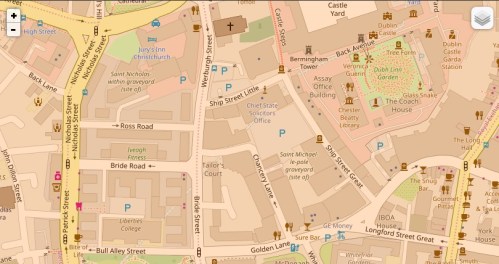
Contemporary Ordinance Survey map showing some of the streets where Dublin’s Italian community settled, including Ship Street Little and Chancery Lane (Image Credit: OSI)

With the emergence of Fascism in Italy, the ideology gained influence among some sections of the Italian community in Ireland. The presence of Italian ‘Fascisti’ in Dublin was closely monitored by state intelligence. The fourth anniversary of Mussolini’s March on Rome was marked at the Italian Consul’s Office on Lower Abbey Street, while an ‘Irish Free State Fascisti Headquarters’ was opened at Fownes Street in September 1927. At the funeral of Kevin O’Higgins, the government minister assassinated by Irish republicans in retaliation for the execution policy of the Free State in the Civil War, the Leinster Leader newspaper reported that “a picturesque note was struck by the Dublin Fascisti in blackshirts.”

1911CenusItalians.jpg

Evening Herald, October 1926.

There is no trace of Italian migration in the areas around Chancery Lane, Werburgh Street and Little Ship Street today. Familiar Italian names over fish and chip shops, and beautiful stucco work inside some of Dublin’s finest homes, remain however.

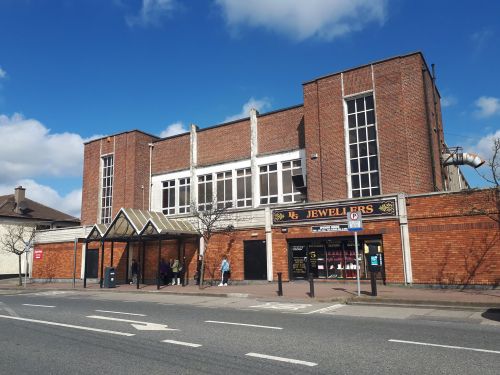
casinofinglas

On both sides of the Liffey, former cinema buildings dot suburban Dublin. They have taken on new lives, often as bingo or snooker halls. The old Astoria Cinema (later the Oscar) by Ballsbridge has become a Sikh temple, while Ballyfermot’s  Gala Cinema became home to a carpet shop, Chinese takeaway and more besides.

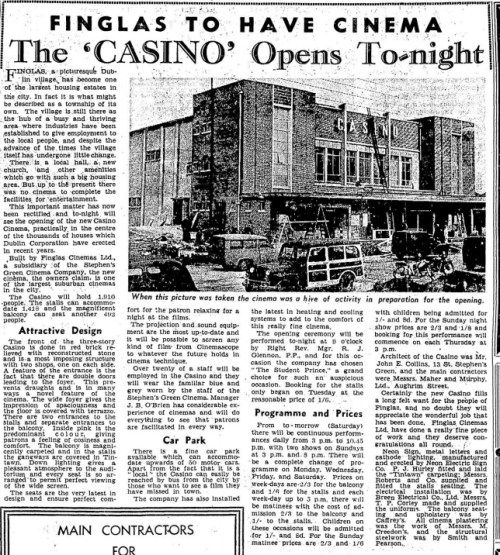
One I’d walked by several times before noticing is The Casino in Finglas village. Sitting between Supervalu and the Shamrock Lodge, The Casino was perhaps a victim of its own ambition, boasting a remarkable 1,910 seats. To put that in context, a nearby church could hold 1,500 parishioners. The misfortune of The Casino was the timing of its arrival on the scene,  opening in 1955 as the spectacle of television was beginning to loom large over suburban Dublin. Looking at it from across the street, it retains the very distinct appearance of a suburban cinema, despite its entrance being swallowed up by new development.

Constructed by Maher and Murphy, a building company based on Dublin’s Aughrim Street, the new cinema became an integral of a suburb that was very new, much like Artane and Ballyfermot on the other side of the Liffey.  Almost overnight, it seemed to the Evening Herald that Finglas, “a picturesque Dublin village, has become one of the largest housing estates in the city.” New suburbs required churches, schools, shops and cinemas.

The Evening Herald praised the building, noting that “the front of the three-story Casino is done in red brick relieved with reconstructed stone and is a most imposing structure with two shops, one on each side. A feature of the entrance is the fact there are doors leading to the foyer.”

casinofinglas.jpg

Evening Herald report on opening of cinema.

The new suburbs saw an influx of families from the inner-city, where tenements remained a subject of worry to many, and which continued to pose a grave threat to the welfare of Dubliners, with four lives lost to tenement collapses in 1963. In the below RTÉ feature from 1964, it is clear that some were quite content to move to Finglas. One youngster interviews mentions there being “plenty of fields to play in”,while another talks of her joy of having hot water in her household. Still, local amenities were often slow to pop up in new suburbia, creating alienation and boredom. The actor Brendan O’Caroll remembered the positive impact of The Casino in the area in the absence of other amenities, recalling that “I loved the fact you could go to the pictures and imagine you were the boy up there on the screen. I never thought that one day I’d ever be in a movie, that would be crazy, but the films allowed you the chance to dream, to use your imagination.”

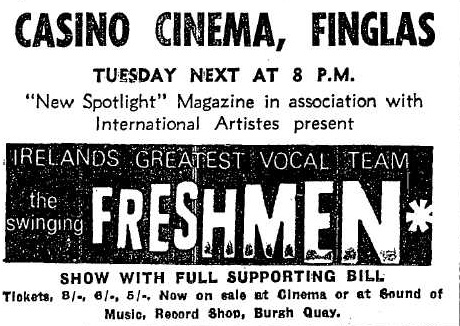
What nobody could predict when the doors of The Casino opened was the impact of television in the following decade. In a city and county that boasted no fewer than 56 cinemas in 1956, the arrival of television into the living rooms of suburbia heralded their death kneel. Cinemas sometimes took on a new lease of life as concert venues, with The Ramones  famously playing in Cabra and Phibsboro cinemas, while The Casino hosted concerts of its own.

casinofinglas

Evening Herald, 1968.

What suburbia felt it needed now was not cinema, but shopping centres. By 1970, The Casino was a memory,  replaced by Superquinn. Still, the facade remains today, reminding many locals of simpler times.

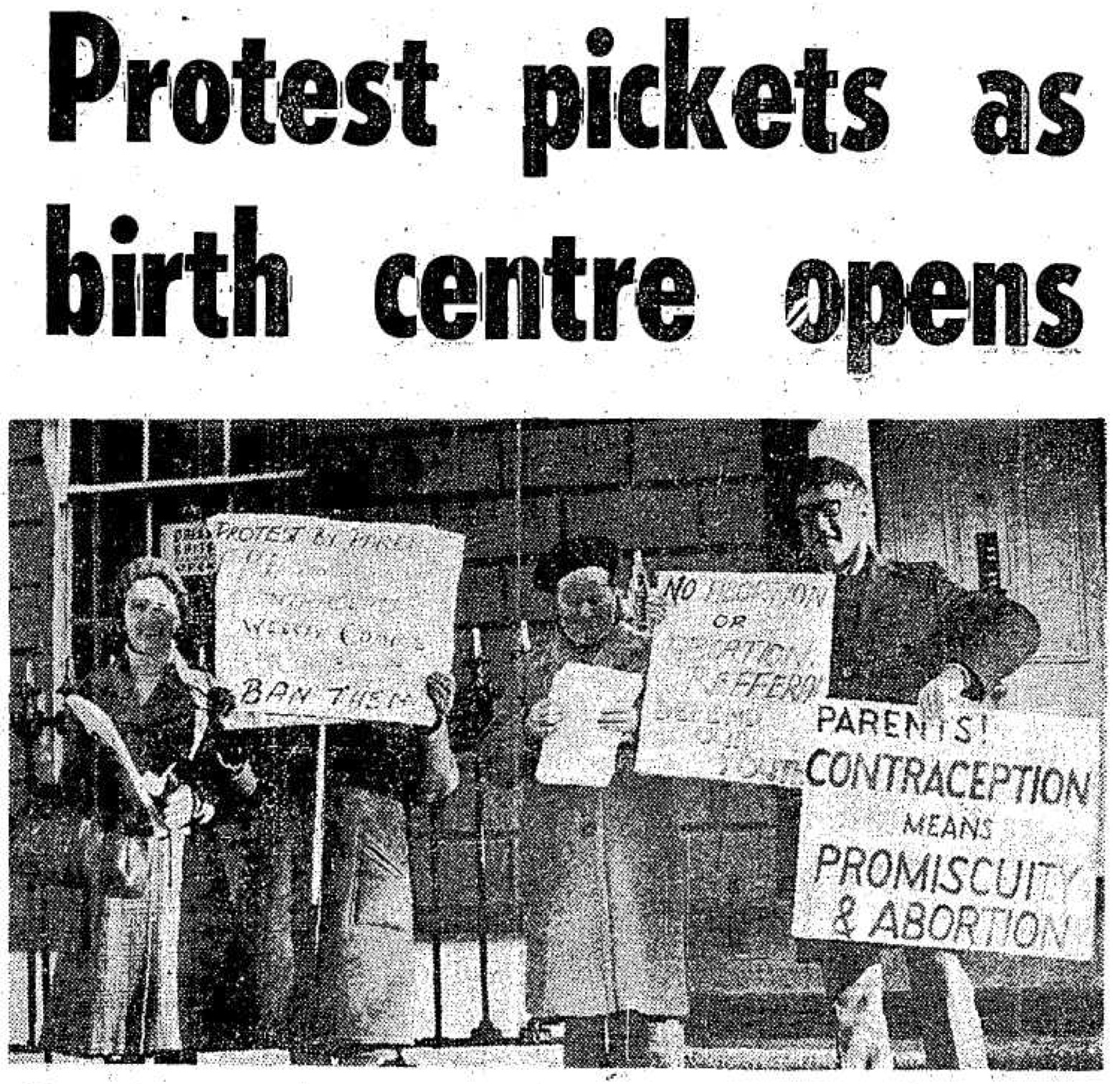
In January 1978, the Dublin Well Woman Centre opened its fifth clinic in the city at 63 Lower Leeson Street under the directorship of Anne Connolly. The aim of the organisation was to help “Irish women access family planning information and services”.

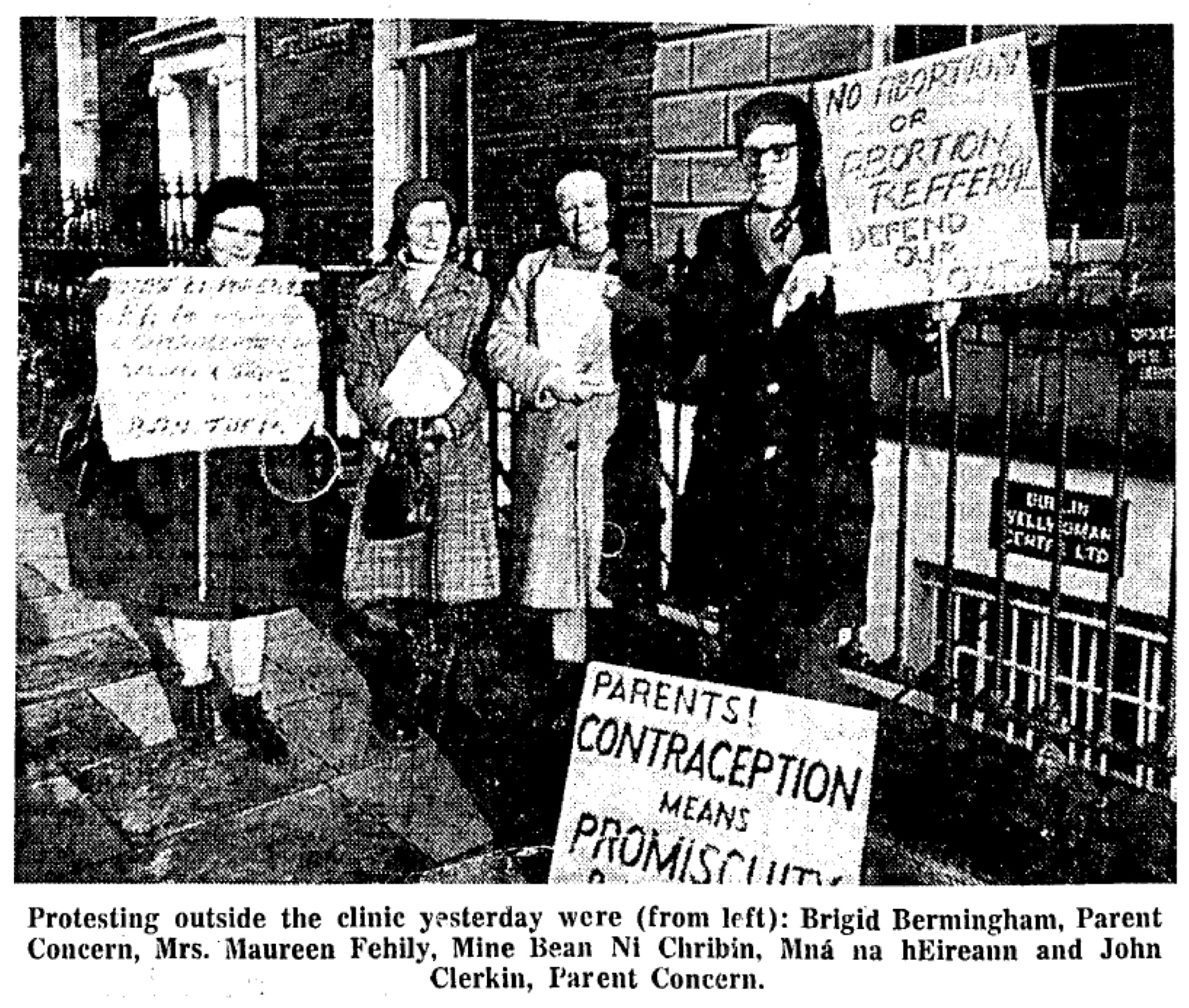
Four right-wing Catholics picketed the opening of the centre with placards reading: “Parents! Contraception means Promiscuity & Abortion” and “No Abortion or Abortion Referral! Defend Our Youth”.

Well Woman Centre picket. Evening Herald, 17 Jan 1978.

The four individuals were Brigid Bermingham, Maureen Fehily, Mine Bean Uí Chroibín/Chribín (Mena Cribben) and John Clerkin.

Well Woman Centre picket. Irish Press, 18 Jan 1978

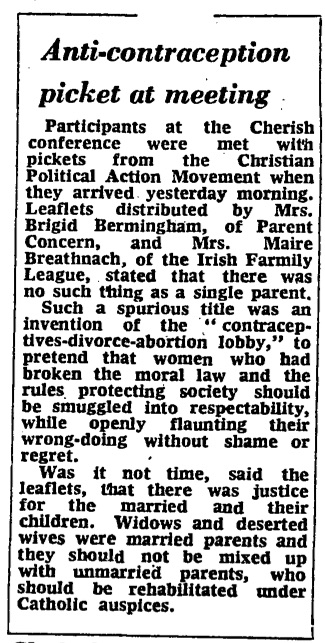
Bridget Bermingham (or Brigid Bermingham) of 25 Lombard Street West, Dublin 8 was Secretary of Parent Concern in the 1970s/1980s and was also connected to the Concerned Christians’ Group in the early 1980s. She wrote dozens of letters to the newspapers from 1975 until 1986. In November 1977 she handed out leaflets, with Máire Breathnach (Irish Family League) outside a Cherish conference, that stated that there was “no such thing as a single parent” and that the term was invented by the “contraceptives-divorce-abortion-lobby”.

Brigid Bermingham. The Irish Times, 19 Nov 1977.

In June 1980, Bermingham wrote a letter to the Taoiseach Charles Haughey expressing concern about family planning centres and suggesting that they “are no more than prostitution centers (sic) for orgies with … the commercial advocacy of contraceptives and abortion”.

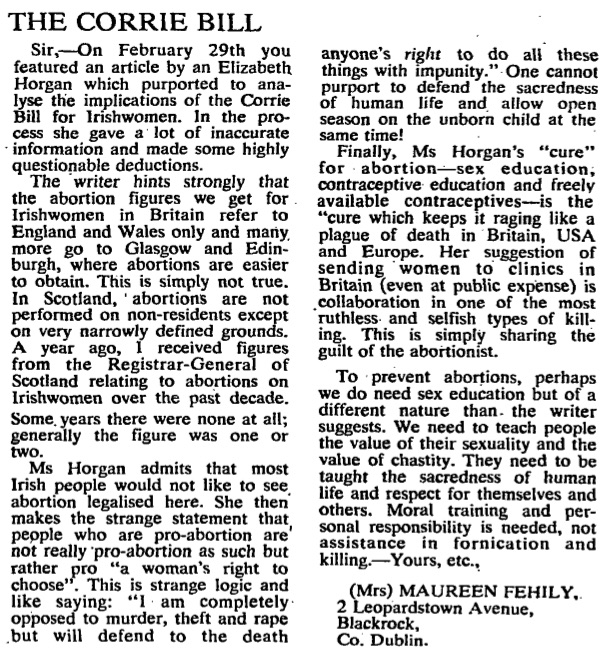
Maureen Fehily, of 2 Leopardstown Avenue, Dublin 18, seems to have been an independent operator. A 1980 letter of hers advocated that Irish children needed a sex education based around the concepts of chastity and moral training and “not assistance in fornication and killing“. She passed away in 1982.

Letter from Mrs. Maureen Fehily to The Irish Times, 06 Mar 1980

Mena Cribben of Santry Avenue, Dublin 9 was a vocal spokesperson for an array of ultra-conservative Catholic groups from the late 1960s until the late 2000s. We covered her political history in a 2012 post on the site. She passed away that same year.

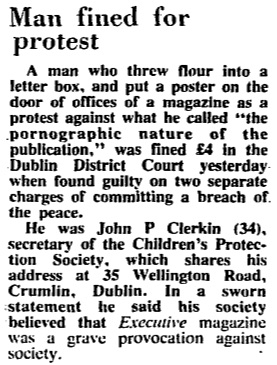
John P. Clerkin of 35 Wellington Road, Crumlin, established the Children’s Protection Society in late 1978. Throughout the 1980s, he rallied against contraception, homosexuality and liberal values.

John P. Clerkin fined. The Irish Times, 27 June 1980.

In 1991, he published a pamphlet entitled ’67 reasons why condoms spread acquired immune deficiency syndrome’.

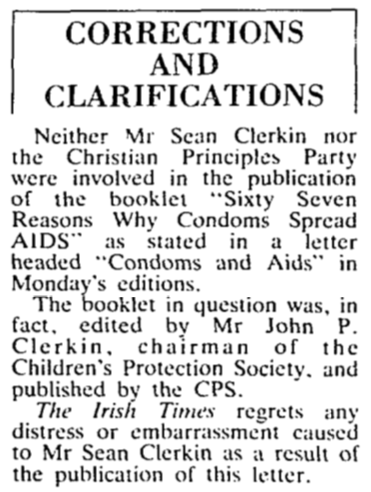
While they have similar names and have been confused in the past, it would seem that John P. Clerkin is a different individual to Sean Clerkin who ran for the Christian Principles Party in the Cabra ward in the 1991 Dublin City Council Local Election polling 1136 votes (10.4%).

Clerkin mix-up. The Irish Times, 25 July 1991.

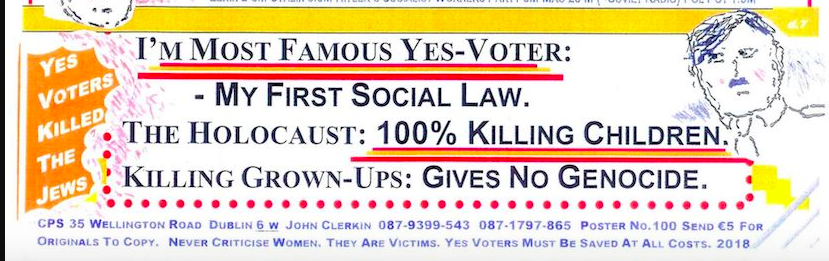
Bizarre leaflets from the Children’s Protection Society using the same address and signed by John Clerkin appeared in 2015 and 2017. Further unhinged literature calling on the Irish public to Vote No to retain the 8th amendment also appeared in April 2018 pasted to lampposts and bus-stops. The original John Clerkin, aged 34 in 1980, would be around 72 today so it is quite possible that he or a close relation are behind the most recent circulars.

2018 anti-Repeal material from the Children’s Protection Society. Credit – Irish Election Literature blog

Sunstroke

The Irish Times image of Sunstroke, 1994.

Times change, and with it so does public taste. It is certainly fair to say that Irish music festivals in recent years have been dominated by electronic acts and hip hop, which of course is not in and of itself a bad thing. Kendrick Lamar headlines Electric Picnic, Forbidden Fruit sees acts like Four Tet. Those complaining that these festivals are moving away from their so-called roots should note that this has always been the case, with festival line-ups reflecting contemporary charts and tastes. For as long as there have been festivals, there have been people moaning about their line-ups.

In Ireland, the festival came late. The first ever outdoor rock festival in Dublin, and one of the first in Ireland, happened on the hollowed-turf of Richmond Park in 1970, headlined by Mungo Jerry supported by upcomers Thin Lizzy. The thing was a spectacular flop, largely because of scaremongering in the run up to it, especially around drug use.  “I’ve been to better wakes” was a quote from one discontented young punter in The Irish Times, which ran with the headline ‘Open Air Festival Hardly Pops’.  In some ways, and as historian Diarmaid Ferriter has noted, the 1970s were Ireland’s 1960s, and as the decade went on we got better and better at festivals, producing some of the finest in the world for diversity. One could hear a New Wave band like The Atrix and folk giants like Moving Hearts at the same festival in Ireland, proper diversity if ever it existed.

Today, we’re looking at Sunstroke – an incredibly optimistic name for an outdoor festival in Ireland, where pneumonia is generally a greater threat that sunstroke to any paying punter. Running in the early 1990s, it rode the wave of grunge, a real youth culture phenomenon in its day. The festival took place on another League of Ireland pitch, this time Dalymount Park, and had a capacity of 15,000 people. It brought music back to a venue with a prestigious musical history, Dalymount had previously hosted acts like Bob Marley, Thin Lizzy and The Specials.

Sunstroke geared itself towards fans of a heavier sound, young people who were drawn in particular to the distinctive Seattle sound that had become both popular and marketable. It was hard to define just what ‘grunge’ was, The Boston Globe had a go in 1992:

The Seattle-based ‘grunge’ movement is a loosely defined amalgam of guitar-heavy rock music, retro-hippie fashion, laid-back attitude and cafe culture. While nobody can define what grunge is exactly other than a youthful rebellion against pop culture’s slicker aspects, musical, sartorial and otherwise, devotees know it when they see it. And from espresso bars to wool caps, from Alice in Chains on the radio to students in plaid on the streets…the trappings of grunge culture are popping up everywhere.

Every subculture of the twentieth century worried someone of course – before Grunge it was Punk, before Punk it was the Beats, before them the Teddy Boys. Bands from this scene found international success – Nirvana’s Nevermind was a game changer, less commercially successful but equally socially important were Soundgarden’s Superunknown and bands like Mudhoney. A ticket to Sunstroke was £23.75, a very significant sum of dosh in 1993.

To launch a music festival in Ireland in 1993 required a certain confidence. The opposition seemed unshakeable.  Feile in Thurles marketed itself proudly as “Europe’s biggest musical festival”, which some may dispute, but its line-up was absolutely stellar. In 1993 it boasted, to quote one regional paper, “top Australian rockers INXS, former bad boy Iggy Pop, supercool Chris Issak and crusty faves The Levellers.  Also being confirmed are The Shamen, Manic Street Preachers, Nick Cave and the Bad Seeds, Henry rolls, Teenage Fanclub, Squeeze and Paul Brady.”

Sunstroke.jpg

‘Pogo on a Nazi’ – The fashion of Sunstroke, City Tribune.

Sunstroke’s line up was reflective of the latest trends – Sonic Youth, the Red Hot Chili Peppers…. When RHCP drop out late in the day, they are replaced by Faith No More. There are brilliant images of the stage constructed on the League of Ireland pitch, and the feedback was overwhelmingly positive. The Irish Press reported that “master of ceremonies Dave Fanning kept everything moving swiftly and this open air gig didn’t suffer from the long delays between acts so many others do.”Tony Connolly in the Independent wrote after that it was a sign of something:

It is clear that something phenomenal has been happening in Ireland over the past five years. By the standards of any economic argument a turnover of millions over just ten days in a summer and in predominantly sparsely populated areas is prodigious….It is clear that bands want to come and record here. Ireland is the new Mecca for rock and roll.

Sunstroke returned to Dalyer in 1994, happening on a Thursday which was peculiar in itself, but with a line up that included RHCP and Soundgarden. Just to give a sense how mainstream this kind of music is at that moment in time, some of the best reportage in the run up to the gig came from the regional press all over the country, who reported on how many youths in every corner of the island were expected to converge on Phibsboro. Like in 1993, there was a high profile drop out, this time Soundgarden; Ice Cube stepped into the breach –  leading the Evening Herald to write “there are as many people appalled at his bitter ranting as there are people who claim to be down with Ice.”

It seemed Sunstroke 1994 rocked a little bit too much – The Dalymount Roar – normally reserved for Block G on a Friday night, infuriated local residents. Mountjoy Garda station were quoted in the press the following day as saying “we were getting between 10 and 15 calls a minute protesting  at the noise levels. Some of the calls came from as far away as Coolock, Raheny and Clontarf.” Sunstroke 94 was a massive success, leading the inimitable Jim Carroll to say that “Sunstroke is now a well-established date in the Irish rock calendar. A one-day event without mud, mislaid tent pegs or the danger of an outraged crozier-bearing bishop, it’s got international kudos, bringing some of the best touring acts to Dublin.” There is something magic about images of crowdsurfing long haired young fellas, with the brutalist Phibsboro shopping centre and the battered terrace of Dalymount behind them.

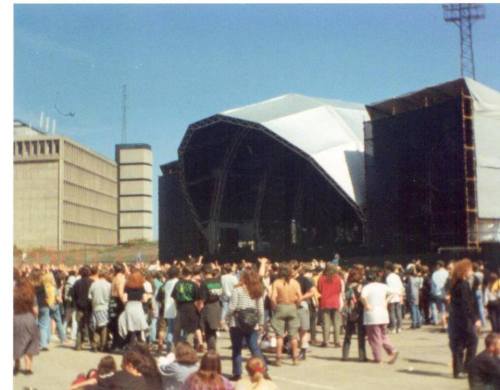
Dalymountstage

Dalymount Park stage and Phibsboro shopping centre. From the excellent Classic Dublin Gigs Facebook.

Ironically, Sunstroke was probably too good at what it did. They promised rock music, they brought it, and they were in turn driven out of Phibsboro quicker than a man clad in a green and white football scarf. Councillors, even the normally hip and down-with-it Tony Gregory, kicked up a major fuss about the noise, and Sunstroke made its way to the RDS, where it died peacefully in 1995. Soundgarden headlined then, continuing a fine tradition of bands showing up a year after they were meant to.

Sunstroke.jpg

Evening Herald coverage of Sunstroke 1994.

The Irish music festival is an institution, it will no doubt continue into subsequent decades. New festivals, like All Together Now, should be welcomed, but particular praise should go to the small independent festivals, who embody the spirit of the pioneers of the 1960s and 70s.  The magic of any festival is diversity – in 1980, Seamus Ennis walked out onto the Lisdoonvarna stage and mesmerised long haired youths with the Uileann Pipes, in 1992 Primal Scream stole Chris de Burgh’s star at Feile. Magic moments.

The Man with the Hat

SeanGarland

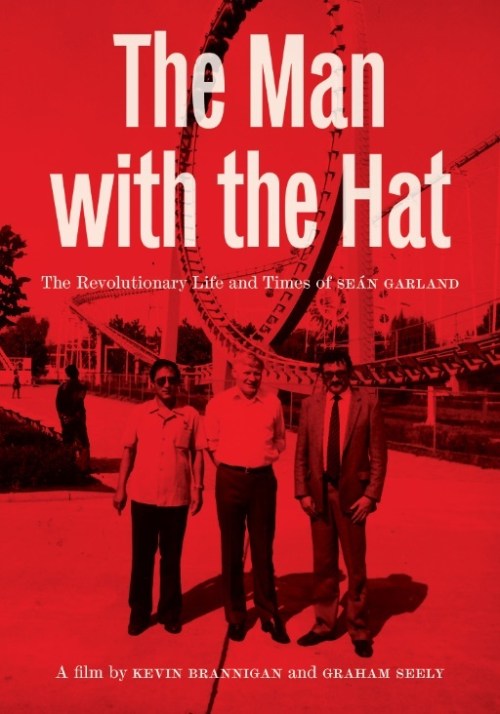
‘The Man with the Hat’ is not a name Seán Garland chose for himself. A code name bestowed upon him during a CIA investigation, it is an intriguing title for a documentary telling the story of one of the most important and controversial figures of Irish republicanism in the second half of the twentieth century. The Man with the Hat premieres May 15th in Dublin’s Sugar Club, with tickets on sale now from Eventbrite.

A veteran of the Operation Harvest campaign, which saw IRA units attacking British military interests on the north of the Irish border in a campaign directed from Dublin, Seán moved away from traditional republicanism and towards a Marxist perspective in subsequent decades. Republicanism is a broad church of course, and one of those who he had fought alongside in the so-called Border Campaign had been Seán South, an ultra-Catholic nationalist who secured his place in the nationalist pantheon thanks to’ Seán South from Garryowen’.

Sunstroke.jpg

The funeral of Seán South.

Garland was prominently involved with both the Workers’ Party and the Official IRA,  which declared a ceasefire in May 1972, though the organisation became entangled in increasingly bitter feuds with rival republican organisations in subsequent years, resulting in the deaths of primarily young men on the streets of Belfast and Dublin on all sides, including Charlie Hughes, Seamus Costello and Liam McMillen. The various feuds tore the republican movement apart at moments when unity was badly required.

Garland’s story plays out in Dublin, Belfast, Moscow, Pyongyang and in other surprising places. It is both the story of a secretive parliamentary organisation (which remained active in various ways long after its supposed ceasefire) and a political party which sought Soviet guidance and political power in Ireland. By 1987, an explicitly Marxist party had eight parliamentarians sitting in Dáil Éireann. In 1992, as communism collapsed across Europe, seven of its parliamentarians had abandoned the party and established the social democratic party Democratic Left.

In 2005, a new chapter in Garland’s life began as the United States sought his extradition on the basis of alleged involvement in the distribution of counterfeited US dollars – widely known as “superdollars” – in 1998. American authorities alleged that the source of the banknotes was the government of North Korea.

This upcoming documentary promises to examine all of these issues and more. How a young man from Dublin’s north inner-city can later become entangled in a tale that involves Pyongyang and the U.S legal system is one of the most intriguing stories of twentieth century Ireland, and it is long overdue an airing.


destroyedcar.jpg

The destroyed car of 1916 leader The O’Rahilly. A Dublin urban myth suggested it found its place buried below Hill 16. (Image Credit: National Library of Ireland)

I am a relatively recent convert to Gaelic football, but I’ve been enjoying cold evenings (and the occasional scorcher) in Parnell Park and Croke Park for a while now, thanks to the invitation of friends. Like with League of Ireland football, I’ve found that there is a strong sense of history and identity among Dublin’s support, which of course finds its best expression on the celebrated terrace of Hill 16.

The Hill is central to the way Dubliners see themselves and their city, synonymous with the packed terraces of the Kevin Heffernan days when Gardaí struggled to keep new young GAA fanatics off the pitch, and the chart storming ‘Heffo’s Army’ shouted that “we came marching in from Ringsend, and from Ballyfermot too”, as “Hill 16 has never seen the likes of Heffo’s Army.”

Yet the Hill doesn’t only represent the triumphs of the capital in GAA, it represents the defiance of Easter Week 1916. The Hill, it was often proclaimed, was constructed from the very rubble that the Helga created in her bombardment of the capital. In the 1980s the Irish Examiner proclaimed that it was “no wonder the Dublin football supporters make no bones about claiming possession on big match days”, as “the famous Hill 16 terracing was built from the stones which were all that remained on the capital’s famous street after the conflict of the 1916 Rising.” As Turtle Bunbury notes in his history of Ireland and World War One, “the items reputedly buried beneath the Hill ranged from the bricks of the General Post Office to a De Dion Bouton motorcar belonging to Michael O’Rahilly, one of the Rising’s slain leaders.”

Prior to becoming Hill 16, the terrace was popularly known as Hill 60, the last major assault of the Gallipoli campaign of 1915 in World War One. British forces, with many Irishmen in their ranks, endured enormous losses on the so-called Hill 60, located south of Ypres in Belgium, something that was strongly felt in working class Dublin. Though the Royal Dublin Fusiliers did not partake in the battle, the Connaught Rangers endured very significant losses. In a memoir of growing up in north inner-city Dublin almost in the shadow of Croke Park, Brendan Behan remembered the very powerful local significance of the First World War:

When the singing got under way, there’d be old fellows climbing up and down Spion Kop til further orders and other men getting fished out of the Battle of Jutland, and while one old fellow would be telling how the Munster’s kicked the football across the German lines at the Battle of the Somme, there’d be a keening of chorused mourners crying from under their black shawls over poor Jemser or poor Mickser that was lost at the Dardanelles.

The terrace was completed in 1915, in time for that years All Ireland Football Final. The Rising remained an idea in the heads of men like James Connolly and Seán Mac Diarmada, keen to capitalise on the chaos of the on-going European war. The adopted colloquial name of the terrace was tied on to a very recent moment then, much like Anfield’s Kop was a nod towards the Boer War and the Battle of Spion Kop.

Of course, the terrace witnessed some scenes of drama during the subsequent War of Independence. IRA Intelligence Officer Daniel McDonnell remembered standing on it during the Bloody Sunday massacre in his statement to the Bureau of Military History:

We parked ourselves on the famous Hill 16, and the match had just started when, as far as we could see, there was a rumble and bustle going on around the entrance gate at the Hogan Stand side. I personally had no interest in the match. We suddenly realised that the whole,ground was under rifle and machine-gun fire. We scattered and separated from, one another on the Hill. My hat’ fell off and while I was picking it up the man in front of was shot. I was very fit in those days and I ran across the slob lands’ at the back of Hill 16 over to the Ballybough gate. I ran so fast that I was nearly the first to reach it. The gates were not open. I jumped for the top of the gate, caught it and went over the far side

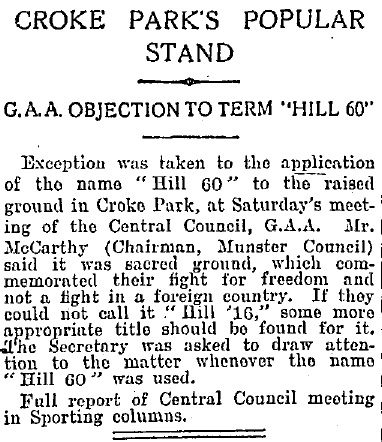
Given the horror of Bloody Sunday, it sat badly with some that the Hill’s name reflected British military conquest. On the fifteenth anniversary of the Rising, the Chairman of the Munster Council of the GAA reportedly raised his objection that “it was sacred ground, which commemorated their fight for freedom and not a fight in a foreign country.  If they could not call it Hill 16 some more appropriate title should be found for it.” From the 1930s, the name Hill 16 was adopted colloquially, reclaiming the Hill for the green.

hill60

Irish Independent, 1931.

Along with the new name, came the myth of the rubble. Paul Rouse brilliantly examines this in his Sport and Ireland: A History, finding evidence from as early as the 1930s of the claim. When Meath made it to the 1939 final, ‘Two Gaels’ writing to a regional newspaper urged the men to victory, reminding them the Hill honoured “Ireland’s fallen heroes, whose blood stains the debris in that immortal Hill.” Rouse also points towards a 1966 claim by one man in a Dublin boozer who claimed to have been paid to transfer rubble to Croke Park. Not for the first time, “history was overwhelmed by the power of men in pubs telling stories.”

The myth of The O’Rahilly’s car being amidst the supposed rubble remained widely believed in Dublin into subsequent decades of the Hill. It has appeared in biographies of O’Rahilly, while as recently as 2003, with the imminent redevelopment of the Hill, it was noted in The Irish Times that:

The recent news that the GAA is to redevelop the historic Hill 16 at Croke Park led us to wonder if the contractors will encounter the remains of an early De Dion car reputedly buried there after the 1916 Rising. The car belonged to The O’Rahilly, one of the founders of the Irish Volunteers.

That the Hill is not created from the rubble of Easter Week does not take away from its magic in any way. Rather, the complex history of its colloquial naming and renaming says much about memory and the meaning of the revolutionary period in Ireland. Republicans sometimes struggled with the continued importance of World War One to many working class Dubliners post-independence. Frank Ryan went as far as to speculate that those who participated in commemorative events around the war were primarily “bank clerks and students of Trinity College”. In truth, there were nowhere near enough bank clerks and Trinity students to fill the space around the Wellington Testimonial in the Phoenix Park or College Green every November 11. Ryan’s astonishing statement ignored the fact that as Brian Hanley has rightly noted, “a section of working class Dublin continued to identify with its contribution during the First World War” in the years that followed independence.

So, what happened to the car?

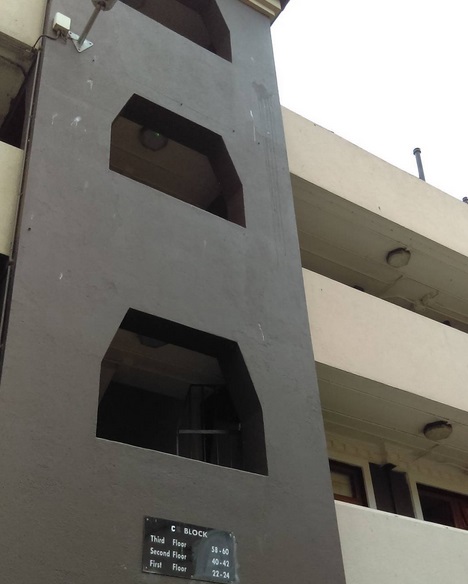
simmslogobwtrnspMy grá for Herbert Simms is well known. Dublin’s Housing Architect from 1932 until 1948, this year marks the 120th anniversary of his birth, as well as the 70th anniversary of his tragic suicide. We have previously examined Simms on the blog. He understood the complexities of public housing and public needs, telling a housing committee in 1935 that “you cannot re-house a population of 15,000 people, as in the Crumlin scheme, without providing for the other necessities and amenities of life.” His beautiful Art Deco housing schemes dot both sides of the River Liffey today, a reminder of his vision.
Along with a Committee that includes some remarkable academics and friends, I am happy to present the Call For Papers for #Simms120 here. Please do get involved. We will be fine-tuning it all in the weeks ahead, but the conference looks set to happen in October and it will be open to the public. If you live in a Simms scheme, or are just generally curious about the history of housing in Dublin, you’re more than welcome. Details to follow.

Housing and how it is provided remains a vital issue across the city of Dublin today. Where and how we should provide housing for a changing population are some of the most pressing issues facing the city. Housing builds community and it develops a sense of place for these communities. As the current challenges in housing show, building houses is more than just an adequate number of rooms. It is one of the main ways that the city’s population retains a sense of itself.

2018 marks the 120th anniversary of the birth of Herbert George Simms. Through his work with Dublin Corporation, Simms was responsible for some of the most elegant and highest quality housing that remains in Dublin city to the present day. From Cabra, Crumlin and in the heart of the city, Simms’ work and vision for Dublin are still present. Their presence is not just about housing, but fostering communities.

To recall his work, and in light of the significant challlenges that face housing in the present, this set of events will draw together some of the main ideas about Simms’ work in and legacy for Dublin city. Through seminars, oral histories and visual representation, the conference will examine Simms’ legacy to the city of Dublin, assess his contribution to the development of communities across Dublin and provide a lens through which to view current contexts.

We are seeking contributions from all to help remember the work of Simms but particularly from:

  • Residents of Simms-designed housing
  • Architectural historians
  • Geographers
  • Planners
  • Local history groups
  • Photographers
  • Poets and other artists
  • Housing policy workers
  • Community workers

Email: simmsdublin@gmail.com

Twitter: @Simms120

Conference committee:

Mary Broe, PhD candidate, Maynooth University

Donal Fallon, Come Here To Me, Historian in Residence Dublin City Council

Erika Hanna, Department of History, University of Bristol

Rhona McCord, Contemporary Irish History, TCD

Eoin O’Mahony, School of Geography, UCD (chair)

Paul Reynolds, Stoneybatter History Group

simms1

North Cumberland Street flats, designed by Simms.

Hester_dowden

Hester Dowden (1868-1949)

There is a curious hidden history surrounding early Irish spiritual mediums, who tended to be women of considerable influence. Hester Dowden, daughter of Irish literary scholar Edward Dowden, claimed to be in contact with the spirit of Oscar Wilde and other illustrious figures. Geraldine Cummins, a distinguished playwright, convinced the American Ambassador to Ireland during the Second World War that she was in direct contact with President Roosevelt’s late mother and former British Prime Minister Arthur Balfour. Ambassador Gray took it all seriously enough to write home from Dublin that that “assuming these comments do come from friends who have passed on, I think they should be treated exactly as advice from friends who are still here.”

The late nineteenth century witnessed a global wave of interest in occultism, spiritualism and in mediumship. In an Irish context, William Butler Yeats is undoubtedly the most celebrated figure to have indulged in it all, as a firm believer in automatic writing and a member of the ‘Ghost Club’ in London. The idea that the dead both had the ability and inclination to speak with the living was a powerful one. The great Harry Houdini would later set out to debunk those he believed were little more than “vultures who prey on the bereaved”, but in the second half of the nineteenth-century converts to the concept of mediumship included leading chemists, physicists and the occasional Nobel laureate. The Evening Herald didn’t buy it, telling readers:

Don’t waste time on spiritualism, for if you wish to demonstrate that you are a first class imbecile you can give no better proof than by parting with your money to so-called professors of occultism who pretend to hold communication with the dead. What strange foolishness sends men and women to ignorant, illiterate, fraudulent mediums in search of ghosts and spirits!

Dubliner Hester Dowden published Voices from the Void (1919) and Psychic Messages from Oscar Wilde (1923), receiving significant international attention for the later. Dowden’s father was a much respected literary critic and academic, which had provided her access to a world of writers. Beginning her career as a medium in London, her introduction to Voices form the Void was not by any means sensationalist, informing readers that:

Those who are willing to devote some of their time to the study of what is commonly called spiritualism should bear in mind that results are slow, uncertain, and cannot be forced. Indeed, one asks on self whether time is well spent seeking for the few grains of gold one finds in the huge dust heaps of disappointment and dullness.

There was nothing dull in Dowden’s Psychic Messages from Oscar Wilde, a collection of claimed automated correspondence with Wilde. Within its pages, she stated that Wilde took a poor view of Joyce’s Ulysses when quizzed on the recently published and then hotly debated work:

Yes, I have smeared my fingers with that vast work. It has given me one exquisite moment of amusement. I gathered that if I hoped to retain my reputation as an intelligent shade, open to new ideas, I must pursue this volume. It is a singular matter that a countryman of mine should have produced this great bulk of filth.

 She claimed too that Wilde told her “being dead is the most boring experience in life. That is, if one excepts being married or dining with a schoolmaster.” Joyce, not to be outdone, parodied it all in Finnegan’s Wake, where Wilde talks gibberish through a medium.

Geraldine_Cummins

Geraldine Cummins (1890-1969)

Perhaps the most widely known Irish medium was Geraldine Cummins, a Corkonian born in 1890 who was many things in one life time. A very capable and talented writer, she wrote three plays for the Abbey – including a comedy – and published a novel, but gradually focused more and more on mediumship. Her influence was significant enough to perhaps impact on US foreign policy. When US Ambassador to Ireland David Gray participated in a number of seances with Cummins, he believed her claims to be in communication with spirits that included former British Prime Minister Arthur Balfour, who had served as Chief Secretary for Ireland and resided in the same home. Balfour provided his own analysis of contemporary events, which were forwarded to the US President by Ambassador Gray. President Roosevelt’s reaction was not dismissive; he informed Gray that to his mind “these are real contributions and I hope you will continue.”

Unsurprisingly in Catholic Ireland, there was frequent denunciation of those who engaged in such behaviour, with the Ouija board specifically denounced on more than one occasion. Created by American lawyer and inventor Elijah Bond, the ‘Talking Board’ launched in February 1891, first marketed as a parlour game. The more common name, it was later claimed, came from an ancient Egyptian word ‘Ouija’, meaning ‘Good Luck’. A flat board marked with the letters of the alphabet, the letters 0-9 and the words ‘Yes’ , ‘No’ and ‘Goodbye’, Elijah’s grave actually includes the markers of a Ouija Board carved into its stonework.

That the board exploded in commercial popularity around the time of the First World War says much about the tremendous hurt of the time, when men were dying in their hundreds of thousands on foreign battlefields and the very idea of a body to bury was out of the question for most. In November 1919, the Freeman’s Journal wrote of how against the backdrop of such trauma on an unprecedented scale, “one might be tempted to transfer one’s allegiance to crystal gazers, palmists, table-rappers, the manipulators of Ouija boards, and such like exponents of the new credulity.”

The leading opponent of all of this in popular culture was the great Harry Houdini, a legend in his own lifetime and ours, remembered for his escape acts and as the greatest illusionist of all time. There was seemingly nothing the man couldn’t work his way out of, and he had drawn large crowds to see his performances in person in Belfast in 1909. Like many people, Houdini wanted to believe. Before his death he had actually agreed with his wife that if he somehow did find it possible to communicate with her after death, he would and that they would have a secret code, with the message being simply ‘Rosabellebelieve’. His widow held a yearly séance on Halloween for ten years after Houdini’s death, in the hope he’d make contact. In his lifetime, Houdini, like a lot of people who approach this field, had gone into it with a broken heart with the death of his mother in the 1920s, and he became convinced that those telling him he could communicate with her had no way of doing it and were merely frauds. When he toured America in 1925, he offered $10,000 to anyone who could exhibit supernatural phenomena that he could not replicate himself. By the time of his death, he had done much to undo the reputations of mediums the world over. Yet some, like Ambassador Gray in the Phoenix Park, continued to believe.


tcd68

Evening Herald, 15 May 1968.

Much will be written in the weeks ahead internationally about May 1968, and the student demonstrations which gripped France. They have achieved something of a legendary status in popular culture,  with the striking graphic posters and slogans of the student movement finding their way into mainstream consciousness. La barricade ferme la rue mais ouvre la voie appeared on Parisian walls, declaring that ‘the barricade blocks the street but opens the way.’

The Stone Roses later adopted the iconic lemon logo of the band on the basis of singer Ian Brown’s obsession with the May ’68 events, learning that lemons were carried by student demonstrators who believed them to nullify the effects of tear gas. Brown recalled that:

When we were in Paris we met this 65-year-old man who told us that if you suck a lemon it cancels out the effects of CS gas. He still thought that the government in France could be overthrown one day; he’d been there in ’68 and everything. So he always carried a lemon with him so he could help out at the front. Sixty-five – what a brilliant attitude.

Of course, angry students were not confined to the occupied universities of Paris in 1968. In the United States, students formed an important part of the Civil Rights movement, while in the North of Ireland People’s Democracy emerged in the later stage of the year, primarily from young activists in Queens University Belfast. To be a student in 1968, it seemed, was to be an activist.

 For what it’s worth, the students in France didn’t think much of the Ireland of the day. At several occupations, they watched the film The Rocky Road to Dublin, Peter Lennon’s great documentary that asked the fundamentally important question of “what do you do with your revolution once you’ve got it?” The film was shown at the Cannes Film Festival, which came to an abrupt end that year owing to the discontent that swept the country. It inspired more than one fierce debate in an occupied classroom.

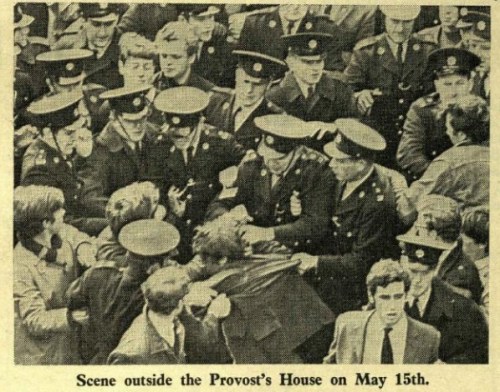
In Dublin, Trinity College Dublin students made headlines in 1968 for their opposition to the visit of King Baudouin of Belgium to the university. It was a time when there was something of a buzz around the Left on the campus, with John Stephenson later recalling how “in the mid-sixties there was a pronounced progressive tendency in the student body.  Not since the Forties Prometheans had there been such a strong Leftist surge.” Central to the story were the Internationalists, a small Maoist grouping on campus who troubled the college authorities and puzzled some in the press beyond the walls of the university that had produced Edmund Burke and Edward Carson. Nusight reported that they “lived communally, shared all their earnings, rose at a certain time for pre-breakfast study sessions, and often worked an 18 hour day bill-posting around the city or stapling magazines.”

tcd68

Trinity News coverage of the event.

Continue Reading »

The crossroads of Ballybough Road and Clonliffe Road will be known to many Dubliners who make their way to and from Croke Park to watch Dublin compete. Today dominated by large advertising boards on what is prime advertising real estate, there is nothing to indicate the rather macabre history of the corner, which it seems was once home to a so-called ‘Suicide Plot’. This was essentially an unconsecrated burial location in the eighteenth and nineteenth centuries for those who took their own lives, as well as the occasional outlaw. It has entered local folklore, and was even mentioned in the Dail in 1990 by a TD who commented “there is also a suicide burial plot in the area and it is said that spirits are still in the park beside the Luke Kelly Bridge.”

B265-1564.jpg

Google Street view of the corner in July 2014. It has since been improved and includes recreational seating.

Ballybough’s name derives from the Irish language ‘Baile Bocht‘, meaning ‘poor town’. Before urban development, the district from Ballybough to North Strand was known colloquially as Mud Island, with the Rev. John Kingston noting in a 1950s piece that “Ballybough had an evil reputation during the eighteenth century…Beside the bridge was a noted suicide plot, where the bodies of suicides were interred in the time honoured fashion, transfixed with stakes, which according to belief, effectually prevented these unhappy beings from wandering about and alarming the public.”

There was little sympathy or understanding in most cases for those who took their own lives in earlier centuries. In an interesting History Ireland feature on Theobald Wolfe Tone, who made the decision to take his own life rather than face the death of a criminal, Georgina Laragy rightly notes that “At the time of his death suicide was a mortal sin, condemned by both Catholic and Protestant churches, and a crime under common law. It was punishable by burial at the crossroads with a stake through the heart, and the confiscation of one’s goods and chattels (both these punishments were overturned by legislation in 1823 and 1872 respectively).” Tone, a formidable political figure, was buried in consecrated ground at Bodenstown in Kildare, which very much defied the norm for such a death.  Felo de se, or ‘Felon of himself’, was the archaic legal term used to describe those who took their own lives.

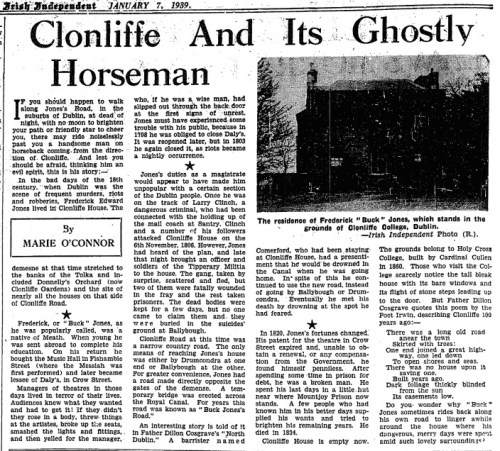
Curiously little has been written about the site, with most of what has appeared in print bring rooted primarily in local lore. In his popular Dublin history The Labour and the Royal, Eamonn MacThomáis talks of Larry Clinch, an early nineteenth century highwayman figure, who was hanged in the vicinity following a shootout with militia men in November 1806: “The bodies of Larry and his gang were left lying on Clonfliffe Road to warn all other highwaymen. Later they were buried at the end of Clonliffe Road, at Ballybough Crossroads. Down the years many people have reported seeing a strange horseman rising up and down Clonfliffe Road late at night.”

B265 - 1960 Anti -Jewish signs in Dublin

A 1939 local history feature from the Irish Independent eludes to Larry Clinch and the “suicides’ ground at Ballybough.”

In Dublin, facts need not always interfere with stories of course, and the manner in which the plot is remembered (and even geographically placed) by locals is important in itself. It is certainly something most locals of a certain vintage seem to have at least heard of, which is interesting given the absence of a historic marker. The excellent East Wall for All blog has speculated on its potential literary importance, but there is undoubtedly a lot more work to be done.


FrankFlood.jpg

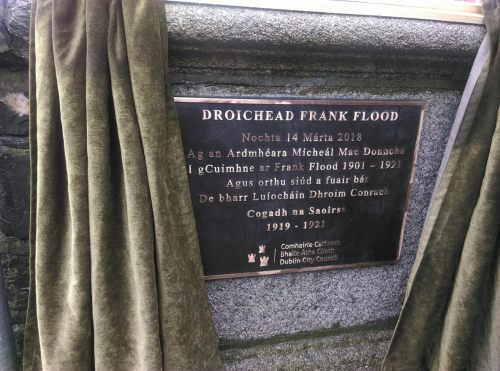
Dublin’s newest plaques were unveiled today on the Frank Flood Bridge, Drumcondra. They commemorate a young and fearless IRA Active Service Unit commander, a mere 19 years of age at the time of his execution. A student of University College Dublin, Flood was among the ‘Forgotten Ten’, buried in Mountjoy Prison until a state funeral in 2001 saw the men reburied in Glasnevin cemetery.

I was asked to say a few words today to put Frank Flood in context and to explain the importance of the Active Service Unit in the War of Independence:

Frank Flood, in some ways, was an unlikely radical. The son of a policeman, he was a very capable student of the same university attended by his friend Kevin Barry. Before this, he had been a student of the CBS North Richmond Street school, and perhaps therein lies the answer. This remarkable school was attended by republicans as diverse as Ernie O’Malley, Seán Heuston, Éamonn Ceannt and Sean Lemass. It was an atmosphere that nurtured nationalism.

If radicalism was found closer to home, it was in his siblings. Seán Flood, a brother, was a member of the 1st Battalion of the Dublin Brigade of the IRA, serving under Ned Daly in 1916 and throughout the subsequent years of struggle. Young Frank, born in December 1901, joined the Volunteer movement in the aftermath of the Rising in 1917. The family lived at 19 Summerhill Parade. Six Flood siblings played a part in the revolutionary period.

Flood proved capable of balancing student life with his involvement in the Republican movement. An active member of the college Literary and Historical Society, he involved himself in college life, in a university that could count Seán MacBride, Sean Ó Faoláin, Kevin Barry and Todd Andrews among its student body.  On the day Kevin Barry was hanged, young Seán MacBride was among those to raise a tricolour to half mast over the university, leading to a military raid on the college.

Flood was a quick rising star of the IRA, which found itself operating in difficult terrain in Dublin city centre, far removed from the rural hills and valleys of the Flying Columns. Flood was among the men who raided King’s Inn’s for arms in June of 1920, securing a Lewis gun among other captured items. Such acts were a morale boost to the movement, as well as providing crucially important arms.

Flood was among the participants in the Church Street Ambush in September 1920, when British soldiers at Monks Bakery were fired upon by an IRA party, resulting in several fatalities. A young Kevin Barry, hiding under a lorry in the confusion that followed the attack, was captured at the site. Barry’s sister later recalled Frank Flood’s heartbreak at Barry’s detention, insisting to her on several occasions that he and his comrades would do all in their power to break him out.

The creation of the IRA’s Active Service Unit in Dublin was a landmark moment in the conflict. As James Harpur recalled, “it was the intention of the Army Council to increase the activities of the I.R.A. and to counter increased British activities in Dublin, and to this end the Active Service Unit was being formed.” Harpur recounted being addressed by Oscar Traynor, and “he informed us that the
British were becoming a bit too ‘cocky’ in the city and were being allowed too much freedom of movement to carry out their policy of subduing the population, and that it had been decided to counter this activity on their part by giving them battle on our own ground.” It was dangerous and stressful work; ASU member Patrick Collins recalled Traynor telling the men “if any man felt that the work now or in the future would cause him too great a strain he was free to withdraw at any time without any reflection on him.”

Flood immediately took a prominent leadership position in the northside ASU’s. On the 21 January 1921, Flood led an IRA ambush party near to here. Dermot O’Sullivan, a surviving participant, recounted the events of that day in his Bureau of Military History Witness Statement:

On the 21st January, 1921, No. 1 Section was detailed to take up positions at Binn’s Bridge, Drumcondra, at 8.30 a.m. and to ambush a party of Black & Tans which usually came into the city at that time from Gormanstown….

 …The  Section Commander’s instructions for the attack on the Tan lorry were that the lorry was to be allowed to pass through our first pair of men and when it came in line with the -pair located on the north side of Binns Bridge they were to open fire on it. We were all to fire simultaneously likewise when it came abreast of our positions. The entire Section remained in position until 9.30 and as no Tan lorry came our way within that time the Section Commander decided to withdraw to a position further down the Drumcondra Road in the vicinity of Clonturk Park.

 The detection of the IRA men in the area by a passing police man created a dilemma, and the DMP man continued on his way, no doubt altering authorities. O’Sullivan recalled their decision to  attack a military van which approached from the Whitehall direction. O’Sullivan’s Witness Statement tells us:

Almost simultaneously with the arrival of the van we noticed that an armoured car and a few lorries of military were coming in our direction from the city and another armoured car and some lorries were also approaching our position from Whitehall direction. It was clear to us then that someone must have summoned the aid of the military and Tans as the place seemed to be surrounded. We saw there was nothing for it but to get out as quickly as we could, so we made our way down Richmond Road in the direction of Ballybough with the intention of cutting across country towards Clontarf. As we reached the junction of Gracepark Road we saw two tenders of Black & Tans approaching us from the Ballybough direction. We wheeled up Gracepark Road and into Gracepark Gardens. At that time Clonturk Park was open country. A Lewis gun which had opened fire at some of our section crossing Clonturk Park (which was not then a built-up area) could have brought us under fire. In fact, one of our men, McGee, was killed as he was trying to get away.

Hopelessly surrounded, most of the remaining the men  surrendered. The following day they were interrogated by intelligence agents from the Castle, with O’Sullivan recalling Frank Flood was “Struck across the face with a butt of a revolver and told to take the grin off his face.” Despite their efforts, their interrogators learned nothing of the inner-functions of the ASU, which was quickly attacking crown forces on the streets of the capital again.

O’Sullivan lived to tell that tale, his life being spared on the basis of his youth, though one could hardly consider Flood and his comrades old men. Four of the party which participated in the planned ambush were executed on the 14 March 1921. They were:

Patrick Doyle, aged 29

Francis Xavier Flood, aged 19

Thomas Bryan, aged 24

Bernard ‘Bertie’ Ryan, aged 21.

The crime for which Frank Flood was executed was ‘High Treason’, yet he had acted not out of any sense of treason, but loyalty to the idea of the Republic proclaimed at Easter Week, and reaffirmed in the Democratic Programme of the First Dáil. In the words of Canon Waters inside the prison, these condemned men “walked to the scaffold like lions.”

In recognition of their contribution, the men were rightly reburied in Glasnevin cemetery in 2001. Let this new memorial, like their prominent resisting place there, remind Dubliners of their bravery and heroism.

RingsendandDublinFootball

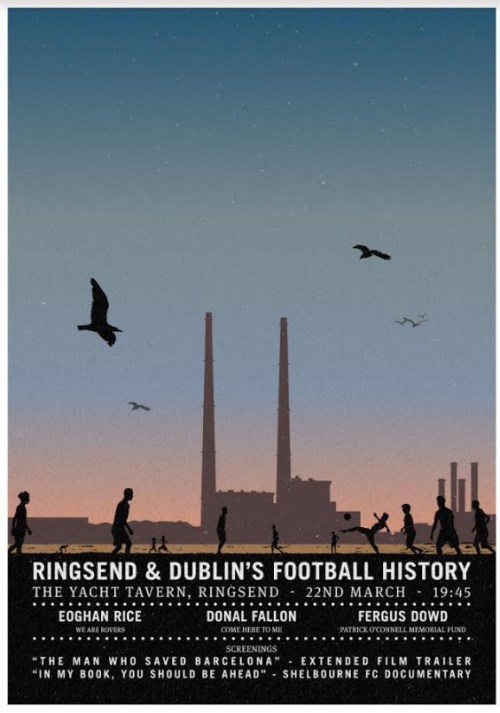
Allow me to tip my Magee cap in the direction of Simon Conway. Man about town, DJ, promoter and publican (behind Lucky’s on Meath Street and The Yacht in Ringsend) his insistence led to us putting together this forthcoming evening of chat.

Ringsend is an area with a strong football heritage, the birthplace of both Shelbourne and Shamrock Rovers. It is also associated with some remarkable players and footballing figures like Billy Behan, recently examined on the blog.

This forthcoming night is a chance to talk about some of that history. Eoghan Rice is the author of We Are Rovers, which remains one of the finest League of Ireland books, right up there with There’s Only One Red Army (examining the other SRFC).Fergus Dowd from the Patrick O’Connell memorial fund will talk about the forthcoming documentary ‘The Man Who Saved Barcelona’ and the Patrick O’Connell Memorial Fund. We’ll be showing the extended trailer for that forthcoming documentary, as well as the wonderful ‘In My Book, You Should Be Ahead’, which examines Shels.

The poster is a magnificent tribute to both the beautiful game and Ringsend, all credit to Manus Jude Sweeney.