Feeds:
Posts
Comments

Here’s the complete list of our 18 pub crawls since September 2009. All prices are from the time we visited. I’ve included some pictures of my favourite spots from along the way.
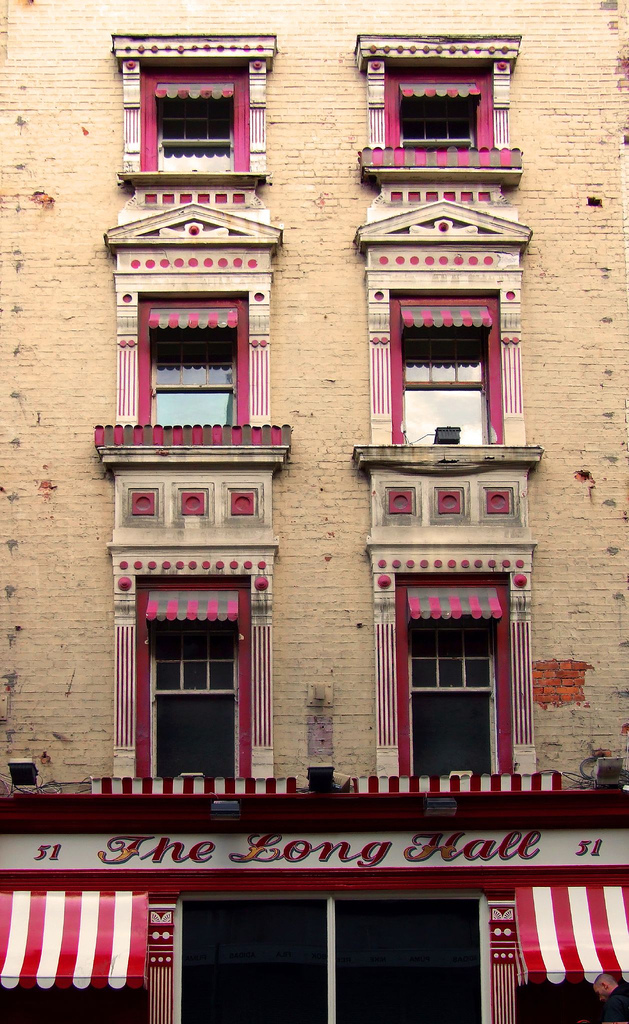
The Long Hall. (Flickr – Steve-h)

1. September 2009 (Pubs 1-5) [hXci, City Centre]

– The Long Hall, Sth. Great George’s St.
– Kehoes, South Anne St.
– The Dawson Lounge, Dawson St.
– Toners, Baggot St. Lwr.
– Mulligans, Poolbeg St.

2.  November 2009 (Pubs 6-10) [dfallon, City Centre]

– Davy Byrnes, Duke St. (€4.80)
Dame Tavern, Dame Ct. (€4.60)
MacTurcaills, Townsend St. (€3.50 w/ student card)
Doheny and Nesbitt, Baggot St. Lwr. (€4.80)
The Bankers, Trinity St. (€4.50)

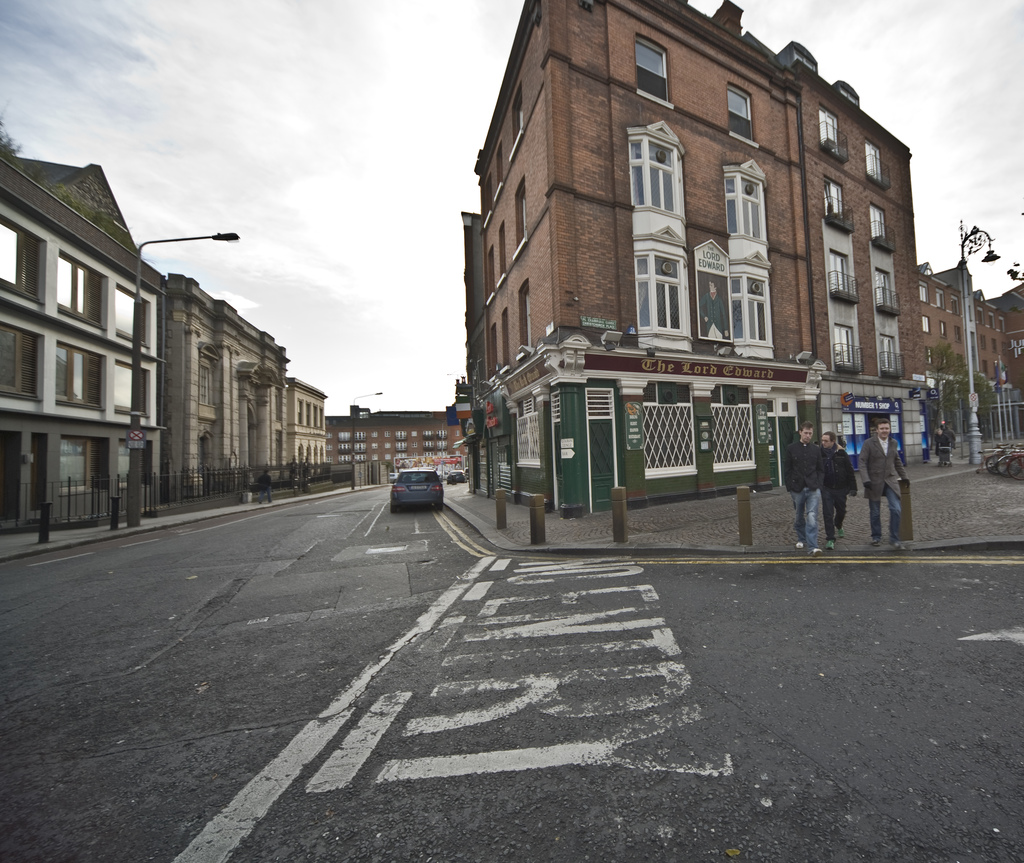
The Lord Edward (Flickr – infomatique)

3.  December 2009 (Pubs 11-15) [hXci, City Centre]

– Peter’s Pub, Sth. William St. (€4.80)
– The Lord Edward, Christchurch Place. (€4.00)
– The Brazen Head, Lwr. Bridge St. (€4.50)
– Frank Ryan & Sons, Queen St. (€4.30)
– The Cobblestone, King St. North. (€4.10)

4. January 2010 (Pubs 16-20) [JayCarax, City Centre]

– Hourican’s, Lwr. Leeson St. (€4.50)
The Shelbourne, St. Stephen’s Green (?)
The Bailey, Duke St. (€5.00)
The International, Wicklow St. (€4.50)
Neary’s, Chatham St. (€4.85)

5. February 2010 (Pubs 21-25) [JFlood, Rathmines. Words – hXci]

– Toast, Lwr. Rathmines Rd. (€4.35)
MB Slattery’s, Lwr. Rathmines Rd. (€4.30)
Graces, Rathgar Rd. (€4.10)
Mother Reillys, Uppr. Rathmines Rd. (€4.15)
Rody Bolands, Uppr, Rathmines Rd. (€4.30)

Bowes. (celticphotography.ie)

6. March 2010 (pubs 26-30) [hXci, City Centre]

– The Duke, Duke St. (€4.45)
– The Gingerman, Fenian St. (€4.60)
– Ned Scanlons, Townsend St. (€3.80)
– The Long Stone, Townsend St. (€4.60)
– Bowes, Fleet St. (€4.50)

7. March 2010 x2 (Pubs 31-35) [Dfallon, Dorset St/Drumcondra]

– The Celt, Talbot St. (€4.40)
– The Red Parrot, Dorset St. (€4.00)
– Patrick McGraths, Lwr. Drumcondra Rd.(€4.50)
– W.J. Kavanaghs, Dorset St. (€4.10)
– Mayes, Dorset St. (?)

8. April 2010 (Pubs 36-40) [JayCarax, Camden St./Portobello]

– Cassidy’s, Lwr. Camden St. (€4.20)
The Bleeding Horse, Uppr. Camden St. (€4.25)
The Lower Deck, Portobello Harbour. (€4.15)
The Portobello, Sth. Richmond St. (€4.15)
J. O’Connell’s, 29 Sth Richmond St. (€4.00)
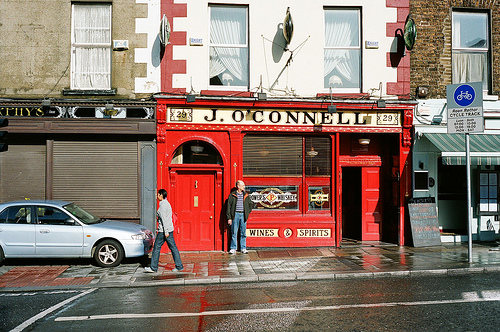
J.O’Connell (Picture – ?)

9. May 2010 (Pubs 41- 47) [hXci, City Centre/Thomas St.]

– The Bull and Castle, Christchurch Place (€4.80 – cider)
– The Legal Eagle, Chancery Place (€3.85) [€2.2.0 – Sundays 1/2 price]
– O’Shea’s Merchant, Lwr. Bridge St. (€4.90)
– Pifko, Usher’s Quay. (€4.00 – Paulaner)
– The Clock, Thomas St. (€4.60)
– Bakers, Thomas St. (€4.60)
– Tom Kennedys, Thomas St. (€4.50)
– Brogans, Dame St. (€4.30)

10. June 2010 (Pubs 48- 53) [hXci, City Centre]

– McDaids, Harry St. (€4.65)
– The Hairy Lemon, Stephens St. (€4.80)
– Hogans, Sth. Great George’s St. (€4.45)
– Jack Nealons, Capel St. (€4.20)
– The Bachelor Inn, Bachelors Walk. (€4.40)

Continue Reading »

Scanned from Lennox Robinson's 'Pictures In A Theatre'

The Abbey has a long and fascinating history. Some stories, like the riots which surrounded both The Playboy of the Western World and The Plough and the Stars have gone on to enter popular Dublin ‘lore and history. Yet there is a great hidden history to the Abbey, and below are five facts about the theatre that may surprise some of you.

1) Yeats could have made it a part-time cinema!

In his excellent history of the “theatre that refused to die”, Sean McCann wrote of the financial crisis that gripped the Abbey in the early 1920s. On the day Sean O’Casey’s classic ‘The Shadow Of A Gunman’ was first performed at the theatre in April of 1923, banks advised the directors of the Abbey that their cheques could no longer be cashed. As McCann notes in his history “by August of that year the letting of the theatre as a cinema was considered, with the warm approval of Yeats, and only the possibility of a Government subsidy gave any hope of keeping it alive.”

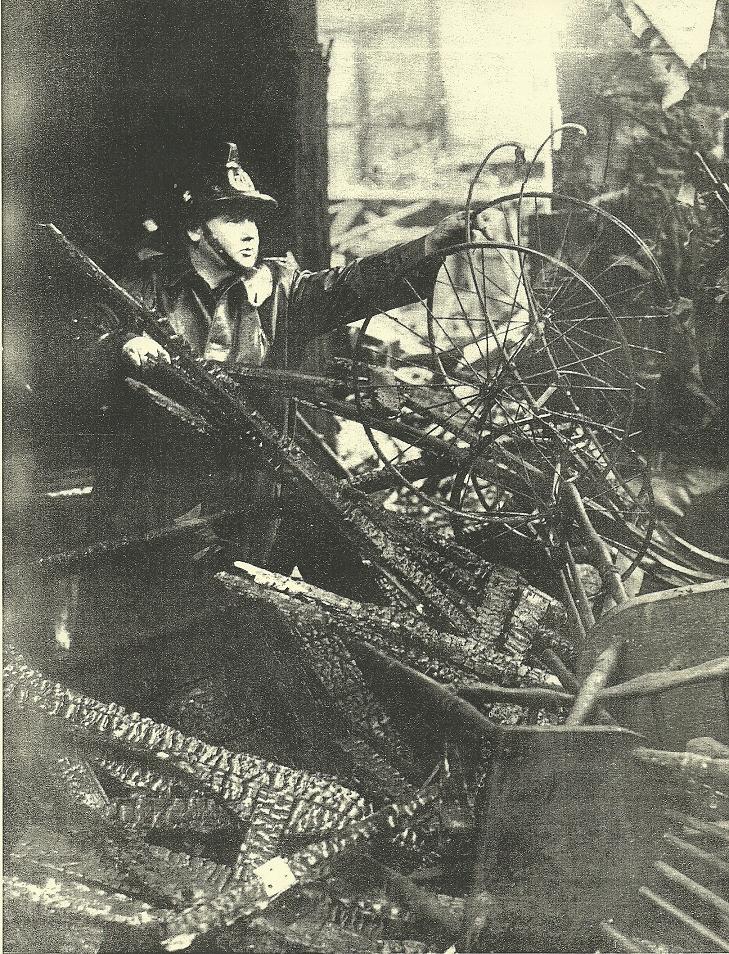
2) The Dublin Fire Brigade saved the pram from O’Casey’s The Plough and the Stars.

L.Fallon collection. Posted previously to 'Come Here To Me'.

On July 18 1951 a fire ripped the home of the Abbey apart. Tom Geraghty and Trevor Whitehead noted in their history of the Dublin Fire Brigade that in was the busiest night of the year for the Brigade, with nine crews fighting the blaze.

What had been the former Mechanic’s Institute and City Morgue was just a gaunt dangerous skeleton festooned with The Plough and the Stars posters, and the ghost of Yeats was left to haunt an eerie smoke-filled chamber.

The incredible image above shows Fireman Frank Brennan salvaging the pram, which featured even in the excellent 2010 production. The frame is original, its casing isn’t.

3) It boasts a fine 1916 connection, though its monument has changed.

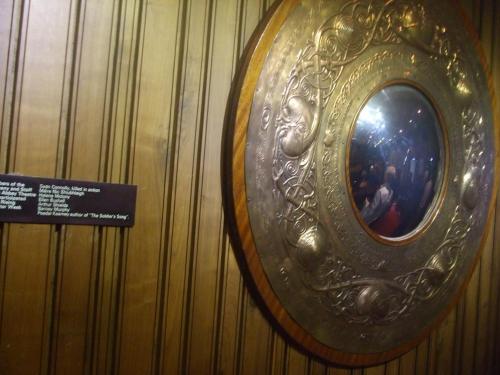
Historically, a plaque was located in one of the pillars outside The Abbey, listing seven names. These are individuals who participated in the Easter Rising, and who held a variety of roles at the theatre. The first casualty of the republican side in Easter Week of course was an Abbey actor by the name of Sean Connolly, but alongside him are six other names, all of whom survived the uprising. Máire Mic Shibhlaigh, Helena Molony, Ellen Bushell, Arthur Shields, Barney Murphy and Peadar Kearney were all listed on the plaque.

Today, their names are on the 1916 memorial inside of the theatre, rather than a plaque outside it:

In an excellent contribution to Dublin Historical Record, the publication of the Old Dublin Society, James Wren correctly noted that the theatres connections to the insurrection went much deeper.

Edward Keegan for instance was a 1916 volunteer who had a long history with the theatre, and his name is sadly omitted from the memorial. He had been a member of the National Players, and even appeared in the first productions of Yeats’ On Baille’s Strand and Lady Gregory’s Spreading The News.

Keegan worked with The Irish Times newspaper as a clerk, but found himself sacked following the rebellion for ‘disloyalty’!

4)It took a decade to pull it down after the inferno of 1951, but in the meantime it made a handy office for one infamous Dubliner.

Ernest Blythe recalled for me the first time he met Brendan Behan was when he went to one of the old rooms a long time after the fire and there he found a man installed. ‘It turned out he was using it for an office. He had all his papers spread out and he had made it his town office. Apparently, someone had told him where the key was kept and he had been using the place for months.

(Sean McCann: The Story of the Abbey Theatre (New English Library Limited, 1967) p.65)

5) Michael Scott, who designed the Abbey we all know today, once trod the boards of the old Abbey.

Michael Scott, the architect responsible for the Abbey which opened to the public in 1966, had a long personal history with the theatre. He joined the Abbey School of Acting under Sara Allgood, while also undertaking a architectural apprenticeship. He would recall in a recollection for The Irish Times that soon after going into private practice, he was given the call-up for a part in an Abbey play, on a London stage. He would also go on to appear at the theatre in Dublin..

Now in private practice in an office on the top floor of a building in O’Connell Street, and working on plans for the Gate Theatre in the Rotunda, and other projects, I was asked to go to London to play in Shaftesbury Avenue. The part offered was the Gossoon,in the Abbey Play The New Gossoon.

(Note: Pub Crawl, December 2012 (84 – 88) is on the way. hXci’s notes were stolen by a seagull)

With a little bit of rain being our only obstacle, an eager group of ten of us set off from Windy Arbour Luas stop at 4:30pm Sunday last for the 20th CHTM! pub crawl and the first of 2012.

Seeing as the best of the city centre pubs have been visited as well as the outlying South Dublin neighborhoods (Beggars Bush, Baggot St, Leeson St, Portobello, Ranelagh, Rathmines and Harolds Cross), it was with great pleasure that I was able to bring people out even further and to areas (and pubs) that were unknown to them.

The areas of Windy Arbour and Dundrum made perfect sense as they were easily accessible (due to the Luas) and, more importantly, had five pubs close enough to each other for walking distance.

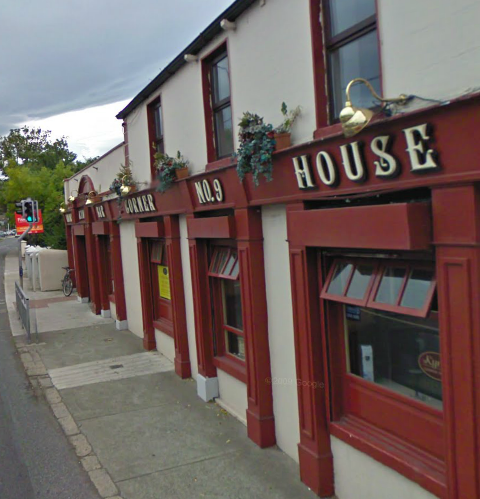
With everyone more than happy to escape the continuous rain, our first stop of call was The Corner House (aka Kynes).

The Corner House (aka Kynes), Windy Arbour. (Google Street View)

Our group of ten immediately doubled the number of patrons in the place. Turning into the pub, you’re faced with a long bar on the left and a row of stools and seats on your right.

At the back, there was a TV showing the Aston Villa – Arsenal game (not too loud thankfully) and in the back left hand corner was a Darts board.  A small group of local lads played with one eye on the game. (The web tells me that the pub runs a dart team, probably one of a dying breed?)

If you had come through the main door and went straight, instead of right, you would got to the bar area which was empty on this Sunday and presumably only used for busy nights and functions.

A sign advertised a weekly Thursday poker night and it was also nice to see a small row of books at the entrance of the bar for people to read (and perhaps swap).

The lovely pint of stout came in at a very reasonable €4.20. The second cheapest of the day.

The Corner House, formerly known as The Nine Arches (and apparently before that J.D.’s Corner House, and The Millrace), is a pub right in the heart of traditional Shamrock Rovers territory. Their former Milltown stadium is just over five minutes walk away and this pub has not forgotten the fact. On the walls were a couple of Rovers & Glenmalure Park framed pictures. With a Dublin GAA flag on the wall as well, this was a definite football (with a dose of GAA) pub. In many ways, a whole world way from the more rugby orientated pubs that are only down the road.

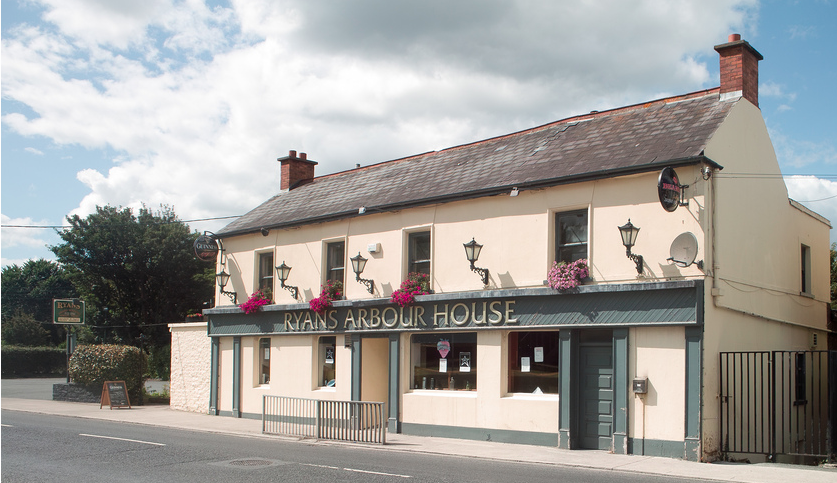
Leaving after an hour, with everyone seemingly content with both the pint and the general atmosphere of the place, we moved down a few yards to Ryans Arbour House.

Ryans Arbour House, Windy Arbour. (Flickr – infomatique)

We decided to go into the lounge and not the bar. Perhaps a mistake. The lounge area was big, kitsch and soulless. On arrival, a group of lads in their early 30s in the corner turned and stared. One said across to us – “Hey, are you foreigners? – Wanna see my dick?” Charming.

A few others, of a similar age, were dotted around the (massive) lounge. The walls were full of various sized framed pictures, ranging from Shamrock Rovers match programmes to random drawings of horses and everything else in between. A jukebox beside the bar was being used to play the most random collection of dodgy Euro-techno, Country n Western and Soul ballads.

The pint, poured by a very friendly young barman, came in at €4.35 and was perfectly drinkable.

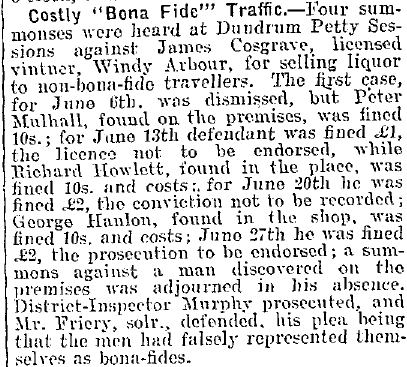
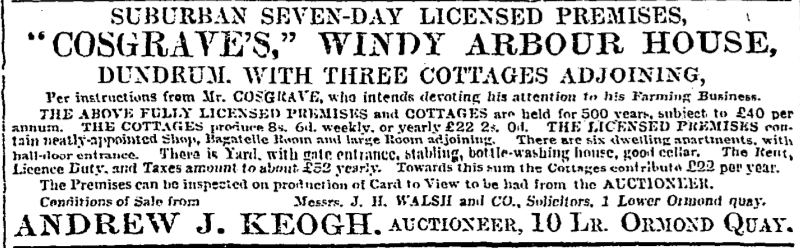
Ryans Arbour House (formerly Windy Arbour House and before that Cosgraves) made the papers a couple of times in the early twentieth century.

Firstly, for selling liquor to ‘non-bona-fide travelers’ in 1915:

July 14, 1915. Irish Independent.

Secondly, for being put up for sale later that year:

27 Nov 1915. The Irish Times.

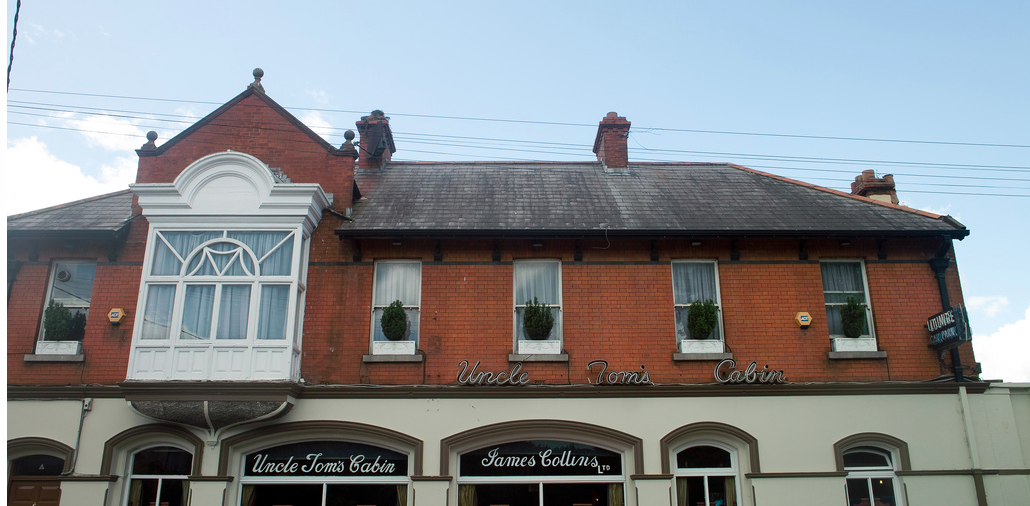
With no real positive feelings about the place (this could have easily changed perhaps though if we had ventured into the bar), we left and made the five-minute walk to Uncle Toms Cabin.

Uncle Toms Cabin, Dundrum. (Flickr – infomatique)

A very unusually named premises (see 1852 anti-Slavery novel), this large pub dating back to 1878, was the favourite for most people I reckon. First impressions were very encouraging when a middle-aged man, who was sitting in the corner reading a newspaper, gave up his seat so that we could all fit in.

The interior of the place made the most lasting impression. It benefited from very high ceilings, lovely seats and an array of interesting (non tacky) items in glass cases around the pub. For example, I spotted a receipt from a Middle Abbey St. grocers from 1912 tucked in beside some old bottles and books.

The overwhelmingly older patrons (60+) were all smiles and did not seem to mind the sudden arrival of our gang – our numbers now swelled to twelve. The pints came out €4.40, the most expensive of the night but many people thought they were the best. So much so that we all stayed for another one.

James Collins (1860 – 1940), described by The Irish Times as “one of the best-known members of the licensed trade in Dublin”, ran Uncle Toms Cabins for most of the early twentieth century. His name can still be seen written on one of the windows pubs facing the front (see above).

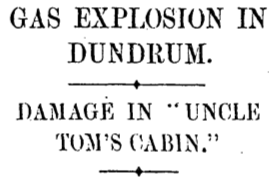
The pub made the news in 1928 when a gas explosion blew out the windows of the building.

22 Dec 1928. The Irish Times.

I’m nearly certain that the Collins’ family still run the pub today.

Continue Reading »

Prisoners outside burning Custom House, Dublin 1921 (NLI)

History Ireland have uploaded a video of the recent War of Independence focused Hedge School held at the National Library of Ireland.

I’ve never seen a waiting line like it at the National Library. Journalists, historians, the generally curious and Dubliners of every kind. Even a certain Vincent Browne was spotted walking away. They could have filled the venue for this one twice or even three times over.

The title of the Hedge School was The War of Independence: ‘four glorious years’ or squalid sectarian conflict? Chaired by Tommy Graham, the speakers are David Fitzpatrick, John M. Regan, Eve Morrison and John Borgonovo.

The video can be viewed here, at the History Ireland Vimeo account. It appears embedding has been disabled so click through.

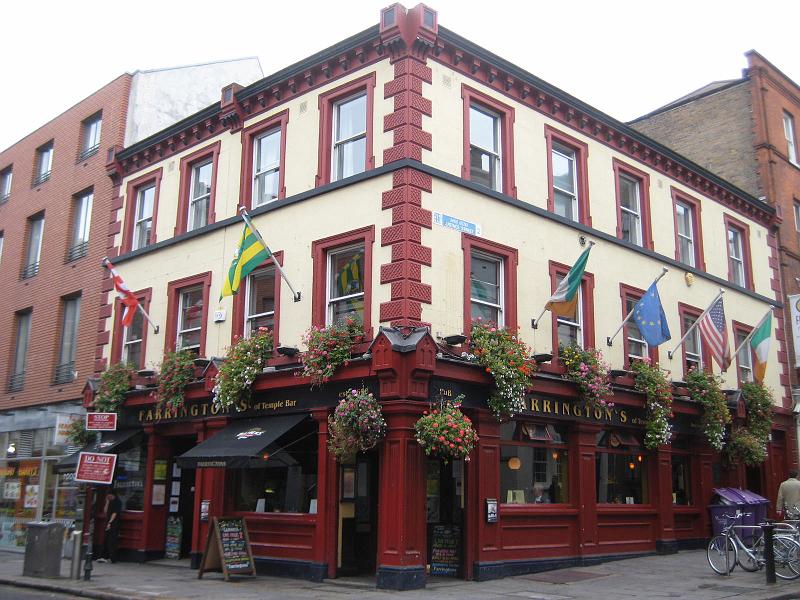
When I look out out my window, I think three things… One is the thought that I might not be in this gaff too much longer, with the bank now owning the place and actively trying to flog it to the highest bidder, the second less depressing thought is wow, this view still amazes me, and the third, hmmm, that Farrington’s place, wonder what that’s like.

Well, I had thought the third until a couple of weeks ago when I made a brief stop in there with a couple of CHTM! comrades. I liked it so much that I persuaded DFallon to call in with me on Friday for an early evening swift one; and its the perfect place for this. While from the outside, it can be compared to the Temple Bar only a few doors down, it exudes much less a “tourist kitsch” feeling, rather an “I know we’re in Temple Bar, have to appeal to tourists but we’re much more serious than that” feeling. If you get what I mean.

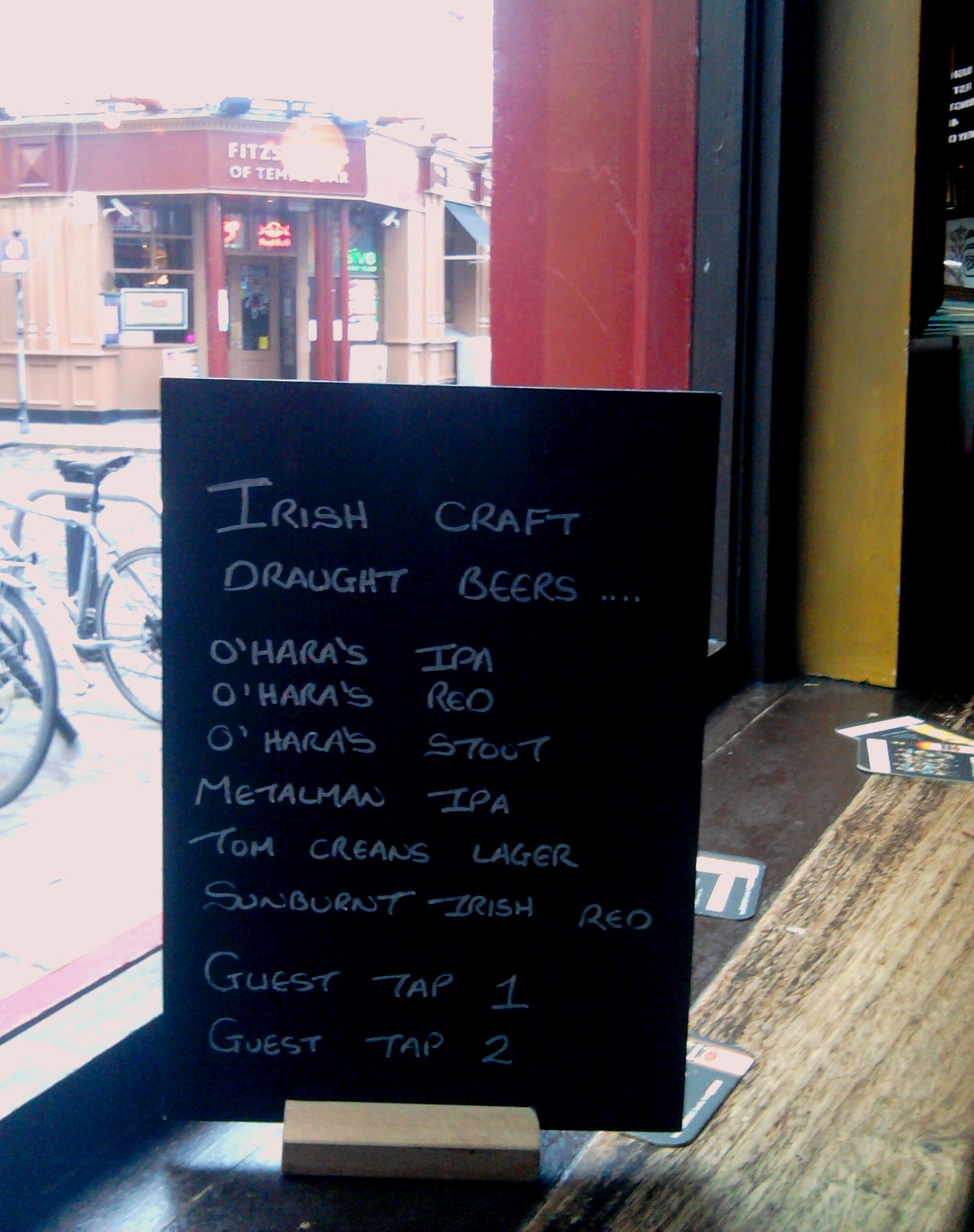
My favourite thing about the pub though? They stock Brewdog, and in particular 5AM Saint, an absolutely beautiful Red Ale, the kind of drink that you feel a little bit guilty about paying over the odds for but when you taste it, you know its worth it! They also stock a wide selection of Brewdog’s other bottled creations, Trashy Blonde, Punk IPA and Zeitgeist included, and the barman, who pulled up a stool beside us and had a chat, let us in on a secret… that they’ll soon be getting Punk IPA on tap, only the second pub in Dublin to have it. So I can see myself going back.

Internally, the pup reminds me somewhat of the Mercantile or The Oak, not a bad thing by any stretch of the imagination, and alongside Brewdog, they’ve a wide range of Irish Craft beers, unusual for a Temple Bar pub, where the staple is four Guinness taps in a row and Diageo branding all over the place, catering to tourists crying out for “a drop of the black stuff.” I went for the 5AM Saint, and tried another beer that they had on special, I think it was O’Hara’s, smoked golden ale (or something to that effect,) and at €5, it compares well with spening around €4.80 on a mainstream lager in any of the pubs around the place.

Its definitely a place I can see myself dropping into the odd time, a nice little spot for one or two pints and a look out the window on a rainy day. The bar was spotless and well run, empty glasses dispensed with as soon as we had fresh pints in front of us (a pet hate of mine is a bar the pulls the glass as soon as you’ve finished it,) the barstaff were spot on, for a pub in TB, it had locals, who all seemed friendly enough, oh and they do food too. I’ll drop in later on in the week to see if they’ve fulfilled their promise regarding Punk IPA, and if so, I’ll bang up a comment here.

‘Little Jerusalem’ (DCTV)

In this documentary screened on DCTV as part of Holocaust memorial day the Dublin Jewish community reflexts on Little Jerusalem and the history of their community.

I truly love this town

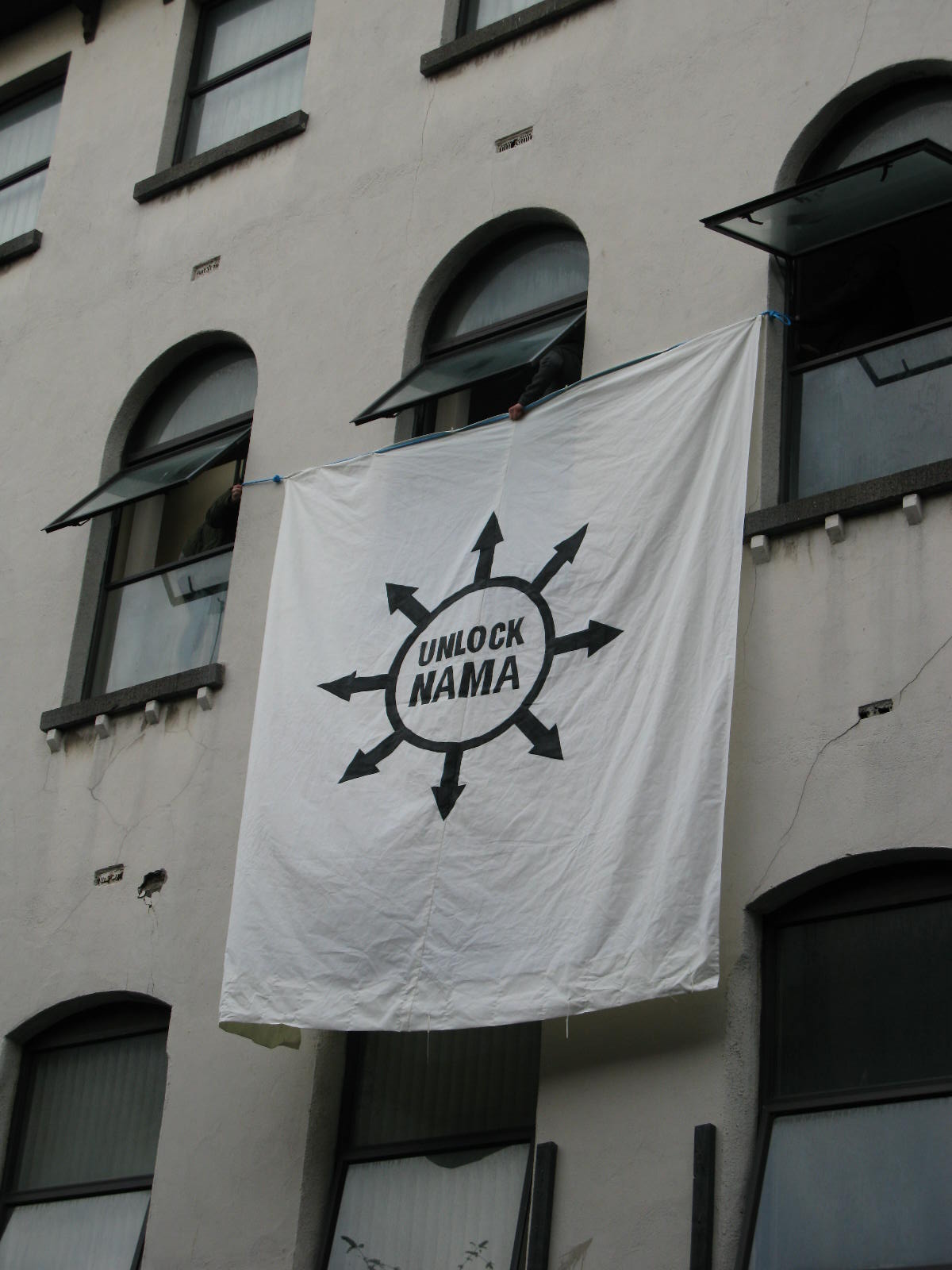
“Ohh, next door.” Brilliant. Well done to all involved in Unlock NAMA for a truly great and inspiring day yesterday! We say more of this kind of thing!

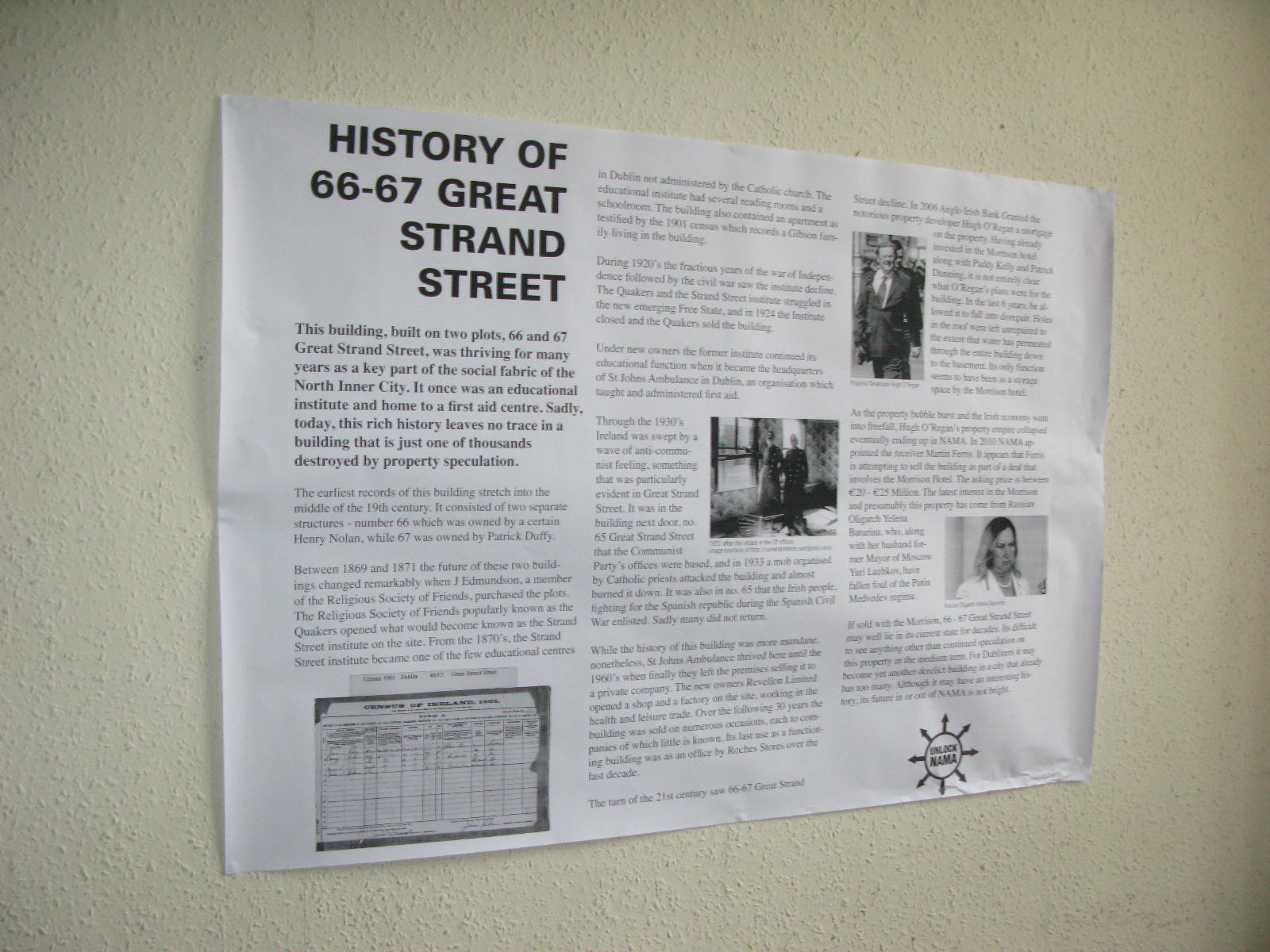
The Unlock NAMA occupation today has really grabbed peoples imagination, and I thought it was a great touch that alongside the information on NAMA and the properties under its ownership, the group behind the occupation included a history of the building to show what it was in past lives.

One picture stood out instantly, taken from here at Come Here To Me. 66-67 Great Strand Street were occupied today, but right next door at 64 occurred one of the most unusual events of the 1930s in Dublin, in the form of the storming of Connolly House following a rather heated mass at the Pro Cathedral.

Bob Doyle, who went on to fight fascism in Spain, was ironically enough among the crowd who stormed Great Strand Street. He wrote in his memoirs years later:

I had attended the evening mission on Monday 27 March 1933 at the Pro-Cathedral, during the period of Lent where the preacher was a Jesuit. The cathedral was full. He was standing in the pulpit talking about the state of the country, I remember him saying – which scared me – “Here in this holy Catholic city of Dublin, these voile creatures of Communism are within our midst.” Immediately after the sermon everybody then began leaving singing and gathered in a crowd outside, we must have been a thousand singing “To Jesus Heart All Burning” and “Faith of our Fathers, Holy Faith”. We marched down towards Great Strand Street, to the headquarters of the socialist and anti-Fascist groups in Connolly House. I was inspired, of you could use that expression, by the message of the Jesuit. There was no attempt by the police to stop us.

We’ve already looked at the event in some detail before, over here, but with the day that is in it I thought I’d repost the image as it appeared in the Unlock NAMA history today. Below is a rare image showing two police officers alongside the petrol cans used during the burning of Connolly House. It came into my possession as a gift, and I’m chuffed to share it.

DFallon’s great piece on Ettie Steinberg yesterday got me thinking about another unusual tale regarding the Irish and the Second World War. That is the story of John McGrath of Roscommon who became the only Irishman to be imprisoned in Dachau concentration camp.

If you stand in the Schubraum section of the Museum Building in Dachau, you will see a large map of Europe on the wall. Over each country is a number,  indicating how many of their citizens were imprisoned in the camp. The number ‘1’ is marked over Ireland.

John McGrath (c1893 – Nov 27 1946), was born in Elphin, Roscommon and educated at the Christian Brothers’ Schools in Carrick-On-Shannon. Joining the British Army, he saw action in France in World War One.

John McGrath. Sunday Independent, Apr 17, 1932.

Returning home safely he worked, as an administrative staff assistant, with the Gordon Hotel in London and then was involved with the organising of the Grand Prix Motor Race in the Phoenix Park and the Military Tattoo in Landsdowne Road in the late 1920s

He became the first House Manager of the new Savoy Cinema in Dublin in 1929, staying there for two years. When the Savoy Cinema in Cork was opened, he was sent down to manage it and worked there for a further two years. Returning to Dublin, in 1935, to manage the Theatre Royal on Hawkins Street, McGrath was recalled up to the British Army, as major, at the outbreak of war in 1939.

Theatre Royal, Hakins St. nd. (Picture credit -Damntheweather)

Landing with the Allies in Dunkirk in May 1940, McGrath was one of the ‘small Allied band’ who fought in France after the evacuation. He was wounded twice in battle near Rouen, Normandy before finally being captured by the Nazis. McGrath, now a Colonel, along with other captured POWs were then forced to march over four hundred miles to Germany. At least two hundred of the captured men died of exhaustion en route.

Continue Reading »

Welcome to Unlock NAMA

Below is a set of photographs from this morning’s activity at the Unlock NAMA building on Great Strand Street, Dublin 1.  I’ll stick up another report later on the meetings, which will be take place as below:

12 noon: Conor McCabe (author of Sins of the Father) on NAMA and Property Speculation in Ireland

2.30pm: Andy Storey (lecturer in politics and international relations) and Michael Taft (research officer, UNITE) on the Anglo: Not Our Debt campaign

4pm: Unlock NAMA: What buildings does NAMA have and how can we identify and gain access to them?

In we go....

Busy busy!

Media team at work...

Before....

After...!

Continue Reading »

Remembering Ettie Steinberg.

Today is Holocaust Memorial Day. With that in mind, I dipped into an old Come Here To Me article which was the popular review we carried out of the Jewish Museum in Portobello.

A small, touching plaque features upstairs in the restored synagogue to Ettie Steinberg. Herself and her son were to become the only Irish citizens to perish in the Holocaust. Ettie was raised in Raymond Terrace. The horrific figure of six million can be difficult to comprehend, but when the story of one individual is brought to life, not least a Dubliner born only a short walk from the Museum, the horror of those years becomes clearer.

Ettie’s family were oiginally from Czechoslovakia, and had come to Ireland from London in 1926. She married a Belgian man in 1937, and moved to Belgium with him before going on to Paris two years later. In 1942, Ettie and her young son, born in Paris, were transported to Auschwitz by the Nazis. In his wonderful work Jews In Twentieth-Century Ireland , Dermot Keough wrote that:

By a strange irony, the Steinberg’s in Dublin had secured visas for Ettie and her family through the British Home Office in Belfast. The visas were sent immediately to Toulouse but they arrived too late. Ettie and her family had been rounded up the day before and sent to the camp at Drancy, outside Paris. They were transported to Auschwitz and to their immediate death.

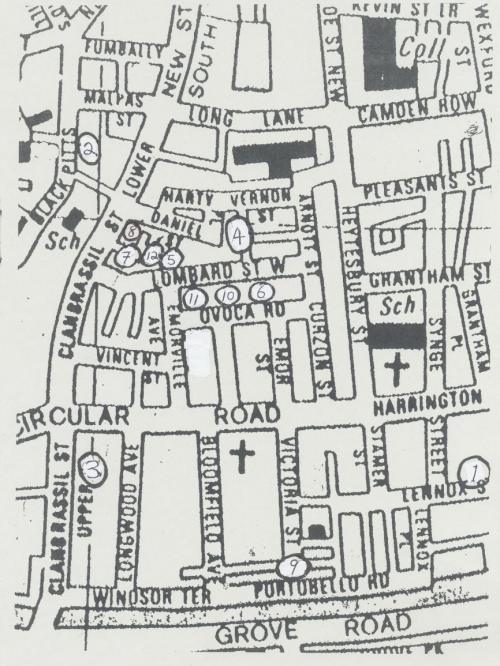
The map below shows that area that once made up ‘Dublin’s Little Jerusalem’, and was first uploaded to Come Here To Me by jaycarax here, at the time of a fascinating documentary on the murders of two Jewish men in the area in the early 1920s.

Snap of Eoin O’Duffy’s Irish Brigade returning from Spain after a pretty disastrous and embarassing campaign which only lasted six months. Getting drunk regularly and, in their first action, coming under friendly fire from an allied Falangist unit from the Canary Islands, it is likely that Franco was glad to see the back of the Irish Brigade.

Brendan Behan famously quipped that “they certainly made history (as) they seemed to be the only army that went out to war, ever, and came back with more”. This is because a number of Irish men in the Spanish Legion(?) decided to get a lift home with O’Duffy and co. when they were leaving.

1937, Dublin, Ireland --- Irish Brigade Returns from Spain --- Image by © Hulton-Deutsch Collection/CORBIS