
On the fifth of June 1919, a concert was due to take place at the Mansion House to commemorate the anniversary of the birth of James Connolly. It had been organised by his comrades in the labour movement, including members of his beloved Irish Citizen Army. Under the Defence Of the Realm Act (DORA) the concert was deemed illegal days in advance, and as one would expect things turned ugly. A small crowd arrived on the night, and while the crowd were being moved in the direction of Grafton Street by the Dublin Metropolitan Police, the Irish Times of the following day noted that “Without a seconds warning, three or four young men faced the police with revolvers in their hands”. Shots were fired, officers injured, and the concert was held at the Trades Hall on Capel Street that night.
How fitting this documentary should first air in the Mansion House then.
Firstly, one must state before beginning any review of this documentary that the fingerprints of Liberty Hall today are clear to be seen on this work. It is introduced to the audience gathered in the Mansion House by not alone Jack O’ Connor of Siptu, but also Liz McManus of the Labour Party. She features in the documentary, as do her party colleagues Dick Spring and Eamon Gilmore. The Labour Party are the only party from the left in Ireland to feature with the exception of a brief appearance from Eugene McCartan of the Communist Party of Ireland, and as the documentary comes to an end to the sound of Paul Cleary of The Blades singing about the fighting spirit of the capital, it is an image of contemporary Liberty Hall which appears on-screen.
With a title like ‘James Connolly-Working Class Hero’, this work was always going to be one of admiration, with many of its contributors from left-wing traditions. Still, it is an important work, and one which almost lives up to my (rather high) expectations. It attempts to not only explore James Connolly, the giant we know from history, but also another James Connolly. The Connolly raised in what became ‘Little Ireland’, a slum of Edinburgh. The Connolly who first visits Ireland not as a socialist revolutionary, but a member of the British Army. The Connolly who noted that his life was forever darkened by the loss of his eldest daughter to an untimely death.
It is a testament to those behind this documentary that they succeeded in attracting such a diverse group of individuals to the project. Colm Meaney in particular deserves great praise for his readings of the work and letters of Connolly. Meaney delivers the correspondences and writings in an almost perfect Edinburgh accent, and captures perfectly the passion in the written words of Connolly.
Connolly himself remarked in 1907 that “Until the movement is marked by the joyous, defiant, singing of revolutionary songs, it lacks one of the distinctive marks of a popular revolutionary movement; it is a dogma of a few, and not the faith of the multitude”.
It is fitting, as Connolly wrote many poems and songs in his time of course, that music and poetry should feature so centrally in this documentary. Christy Moore delivers the first musical performance of the documentary, singing ‘Connolly Was There’, a number he learned from Dominic Behan. Andy Irvine delivers a rendition of ‘James Connolly’, that excellent song by Patrick Galvin that asks “Who will carry high the burning flag?” Jimmy Kelly, Adrian Dunbar and Paul Cleary also lend their voices to proceedings, occasionally with the assitance of a a number of excellent musicians.
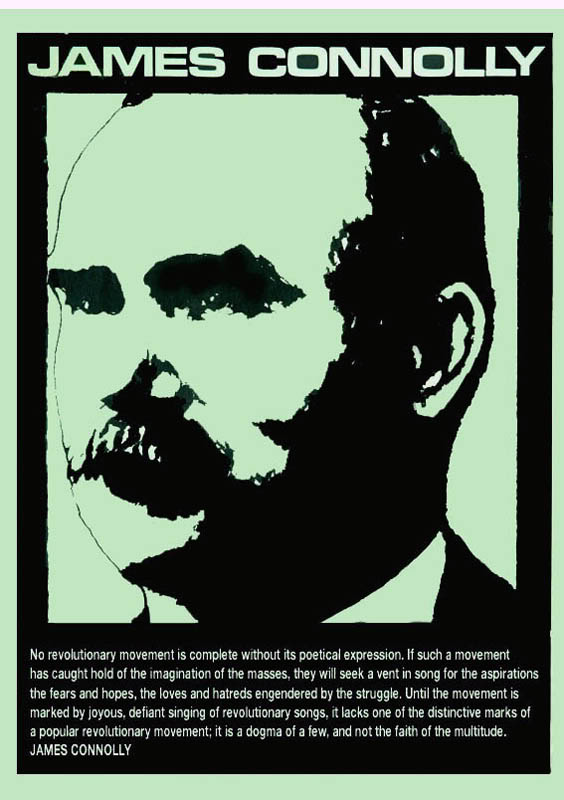
A republican propaganda image of Connolly from more recent times.
The historians featured are a varied lot. Owen Dudley Edwards in particular brings a great deal to the documentary, not least when putting Connolly’s famous Labour in Irish History in its correct context, as a strong work in the field of history as well as politics. Manus O’ Riordan features also, someone who has contributed greatly to my own understanding of Connolly, not least his work on Connolly’s efforts in the Wood Quay election of 1902, the election which produced the famous Yiddish election leaflet. This election campaign, or the engagement of Connolly with that community, isn’t touched upon here. It is arguable this is an effect of too many politicians saying much the same thing regarding his ‘inspirational nature’, leaving too little room for those who have researched Connolly in-depth to discuss the man and his works in much detail.
Connolly frequently fell into debate with others on the left, most notably William Walker at home and Daniel De Leon, in the United States. Both debates feature here. The Connolly-Walker controversy was a series of letters printed in Forward in June 1917, on the issue of socialism and its connection to the national question. Connolly wrote that “Our Comrade is sore over my attitude towards his election campaign in North Belfast. But he should have reminded the readers of Forward of his attitude in that campaign. He should have told them that he pledged himself to oppose Home Rule and religious equality.” Walker had worked as an apprentice in the Harland and Wolfe shipyard, and was a product of working class Belfast, who went on to compete elections under the banner of the Irish Labour Party. The debates between the two remain a fascinating read to this day.
Connolly, a man with little formal education, spoke several languages. He was as gifted with the pen as he was in the field of oration. He was years ahead many on the left even with regards gender equality and social issues. Yet he remains a sometimes controversial figure, not least for his involvement in the Easter Rising of 1916. Labour, Sean O’ Casey noted in his history of the Irish Citizen Army, “…. had laid its precious gift of Independence on the altar of Irish Nationalism” If one agrees or not with this assessment, it is one worthy of much debate. While this documentary is a wonderful effort, and most worthy of support, it is uncritical in its approach and its contributors come mainly from a tradition where Connolly is a heroic and most symbolic figure.
Still, it shows the continuing influence and importance of the ideals of Connolly clearly. Least we forget the Manifesto of the Irish Socialist Republican Party, established in 1896, which called for the “Abolition of private banks and money-lending institutions and establishments of state banks, under popularly elected boards of directors, issuing loans at cost”
What would Connolly say today? Who could know, when so many claim his voice!
James Connolly-Working Class Hero, will be released on DVD in October.

 Click on the book for more.
 Click on the book for more.
 Donal
Donal Ciarán
 Sam
Sam


 Come Here To Me!
For once, I could not disagree with you more! I thought that the documentary was insipid, achieving the unlikely feat of portraying an exciting and revolutionary life as a bore. There is no sense of fun or excitement, although we know from connolly writings that he had a keen sense of humour. It was film-making by numbers, a few talking heads here, some stock footage there, left-leaning muso’s to liven the thing up. Mostly talking heads though.
Crucially, as mentioned in your report, it fails to deal with huge parts of Connolly work. There is no mention of anything that he did from the point he became an organiser in Dubin until heading off on a lecture tour to the States, so we have no idea how or why he achieved his fame.
The end were farcical, notably Dick Spring urging us all to not forget Connolly’s writings and Paul Clearys terrible song at the end.
aargh, published by mistake, wasnt finished!
Last para should go as follows:
Some of the contributions were farcical, notably Dick Spring urging us all to not forget Connolly’s writings and Paul Cleary’s terrible song at the end. Although, Liberty Hall will not be too happy about one of the cartoons portrayed during that song with a placard advocating “No deal on pay cuts”!
It hard to know who this documentary is aimed at. It is overlong and wil have no draw apart from leftie trainspotters. Most of the contributors deal with the ideological issues of the time and we learn almost nothing about what Connolly actually did in his various roles in the ITGWU, ICA and ISRP. The documentary does not add anything to our knowledge of Connolly. I almost never criticise efforts by the left to get out their message but I really think that this whole event epitomised the staleness of the left in Ireland, with the average age of the audience being about 60. Joe Duffy is doing a show on Connolly on rte shortly, my guess is that it will be a big improvement on this.
” There is no sense of fun or excitement, although we know from connolly writings that he had a keen sense of humour.”
This is a good point alright. The Hibs connection is one example with potential. Connolly the father comes off as a great character from Nora Connolly’s ‘Portrait Of A Rebel Father’, there was much more in there than used.
“Crucially, as mentioned in your report, it fails to deal with huge parts of Connolly work.”
I’d agree there are very significant chunks of Connolly’s life missing here, at the expense of talking heads. There were some ‘talking heads’ I would have liked to hear more from though, and some who featured too much.
—
Something I should have put emphasis on above is the way they perfectly capture the first World War as the triumph of nationalism over the workers movement and socialism.
I thought it gave a great insight into connolly as a person; his influences, his struggle growing up in edinburgh, how his daughters death affected him and his uneasy relationship with James Larkin.
I haven’t seen the film. I suspect that the Connolly I like is not in it. You know, the one who was in the Socialist Labor Party and the IWW. The one who called for the abolition of wage labour and the political State. The guy who fought for class conscious unionism against the insipid trade unionism of those who want ‘justice’ in the form of a ‘fair day’s wage for a fair day’s work’.
[…] Ireland to his execution by the British state and via his life in the United States this great documentary explores Connolly and his times. Featuring contributions from the likes of Owen Dudley Edwards, […]