Over recent years, my Dad and myself have come to a great arrangement where I go out and buy a few books for Xmas and then he gets me back. It avoids any sort of hassle (for him) and any disappointment (for me). This is what I got this year, all from Hodges & Figgis.
Jammet’s of Dublin: 1901-1967 by Alison Maxwell and Shay Haurper (The Lilliput Press, 2012) €15 paperback
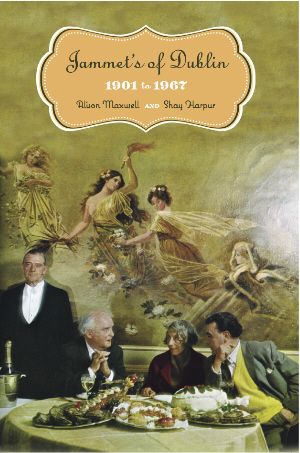
With the paperback coming in at only €15 and with 249 pages, you’re definitely getting value for your buck (no pun intended). Beautifully designed (Niall McCormack yet again), this book traces the history of what was Dublin’s most famous restaurant.
Particularly interesting are the stories of Jammets getting through WWII (extremely well by all accounts except for a small incident when their windows was broken by a group of nationalist UCD students on an anti Allied rampage), of the Jammet staff football team who won the Hotels Cup and League many times in the 1940s and 1950s, of Brendan Byrne’s shop on South Anne which was visited by the mega wealthy including Aga Khan when he visited the city and finally the personal accounts and stories of former Jammet’s waiters Shay Harpur, Jimmie Beggan and Victor Hurding.
The News from Ireland : Foreign Correspondents and the Irish Revolution by Maurice Walsh (I.B. Tauris & Co. Ltd., 2008) €16.35 paperback
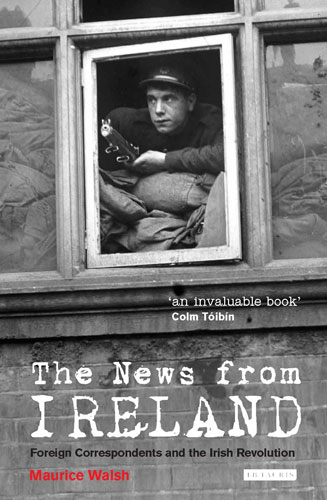
A fascinating but quite academic book looking at the role of foreign journalists and writers, particularly British and American, in the Anglo-Irish war of 1919 – 1921. The chapter focusing on ‘literary tourists’ – G.K. Chesterton, Wilfred Ewart and V.S. Pritchett is particularly interesting. All three spent time in Ireland and wrote upon their experiences. Another issue that jumped out was the effect that WW1 had on the ‘ascendancy families in the South’. The writer Lennox Robinson observed that ‘the Big Houses were emptied of all men of a fighting age [the Great War being] the last chapter in the history of the many families’ while Mark Bence-Joyce said by the end of the war ‘in all too many Irish county houses in 1919 the Young Master was no more than a memory and a photograph in uniform on a side-table’. All very Downton Abbey.
Irish Republican Women in America Lecture Tours, 1916-1925 by Joanne Mooney Eichacker (Irish Academic Press, 2003) €4.99 paperback
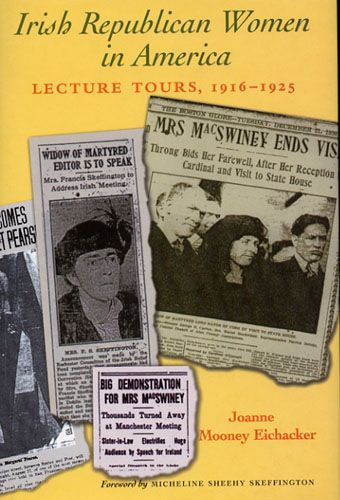
Found in the bargain basement, this book is well worth a read for anyone with an interest in Irish republican or Irish feminist history. Particularly interesting were the revelations that Hanna Sheey Skeffington established close friendships with a number of IWW activists including Elizabeth Gurley Flynn and Marie Equi and for the passing mention that in Butte, Montana in June 5 1917, the local Pearse-Connolly club ‘led a large and unruly anti-draft protest’ ending in a riot and the Montana National Guard being called in to assist the ‘federal, county and city police’ when the disturbances accelerated and more than 25,000 citizens congregated in the streets.
Victorian Dublin Revealed: The Remarkable Legacy of Nineteenth-Century Dublin by Michael Barry (Andalus Press, 2011) €24.99
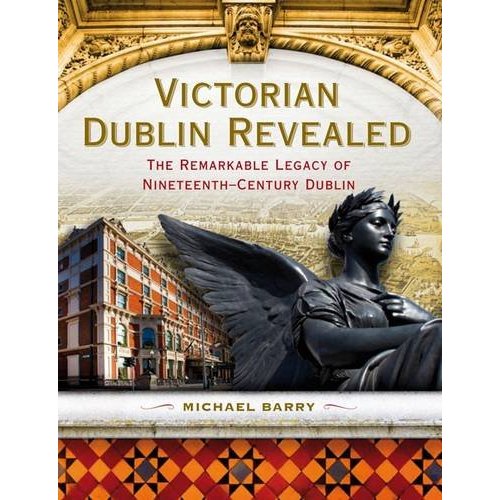
Beautiful full colour 192 page photography book focusing on Victorian Dublin, 1837 – 1901. Besides a few minor design errors (p. 32 and p. 36), the book is a treat on the eye. The Prince Albert statue (1871) on Leinster Lawn, the Zodiac mosaic floor at the entrance of the National Museum (1890), the columns of the Kildare Street Club (1859) [now Alliance Francaise], the entrance floor of the former Masonic Girl’s School (1880) in Ballsbridge [now Bewley’s Hotel], the synagogue at Adelaide Road (1892) and Nearys on Chatham Street (1900) are some of the most interesting examples that feature.
Memories of Baggotonia: Bohemian Dublin from Wilde and Joyce to Beckett and Behan by Brendan Lynch (The Liffey Press, 2011) €19.95
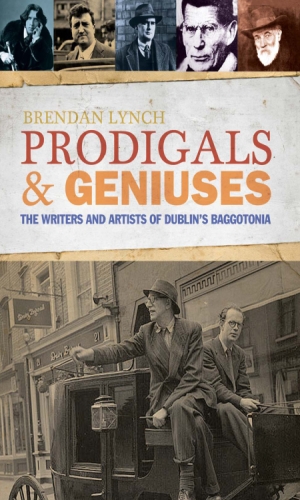
Well-written, engaging book focusing on the writers, artists and journalists that lived around the Baggot Street area. There are chapters focusing on individuals like John Butler Yeats, Brendan Behan, Patrick Kavanagh, Bertie Smyliee and Harry Kernoff and on places like the United Arts Club, Parsons Bookshop and the bars that were frequented by the residents of Baggontia.
I never knew anything about the ‘Catacombs’ before reading the book. This was a shebeen based out of the basement of 13 Fitzwilliam Place which boasted of a ‘maze of dark pantries and windowless rooms’ and regularly attracted ‘up to sixty imbibers, eager to prolong the night after pub-closing’. It was run by Richard ‘Dickie’ Wyeman, English-born former nightclub manager who had fled to Dublin after his army officer boyfriend was killed in the war. (More on the Catacombs here)

 Click on the book for more.
 Click on the book for more.
 Donal
Donal Ciarán
 Sam
Sam


 Come Here To Me!
You’ve got a very generous daddy.
You might be interested in this; there’s a fair bit about The Catacombs in it.
http://www.bookdepository.co.uk/Dead-Doornails-Anthony-Cronin/9781901866421?b=-3&t=-20#Fulldescription-20
And there’s this.
http://www.rte.ie/radio1/doconone/catacombs.html
Cheers.