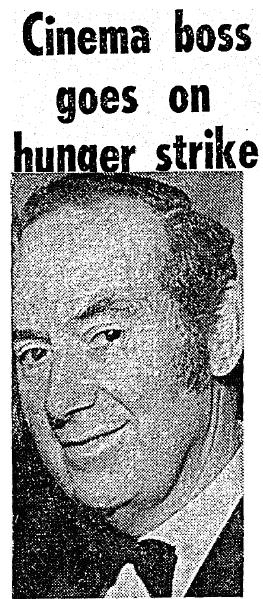
The story of the dispute between the owner of the Forum Cinema in Dun Laoghaire and the Irish Transport and General Workers Union in 1979 is a fascinating one.
On November 19 1979, Barney O’Reilly went on hungerstrike with the intention of drawing public attention to a dispute involving his cinema and the Irish Transport and General Workers Union.
The Irish Press reported that Mr.O’Reilly had told them he would “neither eat nor open the door until he had the choice to run his cinema as a non-union house. After the film was run in the cinema last night he locked the door to begin his protest.”
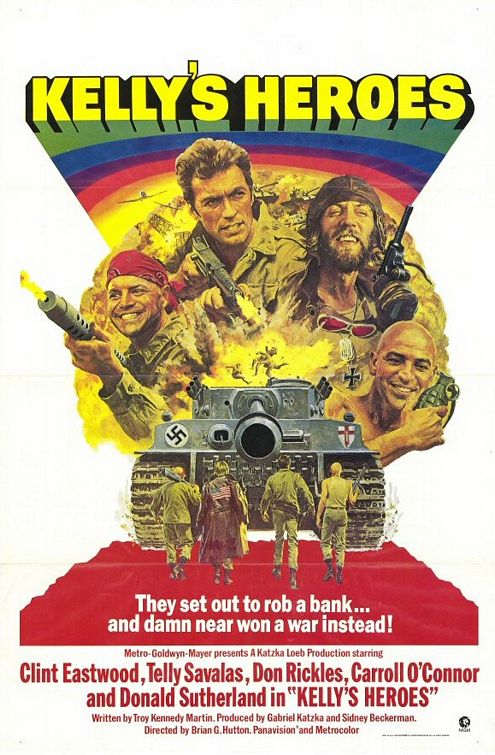
O’Reilly had been in dispute with the No.7 branch of the union, with members of the union refusing to co-operate with him. The first film due to be shown in his brand new cinema was Kelly’s Heroes which was distributed by M.G.M, but I.T.G.W.U members inside M.G.M’s dispatch department refused to handle a film intended to be shown in the Forum Cinema, owing to O’Reilly’s anti-union policies. The Irish Times noted O’Reilly had to replace the planned film with The Trials Of Oscar Wilde at short notice.
The Irish Times report at the start of O’Reilly’s hunger strike noted that he had spent £25,000 on renovating the cinema, formerly the Astoria, and that he intended to use a small-skeleton staff, unpaid and consisting mainly of family members for the first three months following opening.
Patrons who arrived at the cinema to see Kelly’s Heroes were met by a sign informing them that because of “victimisation and intimidation by the Irish Transport and General Workers Union” the film could not be shown. The union had blacklisted the cinema until O’Reilly agreed to employ union labour.
An I.T.G.W.U spokesperson told newspapers at the time that their letter to O’Reilly had gone unresponded to, a letter in which they informed him that they represented cinema workers in the Dublin and Bray areas. Members of the union who had been working in The Forum cinema installing automated equipment then withdrew their labour.
I.T.G.W.U members at other cinemas in Dublin had engaged in radical action in the 1970s, for example the sit-in protests which occurred at both the Ambassador and Academy Cinemas in 1977 with the announcement of the closure of those two cinemas. Earlier, in 1973, a strike of 300 I.T.G.W.U workers against Odeon Ltd. had closed nine cinemas in Dublin and Bray.
The hunger strike went on for a number of days. The Irish Press noted that on the fifth day of the strike O’Reilly was visited by a doctor who advised him to end his fast, and it was upon the advice of this doctor that O’Reilly thankfully ended his five day hunger strike. He told The Irish Press that his 120-hour fast had led to “other people and organisations getting involved” and brought public attention to his cause.
The Forum cinema is no longer with us, demolished in the summer of 2002, having closed in 1999. It was a small, two-screen cinema, and sadly many such cinemas would lose out in the days of the new multiplex outlets. As Justin Comiskey wrote in The Irish Times at the time of the Forum’s closure: ‘Small cinemas are dead, long live the multiplexes. That would appear to be the message following the closure of The Forum in Glasthule four weeks ago, leaving two small independent cinemas in Dublin.’
I’d be interested in hearing more from people about relations between the I.T.G.W.U and The Forum cinema following this dispute.
On a sidenote, some of you may remember a recent piece on this site from jaycarax which looked at a Dublin industrial dispute which lasted fourteen years. It occurred in Dun Laoghaire too, at Downey’s Pub.

 Click on the book for more.
 Click on the book for more.
 Donal
Donal Ciarán
 Sam
Sam


 Come Here To Me!
I didn’t know Troy Kennedy Martin scripted Kelly’s Heroes. Maybe it’s better than I thought.
ejh,It’s an absolute classic, and shame on organised labour keeping the good people of Dun Laoghaire from seeing it!
I wonder does it say in the tourist ads for Dun Laoghaire “famous for strikes!”
One of the staff occupying the Ambassador was the projectionist Gene Kerrigan. Today Gene is better known as the only journalist on the Sunday Indo who tells it like it is.
Thanks for this bit of history, I was aware of some of the history of the Forum but not the hunger strike.
There are some important aspects of Irish social history – regrettably sensationalised from time to time – connected to Mr O’Reilly’s family.
His grandfather, also Bernard, was a member of the RIC based at Ardfert Co Kerry and responsible with others for the capture of Roger Casement who was sent up to Arbour Hill in Dublin. O’Reilly left the RIC shortly after – I believe the barracks in Ardfert were burned down by the IRA – and retired to Kilkee, Co Clare where the family was known as ‘the Casement Reillys’.
Barney’s father John Francis O’Reilly, who later recalled the burning of the Ardfert barracks, was in Jersey when it was occupied by German forces during WW2. He volunteered to work for the Germans and did some propaganda broadcasting from Berlin before being trained as a radio operator.
He was then dropped back into Ireland by parachute with his radio equipment, supposedly to spy on allied shipping off the west coast. He was captured and interned in Arbour Hill from where he escaped. He went straight to his father in Co. Clare who turned him in for a substantial reward.
On his release from prison after the war John Francis bought a hotel in Parkgate Street, Dublin with the reward money. He married Helen Phelan and they had five children, one of whom I believe was Barney.
The hotel didn’t prosper and the family seems to have fallen on hard times. JF O’Reilly found work as a radio operator in Nigeria and the family were living in the Old Connaught area of Bray.
Fascinating comment Ted!
That’s an incredible story all together!
A few corrections.
My grandfather, a giant of a man, whom I have very warm memories of, was Bernard O’Reilly of Roger Casement fame he was the father of Barney and John Francis (Jack to the family)…see the Flighty Boy from Clare
Bree