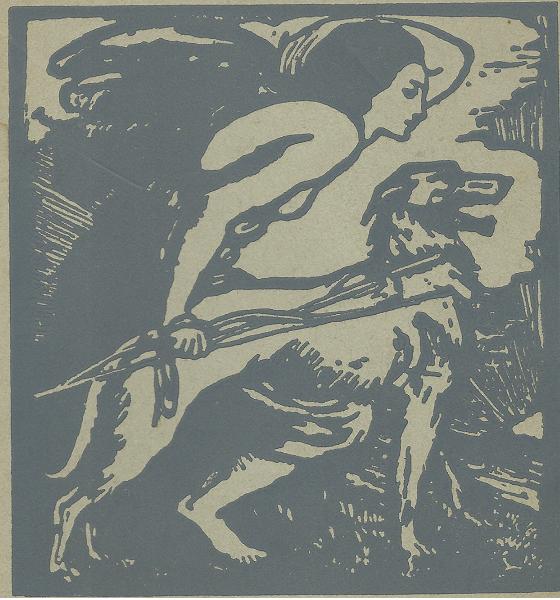
Scanned from Lennox Robinson's 'Pictures In A Theatre'
The Abbey has a long and fascinating history. Some stories, like the riots which surrounded both The Playboy of the Western World and The Plough and the Stars have gone on to enter popular Dublin ‘lore and history. Yet there is a great hidden history to the Abbey, and below are five facts about the theatre that may surprise some of you.
1) Yeats could have made it a part-time cinema!
In his excellent history of the “theatre that refused to die”, Sean McCann wrote of the financial crisis that gripped the Abbey in the early 1920s. On the day Sean O’Casey’s classic ‘The Shadow Of A Gunman’ was first performed at the theatre in April of 1923, banks advised the directors of the Abbey that their cheques could no longer be cashed. As McCann notes in his history “by August of that year the letting of the theatre as a cinema was considered, with the warm approval of Yeats, and only the possibility of a Government subsidy gave any hope of keeping it alive.”
2) The Dublin Fire Brigade saved the pram from O’Casey’s The Plough and the Stars.
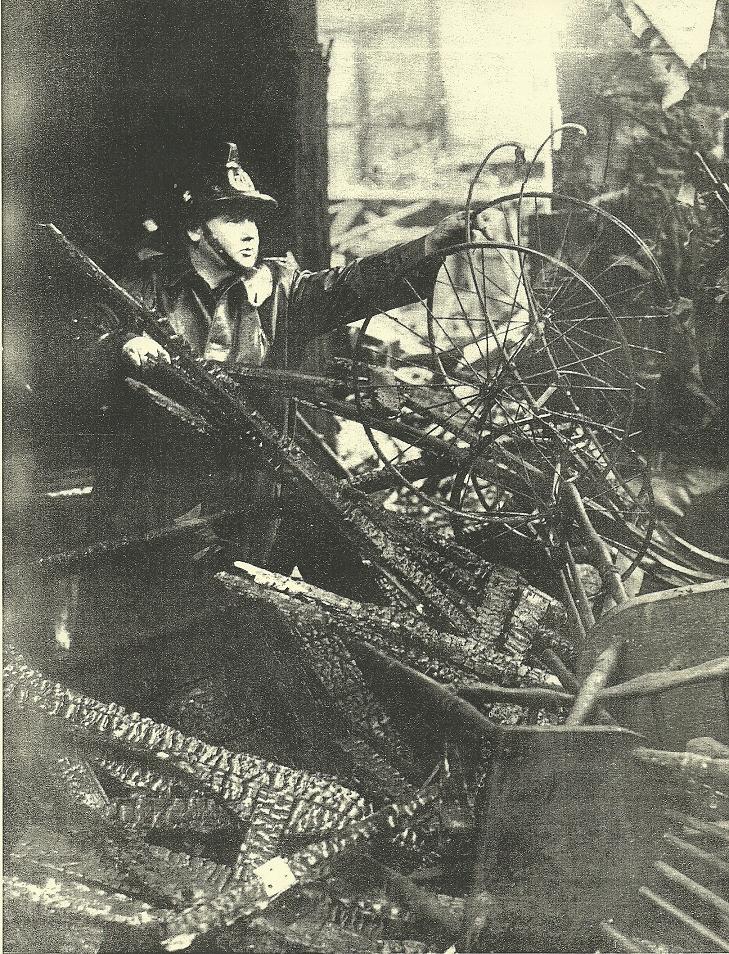
L.Fallon collection. Posted previously to 'Come Here To Me'.
On July 18 1951 a fire ripped the home of the Abbey apart. Tom Geraghty and Trevor Whitehead noted in their history of the Dublin Fire Brigade that in was the busiest night of the year for the Brigade, with nine crews fighting the blaze.
What had been the former Mechanic’s Institute and City Morgue was just a gaunt dangerous skeleton festooned with The Plough and the Stars posters, and the ghost of Yeats was left to haunt an eerie smoke-filled chamber.
The incredible image above shows Fireman Frank Brennan salvaging the pram, which featured even in the excellent 2010 production. The frame is original, its casing isn’t.
3) It boasts a fine 1916 connection, though its monument has changed.
Historically, a plaque was located in one of the pillars outside The Abbey, listing seven names. These are individuals who participated in the Easter Rising, and who held a variety of roles at the theatre. The first casualty of the republican side in Easter Week of course was an Abbey actor by the name of Sean Connolly, but alongside him are six other names, all of whom survived the uprising. Máire Mic Shibhlaigh, Helena Molony, Ellen Bushell, Arthur Shields, Barney Murphy and Peadar Kearney were all listed on the plaque.
Today, their names are on the 1916 memorial inside of the theatre, rather than a plaque outside it:
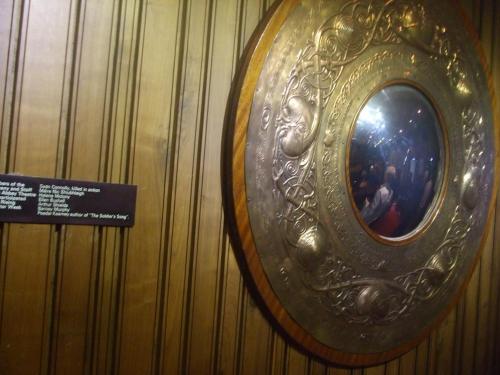
In an excellent contribution to Dublin Historical Record, the publication of the Old Dublin Society, James Wren correctly noted that the theatres connections to the insurrection went much deeper.
Edward Keegan for instance was a 1916 volunteer who had a long history with the theatre, and his name is sadly omitted from the memorial. He had been a member of the National Players, and even appeared in the first productions of Yeats’ On Baille’s Strand and Lady Gregory’s Spreading The News.
Keegan worked with The Irish Times newspaper as a clerk, but found himself sacked following the rebellion for ‘disloyalty’!
4)It took a decade to pull it down after the inferno of 1951, but in the meantime it made a handy office for one infamous Dubliner.
Ernest Blythe recalled for me the first time he met Brendan Behan was when he went to one of the old rooms a long time after the fire and there he found a man installed. ‘It turned out he was using it for an office. He had all his papers spread out and he had made it his town office. Apparently, someone had told him where the key was kept and he had been using the place for months.
(Sean McCann: The Story of the Abbey Theatre (New English Library Limited, 1967) p.65)
5) Michael Scott, who designed the Abbey we all know today, once trod the boards of the old Abbey.
Michael Scott, the architect responsible for the Abbey which opened to the public in 1966, had a long personal history with the theatre. He joined the Abbey School of Acting under Sara Allgood, while also undertaking a architectural apprenticeship. He would recall in a recollection for The Irish Times that soon after going into private practice, he was given the call-up for a part in an Abbey play, on a London stage. He would also go on to appear at the theatre in Dublin..
Now in private practice in an office on the top floor of a building in O’Connell Street, and working on plans for the Gate Theatre in the Rotunda, and other projects, I was asked to go to London to play in Shaftesbury Avenue. The part offered was the Gossoon,in the Abbey Play The New Gossoon.

 Click on the book for more.
 Click on the book for more.
 Donal
Donal Ciarán
 Sam
Sam


 Come Here To Me!
great stuff!
Is that the same Michael Scott who designed Busaras?
I think it is.
I do know however that Scott’s son (also called Michael) emigrated to the States in his late teens and for many years managed the Dunder Mifflin (Paper company) branch in Scranton, Pennsylvania. He retired there in 2010.
You’re some man for one man.
I remember back to when I was a very young child and my next door neighbour was Ellen Bushell. I was very fond of her and I remember I was very upset when she was no longer there. I never found out what happened to her except that she died. I was only about 5 years at the time but I have strong impressions of her open door and her happy welcoming demeanour. I would love to fill in the gap and have some information about her and her daughter Kitty, both were usherettes in the Abbey
Do you know if there is any plan to include the name of my Great Grandfather Edward on the plaque re 1916?
Hi Barbara we must be related as he is my Great grand father too! My dad has been in touch with Abbey over the past 2 years to get it rectified and finally got a call yesterday that plaque will be changed in time for 2016 anniversary.
We must be!