I came across this picture on Facebook. It seems to show most of The Dubliners kitted out before a football game.
Can anyone give any more background information?
KBranno reckons it could be taken in Tolka Park.

The Dubliners
Posted in Dublin History, Photography on February 13, 2012| 5 Comments »
I came across this picture on Facebook. It seems to show most of The Dubliners kitted out before a football game.
Can anyone give any more background information?
KBranno reckons it could be taken in Tolka Park.
The Dubliners

Posted in Dublin History on February 13, 2012| 3 Comments »

The image above is undoubtedly one of the iconic Dublin snapshots, showing The Wicklow, which was carrying cattle, suspended over Hatch Street having smashed through the buffer stops and even the outer station wall. The train has left from Enniscorthy earlier in the day, filled with cattle bound for the Dublin Metropolitan Market. On board too were driver Walter Hyland, guard Robert Doran and fireman Peter Jackston.
The Irish Times report of the following day gave a great account of the dramatic scenes, noting that:
All went well with the train until it was approaching Harcourt Street Station, at half-past four o’clock, when Hyland, it is believed, found he could not get his brakes to act, owing to the slippery nature of the wheels and rails combined with the fact that the train was very heavy. Speed could not be slackened, and the engine with its heavy load dashed through the station to the great alarm of the people on the platform, who saw that an accident of a serious nature must result, nor were they mistaken.
The train dangled 30 feet above Hatch Street, but thankfully there was no loss of life as a result of the crash. Hyland, the driver from Bray, was sadly to need his trapped arm amputated following the accident. 29 wagons made up the trains load, and passengers looked on as it continued towards the buffers. James Scannell noted in his article The Train Now Standing Over Hatch Street for the Dublin Historical Record journal that fireman Peter Jackson, upon realising the train was not going to stop, jumped off the locomotive footplate prior to the collision and avoided injury.
Scannell’s article concludes by noting that both Hyland, and The Wicklow, would recover from their ordeal.
When he recovered from his ordeal Driver Hyland return to work with the company and served until the 1930’s as a goods checker in Bray. The locomotive ‘Wicklow’ was repaired and returned to traffic, continuing in service until 1925 when it was assigned No 440 by the Great Southern Railways and was withdrawn in 1929.
Today, it’s a different rail network that makes its way up Harcourt Street of course with the Luas running in front of what was Harcort Street Station. The line from Harcourt Street was closed in 1958. The Odeon, a restaurant and bar, occupies the space today.
For years afterwards, it was said Dubliners would jokingly ask ‘does this train go through Hatch Street?’ in reference to the crash. On an interesting aside, one of the regular club nights in the Pod venue on Harcourt Street was titled Trainwreck!

Sold! The end of an era.

Posted in Street Art on February 13, 2012| 1 Comment »


The images above come from the page of ‘Canvaz’, Dublin street-artist. You can’t miss these paste-ups walking around the city, and some are in excellent locations, for example what was once ‘Bondi Beach Club’ on the quays, which has sat empty for some time now. If the city is closing up, and being boarded up, in front of your eyes, do something with it I suppose.

Posted in Dublin History on February 13, 2012| 14 Comments »
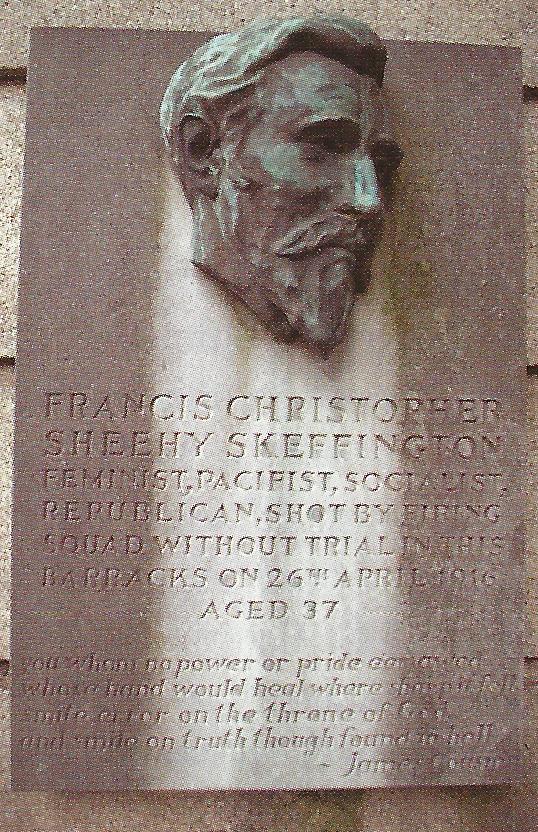
In Sheehy-Skeffington, and not in Connolly, fell the first martyr to Irish Socialism, for he linked Ireland not only with the little nations struggling for self-expression, but with the world’s Humanity struggling for a higher life – Sean O’Casey.
A plaque connected to the 1916 rising, but often overlooked, is that to Francis Sheehy-Skeffington inside what is today Cathal Brugha Barracks. Feminist, pacifist, vegetarian,journalist and activist, Francis was married to Hanna Sheehy-Skeffington, undoubtedly one of the most celebrated feminists in Irish history herself. His death during the rebellion is one of the most tragic episodes of the week, as Francis was not a participant in the rising, but rather had gone to the city on April 25th with the aim of attempting to establish a ‘Citizens Peace Patrol’, to prevent more scenes of looting and criminality among Dubliners following the breakdown of law and order.
The plaque was unveiled on April 1 1970 by Nora Connolly O’Brien, daughter of James Connolly, in the presence of Senator Owen Sheehy-Skeffington, son of Francis, and others. It was sculpted by Gary Trimble, and includes an inscription bearing the words of James Cousins:
‘For whom no power of pride e’er awed
Whose hand would heal where sharp it fell
Smite error on the throne of God
And smile of truth though found in hell.’

Owen Sheehy Skeffington and Cathal O'Shannon view the memorial in 1969, when it was still being completed.
Writing in June of 1916, Padraic Colum noted in the pages of Emma Goldman’s Mother Earth paper:
I shall remember Francis Sheehy-Skeffington as the happiest spirit I ever knew. He fought for enlightenment with a sort of angelic courage, austere, gay, uncompromising. Since he wrote his student pamphlet on Women’s Liberation he was in the front of every liberalising movement in Ireland. He was not a bearer of arms in the insurrection- he was a pacifist…..But Skeffington is dead now, and the spiritual life of Ireland has been depleted by as much of the highest courage, the highest sincerity and the highest devotion as a single man could embody.
Francis was a well known feminist, having co-founded the Irish Citizen feminist paper in 1912, and adopting the surname of his wife, Hanna Sheehy, upon their marrying. He had been involved with the Irish Citizen Army upon the foundation of the workers army, but left when he felt the organisation to be at odds with his pacifist ideology, i.e moving from a purely defensive role towards militarism. He had attended University College Dublin, where he counted James Joyce among his friends, and was well known and indeed liked in the college on a social level, even becoming auditor of the College L&H (Literary and Historical Society) in 1897.
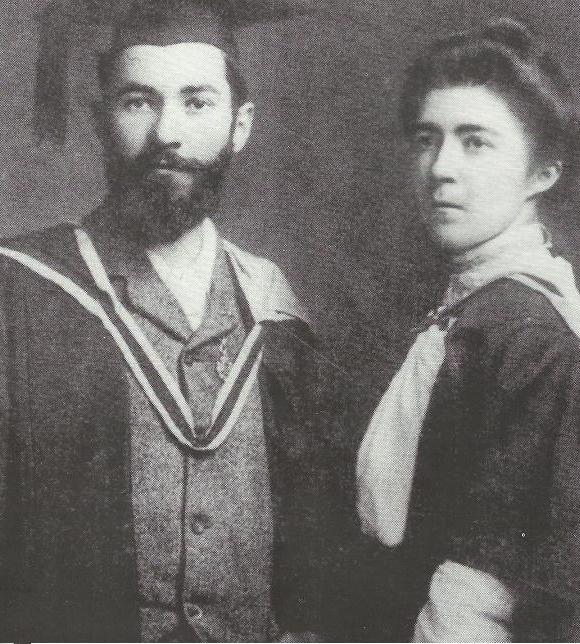
Francis and Hanna Sheehy-Skeffington

Posted in Football Articles on February 12, 2012| Leave a Comment »
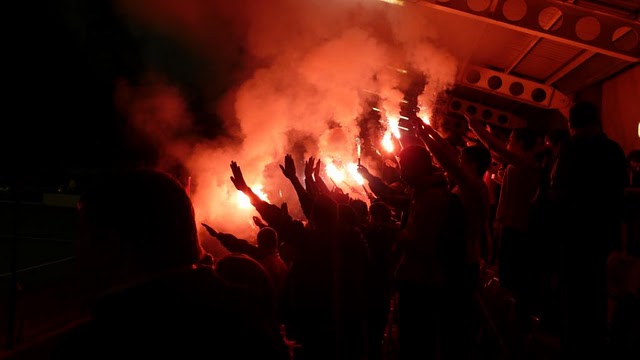
The flare. Try as they might, they’ll never remove it fully from Irish football. They’re nowhere near as common as they once were granted, but they still come out on occasion, you can normally spot them light up a home or away section at a Dublin derby or cup final.
The football season kicks off tomorrow for me and many others. Saint Patrick’s Athletic are heading north to Belfast and Cliftonville await us. Pictures of the street art piece below, tagged ‘SEI’ for Shed End Invincibles, the Saint Patrick’s Athletic ultras, have helped get me in the mood.

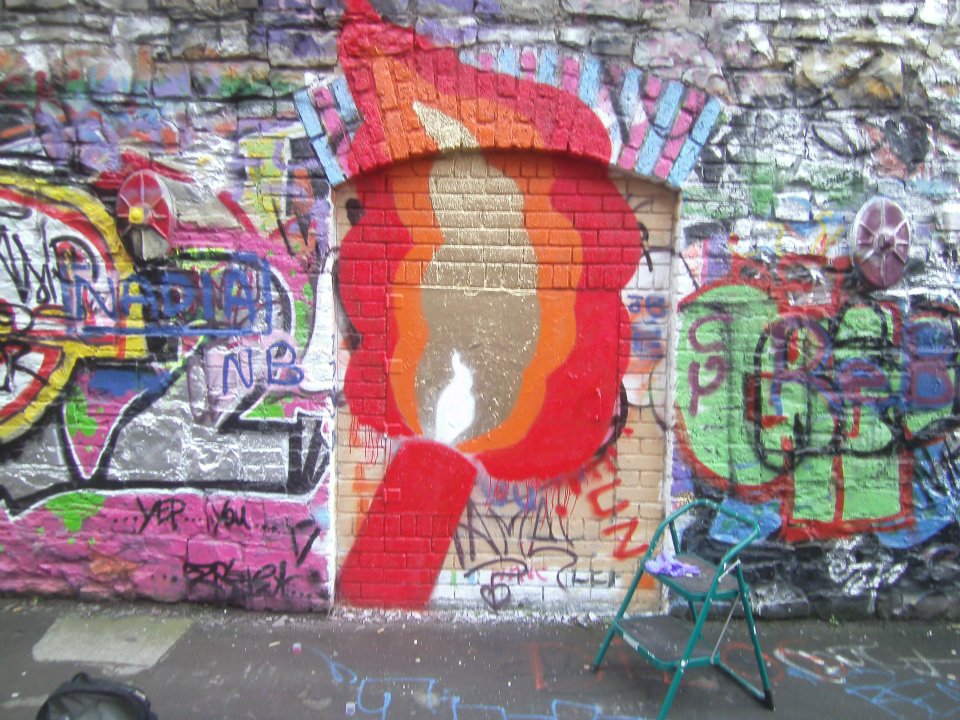

(via LukeFallonArt)

Posted in Dublin History, Miscellaneous, Photography on February 12, 2012| 4 Comments »
Over 200, 000 Irishmen and women enlisted in the Great War, 1914-18. Over 35, 000 were killed, including Jack Coleman, my mother’s uncle. This is something I only found out about in the last couple of weeks, and something I plan on researching more. His sister married a British soldier, Jack Moore and was somewhat ostracized from the family for doing so, whilst his brother, Jim “Pops” Coleman, my grandfather, was a member of the Mullingar Batallion of the old IRA.
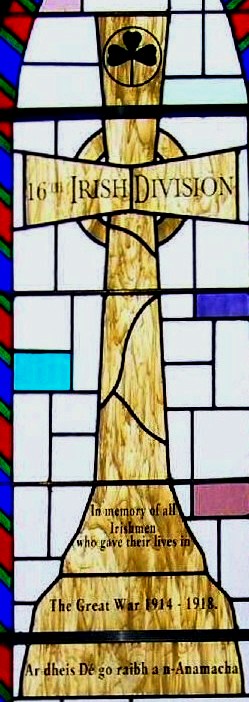
Irish family histories are often steeped in rumour and heresay; positive discrimination when it comes to involvement in the War of Independence, mixed discrimination when it comes to the Civil War, and often ignorance when it comes to the Great War or WWII.

I came across the above pictures a week or so ago on the dublin.ie forum, a stained glass window in Cathal Brugha Barracks dedicated to the memory of the 16th Irish Division. It was from looking at this that my mother started talking about the family history so I thought it was worth sticking these up here.
Credit to Breener for the images.

Posted in Dublin History on February 9, 2012| 20 Comments »
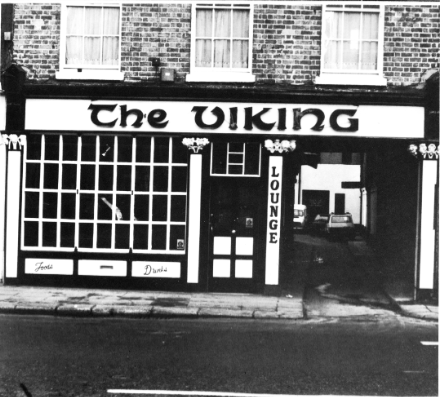
The Viking. (‘A guide to some of Dublin’s pubs and restaurants’, 1970)
The Viking Inn, at 75 Dame Street, predated The George as being Dublin’s first ‘exclusively gay bar’. Situated just beside The Olympia Theatre, the pub was taken over and renamed Brogan’s Bar in the early 1990s.
The earliest (newspaper) records show that 75 Dame Street operated first as a surgery for a ‘mechanical dentist’ by the name of John Egar in the 1850s. Remodeled as a public house it was known as O’Brien Bros. (1920s), Kerins (1940s), McCabes (1950s), Leonards (1960s/1970s), The Crampton Court (late 1970s), The Viking Inn (1979 – 1987), The City Hall Inn (1989 – 1993) and finally Brogan’s Bar (1993 – present).
The Viking was the first bar in the city to be owned by a gay proprietor and to be opened specifically as a gay bar. It closed in 1987, shortly after The Parliament (now the Turks Head) opened and a full two years after The George first set up shop.

The Viking Inn for sale. The Irish Times, 11 Aug 1987.
Poster John K. on gaire.com remembers:
Because it was beside the Olympia there were many amusing incidents when straight people, especially from the country, went in and quickly began to feel very uncomfortable … The Viking was a great spot. I first went in there around 1980 (and) I have no recollection of any Garda harassment.
Fourcort recalls plucking up the courage to visit the place for the first time:
One night in the early eighties, I walked the entire length of Dame St. about 20 times trying to get up the courage to push in through the door of the Viking. A couple of drag queens cottoned on to me at one stage and started laughing at me. Eventually, I just forced myself in, got a pint (I never drink pints, I just thought I could make it last, and not have to move again), and went and hid down the back.
There are lots of aspects to Dublin’s LGBT culture that I’d like to cover in the future including the four-storey gay Hirschfeld Centre (1979 – 1987) in Temple Bar, Sides D.C. (now The Mercantile) on Dame Lane, the legendary acid house nightclub which started out as a gay club and the tragic events surrounding the 1982 murder of Declan Flynn, a 31-year old gay man, in Fairview Park by a gang of thugs.

The Hirschfeld Centre opens. The Irish Times, 25 Apr 1979.
Veteran campaigner and DJ Tonie Walsh has done fantastic work in trying to record the history of the LGBT community in Ireland, his long standing work cumulated in the Irish Queer Archive which was donated to the National Library in 2008. The archive contains, amongst other things, ‘over 250,000 news clippings dating from the late 1960s and covering all the national print media, all lesbian/gay print media published in Ireland since 1974 and rrivate papers, journals and diaries (the earliest dating from 1947)’.

Posted in Dublin History on February 9, 2012| 9 Comments »
I was lucky enough to be asked to contribute a story to Storymap, which is a great project aiming to capture Dublin through its stories. Previously, we featured Shane MacThomais’ excellent contribution on the UVF man buried in Glasnevin for example, and there are stories on everything from street characters like Bang Bang to the ghosts that inhabit the Jervis Centre.
For me, there was only one story to tell, and that is the story of Vonolel, the loyal charger and friend of Field Marshall Earl Roberts. A small white arab pony, of Indian stock, he is buried in Dublin today. We first featured the story of Vonolel back in June 2010, and since then several people have got in touch to say they’ve paid him a visit. Next time you’re in the grounds of the Royal Hospital in Kilmainham, why not do the same?


Posted in Street Art on February 9, 2012| Leave a Comment »

Stuck to a few phoneboxes in the city centre, nice work. Photo is via the excellent Dublin Urban Art.

Posted in Dublin History on February 9, 2012| 6 Comments »

Elizabeth McLaughlin’s statue to the Countess Markievicz was slammed in The Irish Times of October 21 2000 by Robert O’Byrne. In a piece looking at five ‘statues to forget’, it was noted that the statue “bears almost no resemblence to the rebel Countess, it is coarsely executed, a giftshop item enlarged”. Ouch. Still, the writer also thought that John Henry Foley’s masterpiece, the O’Connell memorial, was “vulgar, overblown and overbearing”, and even praised ‘Perpetual Motion’, that weird looking thing out by Naas.
The statue of Countess Markievicz is relatively new, dating back to 1998. It was commissioned by Treasury Holdings. The Countess has a number of statues and monuments in her honour, including at Leinster House and Stephens Green, along with a very impressive statue in her native Sligo, depicting her in the uniform of the Irish Citizen Army. What is unusual about the statue opposite Tara Street fire station and next to The Irish Times, is that it shows Marckievicz in a more informal manner, alongside her beloved dog Poppet.

Sean O’Faoláin wrote of the dog in his biography of the Countess, noting that:
Madame had a dog, Poppet, which some of them disliked intensely and regarded only as ‘an ould dog you’d love to root’, and behind her back Poppet did get an occasional ‘root’
The dog also appears in the memoirs of Margaret Skinnider, the only female wounded on the republican side during a Easter Rising, and a republican from Coatbridge,Scotland.
One day the countess took several of us, including her dog Poppet, out beyond Dundrum. Upon our return we could call this expedition “a little shooting party.” And it would be the truth, for Poppet, being an Irish cocker, more interested in hunting than in revolts, joined himself to two men who were intent on getting birds. He was of so great assistance that these men, in recognition of his services, gave us a few of the birds he brought in. We took them home as trophies.

Constance’s stepson Stanislas with Poppet.
While the statue dates to 1998, monuments to the Countess have stood in the city for decades. It was 1932 for example when the bust in Stephens’ Green was unveiled at a huge ceremony involving veterans of the Rising, President de Valera, and an ex-speaker of the Indian Parliament in the form of Mr.Patel, who received a rousing reception. Early in 1945, someone took a disliking to the bust and a hammer was used upon it, causing considerable damage.


Damage shown in The Irish Press
Constance Georgine Markievicz is today buried in Glasnevin Cemetery, having died at the age of 59, on 15 July 1927. She, and her sister Eva, a radical in her own right and a trade unionist and suffragist, are remembered in W.B Yeats’ beautiful poem In Memory Of Eva Gore-Booth And Con Markiewicz.
The light of evening, Lissadell,
Great windows open to the south,
Two girls in silk kimonos, both
Beautiful, one a gazelle.

Posted in Events on February 8, 2012| Leave a Comment »
Poster Fish Promotions presents “The Harder They Come” film screening at 8pm at King7 on Capel St. followed by a night of Ska, Oi!, Soul and Reggae with the very best of Dublin ska DJs. Admission €5 before 11pm, €8 after.
Full details on Facebook here.
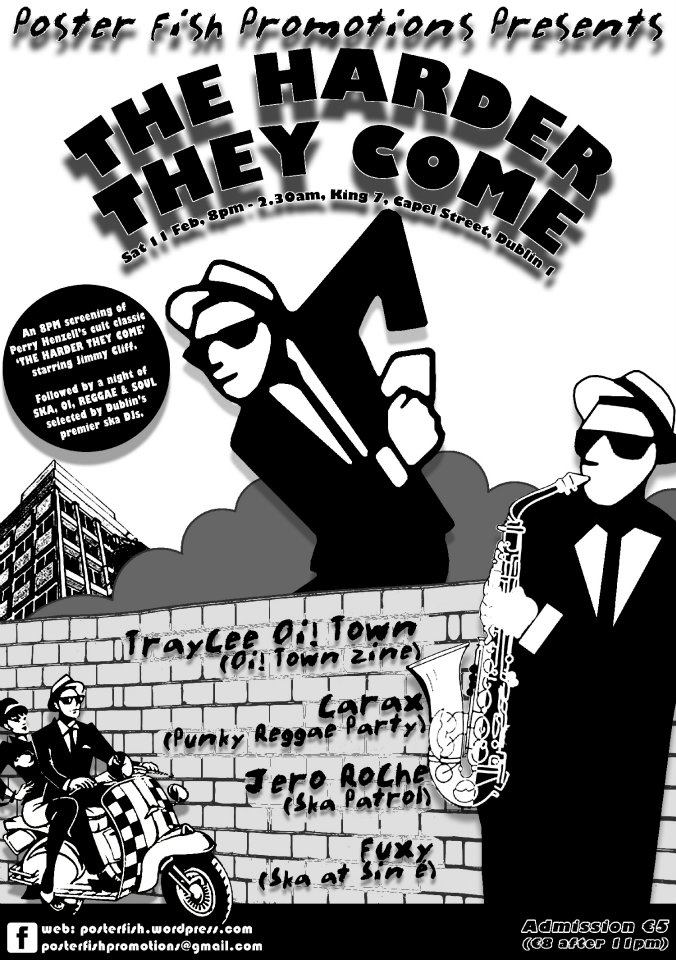
Poster - KS
In the Twisted Pepper, Surge are hosting their third take over which features Manchester’s Andy Stott, Slowburnm The Candidates and the Punky Reggae Party in the cafe. Tickets €10 or €12 on the door.
Full details on Facebook here.
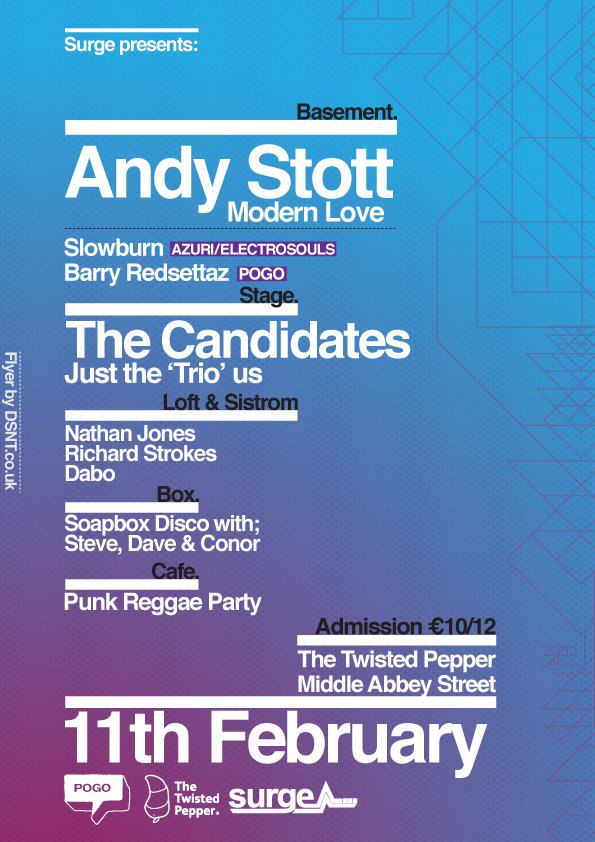
Poster - Surge

Posted in Dublin History on February 8, 2012| 10 Comments »

Leo Broe, himself a member of the Irish Volunteers, is best remembered today for his various monuments to Irish republicans throughout the country. His memorial sculpture opposite Phibsborough Library on the North Circular Road is one of my favourite statues in Dublin, dating back to 1939.
The statue serves as a monument to the men of the Old ‘C’ Co.1st Batt, Dublin Brigade. Made of Irish limestone, and standing an impressive sixteen foot, it was unveiled on February 19 1939. Interestingly, the statue takes the form of a drinking fountain. The statue shows a man in Volunteer uniform clutching a rifle. On the day it was unveiled, Capt. Sean Prendergast unveiled the monument while Seamus Byrne delivered the oration.
The memorial contains three plaques, showing historic moments in Irish history. The landing of the Milesians, Cu Chullan and the death of Brian Boru at Clontarf are shown. As The Irish Press report at the time of the unveiling noted “over the fountains are two brass plaques of celtic design, and the surrounding area is in the form of a celtic cross.”
The Irish Times estimated that three thousand people had attended the unveiling of Broe’s statue.
Vandalised in the 1970’s, and the Volunteer stood for many years with no rifle in his hand, until his restoration in the early 1990s. The image below comes from an issue of inDublin magazine dated August 6th 1981, and first uploaded to the excellent dxarchive.com site, a tribute to Irish pirate radio stations, as Dublin’s first pirate television station ‘Channel D’ operated out of the old ‘State Cinema’ building in Phibsborough, just next to this monument.

Leo Broe, of Harolds Cross, was responsible for some excellent monuments nationwide. This cutting from The Irish Independent shows him at work on a monument which would end up in Bruff, Limerick. His monuments are to be found across the four provinces.

Leo Broe’s profile on the Dublin City Galery page notes that “much of Broe’s time was taken up with ecclesiastical work for Dublin churches, along with IRA memorials in provincial districts.” He died in 1966, with his son Desmond Broe going on to become noted in the field himself.
Just around the corner, and featured on Come Here To Me in the past, is a small plaque to Sean Healy, the youngest republican casualty of the 1916 rising.

 | The Mallens on 4. Johnson’s Court |
 | Mindy on Plaques of Dublin: The Eagle… |
 | Aidan Convery on From McDaid’s to Grogan… |
 | Cormac Figgis on A divided Rathmines |
 | cian reardon on Dublin’s connection to t… |

 Click on the book for more.
 Click on the book for more.
 Donal
Donal Ciarán
 Sam
Sam Come Here To Me!