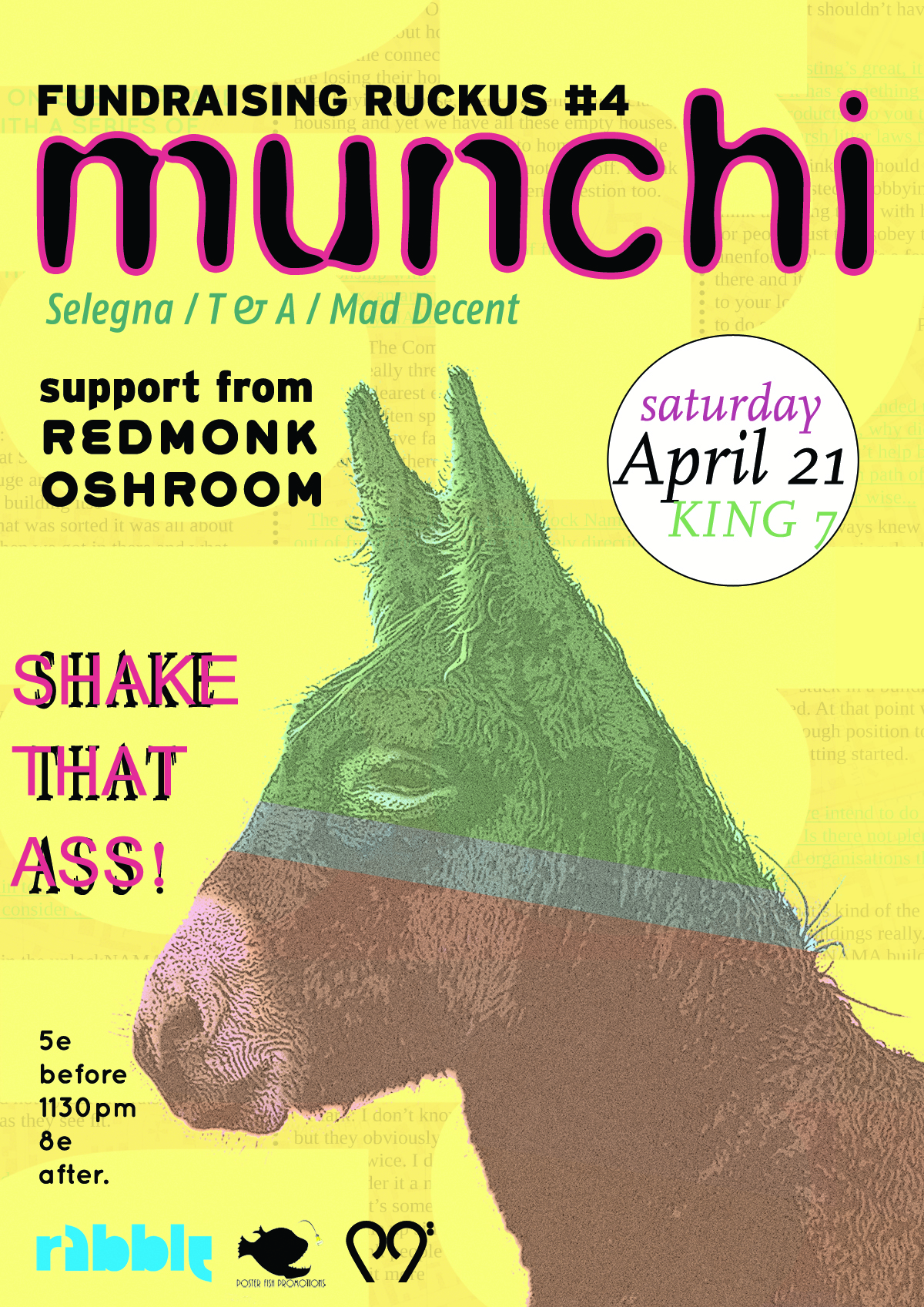
poster - C.Davey
Join Rabble and the legendary Munchi this Saturday for a night of heavy ‘ass’ shaking. Help them get the pennies they need to print issue 4. Without you, it won’t happen.
More details here.
Posted in Events on April 18, 2012| Leave a Comment »
Posted in Dublin History on April 16, 2012| Leave a Comment »
An historic church hidden away in Portobello (Dublin 8) is currently up for sale.
Rev. Patrick Comerford has written a bit about the building’s history:
The granite-block former Kingsland Place Church was designed by John McCurdy in 1870 for the Primitive Wesleyan Methodist Church, and opened in 1871. From the 1950s, the church was used as the Women’s Employment Exchange, and it stands as a reminder of another religious minority that has been lost to this part of Dublin.
It’s yours for €850,000 via Douglas Newman Good.
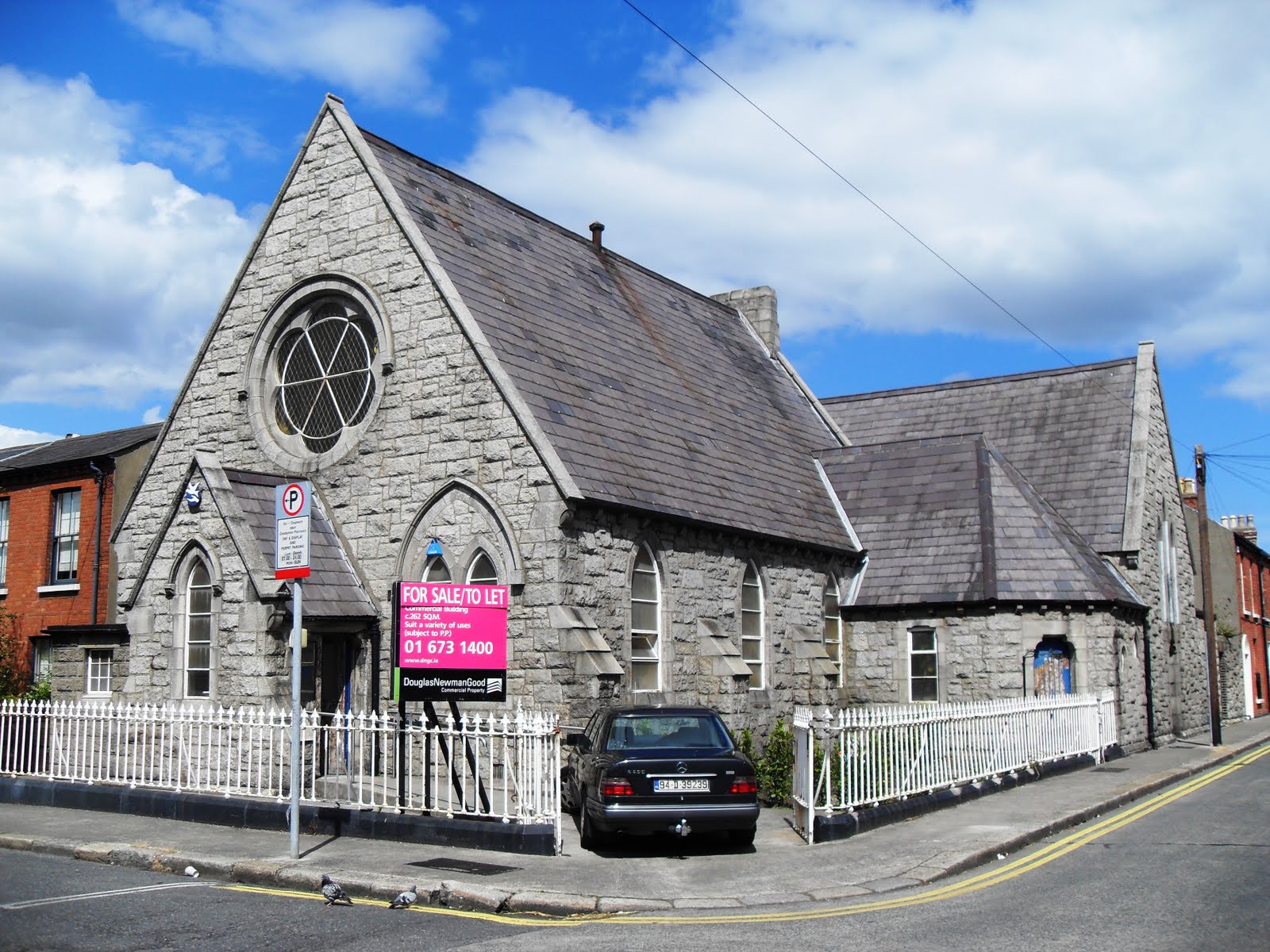
Kingsland Place Church. (Picture credit - http://revpatrickcomerford.blogspot.com)

Posted in Dublin History, Photography on April 16, 2012| 14 Comments »
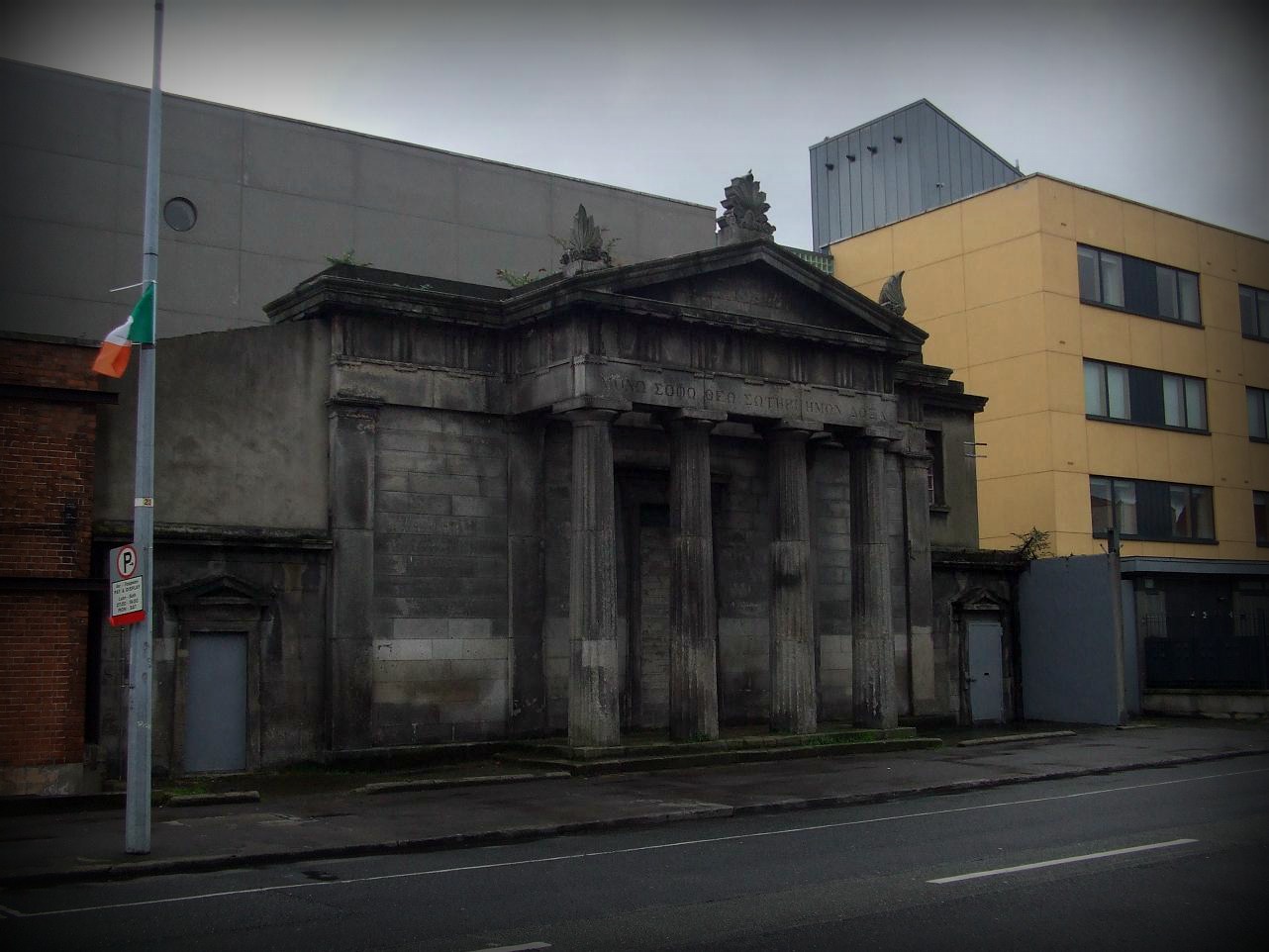
Walking down Sean MacDermott Street recently, I was drawn to this building as I am each time I go down there. It had to be photographed. The contrast between it and all around it is something else, and I had to do some digging to find out more. The natural man to ask was Terry Fagan of the North Inner City Folklore Project, who has written on the history of the area, in particular Monto. An interview we recorded with Terry appeared on the site before.
This was the Scots Presbyterian Church which later relocated to the corner of Howth Road and Clontarf Road, opposite Fairview Park and Clontarf DART station, Terry informed me. While digging around revealed some discussion the architectural merits of the building, Terry gave some interesting social insight on the church:
They helped the ladies of the night in the Monto who wanted out from that life. They ran a school across the road from the church which attracted a lot of poor children who went to get the free soup.
In 1910 the bishop’s built a school on Rutland Street to counter act the work of the free-soupers. There was hand to hand fighting by different groups to prevent the children going to the Presbyterian school as they used to come home with anti-Catholic literature.
This was like a red rag to a bull to the groups who marched on the school “To save the souls of the Children”. The school closed up sometime in the late 1960s.
A poster on broadsheet.ie noted that the church had even appeared on the cover of the single Keep On Chewin’ from Jubilee Allstars! The building featured on broadsheet as one of their frequent posts on unusual locations in the city.


Posted in Dublin History on April 16, 2012| 1 Comment »
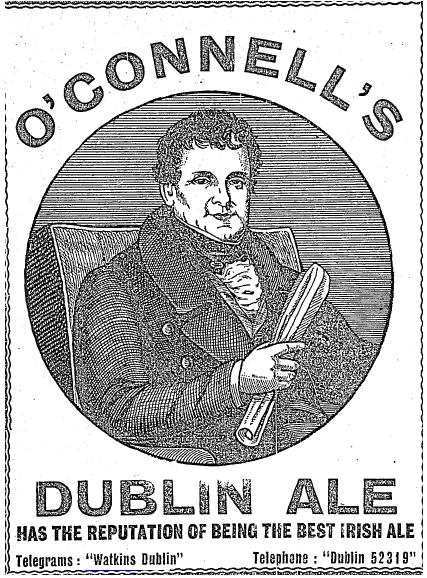
I had to laugh seeing this advertisement for O’Connell’s Ale popping up frequently in An Phoblacht in the early 1930s. Daniel O’Connell of course was far from a militant republican, and one wonders how he’d feel on the pages of that organ!
Daniel O’Connnell Jr. had famously acquired the Phoenix Brewery in James’s street in 1831, which produced O’Connell’s Ale. It should be noted that O’Connell and the Guinness family were at times political rivals, something best captured by the 1841 ‘Repeal Election’, where O’Connell had stood against and defeated Arthur Guinness Jr. This period would see a sizeable boycott of Guinness, dubbed “Protestant Porter” by sections of the populace, though this was against the wishes of O’Connell himself.
John D’Arcy continued to brew O’Connell Ale after the family had ceased their role in brewing, and in time production moved to the Anchor Brewery in Usher Street. Watkins eventually took up the brewing of O’Connell Ale, and this advertisement was placed by them in the pages of leading newspapers in the 1930s.
While Arthur had failed to defeat O’Connell at the Ballot Box, I always wonder what O’Connell would think of the Guinness Empire today every time I see a Diaego truck pass his statue.

Posted in Dublin History on April 15, 2012| 3 Comments »
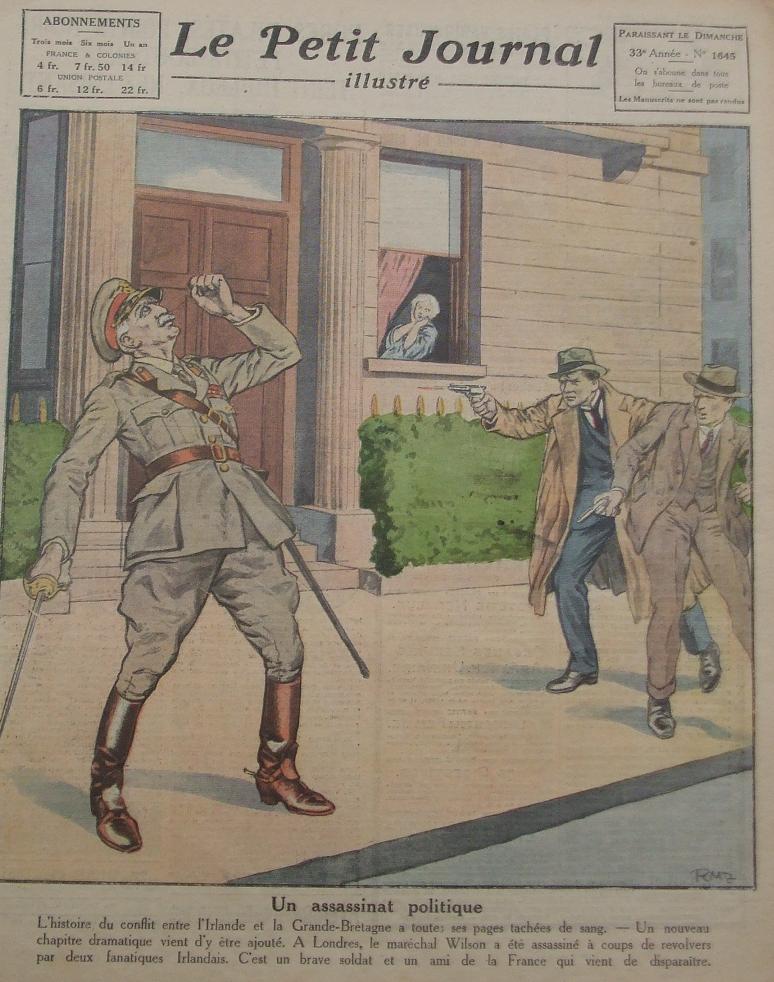
'Un assassinat politique' Le Petit Journal (Fallon collection)
This is a fantastic illustration from ‘Le Petit Journal’ showing the assassination of Sir Henry Wilson by Irish republicans in London, an event which would ultimately lead to the Free State moving in against republicans occupying the Four Courts premises in Dublin. Henry Wilson was assassinated in London on the June 22 1922, only hours after unveiling the Great Eastern Railway war memorial at Liverpool Street Station in London. Reginald Dunne and Joseph O’Sullivan were the two London volunteers responsible for Wilson’s death. O’Sullivan had lost a leg at Ypres in 1917 fighting for King and Country, while Dunne had also seen service in the Great War with the Irish Guards. Wilson was assassinated on his own door step, only hours after unveiling a memorial to those who died in the Great War, by two of its veterans. The men were hanged at Wandsworth Prison on August 10th 1922.
In August of 1929 a memorial was erected at Dean’s Grange Cemetery to Dunne and O’Sullivan, at a ceremony attended by over 500 people. In July 1967 the bodies of the two Volunteers were buried in Dublin in Dean’s Grange, following years of campaigning by the National Graves Association.
The attack on the Four Courts by the Free State attracted huge international media attention, and the images below come from the London Illustrated News of July 8 1922.
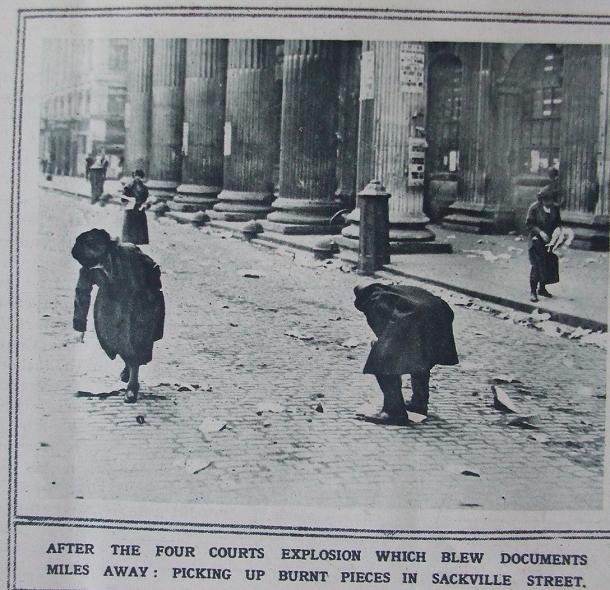
Documents from the Four Courts litter the streets.(Fallon collection)
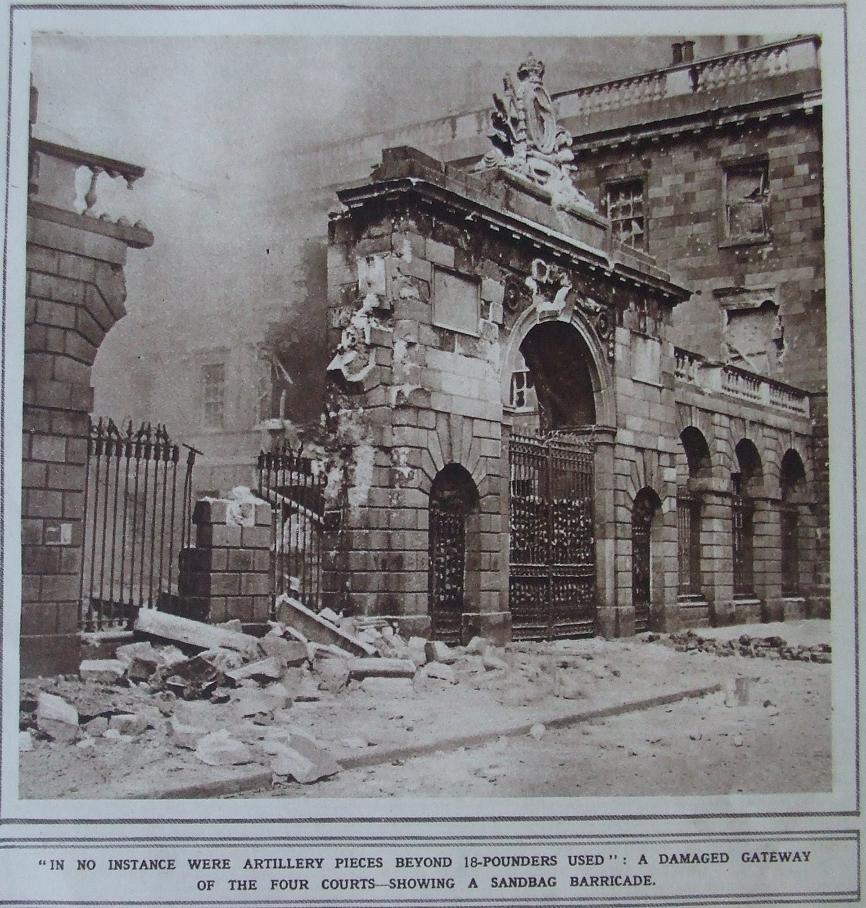
Damage to the Four Courts. (Fallon collection)
The execution of Henry Wilson was not the only Irish interest story to make the front page of the Le Petit Journal. Below is their take on the execution of Michael Collins at Béal na mBláth.
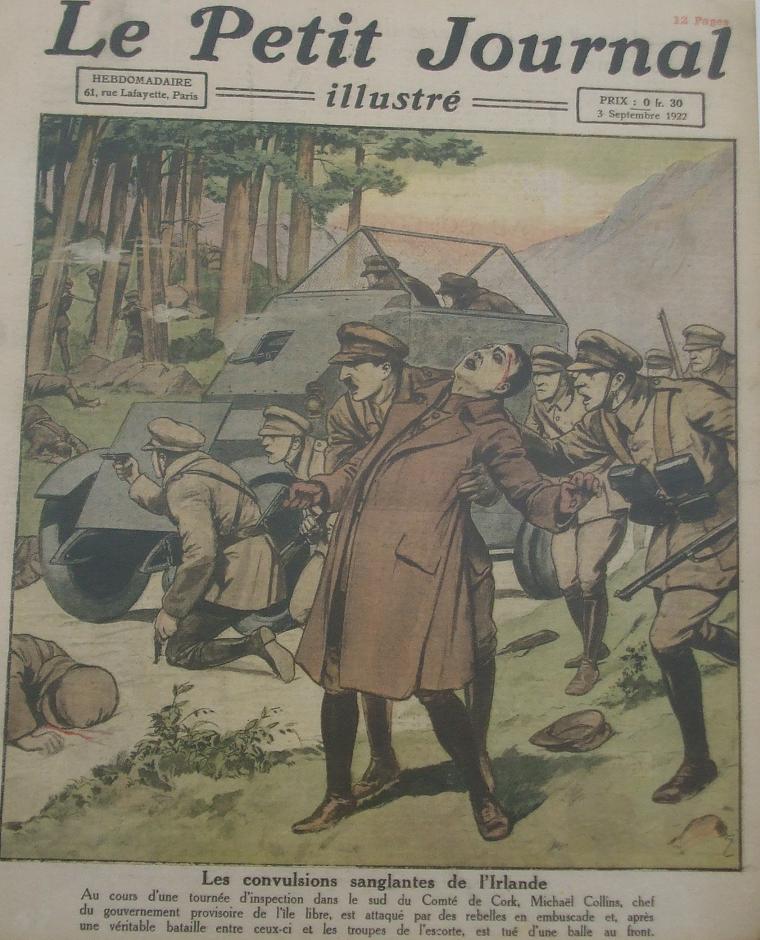
'Les Convulsion sanglantes de I'Irelande' (Fallon collection)
Update: The folks at the Dublin Review of Books have linked to this piece on their site, and in the process have taken the time to translate the caption on the Wilson illutration:
Come Here To Me! does not translate the caption to the illustration of the shooting. It reads: “L’histoire du conflit entre l’Irlande et la Grande-Bretagne a toutes ses pages tâchées de sang. – Un nouveau chapitre dramatique vient d’y être ajouté. A Londres le maréchal Wilson a été assassiné a coup de revolvers par des fanatiques Irlandais. C’est un brave soldat et un ami de la France qui vient de disparaître.” (Every page of the history of the conflict between Ireland and Great Britain is stained with blood. – Another dramatic chapter has just been added. In London Marshal Wilson has been assassinated by the revolvers of Irish fanatics. A brave soldier and friend of France has died.)

Posted in Miscellaneous on April 14, 2012| 4 Comments »

Jim Larkin’s statue will inevitably feature in our series on the statues of Dublin city. This mock up image on Twitter caught my eye earlier, of course it’s referencing events at the Labour conference in Galway earlier today when pepper spray was used on Household Charge campaigners.
The image of Larkin with his hands raised in the air upon his return to Ireland from the United States is one of the most iconic images in the history of this city in my own eyes. Part of the Cashman collection, it is under the ownership of the state broadcaster. I noticed that RTE recently objected to its use by DCTV in an advertisement for their planned output to mark the centenary of the Lockout. There’s something tragic in that.

Posted in Miscellaneous on April 14, 2012| 2 Comments »

Sadly, The Loft bookshop is to close its doors. The bookshop was a very welcome addition to the Twisted Pepper venue, and the building really began to take on a life of its own in ways other than a nightclub venue in my eyes and the eyes of many other Dubliners. It’s undoubtedly a tough time for book sellers, and this is a good warning of that. Fair play to all involved for giving it a go. Below is the statement from the bookshop.
It is with some sadness that, as of this week, I have decided to close up The Loft Bookshop here at the Twisted Pepper. We’ll be finishing up in mid May and as of today we’ll be running a 50% off clearance sale everyday until the doors close.
It has been an eventful and challenging year in which I’ve met many wonderful people and experienced the phenomenal support and encouragement of old friends and new. The list of people whose help and good-will enabled me to start up here is long and I’d be terrified to miss anyone out. Suffice it to say, you all know who you are and you’re great!
To all you book lovers out there, keep supporting your local bookstores, independent or otherwise, wherever you are. Dublin is a city blessed with enthusiastic and knowledgeable booksellers: Chapters Bookstore, The Gutter Bookshop, Raven Books, The Winding Stair, Books Upstairs, Dubray Books, The Secret Bookstore, Hodges Figges, to name but a few. Go and help to keep them doing what they do best!
Seeing the Twisted Pepper get better and better, watching 3FE go from strength to strength both here and at Grand Canal Street, and being here while Elastic Witch Music and The Boxcutter Barber kick off their own ventures has been something to behold. I urge you all to keep supporting the great people here at The Twisted Pepper, supporting all the guys who work so hard, and to help keep it a special place to be in Dublin. We need places like this, now more than ever, and I for one plan to spend as much time as I can this summer hanging out downstairs.
Thank you most of all to the customers and who visited the shop this past year. It was a pleasure and a privilege to meet you all. Your business and your support has been deeply appreciated.
Happy reading,
Rob

Posted in Dublin History on April 12, 2012| 2 Comments »

The Lion and the Unicorn on display at the Custom House today (Dfallon)
While the bombing of iconic Dublin statues by militant republicans in the decades following independence is well documented, other attacks on the iconography of the city have largely been forgotten. Recently, I stumbled across an interesting file in National Archives dealing with the issue of the Royal Coat of Arms, which remained in place on many magnificent Dublin buildings in the years following independence. In the 1930s, following an explosion at Exchange Court targetting one such piece of symbolism, senior figures inside An Garda Síochanna called for the removal of the Royal Coat of Arms from public buildings in the interest of safety and security.
On November 11th 1937 militant republicans were responsible for an explosion at the building which was home to the Engineering Branch of the General Post Office, at Exchange Court. The premises had once been home to ‘G Division’ of the Dublin Metropolitan Police, and it was at Exchange Court that Peader Clancy, Conor Clune and Dick McKee were to lose their lives on Bloody Sunday in 1920.
At half-six on a quiet November morning in 1937, an explosion destroyed the plaster cast of the Royal Coat of Arms, with The Irish Times reporting that:
The force of the explosion broke the plaster cast of the lion and the unicorn into pieces, blew a large hole in the wall of the building, and shattered hundreds of panes of glass in surrounding houses, shops and offices. Bricks and mortar were hurled into rooms of the premises, smashing furniture and damaging official documents.
Windows were broken at the Olympia Theatre, and even on Parliament Street, by the force of the blast.
In the Garda report in the immediate aftermath of the explosion, Chief Superintendent Thomas Clarke noted that Garda intelligence believed republicans had been planning an attack on a symbolic target early in November of 1937, and that Gardaí were monitoring memorial statues, poppy depots and the Ex-Servicemen’s Park. Clarke would write that:
It is the practice to have a Garda in uniform detailed to patrol a special beat in the vicinity of Cork Hill but there was no member available on the night of the 10th/11th,instant, for duty at this point owing to the other demands made on the available strength for protection of Poppy depots, memorial statues, halls etc.
It was noted that Gardaí believed the IRA were likely to cause an explosion at the Ex-Servicemens’ Park, or at some other prominent centre, between the first and the eleventh of November, in the run up to Armistice Day. The Garda report would note that the removal of the Royal Escutcheon from buildings in the city under the control of the Board of Works should be considered, owing to the damage caused through such explosions and the risk to the civilian population. In May of 1937 the statue of King George II in Stephens’ Green had been blown to pieces, and such attacks were undoubtedly seen as a very real threat.
Discussion around the Royal Coat of Arms and its presence on Dublin buildings continued into the following year. In a 1938 Garda report it was noted that if the Royal Coat of Arms could be removed from places “…without attracting press notice”, such a policy should be considered.
The 1938 confidential Dublin Castle report, on the Suggested Removal of the Royal Crest from Courthouse at Kilmainham, noted that “the protection of the buildings on which it is displayed cannot very well be effectively carried out.”
Inspector P.Killeen noted that in the case of the Kilmainham Courts, which display the Royal Coat of Arms to this day:
In view of the attitude adopted by a section of the population of this country to such emblems as this, and inv iew of the damage caused on several occasions within the last few years to statues and monuments associated with the British regime here, I think it should be advisable to have the emblem removed, and I suggest that representations should be made to the Office of Public Works to have this done.
The removal of the object now may save a great deal of trouble to the Police later, and may also save the Rate Payers and perhaps lives of citizens.
The National Graves Association had spent some time calling on the ‘Lion and the Unicorn’ at Exchange Court to be replaced with a memorial plaque to the three republicans who lost their lives there on Bloody Sunday in 1920. Today, such a plaque exists right next to City Hall, where the Royal Coat of Arms had once gazed down on Dubliners.

The Royal Coat of Arms can still be seen in several locations across the city, not only at the Kilmainham Courthouse but also at College Green on the Bank of Ireland (the historic Irish Parliament), at the top of Henrietta Street at the Kings Inns and at the magnificent Custom House.

Posted in Music on April 11, 2012| 15 Comments »
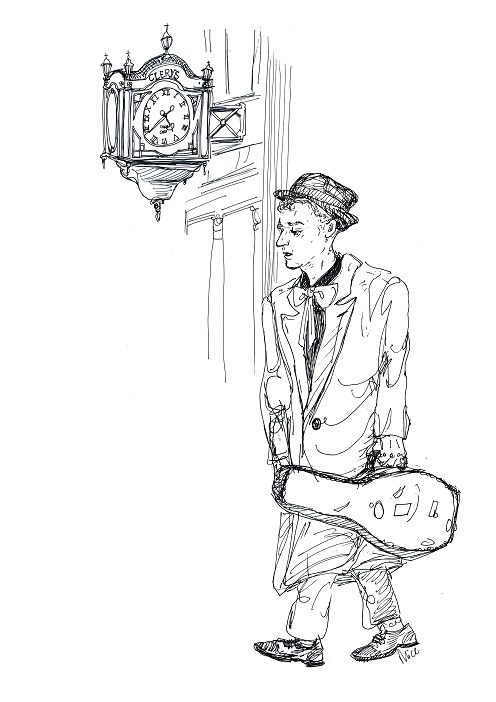
From Rabble Issue 3 by Mice Hell (http://triggerthumbs.wordpress.com)
Edit: RIP Phil. A true gent. x
This year marks the 35th anniversary of The Radiators from Space’s first single Television Screen. It’ll also see the release of their fourth studio album, Sound City Beat. As such, I thought it would be no better time to sit down and have a chat with lead singer and songwriter Philip Chevron. In my opinion, one of the greatest songwriters ever to come out of our fair city. A shortened version of the following was printed in the latest issue of Rabble, here is the full thing…
Were your parents from Dublin?
Yep, both inner city kids. My mother was from the Liberties, hence the Hugeunots. A lot of them ended up in the Liberties … as artisans and tradesman. My Dad was from Ballybough. So basically they were North and South inner city. Absolutely dyed in the wool Dublin, going back several generations. My father’s mother was from Drogheda. That’s the only Culchie blood at all.. and that only counts as North Dublin now anyways! In my Mother’s case, her Father was a trader in Dublin Corporation Fruit Market. He traded in potatoes .. and supplied Tayto crisps. It was one of the big contracts you could get at the time. That elevated my Grandfather into the frontline of the new middle classes in Dublin. As soon as they could, they got the hell out of the Liberties and moved to Terenure. My Mother was still a Liberties girl at heart though. She loved the fact that she moved up in the world. My Father stayed in Ballybough all along. There is that strange reverse snobbishness in Dublin as well, where my mother would say, “We live in Terenure but we’re from the Liberties”.
I heard your Father’s Mother was politically active?
Yes, She was in Cumann na mBan … but I found out after she died that her view of it was that it was great way to meet fellas. There was a bit of craic involved in it, hiding the guns in the prams. Innocence that only a seventeen-year-old girl could have really. That’s probably why they got away with it. Like everybody she hated the Black and Tans and wanted to see the back of them but more than anything it was “I wonder will your man be at the dance on Saturday night”. My grandfather on my Mother’s side, the potato merchant, was one of those Dubliners who covered all angels. He was in the Knights of Colobanus, in the old IRA I think but also the Masons. People then were pragmatic. They weren’t dogmatic or ideologists, idealists maybe though. They did what they had to do. If you’re a tradesman in Dublin, you had to keep everyone happy. Strangely, in his funeral in the early 1960s, he had fifteen-gun salute from the IRA. I was like ‘what the fuck’. Nobody knew. People thought ‘well then, I guess he must have been in the IRA’. I thought well ‘they don’t take the guns out for the fun of it’. The Civil War caused such a rift in this country. It’s as solid, in its own way, as the one that still separates America. In a sense, the Irish were incapable of talking about it. I suppose we all went through our lives not talking about it. Truth is, we will never know if there were 25,000 people in the GPO in 1916.
Or to see U2 in the Dando!
Yes, exactly. I mean Lotte Lenya says about the opening night of The Threepenny Opera in Berlin – “If everybody who said they were there, were there, we’d have to tear down the theatre and build it again”.
Do you think those Civil War wounds are finally healing now? Is this the first generation that we can see that?
I wonder about that. Maybe the de Valera generation is dead. I don’t know. They might go away for a few years but they’ll be back. Hopefully, it is a generation thing. I know one of my uncles still praises Bertie after all this time. It’s because these family bonds die very hard. Saying that, I don’t know anyone personally under seventy who thinks like that. I think we’ve got through the worst of it. We’ve had a century of bullshit from the politicians, priests, teachers and everyone else as well. I genuinely believe that people are moving forward. It feels like people aren’t so easily prepared to take the bullshit, on face value anyway. The whole generation that came up during the time of The Radiators, not just musically but in literature, art, film and theatre, were the first to have had the courage, or the space maybe, to say, “Let’s change it! It’s crap!” It was kind of tentative because we all felt we were kind of transgressing in some deeply important way. In that we were almost being anti-Irish, anti-Catholic and anti-everything. The generation, who are now in their early 50s to early 60s, all felt individually that we were the only ones who felt this way. But when you got to meet people at The Project Arts Centre, you realised that other people were speaking the same language as you. In some ways, Geldof knocked down the last wall by saying “I’m going to talk about this – whether you like it or not”. Had we be been more aware that there was this greater movement towards change; it probably would have been a lot louder and angrier. But we also had a thing when just on the cusp of change it was ‘one step forward, two steps back’. Look at the reaction the pope’s visit in 1978. I remember thinking ‘hang on, thing’s aren’t going the right way’. Suddenly there was a while generation being named John Paul. It was strange.
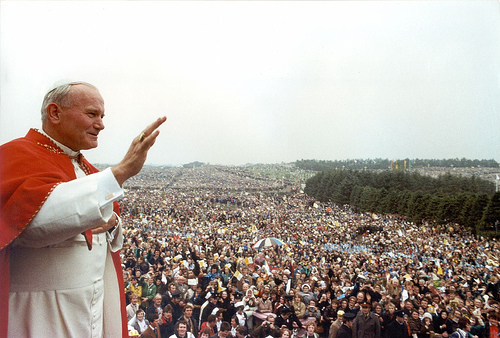
Pope John Paul II, Phoenix Park, 1979. (http://comma.english.ucsb.ed)
I thought Killing Bono visually illustrated that quite well in that scene when the band are in the empty bar while it seems the whole of Ireland are at the Phoenix Park.
Oh yes, absolutely. I had left by then, The Radiators had moved to London in 1977 but when I came back I felt that something, albeit temporarily, had gone wrong. I was even meeting people like Agnes Bernelle who said ‘It was wonderful, you should have seen it’. I thought ‘Why the fuck are you talking about? This guy is an utter bastard. Fuck off!’ We’re hosting the Eucharistic Congress this year and things literally couldn’t be more different than the one in 1932. It will be interesting to see that in action. It will be firm evidence to show that the country has changed. To see a film of the 1932 Eucharistic Congress is terrifying, I’d rather watch the Nuremburg rallies. It feels less regenerated and more artistically valid!
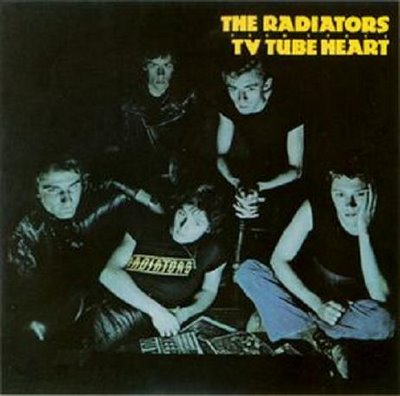
TV Tube Heart (1977)
Moving onto The Radiators first album TV Tube Heart, I thought the two trends running through it were the idea/impact of TV and the feelings of boredom/prison. Was this intentional?
First of all, regarding the aspect of television in the album. You have to understand that we were the first generation in the country to have TV introduced to us in our lifetime. We were not born with TV. Unlike say American kids. So, we had this strange phenomenon of being introduced to TV. Inevitably it had a hold on the imagination. At the time, The Late Late Show acted as a sort of ‘secular pulpit’. It genuinely opened up the doors for people to talk about things at the breakfast table that weren’t being talked abut. Suddenly, the words ‘lesbian’, ‘gay’ and even ‘atheist’ were becoming topical because of TV. But TV also reduced people. While it was freeing people, it was reducing people to commodities and units of commerce. Essentially we were saying ‘What is this fucking thing?’. It was still an object of awe. We recognised it that it helped changed Ireland in our lifetime while similarly acknowledging that most TV was crap and the whole thing with Gary Gilmore. In the sense in ‘Electric Shares’ that even execution was a commodity.
Irish Press. Oct 08, 1979

Posted in Dublin History on April 11, 2012| 14 Comments »
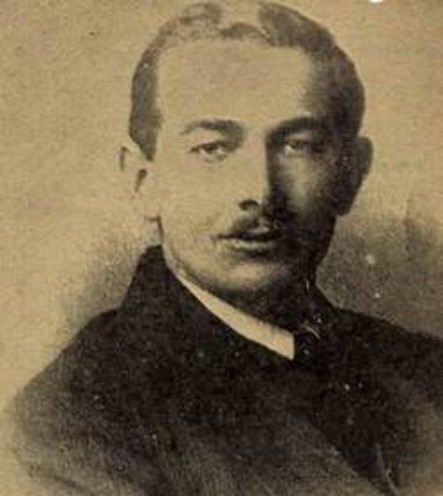
Sean Treacy is a character of great importance to the War of Independence period, indeed he was among the men of the Third Tipperary Brigade who fired the opening shots of that conflict at the Soloheadbeg ambush. Treacy would lose his life on October 14th 1920 on the streets of Dublin, owing to a shoot-out on Talbot Street that would also leave Gilbert Price of the British Secret Service lying dead on the street. A small plaque on Talbot Street today marks the spot where Treacy was killed. The incorrect spelling of his name should be noted, a common error.
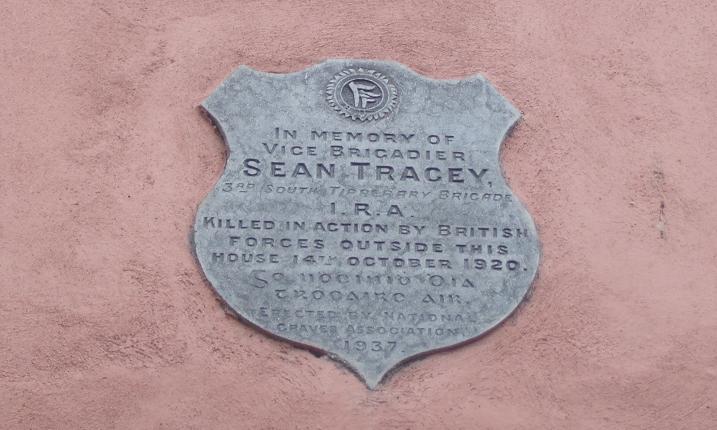
The plaque was unveiled by the National Graves Association in 1937, with a huge crowd gathering for proceedings.
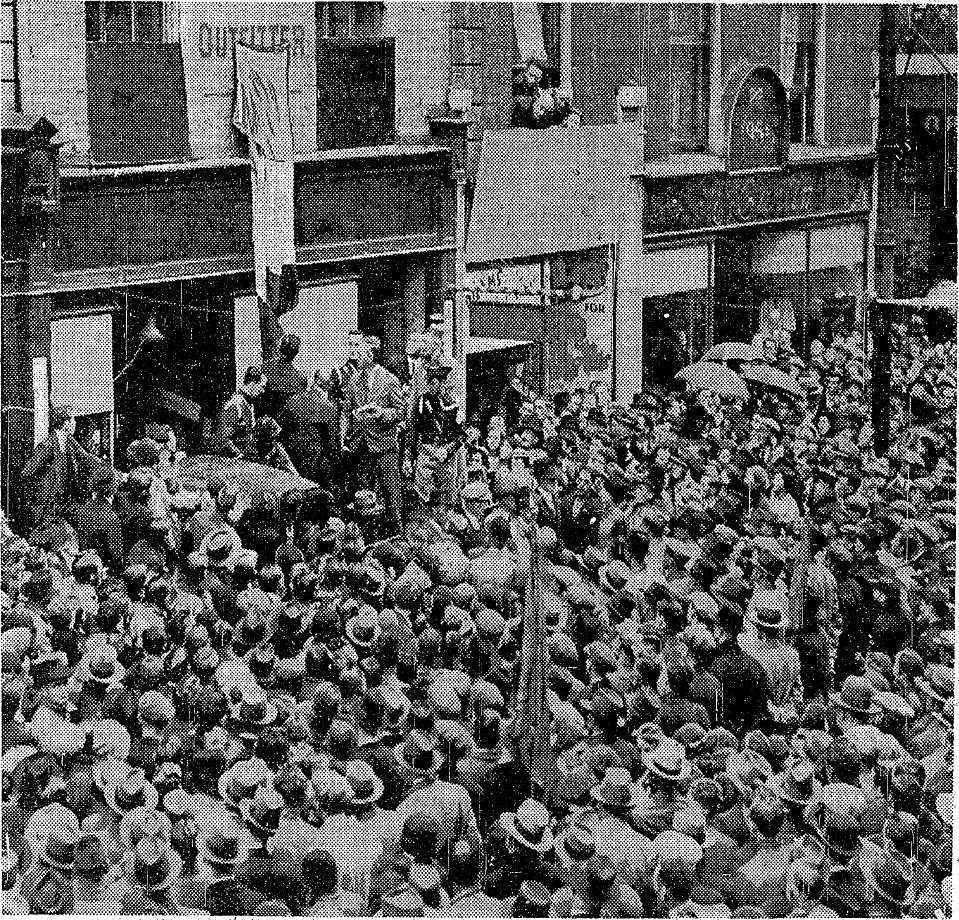
Image taken from the front of The Irish Press newspaper, September 13 1937.
Each time Tipperary reach an All Ireland Final, Tipperary fans gather at the spot on Talbot Street to remember Sean Treacy. The video below shows the 2011 commemoration at the site.
Following Irish independence, the renaming of streets became common place in Dublin. In March 2011 I posted a copy of a 1922 Dublin Corporation report which recommended a number of street name changes in the capital. That report proposed radical changes, including the re-naming of Beresford Place (home to Liberty Hall) as Connolly Place, and not all of its recommendations were implemented. Interestingly, absent from the list was the issue of Talbot Street. In the decades following independence, members of a wide variety of nationalist organisations would call for the renaming of that street to honour Sean Treacy.
Among the organisations demanding the changing of the name Talbot Street in the 1940s were Ailtirí na hAiséirghe, a fascist movement whose name translated into ‘Architects of the Resurrection’ and who were led by Gearóid Ó Cuinneagáin. The movement produced the paper Aiséirghe, a copy of which was previously uploaded to this very blog. The politics of the movement very much fused European fascism with a deep sense of Irish Christianity and cultural nationalism. An impressive collection of election literature and propaganda from the group has been uploaded to the Irish Election Literature Blog, which provide interesting insight into the ideology of the group. In their 1943 General Election leaflet outlining principal points of policy, the organisation noted that: “Your duty to Ireland does not end with the casting of your vote. Serve Ireland always. Speak the language. Encourage others to speak the language. Help everything Irish and national and clean!”
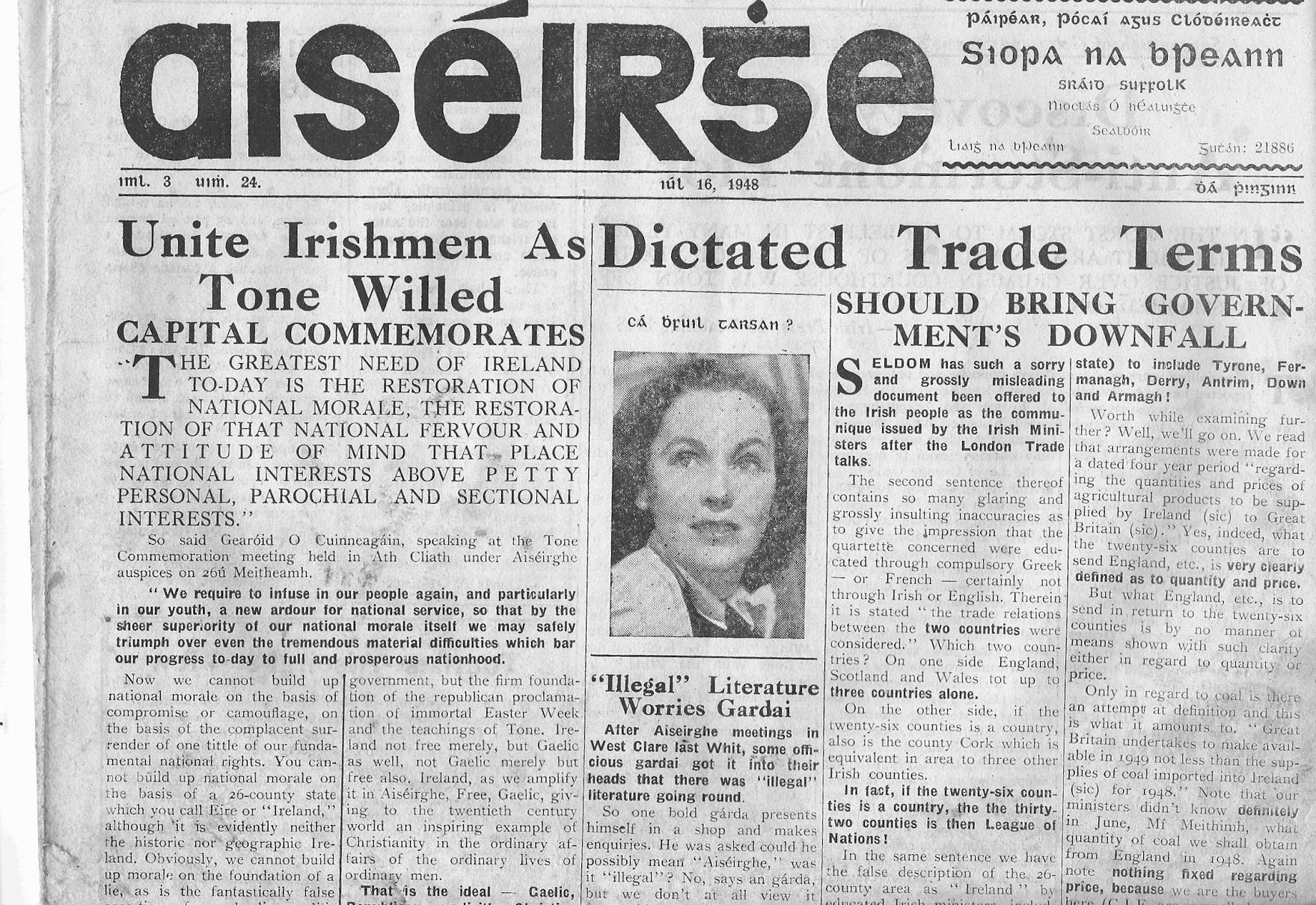
An edition of Aiséirghe's newspaper.
On November 1st 1943, members of Ailtirí na hÁiseirghe created uproar at a meeting of Dublin Corporation, by shouting from the public galleries while the Corporation was sitting. At the time of the interruptions, the Corporation was discussing the planned removal of Queen Victoria’s statue from Leinster House. One man rose and shouted: “Get rid of all the symbols of slavery in the streets! We demand that Talbot Street be renamed Sean Treacy street. Young Ireland is awakening.”
It was reported that another member of the group shouted: “Honour Sean Treacy, despite the shopkeepers of Talbot Street. If you do not, you are not worthy of the name of Irishmen.”

Posted in Uncategorized on April 8, 2012| 12 Comments »
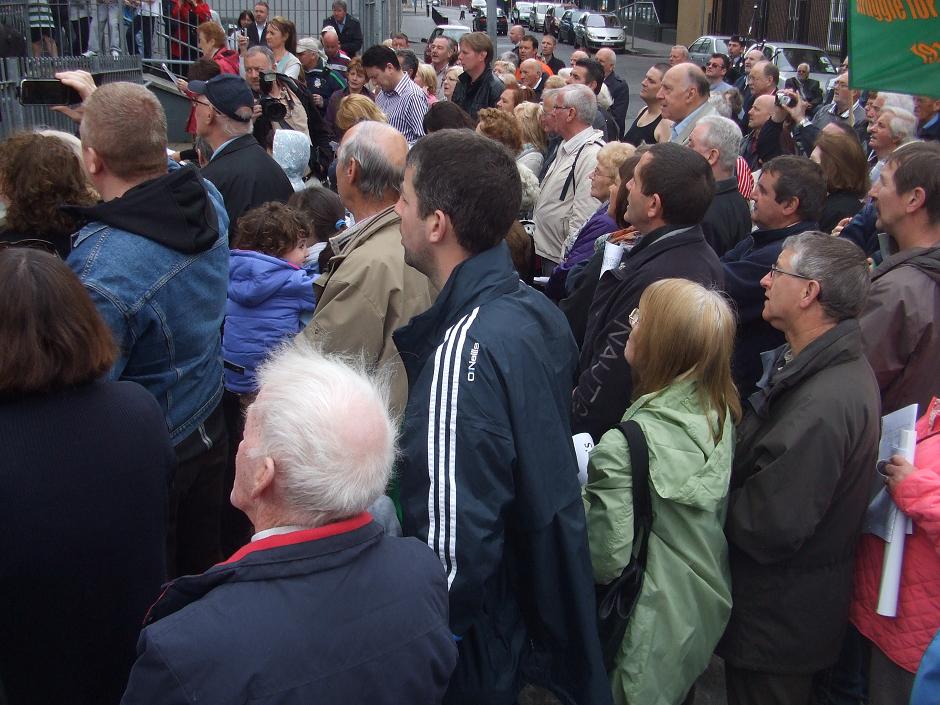
A section of the crowd at the 2011 commemoration.
CHTM report of 2010 North Inner City Folklore Project commemoration.
CHTM report of 2011 North Inner City Folklore Project commemoration.
Each year, the North Inner City Folklore Project mark the anniversary of the Easter Rising by erecting a plaque in the inner city, marking the contribution of their community to the period. It’s an important job, but only one part of what the Project does, and its collecting of oral testimonies from inner-city Dubliners will prove priceless in years to come. It is history from the bottom up, and anyone curious about the project will enjoy a recent audio interview I conducted with Terry Fagan about its work.
This year on Easter Monday the North Inner City Folklore Project will be unveiling a plaque to Sean Heuston, who was born in 1891 at Lower Gloucester Street, now Seán MacDermott Street. The event is non-party political, and begins at 12 noon at Liberty Hall with the raising of the flag. The statement from the Project in advance of the commemoration is below:
5 April 2012
EASTER MONDAY MORNING (12 NOON, 9 APRIL) EVENT TO MARK THE 1916 EASTER RISING
(NON-PARTY POLITICAL)
Unveiling of plaque to Captain Seán Heuston,
Irish Volunteers, 1916ON EASTER MONDAY, the Dublin North Inner City Folklore Project is honouring local man Irish Volunteer Captain Seán Heuston who was born in 1891 at Lower Gloucester Street now (Seán MacDermott Street). Heuston was executed by a British military firing squad in Kilmainham Gaol on 8 May 1916 at the age of 25.
The event will open at 12 noon with a re-enactment of the hoisting of the Citizen Army flag at Liberty Hall in 1916 by James Connolly and a young 14-year-old girl from Gardiner Street, Molly O’Reilly.
This will be recreated Easter Monday by the grandson of James Connolly, James Connolly-Herron, and Molly O’Reilly’s niece, Ciara Gallagher. A colour party in the period uniforms of the Citizen Army and Cumann na mBan will accompany them.
The crowd will then parade to Lower Seán MacDermott Street led by pipers and people carrying photographs of the leaders of the Easter Rising.
At 1pm, at Lower Seán MacDermott Street, facing Our Lady of Lourdes Church, Constance Corcoran (daughter of Molly O’Reilly, whose mother was a member of the City Hall garrison) and Mrs Steenson (whose mother was a member of the GPO/Clery’s garrison) will unveil the plaque to Seán Heuston.Two children from the area will lay wreaths at the spot.
After a lament by the pipers, there will be a 1916-1922 photographic exhibition, in a nearby community hall.

Posted in Uncategorized on April 8, 2012| 2 Comments »
Pela sexta rodada do campeonato irlandês, o St. Patrick recebeu o Shamrock Rovers e goleou por 5 a 1. Mas a goleada ficou em segundo plano porque o destaque da tarde foi o golaço por cobertura de Chris Forrester.
I can’t say I have a clue what the above means, other than the Saints are going viral. I’ve watched this ten times. Remember us Chris Forrester, I’ve a feeling you’re destined for big things.

 | The Mallens on 4. Johnson’s Court |
 | Mindy on Plaques of Dublin: The Eagle… |
 | Aidan Convery on From McDaid’s to Grogan… |
 | Cormac Figgis on A divided Rathmines |
 | cian reardon on Dublin’s connection to t… |


 Click on the book for more.
 Click on the book for more.
 Donal
Donal Ciarán
 Sam
Sam Come Here To Me!