Feeds:
Posts
Comments

Archive for 2012

I’ve found a few interesting immigrants living in Dublin in 1911 thanks to the great National Archive of Ireland (NAI) census website.

– A Swedish ‘Masseur’ by the name of  Kent Magnus Lindeberg living with his Scottish wife and Dublin born daughter in 19 Upper Leeson Street.

– Norweigian born Carl Ludwig Dybing, an Adjutant in the Salvation Army, living with his English wife Clara Dybing in 3 Mountpleasant Parade, Rathmines.

–  A 63 year old ‘hairdresser and perfumer’ by the name of Mathias Greiveldinger Prost from Luxembourg who lived with his Cork born wife and six children at 24 St. Stephen’s Green.

– There was only one Dutch person living in Dublin in 1911 and that was Fritz Hintre, a turner, living at 151 Rialto Cottages with his Irish wife and three children.

– There were eight Portuguese, mainly students, living in Dublin and only seven immigrants from Hungary. Three Greeks, none of which had Greek sounding names and seven Danish of at least three were sailors. A sizeable number of 74  Austrians, many of whom were waiters.

I’ll do something on unusual religions tomorrow.

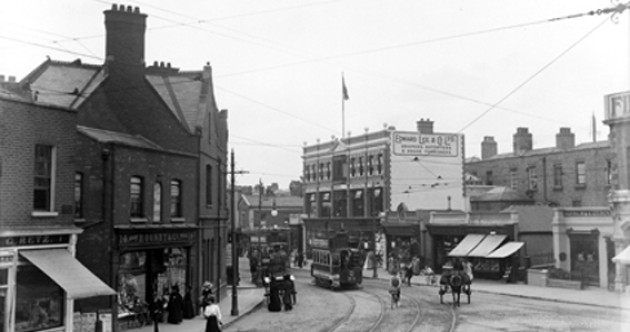
Rathmines, 1911. (thejournal.ie)

Read Full Post »

The UVF in your pocket.

I’ve always been fascinated by this coin, which I was given years ago by my father. Such coins were once pretty common in Dublin, and while most wouldn’t have thought of hanging onto them, a few people did. Frequently Dublin shoppers would look at their coinage and find the likes of ‘UVF’, ‘UDA’, and ‘REM 1690’ (Remember 1690, a reference to the Battle of the Boyne) upon their coinage.

UVF stamped coin (1961 issue date)

In recent times, it seems like dissident republicans are the ones largely responsible for the stamping of coins, and I noticed a recent Belfast Telegraph article dealing with this issue, as ‘RIRA’ has been appearing on currency in the north of Ireland.

A quick search in the archives revealed a fantastic piece in The Irish Times in February 2003 by Joe Armstrong, in which he noted that:

Perhaps the Loyalists were tapping into an earlier nationalist tradition, given that some early 19th century British coins were counter struck with the slogan ‘Repeal’, referring, of course, to the aspiration to repeal the Act of Union between Ireland and Britain.

One coin referenced in the article was said to be stamped ‘BOMB DUBLIN’, although I’ve not been able to find an image of this particular counter struck coin. The earliest reference to the vandalised coins I can find is from the Irish Independent, in an article dated December 1st 1969, in that article it was noted that a boycott of goods from the Republic in the north was intensifying, and that “the boycotting of Irish money had reached the stage that some Irish 2/- pieces are turning up stamped U.V.F”

Read Full Post »

Kapp and Peterson

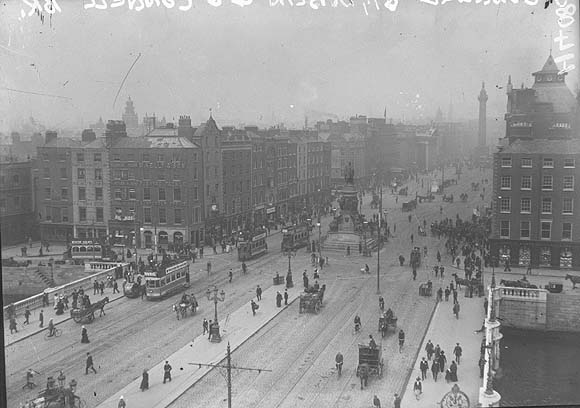
Kelly’s on the corner of O’Connell Street (then Sackville Street) and Bachelors Walk, which later became Kapp and Peterson (Image: NLI)

I noticed recently while walking through the city that Peterson pipes have moved from their Grafton Street HQ to a new premises on Nassau Street, just around the corner. The Dublin institution began life under the Kapp name, before becoming Kapp and Peterson, and later merely Petersons.

Frederick Kapp, from Nuremburg in Bavaria, opened a shop in the late 1870s in Dublin at 53 Grafton Street, which sold Briar and Meerschaum pipes. In time, this business would become known to generations of Dubliners as Kapp and Peterson, with the Peterson name coming from Charles Peterson, a Latvian immigant hired by Fredrick Kapp. In time, the Peterson family would buy-into the company and Kapp and Peterson was born.

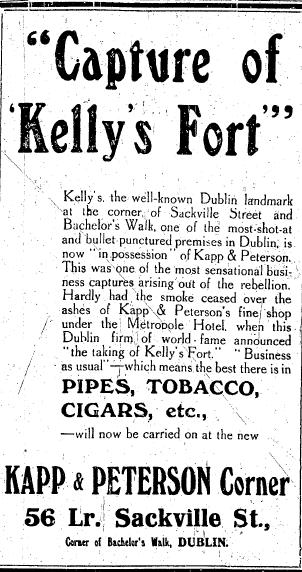
For many years Kapp and Peterson operated from a business premises at the corner of O’Connell Street and Bachelors Walk. This premises was damaged during the Easter Rising of 1916, as the below newspaper piece shows, and was acquired by the company soon after the rebellion.

Image via the fantastic http://pipedia.org/

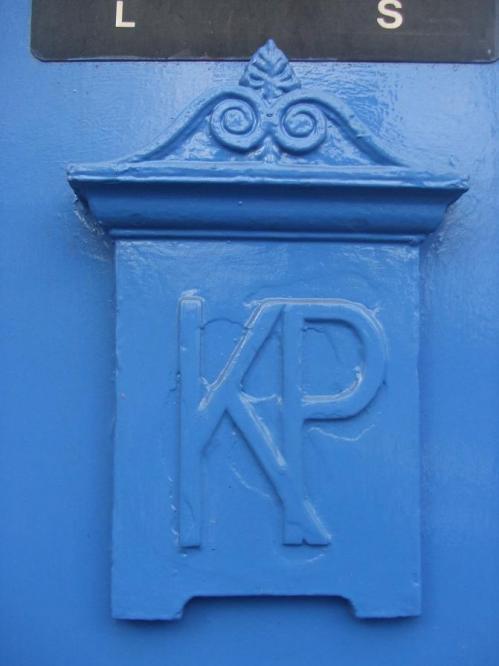
Passing this building today, Dubliners may not notice two excellent little features that hint at its former life, which we have photographed below. In the woodwork of what is now the Daniel O’Connell Newsagents, the letters KP can still clearly by seen:

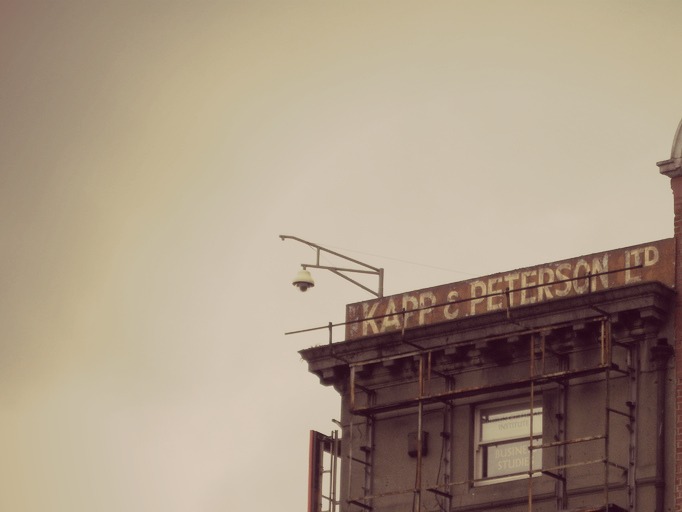
Above the building, the name ‘Kapp and Peterson’ is still perfectly visible too.

Hopefully both of these features will be preserved well into the future, as they were the kind small but historic important details in a city that can often be lost.

Read Full Post »

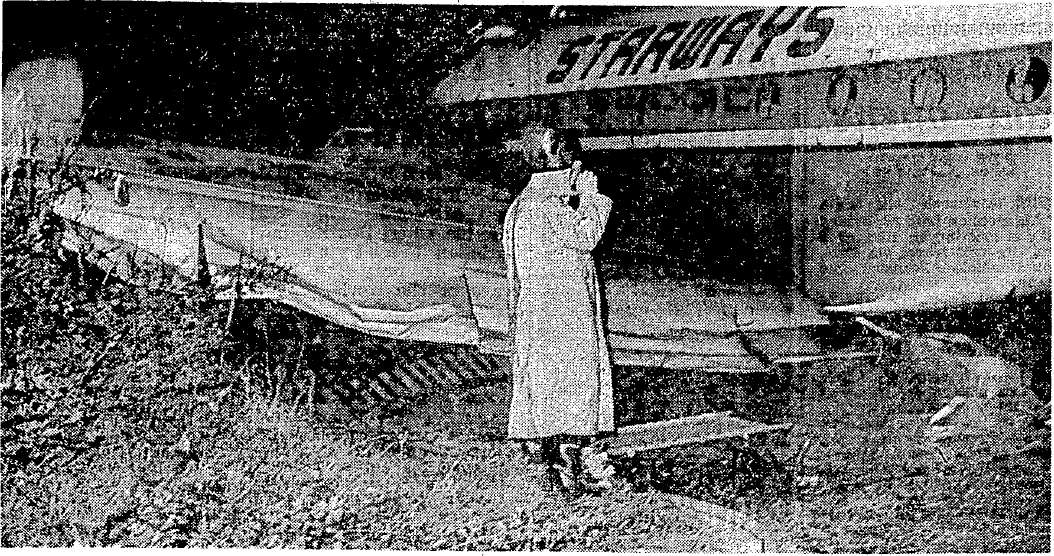
In September 1961 an Aer Rianta flight from Lourdes made a surprising landing, coming to a halt in the middle of the Dublin to Belfast road, near Cloughran. Incredibly, the 69 passengers and 4 crew on board avoided any serious injury, and about a mile and a half from their planned landing location they emerged from the plane.

Irish Press image of the plane resting on the roadway.

The plane was operated by Starways, a Liverpool based company, and was carrying Irish pilgrims. Heavy rain on the night of Tuesday, September 19th was blamed for the incident. The Irish Press described the landing, noting that “it skidded along the ground and crashed through a hedge about half a mile from the airport”. When the plane came to a halt on the road, its nose was in a ditch on one side of the road,and its tail on the far side. The captain of the plane was Ian Johnson McClean, a Glasgow native.

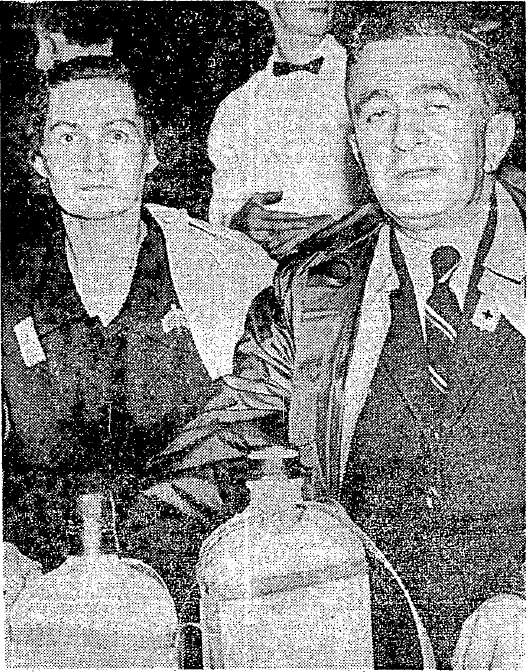
The plane came within twenty yards of striking a car, and among those on board were some members of the clergy. One couple from County Offaly attributed their survival to the bottles of Holy Water they were carrying at the time!

Holy Water saves the day (Irish Press)

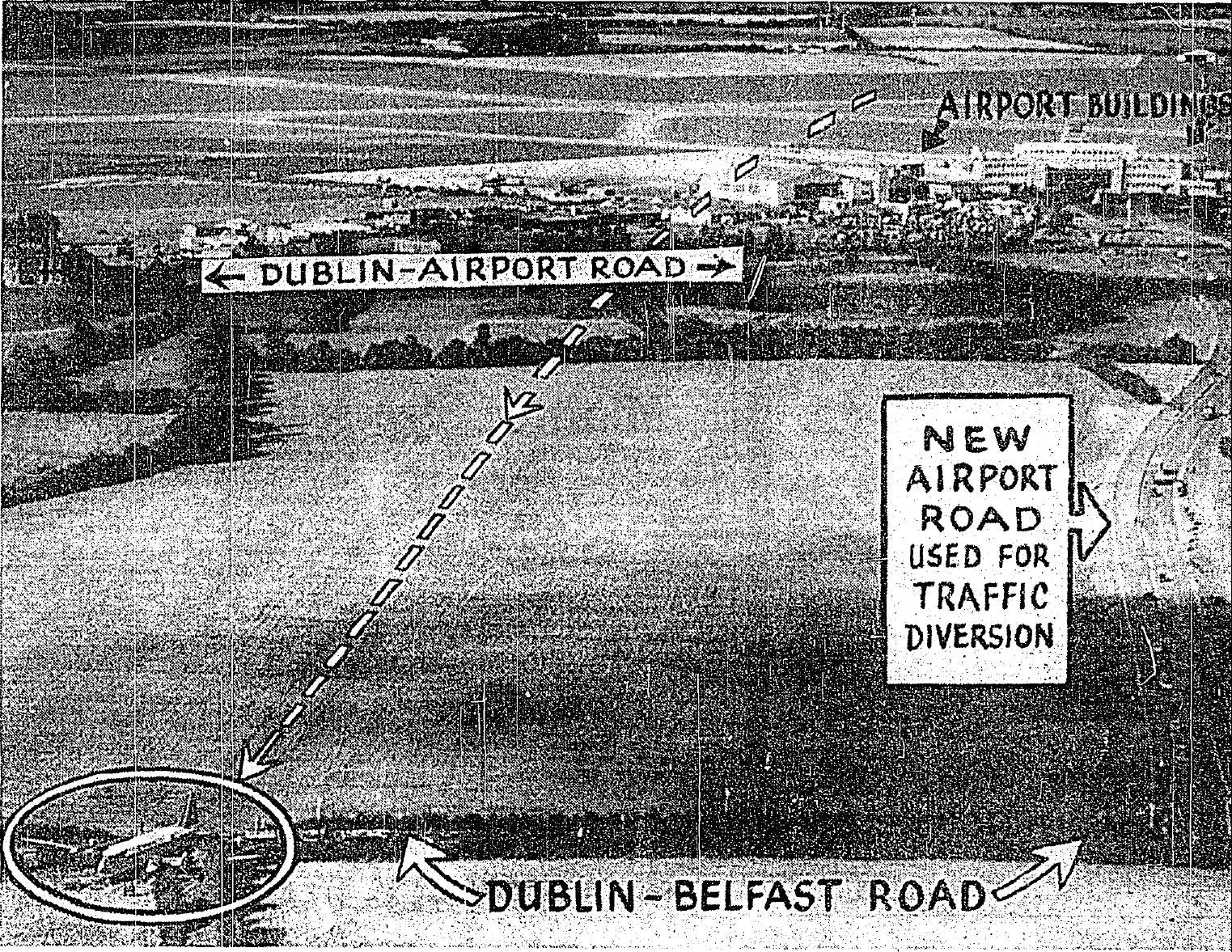
In the aftermath of the crash, the investigation into the incident revealed that the plane had almost struck the Airport Control Tower, and this Irish Independent image gave a good idea of just how serious the failed landing was, showing the distance between the airport and the place where the plane came to a halt. Unsurprisingly, most on board thanked ‘a miracle’ for their survival!

(Irish Independent).

Read Full Post »

Four years before the launch of the The Cat Laughs Comedy Festival in Kilkenny and two years before The Liffey Laugh Comedy Festival in Dublin, there came “Com-Fest ’90”.

Part of the Dublin Theatre Festival 1990, sponsored by Tenant’s Laugh and in association with Serious Productions, it was described as “Ireland’s First Festival of Live Comedy” and offered nine nights of stand-up between the 3rd and 13th of October 1990.

The international highlights were British left-wing comedian Jeremy Hardy and, his then wife, American actress and comedienne Kit Hollerbach.

Two of Ireland’s greatest sketch teams of the time were represented; Mr Trellis (Kevin Gildea, Ardal O’Hanlon and Barry Murphy) and The Quacksquad (Joe Rooney and Paul Tylak) as well as a number of Irish comedians like Ian MacPherson, Owen O’Neill, Jon Kenny who would have been considered veterans at this stage.

Then there was Sid Sinatra (a.k.a Alex Lyons who now does a lot of scriptwriting for the BBC), Mark Staunton who went onto make films, Karl MacDermott, who gave up the stand up for scriptwriting around 2000 and Niall MacAnna, now special events director with MSN.

Last but not least there were the ‘newish kid on the block’ –  Sean Hughes, Morgan Jones and Dermot Carmody who all went onto to do big things to varying degrees.

Finally, the multi-talented Shay Healy who acted as M.C.

While The Olympia and The Project Arts Centre are obviously still on the go, ‘The Goldfish Bowl Comedy Club’ in Whelans and ‘Laugh At The Loft’ in the Purty Loft in Dun Laoghaire only lasted for a couple of years after.

Dermot Carmody went onto to win the ComFest ’90 Laugh Trophy and the £1,000 prize fund.

Com Fest poster 1990 (BM collection)

Read Full Post »

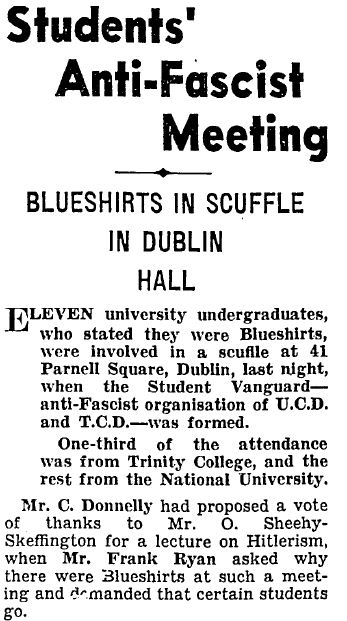
Given that this week has seen the unveiling of a mural and the erection of a plaque in memory of the Irish anti-fascists that went to fight in the Spanish Civil War 1936-39, it was great to come across the clipping below when doing research for a completely different article. Reading like a veritable who’s who of revolutionary politics, Charlie Donnelly, Frank Ryan, and the sons of Thomas McDonagh and Francis and Hannah Sheehy Skeffington all appear in an article dated May 12th 1934.

The article focuses on the foundation of a society called Student Vanguard at a meeting in a room in 41 Parnell Square. The society, a joint effort between UCD and Trinity students, unveiled its manifesto at the meeting, stating:

The Student Vanguard sees in Fascism in Ireland the bludgeon of the reactionary elements against the struggle for the national and social liberation of the Irish people.

The meeting did not go entirely to plan though, and eleven Blueshirts made their presence known at the back of the room causing a scuffle to break out and the meeting to be interrupted. Bizarrely enough, it looks very much like the Blueshirts were present, somewhat under the blessing of Charlie Donnelly, who would later fight and die in Spain, on the Republican side. A Mr. K. Patton from UCD, who declared himself a Blueshirt stated at one stage “We promised Mr. Donnelly we wouldn’t cause any trouble here tonight.”

From the Irish Press, Saturday, May 12, 1934

Frank Ryan later apologized in the meeting stating that if it was the case that the Blueshirts present were indeed there under invite, then he retracted his demand for them to leave. At the meeting, it was also stated that “Fascism (means) political, economic and cultural repression; distortion and restriction of education; the crushing of all progressive movements; perpetuation by force of ‘the present economic anarchy,’ unemployment and distress.”

Despite what seemed to pass off as a rift between two groups of students, settled by a polite handshake and an apology, a couple of years later, men from both sides would be making their way to Spain to fight on either side of the Civil War. The Blueshirts left with a fanfare, and came back without a loss in combat and with their tails between their legs. Some on the Republican side, like Michael O’Riordan and Bob Doyle would come back alive, others, like Charlie Donnelly would not.

Read Full Post »

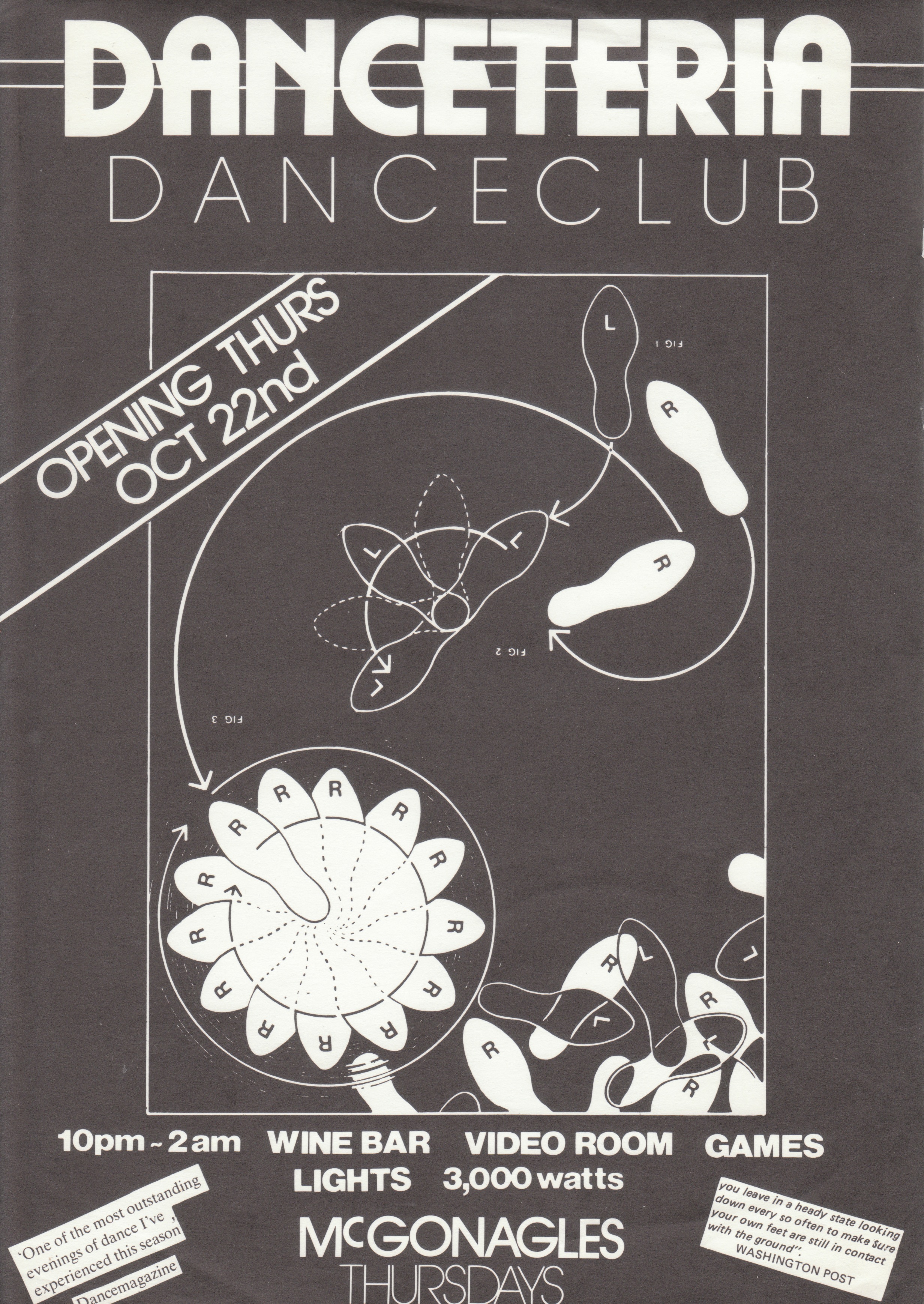
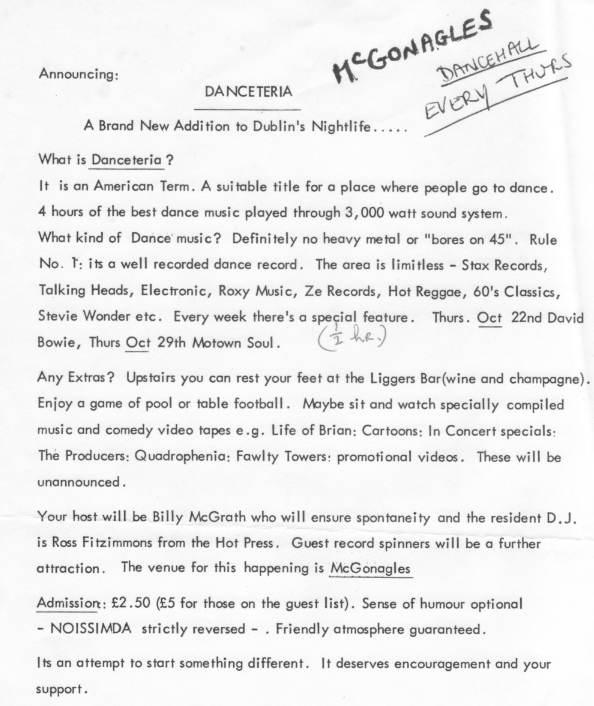
An original poster and press release for ‘Danceteria’, a night in McGonagles (previously of South Anne Street) which was launched in October 1981.

Music policy was Stax, Talking Heads, Electronic, Roxy Music, Ze Records, Hot Reggae, 60s Classics, Stevie Wonder – all on a 3,000 watt sound system. Downstairs was the dance floor while upstairs had a wine bar, pool table, football table and a T.V. showing ‘specially compiled music and video tapes’. Compere was stand up comedian Billy McGrath and resident D.J. was Ross Fitzsimons of Hot Press magazine.

It predated seminal dance nights in McGonagles like Club Voodoo and Soul On Ice which came along in the latter half of the decade.

I’m not sure how long the night itself lasted.

Danceteria at McGonagles poster. (BM Collection)

Danceteria at McGonagles press release. (BM Collection)

Read Full Post »

This aired on Sky Sports last night, and is a pretty interesting piece, an outsiders look-in at football in Ireland. Saint Patrick’s Athletic feature heavily, with an interview with Liam Buckley and footage from the recent Dublin derby between ourselves and Shamrock Rovers. Thanks to Gareth Maher for uploading this onto YouTube.

Read Full Post »

A brief look at the attempts to bring Wimbledon F.C to Dublin in the 1990s.
Wimbledon F.C

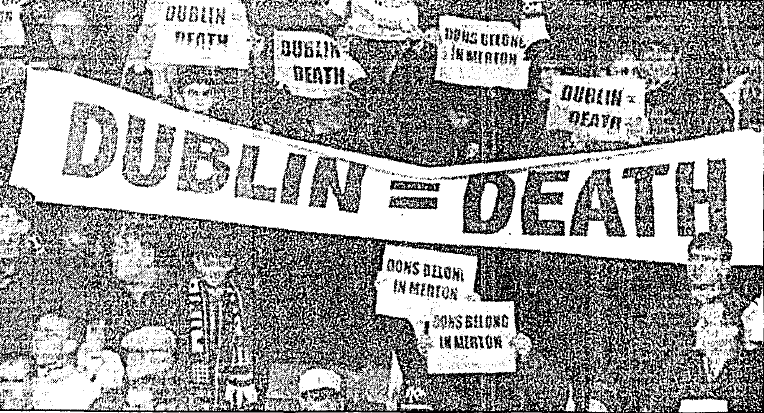
One of the most interesting disputes in the history of ‘The Beautiful Game’ in Dublin was undoubtedly that around proposals to bring Wimbledon to Dublin in the 1990s. Backed by a number of high-profile supporters, a consortium attempted to move the team here and rebrand them as the ‘Dublin Dons’. This caused considerable anger among fans of the domestic league, and the issue featured heavily in the mainstream media.

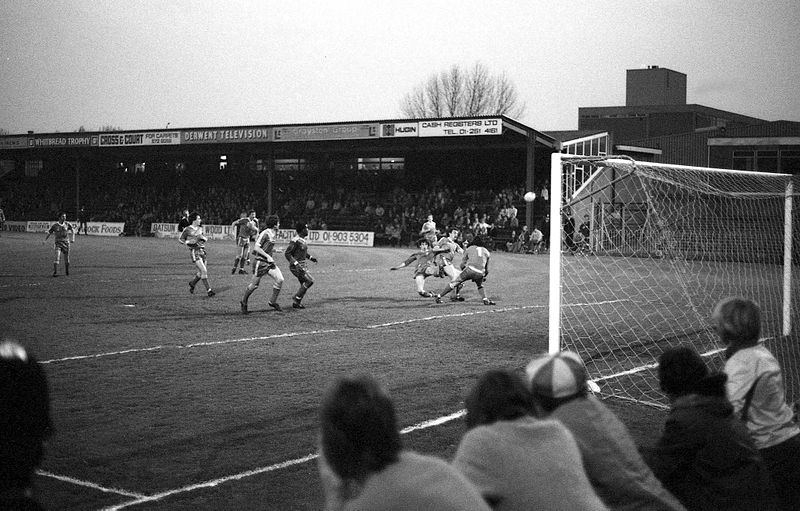
Wimbledon Football Club spent much of their football history at Plough Lane, an old-fashioned football stadium in Wimbledon, south-west London. Wimbledon had played in the ground since September 1912, but by the 1990s the ground was lagging behind and did not meet the required standards. Crystal Palace would become the landlords of Wimbledon, as the club groundshared at Selhurst Park for a period.

Among those who backed the campaign to bring Wimbledon to Dublin were Eamon Dunphy and Paul McGuinness, manager of U2. The developer Owen O’Callaghan and Dunphy were instrumental to the plan, as the hope was for Wimbledon to play their games at a stadium O’Callaghan planned to construct in West Dublin. This stadium, located in Neilstown, was intended to hold an impressive 40,000 seats. The first meetings between O’Callaghan and the owners of Wimbledon Football Club occurred in April 1996.

When O’Callaghan first met with Sam and Ned Hammam, owners of the football club, he was joined by Dunphy and McGuinness. O’Callaghan and the consortium who wished to bring Wimbledon here found common ground and interest on the matter through O’Callaghan’s planned Neilstown stadium. The prohibitive costs of that venture, coupled with a belief it would not be used to its full potential, meant that it was seen as an ideal ‘home’ for Wimbledon to relocate to. In April 1996 it was reported the consortium were urging O’Callaghan to begin quick construction on this ground, in the hope it could be completed by the 1998 football season. Among those who backed the plan to create the ‘Dublin Dons’ was the Dublin Chamber of Commerce, who in August 1996 publicly proclaimed that English Premiership football could bring huge economic benefits to Dublin.

With the domestic game, Damien Richardson was one of the few who backed the planned move to Dublin, noting that “I feel their presence here would raise the profile of the sport in Ireland and the League would benefit”, while Brian Kerr took the opposite view, believing such a move would be devastating for the domestic game, already competing with English soccer for media coverage.
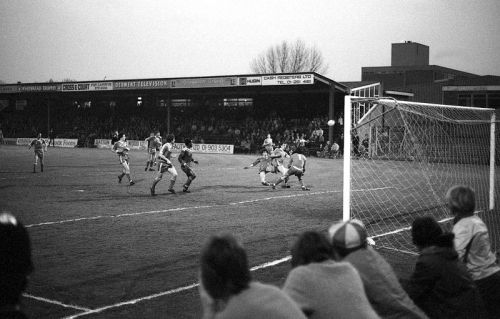
Plough Lane, the historic home of the club. (Wiki)

Opposition to the planned move from lovers of the domestic game was strong. Around 200 supporters packed into Wynn’s Hotel for a meeting in September 1996. At that meeting, Niall Fitzmaurice announced that the arrival of the “Wimbledon Dons” would mean the “death of the National League within five years”, and he went on to state that those behind the proposal had purely financial motivations claiming “they have no love for the game.”
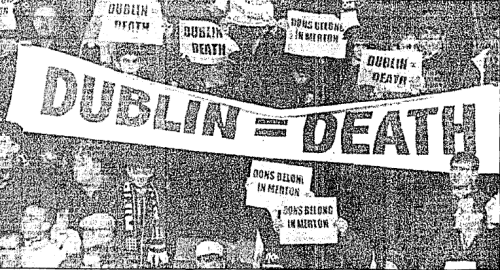
Protesting Wimbledon fans (Irish Independent, Dec. 8 1997)

The idea of moving Wimbledon to Dublin naturally upset many supporters of the club, with scenes of protest inside and outside their matches at Selhurst Park in 1997. In December of that year,Sam Hammam responded to a demonstration by Wimbledon fans following a one-nil win over Southhampton by telling the media he would “probably do the same thing” if he was a fan, but insisting that “Dublin is a fantastically sexy option, what else can I say?” Hammam even claimed that had he wanted it, he could have had the club in Dublin already, insisting that “the only reason we aren’t there is that I’ve chosen not to do it.”

A 1998 poll carried out by Lansdowne Market Research for the Irish Independent claimed that two out of three Irish adults interested in the game of football were in favour of Wimbledon moving to Dublin, but the F.A.I were among the most vocal critics of the idea, with the then Chief Executive Bernard O’Byrne insisting to the paper that all F.A.I surveys within the Irish football community told a very different story in terms of support for the proposed move.

In a brief piece on the Dublin Dons, soccer-ireland notes that:

The cost of the Dublin Dons project was estimated at £100 million (€127 million) including the stadium construction, road, rail and security infrastructure, £5 million for the FAI, £5 million for the League of Ireland clubs, and the provision of a number of football schools of excellence around Ireland.

Ultimately, the opposition of the F.A.I would prove crucial to preventing the move, with Bernard O’Byrne outlining the Associations opposition to the move in a five-page letter sent to the chairmen of every Premiership club in 1998 for example. Likewise, UEFA and FIFA opposed the idea, which proved a crippling blow. Interestingly, in one media interview Bernard O’Byrne mentioned the infamous Lansdowne Road riots of 1995 and asked “do people want 5,000 English football fans every fortnight in Dublin?”. Wimbledon were eventually moved to Milton Keynes, against the wishes of many of their supporters. This new relocation, while keeping the club in England, still ripped the club from its historic heartland. The club fell into financial crisis, and in 2004 was totally rebranded as MK Dons F.C. Out of opposition to the clubs relocation, some fans set about establishing AFC Wimbledon, who currently play in League Two of the Football League in England.

Read Full Post »
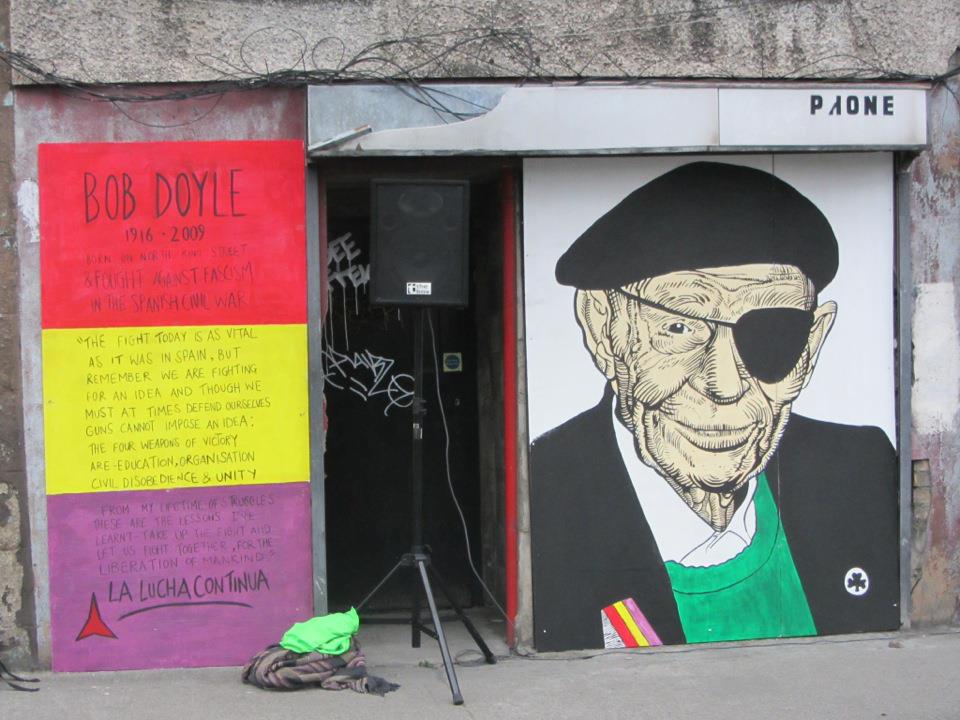
Over the weekend, Anti-Fascist Action Ireland unveiled a new plaque and mural to celebrate their 21st birthday.

The plaque above Connolly Books in Temple Bar, launched by Tom Redmond, Manus O’Riordan and Cllr. Cieran Perry, is dedicated to all those Irish who went to Spain to fight for the Republic during the Civil War.

Plaque, Connolly Books (Photo – MW)

The mural at The Cobblestone pub in Smithfield, unveiled by Harry Owens and Thomas the artist, is dedicated to local Irish Republican and International Brigader Bob Doyle (1916 – 2006)

Bob Doyle mural, Smithfield (Photo – SO)

More pictures can be viewed here on their Facebook page here.

Read Full Post »
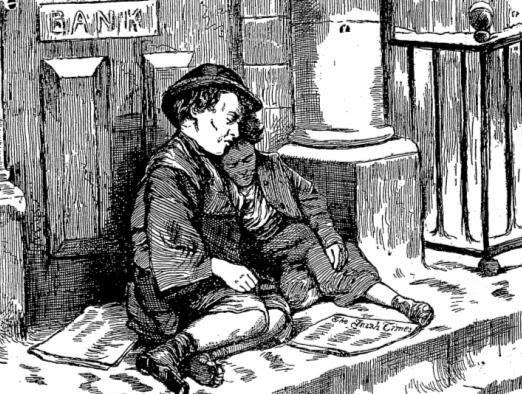
The Irish Times, December 20 1884.

I’ve always loved this illustration of two Dublin newsboys from The Irish Times, published in 1884. It is the earliest illustration of Dublin newsboys I’ve been able to find, and shows two ragged youngsters resting in the doorway of a bank premises.

While street selling is an ancient tradition, the idea of the ‘newsboy’ came to prominence in the British Isles in the 1850s, with the arrival of cheap daily and evening newspapers. Writing in The Journal of the Royal Society of Antiquaries of Ireland in 1924, George Wm. Panter noted that:

The newsboy as we know him now is quite a latter-day institution. Lai Brough, the comedian, whom, doubtless, some may still remember, used to tell how in his early manhood he became assistant publisher to the Daily Telegraph on its establishment in 1855, and that while occupying that position he originated the custom of selling newspapers in the streets by organising a staff of two hundred and forty boys for the purpose. We have seen that the custom existed of selling newspapers in the streets previously, but undoubtedly newsboys were first hired for that purpose in 1855.

References to newsboys operating in Dublin can be found in The Irish Times from the early 1880s, with a letter signed ‘Pro Bono Public’ appearing in the paper in 1882 noting the ‘many trials and hardships which the majority of the newsboys of Dublin have to contend with’ and asking ‘would it not be a truly charitable and benevolent undertaking for the citizens of Dublin to provide a Newsboys Home in a central place’ for the use of these young Dublin workers. In the 1880s, Dublin newsboys were presented in newspaper reports as being typically ragged and barefoot, with The Irish Times in 1884 producing the above illustration entitled ‘The Tired Newsboys!’ showing two young, ragged dressed youths asleep in a doorway, with a poem underneath noting that ‘they may perish! of cold or some worse fate!’

Read Full Post »
High Flying Saints

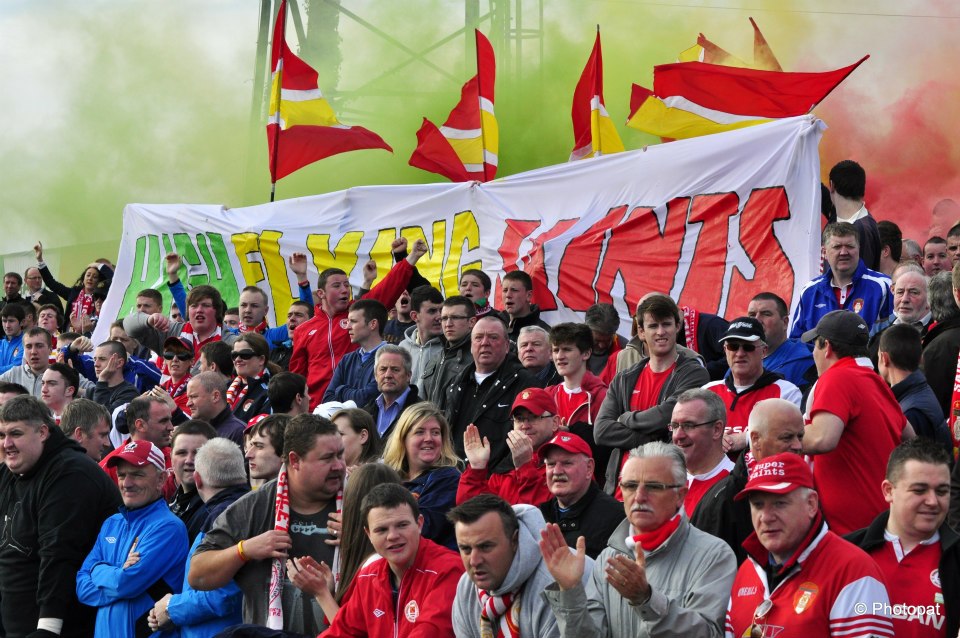
High Flying Saints! Photo: Photopat (C)

There’s nothing as painful as following a match by text updates, not least an FAI Cup Semi-Final. With work obligations, I was destined to follow Pats yeterday through a series of sporadic text messages from the brother. The first one, that “in a moment of unprecedented football history, Dundalk are two-nil up before kick-off”, raised a smile at least.

This image above, from one of the weekly club photographers Photopat, really captures it for me. Last year, the banner in the semi-final against Shelbourne told the lads to ‘Rise like lions after slumber’. This year, the lions have certainly risen.

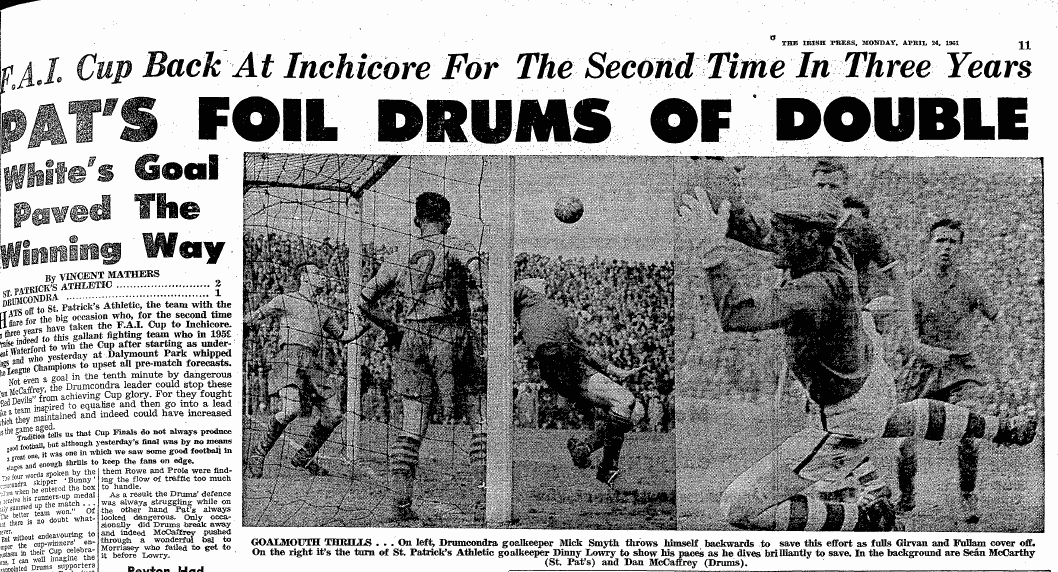
The last time we won the cup, the Irish Press was still in existence!

Read Full Post »
« Newer Posts - Older Posts »