Hidden in the middle of a 1970s housing development in Rathfarnham lies the ruins of a Georgian home, boasting a fascinating history.
Known as The Priory, this house which stood for at least 150 years, played an integral role in “the greatest love story in Irish history”; that of Sarah Curran and Robert Emmet.
Its journey from a beautifully well-kept homestead to a vandalised ruin sums up the unfortunate recurring story that sees the Irish State and other bodies not doing its job in preserving objects of great historical interest.
The house, which was linked to secret societies, wild parties, underground passages, fatal accidents, ghosts, secret rooms and a long-running quest for a forgotten grave, has all the hallmarks of a fantastic melodramatic thriller.
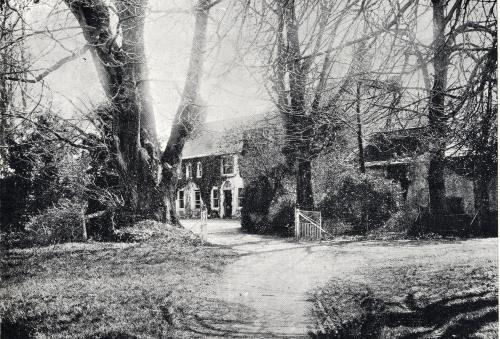
The mystical entrance into The Priory house. Taken from Footprints of Emmet by J.J. Reynolds (1903).
In 1790, the famed barrister and politician John Philpot Curran took possession of a stately house off the Grange Road in the south Dublin village of Rathfarnham. He renamed it The Priory after his former residence in his hometown of Newmarket, Cork. A constitutional nationalist, Curran defended various members of the United Irishmen who came to trial after the failed 1798 rebellion.
[It has been erroneously reported that Curran took over a residence, originally called Holly Park, which he renamed The Priory. Holly Park was, in fact, the name of the home of Jeffrey Foot which stood to the south of Curran’s home. Foot was an Alderman of Dublin Corporation who followed his father’s footsteps into the tobacco and snuff industry. Holly Park later became St Columba’s College and is still in use.] [1]
One of Curran’s earliest biographer’s, William O’Regan, described the view from the second floor of The Priory:
of interminable expanse, and commanding one of the richest and best dressed landscapes in Ireland, including the Bay of Dublin; on the eastern side May-puss Craggs and obelisks, and a long range of hills.
O’Regan described the house itself as “plain, but substantial, and the grounds peculiarly well laid out and neatly kept”. One source, The Irish Times on 14 August 1942, suggests that the higher proportion of the house was the part that Curran rebuilt with the rest of the dating back to the Queen Anne period (1702–1714).
A window under a large box tree beside the house was said to have been the venue for Sarah Curran’s final goodbye to Emmet in 1803. More on their relationship later.
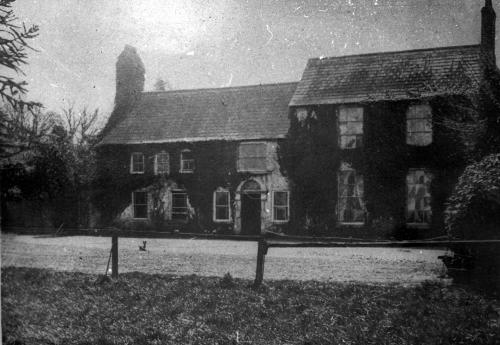
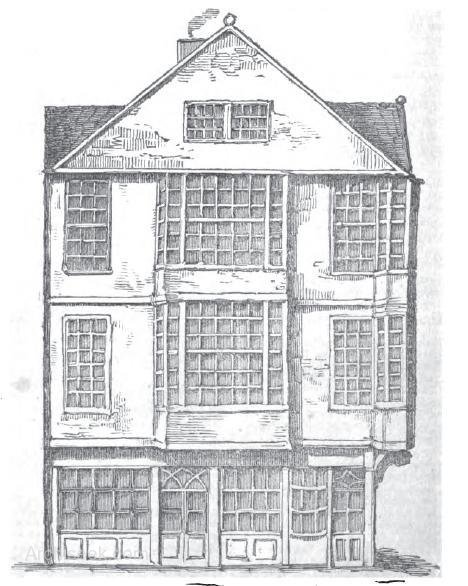
The Priory as it would have looked from the 1790s to the 1920s. Pictured in 1903. From Footprints of Emmet by J.J. Reynolds (1903).
Curran was a founding member of an elite patriotic drinking club called The Monks of the Screw (a.k.a. the Order of St. Patrick) who were active in the late 1700s. The membership, numbering 56, included politicians (Henry Grattan) judges (Jonah Barrington) priests (Fr. Arthur O’Leary) and Lords (Townshend). Many were noted for their strong support of constitutional reform and self-government for Ireland. The club used to meet every Sunday, in a large house in Kevin’s Street owned by Lord Tracton.
Given the title of the ‘Prior’ of the Monks, Curran used to chair their meetings at which all members wore a cassock. It was he who wrote their celebrated song whose first verse goes:
When Saint Patrick this order established,
He called us the Monks of the Screw
Good rules he revealed to our Abbot
To guide us in what we should do;
But first he replenished our fountain
With liquor the best in the sky;
And he said on the word of a Saint
That the fountain should never run dry.
Curran also used to host the Monks at his home in Rathfarnham in a special room situated to the right of the hall-door. The two outside legs of the table, at which they would sit, were carved as satrys’ legs. Between them was the head of Bacchus (God of the grape harvest and winemaking) and the three were wound together by a beautifully- carved grapevine. It was also written that an elegant “mahogany cellarette in an arched recess in another part of the room was cap able of holding many dozens of wines” [2]
The parties, as can be imagined, were all-night affairs. Wilmot Harrison in his book Memorable Dublin Houses (1890) wrote that:
Ostentation was a stranger to his home, so was formality of any kind. His table was simple, his wines choice, his welcome warm, and his conversation a luxury indeed … There were beds prepared for the guests, a precaution by no means inconsiderate. When breakfast came it was sometimes problematical how the party were to return. If all were propitious, the carriage was in waiting; if a cloud was seen, however, the question came “Gentlemen, how do you propose getting to court?”
The house was allegedly haunted by a mischievous ghost who spent most of his time in a secret room of the house, which was eventually closed up by Mrs. Curran.
Tragedy struck on 6 October 1792 when Curran’s youngest daughter Gertrude accidentally fell from a window of the house and was killed. Devastated at the loss of his favourite child, Curran decided to bury his daughter, not in a graveyard, but in the garden adjacent to The Priory so that he could gaze upon her final resting place from his study in the house.
Little Gertrude was buried in a vault and a small, square brass plaque was put on the stone slab reading:
Here lies the body of Gertrude Curran
fourth daughter of John Philpot Curran
who departed this life October 6, 1792
Age twelve years.
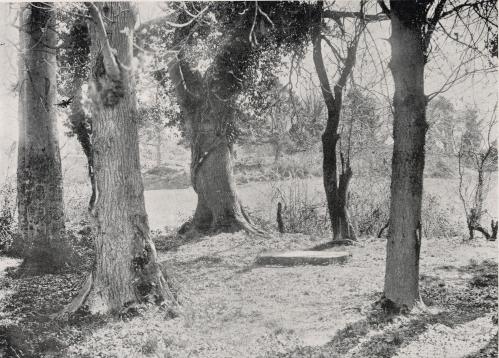
Grave of Getrude Curran, killed aged only 12 in 1792. From Footprints of Emmet by J.J. Reynolds (1903).
Sarah Curran’s last request on her death bed was to be buried “under the favourite tree at The Priory, beneath which her beloved sister was interred” [3] but Curran did not agree to this. Lord Cloncurry told Richard Robert Madden, historian of the United Irishmen, that Curran did not accede to the request because he had been previously criticised for burying Gertrude in unconsecrated ground. [4] The fact that Curran also disowned and essentially banished his daughter Sarah obviously had something to do with it as well.
(more…)
Read Full Post »

















 Click on the book for more.
 Click on the book for more.
 Donal
Donal Ciarán
 Sam
Sam


 Come Here To Me!