
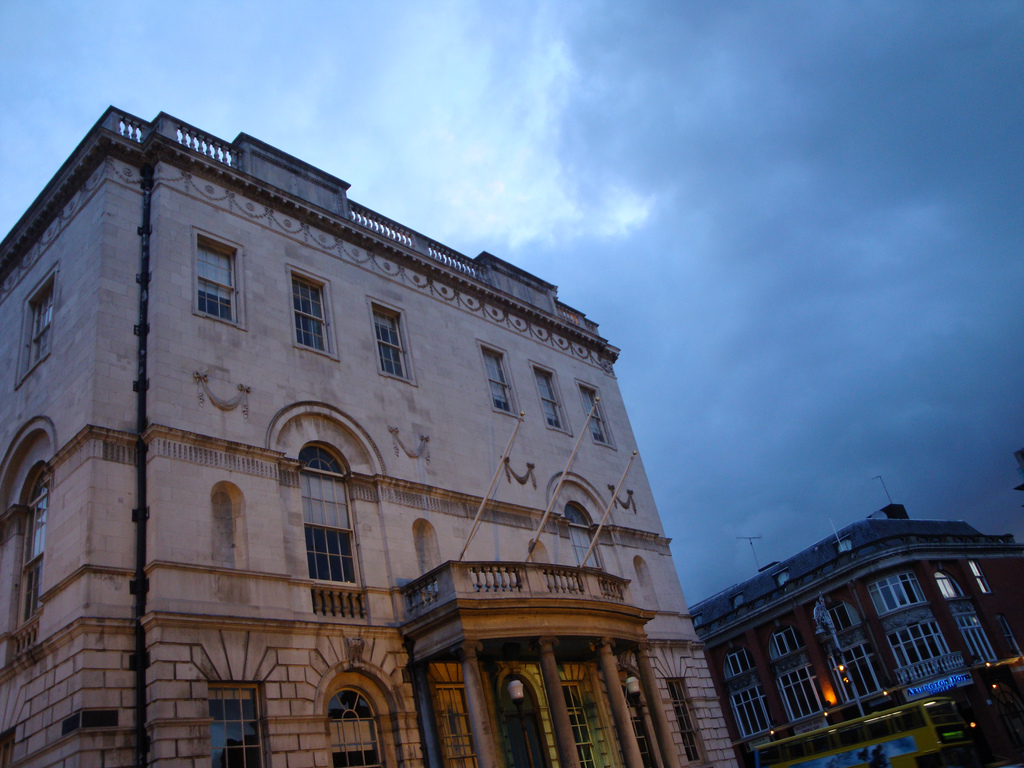
One of James Malton’s famed illustrations of eighteenth century Dublin, showing the Irish Parliament on College Green. (c.1793, NLI)
Dublin history is littered with famous gangs, from the Liberty Boys to the Animal Gangs. These gangs have entered the folklore, songs and popular history of the city. One rather unusual gang who haven’t quite received the same amount of attention are the ‘Pinking Dindies’ of the eighteenth century. The ‘Pinking Dindies’ are an interesting phenomenon in that they sprang from the upper-echelons of society, while gang violence often has its roots in lower socio-economic groups. When we think of gangs in Dublin we think of times of poverty and areas of misery, but this gang existed at a time of great prosperity in Dublin.
Margaret Leeson was Ireland’s first brothel owning ‘madam’, and a fascinating woman. Born in Killough, Co. Westmeath, she would become the most famous of Dublin’s eighteenth century madams, and even published her memoirs in 1797, opening the work by noting “I shall now commence with the most memorable epoch of my unfortunate life….”
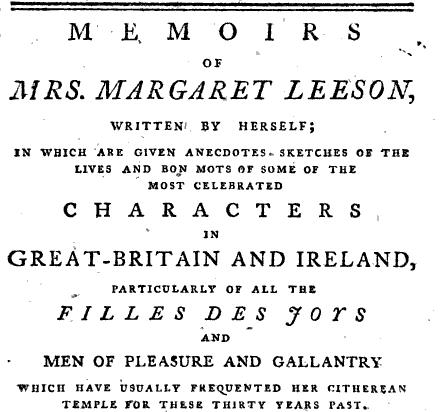
Her first brothel in Dublin was opened on Drogheda Street, and I had read that this premises was closed owing to the vandalism of a group called the ‘Pinking Dindies’. In Leeson’s work she complains that Dublin was home to many men who “however they might be deemed gentlemen at their birth, or connexions, yet, by their actions, deserved no other appellation than that of RUFFIANS.” Researching this group, I found plenty of information within J.D Herbert’s book Irish varieties, for the last fifty years: written from recollections. Published in 1836, this book is a fascinating insight into the gangs and characters of Ireland once upon a time.
Writing about ‘Pinking Dindies’, Herbert notes that:
It is now upwards of fifty years since Dublin was infested by an organised body of dissolute characters, composed of persons; some were sons of respectable parents, who permitted them to get up to man’s estates in idle habits, without adequate means of support; others were professional students, who having tasted the alluring fruits of dissipation, abandoned their studies and took a shorter road to gain supplies, by means no matter how fraudulent.
Herbert writes about a gang of wealthy men who roamed the streets, men of “imposing appearance, being handsome and well made in general”. In a time before the establishment of the Dublin Metropolitan Police force, Herbert writes that these men were so well prepared for violence that the “ancient and quiet watchmen” who guarded Dublin were no match for them. These wealthy men would “assail passengers in the street, to levy contributions, or perhaps, take a lady from her protector, and many females were destroyed by that lawless banditti.”
The account Herbert provides of these ‘Pinking Dindies’ is grim, noting that one manner in which they would raise funds was through extorting girls who worked within brothels, “by exacting from unfortunate girls, at houses of ill-fame, their share of what they deemed booty.” The gangs would also be frequently found at a gambling house on Essex Street, which when unsuccessful they would emerge from “enraged at their loss, and repaired them, by robbing the first eligible subject they met in the streets.”
Well-dressed and presented, the standard plan of attack for the men was to jostle a victim meant for prey, and then, with their swords “just protruded, they pricked him in various parts, and if he did not throw down his watch and money,two others came and took it by force.”
What became of the Pinking Dindies? Herbert claimed that the gang were ” never finally extirpated until the police was established. That useful institution, though decried by many, was more salutary and timely to the city of Dublin than any plan that has been since devised”. He noted that “several went to London,
and became expert at gaming-tables ; two of them were enabled to obtain admission to clubs in St. James’s-street, and I have often seen them walking and conversing familiarly with high fashionables.”
Read Full Post »













 Click on the book for more.
 Click on the book for more.
 Donal
Donal Ciarán
 Sam
Sam


 Come Here To Me!