Feeds:
Posts
Comments

Archive for the ‘Dublin History’ Category

Kingsland RIP

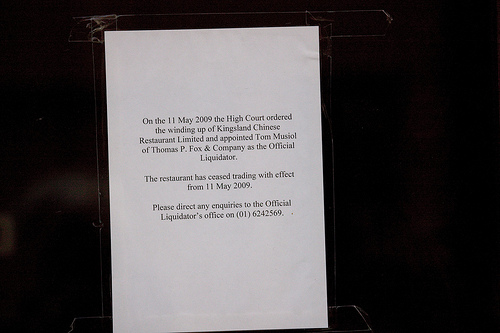
While walking down Dame Street over the weekend, I was shocked to see that Dublin favourite Kingsland chinese restaurant had gone. In its place was a much more gaudy looking establishment called KingCharlies.

A quick google search led me to finding out that it actually closed back in May 2009!

Picture: infomatique (flickr)

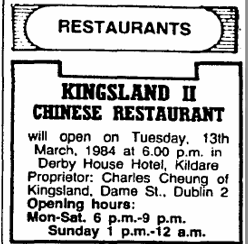
Kingsland was a real Dublin institution. I’ve been trying to find out when it actually opened. The newspaper clip below shows that they opened another branch in Dalkey in 1984, so I guess the Dame Street restaurant dates back to at least the early 1980s? I’ve made the necessary correction on my list of Dublin’s oldest restaurants that are still open.

(c) The Irish Times. Tuesday, March 13, 1984.

Read Full Post »

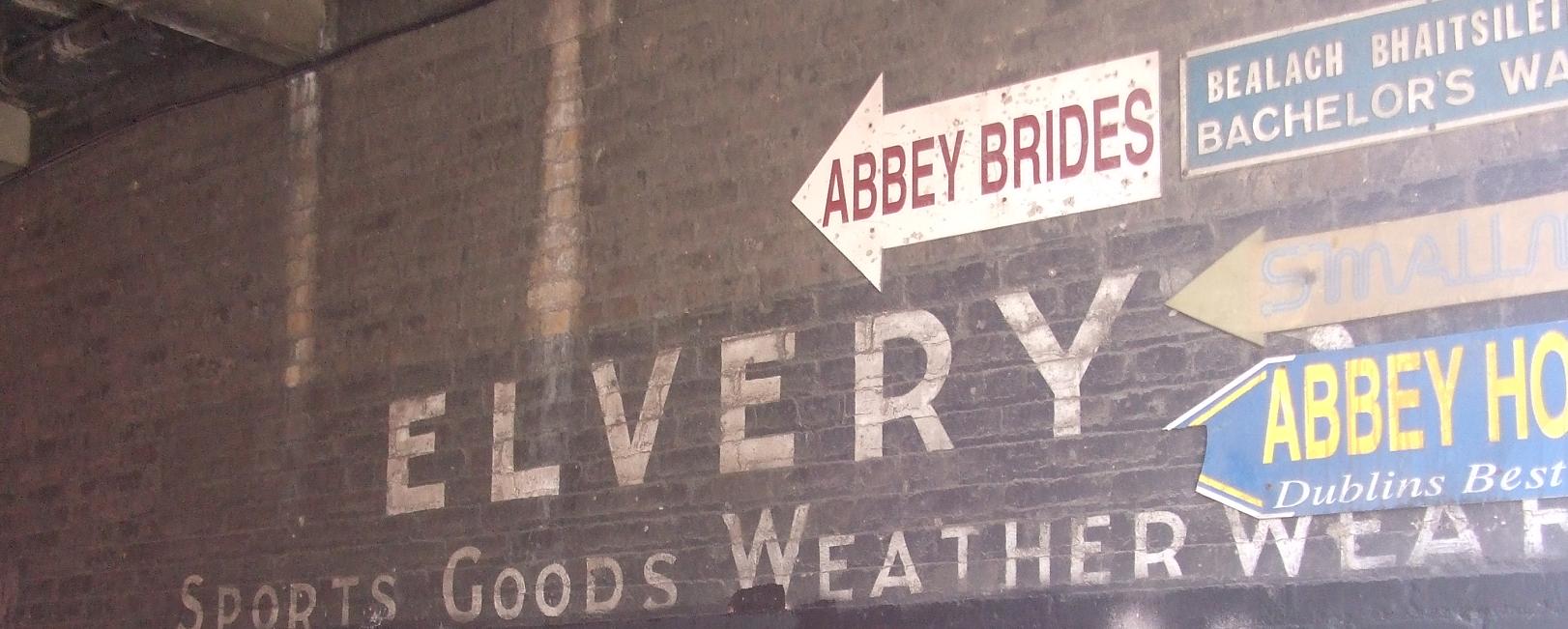
The Daniel O’Connell newsagents on the corner of Bachelors Walk and O’Connell Street is something we’ve touched on before. A real effort to make a quick quid on the tourists, it’s not hard to work out why it was given the name it boasts. It was once Elvery’s of course, and the Elvery’s advertisement in the laneway behind it is a great little throwback.

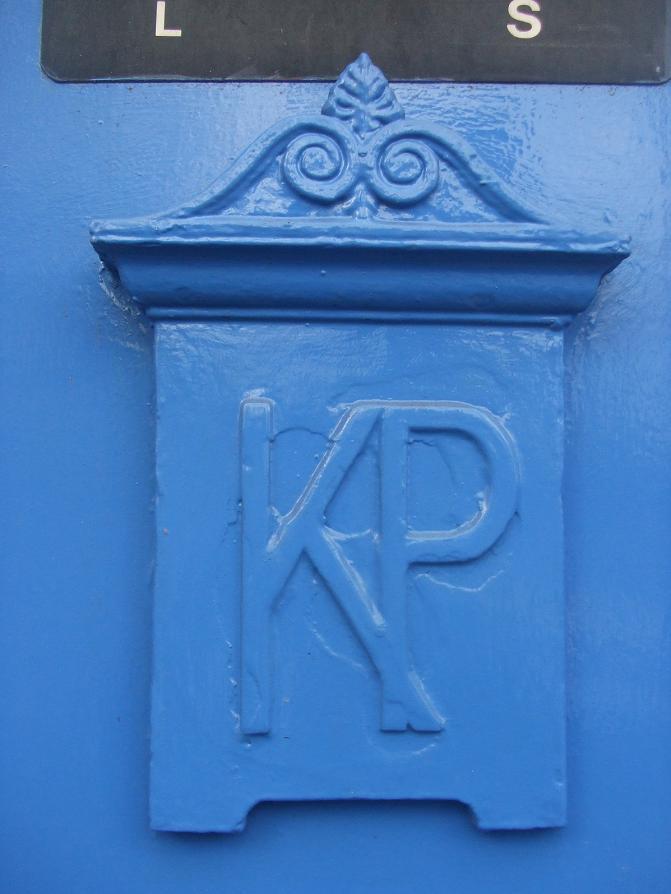
Something I always notice, but it seems passes a lot of people by, is the woodwork. The KP lettering has survived many coats of paint, and is something I always remember looking at as a kid at the traffic lights by O’Connell Bridge. There’s also Kapp and Peterson branding on the roof on the premises, which is visible from the O’Connell statue.

How many buildings in Dublin have fronts like this which give a bit of their history?

Read Full Post »

Back to the Future

(c) The Irish Times

The iPhone app Dublin City Walls is a virtual tour guide of a kind that could transform our experience of historical sites

YOU KNOW the way you sometimes go to visit a historical site and when you find it there’s just a bump in the ground or a pile of stones – and that, pretty much, is that? Those who are trained in matters historical can get their imagination into gear and fill in some of the gaps. But for the rest of us it can be a somewhat underwhelming experience.

A new iPhone app promises to revolutionise the way we interact with our heritage sites. Dublin City Walls uses high-resolution graphics, 3D imaging, video and GPS technology to bring the marvels of medieval Dublin right into the palm of your hand. – The Irish Times

If only I had an I-Phone. 🙂

(c) The Irish Times

Read Full Post »

Story Map

Storymap presents a charming vision of Dublin through its stories and storytellers.

Fantastic idea. Storymap interviews various Dubliners all over the city, each of whom tells their own little story whether historical or personal.

Add them on Facebook here and check them out on Youtube here.

Read Full Post »

This is a fascinating read. It’s a 1934 Communist Party of Ireland leaflet regarding the threat of fascism to Ireland, and looking at the international situation. I’ve had this scanned up for a few days but am tragically internetless so pardon the delay. It was part of a collection of leaflets gathered by the Gardaí at left wing demonstrations in the capital in the early 1930s. As ever, click to expand.

Read Full Post »

Remembering Bang Bang

Thomas Dudley a.k.a. Bang Bang was one of Dublin’s most loved and remembered street characters. Dudley was a big fan of cowboy films and in the 1950’s and 60’s he traveled all over Dublin staging mock shoot outs with people using a large church key as his “gun”.

2011 marked the 30th anniversary of his death and last week the Lord Mayor of Dublin, Gerry Breen, presented Dublin City Archivist, Dr. Mary Clark with a key that belonged to Bang Bang.

The key was presented to the Lord Mayor by Gerry Doherty, a great friend of Thomas Dudley who held the key for many years and will now be available to view in the Reading Room of Dublin City Library & Archive, 138-144 Pearse Street, Dublin 2.

The only known photo of 'Bang Bang'. Credit - gormangenealogy

Read Full Post »

The Digital Projects section of Dublin City Public Libraries have over the past year done great work in sticking up old images of the City in times past. The latest collection to go online is one hundred and thirty or so images of Dublin pubs, some whose doors are still open, others who who live only in the memories of ex- punters. The full gallery can be seen here.

The Commodore, from Dublin City Public Libraries

The Swallow, from Dublin City Public Libraries

The site is a mine of photographic information, they have fantastic galleries on Dublin’s Sporting Heritage, the ’74 Dublin Bombings, “Missing Dublin” and now this. I look forward to more.

Billy Lavelles, from Dublin City Public Libraries

Read Full Post »

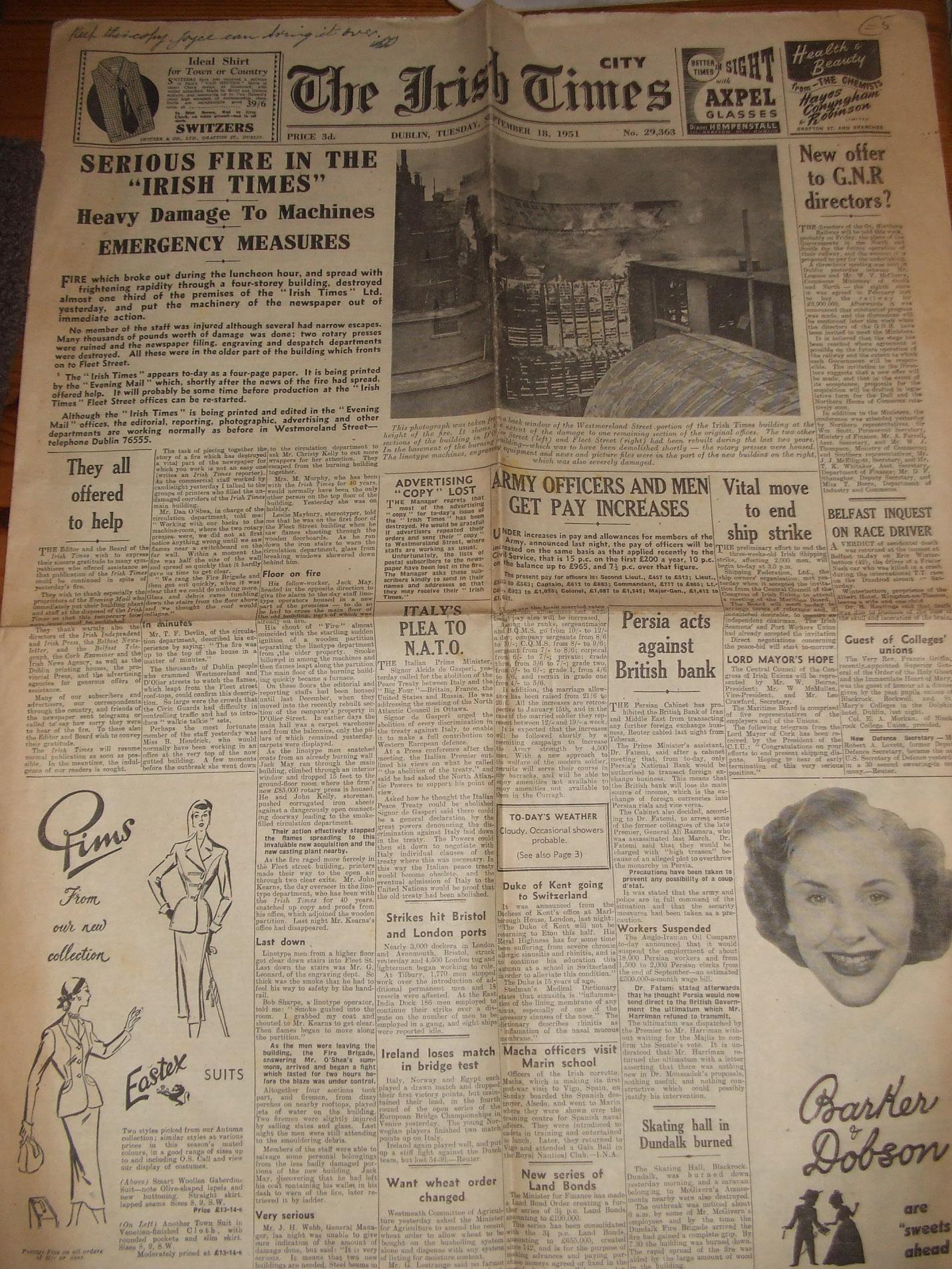
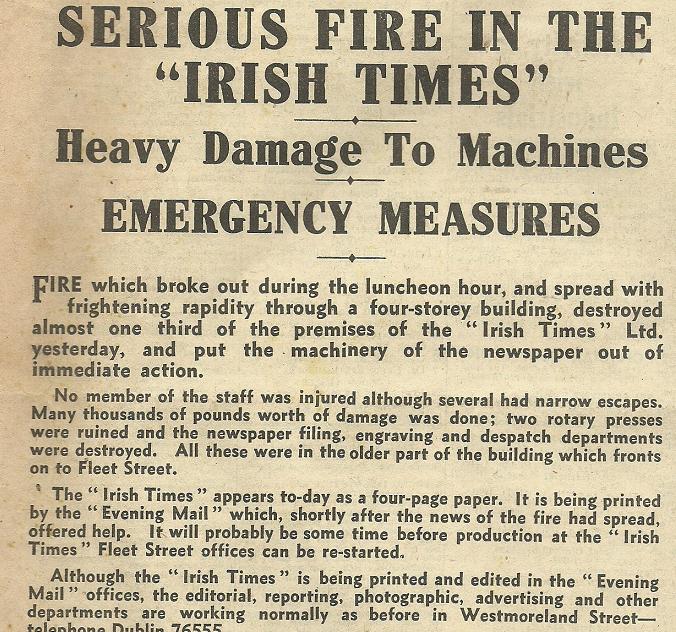
On September 18, 1951 The Irish Times of the day was a most unusual one. It was only four pages of content, owing to a fire which destroyed about a third of the companies premises on Westmoreland Street. Below is the front page of the paper which I picked up recently. Note the side column entitled ‘They all offered to help’ detailing the manner in which other Dublin based publications offered assistance to get the paper out on the 18th. It was an incredible display of the work ethic and attitude of the paper that on September 18 1951, one could still purchase The Irish Times from their local vender.

Click on the image to enlarge it. The paper was quite fragile so I didn’t wish to scan it.


Read Full Post »

These were discovered hiding in the attic recently, coming from the Watts Gunsmiths which used to be based at 18 Ormond Quay. I’m fascinated by the history of gunsmiths in Dublin, does anyone have a photograph of Watts they can share? Previously, I uploaded this company logo from the ‘compliments’ card of the shop.

Today, Watts is the adifferentkettleoffishaltogether art space at 18 Ormond Quay. We love to document the live of Dublin buildings, so a snap of Watts as it once appeared would be most welcome.

Read Full Post »

Toners is an unique pub. It has was a haunt of Kavanagh and his ilk in the 1940s and 1950s, it was an important venue for punk and rockabilly in the 1970s and 1980s and now in 2010-2011 it holds irregular electronic/bass gigs.

While helping to help set up sound equipment at the Munchi gig last November, I was able to have a brief poke around in the back underground rooms/passages.

If only the walls could talk…

credit - jaycarax


credit - jaycarax

Read Full Post »

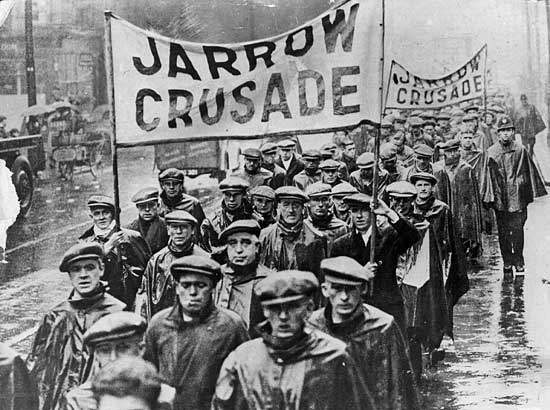
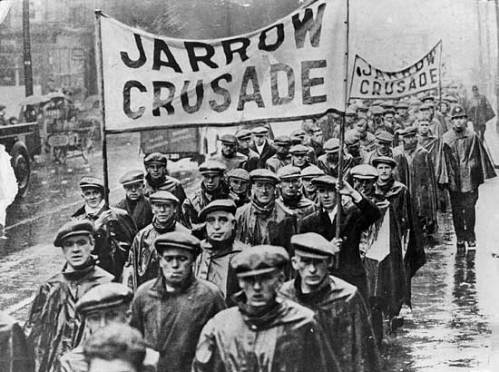
The famous Jarrow Crusade of 1936.

I’ve just been on Liveline, which was a new experience.

I was approached to give a bit of historical context to the march on the capital by a group of South Kilkenny men who are completely fed up with how things have turned out for them and indeed all ordinary people in this state in recent times. Some of them are now unemployed, others have had to wave children off at the airport. In short, they decided to march onto the capital because in years to come none of them could stomach the idea of saying ‘we sat back and watched’.

In my brief time on air, I spoke about a 1953 march on the Dail, dealt with here before by Sam. In that piece, Sam wrote that

Jubilant scenes follow when the news is spread that the march will make its way down to the Dail, “the first time such a protest has been held at its gates”.

Now, taking your anger to the gates of the Dail is routine. Walking so far to do it however is not. It is an incredible act on the part of these men.

We are supposed to have come a long way from the doom and gloom of the 50’s and later the 80’s, but have we really? Tomorrow, those men will begin their march on the Dail, passing so many areas of historical importance. They will begin at Kilmainham Jail, where the leaders of the 1916 insurection were executed, and will pass the spot where Robert Emmet was hanged. Along the way too, Dublin Castle, for so long the fortified home of the British administration in Ireland. Yet a ‘free’ Ireland, appears to be one of great economic and social divisions and barriers, and a nation that could be described as on a life support machine.

Post independence, we know Dublin Castle as the place where Bertie Ahern went to justify(or talk away) his actions before a Tribunal. What a sad, sad reflection on our state.

I ended my brief time on air today by quoting a few lines from the great folk singer Liam Weldon, about how those who died for liberty “have died but for a dream.” We are living through extraordinary times to say the least, and I was delighted to be asked to show these men some historical spots in the capital on their way to the Dail. Like them, I just hope in decades to come I can say I didn’t sit at home through this incredible chapter of Irish history.

You’re more than welcome to join them, they will set out from Kilmainham Jail at 12 tomorrow.

Read Full Post »
Though we’re still riding out a cold January, it wouldn’t be fair to exclude this chart-topping radio-friendly rock ballad just because of its title.

I’m not sure what the story is with the video though. While the single came out in 1980 the video has live footage from 1985 and it would seem near impossible to date the opening scenes of the city. My guess would be mid 80s.

The first minute and a half features Grafton Street, Suffolk Street, Ha’Penny Bridge, College Green and the quays. How dated do the green buses look!

Damien Corless, in a piece last year entitled ‘I remember that summer in Dublin. . . and it was bloody awful’, deflated the idea that Dublin in 1980 was a care free, wonderful place and took issue with Bagatelle’s single.

Read Full Post »
« Newer Posts - Older Posts »