Feeds:
Posts
Comments

Archive for the ‘Dublin History’ Category

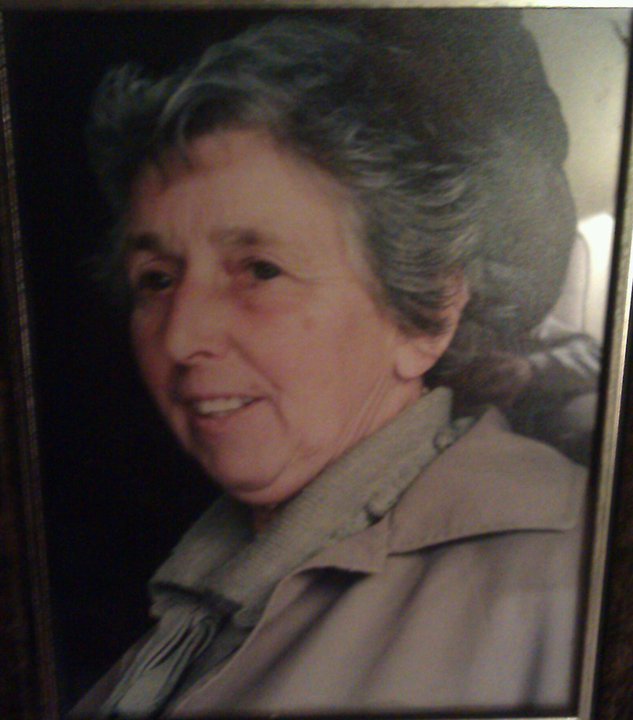
Peggy Keogh RIP

Dublin lost one of its real characters this week with the passing of Peggy Keogh.

Born Margaret Keogh (nee Dowdall), of Cabra Road, she will be most remembered for selling Doctor Marten boots to a generation of Dubliners from her stall at the back of the Ilac Centre. For most of the 1970s and 1980s, Peggy Keogh’s stall was the only place in Dublin where you could get yer Docs.

Her great-grand mother started off selling second – hand clothes and furniture in the 1910s in the area where the Ilac Centre now stands.

Tributes have been pouring in on Boards.ie and Biker.ie

Peggy’s son, the actor Garret Keogh, was on Joe Duffy yesterday speaking about his mother’s life.

Her grand children have set up a facebook page in memory of her and are asking people to leave any recollections.

Peggy Keogh (1923 - 2010)

Read Full Post »

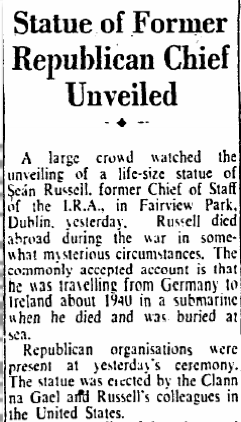
In 2001 Saoirse, the paper of Republican Sinn Fein, published a very interesting Special Branch report on the Seán Russell Memorial unveiling that took place in September 1951. It is said that a writer found it in the Archives during his own research into Russel.

The branch report lists in detail the attendees, their vehicles and their movements. The long list of IRA members and a separate list of “fellow travelers” should be of interest to students of history in the not so distant future.

The Irish Times. Monday, September 10, 1951.

Read Full Post »

For all you students and dolies, you can visit the new exhibition in the GPO for free by printing out the following page. Why not use the €2 saved to buy yourself a nice bar of chocolate?

The exhibition reopens on January 4th and is open Monday to Friday (10am to 5pm) and Saturday (10am to 4pm).

Read Full Post »

A different time altogether.

A time when three young families were forced to squat an empty hotel for somewhere to live.

I wonder will we see these days return?

The Irish Independent. August, 01 1969.

Read Full Post »

Someone picked me up a series of 1916 press cuttings from the English papers of the day at Christmas. These two are great. Some of you may have seen the images before, but for those who haven’t, look at the man just casually observing the situation in the first, while in the second we have a few true Dubs out for a quick buck before the smoke settles. We’d all have done it too.

Read Full Post »

Chapters of Dublin is a wonderful resource, and one I come back to time and time again. There, I recently found J.T Gilbert’s excellent History Of Dublin, a work I had frequently seen referenced but never read myself. Chapters of Dublin have volume 1 of the work online, where it can be read for free. This folks, is what the internet is for.

Volume 1 focuses on the areas around Christchurch and Dublin Castle, with Fishamble Street particularly fascinating.

In Fishamble-street were the “Swan Tavern” (1639), the Ormond’s Arms” (1662), the “Ossory” (1664), and the “Fleece Tavern” (1666). The locality of the latter, on the western side of the street, is still indicated by “Fleece-alley,” which, in the last century, was chiefly occupied by velvet eavers, man of whom were distinguished for the beauty and richness of the fabrics which they manufactured.

Here, in the reign of Charles I., was the “London Tavern,” which in 1667 is described as “a timber house slated, a base court, a back building more backward, and a small garden in Fishamble-street.” In this tavern was the office of Joseph Darner, a noted usurer, who in a contemporary elegy is described as follows:-

“He walk’d the streets, and wore a threadbare cloak;
He” dined and supp’d at charge of other folk;
And by his looks, had he held out his palms,
He might be thought an object fit for alms.
So, to the poor if he refused his pelf,
He used them full as kindly as himself.
Where’er he went, he never saw his betters;
Lords, knights, and squires, were all his humble debtors.
And under hand and seal, the Irish nation
Were forced to owe to him their obligation.
Oh! London Tavern, thou hast lost a friend,
Though in thy walls he ne’er did farthing spend;
He touched the pence when others touch’d the pot;
The hand that sign’d the mortgage paid the shot.”

Read Full Post »

Dublin Stevedores Limited, a family business with roots in Dublin port going back over 200 years, have redesigned a crane in memory of folk singer Ronnie Drew (1934 – 2008).

They say that the lakes of Killarney are fair
That no stream like the Liffey can ever compare,
If its water you want, you’ll find nothing more rare
Than the stuff they make down by the ocean.

Read Full Post »

Surely ‘Dublin Mean Time’ is one of the great pub quiz/pub banter phenomenons of Irish history? DMT meant that for many years we in Ireland were in fact 25 minutes and 21 seconds behind of ‘them across the water’, a situation that remained in place until October 1 1916, when the Time (Ireland) Act brought Ireland into line with Great Britain.

Incredibly, prior to October 1916, there had been some hostility to the idea of synchronizing our watches with Britain. In August 1916, a letter appeared in the Irish Independent arguing against it on nationalist grounds! The writer noted that “the question is whether we should give up this mark of our national identity to suit the convenience of shipping companies and a few travellers”.

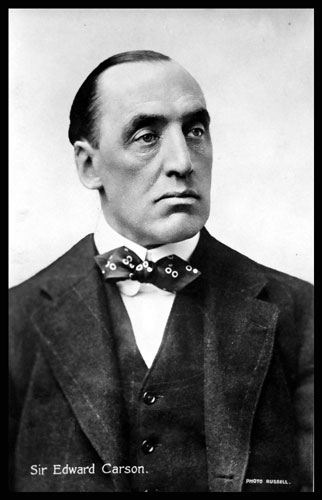
The Time Act became a political football in Ireland, an Ireland changed (changed utterly you could say….) by the events of Easter week. Edward Carson, The Irish Times of August 12 noted, failed to understand the controversy of it all. “All he could say was that if certain hon. members stopped this bill he would see that the Dublin Reconstruction Bill, or other bills, would also be treated as controversial and not allowed to proceed”

At a meeting of the Dublin Corporation, reported in the same edition of the Times, it is noted that one Mr. Briscoe opposed the motion of support for the adoption of Western European time, on the grounds that “…there was too much of the German method about European time.”

I first heard of DMT when reading 50 Things You Didn’t Know About 1916 by Mick O’ Farrell, but was recently delighted to see that having consulted the archives of The Irish Times for more information, Frank McNally would pen an excellent (as most of them are) An Irishman’s Diary on the very subject. It can be read here.

Even so, Dublin Mean Time had science on its side. It was also known as “Dunsink Time”, after the astronomical observatory in Finglas where the measurements were made. And as such it had gained a place in literature, via the inevitable James Joyce and Ulysses .

I’ve always told tourists and visiting friends alike that things move at a much slower pace in Ireland, but once we were a different people, 25 minutes or so behind of the busiest city in the empire.

Read Full Post »

A Curious Journey (1973)

Curious Journey – The 1916 Easter Rising. In 1973, Kenneth Griffith, the renowned documentary maker, gathered together a group of veterans of the Easter Rising. Almost half a century after those terrible events, this highly diverse group – branded terrorists by the British in their youth – gave their own account of what is was like to live through those turbulent times. It is a powerful and heartfelt testament to nine brave men and women who risked their lives for their country.

Ignore the dramatic voice over. This 50mins documentary has countless of fascinating interviews. Incidentally it also has great scenes of 1973 Dublin. A history documentary now becomes history.

Interviews: Maire Comerford, Joseph Sweeney, Sean Kavanagh, John O’Sullivan, Brigid Thornton, Sean Harling, Martin Walton, David Nelligan/Neligan and Tom Barry

(more…)

Read Full Post »

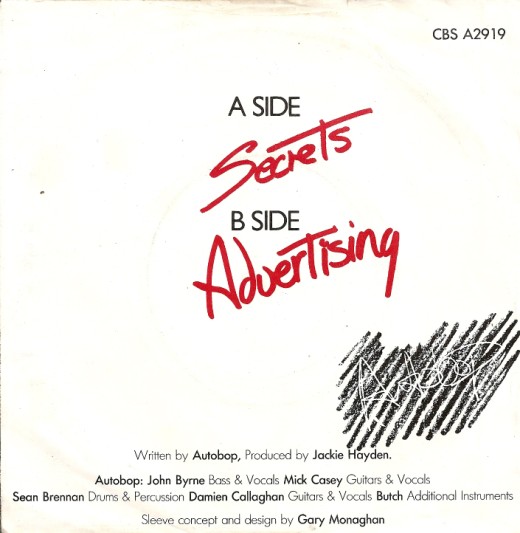
One of the best Irish pop singles ever.

There should be a law to force 2FM to play this at least once everyday.

Not only is it catchy as hell but it has an obvious social message. Rare enough for the time.

Autobop won the rock section of the 1980 City of Dublin Music Festival. In 1981, they had a Sunday night residency in The Ivy Rooms (now Fibbers) on Parnell Street. They split, I believe, in 1983.

Anyone have a copy of their six track demo tape that they’d care to digitize?
Anyone have a spare copy of their single which they’d like to give a good home?
Anyone have any contact details for any of the band members?

Last Saturday night, I played ‘Advertising’ at The Workman’s Club to a packed room of people in their 20s and 30s. It got more people nodding their head than most of the other ‘well-known’ tracks I played. It is true. Great songs never age.

Back cover of Autobop's first and only single. Thanks to Conor McCabe for scanning up

Read Full Post »

The band that keeps on giving. Twenty five years after recorded, a single from The Blades sees the light of day.

Building A Wasteland edit radio01-1 by Reekus Records

‘Building A Wasteland’ was recorded in 1985 by The Blades but was never released. The single was mastered in 2010 and an extended version will be available on a Reekus compilation of the early years which I believe is due out soon.

I’ve already written about The Blades twice on the blog. Check out Revelations (Of 45s) & The Blades Are Sharp.

Buy The Blades two album boxset, Those Were The Days, here at the Reekus Records website.

Read Full Post »

In March 1974, the recently opened Spanish Cultural Institute on Northumberland Road was petrol bombed by suspected insurrectionary anarchists. It took three sections of the Dublin Fire Brigade to put out the fire which badly charred the hall door.

The wife of the director of the Institute and her 10-month-old son were in the house at the time of the blast. Both escaped injury.

Passers-by told the gardai that they had seen two men running down the steps and getting into a blue Hillman Minx car parked a short distance from the house, shortly after the attack. The men were aged between 20 and 30, 5 ft. 9 ins., slim, with dark shoulder length hair and dark suits.

Soon after the attack, a man with an Irish accent telephoned The Sunday Press and said: “I am speaking for the First of May group. We have exploded a bomb at the Spanish Cultural Institute. It is in retaliation for the murder today in Spain of the Spanish anarchist”. The anarchist in question was Salvador Puig Antich (26), a student, who was executed in Barcelona for killing a policeman in September 1973. Also executed that day was Polish citizen Heinz Ces, for shooting a Guardia civil police officer, in Tarragona.

The Irish Independent. March 04, 1974.


On March 8 1974, a letter was published in The Irish Times deploring the attack and was signed by more than sixty U.C.D. students and teachers. It stated that “the Institute … is exclusively concerned with cultural activities, and thousands of people have already availed themselves of its services, and know that these are offered without any political strings.” “We hold no brief whatever for the Franco regime, political representation or any form of capital punishment” it added and we “deplore the execution of Spanish anarchists as much as any petrol-bomber thinks the does.”

In July 1974, a twenty-four old clerk called Robert C. (Surname withhold for privacy), with an address on the South Circular Road, was sentenced to jail for seven years after admitting making a letter-bomb and leaving it outside the Iberian Airlines office on Grafton Street. He was also charged with armed robbery, possessing firearms, ammunition and explosive substances. Three other individuals in their early 20s were also sentenced. The first for ‘conspiring with others to cause explosions’ and the other two for holding money that they knew had been stolen. [1]

(In January 1972, Robert C. was one of nine people up in court in connection with squatting Frascati House in Blackrock. The charges included ‘making or having explosives’ and assualting a Garda by the name of John Munnely. Frascati House was threatened with demolition and it would appear that these nine individuals who squatted were involved with the Dun Laoghaire Housing Action Group [2] )

Among other items found in the possession of Robert C. during searches of his house in July 1974 was a notebook containing information on the Spanish Embassy in Dublin, the registration number of the Ambassador’s car and the names of the Director of Spanish Cultural Institute as well as those of his wife and son. [3] One could come to the conclusion that Robert C. may have been involved in the attack on the Spanish Cultural Centre a few months before.

A Dublin Housing Action Committee protest in late 1960s(?) Dublin. Is Robert in the background? Who knows. (Taken from an article 'What motivated Noel Murray', I.T. 10/12/76)

On February 23 1975, Robert C. joined a hungerstike with nine other prisoners, in the Curragh Camp, in protest against visiting conditions, the standard of food and other grievances. [4] By March 3, Robert was one of only four prisoners still on hungerstrike. The Prisoners’ Rights Organisation picketed the Department of Justice and the Curragh Detention Centre in protest against the “deplorable conditions” which forced the non-political prisoners to start the strike. [5] On March 5, the hungerstrike came to an end. No details were available as to the condition of the prisoners or as to the reason why the strike was called off. [6]

The trail ends there. What became of Robert C.? Your guess is as good as mine. He would of turned 60 this year. I’m no fan of bombs, letter or otherwise, but I wish Robert all the best and hope he’s alive and well. Do you know what happened to him? Get in touch. Or if you know him, send him a link to this article. It be great to hear from him.

===

[1] The Irish Times, July 11, 1974, p. 15
[2] The Irish Independent, January 22, 1972, p. 9
[3] The Irish Times, December 10, 1976, p. 14
[4] The Irish Times, February 24, 1975, p. 1
[5] The Irish Times, March 3, 1975, p. 8
[5] The Irish Times, March 5, 1975, p. 16

Read Full Post »
« Newer Posts - Older Posts »