Feeds:
Posts
Comments

Archive for the ‘Miscellaneous’ Category

These are everywhere in town. I had to explain to two American tourists at the traffic lights by Poolbeg Street that not alone was the tap water fine, but I’d filled up the bottle I was carrying at home that morning.

This one comes from the bathroom of one of my local pubs. Sticking to the Ballygowan now?

Read Full Post »

Enemy at the gates.

This is excellent, TDs discuss truckgate at the Dail this morning.

If you’re not from this parish and confused about the subject at hand, I suggest you read this typically over the top Evening Herald report. Only in the Evenin’ Hedild can a truck parked outside the Dail become a doomsday device rammed through the front gates.

Interesting microphone too. No prizes.

Read Full Post »

A portrait of legendary bare-knuckle boxer Dan Donnelly.

Ye sons of proud Britannia, your boasting now give o’er,
Since by our hero Donnelly, your hero is no more;
Eleven rounds he got nine knocks down, broke his jawbone,
Shake hands, says she, brave Donnelly, the battle is our own.
(from the ballad “Donnelly and Cooper,” words here.)

Irish history is rich in stories of playwrights and poets whose characters matched if not outshone their talent with a pen. When it comes to sports people, we are arguably equally rich in those characters. When it comes to boxing, one name that comes to my mind (and in honesty, only because I saw an excellent documentary on TG4 about the man) is Dan Donnelly, beknighted (though that tale behind this is a story in itself) prize fighter who won the hearts and minds of Irish men and women in the early 19th Century.

Dan Donnelly

With Ireland still under British rule, and with ten years yet to pass until the uprising of 1798, Dan Donnelly was born into poverty and a house already full of children (eight before him, with another eight to come after him) in the heart of Dublin’s Docklands. He trained as a carpenter at early age, but it was with his fighting prowess that he excelled, garnering a reputation as a man “handy” with his fists with a few pints in him; what wages he had left after he had provided for his family, he spent on drink, or on some occasions, the other way around.  He grew to be a formidable beast of a man, standing six foot and one half inch tall and weighing fourteen stone. His arms were said to be unnaturally long (a fact since proven false) giving him a reach to worry opponents. But as scary as he looked, he was said to be a man of manners, and on more than one occasion stepped in to stop muggings or assaults around the area of Townsend Street where it is said he lived. (His introduction to boxing came from fighting, and beating, a bullying English sailor in a bar close to his home.)

Dan’s infamy as a bareknuckle boxer grew, and he soon progressed from drunken brawls outside taverns to organised fights, with a purse to be taken home by the winner; and though it is said he only ever took part in three of these bouts, it is the manner of the victories and the opposition he faced and defeated that ensure his place in history.

The fight he is remembered for was his second and took place on December 13th, 1815 in The Curragh of Co. Kildare. Now called Donnellys Hollow, the area was a natural amphitheatre with sloping hillsides surrounding a flat area of ground where the fight took place. It is said that over 30, 000 people made the trek to Kildare for the fight by foot and carriage, with the upper classes mixing with slum dwellers, as each had a stake on the outcome.

The fight itself was said to be a dour affair, with the favourite Cooper (1/ 10 to win) using dirty tactics and falling to his knees on a couple of occasions in order to get a round to be stopped. Donnelly put paid to the Englishmans arrogance when he broke his jaw with a right hook in the eleventh round, taking the fight in the process.

A victory against English opponents these days is greeted with a cheer, so it’s hardly suprising that Donnellys victory against Cooper was seen as a national event. His trip back to Dublin is said to have taken over two weeks, so many were his stops, doing his best to spend the £60 purse he earned from the fight in taverns along the way. His footsteps from the Hollow itself are still there to be seen, as supporters, keen to follow in his footsteps, did so physically, marking out the steps on the landscape, as people still do to this day- as can be seen from the photograph above.

The stone obilisk surrounded by an iron fence below marks the spot where the fight took place, bearing the inscription “Dan Donnelly beat Cooper on this spot 13th Dec. 1815.”

The Obelisk marking the spot.

Donnelly decided to make his way to England where he became parlour entertainment for the wealthy upper classes who welcomed him at their parties, no doubt as a lumpen Irishman with extraordinary strength. it was at one of these parties that Donnelly (according to legend as there is no documentation to prove so) knelt before the Prince Regent, George IV and was granted knighthood with a sword tap on each shoulder- an Irish pugilist who once worked with the brother of Anne Devlin, a figure central to Robert Emmets revolt of 1803 receiving knighthood from the future King of England. Implausible, but apparently true.

He moved back to Ireland and with the money he had earned from his fights (and with his reputation still intact,) he decided to go into business, opening four bars in succesion. But, as is often the case, he was often the bars best customer and this was eventually his undoing. Of all the bars, Fallons Capstan Bar is the only one that remains in business today. He died broke and lonely on February 18th, 1920 at the young age of thirty two. The procession that followed his coffin numbered in the tens of  thousands and he was buried in Bullys Acre- a paupers graveyard and one of Dublin’s oldest. Within days, his body was stolen by grave robbers; Riots broke out in Dublin upon the news and Surgeon Hall, who had purchased the body, returned Donnelly to his grave in Bully’s Acre- minus his right arm. The arm was transported to Edinburgh University where it was used in anatomy lessons, was taken around England by a travelling circus, was brought back to Ireland and displayed in several pubs throughout the twentieth century, and went to New York and back before it found its resting place in The Hideout Bar, Kilcullen where it remained on show until 2006 before being removed from public viewing.

Dan Donnelly's arm

While undoubtedly, it’s Dan’s arm that garners most interest in him, its his story that gets me most. Maybe I’m just a sucker for social history but the thought of 30, 000 people making the trek out to the Curragh in the days before Bus Eireann to see what equates to an amateur bare- knuckle fight, the image of the streets lined on his victorious return, and the 70, 000 that showed up at his funeral, and yet I only know about him because of a chance viewing of a documentary on TG4 makes you think how many other stories like Dan’s have gone beneath the radar.

Underneath this pillar high,
Lies Sir Dan Donnelly;
He was a stout and handy man,
And people called him buffing Dan.
Knighthood he took from George’s sword,
And well he wore it by my word!
He died at last from forty seven
Tumblers of punch he drank one even.
O’erthrown by punch, unharmed by fist,
He died an unbeaten pugilist.
Such a buffer as Dan Donnelly,
Ireland never again will see.

—————————-

Links used for research on the above piece:

http://issuu.com/onlinemedia/docs/nw-19-08-2008/11?mode=a_p

http://sportsillustrated.cnn.com/vault/article/magazine/MAG1072458/index.htm

http://en.wikipedia.org/wiki/Dan_Donnelly_(boxer)

Read Full Post »

1948

Amazing footage here, well done to YouTuber tallowmanirish on booting it up.

The first three minutes are so are of the city during the build up to the game, capturing everything from an Irish-American marching band to crowds on O’ Connell Bridge. If you’ve got footage like this hiding somewhere in the house, get it up online!

Read Full Post »

Many of the episodes involve Indiana meeting and working with famous historical figures. Historical figures featured on the show include Leo Tolstoy, Howard Carter, Charles de Gaulle, and John Ford, in such diverse locations as Egypt, Austria-Hungary, India, China, and the whole of Europe.

Jesus. How in the name of all that is good in the world have I never seen this before?

As well as the Easter Rebellion, Indiana seems to have come into contact with a young Sean O’ Casey.

Read Full Post »

League of Ireland fans do it

Shed End Invincibles , the Saint Patrick’s Athletic Ultras, take recent results in their stride. Excellent.

Read Full Post »

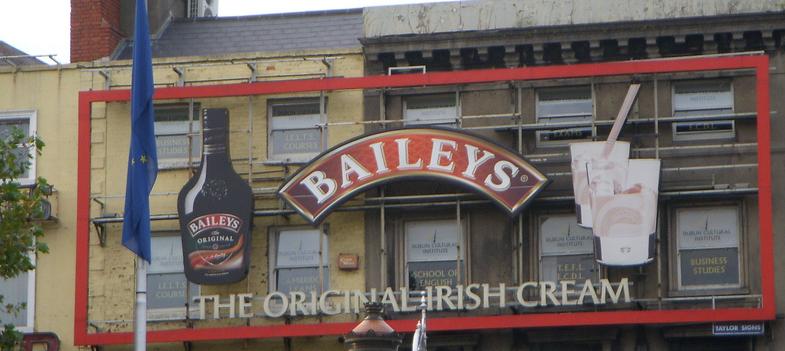
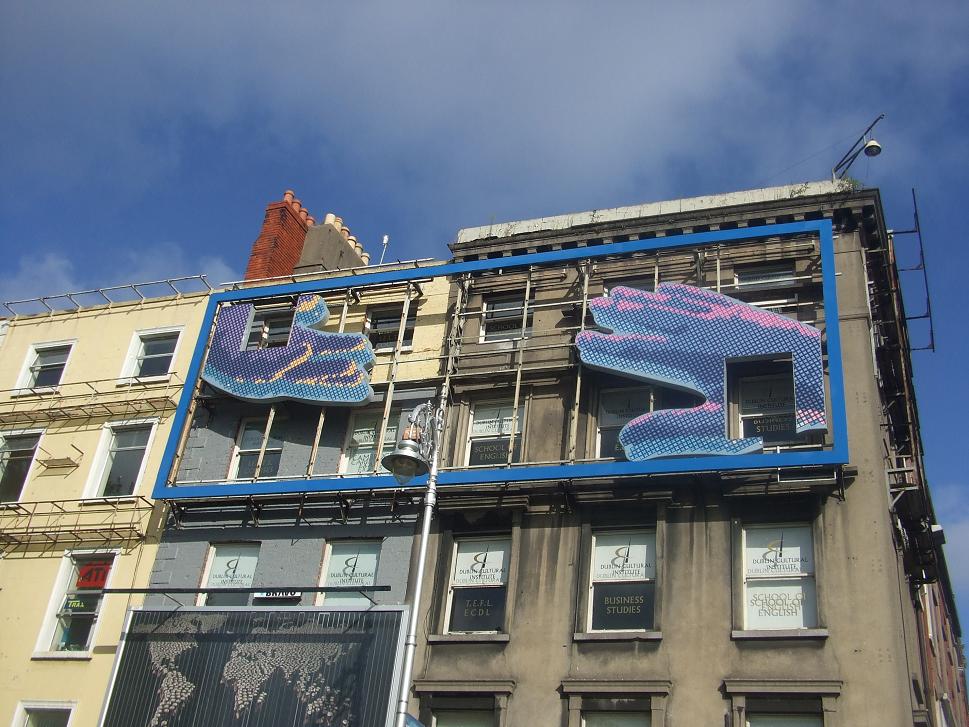
Know the old Baileys sign at the bottom of O’ Connell Street? Of course you do, it’s been there as long as I can remember anyway. This one.

Well, look what I spotted on the way to work today:

Hmm. We’ll wait and see.

Read Full Post »

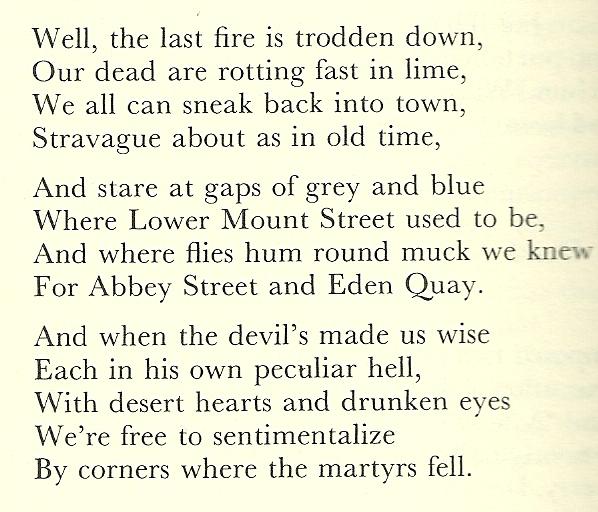
You have to go abroad to find the gems. In a second hand bookshop in Edinburgh, a copy of Dublin:A Travellers’ Companion showed up, which features many excerpts from classic Dublin books and accounts.

This Dublin ballad by Dermot O’ Byrne, which was taken from An Anthology of 1916 by Edna Fitzhenry, is one I had not come across before and deemed worthy of sharing here.

Read Full Post »

The Irish: A Dancing People.

Skip to 5:19. No comment.

Read Full Post »

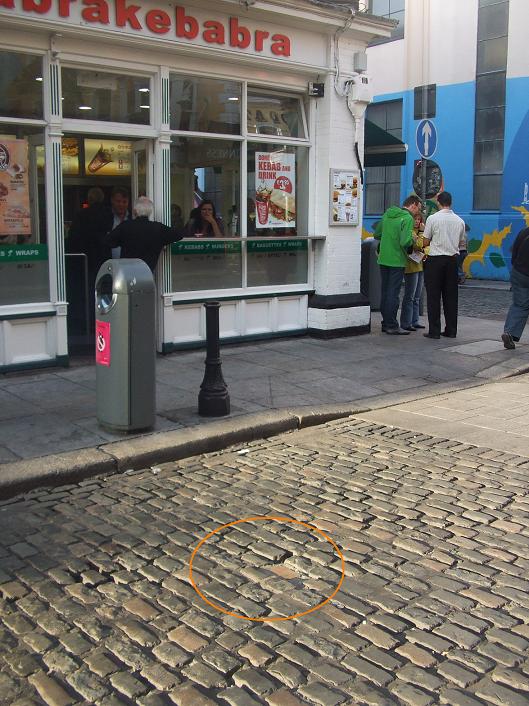
I hadn’t!

A tip of the hat to CHTM regular commenter Oisin, who presumed I’d seen it somewhere down the line. How bizarre. If you didn’t cop straight away, this is beside The Auld Dubliner and Oliver St.John Gogarty pubs.

Read Full Post »

“We no longer have a retail outlet in Dublin, but visitors to our new base, in a converted stables, near Lucan, just outside Dublin, are welcome, by appointment.”
Irish Historical Picture Company online.

——

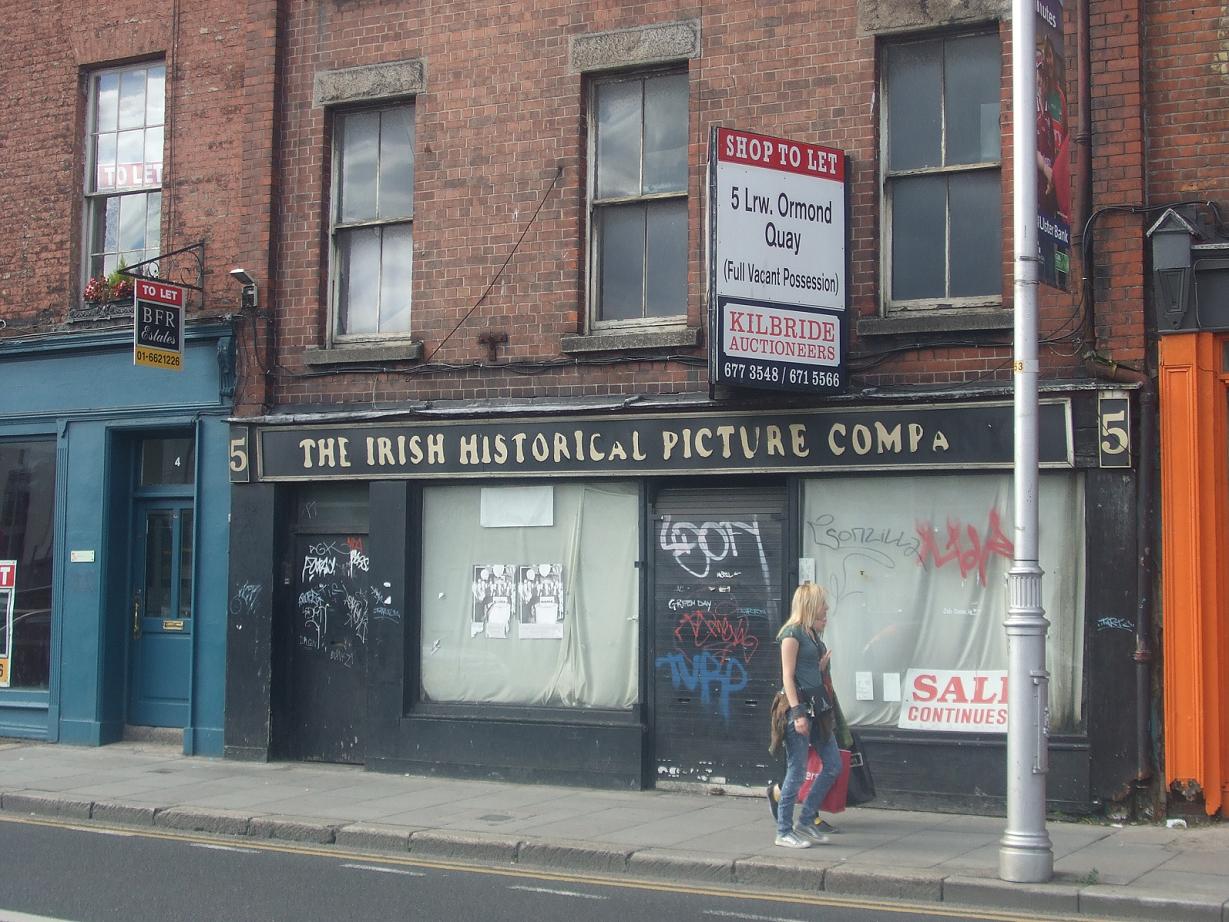
I used to spend a good bit of time in here, The Irish Historical Picture Company.

In truth, there probably wasn’t a street in Ireland they didn’t have a snap of in a previous life. Sometimes however it was more fun to just browse random parts of the country, looking at amazing images that in some cases gave life to the old saying, the one about a thousand words and all that.

Of course, a simple eBay search shows it isn’t impossible to find such images. Yet the sheer volume of them, under one roof, was staggering. From the revolutionary years to quiet rural roads of the nineteenth century, headline news to daily routine was well documented. Occasionally, if I am giving a walking tour, a tourist will ask about this place, saying they spotted it across the Liffey. At this time of year in particular it is missed.

I only spotted it again recently in all truth from the upstairs window of the Workman’s Club pub, which provides a look down over the Liffey. It’s shopfront is redecorated in the way closed down shops tend to be, a mix of idiotic tags nobody can read, notices for this, that and the other and pasted political posters. A few letters have vanished too, but not enough to confuse anyone about what existed there before.

How funny the snap above now shows the past life of a place that frequently amazed me itself with an image of a familiar site in days long gone by.

Read Full Post »

Unless you’ve been hiding under a rock for the last 16 years, you will most definitely have heard about the annual Absolut Fringe Festival. In those 16 years, it has grown from humble begininnings to become Ireland most exciting multidisciplinary festival covering all walks of culture; music, art, literature and performance.

Spanning over two- and- a- bit weeks, and visiting over twenty venues, the festival is ambitious in it’s enormity, but then again, why shouldn’t it be going on the successes of the last couple of years.  While it would be close to impossible to list a full programme here ( you can check that out on the official website @ www.fringefest.com , or alternatively pick up the free guide from cafés and bookshops citywide,) below are some of the events I hope to attend, and suprise suprise, they’re Dublin-centric.

As You Are Now, So Once Were We

As You Are Now So Once Were We, The Company

Blurb from the fringefest site:

“Why haven’t you read Ulysses? Ulysses is Dublin. You live in Dublin. So do we. Four actors in a city we don’t really know pick up the most important and unread book in Irish history and follow James Joyce as he invents a whole city and its people. Returning to this year’s Festival with the Spirit of the Fringe 2009 award for ‘Who is Fergus Kilpatrick?’, The Company are back to delve into Joyce’s seminal work and ask – where are you in this story? Join us as we rediscover what it means to be Irish. By the way, we haven’t read Ulysses either… yet. The Company are part of Project Catalyst, an initiative of Project Arts Centre.”

—-

Having laboured my way through Ulysees in my UCD days, I’m interested to see what the good folks from The Company make of it. The questions of nationhood and identity always stood out in the book, and this show looks set to examine both.

The Project Arts  Centre Space Upstairs, Sat 11th – Wed 15th, 9pm, €14/12

World’s End Lane

World's End Lane, Anu Productions

Blurb from the fringefest site:

“For over 100 years, Monto was the most notorious red light district in Europe. Presided over by infamous Madams and fortune-tellers, lost strangers sought sex, guidance and the divine. You and I will be the strangers. Immerse yourself in a fragile and intimate encounter, exhuming an area of Dublin that no longer exists, as presented by the multi-award winning company that brought you last year’s festival favourite, ‘Basin’. Presented in association with The Lab. Supported by Rough Magic Hub.”

—-

Monto; An area sung about in a thousand songs and the backdrop for a hundred thousand stories of woe and debauchery, lonliness and violence, intrigue and legend. Some say that a branch of the current Monarchy flourishes in Dublin City due a night on the town by a British prince here in the late 19th Century. It is written into revolutionary lore as it’s many brothels and slums were used as safehouses in the period 1916- 22. In World’s End Lane, we get a unique look at this unique period in Dublin’s past.

The Lab,  Foley Street, Mon 13th- Sat 25th, (times can be found here ,) €15.

The Hidden Garden

The Hidden Garden, Garvan Gallagher Photography

Blurb from the fringefest site:

“‘It’s like going to mass’ is how one local resident describes her time in one of the most charming and unlikely secret retreats in the city. This uplifting film maps the transformation of an urban dumping ground in the North Inner City into a vibrant community growing space. Winter surrenders to spring as the characters and the space come to life while the goodwill and honest nature of the local residents spill out like the cups of tea poured in their hundreds. As informative as it is inspirational, don’t miss the chance to see this heart-warming film screened in The Hidden Garden. Arrive early if you’d like to potter around the garden!”

—-

Whilst over the last couple of years, developers have tried to rid us of any green spaces we have in the inner city, there has been a struggle within some local communities to take back some peace and tranquility. With inner- city community spirit diminishing as office and retail developments push people into the suburbs, projects like the Summer Row Community Garden are to be applauded.

Summer Row Community Garden, Summer St. North. Thurs 23rd – Sat 25th, 8.30pm, €8.

——

All details, blurbs and pictures (apart from my own interjections of course) are taken from the excellently informative www.fringefest.com . For up to date information, tickets and more details, check it out.

Read Full Post »

« Newer Posts - Older Posts »