Feeds:
Posts
Comments

Archive for the ‘Social History’ Category

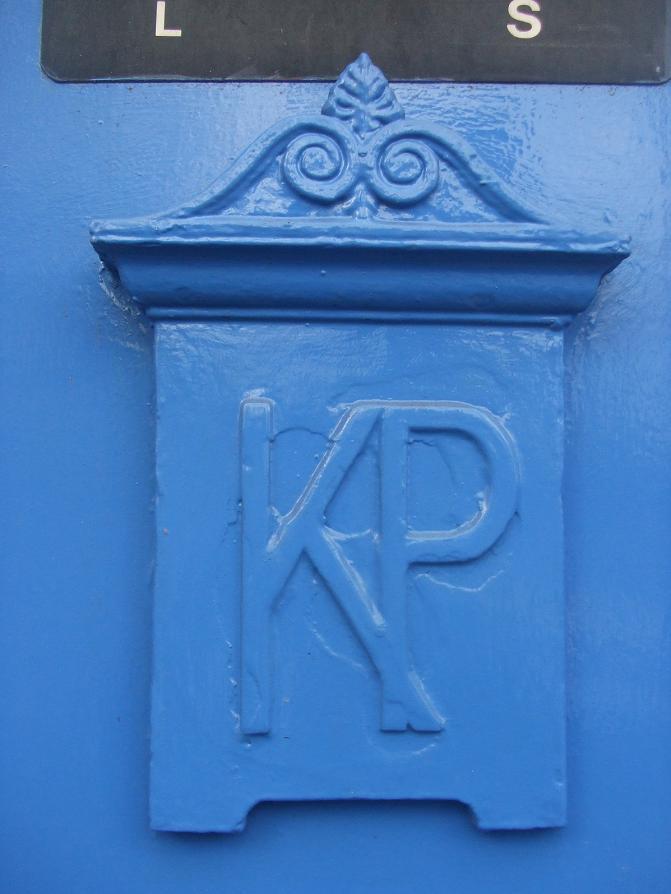
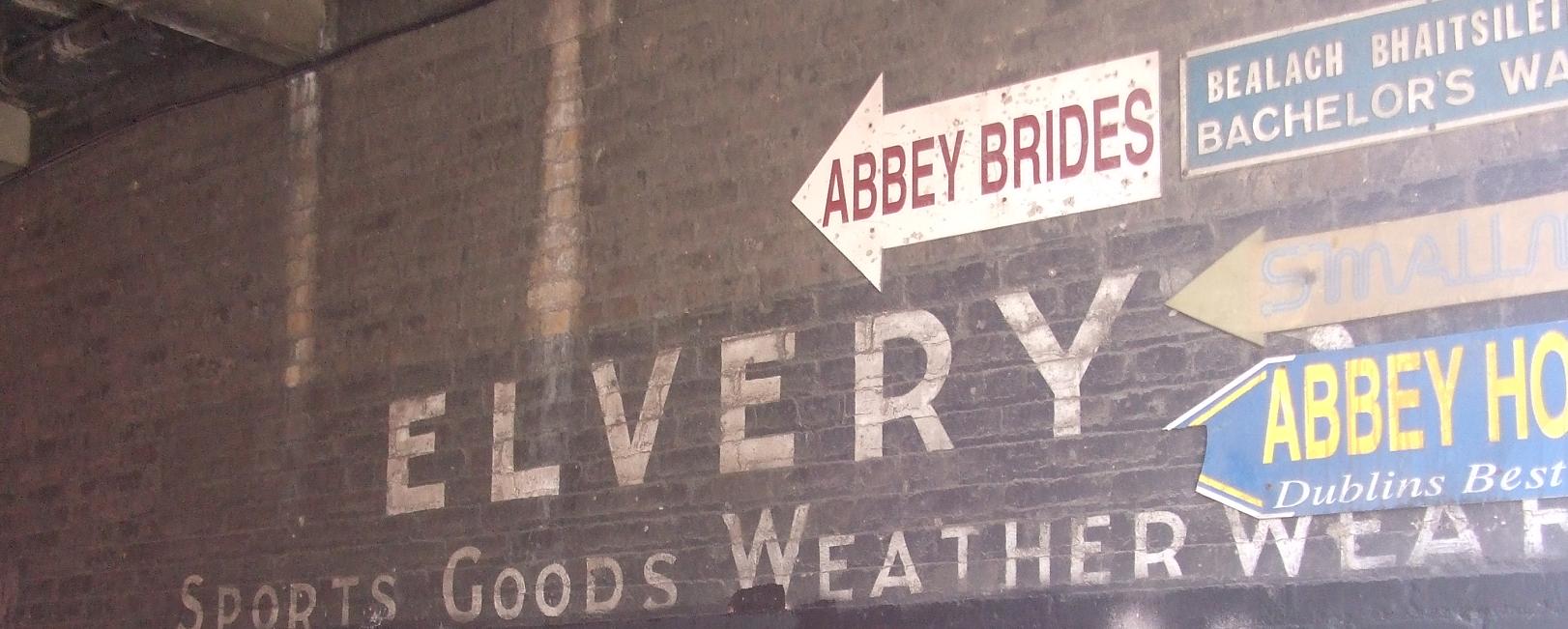
The Daniel O’Connell newsagents on the corner of Bachelors Walk and O’Connell Street is something we’ve touched on before. A real effort to make a quick quid on the tourists, it’s not hard to work out why it was given the name it boasts. It was once Elvery’s of course, and the Elvery’s advertisement in the laneway behind it is a great little throwback.

Something I always notice, but it seems passes a lot of people by, is the woodwork. The KP lettering has survived many coats of paint, and is something I always remember looking at as a kid at the traffic lights by O’Connell Bridge. There’s also Kapp and Peterson branding on the roof on the premises, which is visible from the O’Connell statue.

How many buildings in Dublin have fronts like this which give a bit of their history?

Read Full Post »

This is a fascinating read. It’s a 1934 Communist Party of Ireland leaflet regarding the threat of fascism to Ireland, and looking at the international situation. I’ve had this scanned up for a few days but am tragically internetless so pardon the delay. It was part of a collection of leaflets gathered by the Gardaí at left wing demonstrations in the capital in the early 1930s. As ever, click to expand.

Read Full Post »

The Digital Projects section of Dublin City Public Libraries have over the past year done great work in sticking up old images of the City in times past. The latest collection to go online is one hundred and thirty or so images of Dublin pubs, some whose doors are still open, others who who live only in the memories of ex- punters. The full gallery can be seen here.

The Commodore, from Dublin City Public Libraries

The Swallow, from Dublin City Public Libraries

The site is a mine of photographic information, they have fantastic galleries on Dublin’s Sporting Heritage, the ’74 Dublin Bombings, “Missing Dublin” and now this. I look forward to more.

Billy Lavelles, from Dublin City Public Libraries

Read Full Post »

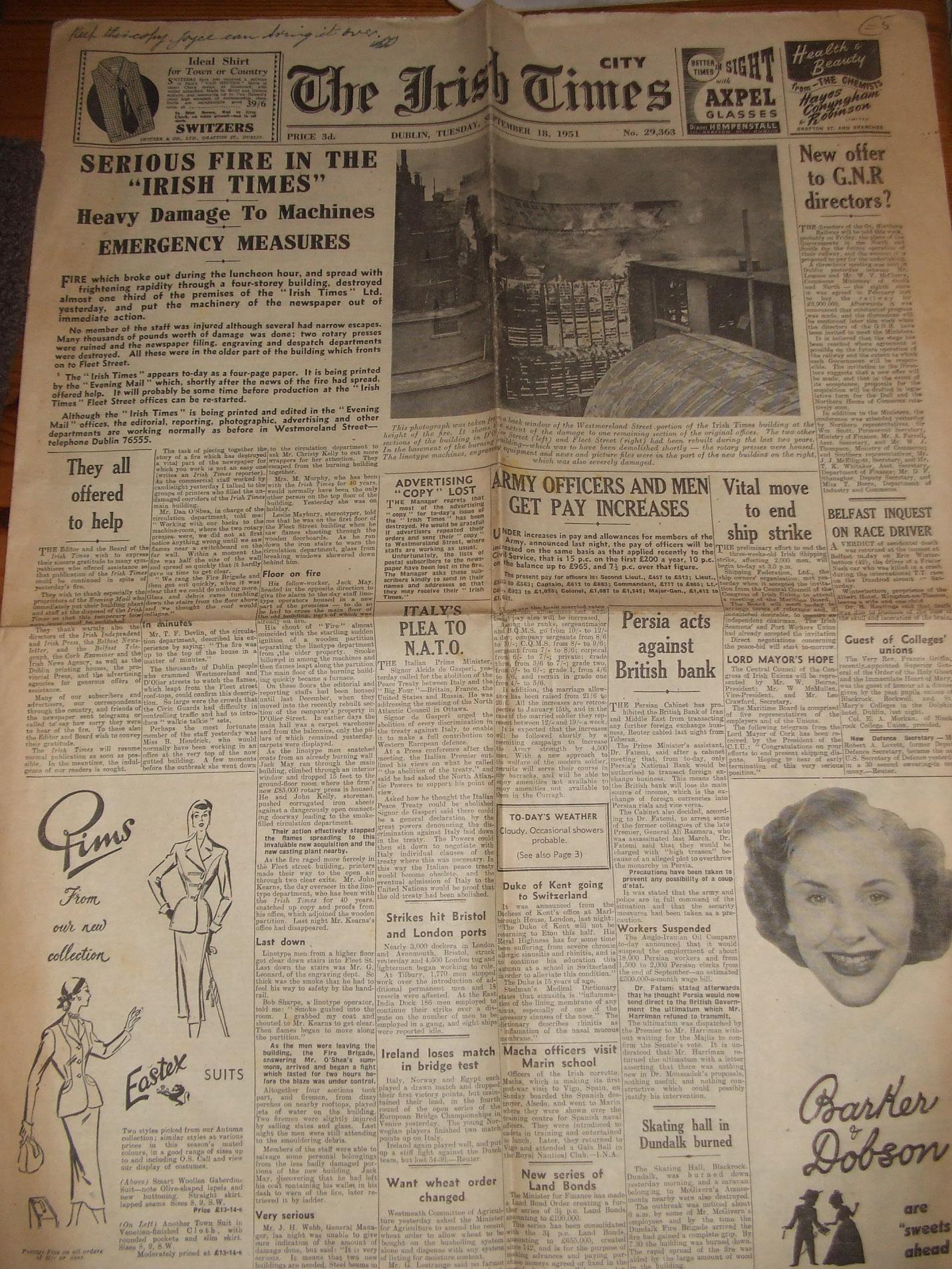
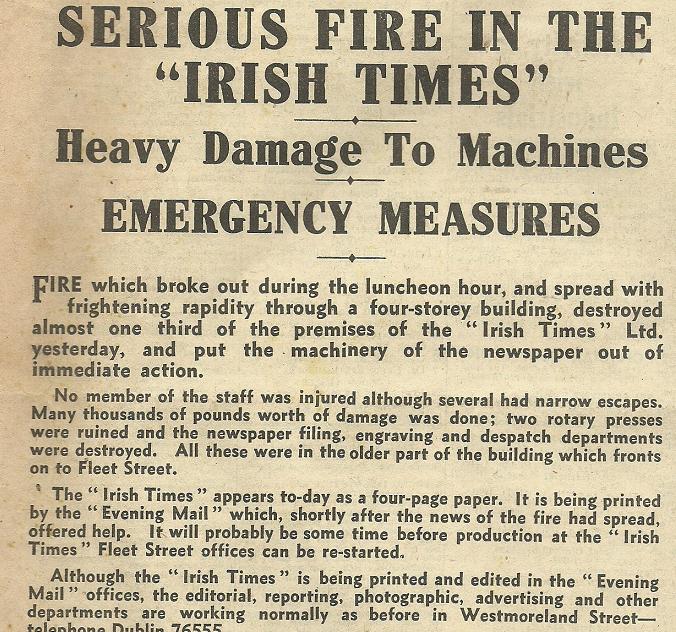
On September 18, 1951 The Irish Times of the day was a most unusual one. It was only four pages of content, owing to a fire which destroyed about a third of the companies premises on Westmoreland Street. Below is the front page of the paper which I picked up recently. Note the side column entitled ‘They all offered to help’ detailing the manner in which other Dublin based publications offered assistance to get the paper out on the 18th. It was an incredible display of the work ethic and attitude of the paper that on September 18 1951, one could still purchase The Irish Times from their local vender.

Click on the image to enlarge it. The paper was quite fragile so I didn’t wish to scan it.


Read Full Post »

These were discovered hiding in the attic recently, coming from the Watts Gunsmiths which used to be based at 18 Ormond Quay. I’m fascinated by the history of gunsmiths in Dublin, does anyone have a photograph of Watts they can share? Previously, I uploaded this company logo from the ‘compliments’ card of the shop.

Today, Watts is the adifferentkettleoffishaltogether art space at 18 Ormond Quay. We love to document the live of Dublin buildings, so a snap of Watts as it once appeared would be most welcome.

Read Full Post »

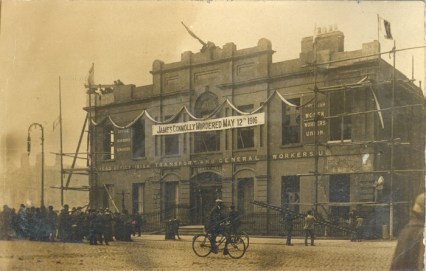
“For many years past, Liberty Hall has been a thorn in the side of the Dublin Police and the Irish Government. It was the centre of social anarchy, the brain of every riot and disturbance.” The Irish Times. (pg 191, Easter 1916, Townshend)

Neither Kenny nor Gilmore.

Reading through Charles Townshend’s excellent book “Easter 1916,” I picked out the above quote about Liberty Hall and thought to myself, how times really have changed. While DFallon’s recent post on Hawkin’s House challenged the myth, some still call it Dublin’s ugliest building, while others hold it in reverence. Although in this climate, the plans to see it torn down are unlikely, SIPTU have been talking about redeveloping as recently as last August. Personally I’d hate to see it removed, not because of it’s architectural significance or visually appealing exterior (or lack thereof,) but because of the historical relevance of the site and the significant difference it would make to Dublin’s skyline if it was replaced.

"And the banner read..." Originally posted here by DFallon

With the next government looking likely to be made up of a collaboration between Labour and Fine Gael, the current occupants of Liberty Hall, (SIPTU, who to be honest have been about as Anarchic as Tory Boy,) look fully set to have one foot in Leinster House. Not discounting the fact that due to Social Partnership, they have been bedfellows with the Government for over a decade, for the next four years or so, the party they have official ties with are to share power with a party whose roots are seeped in the fascist tradition. Dark days indeed.

"Vote Labour," Reclaim the Streets, 2002

I dread to think that in the next couple of weeks, a new banner will appear on the side of Liberty Hall, calling on the people of Ireland to vote Labour. Lets just hope it isn’t accompanied with an image of Joan “Joe Higgins eats babies” Burton. “The brain of every riot and disturbance” indeed.

Read Full Post »

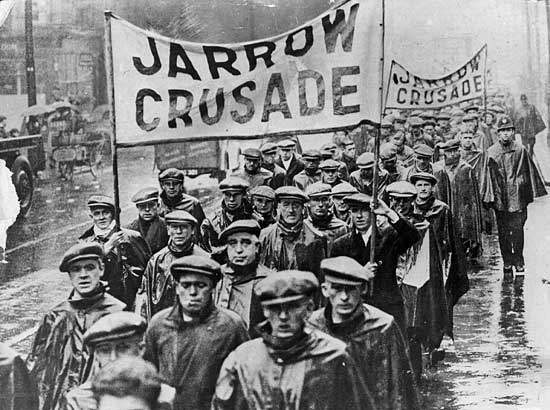
The famous Jarrow Crusade of 1936.

I’ve just been on Liveline, which was a new experience.

I was approached to give a bit of historical context to the march on the capital by a group of South Kilkenny men who are completely fed up with how things have turned out for them and indeed all ordinary people in this state in recent times. Some of them are now unemployed, others have had to wave children off at the airport. In short, they decided to march onto the capital because in years to come none of them could stomach the idea of saying ‘we sat back and watched’.

In my brief time on air, I spoke about a 1953 march on the Dail, dealt with here before by Sam. In that piece, Sam wrote that

Jubilant scenes follow when the news is spread that the march will make its way down to the Dail, “the first time such a protest has been held at its gates”.

Now, taking your anger to the gates of the Dail is routine. Walking so far to do it however is not. It is an incredible act on the part of these men.

We are supposed to have come a long way from the doom and gloom of the 50’s and later the 80’s, but have we really? Tomorrow, those men will begin their march on the Dail, passing so many areas of historical importance. They will begin at Kilmainham Jail, where the leaders of the 1916 insurection were executed, and will pass the spot where Robert Emmet was hanged. Along the way too, Dublin Castle, for so long the fortified home of the British administration in Ireland. Yet a ‘free’ Ireland, appears to be one of great economic and social divisions and barriers, and a nation that could be described as on a life support machine.

Post independence, we know Dublin Castle as the place where Bertie Ahern went to justify(or talk away) his actions before a Tribunal. What a sad, sad reflection on our state.

I ended my brief time on air today by quoting a few lines from the great folk singer Liam Weldon, about how those who died for liberty “have died but for a dream.” We are living through extraordinary times to say the least, and I was delighted to be asked to show these men some historical spots in the capital on their way to the Dail. Like them, I just hope in decades to come I can say I didn’t sit at home through this incredible chapter of Irish history.

You’re more than welcome to join them, they will set out from Kilmainham Jail at 12 tomorrow.

Read Full Post »

A look at the Dublin story of ‘Joe Edelstein’s Alarm’ in Little Jerusalem.

Back in September, I paid a visit to the Irish Jewish Museum in Portobello, a pretty incredible gem covering everyone from the fictional (Leopold, I’m talking to you…) to the very real Jewish characters in Dublin history.

One of the characters touched upon was Joe Edelstein. Joe’s name would have been very well-known in the area that became Dublin’s ‘Little Jerusalem’. He was a businessman and writer of some importance in the Jewish part of the city. The Irish Times of September 11 1908 noted for example that he spoke at a meeting of the Judaeo-Irish Home Rule Association at the Mansion House in Dublin and proposed that “….this great meeting of Jews resolve to support such measures as will tend to secure for the people of Ireland a full grant of self-government.”

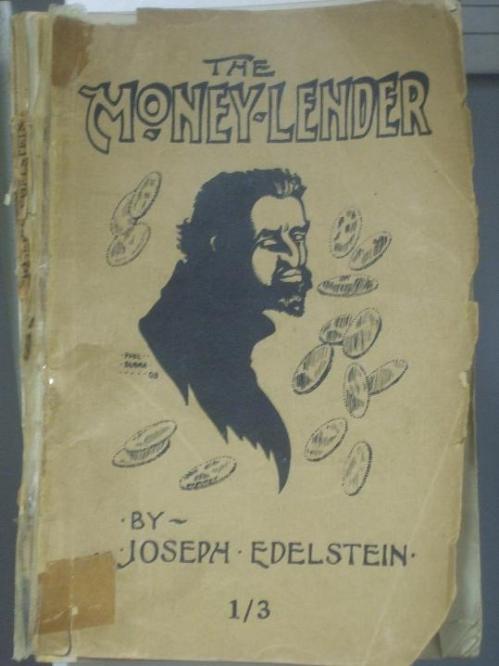
Edelstein wrote a most controversial work, The Money Lender, which was not well received in the Jewish community of the capital. A copy of it can be seen in the museum today. It was felt by some that the book re-inforced negative stereotypes about the community. It was published in 1908. Despite objections to the work, Joe remained an influential figure in the Jewish community, and newspaper archives show he continued to speak at many public events, continuing to champion the Home Rule movement.

Sadly, Edelstein, once an influential figure in his community, was to fall on hard times and turn to drink. The Irish Independent of November 11, 1939 noted that he was fined a sum of 40s for an offence arising out of being drunk. On one occasion Edelstein was fined by damaging works in the National Library.

Manus O’Riordan has done some excellent research on the Jewish community in Dublin, and noted that:

Edelstein was a man with a serious drink problem, and was subject to frequent psychiatric breakdowns, with resulting periods of hospitalisation. In fact, one such commitment to the Richmond mental hospital for a whole nine months stretch stemmed from the scandal of his 1911 conviction for the crime of indecent assault….

… Edelstein lived on New Street, the central venue for James Connolly’s outdoor public meetings during his 1902 Wood Quay election campaign, and a straight continuation of Clanbrassil Street, the principal thoroughfare of Dublin’s “Little Jerusalem”.

(more…)

Read Full Post »

While historically, and perhaps understandably, The Abbey Theatre takes centre stage in this city, mainly because of it’s connections with Synge, Yeats and O’Casey and their associations with the 1916 Rebellion, its sometimes easy to forget that there are, and were a plethora of other theatres, not only The Gaiety, The Olympia, The Gate, but a long list of many more.
I came across the picture below, of a building on the corner of Poolbeg Street and Hawkins’ Street with a stone columned pallisade and cast iron and glass canopy while flicking through the excellent dublin.ie forum recently. It started me thinking about the recent publishing by the Dublin City Council of images of Dublin’s vanishing and forgotten features (see JayCarax’s piece on that here ) and about actually how much of this city has been erased. Streets, buildings and sites of archaeological significance were destroyed; eradicated in the name of progress without thought of their value, socially and historically, to future generations.
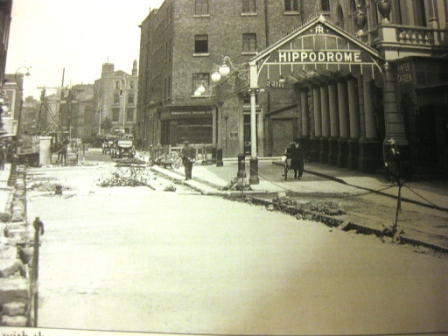
The Theatre Royal Hippodrome, Credit to Cosmo on dublin.ie for the picture

One such building is the Theatre Royale Hippodrome/ Winter Gardens on Hawkins’ Street. The only reason I know of its existence is because of a flash of interest when I first saw the picture above, did a quick search and found the poster below. Dating from 1919, these were turbulent times in Dublin. The Declaration of Independence was declared at the 21st January assembly of Dáil Eireann, and hostilities in the War of Independence began on the same day with Dan Breen and Seán Treacy’s attack on two RIC constables who were escorting explosives in Soloheadbeag, Co. Tipperary.

The Evening Telegraph front page, from the morning of January 22nd, 1919

There is not too much information on the Theatre Royal Hippodrome available. It is known that there were four in existence; the first was on the site of the still running “Smock Alley” theatre, the second on Hawkins Street, (the site of the image above,) where it ran until it burned to the ground in 1880. This theatre re-opened in 1897 with a capacity of 2, 300 (compare this to the Olympia, which nowadays holds 1, 100) and ran until 1934 when it was demolished and replaced by the fourth theatre which opened in 1935 and ran until 1962. The picture is estimated to be from around 1906/ 07, which suggests it is from the third incarnation of the Theatre.
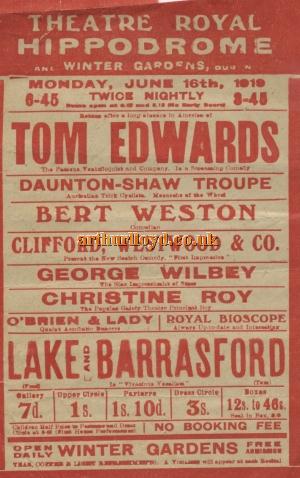
Poster for the Theatre Royal Hippodrome for 16th June 1919, credit to Matthew from http://www.arthurlloyd.co.uk for permission to reproduce here.

Two events stood out for me in reading about the theatre. The first was Charlie Chaplin’s appearance here as a young man in 1906 as part of an act called The Eight Lancashire Lads (1.) The second was the attempted assassination of British Prime Minister Herbert Asquith here on July 19th 1912, not by Irish Revolutionaries but by militant English Suffragettes (2.) Their first attempt involved a hatchet thrown at him by one woman as his carriage passed the GPO on O’Connell Street. While it missed him, she did succeed in striking John Redmond, the nationalist leader. The second involved three women who attempted to set fire to the Theatre as Asquith was about to speak.

The Irish Times report stated:

Sergeant Cooper, accompanied by his wife and Colour-Sergeant and Mrs Shea, was sitting in the dress circle of the theatre. About a quarter to nine, when the performance had concluded and the people were going out, he saw a flame in the back seat, just in front of the cinematograph box.

With the presence of mind that one should expect in a soldier, he rushed to the place, and found that the carpet was saturated with oil and ablaze. He and Colour-Sergeant Shea beat the fire out with their mackintoshes. Just as they had succeeded in this, under the seat there was an explosion, which filled the dress circle with smoke.

At this moment Sergeant Cooper saw a young woman standing near. She was lighting matches. Opening the door of the cinematograph box, she threw in a lighted match, and then tried to escape. But she was caught by Sergeant Cooper and held by him. She is stated to have then said: “There will be a few more explosions in the second house. This is only the start of it.”

From the Irish Times archive.

From the posters, I get the feeling that the Theatre was the anti- thesis of the Abbey which stood a mere 100 yards away as the crow flies, albeit the other side of the River Liffey. An advertisement which I have been unable to reproduce (but can be seen here on the arthurlloyd.co.uk website) has the adage “God Save the King”  amid advertisements for “Hammam Turkish Baths, Sackville Street” and open daily “Winter Gardens” serving “Teas, coffees and light refreshments,” delights the majority of Dubliners at that time could only dream about.

As far as I know, nothing remains of the Theatre Royal Hippodrome today. From the photograph above (and from deductions that the construction work in the background was the construction of he Sheehan Memorial on Burgh Quay,) its been worked out that the National Aviation Authority  stands on the site formerly occupied by it. There is now a housing scheme off Pearse Street named after the Winter Gardens, but searches for more information have thrown up little more than (apart from advertisements for apartments for sale and to let,) the poster above, the picture of the Hippodrome, the Irish Times article and a brief history of the theatre in a book called “Dear, Dirty Dublin: A City in Distress.” Published in 1982, this book has a great paragraph on the Gaelic Leagues denunciation of the demise of Irish culture as a product of the hegemony of imported English popular culture. While in the early twentieth century, the Abbey Theatre put paid to the notion that Irish culture was condemned to obsucurity, the book also has a great quote from Padraig Pearse as he proclaimed the Dublin of his day held:

Nothing but Guinness porter. Her contribution to the world’s civilisation (3.)

Due in part to some of the works that have made their debuts in The Abbey Theatre, Dublin has proven itself to have contributed more than just Guinness porter to the world. Who knows how much more we could have contributed if sites of historical and cultural relevence such as the Theatre Royal and the Viking Settlement at Wood Quay not half a mile down the same side of the river weren’t trampled on and replaced by drab, dour, and most importantly “conventional” buildings.

Footnotes:

(1.) http://en.wikipedia.org/wiki/Theatre_Royal,_Dublin

(2.) http://www.irishtimes.com/newspaper/opinion/2010/0719/1224275016332.html

(3.) Dear, Dirty Dublin: A City in Distress by Joseph V. O’Brien, Page 23. Can be read here.

Read Full Post »
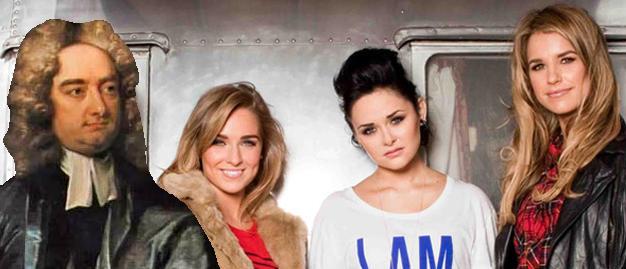
Jonathan Swift: unlikely to appear in Fade Street.

Finished the exams (YES!) for a few hours now, and I decided to mark it by picking up a book from the library that I wasn’t actually obliged to read. Post exams, reading is actually a pleasure again. I went with a work from the Civic Trust, as they’re among my favourite Dubliners. I’ve always loved the irony in their offices being located so close to the Wood Quay monstrosity.

They’ve published some excellent studies of individual Dublin streets, looking at the development of the street and the factors that make them unique, with a particular focus on architecture. I ran with the Thomas Street edition,my great-grandmother was from Cornmarket and I’ve long been fascinated by the Liberties.

The information provided on Number 34 Thomas Street was particularly interesting:

The site of Frawleys is also significant, as it was formerly owned by the Quaker, Joseph Fade. Fade established himself in business on the site around 1715, and rapidly became one of the city’s most important bankers, having two streets named after him: Joseph Lane, which has subsequently been demolished and Fade Street, both off South Great George’s Street.

The book noted that Fade had been mentioned in some of the poetry of Jonathan Swift, and a look around revealed one example quite quickly. Within Will Wood’s Petition To The People Of Ireland (1725) there is mention to Fade and another famous Dublin banker of the day.

You will be my thankers,
I’ll make you my bankers,
As good as Ben Burton or Fade
For nothing shall pass
But my pretty brass,
And then you’ll be all of a trade.

(more…)

Read Full Post »

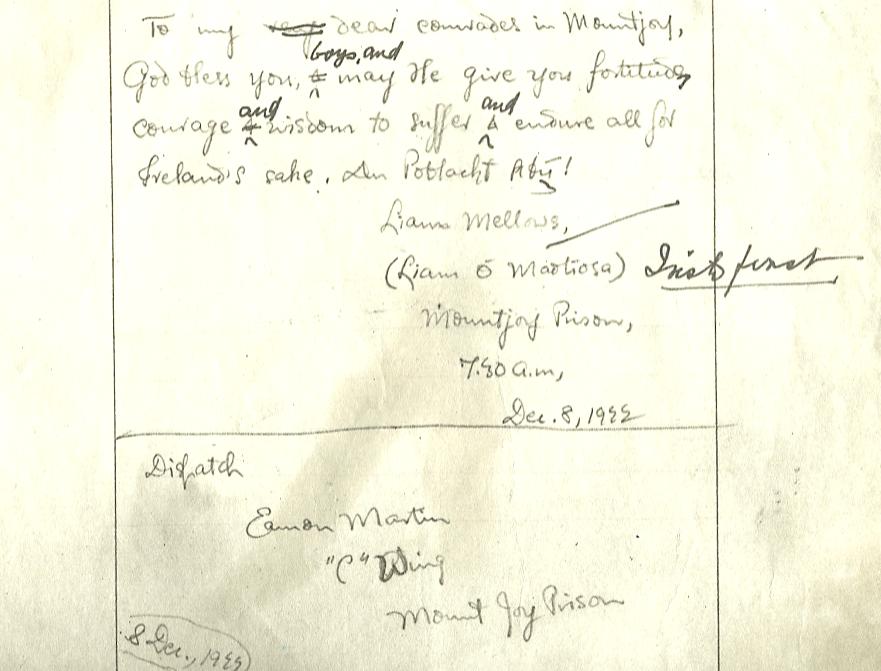
Mellows’ last message was delivered to Eamon Martin by a prison officer. It was written at 7.30am and ran:

To my dear comrades in Mountjoy. God bless you, boys, and give you fortitude, courage and wisdom to suffer and endure all for Ireland’s sake.

An poblacht abu!
Liam O Maoiliosa (Liam Mellows)

The above is taken from C Desmond Greaves wonderful biography of Liam Mellows, entitled Liam Mellows and the Irish Revolution. Undoubtedly one of the most complex characters of the anti-treaty republican movement, I’ve always been fascinated by Mellows. A great account of what Mellows was like as a man inside Mountjoy can be found in Peadar O’ Donnell’s prison memoirs The Gates Flew Open.

Recently, I saw the letter below. It is the final letter of Liam Mellows, the letter published above in Graves biography. It comes from the personal papers of Paddy Kelly, whose father was a republican prisoner in Mountjoy at the time. Look closely at it however. There are a number of clear edits made to the letter, for example the first line, where “to my very dear comrades…” becomes “to my dear comrades”. “God bless you,” becomes “God bless you boys” and the word “and” is added at various points, replacing the & symbol.

At the end of the letter “Irish first” is added and underlined next to Liam’s name.

Were these edits made by Mellows himself, or are they an early example of spin doctoring? Was the letter edited by republicans for propaganda impact before publication? Several of the letters seem completely different to those in the original letter, yet with others it’s a little less clear.

Read Full Post »

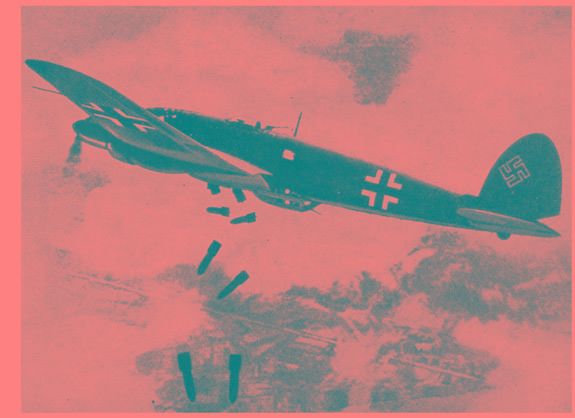
Heinkel III German bomber.

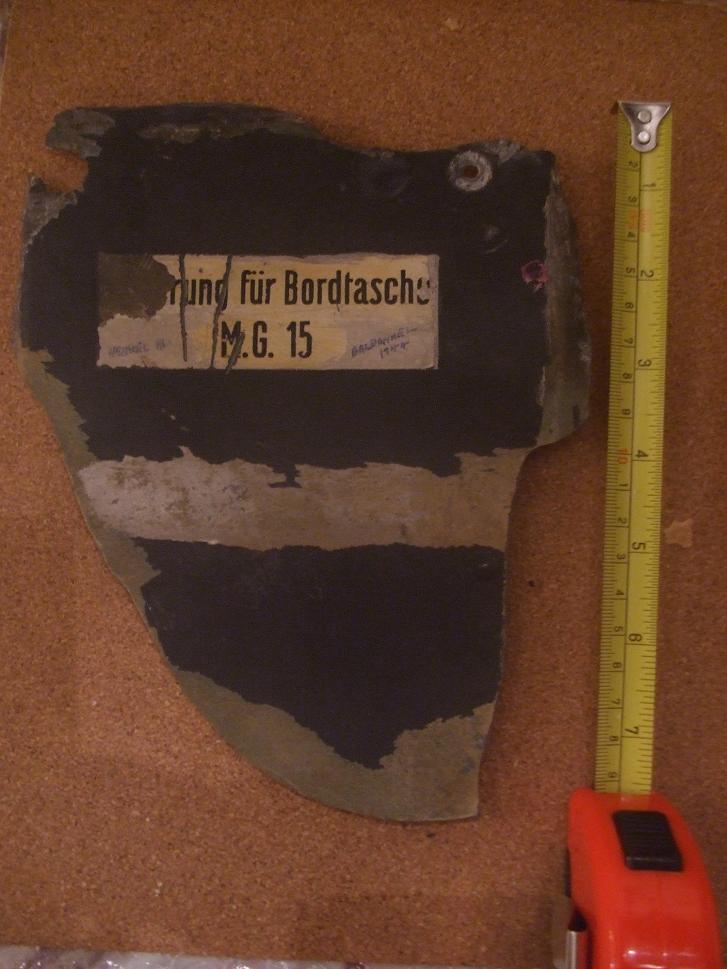
An unusual one this, a piece from the wreckage of a Heinkel III German bomber. The Heinkel’s were the mainstay of the German bomber squadrons during the Blitz and several crash landed in the Irish Free State, resulting in their crews being interned in the Curragh. Some German bombers did not survive such crashes, and a number of men found their final resting place in the German war cemetery in Glencree.

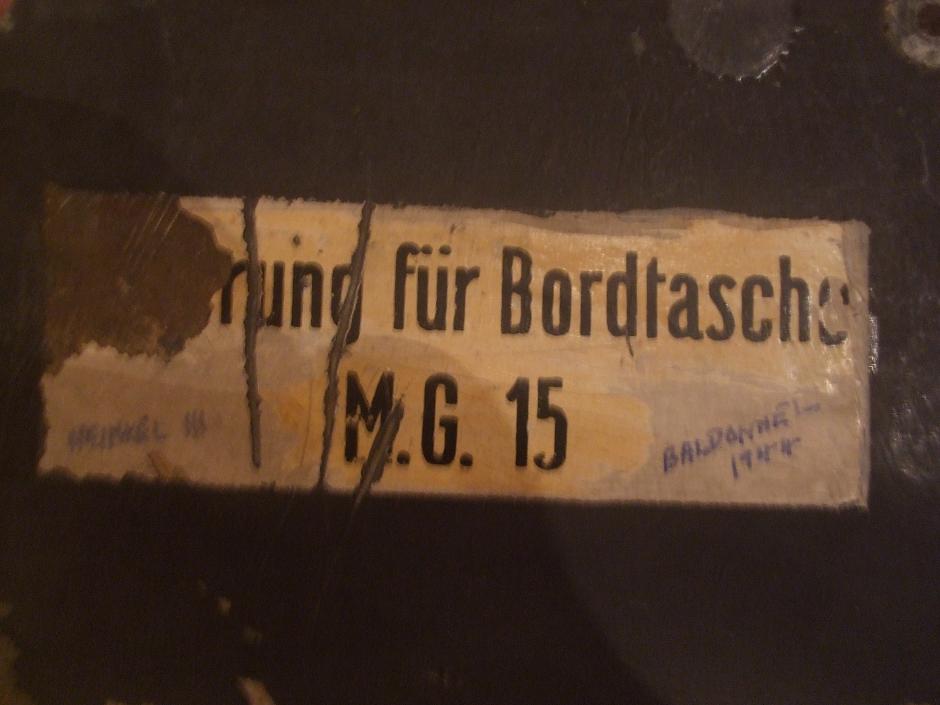
This piece was salvaged in 1944 at Baldonnell Airdrome by a young Irish army officer and remains in the possession of his family. It was loaned to my father for a project he is working on, in relation to the 70th anniversary of the Belfast Blitz in April.

The piece comes from the planes fuselage and has markings which indicate that it was part of the housing of one of the planes M.G 15 machine guns.

German Kampfgeschwader (A unit of the Luftwaffe) flying out of airfields in France and the low countries carried out the raids over southern and western England and Ireland. The attacks on Belfast on April 15 and May 5 inflicted huge casualties and according to Luftwaffe records involved up to 180 aircraft. Dublin was bombed too, not just at North Strand but also at Dolphin’s Barn and the South Circular Road. More information on the the lesser known Dolphin’s Barn and South Circular Road bombings can be found in Eoin C. Bairéad’s The Bombing of Dolphin’s Barn, Dublin, 1941. This work has only just been released as part of the Maynooth Studies in Local History series.

(more…)

Read Full Post »
« Newer Posts - Older Posts »