Feeds:
Posts
Comments

Sign of the times

Heading into town today I came across this sight outside the American embassy on Ballsbridge. Dozens and dozens of young adults queuing up for their Visa interview. Depressing.

Queue outside U.S. embassy. 9 May 2011. (c) Jay Carax

I don’t think there’s anyone out there who doesn’t know someone close who has moved away or is planning on doing so too. Over the weekend, I went to two going away drinks of close friends of mine. Both were leaving for the summer at lack of job opportunities in the city. One to Berlin, the other to South America.

“The revolution will inevitably awaken in the British working class the deepest passions which have been diverted along artificial channels with the aid of football.” Leon Trotsky.

A couple of weeks back, I got the oppurtunity to interview Gabriel Kuhn of PM Press, and author of “Soccer versus the State.” Anyone on here knows our views when it comes to football, keep it local, keep it real and forget about your barstool; a lot of that is covered in the interview. Not initially done for here, it was DFallon who suggested I put it up.  If you’ve an interest in football, history and politics, read on.

Notorious Boo Boys

1) Football comes in for much negative criticism from the left, mainly criticisms similar to Trotsky’s above, deriding it as cathartic and a distraction. Yet in recent years, we’ve seen iconic events like the “Football Revolution” in Iran, the Greek riots following the death of Alexandros Grigoropoulos (where Panathanaikos fans fought against the police side by side with Anarchists) and the Al-Ahly Ultras in Egypt and their apparent hand in revolution there. How influential has football been in Rebellions and amongst the rebellious throughout history?

Football has been attracting the masses around the world for over a century. Where masses gather, the powerful lose control – unless we’re talking about orchestrated mass gatherings, which are characteristic of fascist and authoritarian regimes. But this doesn’t really work with football, since it is hard to orchestrate a football game. Football is too unpredictable.

Authoritarian regimes have always used the prestige that derives from football victories for political purposes, but they have had a hard time to use football as a general propaganda tool. The Nazis abandoned national encounters altogether after an embarrassing loss to Sweden in Berlin in 1942. And it is not only the game that is unpredictable. So are football crowds. You never know which direction their desires might take. There is always a potential for rebellion – unfortunately, there is also always a potential for reactionary celebrations of the status quo. Neither football nor football fans are rebellious per se. We have radical supporters, we have fascist supporters; we have football teams that spur nationalism, we have football teams that spur international solidarity. At the right moments, the rebellious side comes through, as in the examples you mentioned and in many others: long before the current uprising in Libya, the terraces of Libyan football stadiums turned into spaces of dissent whenever Gadaffi-favoured teams were playing; in the 1980s, Polish workers made regular use of football stadiums to express support for the then illegal trade union Solidarność; in fact, the very first steps to regulate the game of football in the early 19th century was caused by regular antiauthoritarian riots in connection with the inter-village football games at the time.

Football does have the cathartic and distracting dimensions that many leftists deride, no doubt. But it also has a subversive dimension. The challenge for radical football-loving activists is to fuel the latter.
Continue Reading »

A great piece this, and my thanks to Paddy Kelly for providing it.

This is a fascinating propaganda leaflet from 1922, deriding Michael Collins and the Free State. A different Queen Elizabeth to the one currently making the headlines here of course!

‘I wish to advise you that your application has been refused. This decision has been taken on the basis that no postering applications for events between 15th and 25th May are being granted in the interest of promoting a clean environment for Dublin City during forthcoming State visits.’

-An email sent by Dublin City Council to various groups who applied for for permission to erect posters ahead of the royal visit to Ireland.

Regardless of what one thinks of the visit, this is remarkable. Even during the visits of George W. Bush and other controversial state figureheads, postering has been permitted. It’s worrying to see the council refuse the right to poster on political grounds.

We’re At

For those who aren’t sure what “We’re At…” actually is, I’ll yoink the following sentence from their Facebook as it succinctly sums them up; “We’re At…” is an exciting new community media initiative about to take part in the heart of Temple Bar. Using a fully digital, state of the art pop up TV studio in a shop front at 5 Scarlett Row, Dublin Community TV is going to throw itself into covering the roaring arts and culture festival circuit that takes over the city during the summer months.”

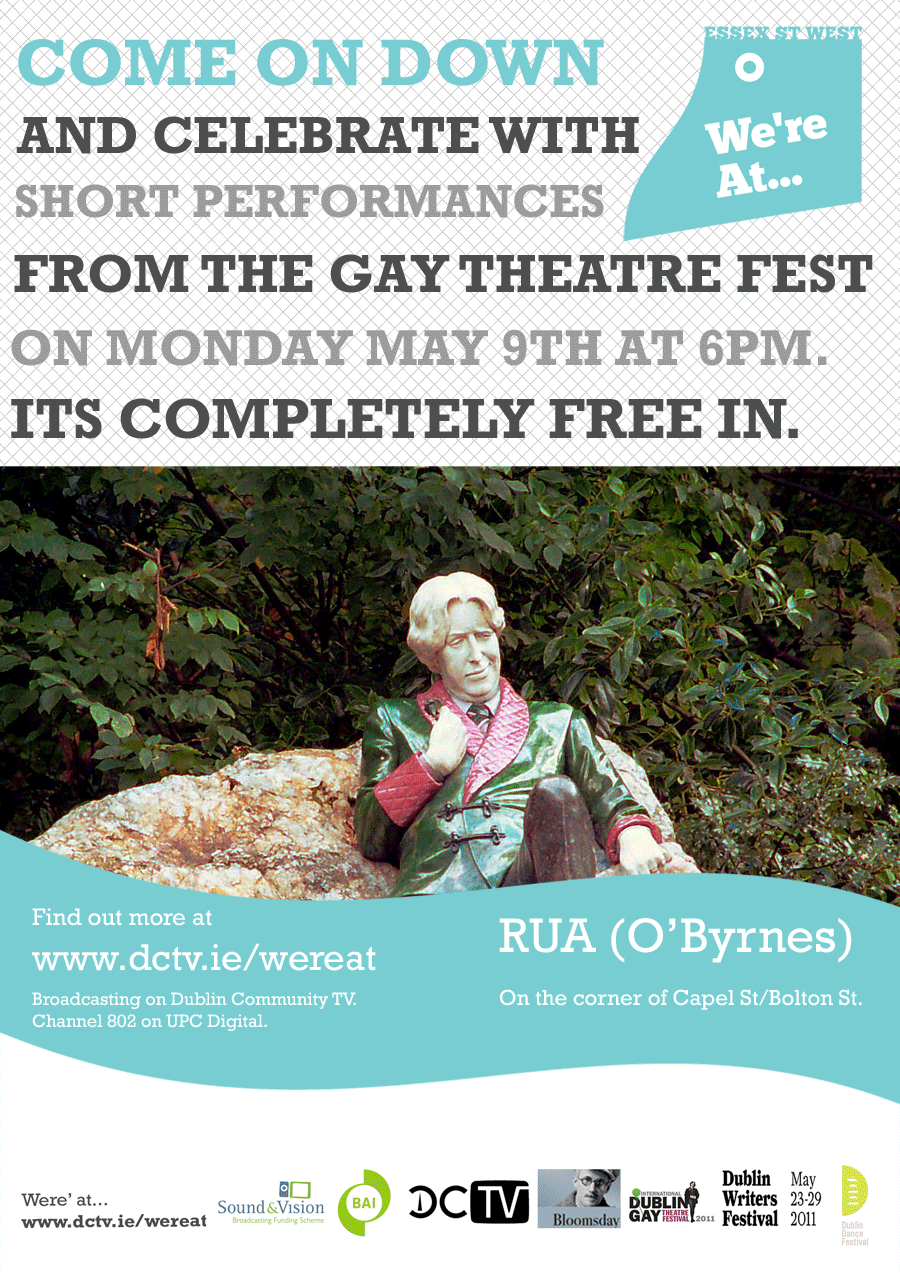
Come celebrate the launch of We're At....

To celebrate the launch of the show, the crew of “We’re At…” are  teaming up with the IDGTF to bring you an early evening of performances from some of the star performers at this years festival.

Its a once off event, and a chance to have a gander at what’s going on at the IDGTF. Looks like a great evening, I’ve taken quite a liking to O’Byrnes, great pints of Guinness for €4 on the button, can’t go wrong. Might see yiz there.

Well done to the people at Dublin Community Television for this excellent interview with Sam Nolan, a man who has given decades to the trade union and labour movement. Brian Kenny’s Sam Nolan: A Long March on the Left has only recently been released.

There is an article in Dublin May Day’s I hope to get around to in time. Sadly the event has been in decline in Dublin for a number of years, with extremely small turnouts of several hundred people. Ironically I missed this years May Day with work commitments, but last year I got along and recorded Arthur Scargill’s speech:

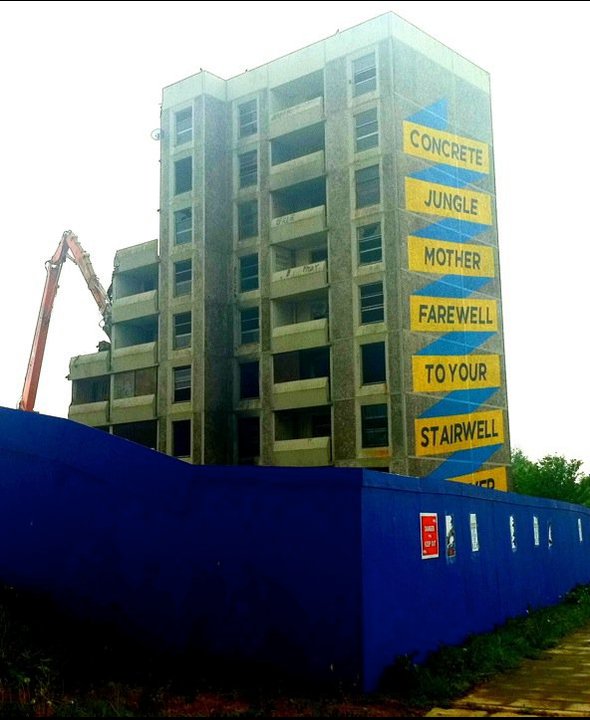
Maser/Damo Ballymun mural will be knocked Friday morning

-Image and above from MASER ART Facebook.

These HUGE posters are hanging out the front of The Gibson Hotel down by The Point, with ‘Welcome To Ireland’ above them. On Facebook, Joe and Joanna Public are giving out yards.

Update: 00:40. Now they’re denying they’ve any role in the whole thing.

Update 15:30 5/5: “The gibson hotel would like to confirm that the banners placed in front of the hotel building at the Point Village were placed there by Crosbie Property, the owners of the development. Crosbie Property do not operate the hotel. The banners have now been removed.”

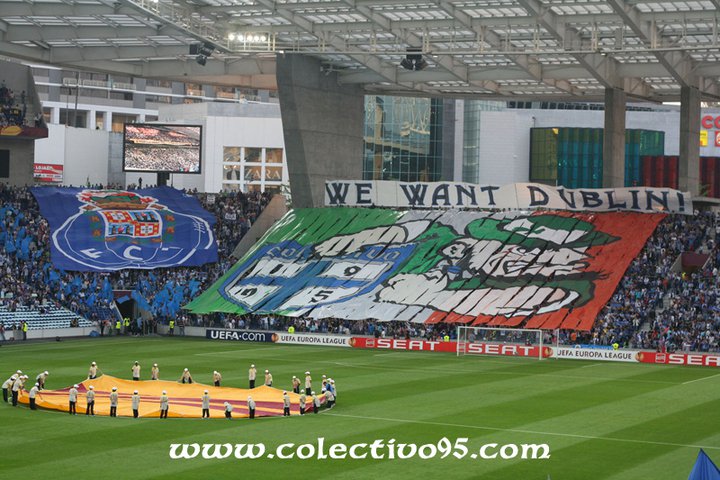
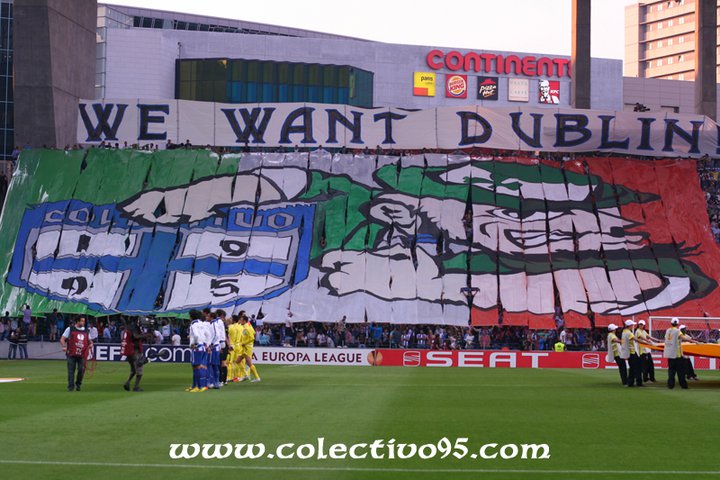
‘We Want Dublin!’

The Europa League trophy is in Dublin right now. Ultras FC Porto made it perfectly clear last week that they want to come here and get it.

A little different from the Shed End Invincibles and the Irish groups normally featured here!

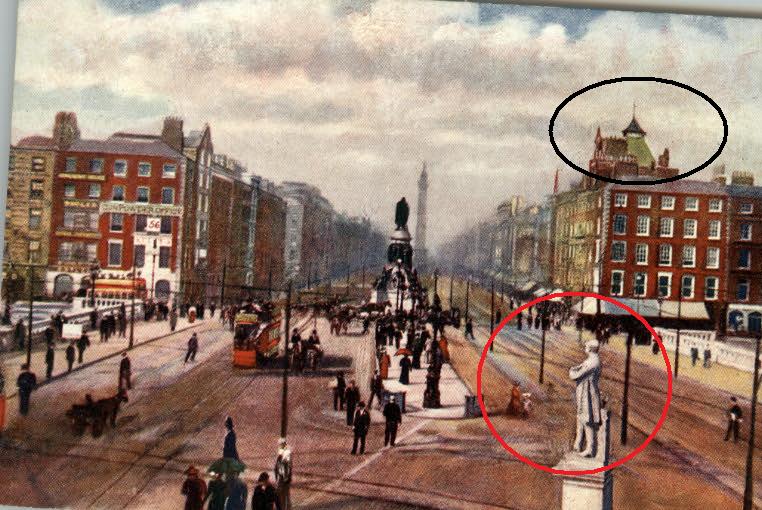
I was looking through some old postcards of O’Connell Street and came across this one. It’s obviously depicting Dublin pre Easter rebellion, as I’ve circled the Dublin Bread Company on the right of the photo. The tower of the Dublin Bread Company was used by rebels during the rebellion to return fire to snipers from Trinity College Dublin, but it was never reconstructed following the rebellion.

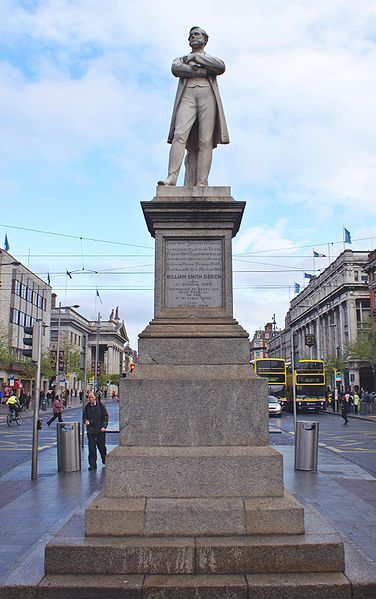
Who is the statue circled in red? It’s William Smith O’Brien. I never knew he was positioned at the corner of D’olier Street and Westmoreland Street for a period. The statue, by Thomas Farrell,was unveiled in 1870.

William Smith O’Brien now stands proudly on O’Connell Street, across the River Liffey and among giants of Irish history.

O’Brien made the journey across the Liffey in 1929. A great article in the Independent at the time commented on the statue, noting it was “..about twice life-size” and “..is composed of Caravazzia marble”. The statue had first been unveiled on the southside of Dublin on Stephens’ Day 1870, before a large assembly. The Times in London remarked at the time “Why gibbet such a failure in monumental marble?”

In 1900, the statue saw the name “O’Brien” removed from its pedestal by Dublin Corporation, substituted for the current bi-lingual inscription. As noted in the Independent: “This was the outcome of an agitation aroused to remove the doubt that somehow got abroad that the statue was that of William O’Brien, the Irish Nationalist M.P, whose name was so much before the public at the time, and not that of the ’48 rebel.”

Will he be left in peace? Well, no. William Smith O’Brien is due to be moved again, though only temporarily. Collins Barracks is the location. The reason for his latest move is of course the Metro North project.

I have to say membership of the IFI is the best investment I’ve made in Dublin to date. As much as the great new films on offer though, I’ve been loving the re-releases. Seeing the Battleship Potemkin on a big screen was every bit as cool as I expected it to be.

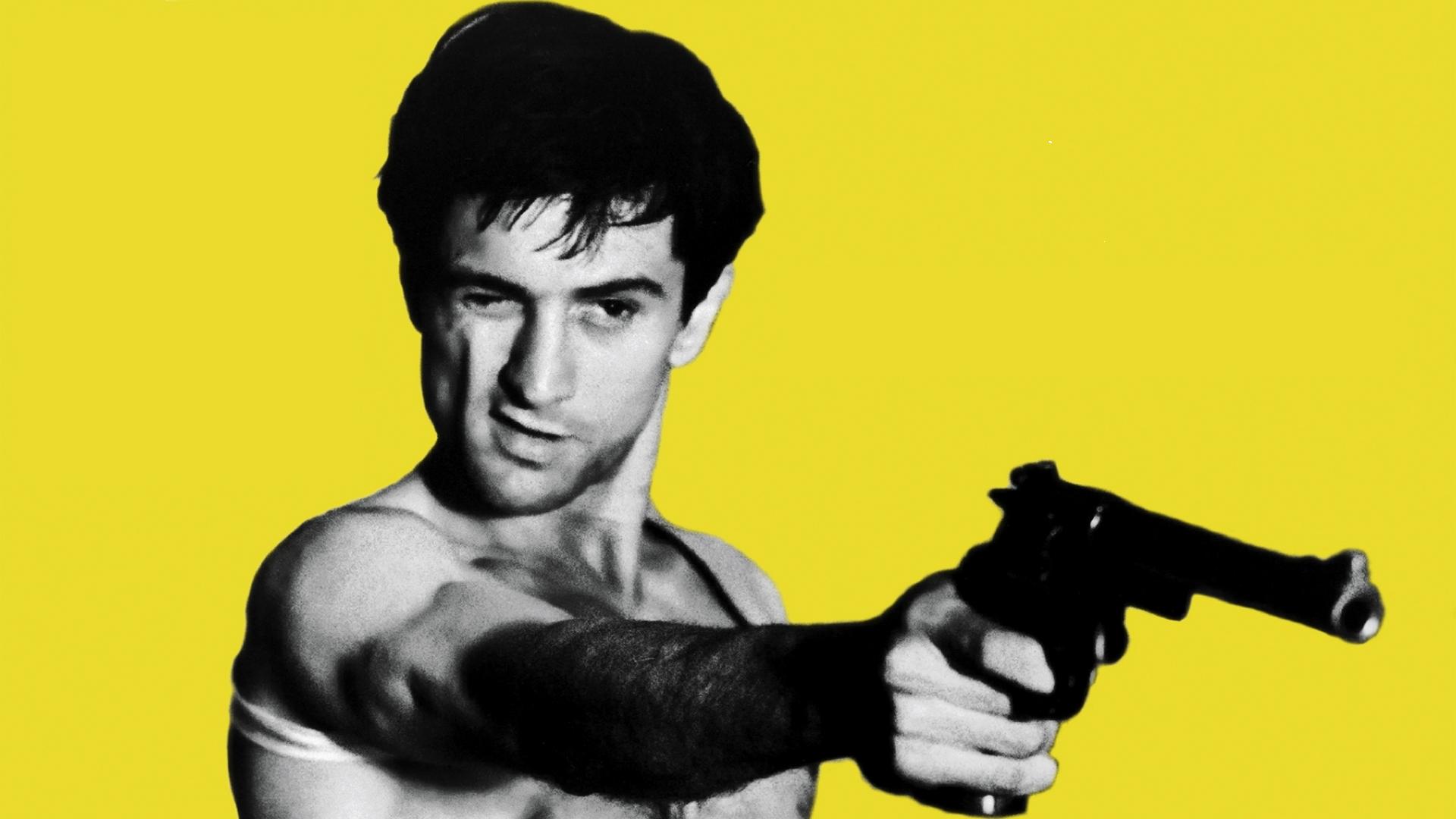
This month, from May 13th to 19th, Taxi Driver gets an airing at the IFI. I’ve only watched this film once before, on a crappy portable DVD player. They were the thing to have about five years ago, presenting new and exciting ways to set a house on fire while you sleep.

The chance to see Travis Bickle on the big screen is something to seize I think. The May programme for the IFI is available to read right now.

If so, Curleysue wants to borrow them for a production of Irvine Welsh’s Ecstasy at the T@36 Theatre in The Teachers Club later this month.

Ecstasy by Irvine Welsh, is set in Edinburgh against the backdrop of the early 90’s rave scene. Our members and our audience will be familiar with Welsh’s other works, in particular ‘Trainspotting’ which achieved great success and depicted heroin addiction. The subject matter of the play, the language used and many …of the scenes presented new challenges for our entire team and provided an excellent opportunity for those on and off stage to develop their skills.

For me, I’ve always had a soft spot for the music and ethos of the rave culture. The high energy, anthemic music was pretty much all I listened to at the time. The friendly vibes and dancing contrasted with the dark and introspection of the grunge sceneof the time. However there was a dark subculture within that scene. Making it both an uplifting and tragic cultural background for the story. – Director Dave McGowan

The play runs from the 17th to the 21st of May. Doors open at 7.30 and the play begins at 8 sharp!

Tickets are only available online at nodrama.eventbrite.com. More info on Facebook here.