Feeds:
Posts
Comments
Cervi

Historic postcard of Great Brunswick Street, today Pearse Street (Image Credit)

I was delighted to see this historic postcard posted on Facebook recently. While the focus of the photographer was probably the Army Recruitment Office on Great Brunswick Street (or Pearse Street to me and you), they accidentally captured what would become an interesting bit of Dublin social history. At 22 Great Brunswick Street, we get a great view of Dublin’s first chipper, opened by Giuseppe Cervi, who arrived here in the 1880s.

Cervi

22 Great Brunswick Street.

Today, the takeaway section of popular restaurant Super Miss Sue is named ‘Cervi’s’ in his honour. His humble takeaway booth on Great Brunswick Street stood on what is now the site of the Dublin Fire Brigade headquarters, though the Cervi family later established a proper premises at no. 22, which we can see advertised “Fried Fish & Chips” to all. Italians had been arriving here long before Cervi; as Vinnie Caprani has noted, “many of the Italian immigrants who arrived in Ireland in the middle and latter half of the nineteenth century were stonemasons, church decorators and terrazzo tile workers.”

Tony Cervi, a son of Giuseppe, remembered his father in a 1976 Evening Herald feature on Dublin’s Italian chipper community, recalling that “there were very few Italians living in Dublin when my father first arrived here. My father was illiterate to the end of his life, yet he could do the most difficult accounts in his head, and never come out wrong. He loved horses and horse racing, and could out odds and prices to the very last penny.”

The Italian community would become synonymous with Dublin’s takeaways and ice cream parlours, and by 1910 the city could boast of twenty chippers. While most  of Dublin’s big chipper names came from the Frosinone region of central Italy, the Cervi’s came from Picinisco. Cervi’s wife is credited with coining the Dublin phrase ‘One and One’, still used to describe a fish and chips meal. She would ask customers ‘Uno di questo, uno de quello?’, meaning one of each. By the early twentieth century, the Italian community was significant enough to see the area around Little Ship Street, where Giuseppe and his family lived, become known as ‘Little Italy’. Tony Cervi remembered that:

The area around us – off St. Werbrugh Street, Chancery Lane and Whitefriar Street was known as ‘Little Italy’. If someone came to Dublin and wanted to locate a particular Italian, he would more often than not be directed to ‘Little Italy’. The place was filled with barrel-organ men, ice cream men who traveled the city with their barrows and  marblemen. My mother usually ‘put up’ traveling Italian or Greek terrazzo workers of craftsmen, and Italians who came here to erect altars and suchlike. They’d be given our address and know my mother would give them good Italian food.

Dublin Inquirer x CHTM.

TheRussianRevolu.jpg

Dublin Inquirer, April 2017.

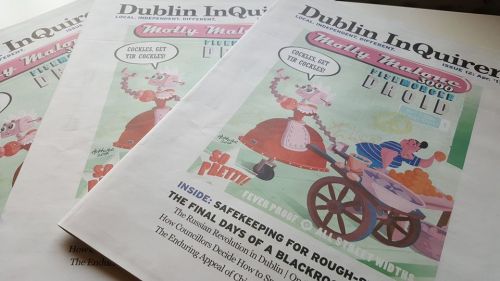
Dublin Inquirer first burst onto the scene in June 2015, as an online news website covering all aspects of life in the capital. With a particularly keen eye for civic politics and culture, it caught our attention right from the start. Evidently many others liked it too, allowing it to grow into a monthly print publication while retaining a strong online presence.

Independent media of all shades has an important part to play in the life of any city. With this in mind we continue we have actively contributed to Rabble magazine since its inception, and have been lucky enough to have the wonderful Dublin Digital Radio air our last ‘Dublin Songs & Stories’ event.  All of these outlets are doing great work in providing spaces to alternative voices.

When asked to contribute a monthly historical feature to DI I jumped at the chance. From the April issue onwards (which should be appearing on the streets in the days ahead) there will be a regular contribution, which will be exclusive to the print edition of DI and which will be new material, i.e not published previously on this site or the DI website.

The first feature is a look at the sometimes strange intersections of the Russian and Irish revolutionary periods, and the widespread enthusiasm in Dublin for the Bolshevik revolution in its immediate aftermath. It was largely inspired by the recent condemnation from some quarters of Dublin City Council’s decision to invest on a programme linked to the Russian Revolution centenary as part of the on-going Decade of Centenaries. As this piece argues, events in Russia did impact directly and indirectly on revolutionary Ireland.

You can pick the physical newspaper up (€3) from the following places, which includes a few friends of ourselves (Bang Bang, Connolly Books and more besides).

  • Wigwam – 54 Abbey Street Middle, Dublin 1
  • Connolly Books – 43 East Essex Street, Dublin 2
  • The Library Project – 4 Temple Bar Street, Dublin 2
  • George’s Street Arcade – 2 South Great George’s Street, Dublin 2
  • Little Museum of Dublin – 15 St Stephen’s Green, Dublin 2
  • Books Upstairs – 17 D’Olier Street, Dublin 2
  • Bark Coffee at Alan Hannah’s Bookshop – 270 Rathmines Road Lower, Dublin 6
  • Village Bookshop – 101 Terenure Road North, Dublin 6W
  • Back Page – 199 Phibsborough Rd, Dublin 7
  • Urbanity Coffee – The Glass House, 11 Coke Lane, Dublin 7
  • Bang Bang – 59A Leinster St North, Dublin 7
  • The Pupp Cafe – 37 Clanbrassil Street Lower, Dublin 8
  • The Green Door Market – 18 Newmarket, Dublin 8
  • Smallchanges Wholefoods Store – 40 Drumcondra Road Lower, Dublin 9

An Unusual Prisoner

Ernie O’Malley has always appeared as somewhat of an enigma to me. A veteran of the War of Independence and the following Civil War, he remained puritanical in his vision for an Irish Republic and held an uncompromising belief that any violence used in attaining same was soundly and morally justified. His politics never deviated from the creation of the Republic, his head never turned and he was happy to play the part of the consummate soldier.

His works on the War of Independence (“On Another Man’s Wound”) and the Civil War (“The Singing Flame”) are easily two of the best books on the Revolutionary period, his style a descriptive pose capable of painting a vivid scene. Covering the period July 1921 to July 1924, The Singing Flame commences around the 1921 Truce and runs right through to the death of Liam Lynch and as such the cataclysmic aftermath of the split and all it entailed feature heavily and heartrendingly.

ernieandjack

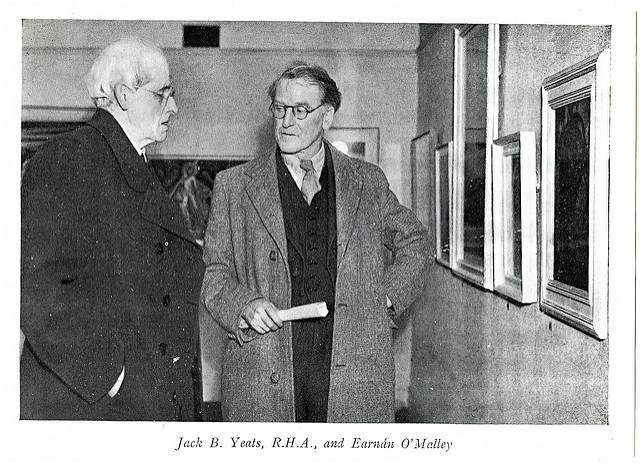
Jack B. Yeats and Ernie O’Malley, from the 1948 Capuchin Annual.


For the purpose of this article though, the book goes into great detail about the occupation, defence of and surrender of the Four Courts during the Battle of Dublin (in which O’Malley’s younger brother also fought, under Oscar Traynor in ‘The Block’ on O’Connell Street.) There are articles to be written about that event in detail and no doubt there will be given the upcoming centenaries but an interesting character jumped out on my last reading of the book that I can find no record of anywhere else- a well coiffured American Dandy gun-runner who had somehow been taken prisoner in the Four Courts.

Already we had one prisoner near the guardroom. He was a professional gun-runner. He entertained us with stories of Mexico and of the South American Republics. He passed comments on the hotels in Dublin; there was only one where a person could eat in comfort. I expect the food from the Officer’s Mess was not much to his liking. He was rather tall, well dressed, with light fair hair and a slight mustache varying between fair and white, well pointed at the ends, he must have used some kind of grease. He was accused of trying to double cross some of our agents in Belgium and Germany who were attempting to purchase arms. He protested vigorously. This was an outrage, it was the first time he had ever been arrested. He was told it might be the last time, and his smile, showing a few gold teeth, dwindled away. His nasal voice was not raised so often now.

After O’Malley’s escape from Dublin, he describes making his way to Bray where he encountered the prisoner again.

What South Dublin had been doing since the attack on the Courts I could not imagine. A man walked over from the hotel door. He was the American gun-runner whom we had released a few hours before the attack on the Four Courts began. He inquired for Liam Mellows and Paddy O’Brien. ‘I liked them well,’ he said. ‘I sure am sorry about O’Brien. They were good boys in there.’ He flashed his gold- toothed smile. ‘I’m waiting for the next boat, glad to go; this country of yours is too sharp for me.’ ‘If you send us a consignment of trench mortars,’ I said, ‘no one will quarrel with you about your excess profits.’

The Easter Rising and the War of Independence have their fair share of tales of foreign influence, accounts of which can be drawn down from the Bureau of Military History’s Witness Statements and the Military Service Pensions Collection. The Civil War, given the Republican side’s principled refusal for the most part to deal with the Free State relies on O’Malley’s own collection “The Men Will Talk to Me” for any anecdotal evidence relating to the period. I’ve searched several other sources relating to the Four Courts occupation but can’t find any other references to the prisoner- any help would be appreciated!

stereopairsGrafton

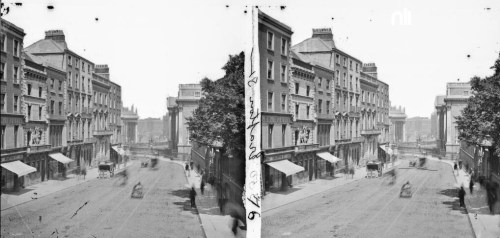
Grafton Street, c.1860 -1880, From the Stereo Pairs Photography Collection, National Library of Ireland.

Any discussion of prostitution in Dublin historically will inevitably focus on the so-called ‘Monto’ district of the north-inner city, the area around Montgomery Street which became notorious enough to warrant mention in the Encyclopedia Britannica of 1903:

Dublin furnishes an exception to the usual practice in the UK. In that city the police permit ‘open houses’ confined to one street; but carried on more publicly than even in the south of Europe or in Algeria.

Yet while ‘Monto’ emerged in the late nineteenth century, there was nothing new about prostitution in the city, indeed all that tended to change with time was the localities where prostitution was to be found. In earlier decades,and in particular throughout the 1860s and 1870s, Grafton Street and its environs was regarded as a centre of prostitution in the city. This infuriated sections of Dublin society, who complained repeatedly in the letters pages of newspapers that the street had become “impassable to virtuous women.” In the words of one writer to the Freeman’s Journal in 1870:

Let some half-dozen men of the G Division (Dublin’s intelligence police) parade Grafton Street at the hours of four to six. This was found very successful in Sackville Street during last summer, and I have no doubt we shall soon be free of these social pests, and can again escort our wives and daughters through one of our finest streets.

An earlier letter writer to the same paper described how the street “literally swarmed with women of loose character.” It is worth considering if the emergence of the later ‘Monto’ district was tolerated to a degree, on the basis that it removed the sight of women working in the Grafton Street area, something which clearly troubled some.

While the above letter calling for the G Division to be deployed against prostitutes bore little sympathy for the women themselves, others avoided such loaded and vindictive terms as “social pests”. A letter write who signed a piece of correspondence as ‘Strike At The Root’ instead referred to the women as “poor unfortunates”, and insisted that it was not “motives of avarice or sensuality” which drove most women to the streets.

Certainly, there were two very different versions of Grafton Street. While some, like our letter writers above, believed the street was in decline, guide books to the city throughout the 1860s and 1870s praised it, with one insisting that “the elite of Dublin…will be found in Grafton Street…This street…is the brightest, cheeriest street in Dublin. It is the fashionable shopping street. Equipages in the very perfection of good taste may be seen in long lines at both sides of the street in front of the principal shops.” This description of the street was at odds with that of a priest in 1877, who described:

Dozens upon dozens of females belonging to that class truly designated unfortunate, the majority of them not eighteen years of age….passed me, using language and openly flaunting a shame the very mention of which is enough to bring a blush to the cheek of virtue.

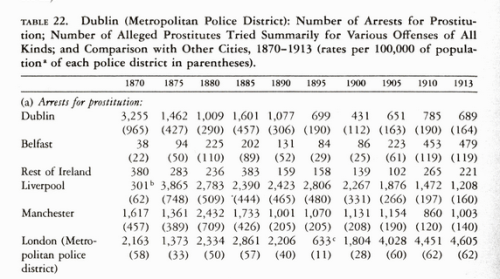
The sheer number of women working in Dublin in this period as prostitutes was quite remarkable. Take this table from Joseph V. O’Brien’s study of Dublin at the turn of the century. It wasn’t that numbers were proportionately higher than cities like London and Manchester, they were higher in general. In 1870 for example, London witnessed 2,183 arrests for prostitution, Manchester 1,617 and Dublin 3,255.

screen-shot-2014-04-29-at-09-59-31.png

From Joseph V. O’Brien’s classic study Dear,Dirty Dublin:A City in Distress 1899-1916 (California, 1982)

Continue Reading »

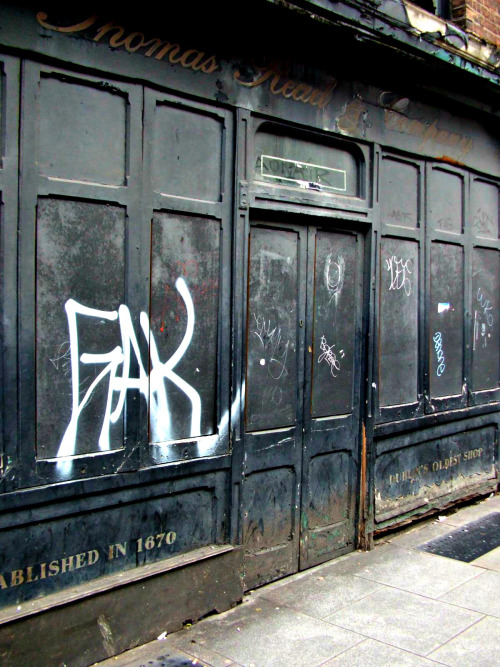
Way back in the distant past of 2012, we noted the continued deterioration of Thomas Read’s on Parliament Street. Established in 1670, Read’s was one of the oldest cutlers in the world, and it was the oldest shop in the capital before its closure some years ago.

TR4.jpg

Producing cutlery, surgical instruments and swords, the shop once opened onto Crane Lane, but in 1766 this changed with the opening of Parliament Street, thanks to the endeavors of the Wide Streets Commissioners, who truly transformed the urban landscape of Dublin. With this, Read’s address changed from 3 Crane Lane to 4 Parliament Street. The origins of the business were with a sword maker, Edward Read, who worked at Blind Quay before establishing his premises on Crane Lane.

When interviewed in 1984,the then-owner Jack Read Cowle told a newspaper reporter that while Dubliners always told him they were glad the business was still in existence, he would joke that “you’d better make the most of me, because I won’t be here much longer.” Great footage of the Read’s interior survives, thanks to the digitisation of a classic Éamonn MacThomáis television series:

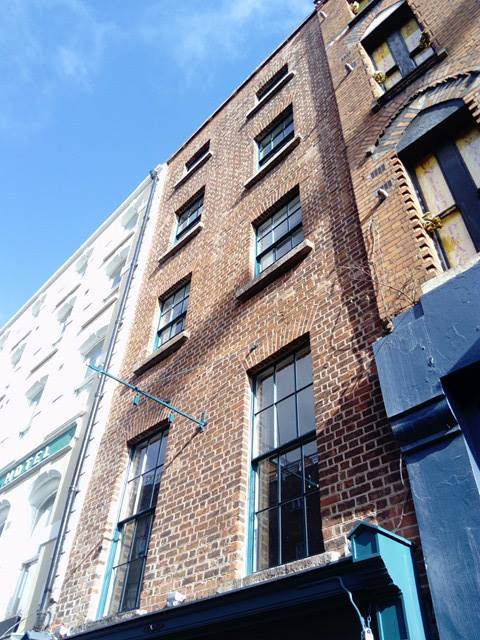
Passing Parliament Street recently, it was clear that recent work on the building has been truly transformative. The brickwork has been restored beautifully, and the general sense of decay around the building is no more. ReadsCutlers.com provides insight into the restoration work underway, while a glance at the interior contents in possible on the Read’s Cutlers Instagram account, including beautiful 18th century cabinets. It looks like this important piece of Dublin will reemerge in the near future.

TR1.jpg

Thomas Read’s, March 2017.

TR2.jpg

Thomas Read’s, March 2017.

TR3

Thomas Read’s, March 2017.

The Other Proclamation.

150 years ago today, the Fenian Rising commenced.

Less than ten years after the founding of the Fenian Brotherhood in New York and the Irish Republican Brotherhood in Dublin, armed men assembled across Dublin and in other parts of the country. The insurrection is synonymous with Tallaght, where thousands of Fenians mobilised for action, but there were outbreaks of violence in other places too. At Stepaside and Glencullen, men led by the American Civil War veteran Patrick Lennon carried a green flag into battle emblazoned with the words ‘REMEMBER EMMET’.

The insurrection quickly collapsed; William Domville Handcock, a Tallaght landowner and Magistrate for County Dublin, wrote dismissively of “the Fenian Battle of Tallaght as it was called, though it was unworthy of the name.” Even some later separatists dismissed what occurred in 1867; Bulmer Hobson, the maverick IRB organiser who would do so much to revitalise the Fenian movement in the early 20th century, referred to the 1867 rebellion in his Bureau of Military History Witness Statement as “a pitiful demonstration.”

Despite its military failure, one interesting dimension of the rebellion was the Proclamation issued by the Fenian leadership, and delivered to the offices of The Times newspaper in London and other media outlets. To mark the anniversary of this historic event, we are reproducing it in full below.

It called for “absolute liberty of conscience, and complete separation of Church and State”, and appealed directly to English workers, encouraging them to take up arms and to “remember the starvation and degradation brought to your firesides by the oppression of labour.” In many ways, it is a document more radical than the much more celebrated Proclamation of Easter 1916.

Lastly, we wish to express our sadness at the passing this week of historian Shane Kenna, who had done so much in recent years to highlight the role and importance of the Fenian movement in Irish history. Shane was a talented writer, a wonderful tour guide and one of the nicest people in the small community of historians in Dublin. He was laid to rest yesterday in Tallaght, only one day short of the anniversary of the Fenian Rising there. We express our condolences to his family and friends, and we are grateful to have known him.

FenianProclamation.jpg

The 1867 Proclamation, reproduced by historian Pádraig Óg O Ruairc for a recent event in Limerick exploring 1867.

I.R

-PROCLAMATION-

THE IRISH PEOPLE TO THE WORLD.

We have suffered centuries of outrage, enforced poverty, and bitter misery. Our rights and liberties have been trampled on by an alien aristocracy, who treating us as foes, usurped our lands, and drew away from our unfortunate country all material riches. The real owners of the soil were removed to make room for cattle, and driven across the ocean to seek the means of living, and the political rights denied to them at home, while our men of thought and action were condemned to loss of life and liberty. But we never lost the memory and hope of a national existence. We appealed in vain to the reason and sense of justice of the dominant powers.

Our mildest remonstrance’s were met with sneers and contempt. Our appeals to arms were always unsuccessful.

Today, having no honourable alternative left, we again appeal to force as our last resource. We accept the conditions of appeal, manfully deeming it better to die in the struggle for freedom than to continue an existence of utter serfdom.

All men are born with equal rights, and in associating to protect one another and share public burdens, justice demands that such associations should rest upon a basis which maintains equality instead of destroying it.

We therefore declare that, unable longer to endure the curse of Monarchical Government, we aim at founding a Republic based on universal suffrage, which shall secure to all the intrinsic value of their labour.

The soil of Ireland, at present in the possession of an oligarchy, belongs to us, the Irish people, and to us it must be restored.

We declare, also, in favour of absolute liberty of conscience, and complete separation of Church and State.

We appeal to the Highest Tribunal for evidence of the justness of our cause. History bears testimony to the integrity of our sufferings, and we declare, in the face of our brethren, that we intend no war against the people of England – our war is against the aristocratic locusts, whether English or Irish, who have eaten the verdure of our fields – against the aristocratic leeches who drain alike our fields and theirs.

Republicans of the entire world, our cause is your cause. Our enemy is your enemy. Let your hearts be with us. As for you, workmen of England, it is not only your hearts we wish, but your arms. Remember the starvation and degradation brought to your firesides by the oppression of labour. Remember the past, look well to the future, and avenge yourselves by giving liberty to your children in the coming struggle for human liberty.

Herewith we proclaim the Irish Republic.

THE PROVISIONAL GOVERNMENT.

Sixty years ago, thirty-eight young IRA recruits from Dublin and Wicklow were arrested at a training camp.  The raid took place in May 1957 while the group were drilling in the Glencree Valley near Enniskerry in County Wicklow.

Amongst those picked up were Sean Garland (1934-2018), Seamus Costello (1939-1977) and Proinsias De Rossa (1940-). The average age of the three men was just nineteen.

The arrests occurred a year into the ill-fated Border Campaign (1956-62).

"A group of IRA men before embarking on an operation" in the 1950s. Credit - http://laochrauladh.blogspot.ie/

“A group of IRA men before embarking on an operation” in the 1950s.
Credit – http://laochrauladh.blogspot.ie/

The addresses of the men arrested offer an interesting insight into the backgrounds of those individuals involved.

Traditional Northside working-class areas like East Wall, Whitehall, Arbour Hill and Finglas are well represented. While south of the Liffey, the neighbourhoods of Inchicore, Ballyfermot and Crumlin in the South-West are particularly prevalent.

There are also a few addresses that stand out as not being representative of the stereotypical working-class IRA Volunteer including Dartmouth Square in Dublin 6, Tivoli Terrace in Dun Laoghaire and Islington Avenue in Sandycove. Ballsbridge also initially jumps out but further research reveals that Turner’s Cottages, where was one of the arrested men lived, was a rare working-class “slum” in the heart of Dublin 4.

Anthony Gill and Sean Garland lived less than a minute walk from each other in the North Inner City. Seamus Fay and Eamonn Ladraggan were neighborours on Merchant’s Road in East Wall. While brothers Patrick and Phil O’Donoghue gave the family address in Ballyfermot.

Northside Dublin:

  • Sean Garland, 7 Belvedere Place, Dublin 1
  • Anthony Gill, 555 North Circular Road, Dublin 1
  • Partholan O’Murchadha, 1 Leinster Avenue, North Strand, Dublin 3
  • Eamonn Ladraggan/Ladrigan, 19 Merchant’s Road (Bothar na Gannaide)*, East Wall, Dublin 3
  • Seamus Fay, 55 Merchant’s Road (Bothar na Gannaide)*, East Wall, Dublin 3
  • Seamus Doran/O’Dorain, 31 Sullivan Street, Arbour Hill, Dublin 7
  • Patrick ‘Paddy’ O’Regan, 1 Goldsmith Street, Phibsboro, Dublin 7
  • Seamus O h-Eadaigh, 110 Falcarragh Road, Whitehall, Dublin 9
  • Patrick McLoughlin, 183 Larkhill Road, Whitehall, Dublin 9
  • Proinsias De Rossa/Frank Ross, 14 The Rise, Glasnevin, Dublin 9
  • Martin Shannon, 46 Griffith Drive, Finglas East, Dublin 11
  • Padraig MacBhardaigh, 126 Glasnevin Road, Dublin 11

* Thanks to Stephen Donnelly who  originally suggested that this was a misspelling of Bóthar na gCeannaithe (Merchant’s Road) which checked out.

Southside Dublin:

  • Liam Healy, 22 Luke street, off Poolbeg Street, Dublin 2
  • Tadhg Connellan (Tim Conlon), [22] Turner’s Cottages, Ballsbridge, Dublin 4
  • Donal O’Shea, ?, Dartmouth Square, Dublin 6
  • Sean Ryan, 1 Spencer Street (South), South Circular Road, Dublin 8
  • Gordon O’Holain/Hyland, 17 McMahon Street, South Circular Road, Dublin 8
  • Thomas Montgomery, 25 Wolseley Street, off Donore Avenue, Dublin 8
  • Peter Pringle, 17 Woodfield Cottages, Inchicore, Dublin 8
  • Michael Mann, 57 Tyrconnell Road, Inchicore, Dublin 8
  • Patrick O’Donoghue, 95 Lally Road, Ballyfermot, Dublin 10
  • Phillip O’Donogue, 95 Lally Road, Ballyfermot, Dublin 10
  • Eamonn Mac Aonghusa, 178 Landen Road, Ballyfermot, Dublin 10
  • Liam O’Rourke, 2 Thomond Road, Ballyfermot, Dublin 10
  • Desmond ‘Des’ Webster, 50 Curlew Road, Drimnagh, Dublin 12
  • Frank Delaney, 150 Benmadigan Road, Goldenbridge, Dublin 12
  • Seamus/James Fagan, 171 Windmill Park, Crumlin, Dublin 12
  • Sean O’Nolan/Nolan, 67 Bangor Road, Crumlin, Dublin 12
  • Bernard S. Ryan, ?, Tivoli Terrace, Dun Laoghaire, Co. Dublin
  • Liam Egan/Mac Aodhagain, 3 Islington Avenue, Sandycove, Co. Dublin

Wicklow:

  • Desmond Byrne, 41 O’Byrne Road, Bray, Co. Wicklow
  • Michael Fortune, 5 Brennan’s Parade, Bray, Co. Wicklow
  • Daithi O’Ceallaigh/Kelly, ?, Adelaide Road, Bray, Co. Wicklow
  • Joseph McElduff, 20 Beach Road, Bray, Co. Wicklow
  • Seamus Costello, Roseville, Dublin Road, Bray, Co. Wicklow
  • Seoirse Doyle, Killincarrig, Greystones, Co. Wicklow
  • Patrick Phelan, Kilquade, Co. Wicklow
  • Proinsias Wogan, Atha na Scarlien, Enniskerry, Co. Wicklow

Peter Pringle recalled the raid in his 2012 book ‘About Time: Surviving Ireland’s Death Row’:

In May 1957, while on a weekend training exercise, I was among thirty-eight volunteers who were surrounded and arrested by armed detectives. We were on a night trek along the Glencree Valley in County Wicklow. During the night, I noticed the lights of a lot of traffic on the roads above us on each side of the valley and knew from my hiking experience and my familiarity with the area that this was very unusual.

My alarm bells went off as I wondered what trucks might be doing on those quiet roads, all travelling in one direction in the middle of the night. I instinctively felt that we should leave and move up to the high ground above the road. I brought this to the attention of those in command of our column but they chose not to act.

When we reached the head of the valley with daylight coming on, we found that we were surrounded by armed detectives. I have no doubt that the traffic I had observed was the Garda and that that they had been informed of our location that night.

We were taken into custody to the Bridewell, a Garda station and holding centre in Dublin. We were each charged under Offences Against the State Act, 1939.

The men were charged with Section 32 of failing to give an account of their movements at a specific time and with membership of an unlawful organisation under Section 21. All of the accused men were remanded on bail at £25 each. The Irish Times (7 June 1957) reported that each man was sentenced to two-months imprisonment with hard labour. After this, most of the men were interned in the Curragh camp for a further two years.

What happened to the men?

Earlier that year, Sean Garland, Paddy O’Regan and  Phil O’Donoghue were among fourteen volunteers involved in the Brookeborough raid during which volunteers Seán South and Fergal O’Hanlon were shot dead.

Garland became a leading figure in the Official Republican movement and was still active with the Workers’ Party until his death in 2018.

O’Regan was active with the Republican movement throughout the 1960s.

O’Donoghue was active throughout the 1970s with the Provisional IRA and later became National Organiser of the 32 County Sovereignty Movement.

His brother Patrick O’Donoghue was sentenced to six months in 1960 when he was caught with a .45 Webley revolver and six rounds of ammunition found in a drawer in a house he was in with Tony Hayde.

Seamus Costello was also involved with the Officials until he broke rank and helped form the Irish Republican Socialist Party (IRSP) in 1975. He was killed by a member of the Officials in 1977 as he sat in his car on Northbrook Avenue, off the North Strand Road in Dublin.

Proinsias De Rossa took the Officials side in the 1970 split and was active with the Workers’ Party until 1992. He became the first party leader of Democratic Left, a moderate wing of the party that split, and later merged with the Labour Party in 1999.

Martin Shannon was up in court again in 1961 for being a member of an ‘unlawful organisation’ and was later involved in the Official IRA. He was also editor of the United Irishman newspaper for a period in the 1960s.

Peter Pringle, father of left-wing Independent TD Thomas Pringle , became active with the Official IRA and later the IRSP/INLA for a short period in 1975. He was blamed for being part of a bank robbery in 1980 during which two Gardaíí were shot dead near Loughglynn in County Roscommon. He always denied any involvement in the crime and his conviction was overturned, due to discrepancies in the evidence, by the High Court in 1995 after serving 15 years.

Liam Egan/Mac Aodhagain, and Seamus Doran/O’Dorain were up in court again in 1961 when they were arrested with Liam Boylan and Thomas Mac Golla. Ammunition was found and they also failed to give accounts of their movements.

If you have any further information on any of the other individuals, do let us know.
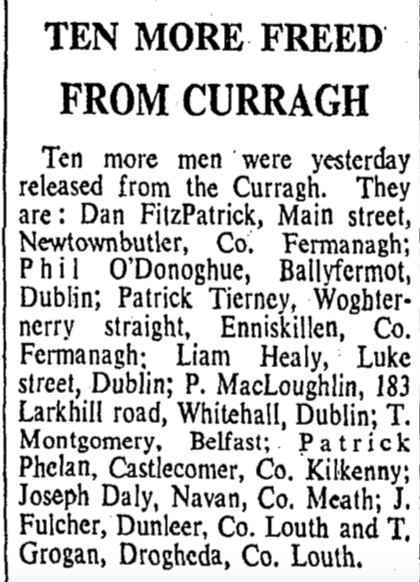
19 February 1959.

19 February 1959.

As we move from the centenary of the Easter Rising into the broader revolutionary period,  there will be key moments in the War of Independence chronology that will undoubtedly be significantly marked. The firing of the first shots of the conflict at Soloheadbeg in Tipperary, the destruction of Dublin’s Custom House and, of course, Bloody Sunday in November 1920.

One date which could have taken on such significance, had things gone a little differently, is 24 June 1921. On that day, the IRA planned a major attack in Grafton Street and its surrounding districts, designed to take out every Auxiliary in the vicinity of one of Dublin’s busiest streets. Encircling the area, they hoped to then move against uniformed and plain clothes Auxiliaries, with IRA intelligence officer Joseph Dolan remembering that “the idea was to nail the whole lot in one blow.” In many ways, this operation would have been a ‘second Bloody Sunday’, and conducted in a much more open environment.

acira

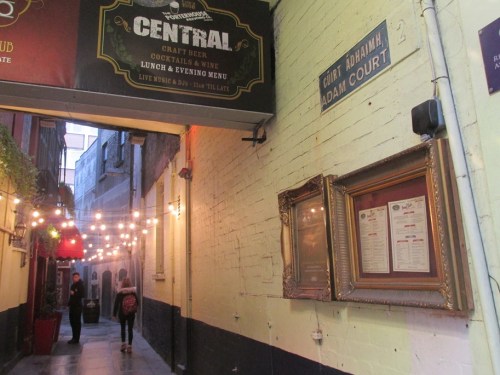
Adam Court, just off Grafton Street. Today home to the Porterhouse and Lillie’s Bordello, in 1920 the lane led to Kidd’s Buffet, which was to be targeted on 24 June 1921.

John Anthony Caffrey, a member of the IRA’s Active Service Unit, remembered in his statement to the Bureau of Military History that:

On an evening in June 1921, the entire Active Service Unit in conjunction with selected members of the Dublin Brigade were detailed to shoot every Auxiliary in Grafton Street, and at the same time one squad was to bomb Kidd’s Buffet, which was one of the places chiefly frequented by members of the Auxiliary Division. The section to which I was attached was to operate on the top of Grafton Street, south King Street to Chatham Street. Our instructions were that the operation would commence at 6 or 6:15pm sharp.

Armed IRA men would be joined by an Intelligence Officer, capable of pointing out Auxiliaries who were dressed in civilian clothes. Joseph Dolan  remembered that:

At the time great numbers of Auxiliaries paraded up and down Grafton Street in civilian clothes, and frequented Kidd’s restaurant which was at the corner of Grafton Street. Michael Collins decided that there should be an attack on the Auxiliaries in this restaurant and in Grafton Street. The job was timed for the afternoon. This was the time the greatest numbers of enemy troops would be strolling in Grafton Street. The idea was to nail the whole lot in one blow.

Kidd’s Buffet was a well-known rendezvous point for Auxiliaries and agents. Rather bravely, a number of IRA men close to Michael Collins, had begun frequenting the restaurant from October of the previous year. David Neligan, a leak within the British intelligence operation who was providing intelligence to Collins and the IRA, introduced these men as informers. Frank Thornton, one of the IRA men who infiltrated this circle, was surprised by how little the Auxiliaries seemed to know about the IRA leadership, recalling that “they actually had no photograph of any of us, and had a very poor description of either Collins or the three of us.”

Kidd’s was popular with more than just Auxiliaries and the Dublin Castle set however, and contemporary menus promised “the best Culleenamore Oysters in season…Salmon, lobster, home-made pressed beef” and more besides.

kdids

1920 advertisement for Kidd’s Buffet.

Participating IRA man Padraig O’Connor remembered the manner in which the area was subdivided:

The area was divided up from Suffolk Street to Wicklow Street; from Wicklow Street to Johnson’s Court; from Johnson’s Court to Harry Street and from Harry Street to South King Street. Parties were also taking in Stephen’s Green, Dawson Street, Nassau Street and Suffolk Street and a special party were going to Kidd’s Cafe.

Unfortunately, a number of factors worked against the IRA plans for the night in question. Dolan recalled that the plans were dealt a serious blow owing to what seemed to be an increased checkpoint presence on the streets of the capital, making it difficult for IRA members to take their positions. The men had even planned for “a Ford Van to take away and wounded, and that couldn’t turn up either. It was also cut off. Because all these things happened it was decided to call the whole thing off.”

Still, some shots did ring out that night. Joseph McGuinness, one of the men who had gathered to attack Kidd’s specifically, remembered that “the four of us loitered for some time and no shot was fired.” Yet further up Grafton Street,  at the intersection of Chatham Street and Grafton Street, an opportunity presented itself, as two Auxiliaries wandered into the path of a waiting IRA unit. One participant recalled that “one man fell on top of the other on the footpath. We fired against them and got away.”

CHATHAMIRA.JPG

Where Chatham Street meets Grafton Street today.

Continue Reading »

Every youth culture has sparked something of a moral panic in the press, and if it hasn’t, then it wasn’t much of a culture to begin with.

In the late 1960s, the Irish media struggled to get their heads around the hippy movement. When a visiting philosophy lecturer warned of “an outcrop of bearded, long-haired, unwashed, strangely clad, guitar-playing, drug-taking, promiscuous young people”, more than one Irish newspaper reported on his warnings. According to Cyril Barrett:

These young people, a small but conspicuous minority, were not simply rebelling against the older generation as they predecessors did. They regarded themselves almost as a race apart and would have nothing to do with what they called ‘The Other Generation.’

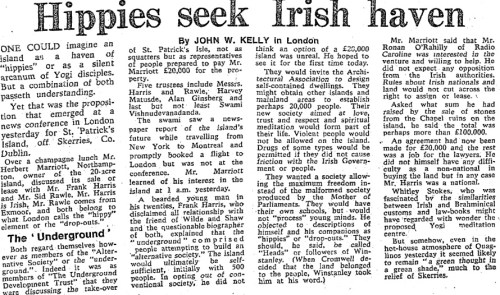
By 1969, the fear that English hippies were going to establish a commune on Saint Patrick’s Island was preoccupying locals and journalists. The island, described as “the most distant of three low-lying uninhabited islets off the headland of Skerries”, caught the eye of London hippies who required a new home following the high-profile eviction of their Picadilly squat. It was, according to the Irish Press, “suggested that if 1,000 hippies raised £20,000 they could buy the island.” Sid Rawle, described in the Irish media as “the leader of the London commune”, was said to be considering moving to the desolate island, and taking his friends with him.

According to the hippies, the island could be home to a “new a society aimed at love, trust and respect”, where “violent people would not be allowed on the island. Drugs of some types would be permitted if they did not cause friction with the Irish Government or people.”

hippyrain1.jpg

Irish Independent, 30 September 1969.
The London-based hippies enjoyed the support of a number of prominent figures, including the iconic Beat Generation poet Allen Ginsberg and Swami Vishnudevananda, an internationally known peace activist and yoga instructor. Despite their impressive international supporters, the hippies faced competition; it was reported that Butty Sugrue, a man who adored a good gimmick, intended to buy the island and place “a 150-foot statue of Saint Patrick” upon it.  Butty Sugrue, a “circus strongman, entrepreneur and boxing promoter” among other things, spent most of the 1960s in the newspapers. Instrumental in bringing Muhammed Ali to Dublin, he had also attempted to purchase the head of the Admiral Nelson monument that stood on O’Connell Street for his Kilburn pub.
When Sid Rawle and other hippies arrived in Dublin late in September 1969, the reception was frosty. The weather wasn’t great either. A local boat owner reportedly “did not want to take the hippies to the island. ‘I am not too keen on them at all’ he said, before being persuaded to take them on the hour-long trip.”

hippyrain1.jpg

Sid Rawle visits the island, September 1969.

Some locals saw the funny side of it all; one Skerries man joked that “a friend of mine brought sheep out there some time ago and they all swam back to the mainland…they’re welcome to the island, sure you couldn’t even get a rat to stay on it.” Not to be outdone, Butty arrived on the island shortly afterwards, claiming he had out-maneuvered the hippies and the island was his.

To make matters even more bizarre, by December rumours abounded that Rolling Stones front man Mick Jagger was going to buy the island. Jagger shot the claims down, insisting “I am not in the island-buying business.”

hippyrain1.jpg

Irish Examiner, December 1969.

Continue Reading »

Reading Gregory and Audrey Bracken’s Dublin Strolls recently was a reminder to always look up. Divided into eleven seperate walks, the book shines a light on some of the lesser-known architectural gems in the city, alongside the well-known and important works that in some cases have become much more than just buildings, like Francis Johnston’s General Post Office.

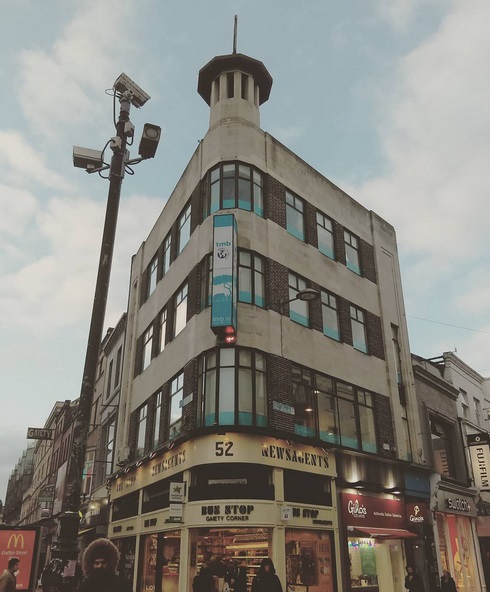
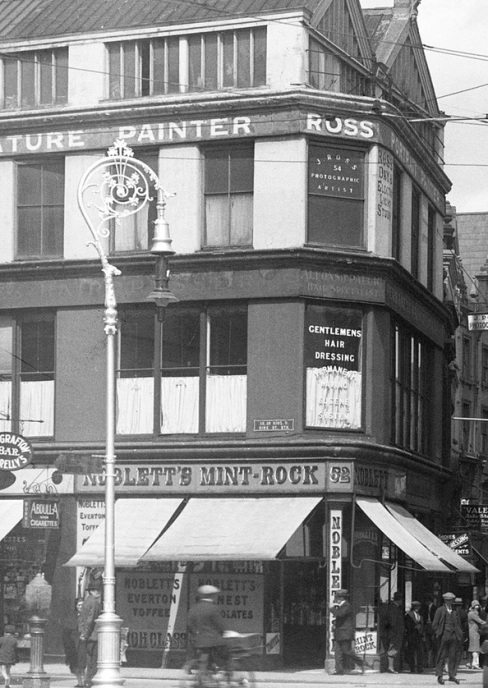
One building mentioned in the work is 52 Grafton Street. Depending who you ask, it’s known as Noblett’s Corner (Noblett’s sweet shop was once located here), Gaiety Corner or just ‘the old Gael Linn building’. Whatever one calls it, it’s a beautiful Art Deco building in the heart of the city, and one I’m kind of embarrassed I missed for so long, with its very distinctive corner tower certainly standing out from the pack.

52Grafton.jpg

Robinson and Keefe Architects transformed this corner building in the early 1930s, and it is just one example of their work that can still be found in the city today. The popular Gas Company premises on D’Olier Street, the Carlton Cinema on O’Connell Street and the DIT building on Cathal Brugha Street are just some of their surviving works.

Architectural historian Patricia Bayer has described the firm as being “probably the foremost Irish exponent of the Art Deco style.” John Robinson, the senior partner in the firm, championed a new architectural style and approach, and had little time for a nostalgic longing for the past. In his survey history of the capital, David Dickson quotes him as stating that “the Georgian era is over, and there is little sense in seeking to perpetuate it.”

Fink3.jpg

An image of 52 Grafton Street (late 1920s/early 1930s) from the Eason Photographic Collection, National Library of Ireland.

Robinson and Keefe managed to incorporate much of the existing building into something new. The excellent More than concrete blocks: Dublin city’s twentieth century buildings and their stories notes how:

The architects retained and reworked the existing fabric to create an Art-Deco-style building. The extensive reconstruction involved incorporating a new steel and reinforced-concrete structural framework, raising the parapet level to enclose the attic story, reconfiguring and replacing windows throughout and re-cladding the exterior. The work also included the construction of a new shopfront and corner tower.

The building was warmly praised at the time; The Irish Times noted that it “has been designed in the modern manner, and relies for appearance on its clean cut lines and proportions”.

The Grafton Street Noblett’s shouldn’t be confused with the O’Connell Street sweet shop of the same name, emptied by the “denizens of the slums” (to quote one Volunteer) on the first day of the Easter Rising. Beyond sweet shops, the building was also home to Gael Linn for many years, whose distinctive branding once graced it.

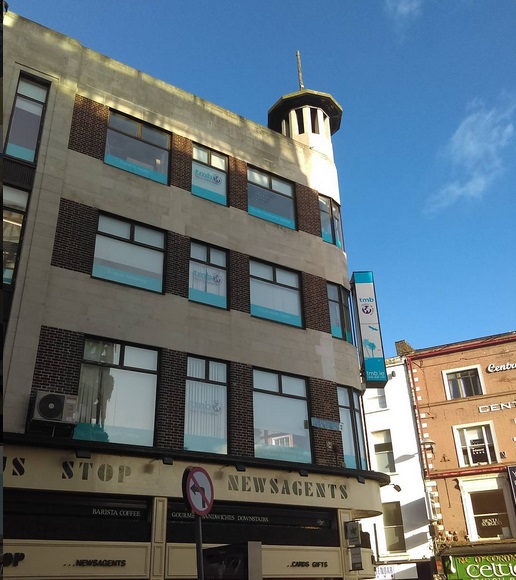
52Graftonb.jpg

The tower of the building, viewed from South King Street.

Fink and Dublin 8.

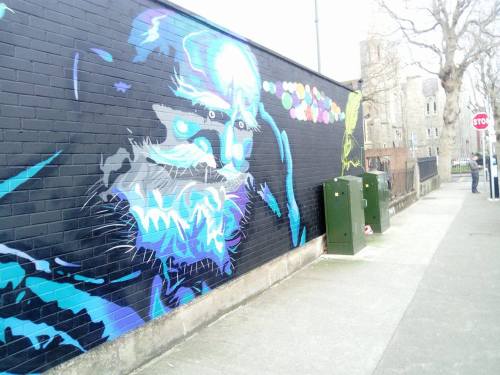
For more than fifteen years, Fink has been painting walls. In an interview with Dublin Inquirer last year, he talked about his influences and his history in the field of street art. It seems Dublin 8 is something of a stomping ground, and walking around the area last weekend three bits of his work caught my eye.

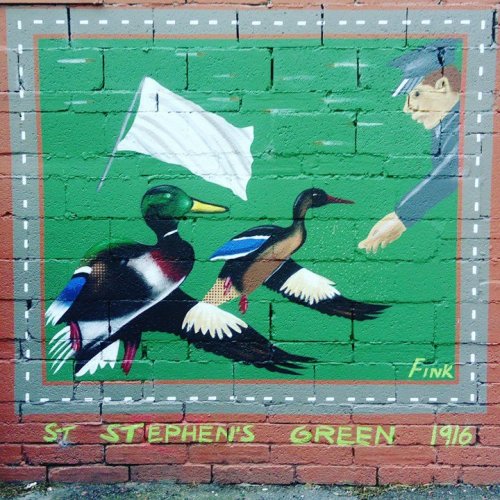
Firstly, behind the Vicar Street venue, is this great little tribute to Mr.James Kearney, the Saint Stephen’s Green park keeper who famously fed the ducks of the park during the Easter Rising.Kearney left his lodge twice daily during the insurrection, and made his way to the artificial lake. He thankfully survived the week, though six of his beloved ducks were not as fortunate.

Fink3.jpg

On Synge Street, this piece pays tribute to George Bernard Shaw, who was born just across the street at No.33. Sadly, since 2012, the museum that occupied the birthplace of the Nobel Prize winner has been closed to the public, but the plaque on the building, along with Fink’s mural, is a reminder of a local genius.

fink2

While the first two pieces of work are very Irish in subject, the last piece is something different entirely. The Barley Mow pub, on a corner of Francis Street, has been closed for some years now (here it is in the 1990s). Fink has been painting on it for a few years now, including a 1916 centenary piece last year, but this is a very fine tribute to the late Carrie Fisher, and her iconic depiction of Princess Leia in the Star Wars franchise.

Fink1.jpg

This Saturday sees a historical public meeting on the life of Dublin-born Trotskyist and Saor Éire activist Peter Graham. He was tortured and shot dead in a flat off Stephen’s Green on 25 October 1971 aged 26. A cloud of mystery, silence and betrayal still hangs over the incident to this day.

The talk will be chaired by Alan MacSimoin (Stoneybatter & Smithfield People’s History Project) and the main speaker will be historian Rayner O’Connor Lysaght who was a close friend of Graham’s. It takes place at 4.30pm in The Cobblestone pub, Dublin 7.

Peter Graham pictured in The Irish Times (05 Dec 1968)

Peter Graham pictured in The Irish Times (05 Dec 1968)

Growing up in the Liberties at 46 Reginald Street, Graham attended Bolton St. College of Technology and later worked as an electrician within Córas Iompair Éireann (CIÉ) where he was a shop-steward for the Electrical Trade Union.

A founding member of the Young Socialists, he helped organise a picket of the French Embassy in June 1968 in solidarity with the student and workers revolt and a picket of the Department of Labour in opposition to proposed anti-Trade Union legalisation in October 1968.

He was later involved with Saor Éire and the International Marxist Group in London. On his return to Dublin, he became active with the Revolutionary Marxist Group and helped established the Irish Section of the Fourth International.

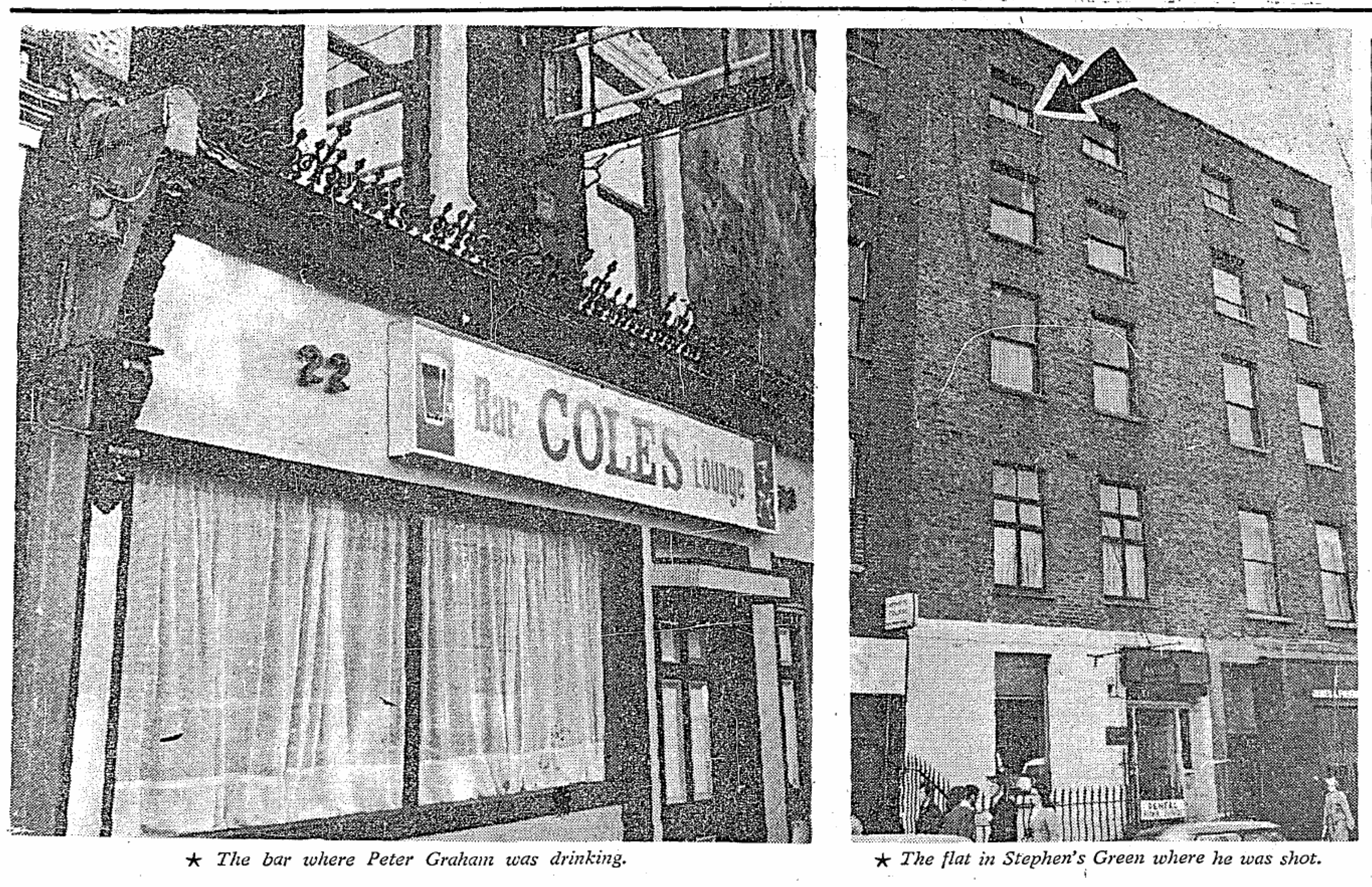
On 27th October 1971, he was brutally beaten with a hammer and shot in the head in the flat he shared with his comrade O’Connor Lysaght at 110, St. Stephen’s Green.

Photographs showing the flat where Peter was killed and the pub in which he drank in that evening. The Sunday Independent, 31 October 1971

Photographs showing the flat where Peter was killed and the pub in which he drank in that evening. The Sunday Independent, 31 October 1971

Bob Purdie (1940-2014) wrote that Graham was “falsely suspected of diverting money from a bank robbery” by rogue elements of Saor Eire who “tortured him in an attempt to make him confess.”  Liam O’Ruairc in a 2005 piece went further and said that he “had been assassinated by two of his own comrades from Cork (including Larry White, himself later killed by the Official IRA in Cork in 1975) in a dispute over money.”

No-one was ever arrested or charged with his murder.

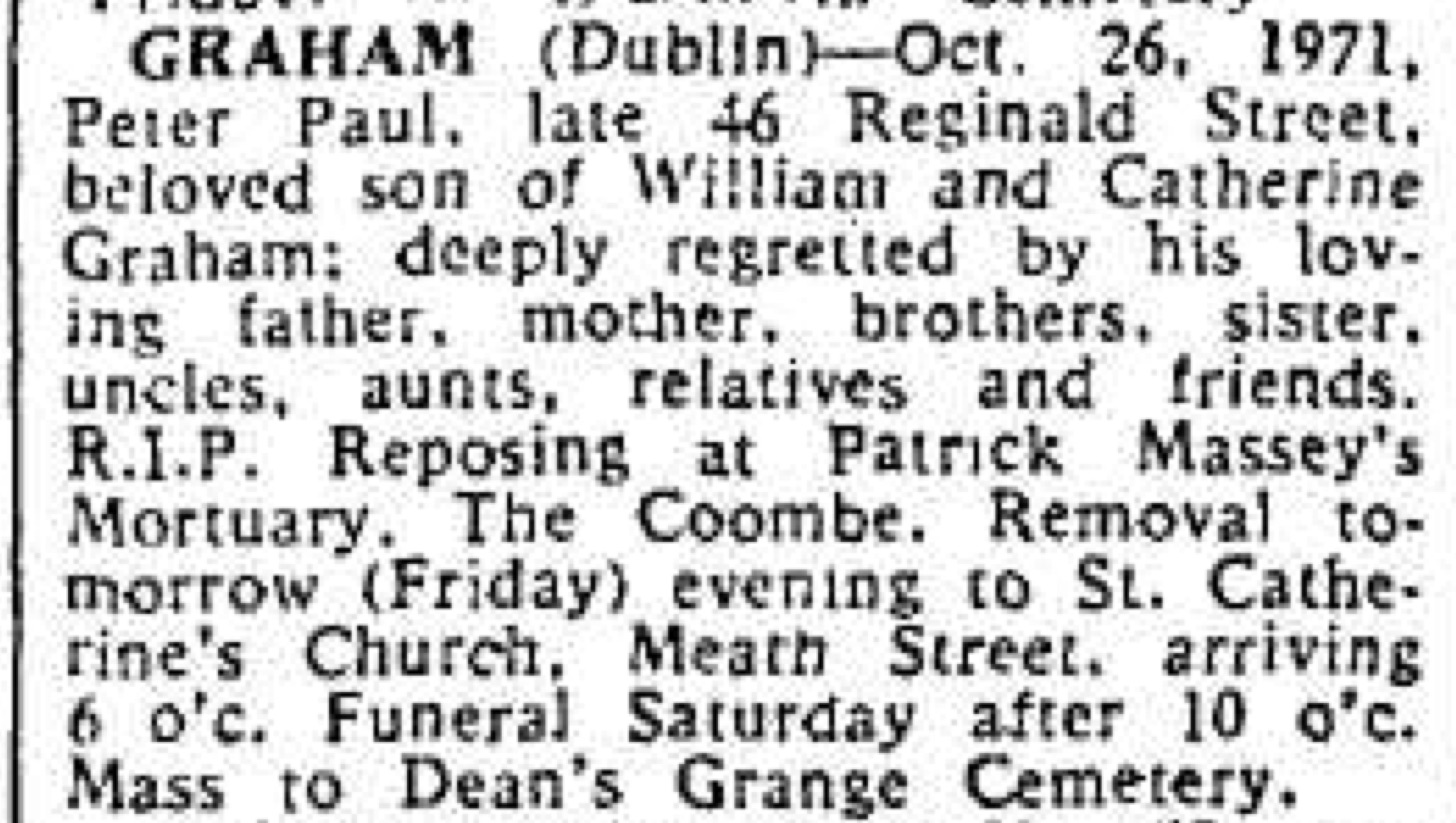
Death notice of Peter Graham. The Iris Times, 28 Oct 1971.

Death notice of Peter Graham. The Iris Times, 28 Oct 1971.

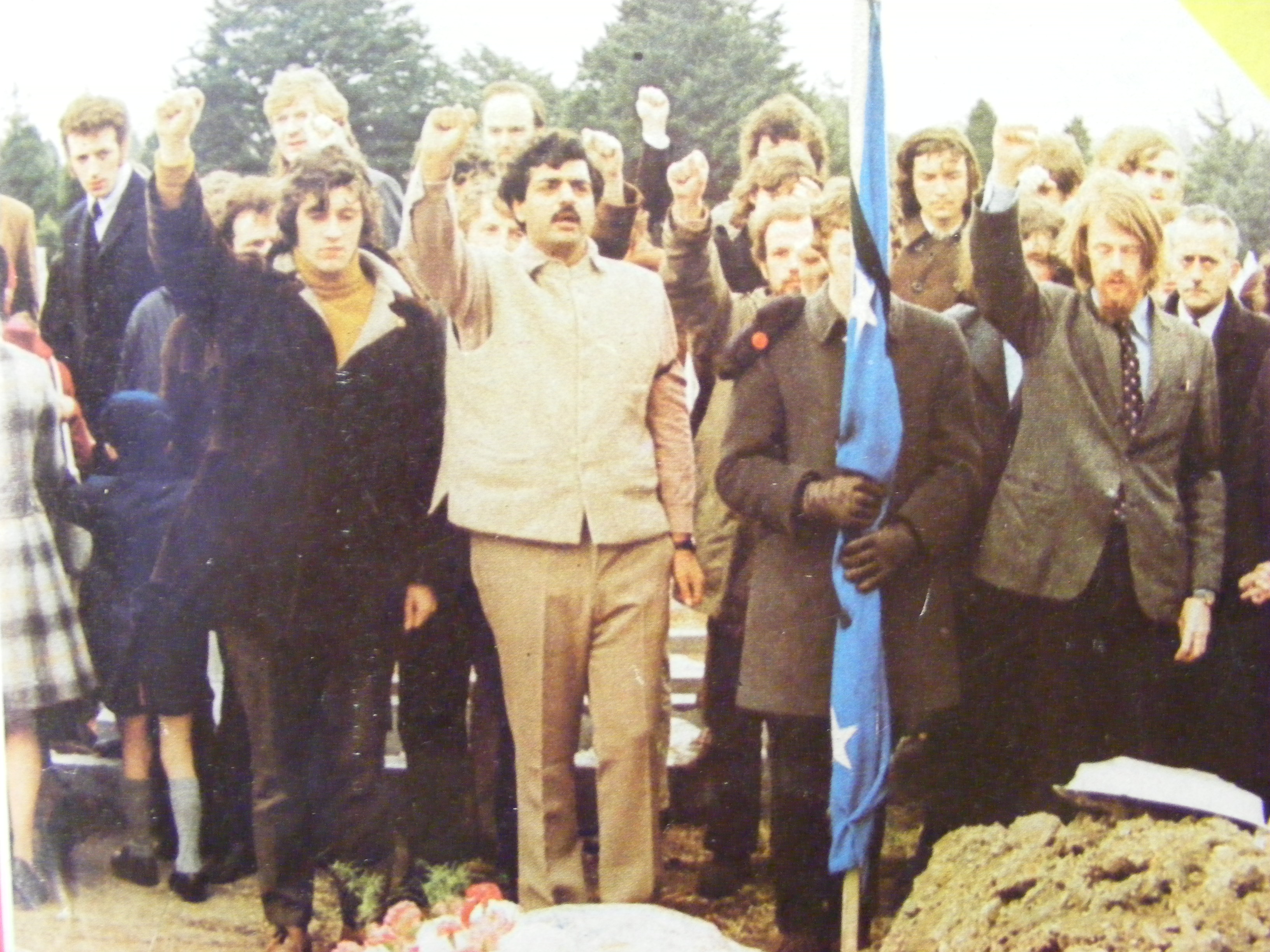
His funeral was attended by hundreds of people including Bernadette Devlin MP, Eamonn McCann and Michael Farrell. The oration was given by Tariq Ali who was pictured beside Charlie Bird (former member of the Young Socialists) giving the clenched salute.

Charlie Bird and Tariq Ali at the funeral of Peter Graham. Credit - irishrepublicanmarxisthistoryproject.wordpress.com

Charlie Bird and Tariq Ali at the funeral of Peter Graham. Credit – irishrepublicanmarxisthistoryproject.wordpress.com

Leading Saor Eire member Mairin Keegan died of cancer in January 1972 and another activist within the organisation, Liam Daltun, took his own life in London the following month.

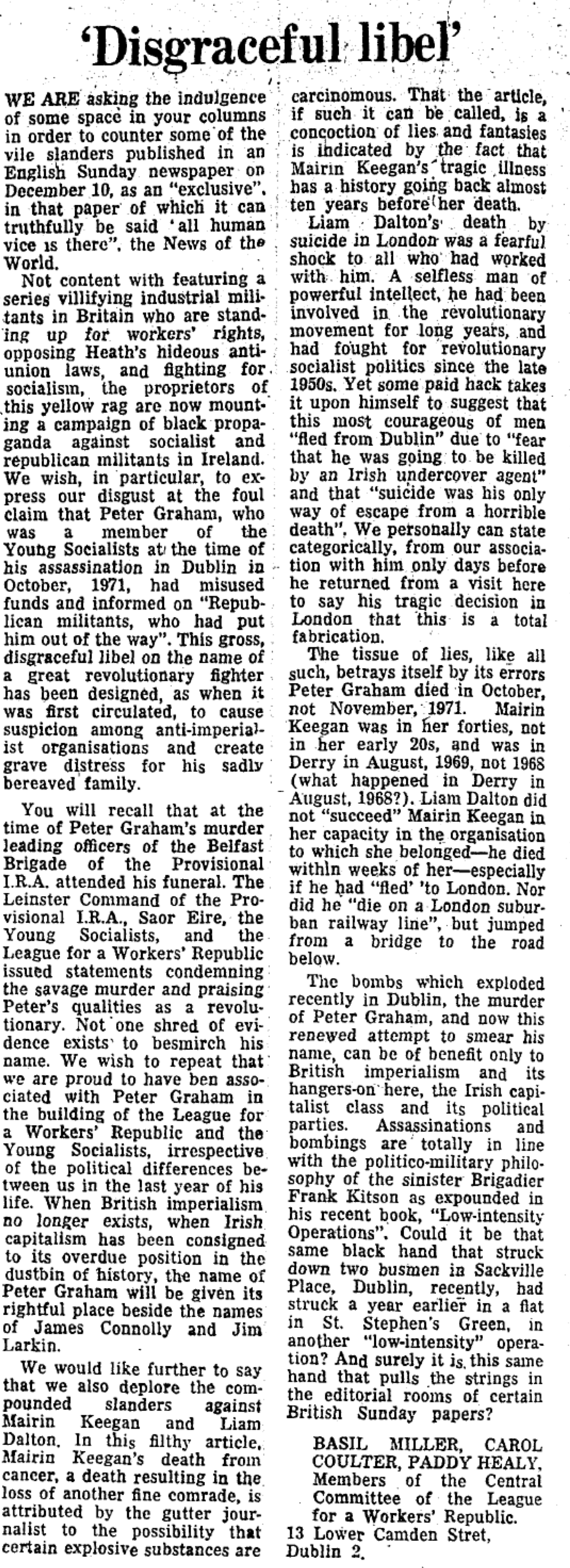
In December 1972, three members of the League for a Workers’ Republic (Basil Miller, Carol Coulter and Paddy Healy) wrote a letter to the Irish Press denouncing a recent tabloid article in the British Press which slandered the three Saor Éire activists who died in the 1971-72 period .

The Irish Press, 18 Dec 1972)

The Irish Press, 18 Dec 1972)

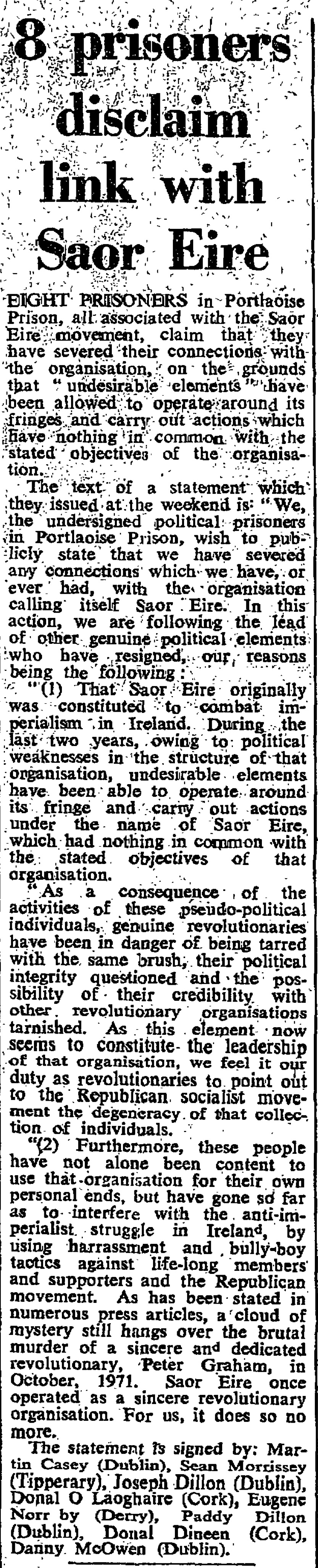
In May 1973, eight imprisoned members of Saor Éire released a statement severing their connections with the organisations due to the activity of “undesirable elements” within the movement. They particularly made reference to the “cloud of mystery” which still hung over the murder of “sincere and dedicated revolutionary” Peter Graham.

The Irish Times, 21 May 1973.

The Irish Times, 21 May 1973.