Feeds:
Posts
Comments

Gilbert’s History Of Dublin.

Chapters of Dublin is a wonderful resource, and one I come back to time and time again. There, I recently found J.T Gilbert’s excellent History Of Dublin, a work I had frequently seen referenced but never read myself. Chapters of Dublin have volume 1 of the work online, where it can be read for free. This folks, is what the internet is for.

Volume 1 focuses on the areas around Christchurch and Dublin Castle, with Fishamble Street particularly fascinating.

In Fishamble-street were the “Swan Tavern” (1639), the Ormond’s Arms” (1662), the “Ossory” (1664), and the “Fleece Tavern” (1666). The locality of the latter, on the western side of the street, is still indicated by “Fleece-alley,” which, in the last century, was chiefly occupied by velvet eavers, man of whom were distinguished for the beauty and richness of the fabrics which they manufactured.

Here, in the reign of Charles I., was the “London Tavern,” which in 1667 is described as “a timber house slated, a base court, a back building more backward, and a small garden in Fishamble-street.” In this tavern was the office of Joseph Darner, a noted usurer, who in a contemporary elegy is described as follows:-

“He walk’d the streets, and wore a threadbare cloak;
He” dined and supp’d at charge of other folk;
And by his looks, had he held out his palms,
He might be thought an object fit for alms.
So, to the poor if he refused his pelf,
He used them full as kindly as himself.
Where’er he went, he never saw his betters;
Lords, knights, and squires, were all his humble debtors.
And under hand and seal, the Irish nation
Were forced to owe to him their obligation.
Oh! London Tavern, thou hast lost a friend,
Though in thy walls he ne’er did farthing spend;
He touched the pence when others touch’d the pot;
The hand that sign’d the mortgage paid the shot.”

Gotta Catch ‘Em All.

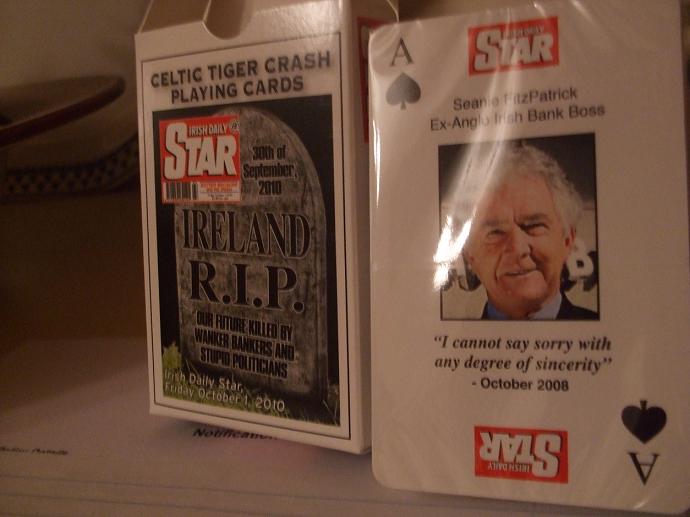
Well, it took yonks, but my Star ‘Celtic Tiger Crash Playing Cards’ finally arrived today. They’re excellent.

The deck includes two Jokers. They are the former Financial Regulator, Patrick Neary. Along with the wise Neary, John Hurley, former Governor of the Central Bank, also features.

In 2020, I’ll post my ebay details here on Come Here To Me.

Ronnie Drew Crane

Dublin Stevedores Limited, a family business with roots in Dublin port going back over 200 years, have redesigned a crane in memory of folk singer Ronnie Drew (1934 – 2008).

They say that the lakes of Killarney are fair
That no stream like the Liffey can ever compare,
If its water you want, you’ll find nothing more rare
Than the stuff they make down by the ocean.

I need a little time.

Surely ‘Dublin Mean Time’ is one of the great pub quiz/pub banter phenomenons of Irish history? DMT meant that for many years we in Ireland were in fact 25 minutes and 21 seconds behind of ‘them across the water’, a situation that remained in place until October 1 1916, when the Time (Ireland) Act brought Ireland into line with Great Britain.

Incredibly, prior to October 1916, there had been some hostility to the idea of synchronizing our watches with Britain. In August 1916, a letter appeared in the Irish Independent arguing against it on nationalist grounds! The writer noted that “the question is whether we should give up this mark of our national identity to suit the convenience of shipping companies and a few travellers”.

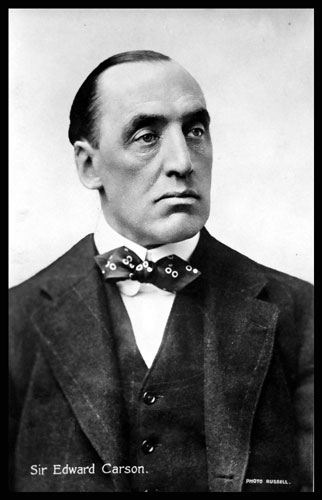
The Time Act became a political football in Ireland, an Ireland changed (changed utterly you could say….) by the events of Easter week. Edward Carson, The Irish Times of August 12 noted, failed to understand the controversy of it all. “All he could say was that if certain hon. members stopped this bill he would see that the Dublin Reconstruction Bill, or other bills, would also be treated as controversial and not allowed to proceed”

At a meeting of the Dublin Corporation, reported in the same edition of the Times, it is noted that one Mr. Briscoe opposed the motion of support for the adoption of Western European time, on the grounds that “…there was too much of the German method about European time.”

I first heard of DMT when reading 50 Things You Didn’t Know About 1916 by Mick O’ Farrell, but was recently delighted to see that having consulted the archives of The Irish Times for more information, Frank McNally would pen an excellent (as most of them are) An Irishman’s Diary on the very subject. It can be read here.

Even so, Dublin Mean Time had science on its side. It was also known as “Dunsink Time”, after the astronomical observatory in Finglas where the measurements were made. And as such it had gained a place in literature, via the inevitable James Joyce and Ulysses .

I’ve always told tourists and visiting friends alike that things move at a much slower pace in Ireland, but once we were a different people, 25 minutes or so behind of the busiest city in the empire.

Three Golden Rules

Officially adopted in 1894… were the three golden rules; never say die, keep the ball on the floor and the best defence is attack

From “Bohemian Times.”

The Bohs team of 1890

I’m in the process of doing an article on the famous Bohemians FC team from the Golden era of the late twenties, so was delighted to find the above picture posted by JayCarax on thebohs.com forum; the picture is from 1890, the year of Bohemians birth. “The first set of jerseys worn were white with two red down stripes front and back, and a red star of David on the right breast, with black shorts.” Brilliant.

Writings on the wall

Picture - JCarax

Spotted yesterday on O’Connell St. just doors away from the Garda station and A.I.B. bank.

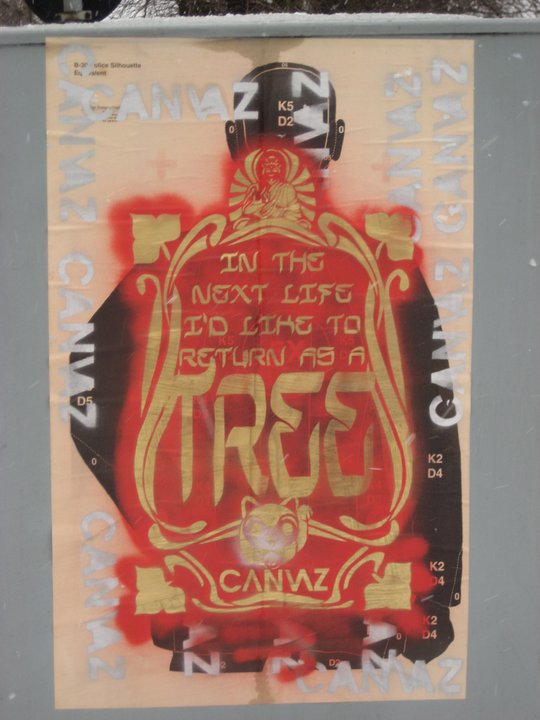
In The Next Life

Great stuff on Baggot Street from CANVAZ.

In the next life I’d like to return as someone with any artistic ability at all. I’m always thankful there are Dubliners, native and adopted alike, who can make you think on the way to work or laugh on the way home. More of this.

Most unparliamentary language

How brilliant is this?

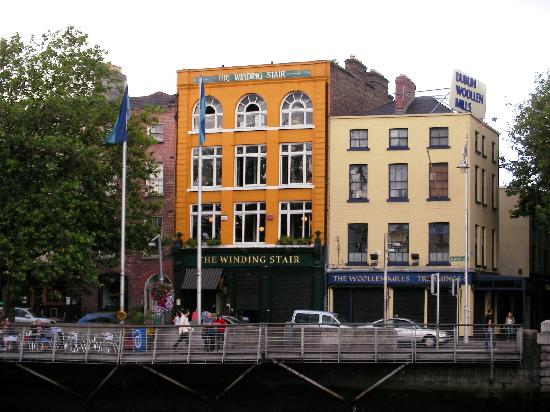
The Winding Stair

This blog has existed for more than a year, yet we’ve never reviewed a single restaurant. How shocking is that!? I’ve taken it upon myself to reverse this trend, and can think of no better Dublin restaurant to begin with than The Winding Stair.

Firstly, I’ve always loved The Winding Stair as a bookshop. Living in west Dublin, I tend to get off the bus on Bachelors Walk so the bookshop is nearby and in the pissings of rain is very inviting. Right at the northern base of the Ha’penny Bridge, I’ve picked up a few classics in this bookshop in my time. More often than not, I drop in to hide from the rain and try look eager to purchase, despite empty pockets. I don’t think they mind.

I remember the panic in 2005 when The Winding Stair looked royally fucked. Thankfully for everyone, the Thomas Read group stepped in and the building was saved. The hype surrounding The Winding Stair as a restaurant since 2006 has been incredible, and it took me four years to try it for myself.

To mark a family birthday of note, we decided upon this spot. The printed reviews had been friendly, and Google much the same. Needless to say, you’ve got to book. The small room overlooking the River Liffey is packed to capacity, yet nobody is rushed out the doors again. This has ruined so many meals in Dublin for me before. The sound of laughter and chat fills the room.

The menu is Irish and Irish only. The Kerry prawns on toast to begin with are something else, and unlike any I’ve tasted before. As we’re eating I comment the only downpoint is that we’ve not got a window view, as the restaurant looks right over the Ha’penny Bridge and the flowing Liffey. It’s a small complaint to have.

We don’t eat out a lot in my family which is a shame. I can’t blame this entirely on Brian Lenihan and/or the IMF, as this tradition of marking birthdays by eating somewhere nice is a long one. We normally settle on one of a few places, for example you could chuck a rock at The Angler’s Rest from the rest side of Palmerstown, so it normally does well around this time of year. Before the main courses even arrive, it’s clear people have fallen for The Winding Stair.

The lamb follows on from the prawns and it delivers. The restaurant is noisy, but this is no complaint. Conversations are flowing, and you overhear some great stuff. Montrose this and Merrion Square that types. You’d be tempted to lick the actual plate if it wasn’t for the fact it would make you look like a weirdo around this lot (or eh…any lot), and a glance at the table reveals nobody has left anything to show there was ever actually food on the plates.

We wrapped up with the chocolate pudding, which again vanishes without trace. On one of the coldest nights I can recall in Dublin, popping up here was a great call. We might only pop out for birthdays, but three of us were born within a month of each other. They’ll be glad to see us again in here.

Three courses was just under €30, not exactly a weekly venture but a very nice treat.

Shop around

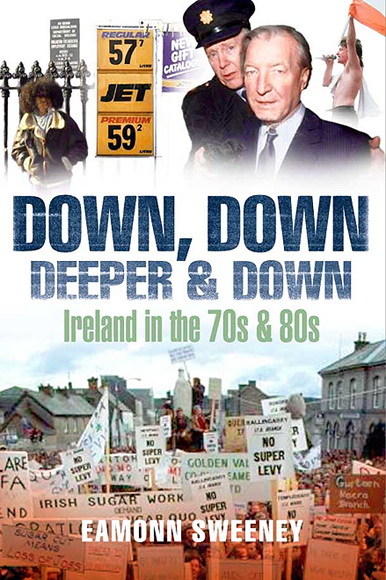
Two books which have been on my Christmas list since I first heard about them were Eamonn Sweeney’s Down Down Deeper and Down: Ireland in the 70’s and 80’s and Brian Hanley’s The IRA – A Documentary History 1919-2005.

This evening my mum said she’d buy them online as a  Christmas present. Wahey.

I first checked out Eason’s:

Down, Down Deeper and Down by Eamonn Sweeney (€16.99)

The IRA – A Documentary History 1919-2005 by Brian Hanley (€24.99)

Total: 41.98 with free delivery

Quite expensive but was on par with what I’ve seen in the shop themselves.

Then I tried my luck with Kenneys:

Down, Down Deeper and Down by Eamonn Sweeney (€16.99)

The IRA – A Documentary History 1919-2005 by Brian Hanley (€40.72)

Total: 57.71 with free delivery

Absolute day light robbery. I’m sorry to say that as I’ve always had time for the Galway based, family-run Kenneys.

My next stop was BooksUnlimited.ie:

Down, Down Deeper and Down by Eamonn Sweeney (€15.80)

The IRA – A Documentary History 1919-2005 by Brian Hanley (€22.82)

Total: €38.62 with free delivery

Going with them instead of Easons was going to save a couple of quid, not bad.

I then checked out the publisher Gill and Macmillian’s website:

Down, Down Deeper and Down by Eamonn Sweeney (€13.59) [Out of order]

The IRA – A Documentary History 1919-2005 by Brian Hanley (€19.99)

Total: €33.58 with free delivery

Cheaper again but not much use as one of the books was out of order.

By luck as I was checking out the Bargain Alerts section of Boards.ie, which I do most days, I saw a thread about the Book Depository website offering 10% discount for Irish customers.

I had a check first to see if this English website had the two books that I wanted. They had, and he savings were remarkable.

Down, Down Deeper and Down by Eamonn Sweeney (€11.88)
The IRA – A Documentary History 1919-2005 by Brian Hanley (€16.52)

Total: €28.40 – 10% discount for Irish users
= €25.57 with free delivery

—> A whopping saving of  €32.14 compared to Kennys and a sizeable saving of €16.41 compared to Eason’s.

So ladies and gentlemen, remember to shop around this Christmas to get more value for your buck, euro IMF token.

A Curious Journey (1973)

Curious Journey – The 1916 Easter Rising. In 1973, Kenneth Griffith, the renowned documentary maker, gathered together a group of veterans of the Easter Rising. Almost half a century after those terrible events, this highly diverse group – branded terrorists by the British in their youth – gave their own account of what is was like to live through those turbulent times. It is a powerful and heartfelt testament to nine brave men and women who risked their lives for their country.

Ignore the dramatic voice over. This 50mins documentary has countless of fascinating interviews. Incidentally it also has great scenes of 1973 Dublin. A history documentary now becomes history.

Interviews: Maire Comerford, Joseph Sweeney, Sean Kavanagh, John O’Sullivan, Brigid Thornton, Sean Harling, Martin Walton, David Nelligan/Neligan and Tom Barry

Continue Reading »

Book Review: A Visual Feast.

A Visual Feast is an ambitious work. A look at “stencils, paste ups, murals and portraits” from Irish street artists, it covers such diverse canvases as the walls of Free Derry and the backlanes of Dublin 8. It provides a fascinating insight into not alone the works we find on the walls of the capital and beyond, but those who place them there too.

“Take some paint. Any paint. Even markers or pencils. Make a poster on paper if you have to. Go outside and change the world to how you want it to be”

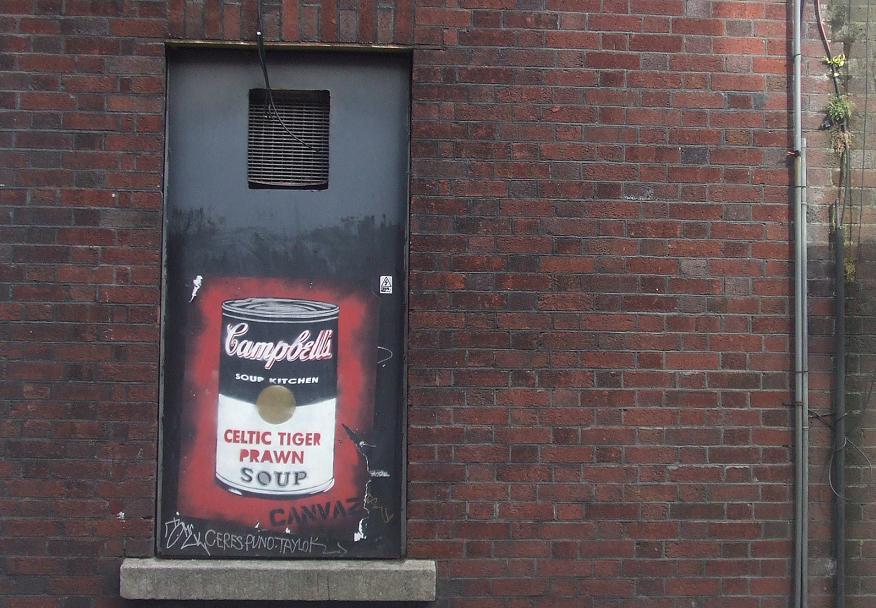
So Canvaz tells us. He’s done just that, and he is by no means alone. Within the pages of A Visual Feast we find not alone Canvaz and his clever ‘Celtic Tiger Prawn Soup’ effort by Temple Bar, but other artists taking a message to the street. They range from the excellent and very polished works of the likes of ESPO and Maser to homemade stickers, paste ups and stencils. ‘BERTIE’S SOUND BLOKE ROUTINE IS A CON’ one effort tells us. Perhaps it was the first time that person left the house in the early hours to leave a message for the rest of us the following morning.

The book is divided into six sections. Society, installation, religion, manifesto, portraits and city streets. ‘Society’ sees much social commentary on the economic collapse, for example ADW’s excellent broke leprechaun and the wonderful ‘GREED IS THE KNIFE AND THE SCARS RUN DEEP’ East Wall assessment of Damien Dempsey and Maser. Fascinating as the works of the high-profile names are, it is the “Artist unknown” pieces of social commentary that sometimes pack the heaviest punch.

Continue Reading »