Feeds:
Posts
Comments

O commemorate me where there is water,
Canal water preferably
Greeny at the heart of summer. Brother…

O commemorate me with no hero courageous
Tomb – just a canal bank seat for the passer-by.

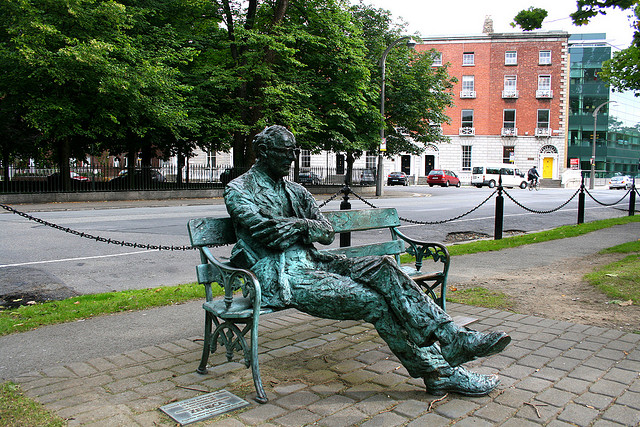
It may come as a surprise, it certainly did to me, that Patrick Kavanagh is commemorated by not one but two seats along Dublin’s Grand Canal.

The one that is known to most Dubliners and tourists is the bench which has a life sized statue of Kavanagh sitting on one side. This was made by the sculpture John Coll and was unveiled in June 1991 by Mary Robinson. It is situated on the north bank of the Grand Canal on Mespil Road.

Photo credit - Andrew B47 (FlickR)

The second statue predates the first by 23 years and was unveiled only a few month’s after the poet’s death. It is a simple ‘wood and granite’ seat that was designed by the artist Michael Farrell (1940 – 2000). A fantastic account of the fundraising and committee work that went into commissioning the seat can be read here. This seat is located on the South Bank at the Lock Gates close to Baggot Street Bridge.

The first and original 1968 bench (The Irish Times 2.2.68)


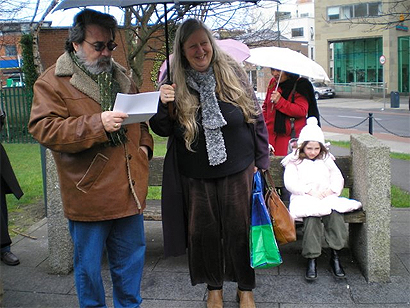
Every St. Patrick’s day, old friends and fans of Kavanagh gather at this bench to remember his life and read extracts of his work.

The 2007 gathering. (Photo credit - http://kavanaghseat.com/photos.html)

So, there you go. There are in fact two seats dedicated to the memory of Patrick Kavanagh on the Grand Canal. Let’s do our best not to forget the first. (Many thanks to the beautiful Kavanagh Seat website that first brought my attention to the above)

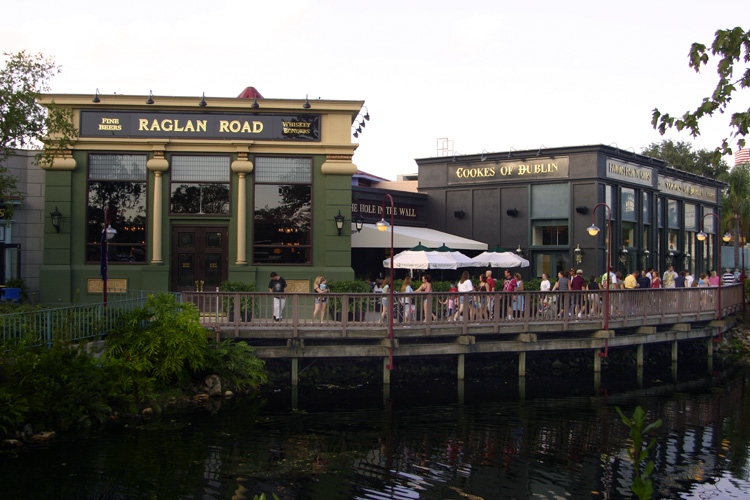
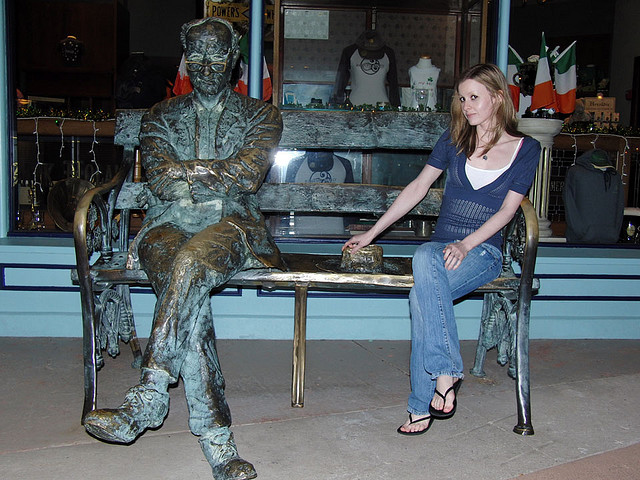
Now for a bonus question. Besides the canal seat, can you tell me where the only other statue to Patrick Kavanagh is in the world? Give up? Disneyland, Florida! I know, hard to believe but it’s true. There’s a statue to him, based on the Grand Canal seat, outside the Irish pub and restaurant, Raglan Road, at Walt Disney World’s Downtown Disney in Orlando, Florida.

Disneyland, Florida. "Step inside Raglan Road Irish Pub & Restaurant and you'll feel you've been transported to the Emerald Isles"

The Kavanagh statue outside Raglan Road restaurant, Disneyland. Photo credit - Eric J. Lubbers (FlickR)

Come Here To Me! is one today.

Some reflections on our first birthday….
dfallon: A lot can change in a year. Interestingly, it is exactly a year today since we began this blog. It emerged, as hxci reminded me, out of a conversation in The Flowing Tide. At a History Ireland Hedge School in Phibsboro, a member of the panel refered to Come Here To Me! To me as a “mix of the Communist Party of Ireland and Saint Patrick’s Athletic”. Certainly, both have been known to feature! Much else has too.

The city herself has changed a lot in a year. It’s been an infuriating few months. Dublin, in some ways, has taken a serious fall from grace. Yet the blog is a tribute to Dublin, and not just the back alleys and highstreets of Dublin 1 and 2.

Much thanks goes to others in the blogging community of course. Pue’s Occurrences, the excellent group history blog, invited us to partake in a symposium for example, at a time when we were still a relatively new blog. Others, in particular the Irish Election Literature Blog, have sent on wonderful material that ended up here.

On a personal note, the highlights have been the blogs engagements with what is often reffered to as ‘the real world’. The 1916 And After walking tour I provided in the capital is one example, but others have included an Irish Blog Awards nomination and occasional appearances in printed word publications. Here’s to another year.

hXci: One year on and all has changed, changed utterly. Not necessarily for the good either. As the country has sank deeper into the mire, we’ve done our best on here to provide a balance between history, music, football and social commentary to keep people’s minds off things. And considering we did this fairly off the cuff after having a discussion about it in the Flowing Tide, I don’t think we’ve done a bad job. We’ve come a long way in a year, I think it has taken that for us to find our feet, so hopefully this next year will only get better; it sometimes surprises me the kind of articles that take off and get large numbers of hits or comments, but it’s always a nice surprise.

Getting shortlisted in the Irish Blog Awards  after only being in existence a few short months was certainly one of the highlights of the year, but what really buoys me about this project is the amount of feedback we get on here as well as in the “real world.” We have close enough twice as many comments as we have articles  and if anything, that suggests an interested readership; if we can maintain that, I’ll be happy come 29th November 2011.

Support from the online community, everyone from the diehards on League of Ireland forums like thebohs.com to those on similar blogs like Cedar Lounge Revolution and Pue’s Occurrences has been pretty fantastic, as has the real world support from the likes of History Ireland and down to the people who over pints tell you that they enjoy what we’re doing, a major thanks to all of you.

Who knows what the next year might hold in store, but no doubt, you’ll be getting more of the same on here. All the best!

JCarax As already mentioned, this blog celebrates its first birthday today. We published our first article on the blog on November 29 2009.

The history of the blog goes back a little further than that. I managed to find an old email in my inbox from the 14 September 2009 entitled simply ‘we should start a blog together’ which I had sent out to DFallon and hxci. It’s fantastic to be able to look at the initial discussion about what we should focus on and what we should call the blog. (Some of the other suggestions were OneAndOne.wordpress.com, UpToNinety.wordpress.com and KeepSketch.wordpress.com)

The last year has been a great success and the numbers speak for themselves. 100,000+ views, 500+ posts and 1,000+ comments. The only reason this blog has worked is because of the fantastic interaction between the articles and readers. I probably can speak for the others as well when I say that we value comments a lot more than views.

I don’t feel I’m exaggerating when I say that CHTM! has opened up an online platform, for aspects of Dublin music, politics, history and football, that wasn’t there before. We’ve also worked hard to help upload pamphlets, pictures and music that might have been otherwise forgotten or left gathering dust forever.

Special thanks to Conor (Dublin Opinion), Ciaran (Cedar Lounge Revolution), Antrophe (Soundtracksforthem.com), anarchaeologist, Mark H., my uncles John F. and Donal M. and everyone else who have helped us along the way. Here’s to another 12 months.
Highly relevant, catchy and almost forgotten single from Galway’s The Illdependents, a recording project of producer ‘Hazo’. This song came from the 1999 Back In The System EP.

You took what was not yours,
went against your own bible,
you broke your own laws,
just to out do the rivals.

Damien Dempsey, Colony

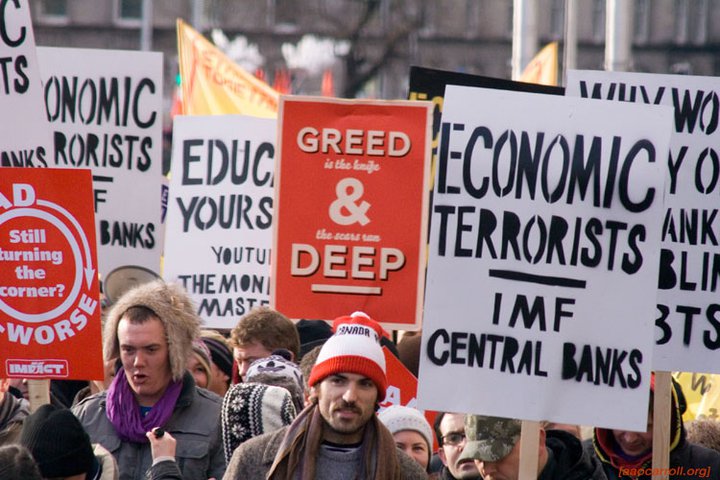
"Greed is the knife and the scars run deep." Print from the recent Maser/ Damo collaboration at today's demo, as spotted by Comrade O'Carroll

Whilst the lyrics of the Damien Dempsey’s “Colony” refer to imperialist colonisers like England, Portugal and Spain, the above lyrics may just as well refer to our own dear leaders. Poisonous and clueless shower the lot of them.

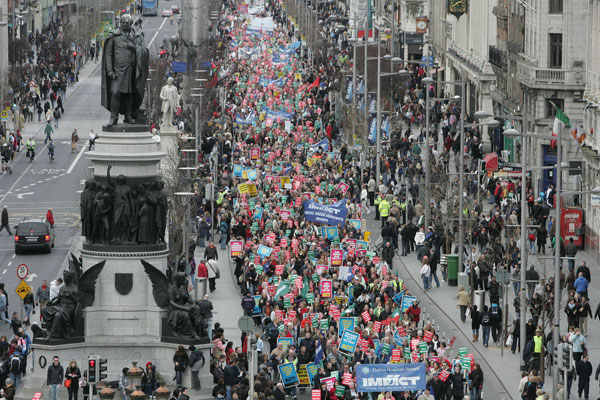
With one third of CHTM nursing a bad headache from his birthday last night whilst on a plane to the Basque country for some football tourism, it was up to the remaining two thirds to take to the streets today, alongside an estimated 100,000 others. Irish media are using a figure of 50, 000 but I defy that, the ICTU demo last year had 120, 000 and this certainly came close to that. From my viewpoint, it took approximately an hour for the march to stream past before I joined in the left block towards the back. Impressive showing it has to be said. Lets get the same outside the Dáil on budget day.

(kudos to http://www.aaocarroll.org for the pic!)

Come Here To Me has, in the past, covered the Dublin Fire Brigade strike of 1988 on numerous occasions. Examples would include this copy of Class Struggle from the period, and scans from the magazine of the British Fire Brigade Union (FBU) during the dispute.

Here, we bring you the logo of the new IFESA (Irish Fire And Emergency Services Association) trade union. It is one of the first breaks with SIPTU to emerge out of what many in the union see as its failings to protect and represent its workers in recent times. I don’t doubt there will be more.

Mark Hillard of the Tribune wrote a piece on the new union recently, available here. SIPTU had, rather shamefully, attempted to purge union members who wished to establish a new option. That option is there now.

Best of luck to the IFESA.

Excerpt from letter of general secretary:
It is undoubtedly the case that we are currently operating in the most challenging environment ever for workers and their representatives. However, this too will pass. We must identify our ambitions and aspirations for our members and for the community on the basis of immediate, short term, medium term and long term objectives. We must commit to you, our members, that we will pursue your issues, your claims and your concerns as instructed by you; without fear or favour.

ICTU demonstration tomorrow.

Remember when we marched TO the Dail?

Some interesting odds and ends today ahead of the demonstration in Dublin tomorrow against the austerity plans and the upcoming budget.

The Garda statement is available to read over here.

Recent experience has shown that while it is possible for thousands of people to assemble and march through the streets of Dublin in a dignified and civilised manner, there are individuals and groups who seek to exploit such events for their own ends. I want to reassure the community that Gardaí are both alert to and prepared for this possibility. While our policing plan is primarily focused on crowd safety, it will also aim to prevent any disruption of tomorrow’s demonstration. In addition we will gather evidence of any unlawful or criminal behaviour which might occur with the intention of bringing those responsible before the courts

ICTU, those not-so-great followers of Connolly, have produced a video calling on people to march. Connolly would have marched us miles away from the Dail it seems.

The Irish Times report on the demonstration gives a good idea of the route and plan.

Those taking part will assemble at 11.30am on Winetavern Street, Dublin and proceed along the north quays to the GPO on O’Connell Street where a rally will take place. There will be a programme of entertainment and speeches for about one hour. The master of ceremonies will be Irish Times columnist Fintan O’Toole and artists such as Christy Moore and Frances Black will perform.

Rise Like Lions! is great new blog which is following events in Ireland closely, in terms of the response of the people to the government/IMF austerity plans.

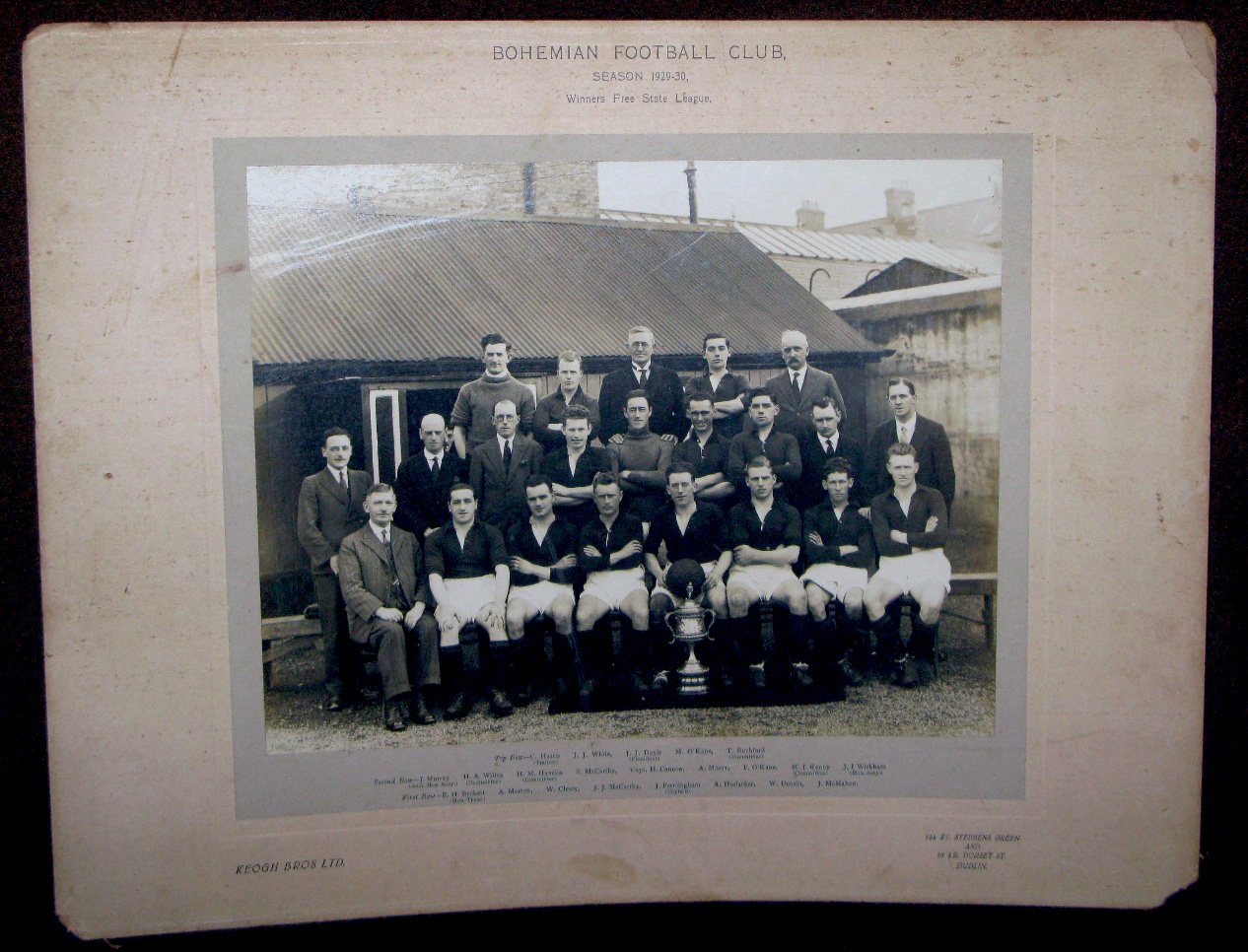
In an article way back in April, when the IMF was still a bogey man the government used to terrify the unions, I wrote a quick piece on an auction taking place at the famous Whyte’s on Molesworth Street. On sale at that auction was a 1929/ ’30 Free State League winners medal- won that year by Bohemian FC.

So, when I heard the below picture was on sale at an auction in Dalymount with all proceeds went to Bohemian FC, my ears pricked up. What better way to satisfy three of my favourite things; Bohemians, history and photography than by buying this. I may have paid a little more than I thought I planned to for it but I myself think it was worth every penny.

Words cannot describe how chuffed I am to have this in my possession (click for larger image)

You may not be able to buy a clubs history, but you can hold onto a little bit of it, and thats what I feel like now. I don’t really feel like I own this picture, indeed, when Bohemians iron out this little blip it our history like I’m sure we will, I’ll most likely donate this picture to the club. Or maybe that’s just my optimism, hoping that the torrid time we’re going through is just a blip. But what else do we have to hold onto?

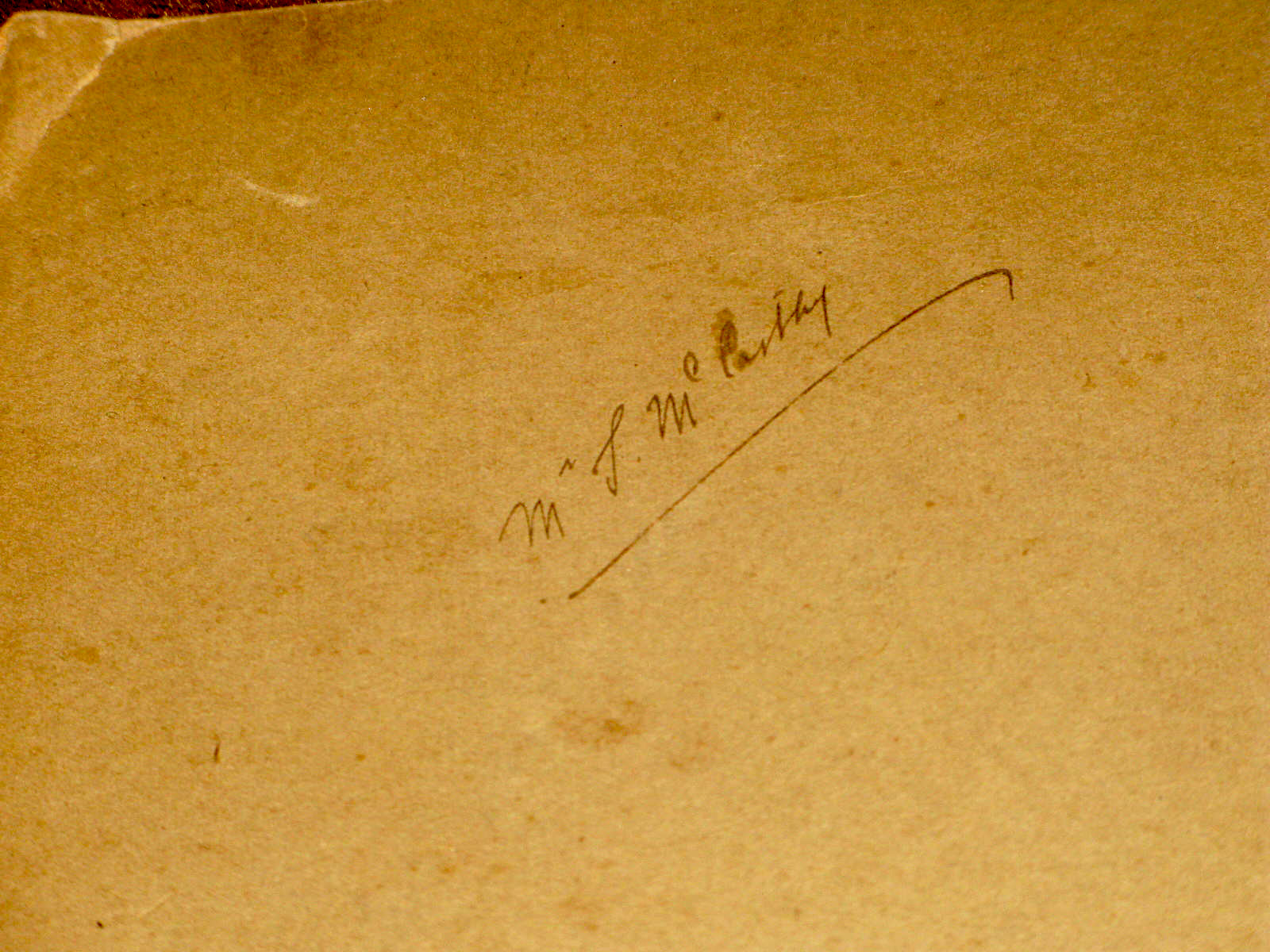
Autograph of J. McCarthy (fourth from left in main picture)

I’ll be getting it framed and mounted in the near future. When I get that done, I’ll check back in here, and give you some history behind a great era in Bohemians history, not unlike the one just passed. A bit of trivia before I go; the shed- like structure in the background are the old dressing rooms. Because of the corrugated iron on the roof, the structure got the nickname “The Hut,” now the name of the pre-game drinking hole in Phibsborough favoured by many a Bohs fan.

Yesterday, I wrote a piece on the assassination of Kevin O’Higgins and briefly discussed the theory on whether we should commemorate historical events regardless of whether we have strong positive or negative feelings on the individual or individuals involved.

Today, I plan to do a little research on the O’Higgins’ three killers:

1. Archie Doyle (? – 1980)
2. Bill Gannon (? – September 12, 1965)
3. Tim Coughlan (1906 – 28 January 1928)

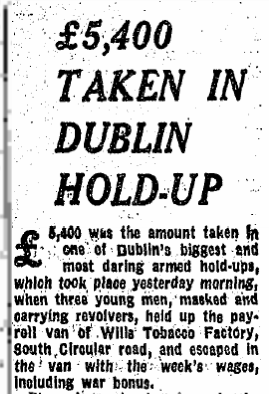
1. Archie Doyle, described as ‘one of the more shadowy figures in the IRA’[1] , is believed to have fought in the War of Independence and on the anti-treaty side of the Irish Civil War.. He was interned afterwards and was then involved in the assassination of O’Higgins in 1927. Doyle took an active part in the IRA’s 1940s campaign including the September 1942 attack on the RUC barracks in Crossmaglen, County Armagh and the July 1943 robbery of a van outside the Willa Tobacco Factory on the South Circular Road, Dublin. [2]

The Irish Times, Friday, July 2, 1943.

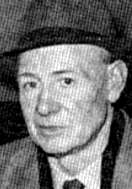
Proinsias Mac Aonghusa in a Sunday Press article has described Doyle leading a double life between an unobtrusive private existence in the Dublin suburb of Rathgar in which he worked initially for the Board of Works and later for Woolworths where he was buildings manager travelling the country, and active service in the IRA during which he was ‘generally thought to be responsible for all or nearly all assassinations’ according to former IRA Chief of Staff[3]. Doyle died in St. Jame’s Hospital in 1980.

2. Bill Gannon is also believed to have fought in the War of Independence and on the anti-treaty side of the Irish Civil War. He joined the refounded Communist Party of Ireland in the early 1930s and was one of the defenders of Connolly House in the March 1933 attack [4].

Bill Gannon, founder-member of the CPI, 1933, recruiting officer of volunteers for Spain, 1936–38 (From CPI Website)

During the Spanish Civil War, he along with Frank Ryan and Peadar O’Donnell helped to organise Irish Volunteers to travel to Spain to fight on the Republican side. He died in September 1965 and was buried in Mt. Jerome cemetery with military honours. His coffin was draped with a red flag and the Irish tricolour.

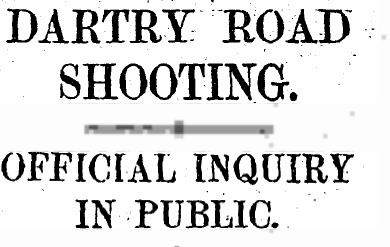
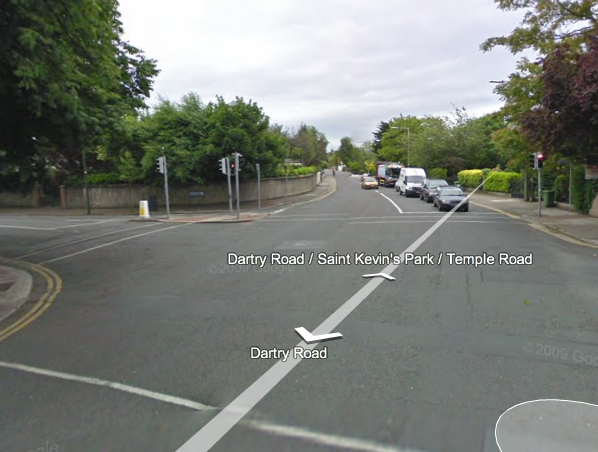
3.Tim Coughlan , the second eldest in a family of nine, lived with his parents at 24, Ring Street, Inchicore. Coughlan played a role in both the Tan War and the Civil War. Interned for much of the latter, he re-immersed himself in republican activities upon his release. He was killed in very mysterious circumstances in January 1928. That day Coughlan and another IRA volunteer were on Dublin’s Dartry Road, opposite ‘Woodpark Lodge’, the home of Sean Harling – a former IRA comrade-in-arms turned government informer. It is accepted by most and Coughlan and co. were there on a fact-finding mission. At around 6:55pm, Harling returned home from work and he noticed two men watching him from the other side of the road. A gun fight broke out in which Coughlan was fatally wounded. Harling claimed he killed him in self-defence.

The Irish Times, Thursday, February 16, 1928

However, there are lots of unanswered questions surrounding the night which prompted the IRA to claim at the time that Coughlin was in fact ambushed and in effect extrajudicially executed. This version is especially supported by the autopsy carried out by Dr. Wilfred Lane which “amongst other anomalies, discovered that the IRA man died as a result of being shot in the back of his head”. Also, the doctor found a cigarette butt in his mouth, which again indicated he had been caught unaware and killed, and tenants on Dartry Road testified that there had been unusual police activity that evening and that they heard more shots than mentioned in Harling’s account.

I could not find Woodpark Lodge but this, the corner of St. Kevin's Park and Dartry Road, is where Harling first saw Coughlin and the other IRA volunteer.

Harling, fearing for his life, was relocated to the United States. Though blocked for a time, he returned to Ireland several years later and was given a job in the Revenue Commissioners. He lived on New Grange Road, Cabra unil his death in 1977. (The above was based on articles by Aengus O Snodaigh and Gabriel Doherty)

==

Footnotes:

[1] The Irish Times, Monday, October 7, 1985, p. 9
[2] Saoirse, Issue 65. September 1992.
[3] The Irish Times, Monday, October 7, 1985, p. 9
[4] Uinseann MacEoin, The IRA in the twilight years:
1923-1948 (Dublin, 1997), p. 136
[5] Brian Hanley, The Storming of Connolly House, History Ireland Volume 7 (2), Summer 1999, p5-7

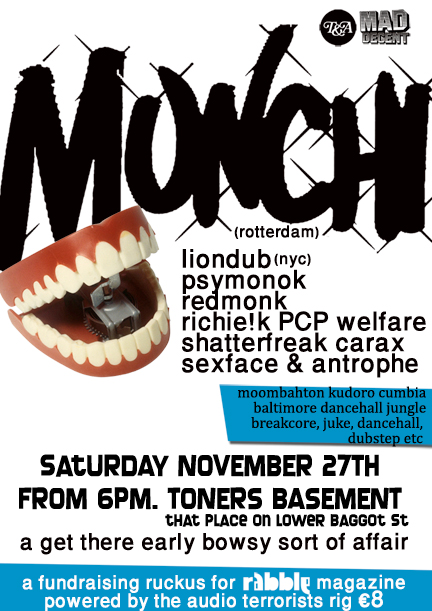
There’s been murmurs, there’s been whispers in the dark and there’s been fallow moments. But fuck it, we’re heading straight deep into a winter of deep discontent. And we want to get this magazine moving. So, what better way to do it than with a party. The bass and genre fucking blogosphere has been going ga-ga with production prodigy Munchi, some like Generation Bass have gone so far as to call him “the next Diplo.”

Why not drop down after the ICTU march?

Full Line up:

MUNCHI (ROTTERDAM)
LIONDUB (NEW YORK)
PSYMONOK
PCP
REDMONK
RICHIE K
WELFARE
SHATTERFREAK
CARAX
ANTROPHE
SEXFACE

Saturday, November 27. | Toners, Baggot St. | €8. | All dayer, kicks off @ 6pm. | More info here.

O’Higgins, who was once called the ‘Irish Mussolini’,  is one of the most notorious Free State figures and has been a figure of hate of republicans for generations. Between 1922 and 1923, he personally ordered the execution of seventy-seven republican prisoners including Rory O’Connor (who had been best man at O’Higgins’ wedding), Liam Mellows and Erskine Childers. A unapologetic social traditionalist, he famously remarked that was part of a generation of ‘the most conservative-minded revolutionaries that ever put through a successful revolution’. [1]

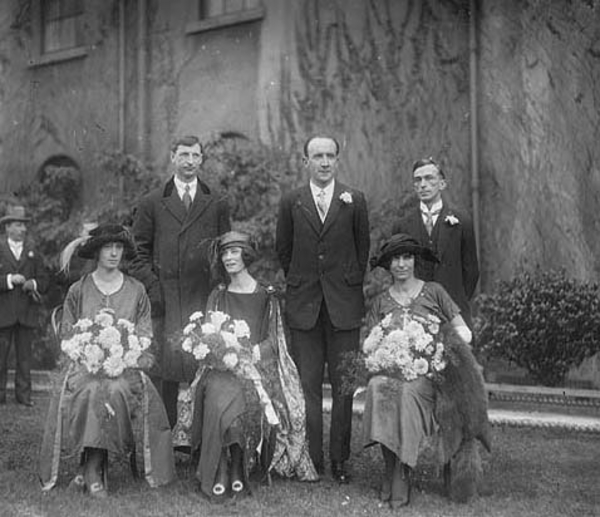
back row l-r: Eamon de Valera, O’Higgins and Rory O’Connor at O’Higgins’ wedding, 1921.

He was killed just before midday on Sunday, 10 July 1927 as he walked from his home Dunamase House on Cross Avenue to the Church of the Assumption on Booterstown Avenue. As he approached the junction of Booterstown and Cross Avenue, a man stepped out of a parked motor car and fired at point-blank range.

O’Higgins staggered, turned and began to run, followed by the man firing. O’Higgins collapsed on the other side of the road and two men came from the rear of the car and fired down at O’Higgins as he lay on the ground. The men then leaped into the car and drove off.[2]

The three anti-Treaty IRA men who killed him – Archie Doyle, Bill Gannon and Tim Coughlan – apparently saw him by chance. Gannon later recalled:

‘seeing him … we were just taken over and incensed with hatered. You can have no idea what it was like, with the memory of the executions, and the sight of him just walking along on his own. We started shooting from the car, then getting out of the car we continued to shoot. We all shot at him, he didn’t have a chance’.[3]

The motor car in which they used was believed to have been stolen from a Captain McDonnell on the night before. After the shooting, the car was later found abandoned at Richmond Avenue in close by Milltown. [4]

A weekly mass goer, O’Higgins was usually accompanied by his wife or by P. J. Hogan the Minister for Agriculture and his closest friend. This week however he was escorted by Detective O’Grady. When the two men were ‘between their house and Booterstown avenue’, O’Higgins sent the detective back to collect something that he had forgotten. It was later believed that the Garda escort was in fact sent to Blackrock to buy cigarettes [5]

O’Higgins was found lying by a ‘lamppost outside the gates of the house Sans Souci, which directly faces up Cross Avenue’ [6] by locals on their way to mass who heard the shots. Apparently local resident Eoin MacNeill was one of the first people to reach the dying O’Higgins. He was moved to his house and miraculously lingered on for another five hours. (Tens of thousands attended his funeral. You can see footage of it here.)

The Boards.ie user GusherING believes that there used to be a ‘little cross’ to mark the spot in which he was shot ‘near the entrance to Sans Souci’. A local history site confirms that there a ‘small cross inscribed on the present footpath’ that identified the location.

The question that now has to be asked is whether ‘historians’ like ourselves should be pushing to replace the cross that marked the spot of O’Higgins assassination. I think we should be. No matter your political views or opinions on individuals, historical moments in our city’s life should be properly identified.

===

[1] Joseph Lee, Ireland 1912-1985: politics and society (Cambridge, 1989), p. 105
[2] J. Bowyer Bell, The secret army: the IRA (New Jersey, 1997), p. 61
[3] Richard English, The Armed Struggle (London, 2003), p. 45
[4] The Irish Times, Monday, July 11, 1927, p. 7
[5] The Irish Times, Monday, June 11, 2007
[6] The Irish Times, Monday, July 11, 1927, p. 7

Italia ’90 came just too early for me, and while I still have recollections of it, most of them more than likely made up as they are far too glorious for any six year old to have experienced. So, USA ’94 was more within my grasp and while I wasn’t a football loving child (oh how my ways have changed,) it was hard not to get caught up in the fever pitch that surrounded a national event like Ireland playing in the World Cup. Streets empty during games and lined with Olé Óle Olé chanting, pint swilling headcases after them.  Audacious thieves made a fortune ram- raiding shops during the games, safe in the knowlege their local Gardaí were most likely huddled around a portable tv in the station, blissfully unawares to the happenings in the outside world. The glory of Italia ’90 was impossible to recreate but the reactions to beating Italy and drawing with Norway were the same. Pure unadulterated lunacy.

Soccerball World Cup mascot, 1994

The football sure as hell wasn’t beautiful. The mind truly boggles to think that Ireland beat Italy with a team consisting of five defenders, two defensive midfielders and a man by the name of Tommy Coyne up front. But we did win, Ray Houghton netting in the eleventh minute before eloping on a mad run, tumbling like a toddler and emitting screams that put Marco Tardelli to shame.

Celebrations were short lived as Jack Charlton sent out the same side against Mexico and they were duly spanked 2-1. And still, we somehow managed to qualify for the second round by playing out a dull encounter against Norway that ended 0-0. Exciting stuff, the four teams in the group finishing on four points,  Ireland scraping through only due to their win against Italy.  Three games, two goals scored and two conceeded. You really do look back at these things with rose tinted glasses as reading that statistic shows it was about as far from total football as our Monday night kickabouts. But these were different times, Roy Keane was still a young man, we had squad members like Alan Kernaghan, Alan McLoughlin and John Sheridan and Gary Kelly was still a player with “great potential for the future.” We were tonked 2-0 in the next round and the dream was over.

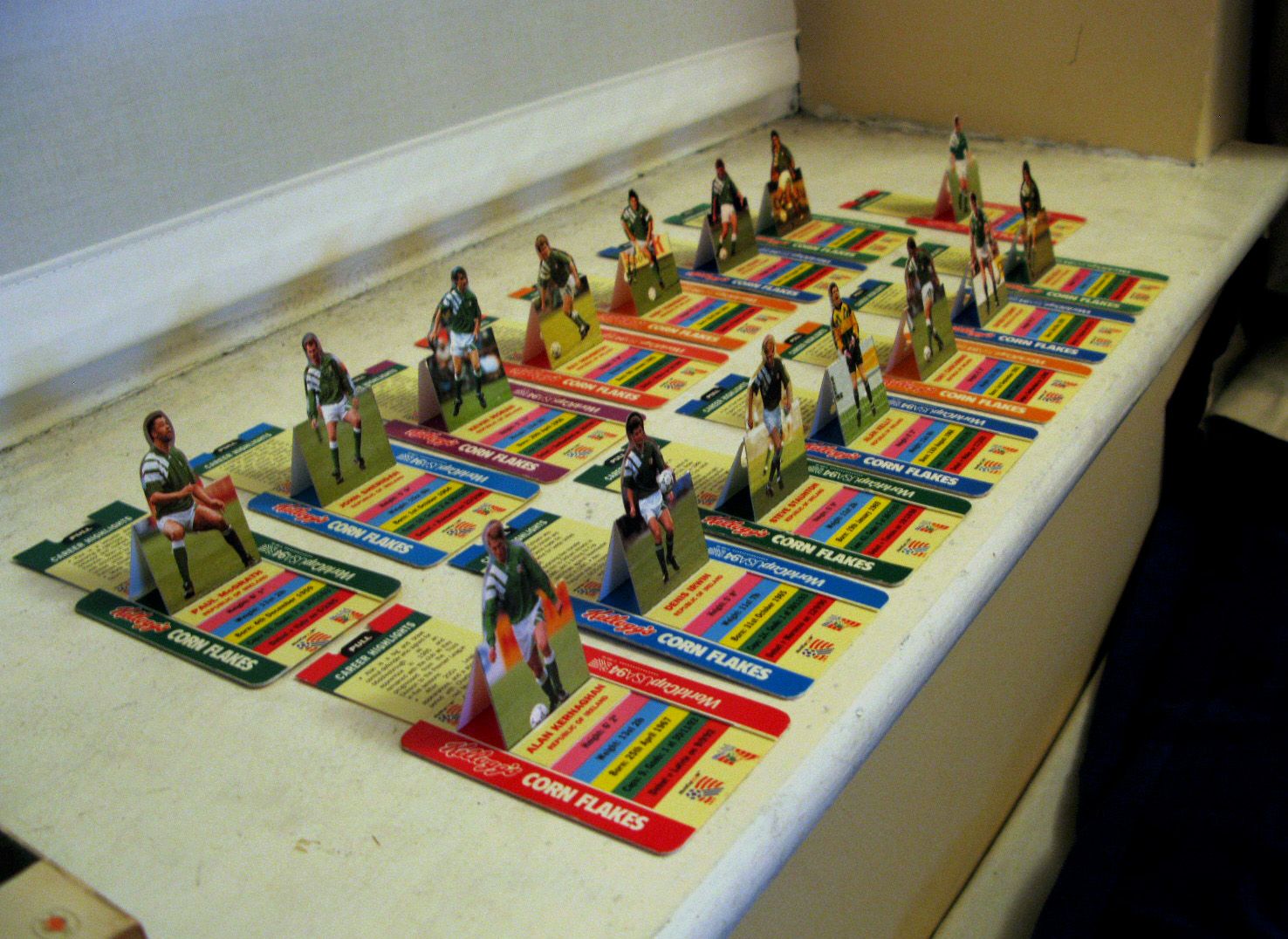
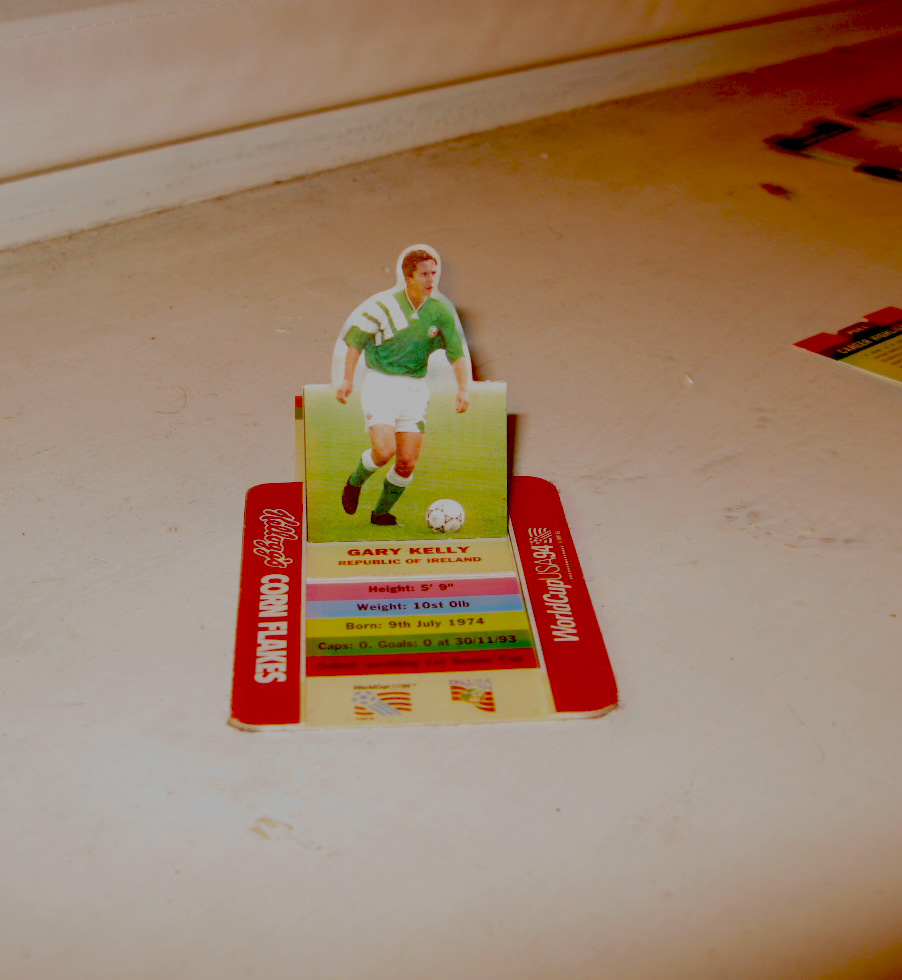
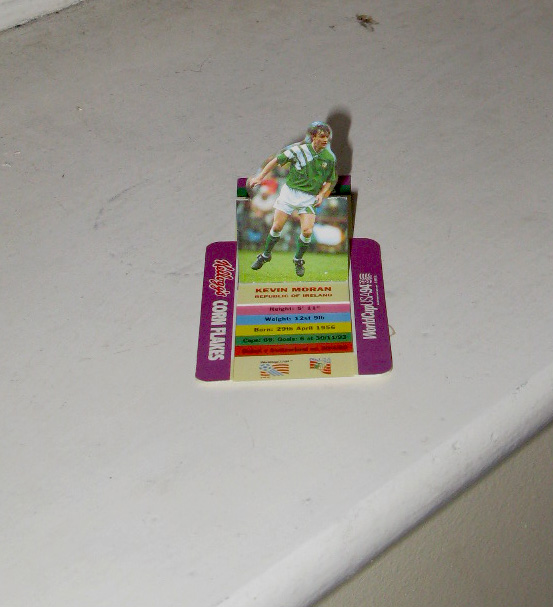
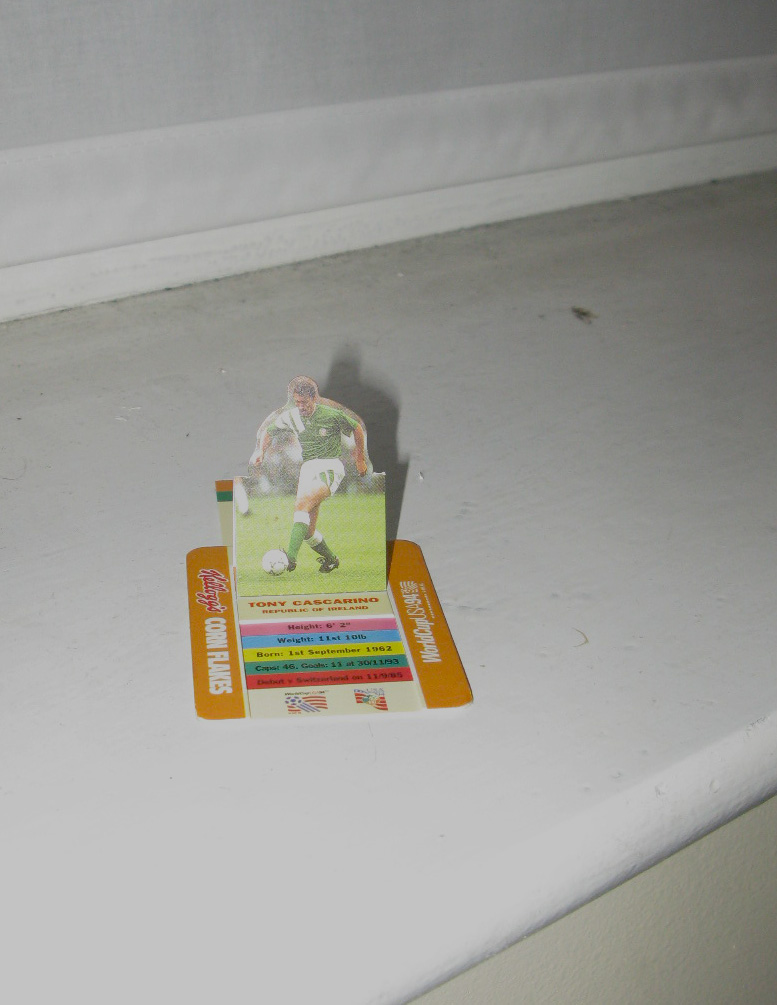
Why am I harping on about all this you may be (or more than likely aren’t) wondering. Well, digging in the attic last week I came across a collection of cards Kellogs had produced for the occasion. You got free stuff in your cereal those days, generally useless plastic toys or reflectors for the spokes of your bike, but they came up trumps with these. I’m missing Bonner, Babb, Coyne, Eddie McGoldrick (remember him?!) and John Aldridge; Terry Phelan has lost his head. Anyone out there with swapsies?

The Kellogs freebies from USA '94, six shy of the full squad!

Gary Kelly; His profile says he has "great potential" and he hadn't won the first of his 51 caps yet

Ex- Bohs, and the only person in the world to have an All Ireland GAA medal for football and a FA Cup winners medal, Kevin Moran

The man who played 88 times for Ireland and scored 19 goals despite not having a drop of Irish blood in him- Tony Cascarino

Anyone who can provide the missing cards mentioned above, please get in touch- I’d love to get a picture of the full squad… Comment on here or e-mail me at ci_murray@hotmail.com …