Feeds:
Posts
Comments
AntiClericals

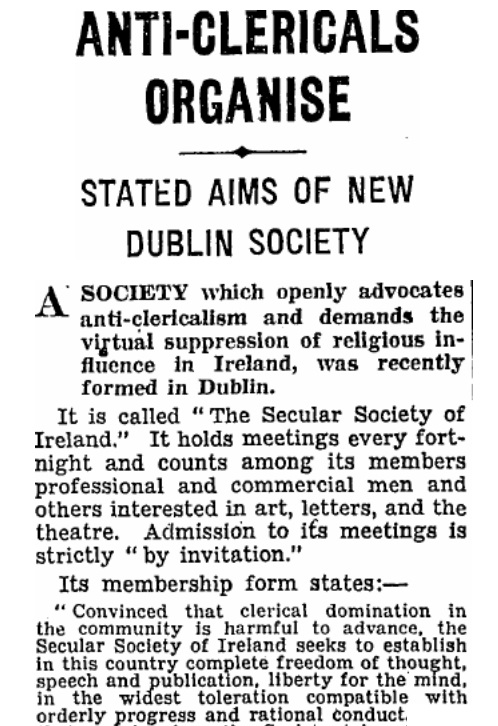
Irish Press, 17 January 1934.

You can’t imagine that the ‘Secular Society of Ireland’ were too popular in 1930s Dublin. At a time when the Irish Christian Front  were mobilising tens of thousands at College Green and glorifying General Franco, and when the Saint Patrick’s Anti-Communist League were smashing the windows of Connolly House,  the name certainly leaps out from the archives of Irish newspapers.

Reporting on the foundation the Secular Society of Ireland in a January 1934 edition of the paper, the Irish Press noted that “a society which openly advocates anti-clericalism and demands the virtual suppression of religious influence in Ireland was recently formed in Dublin.” The paper went on to quote from the membership form of the body, noting that it aimed to terminate, among other things,”the clerically-dictated ban on divorce”, “the Censorship of Publications Act” and “the system of clerical management, and consequent sectarian teaching, in schools.”

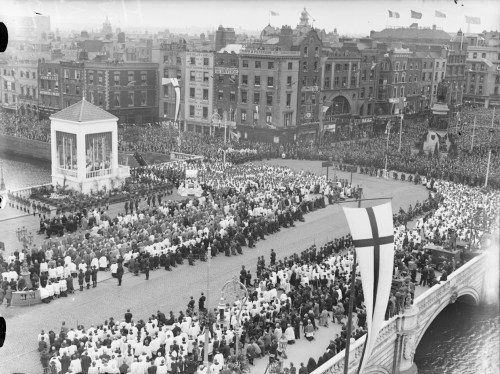
Eucharistic_Congress_-_Dublin_-_June_1932_-Benediction_on_the_Bridge

The Eucharistic Congress of 1932, an event that demonstrated the strong Catholic ethos of the Irish Free State.

The society met fortnightly in the Contemporary Club’s premises at Lincoln Place, and a journalist from the above paper was present at one lecture, noting that “there were about 35 people present…the attendance included a number of young men, apparently students,and about half a dozen women.”

The Chairman of that meeting explained that the society “did not advocate either Divorce or Birth Control but would press for facilities in both matters for people who desired them,and would endeavour to have the law here amended accordingly.” It was reported that “It would also press for full sex-education for all classes.”

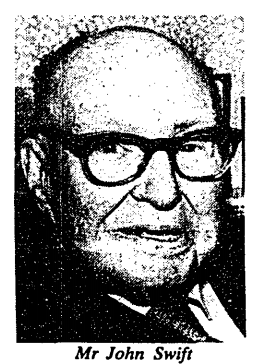
JohnSwift

The driving force behind the Secular Society of Ireland was John Swift, a trade union activist who was born in Dundalk in 1896, and a man who devoted much of his life to progressive politics.  From a family of bakers, he had arrived in Dublin in 1912, and was once a member of the Irish Volunteers.  At the time of his passing in 1990, an obituary noted that:

He joined the Labour Party in 1927 and became the first Irishman to be given the Soviet decoration “for friendship between peoples” having been president of the Ireland-USSR Friendship Society. He was a major force in the founding of the People’s College in Dublin, a co-founder of the Secular Society which existed from 1933 to 1936, and of the Spanish Aid committee which helped those fighting on the Republican side in the Spanish Civil War.

Fergus D’Arcy has written that”in a number of important respects John Swift was untypical…most obviously as a secularist, socialist and supporter of the Soviet Union in an Ireland either hostile or indifferent to all three.”

Interviewed in Uinseann MacEoin’s Survivors, Swift recalled that “among the founder members of the Society was Capt. Jack White, who had trained Connolly’s Citizen Army in 1914-1916, Denis Johnston of Dungannon, the playwright, and Mary Manning, the critic.”  Another leading figure in the body was Owen Sheehy Skeffington, later a Senator and university lecturer. Owen was the son of Francis and Hanna Sheehy Skeffington, two outspoken liberal voices in the Ireland of the early twentieth century. Of  the small organisation, Swift joked that “we were few so we had no trouble fitting in the average size sitting room.”

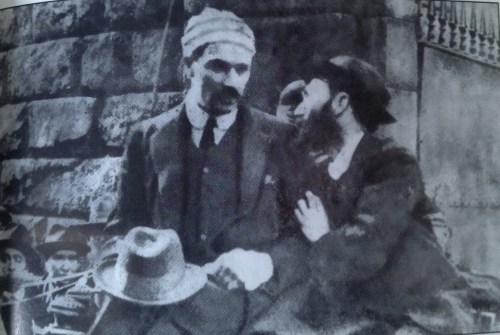
CaptainJackWhite

Jack White, a founding member of the Irish Citizen Army, with a bandaged head during the 1913 Lockout. Beside him is the great feminist and pacificist Francis Sheehy Skeffington. (Image via: Century Ireland, http://www.rte.ie/centuryireland)

Reports of the existence of such a society in Dublin caused great offence to some, and at a meeting in Veritas House days after the Irish Press report , a lecturer denounced the movement, believing that “it was allied to the widespread movement of Materialistic Communism.”

Continue Reading »

‘Meet me at the pillar’

9c59000000000000

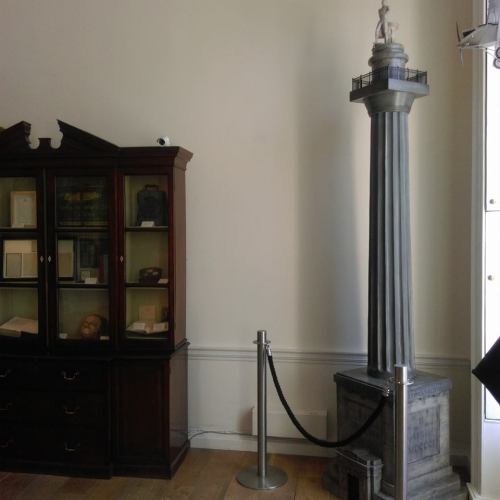
New information panel and artefacts at the Little Museum of Dublin.

While there is plenty of talk about next year being the centenary of the Easter Rising, it is also worth pointing out it will mark the fiftieth anniversary of the destruction of the Nelson Pillar on O’Connell Street. In 2014 I wrote The Pillar: The Life and Afterlife of the Nelson Pillar, an illustrated history of the monument that includes plenty of previously unpublished photos from Pól Ó Duibhir, who had the good sense to make his way down to O’Connell Street the morning after the night before, camera in hand. It’s currently available at a special price direct from the publisher, with free postage.

I was delighted to work with the Little Museum of Dublin on a new information panel on the monument, which has taken pride of place in the front room of their Dublin collection. Trevor White, Simon O’Connor and the others behind the museum of twentieth century Dublin share an obsession in Horatio Nelson’s doomed Doric column with us, and the story of its destruction in 1966 has been told on tours of the Museum since it opened to the public.

The information panel looks at, among other things:

  • The Nelson Pillar and the 1916 Rising.
  • The attitude of W.B Yeats and other public voices to the monument.
  • Proposed replacement statues over the years.
  • The eventual destruction of the monument.

What’s exciting about it for me is in the inclusion of physical artefacts alongside the panel. There are two surviving chunks (of very different sizes) of the pillar, a tram destination sign, postcards featuring the monument and other bits and pieces that help to tell the story. The piece nicely compliments the model of the pillar placed in the museum a few months ago.

On the subject of the Little Museum, I should remind readers that every Saturday and Sunday I offer  the ‘Green Mile’ tour, a one hour history of Stephen’s Green, that leaves from the Museum at 11.30am. It is included in the standard admission cost of the Museum. While the weather lately has been ‘for the ducks’ so to speak, it’s a chance to see some real ones up close.

9c59000000000000

The Insurrection in Dublin

theinsurrection

The Insurrection in Dublin (First published in 1916, this is the 1978 Colin Smythe edition)

I had the good fortune to spend much of this week in Edinburgh,  a city which has a great sense of history, and which is home to many great bookshops, both big and small.  I always make sure to drop into the bookshops around Grassmarkets while there, and I was fortunate this time to find this beautiful edition of The Insurrection in Dublin, which I thought was worth picking up for the cover alone.

The 1978 edition of the book shows Dublin’s historic coat-of-arms ablaze, and the city motto (which roughly translates to ‘The happiness of a city depends upon the obedience of its citizens’) is burning too.  I also love the cowboy western style font of the title.

This was one of the first books published on the Easter Rising, released originally only months after the fighting.  As an eyewitness account, it is one of the finest we have of that chaotic week in Dublin. Stephens was a novelist and poet, as well as an Irish nationalist who was familiar personally with some of the participants in the fighting.  He was not a participant in the Rising himself however, but an observer who did get out onto the streets in the search for information. Brian Hughes has noted that:

James Stephens (d. 1950), was part of [Thomas] MacDonagh’s close circle of friends and collaborators in literary Dublin having co-founded the Irish Review with him. He contributed articles to Arthur Griffith’s journal United Irishman and his first book of poems appeared in 1909 entitled Insurrections. Over the following years he continued to publish poetry, contribute to journals and was appointed registrar of the National Gallery of Ireland after returning to Dublin in 1915.

George Russell, reviewing this book at the time of its release,  heaped praiseon Stephens, writing that “he has the most vivid senses of any Irishman now writing. He kept a journal day by day,writing down what he saw with those keen eyes of his.”

His account of the Rising is available to read in full here, thanks to the excellent ricorso.net.

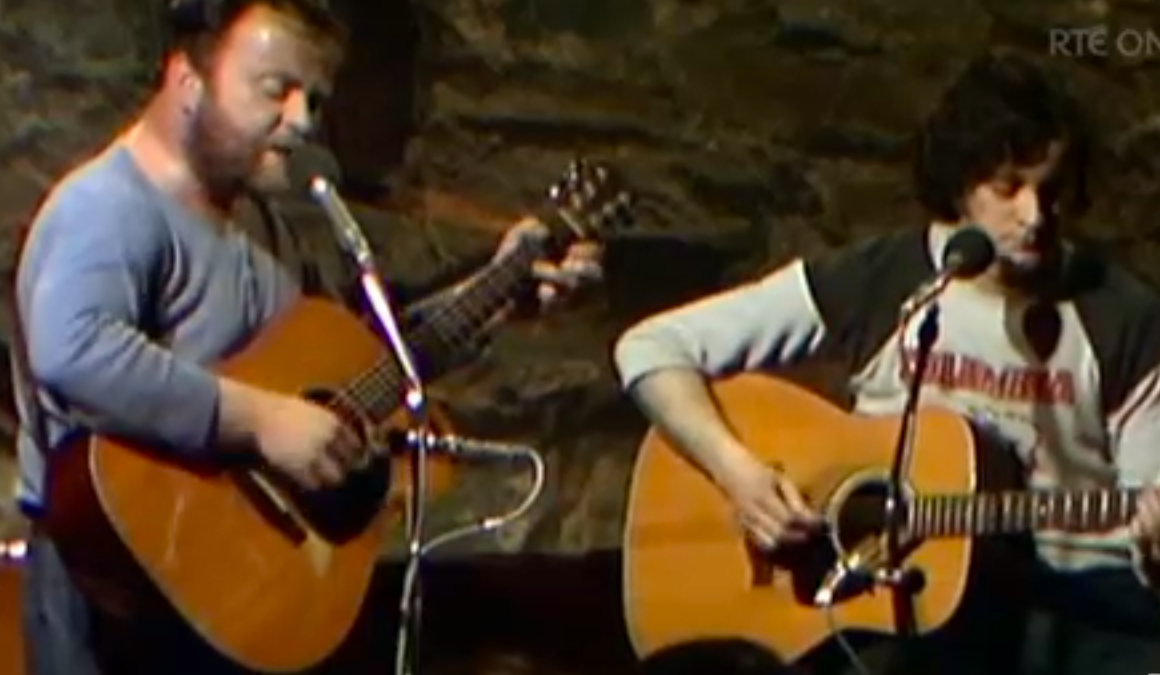
The first episode of the new RTÉ television series ‘Pat Shortt’s Music From D’Telly’ featured Christy Moore performing in The Abbey Tavern in Howth in 1980. Playing beside him in the short clip was Declan McNelis.

Christy Moore and Declan McNeilis - The Abbey Tavern, Howth, 1980. Credit - rte.ie

Christy Moore and Declan McNeilis – The Abbey Tavern, Howth, 1980. Credit – rte.ie

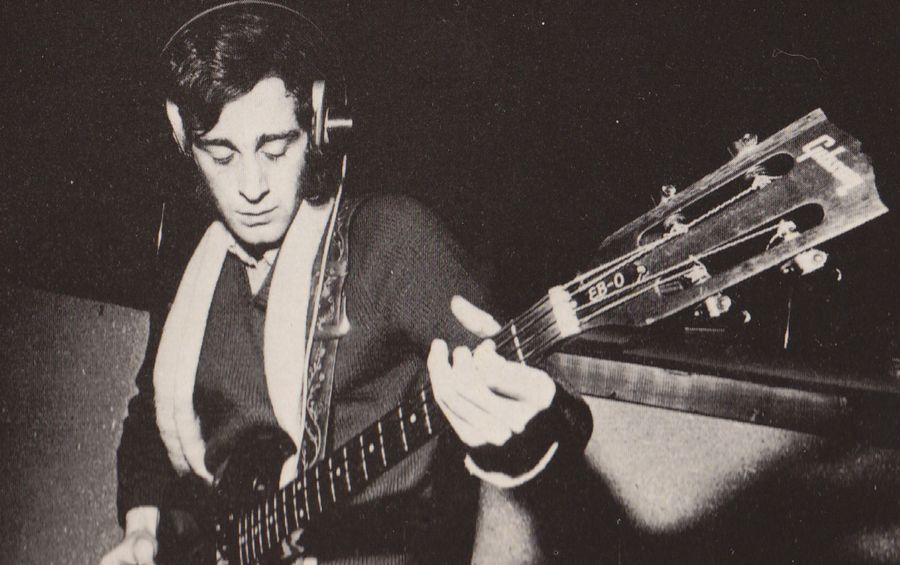
It was highlighted to me later by my Dad that the show missed a perfect opportunity to call attention to the fact that Declan was a well-respected musician who was tragically killed after performing a gig in Limerick in April 1987. As there are no major tributes online, I felt it would be of value to collate information and pictures about this well-loved and accomplished instrumentalist.

From Marino on Dublin’s Northside, Declan McNelis took up the bass at the age of 12. After secondary school, he began studying in UCD with intentions to become a school teacher. But he gave it up to join the Red Peters and The Dublin Floating Blues Band in the mid 1970s. Around this time, he also played with an acoustic blues outfit called Dirty Dozen with Johnny Norris.

From around 1974 onwards, Christy Moore played with Declan, Jimmy Faulkner and Kevin Burke. They had a residency on Monday and Saturday nights in The Meeting Room on Dorset Street. Declan played bass on Christy’s album ‘Whatever tickles your fancy’ (1975) and guitar on his self-titled ‘Christy Moore’ (1976).

Declan pictured in 1975 recording Christy Moore's album 'Whatever Tickles Your Fancy'. Credit - theballadeers.com

Declan pictured in 1975 recording Christy Moore’s album ‘Whatever Tickles Your Fancy’. Credit – theballadeers.com

In October 1979, Declan set out on the Anti-Nuclear Roadshow to help the campaign against the Carnsore Point nuclear power plans with Freddie White, Matt Kelleghan and Jimmy Faulkner. Together with other groups they mobilised support concerts across the country.

In the 1970s and 1980s played with many of Ireland’s leading musicians including Christy Moore, Tríona Ní Dhomhnaill, Maura O’Connell, Freddie White, Robbie Brennan, Mary Coughlan, Donal Lunny, Honor Heffernan, Philip Donnelly, Frankie Lane, Pete Cummins and Jimmy Faulkner.

Nicknamed ‘Seagull’, Declan was known for his humour and organising outrageous fund-raising raffles for the campaign – a £1 ticket could led to people winning a bottle of lemonade, a wrapped sandwich or a set of boot studs!

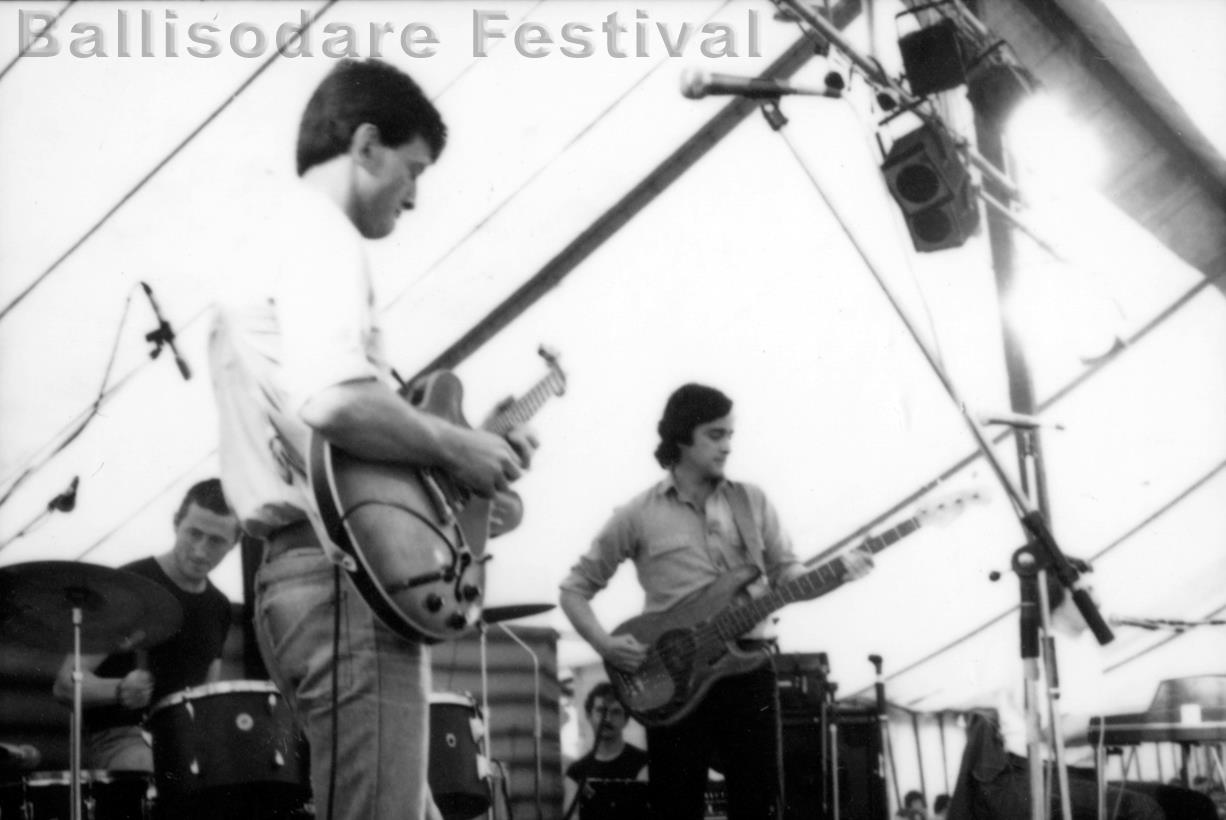
Freddie White on stage at Ballisodare Festival, 1980. Declan McNeilis on bass and Arty Lorrigan on drums.

Freddie White on stage at Ballisodare Festival, 1980. Declan McNeilis on bass and Arty Lorrigan on drums.

Continue Reading »

MAnchester

Manchester Martyrs cenotaph memorial, thanks to Niall Oman.

Looking at the above,  you would be forgiven for thinking you were looking at a final resting place in Glasnevin Cemetery.

Despite appearances however, and the fact three names are listed on the memorial, there is nobody buried there. This cross commemorates the ‘Manchester Martyrs’,  three Fenian prisoners who were publicly hanged at Salford Gaol on 22 November 1867. A crowd of several thousand watched the men meet their end, and the sad affair is primarily remembered today for a moment of defiance, and the shouts of ‘God Save Ireland’ inside the courts of law.

William Philip Allen, Michael Larkin and Michael O’Brien had all partaken in an event that became popularly known in republican folklore as the ‘Smashing of the Van’, on 18 September 1867 in Manchester.  This was an attempt by republicans to free two of their ranks from police custody. Thomas J. Kelly and Timothy Deasy were two high profile Fenian prisoners, who had travelled to Manchester to take part in a council of Fenian Centres (or organisers) in England. Both men were veterans of the American Civil War, and their arrests galvanised the Irish communities in British cities like Manchester into action. Michael Herbert, who has a particular interest in the history of the Irish Diaspora in Manchester, has written that when both men were arrested on 11 September 1867, “this was a major coup for the authorities, but Edward O’Meagher Conlon, another Irish-American Civil War veteran who was in charge of re-organising the Fenians in the north of England, immediately set plans in motion to free the two men, procuring arms from Birmingham and organising a party of men to effect a rescue.”

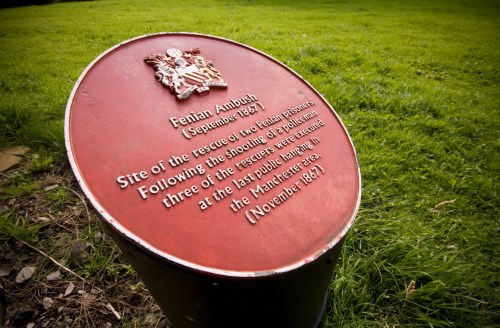
Fenian_ambush_plaque_hyde_road

A historical marker in Manchester detailing the events that led to “the last public hanging in the Manchester area.” (Wiki)

Conlon’s party did succeed in stopping a horse-drawn police van , and both prisoners were successfully rescued and smuggled to America by the Fenian movement. The problem was that in the course of this, a policeman, Charles Brett, was shot inside the van. In one ballad dealing with this affair, it’s noted that:

With courage bold those heroes went

and soon the van did stop,

They cleared the guards from back and front

and then smashed in the top,

But in blowing open of the lock,

they chanced to kill a man,

So three must die on the scaffold high

for smashing of the van.

As Herbert has noted, the police response was immediate, as “the Manchester police arrested some of the rescuers at the scene and dragged in dozens of other Irishmen in the following days as the constabulary ransacked the Irish quarters, enraged by the deaths of their colleague.” One man who was present at the ‘Smashing of the Van’, but who evaded arrest, was James Stritch. A committed revolutionary for decades to follow, he was only seventeen at the time. He would later emerge in the General Post Office during the 1916 Rising, and was interned in Frongoch for his troubles.

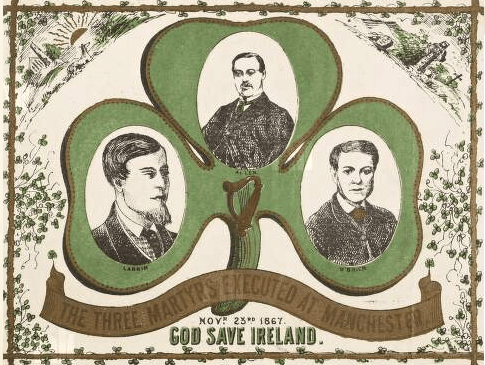
MM

‘God Save Ireland’ commemorative artwork (National Library of Ireland)

Before Allan, Larkin and O’Brien were executed for their role in the affair, they appeared in court, as did dozens of other Irishmen.  O’Brien struck a defiant note, telling the Manchester court that: “The right of man is freedom. The great God has endowed him with affections that he may use, not smother them, and a world that may be enjoyed. Once a man is satisfied he is doing right, and attempts to do anything with that conviction, he must be willing to face all the consequences.” When the men were hanged outside Salford Gaol, the crowd that gathered taunted and jeered them in their final moments. One of the Catholic clergy who attended the men remembered that “A crowd of inhuman ghouls from the purlieus of Deansgate and the slums of the City … made the night and early morning hideous with the raucous bacchanalian strains of “Champagne Charlie”, “John Brown”, and “Rule Britannia”. No Irish mingled with the throng … They had obeyed the instructions of their Clergy.”

The hangings attracted international attention. Frederick Engels would write to his co-author Karl Marx that “only the execution of the three has made the liberation of Kelly and Deasy the heroic deed as which it will now be sung to every Irish babe in the cradle in Ireland, England and America.” With the men buried in England, the demand for the return of their remains was immediate. In the absence of bodies however, mock funerals took place.

Manchester2

Detail of Glasnevin memorial. Thanks to Niall Oman for picture.

In Dublin, tens of thousands marched in procession to Glasnevin Cemetery on Sunday 8 December 1867, behind three empty hearses, while there were similar mock funeral processions in other parts of the country too, with a particularly large event in Limerick. Of the Dublin march, the  following description of plans appeared in the Freeman’s Journal days in advance:

We understand that the following is the programme as arranged up to the present by the managing committee of the funeral demonstration to be held on Sunday: – A body of men, eight abreast, to lead the procession; the Youth of Dublin; a Band playing the “Dead March in Saul”, three Hearses, the Ladies, the general procession with bands interspersed. The procession will assemble in Beresford Place, the head of the cortege facing up Abbey Street. The start will be twelve noon.

Continue Reading »

1004.jpg

James Connolly (From  C. Desmond Greaves biography cover)

Media coverage of the 1916 Rising is a favourite subject here, and in the past we’ve looked at how American newspapers reported on the events in Dublin. I recently found this report from the Daily Chronicle and thought it worth posting. It deals with James Connolly, who is contrasted with Jim Larkin. By the time of the Rising, Larkin was in the United States. Despite that, as you’ll see in the above link, some American newspapers managed to blame him for events, even printing images of Larkin in their reports.

There’s lots of food for thought in a recent contribution by Brian Hanley to a panel discussion of the Irish Labour History Society on the theme on Connolly, which is posted in full over on Cedar Lounge Revolution.

Here is the piece from the Daily Chronicle, published in May 1916:

Jim Connolly hardly belongs to any recognised type of Irish agitator. To hear him speak one would have thought of the most pronounced type among the strong Glasgow accent. He measured his words and spoke with a reticence that was wholly un-Irish. In the substance of his talk, apart from  his fervent Irish Nationalism, he would have seemed to be neither Irish not Scottish, but Western American, with strong notions of industrial unionism, as practised by the IWW and the Federation of Labour, and in these characteristics were summed up the history of the man. Born in Scotland, of Irish parents, he became an advanced Socialist of the self-educated type, traveled to America, where he absorbed the new ideas of labour agitation, drifted back to this country, and eventually became Larkin’s right hand man in Dublin and his chief organiser.

Connolly’s greatest achievement was to have succeeded in planting Syndicalist theory and practice – industrial anarchist of the most pronounced type – among the unskilled workers of Dublin. When Larkin descended on the Irish capital in 1907, to lead a dock strike, Connolly became his right-hand man. The one, a hysterical, half-insane enthusiast, supplied the rhetoric and the emotion; the other supplied the wonderful semi-political organisation that had its headquarters at Liberty Hall.

Of the two chiefs of the movement it might be said that the moment it began to assume the character of political revolt Connolly, as the man of strong will and almost unique organising ability, was the more dangerous. During the labour troubles of 1913-14, he preached and taught his followers to practice pure Syndicalist doctrines, as have been practiced in Los Angeles and other cities of the American West – no trust with employers, violence if necessary, cynical repudiation of contracts, unceasing war, by any and every means. He was sentenced for conspiracy, but was set free after a seven days’ hunger strike.

On the subject of James Connolly, his political ideas and his involvement in the Rising, this Witness Statement from Mortimer O’Connell, an Irish Republican Brotherhood member and Volunteer,  is interesting reading. He recalled that:

I attended many of the strike meetings of 1911, 1912 and 1913, coming in from Blackrock with other students from The Castle to hear Larkin and Connolly, amongst others, speak. My impression was that he was an extreme international Socialist or what we would now term a Communist.

O’Connell believed that Connolly’s political views were shaken by the outbreak of the World War and the manner in which many Socialist Parties threw themselves behind their national war efforts, supporting recruitment and the like, rather than opposing the brutal conflict. He recalled that:

Between January 1916 and Easter Week Connolly gave lectures to selected groups of Volunteers. These lectures were held in the offices of some accountant in Nassau St., whose name I cannot recall. I was on occasion one of the Volunteers sent to stand guard, and I was present at some of these lectures. I remember Frank Fahy, later Ceann Comhairle, and others discuss with Connolly’s his views of a National Policy and asking him how it happened that he was taking this National stand in view of his past pronouncements.

Connolly’s explanation was that he got a shock when the Labour Leaders of England, France, Germany, Austria and Russia all had declared in 1914 for their respective countries. In other words they had become national. He felt that he himself should take stock, and he came to the conclusion that his first duty in the crisis was to be an Irishman.

A cocktail in 1960s Dublin.

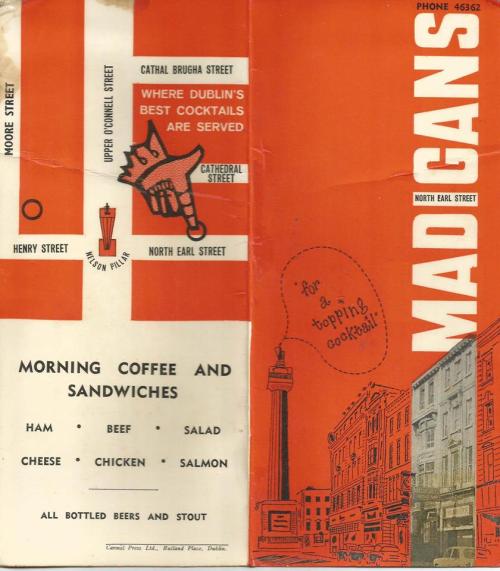
Thanks to Walter Wouk for sending this interesting little 1960s tidbit through to our Facebook page in recent times. I like it for a couple of reasons, including the fact it not only features the Nelson Pillar (gone fifty years next year of course), but also uses the monument in the menu, with Horatio Nelson recommending Madigans “for a topping cocktail.” Madigans on North Earl Street is still going strong today of course.

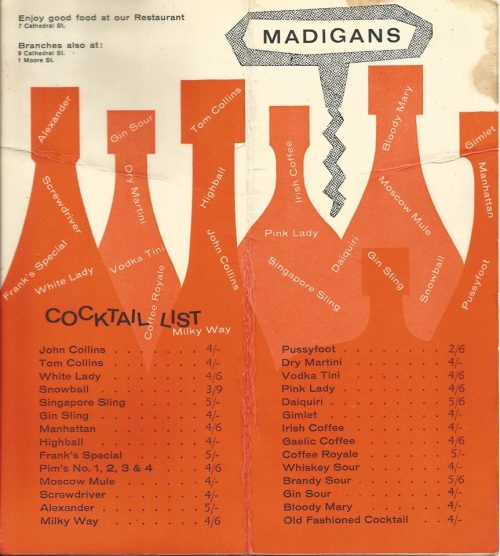
There has been a trend of cocktail bars opening in Dublin in recent years, and you’ll find some of these drinks on menus across the city today. We previously looked at denunciation of alcohol cocktails in 1930s Dublin before. The Irish Times denounced the cocktail in 1932, warning readers that the cocktail “fulfils no useful function. It is supposed by the many to induce an appetite and to stimulate intelligent conversation; in fact, it absorbs the pancreatic juices and encourages cheap wit.” This menu shows there was plenty on offer in Dublin fifty years ago.

Madigans cocktail menu (1/2)

Madigans cocktail menu (1/2)

Madigans cocktail menu (2/2)

Madigans cocktail menu (2/2)

The menu also directs customers towards another Madigans on Moore Street, which is now no more – in fact, there isn’t a single pub on Moore Street today.

These are times of great change on Moore Street, with potential new developments that could drastically alter the appearance and character of the street, not to mention the focus on the street with the centenary of the Easter Rising approaching.

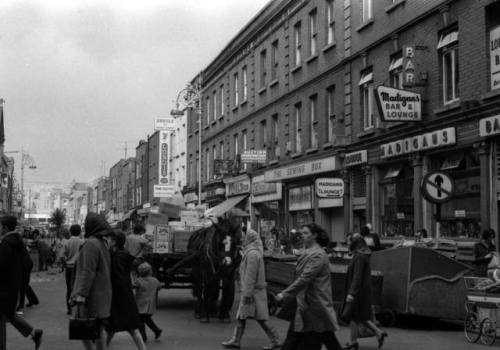
A Madigans Lounge sign can be seen in this image of Dublin street traders from the 1970s, and the below:

9c59000000000000

Madigans Bar & Lounge (Unsure of date of image)

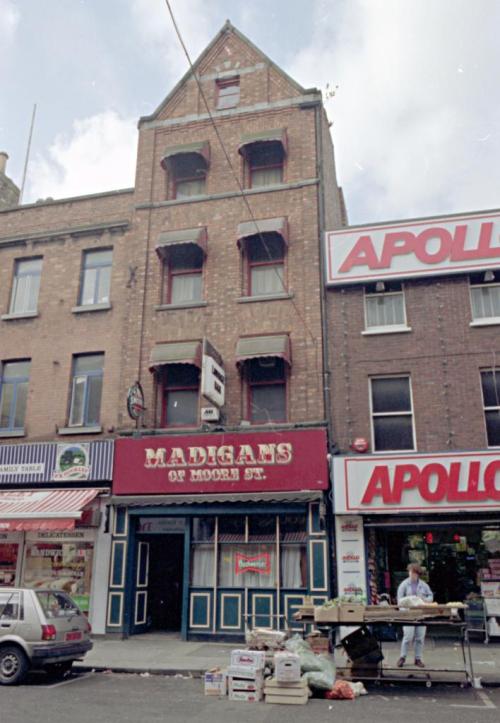
Twenty years later, there was still a pub trading under the Madigan name on the street, though on the other side of it, were these premises related?This image is found in the excellent Dublin City Council Photographic Collection, from 1992:

9c59000000000000

This photograph is from the Dublin City Council Photographic Collection.


Joseph E.A Connell Jr.’s recent book, Dublin Rising 1916, is a remarkable resource that we’re going to be dipping into for a long time to come. Listing addresses in Dublin by postcode, it gives us an idea of the secret lives and histories of buildings that in many cases are very familiar to us. The buildings featured range from the iconic, such as the General Post Office, to the totally forgotten, like safe-houses in places like Cabra and Phibsborough.

Having dived into the secret histories of  known places in the context of 1916, it got me thinking about the period that later followed, with the War of Independence (1919-1921), and the Civil War (1922-1923). The Bureau of Military History Witness Statements are one way of unearthing the hidden histories of  places, and one that popped up a few times in various statements caught my attention; a bomb factory in the very heart of modern-day Temple Bar, active during the later stages of the War of Independence and into the early phase of the Civil War.

Crown Alley today. (Image Credit: www.geograph.ie/photo/2266860, Eric Jones. Creative Commons)

Crown Alley today. (Image Credit: http://www.geograph.ie/photo/2266860, Eric Jones. Creative Commons)

For the republican movement, carrying on the fight in the aftermath of 1916 involved great logistical difficulty. A defeated army lacks weaponry, not to mention the fact the Easter Rising had clearly demonstrated the need for better weaponry. Arms were procured in the period that followed the Rising in a number of ways. Sometimes, they were purchased abroad and smuggled into Ireland. On other occasions, they were seized during raids on police stations and barracks premises. In Dublin, they were even removed from visiting ships, like the American ship Defiance in 1918. The movement also depended on secret munitions factories, often hidden deep within legitimate places of business. The unenviable task of overseeing all of this fell on the shoulders of the IRA Director of Munitions.

Seán Russell, a Dubliner born in Fairview in 1893, was a veteran of the Easter Rising who had been active with the Irish Volunteers from the time of their inception in 1913, and he is central to this story. By the time of the War of Independence he was a respected member of the IRA General Headquarters Staff (GHQ), and in 1920 he became the Director of Munitions for the body. He would later prove an important figure in the IRA of the 1920s and 1930s, serving as quartermaster general of the organisation from 1926 to 1937 and playing an active role in reorganising the body after its Civil War defeat.  A deeply controversial figure today, he is primarily remembered for his later time as Chief of Staff of the IRA in the late 1930s, during which he orchestrated a disastrous and short-sighted bombing campaign of British cities. He also attempted to procure support for the organisation from both Soviet Russia and Nazi Germany in the 1920s and the 1930s, something that has led to repeated vandalism of his Fairview statue.
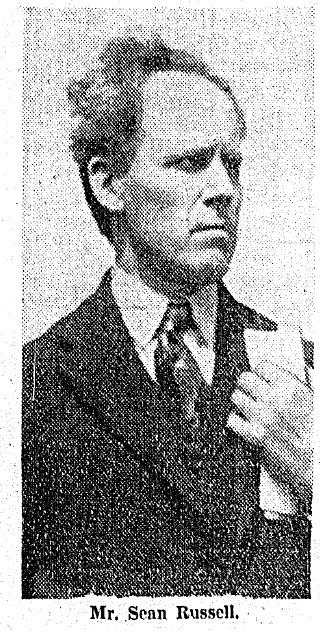
Seán Russell in the 1930s.  He died in August 1940 on board a German U-Boat, having attempted to secure German assistance for the IRA.

Seán Russell in the 1930s. He died in August 1940 on board a German U-Boat, having attempted to secure German assistance for the IRA.

Seán Russell became IRA Director of Munitions in the aftermath of the death of Peadar Clancy, a 1916 veteran who had become second-in-command of the Dublin Brigade of the IRA, and who was shot in Dublin Castle on Bloody Sunday, November 1920.

As Director of Munitions, Russell would have been acutely aware of the need for munition and bomb factories. What he didn’t have, according to fellow 1916 veteran Thomas Young, was the required technical or engineering knowledge. Young recalled that “I can’t say that this appointment had the approval of any member of the munitions staff, as Seán Russell had no engineering ability but considered himself, by virtue of his appointment, to be in a position to instruct and direct all munition workers.” Patrick McHugh, another member of the IRA’s munitions team, felt differently towards the appointment, remembering that “Sean and I got on well together. Our ideals were identical and although he had little technical knowledge of work in hand he left the production entirely to my discretion and always introduced me as his assistant and appointed as his deputy whenever he was absent.”

Oscar Traynor, later a Fianna Fáil Minister and Football Association of Ireland President, remembered that Russell stepped into the role quickly, as “a tremendously keen Volunteer”, who “had an extraordinary bent for organising and establishing matters of this kind.”

Before Russell, the movement was utilising a munitions factory at 198 Parnell Street “underneath the bicycle shop of Heron & Lawless”, but the eyes of the law came onto this site, and it became very clear that the work needed to be spread across the city after it was raided. Seán O’Sullivan, a munitions worker who had first joined the republican movement in Manchester in 1916, remembered that raids upon the Parnell Street factory made it redundant:

The munitions factory in Parnell Street was again raided in November, 1920, at night. The whole area was cordoned off. The military and auxiliaries remained on the premises the whole night apparently with the intention of capturing the staff when they arrived in the morning. A young fellow who had left his bicycle there for repairs, called that morning to collect it. When he saw the auxiliaries inside, he made an effort to run away from them. They opened fire on him and wounded him. That gave us the warning as Parnell Street was crowded when we arrived near the premises. None of us knew who was inside as a few of us had our own keys. We kept outside until we collected all the staff and got rid of our bicycles, mixing in the crowds. They seized everything, took away the plant and the premises were closed down. It was our idea at the time that they had only stumbled on to this through an area raid.

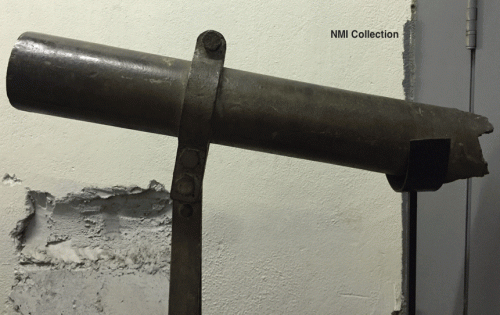
The IRA 'big gun', produced at the Parnell Street munitions factory. See 'The Cricket Bat that Died for Ireland':  http://thecricketbatthatdiedforireland.com/2015/05/17/the-ira-big-gun-and-the-death-of-matt-furlong-1920/

The IRA ‘big gun’, produced at the Parnell Street munitions factory. See ‘The Cricket Bat that Died for Ireland’: http://thecricketbatthatdiedforireland.com/2015/05/17/the-ira-big-gun-and-the-death-of-matt-furlong-1920/

Munitions worker Patrick McHugh recalled that “I informed him [Russell] of our requirements regarding a foundry etc., and expressed the view that we should, as far as possible, scatter our work and duplicate premises so that we should not have a recurrence of Parnell Street.” McHugh claimed that within a week, Russell had sourced a new facility for the making of weapons at Crown Alley. This was the Baker family ironworks.

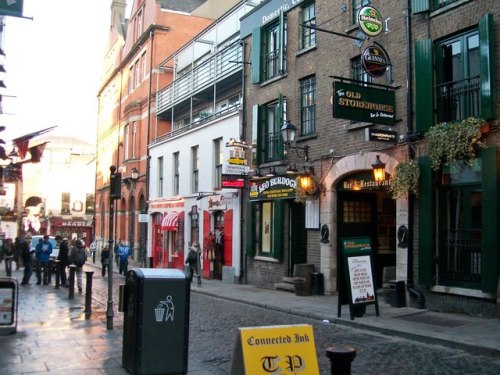
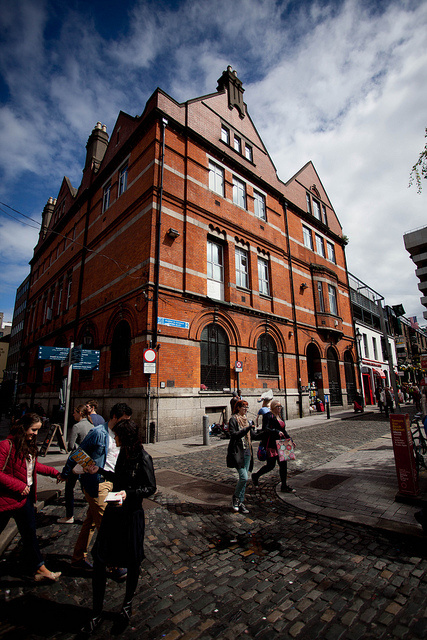
Today home to a Starbucks, the Bad Ass Cafe and The Old Storehouse among other businesses, Crown Alley is a bustling street in the heart of tourist-centric Temple Bar. In 1920 it was a very different place, located in what was still primarily an industrial district. Directly opposite the Telephone Exchange, a large imposing building still there today, was Baker’s Iron Works. It stood where Temple Bar Square is today, beside the Bad Ass Cafe. McHugh recalled inspecting it with Russell:

With Seán I inspected premises owned by Mrs. Baker facing Telephone Exchange which was under military guard. Mrs. Baker was running a small engineering and blacksmith business with her son, Paddy, in charge and a younger son in office. The premises suited our needs and she agreed to allow us more space in the general machine shop which we could partition off for machining grenades…. None of Mrs. Baker’s staff were in I.R.A. and it is a great credit to them that the presence of foundry and work done there was never disclosed to anyone.

The imposing Telephone Exchange, opposite the Baker family ironworks (Image Credit: Paul Reynolds, Rabble: http://www.rabble.ie/2012/11/14/look-up3-rebel-without-a-call/)

The imposing Telephone Exchange, opposite the Baker family ironworks (Image Credit: Paul Reynolds, Rabble: http://www.rabble.ie/2012/11/14/look-up3-rebel-without-a-call/)

There were a number of other such factories established across the city at this time, ensuring that a repeat of the disaster on Parnell Street would be avoided. Yet while dividing the workload between various munitions factories was a good idea, situating one right  across from the Telephone Exchange at Crown Alley would have raised some eyebrows.

The Telephone Exchange was under British military occupation, owing to an eagerness that it not fall into rebel hands. in 1916, the rebels had planned for the occupation of the important communications centre, but in the chaos of the week it had gone unoccupied. It was too important a facility to be left unguarded now. Still, as munitions worker James Foran remembered:

They had sentries marching up and down on the roof of their building as we were going in and out, and we were never caught. I got paid while I was in Crown Alley. It was a full-time job and we were there for a couple of months. I was paid £1 a week, or maybe it was £1 a day. I think it was £1 a day. I was there for two or three months and finished up at the Truce.

RTE Stills image of Crown Alley before the modern development of Temple Bar, 1970s. The carpark on the right, opposite the Telephone Exchange, is (I think!) where Baker's ironworks once stood.

RTE Stills image of Crown Alley before the modern development of Temple Bar, 1970s. The carpark on the right, opposite the Telephone Exchange, is  where Baker’s ironworks once stood. (Image ownership: RTE)

McHugh’s entertaining Witness Statement details how a furnace was acquired for use in the Baker premises, as “try as we might we were unable to produce sufficient heat to melt iron” without acquiring a new one. These issues were resolved, and by March 1921 the munitions factory was well and truly in operation.

This particular munitions factory specialised in the part-production of grenades and landmines, with one munitions worker recalling that “we made there casings for hand grenades and fittings for mines.” Foran recalled that the grenades would be taken away in sacks, and that:

I never noticed how many grenades we turned out. They used to come twice a week and take three or four sacks of them in the car – not full bags. Seán Russell was in charge of us… It was marvellous the way we got away with it, we were very lucky. We were never raided. All the other fellows working there in the usual way at the usual foundry work never gave us away.

An idea of quantity comes from Frank Gaskin, who claimed that when the pieces moved on from Crown Alley to another munitions factory, “we were able to turn out two or three hundred grenades per day.” The product was constantly moving, from one factory to the next:

Finished grenades were brought direct to O’Rourke’s Bakery, Store Street, where all filling was done. Firing set castings were delivered to 1 and 2 Luke Street where machining and screwing was done. Strikers were taken to Percy Place for pointing ,safety levers were taken to Mountjoy Square where assembling of firing set was done.
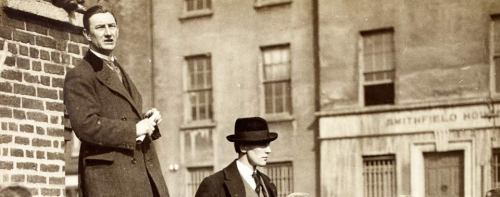
Oscar Traynor, who provided an in-depth statement to the Bureau of Military History (National Library of Ireland)

Oscar Traynor, who provided an in-depth statement to the Bureau of Military History (National Library of Ireland)

Not alone were the IRA capable of producing huge numbers of grenades at this time – they were producing grenades of a much greater quality to what they had earlier relied on. According to Oscar Traynor:

In the course of time very great improvements were made in this particular type of weapon. Apart from the fact that the grenades were made larger, the explosive material was also greatly improved. The old complaint from which Volunteers suffered previously, that of throwing a grenade and having the experience of not seeing it explode, was almost eliminated. This aspect of the Volunteers’ armament developed a greater confidence in the fighting men of the various units.

The work of making grenades at Crown Alley continued right up to the Truce, and for those who took the Republican side in the Civil War, it was resumed. With the Civil War, the IRA found itself with a serious problem on its hands: former comrades in the Free State Army knew its modus operandi, and in many cases knew the location of such factories. McHugh remembered that the making of grenades and landmine parts “continued in these premises until taken possession of by Free State forces in March 1922.”

Mrs. Baker, who provided Seán Russell and his men with the use of her family ironworks at Crown Alley, was not a soldier, nor did she receive a pension or a medal. Yet, in her own small way, she was a vital part of the republican movement in the Dublin of her time, as were many others. As Patrick McHugh recalled:

Mrs. Baker, too, deserves great credit for the risk she took. She was not a young woman but had a great national spirit. Ireland’s soldiers needed help and she did not count the risk or cost, and was always in the best of spirit. Few women with a military guard facing their premises would take such a risk.
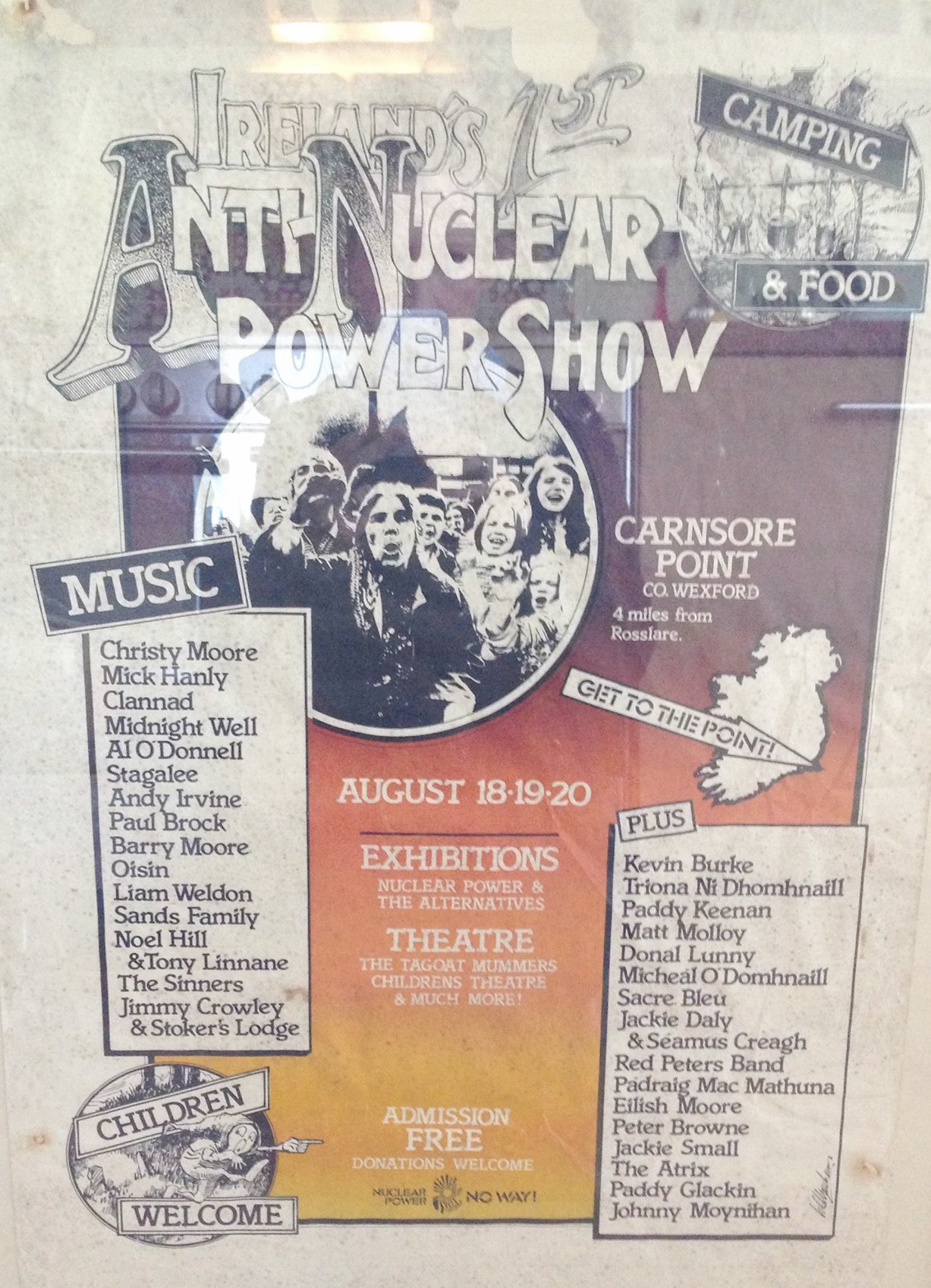
Thanks to Martin on The Atrix Facebook page for taking a high-quality photograph of his original poster for the Carnsore Point anti-Nuclear festival in August 1978.

Carnsore Point poster, 1978.

Caransore Point poster, 1978.

The free festival was attended by thousands of people who wanted to express their opposition to the proposed first nuclear power plant in Ireland. Entrance to the three day festival in the South West corner of County Wexford was free and entertainment on offer also included exhibitions, workshops and theatre productions.

The cream of the crop of the Irish musical scene provided their services. They included traditional legends like Christy Moore, Clannad, Andy Irvine, Liam Weldon, Donal Lunny, Paddy Glackin who were backed up by soulful rock group Stagalee and Dublin New Wave bands Sacre Bleu, The Atrix and The Sinners.

Christy covered the event in his 2000 autobiography ‘One Voice’:

It was my first time to become directly involved in a political campaign, and I was to meet many  people who became lifelong friends and a few who became somewhat less than that. The festival was  a huge success and opened my eyes to the potential of people power. It was a wonderful collective and  to this day I still try to carry the message of Carnsore Point in my everyday life.

After the 1978 festival, Wexford writer Jim “Doc” Whelan presented Christy with a song he wrote called ‘Nuke Power’. Christy loved it and began performing it at gigs. This version was recorded in St. Patrick’s Training College in Drumcondra in 1979.

Political speakers at the 1978 festival included Petra Kelly (1947-1992; German Green Party), John Carroll (vice-president of the Irish Transport and General Workers’ Union) and Dr. Robert Blackith (1923-2000; Trinity College lecturer).

Not everyone on the radical Left was onside though. The pro-Unionist Marxist-Leninist group British and Irish Communist Organisation (BICO) picketed the festival as they believed nuclear power was was necessary to achieve socialism in Ireland!

There were further festivals in 1979, 1980 (with U2 on the bill) and 1981. The campaign was ultimately successful and a number of wind generating stations were opened on the headland in 2003.

'The Famous Boer Hat'.

‘The Famous Boer Hat’.

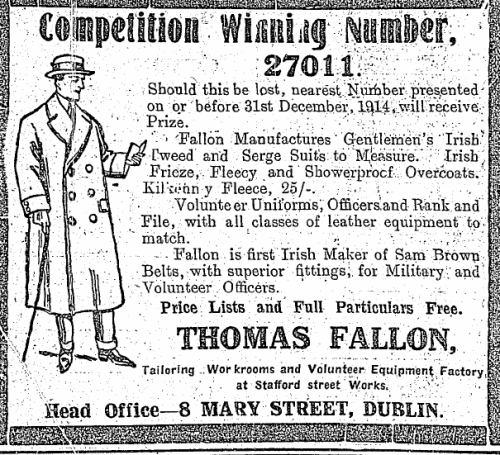
Thomas Fallon, a “tailor, outfitter & equipment manufacturer”, operated out of Mary Street in the early twentieth century. His business could boast of being the “first maker in Ireland of Sam Brown belts for officers”, and when the Irish Volunteer movement was born, Fallon was one of the men who dressed its ranks. These advertisements for his business premises, published in the Irish Independent a century ago, are an interesting little insight into a sometimes overlooked aspect of the period, the manufacturing of uniforms for bodies like the Irish Volunteers.

Advertisement for Thomas Fallon.

Advertisement for Thomas Fallon.

Writing in August 1914 to the Irish Independent, Fallon stated that “I do a good trade with the Irish Volunteers….I have always been a Home Ruler and supporter of Mr. John Redmond…” While Fallon was a great admirer of Redmond, the later would ultimately split the Volunteer movement by encouraging Irishmen to enlist in the war effort of WWI. At a famous speech at Woodenbridge in Wicklow in September 1914, Redmond stated that:

The interests of Ireland, of the whole of Ireland, are at stake in this war. This war is undertaken in defence of the highest interests of religion and morality and right, and it would be a disgrace forever to our country, a reproach to her manhood, and a denial of the lessons of her history if young Ireland confined their efforts to remaining at home to defend the shores of Ireland from an unlikely invasion, and shrinking from the duty of proving on the field of battle the gallantry and courage which have distinguished their race all through its history.

This split the Volunteers into two opposing camps. One became known as the Irish National Volunteers, a body that followed Redmond and which consisted of the majority of the organisation, while a smaller body of men continued to operate under the title of Irish Volunteers, rejecting Redmond’s call to support the war effort. Fallon appears to have focused on providing for the Redmond-aligned wing of the movement from this point onwards:

'National Volunteer Review'

‘National Volunteer Review’

Items produced by Fallon’s have come up for auction in recent years, for example this leather Officers Belt and Holster, stamped ‘T.Fallon, Mary St. Dublin’. For men of certain social classes in armed organisations, uniforms remained a distant dream.

James O’ Shea, a Citizen Army man who fought around Stephen’s Green in 1916, remembered bringing young Charles D’Arcy to the shop in the days before the Rising. D’Arcy would give his life at only fifteen years of age during the insurrection, the youngest member of the ICA to die in the fighting:

He was great although only a lad. His father and mother came to Liberty Hall one night and his father asked him after long persuasion to choose Liberty Hall or home. He immediately, and without hesitation, chose the Hall. I was present and I admired him with all my heart. I said to him while chatting that night “God knows what you have chosen”. He was killed on Henry & James’ roof, a bullet between the eyes. I had brought him to Confession on Saturday evening to Father Augustine in Church Street and we then went along and bought some equipment in Fallon’s of Mary Street. We then went along to Liberty Hall. This was on Easter Saturday.

The original uniforms of the ICA, to which D’Arcy belonged, had been procured from Arnott’s by Captain Jack White D.S.O, a veteran of the British Army in the Boer War and a founding member of the workers’ militia in Dublin. Sean O’Casey remembered that:

Captain White gave an order to Messrs. Arnott for fifty uniforms of dark green serge, and the men eagerly awaited their arrival. For the time being the rank and file wore on their left arms broad bands of Irish linen of a light blue colour, and the officers a band of crimson on the right arm. In a short time a consignment of haversacks, belts and bayonets arrived, and for a few nights following there was a terrible scene of polishing, oiling and cleaning, in which work Jim Larkin showed an enthusiasm worthy of a young boy with a new toy.

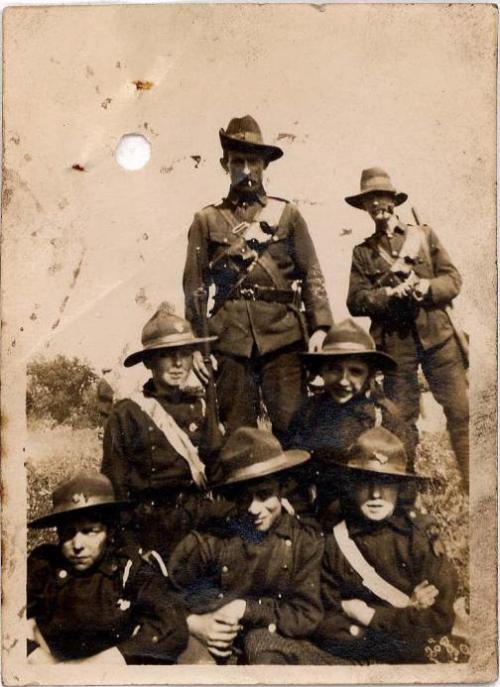
A noticeable feature of nationalist uniforms and dress at the time was the ever-present slouch hat, modeled on that of the Boers, whose fight in the Second Boer War had captivated nationalist Ireland. The first advertisement at the top of this post references “the famous Boer hat.” In Ireland, the slouch hat of the Boers became popularly known as the ‘Cronje’, a nod towards Piet Cronjé, a Boer General of the conflict.

A slouch hat on display. " John Kelly of the Irish Citizen Army (back centre), and what appears to be young ICA scouts at the front." (Image via the excellent: https://fiannaeireannhistory.wordpress.com/)

A slouch hat on display. ” John Kelly of the Irish Citizen Army (back centre), and what appears to be young ICA scouts at the front.” (Image via the excellent: https://fiannaeireannhistory.wordpress.com/)

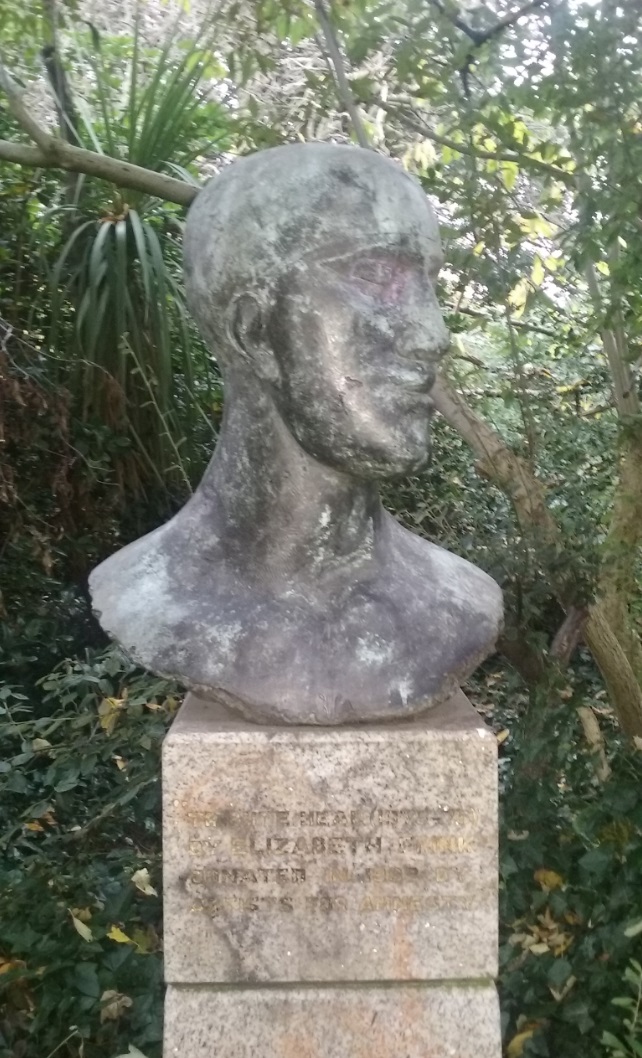
On 26 June 1983, about 1,500 people gathered in Merrion Square to see the Lord Mayor of Dublin, Dan Browne, unveil the bronze artwork ‘Tribute Head’ in honour of Nelson Mandela,then the imprisoned leader of the African National Congress. Seamus Heaney read fitting poetry, and The Chieftains performed before the crowd which included Kadar Asmal of the Anti-Apartheid Movement and Sean MacBride, a founding member of Amnesty International. The Chief Representative of the ANC in Britain and Ireland,Ruth Mompati, outlined her belief that “this gesture would give the South African people courage to carry on for the liberation of their country.”

'Tribute Head', The Irish Times.

‘Tribute Head’, The Irish Times.

The bust in Merrion Square was the work of Elisabeth Frink, who had donated the piece inspired by Nelson Mandela to ‘Artists for Amnesty’, who sought a home for it in Dublin. Frink, born in Suffolk in 1930, became a highly respected sculptor in her lifetime, and as an obituary in the Independent noted at the time of her passing:

In 1975, she made a monumental group of four male heads, with closed eyes and clearly modelled, serene features. These were the Tribute heads…’In a sense, these sculptures are a tribute to Amnesty International,’ the sculptor said. ‘The heads represent the inhumanity of man – they are the heads of victims.’ A more recent pair of monumental heads is called In Memoriam, with eyes open, and are an extension of the same theme: people who have been tortured for their beliefs.

Frink beside two of her 'Tribute Heads'. (Image Credit: http://www.artcornwall.org/features/Elizabeth_Frink_archive_at_Sherborne_House.htm )

Frink beside two of her ‘Tribute Heads’. (Image Credit: http://www.artcornwall.org/features/Elizabeth_Frink_archive_at_Sherborne_House.htm )

The artist Fiona Robinson has praised the Tribute Heads, stating that “these heads are majestic. They epitomise Elisabeth Frink at her best, the visual realisation of profound emotion.” At the time of the unveiling of the Tribute Head in Dublin,Mandela was in his twenty-fourth year of imprisonment. The following year, while he was still a prisoner, the decision was made to award the Freedom of the City to the ANC activist and leader. In 1990, Mandela did come to Ireland to accept the honour.

The arrival of the artwork in Merrion Square (Dublin City Public Libraries, http://www.dublincity.ie/main-menu-services-recreation-culture/dublin-city-public-libraries-and-archive )

The arrival of Frink’s work in Merrion Square (Dublin City Public Libraries, http://www.dublincity.ie/main-menu-services-recreation-culture/dublin-city-public-libraries-and-archive )

When Mandela was released from prison, the Tribute Head became the location for a gathering of hundreds in celebration. Gary Kilgallen of the Irish Anti-Apartheid Movement told the crowd that “Nelson Mandela is already a freeman of Dublin – now he is a freeman of the world.”The trade unionist Donal Nevin called Mandela “the noblest felon of our time”, while tribute was also paid to the brave Dunne Stories workers who had refused to handle goods from Apartheid South Africa. When Nelson Mandela came to Dublin only months after his release from prison, he made time to meet with the Dunnes strikers. He was presented with a picture of the Birmingham Six by artist Robert Ballagh.

Today, Frink’s piece remains in Merrion Square, though time hasn’t been kind and its inscription is near impossible to read.It could do with a little TLC, but it remains standing, a reminder of a small act of solidarity with Nelson Mandela and the ANC during their long struggle.

'Tribute Head' - Merrion Square today.

‘Tribute Head’ – Merrion Square today.

Poppy-snatching in Dublin.

Advertisement for an anti-Poppy Day demonstration, November 1933.

Advertisement for an anti-Poppy Day demonstration, November 1933.

In the Dublin of the 1920s and 30s, the selling of the Flanders poppy was commonplace. Every year the British Legion would open ‘Poppy Depots’ in the city, and beyond it in places like Rathmines, and every year without fail the presence of the symbol on the streets of Dublin was enough to instigate violence. Hand-to-hand fighting, flag burning and even attempted arson on poppy depots pop up in the newspaper archives from the period.

The poppy was formally launched in Ireland by the British Legion in October 1925, though it had been sold on the streets for years before that. The selling of the poppy brought in huge revenue to the body. In March 1930, at the annual conference of the British Legion in Dublin, it was claimed that Poppy Day had raised £487,272 in the year gone, against £469,215 the year previous. These were very significant figures, but the organisation existed for a variety of reasons beyond commemoration. At that same conference, A.P Connolly of the Legion bemoaned the fact that tens of thousands of WWI veterans were in dire need of housing assistance.

The Irish Times wrote in October 1925 that:

The sale of poppies benefits disabled ex Service men who are engaged throughout the year in making them, and also a large number of deserving ex-Service men who are assisted out of the profits. The men employed in manufacturing the emblems are badly disabled men who would stand small chance in the ordinary labour market.

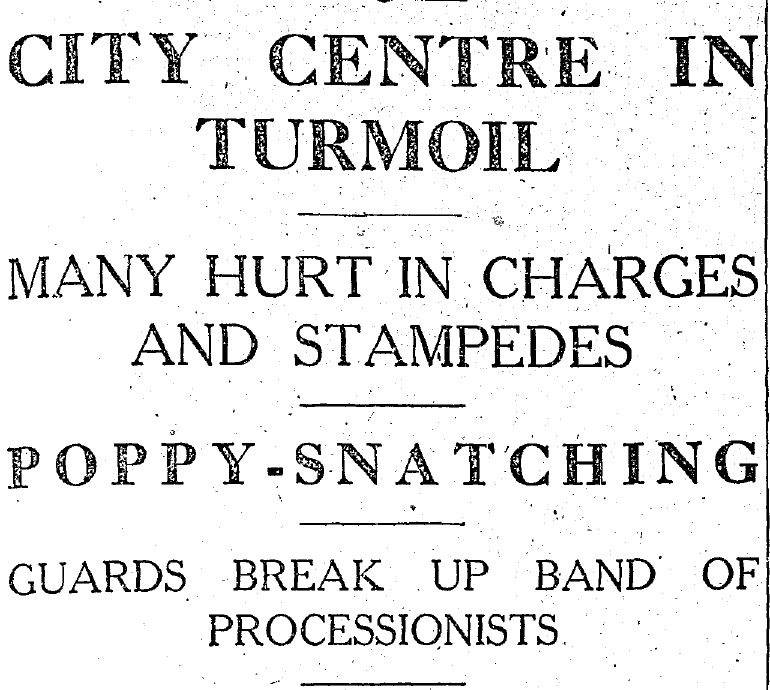
'City Centre in Turmoil' - The Irish Press reports on Armistice Day, 1932.

‘City Centre in Turmoil’ – The Irish Press reports on Armistice Day, 1932.

Much of the opposition to Armistice Day, or ‘Poppy Day’, was instigated by republican activists, many with an IRA background. Indeed, during the revolutionary period itself,Armistice Day had been opposed by the IRA, who had considered taking very drastic action against it. George Joseph Dwyer, a member of the Dublin Brigade of the IRA, remembered in his statement to the Bureau of Military History that:

An Armistice parade was held in Dublin in the year 1919 to commemorate the entry of the Allies into the Great War. We paraded under arms and took up positions in Dame Street and George’s Street. We were to open fire on the parade but at the last moment this instruction was cancelled. On our way home we observed a camera man who had taken pictures of the parade. We took the camera off him and destroyed it.

Organisations in the late 1920s and early 1930s like the ‘League Against Imperialism’ drew heavily from the ranks of the IRA, while Eamon de Valera also addressed an anti-Armistice Day rally in 1930, in the capacity of Fianna Fáil leader. On that occasion, Dev shared a platform with IRA radicals Peadar O’Donnell and Frank Ryan, as well as Sean Murray of the Communist Party of Ireland and Sean MacBride. On the eve of Remembrance Sunday, he claimed that if Ireland were free “there would be no such a thing as the demonstration we will see tomorrow.” He went on to state that those opposed to the day “were not unmindful of the comrades who were anxious to honour the memory of their dead companions. But objection was being – and properly – taken to those who on each Armistice Day took the opportunity of indulging in a flagrant display of British Imperialism.” Two Union flags were burnt at the conclusion of the meeting. It is not surprising that after coming to power in 1932, Fianna Fáil representatives largely stayed away from such gatherings.

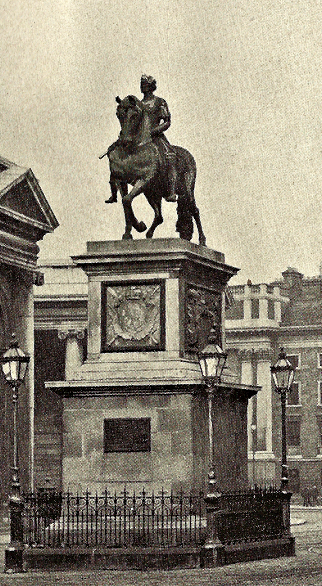
The statue of King William of Orange,College Green. It was bombed on Armistice Day, 1928.

The statue of King William of Orange,College Green. It was bombed on Armistice Day, 1928.

‘Poppy-snatching’ became something of a sport in Dublin. In 1926, it was reported that as ex-Servicemen were passing the junction of D’Olier and Westmoreland Street as they paraded through the city, “a crowd of between 200 and 300 men and boys, also marching in military formation, came from the direction of Westmoreland Street and headed as if to cut straight across the process ion, their leaders shouting ‘Here we are again’ and ‘Up the Republic!'” Poppies were grabbed from lapels and trampled. The Irish Times reported that “there were many motor cars in the city..decorated with poppies and Union Jacks. When some of these cars came to a stand-still the decorations were torn off the bonnets.”

In 1932, Gardaí “drew revolvers and fired about half-a-dozen shots” over the heads of crowd who threw stones at poppy depots and snatched poppies. Windows were smashed at businesses who sold the emblems. The poppy depot on Dawson Street was often targeted, once even for arson. Kathleen Kavanagh, a 27-year-old from Dorset Street, was sentenced to six months imprisonment in 1926 for “conspiring to set fire to the premises 2 Dawson Street; with having poured petrol on a flag and table, and set them on fire; and with endangering the lives of a number of persons who were on the premises in connection with the sale of poppies.” Beyond arson, there were some other notable interventions. Todd Andrews, a republican veteran of the Civil War who was then a student in UCD at Earlsfort Terrace, remembered that on one year the 11 November commemorations occurred beside the University, and that “when the order was given for the traditional two minutes’ silence smoke and stink bombs exploded in all directions. Mutual abuse and poppy snatching led to scuffles and fistfights until eventually the students withdrew inside the college.”

1930s advertisement for Dublin poppy depots.

1930s advertisement for Dublin poppy depots.

The numbers participating in the ‘anti-imperialist’ events could grow to thousands, but there were also tens of thousands partaking in the British Legion events. In laying out the workload of the Legion, A.P Connolly stated in November 1930 that “there were still 142,000 war widows, 35,000 officers and men who had lost a leg or an arm in the war, 6,450 officers and men who are insane and have been detained in lunatic asylums.” Giving the sheer scale of recruitment in Ireland during the war, not least from working class areas, the numbers taking part in remembering that war two decades later isn’t all that surprising. On the other side, the Irish Independent claimed in 1932 that “a procession of about 2,000 young men” caused trouble in the city, and that “all wore green, white and yellow favours; inscribed with the legend ‘Boycott British Goods.'” The paper claimed that the boys sang and chanted that “we’ll crown de Valera King of Ireland” and shouted “no poppies in this city.” At Trinity College, they sang The Soldier’s Song, but the reply from within the gates was Rule Britannia! The annual singing of God Save The King by Trinity College Dublin at College Green was seen by republicans as a provocative act, but Trinity students were more than willing to stand their ground and it took huge numbers of police to separate the two sides. League Against Imperialism demonstrations could mobilise crowds of 10,000 to 15,000 at College Green.

Marching to the Pro Cathedral, November 1930. Remembrance services occurred in both St. Patrick's Cathedral and the Catholic Pro Cathedral.

Marching to the Pro Cathedral, November 1930. Remembrance services occurred in both St. Patrick’s Cathedral and the Catholic Pro Cathedral.

Poppy Day didn’t only annoy republicans, it also troubled the authorities. Writing to the Garda Commissioner Eoin O’Duffy, Colonel Neligan outlined a belief in 1928 that the commemorations were becoming “the excuse for a regular military field day for these persons…if the irregulars (a reference to the IRA) adopted these tactics they would be arrested under the Treasonable Offences Act.” The presence of uniformed British Fascisti members was also highlighted in the press, and troubled Gardaí. Attempts were made by the authorities to introduce restrictions on the emblems and flags on display on Poppy Day, in the hope it would reduce some of the tensions.

'The Anti-Imperialist', which appeared on the streets of Dublin on the eve of Armistice Day in 1926 (National Library of Ireland, http://catalogue.nli.ie/Record/vtls000511068)

‘The Anti-Imperialist’, which appeared on the streets of Dublin on the eve of Armistice Day in 1926 (National Library of Ireland, http://catalogue.nli.ie/Record/vtls000511068)

Continue Reading »