Feeds:
Posts
Comments

Rock against the Referendum 1982

Great find from the Irish Student Movement Research Project who originally uploaded the scanned document onto their Flickr page.

It’s a poster for three benefit gigs in September/October 1982 in aid of the Anti-Amendment Campaign. This wide reaching group unsuccessfully fought against the Eighth Amendment which introduced a constitutional ban on abortion in Ireland. Thirty-two years later and we are unfortunately still fighting to repeal it.

Anti-Amendment Music - Rock against the Referendum (1983). Uploaded by Student History Ireland Project.

Anti-Amendment Music – Rock against the Referendum (1982). Uploaded by Student History Ireland Project.

The leaflet indicated that the ‘Anti Amendment Music’ sub-group had the support of many of the country’s leading musical acts including Bob Geldof, Paul Brady, Christy Moore and the Tokyo Olympics.

Ringsend’s finest The Blades also backed the fight and played a benefit gig for the campaign in September 1982. They, along with the Rhythm Kings and Some Kind of Wonderful, headlined the annual The Lark in the Park concert in Saint Anne’s Park in Raheny in July 1983. Illustrating the point well that these ‘on side’ bands were really at the top of their game when they helped the campaign out.

The poster offers an interesting snapshot into the Dublin music scene of a time featuring some of the leading gigging bands in three iconic venues. The first of which is now demolished, the second one completely unrecognisable and the last renamed.

On 30th September 1982, Dublin funky reggae band Some Kind of Wonderful headlined the first gig in McGonagles (now demolished) on South Anne Street off Grafton Street. Support came from Max (featuring former members of the Soulmates and the New Versions) and pop music luminary BP Fallon. Other enticements to get punters through the door included food, wine and “video” (!)

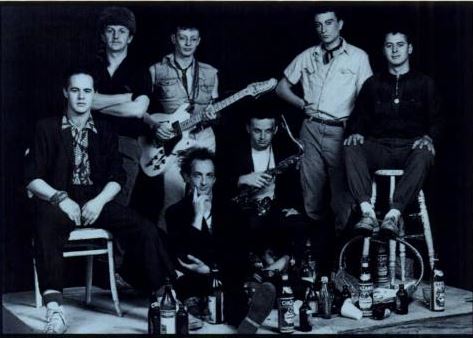
Some Kind of Wonderful (nd). From 'U2: Into the Heart: The Stories Behind Every Song' by Niall Stokes (2005)

Some Kind of Wonderful (nd). From ‘U2: Into the Heart: The Stories Behind Every Song’ by Niall Stokes (2005)

On 9th October 1982, pub-rock group the Rhythm Kings featuring Ferdia MacAnna (aka Rocky de Valera) played The Baggot Inn. The venue, which along with McGonagles was a crucial cornerstone in the Dublin live music scene for decades, has been completely refurbished and was reopened recently as a Mexican-themed bar called Xico.

On 14th Octobe 1982r, stand-up comedian Billy Magra hosted a night in The Sportman’s Inn (now known as Kiely’s) in Mount Merrion. The Club Comedy nights, along with others that Billy ran in the Project Arts Centre and the Mansion House, helped develop the live stand up comedy scene in Dublin and played host to amongst others the late Dermot Morgan, Kevin McAleer, Michael Redmond, Ian MacPherson and Mannix Flynn (today an independent Dublin City Councillor).

If anyone has any more posters from ‘Anti Amendment Music’ gigs or related memories, please get in touch or leave a comment.

Early Houses of Dublin (2015)

(This was originally featured on our Facebook page which may have been missed by some of our readers. It was hugely successful with 372 likes, 60 comments and 114 shares)

There are close to 1,000 pubs open today in Dublin city and county. Of these, around 12 are part of an exclusive club. Known as Early Houses, these are public houses that were granted and still avail of a special licence (dating back to 1927) which allows them to open from Monday to Saturday at 7am. Regular pubs can start serving from 10.30am.

We’ve previously looked at the all-hours drinking culture of Bona-Fides, Kips and Early Houses in this article.

Originally these places catered for dock workers, market traders, fishermen, night workers and those attending early-morning fairs. Today the clientele is a little more varied and depending on where you go, you are likely to rub shoulders with wired shift-workers (postmen, nurses etc.), thirsty early risers, tourists who have landed into Dublin early and all-night revellers who have no intention of going to bed yet.

Brand New Retro recently scanned up a hilarious 2003 article on Early Houses from the legendary and must missed Slate magazine.

The Chancery featured in The Slate (2003). Scanned by Brand New Retro.

The Chancery featured in The Slate (2003). Scanned by Brand New Retro.

Since 1962, no new pubs have been added to the list and they are considered a dying breed. In 2008, the government put forward legislation to revoke Early House licences but they eventually decided to leave them as they are. For the time being anyway.

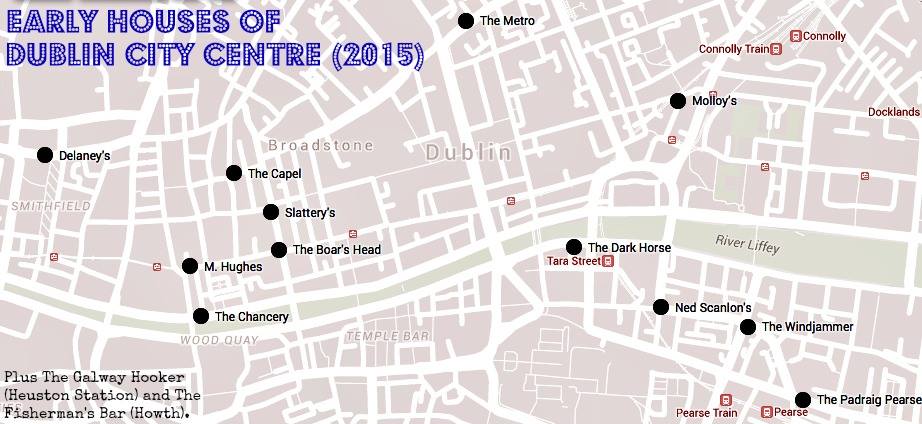
The 12 Early Houses left in the city centre are clustered on the Northside around Capel Street close to the old Markets and on the Southside around the Quays and Pearse Street area which would have the ports of call for dockers and sailors. See map below.

The Fisherman’s Bar, attached to The Waterside pub, in the Northside coastal village of Howth is the only early house in the Dublin suburbs as far as we know. There were early houses in Dun Laoghaire and in Bray Dart Station but they’ve since closed their doors.

Slattery’s on Capel Street is the only one that offers food and is unquestionably the place to go if you want a Full Irish breakfast and a pint at 7am.

The Dark Horse (which hosts a monthly ‘Breakfast Club’  for early morning ravers), The Chancery and The Capel are the most popular spots for the mad-out-of-it crew.

M. Hughes, due to its location, probably attracts more members of the legal profession than the other pubs.

Similarly the Galway Hooker in Heuston Station would be the natural spot for a thirsty traveller before he jumps on an early-morning train.

The rest of the pubs would normally be full of locals and regulars so a better place if you are looking for a quiet early morning pint but they probably won’t be too hospitable to Ebenezer Goode and a large group of his mates.

We’ve put together this handy map for locals and tourists who might find themselves looking for an early morning tipple :

Map of Dublin Early Houses. Credit - Sam (CHTM!)

Map of Dublin Early Houses. Credit – Sam (CHTM!)

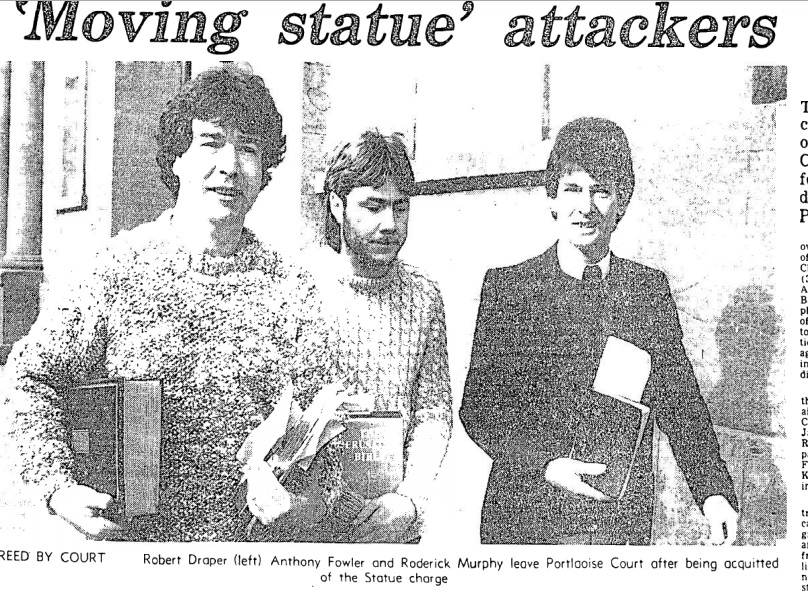
Thirty years ago in 1985, Ireland was gripped by the summer of moving statues. From Ballinspittle in County Cork to suburban Dublin, people gathered at religious monuments in the hope or belief that they would witness statues physically moving before their very eyes. While this story is well-known now, one aspect of the story has largely been forgotten. At Ballinspittle, where huge crowds and sections of the international media gathered over several months, the monument of the Virgin Mary was attacked with axes and hammers by a fundamentalist religious group from Dublin, leading to a high-profile court case, media appearances and a few broken windows in Clondalkin (more on that below!)

Irish Press (5 May 1986)

Irish Press (5 May 1986)

1985 in Ireland is perhaps best remembered for the signing of the Anglo-Irish Agreement at Hillsborough, as a year of much violence in the North and for the founding of the Progressive Democrats by Des O’Malley in the South. For many reading this however, it is perhaps a year best remembered for standing at roadsides and roundabouts.

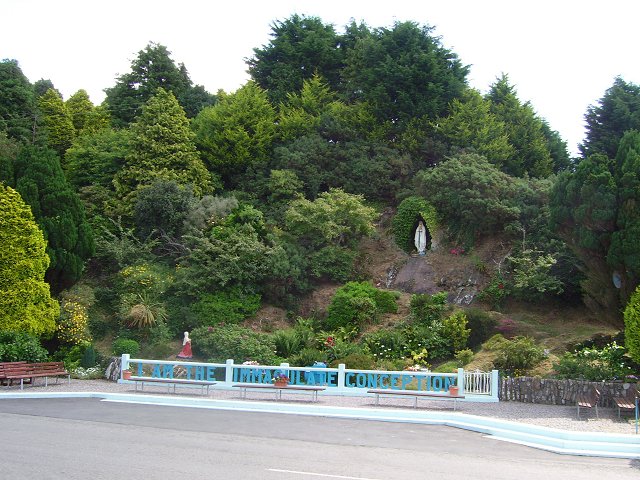
Ballinspittle in Co. Cork, the centre of much of the media attention in 1985. (Image: Copyright Richard Webb and licensed for reuse under this Creative Commons Licence, via www.geograph.ie)

Ballinspittle in Co. Cork, the centre of much of the media attention in 1985. (Image: Copyright Richard Webb and licensed for reuse under this Creative Commons Licence, via http://www.geograph.ie)

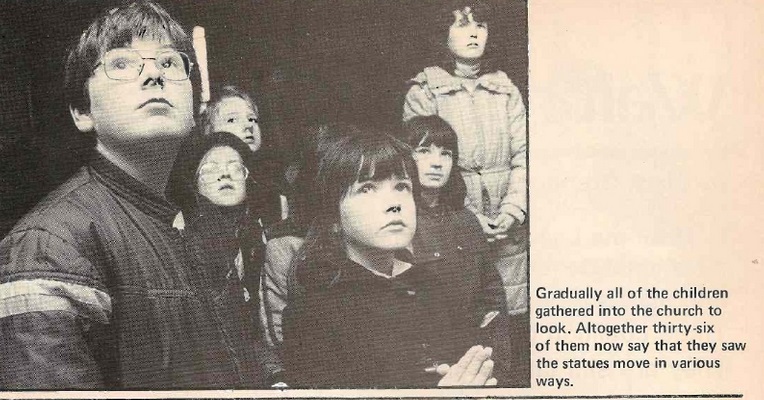
Ballinspittle, about 5 miles southwest of Kinsale, was to find its way into the pages of the New York Times and papers right across the world as a result of events there in July 1985. The first reports in the Irish media began to appear around 26 July, with reports of two local women claiming to have seen the statue of the Virgin Mary in the town moving, at a shrine that had been there since the 1950s. What was interesting is that the local Parish priest was in no hurry to endorse the claims being made, remarking that he had no comment to make. From small groups of local people, word spread throughout Munster in particular, and by 31 July the press were reporting that 5,000 people had shown up at the monument on a single night. The media jumped on all of this, but there had been claims earlier in the year, by schoolchildren in Kerry, that they had witnessed a Marian statue in their local church move. Fintan O’Toole, as a journalist with Magill, travelled to Kerry and interviewed some of those who had claimed to witness the Marian statue there moving, in a feature which was published before events at Ballinspittle. Now however, with what was allegedly happening in Cork, people took those claims more seriously too and this was seen as a chain of events.

Magill reports on the claims of a moving statue in Kerry. (Source: http://politico.ie/magazine/magill/1985-05-16)

Magill reports on the claims of a moving statue in Kerry. (Source: http://politico.ie/magazine/magill/1985-05-16)

The Bishop of Cork, Michael Murphy, issued a statement informing people that “direct supernatural intervention is a very rare happening in life, so common sense would demand that we approach the claims made concerning the grotto at Ballinspittle with prudence and caution. Before a definite pronouncement could be made by the Church all natural explanations would have to be examined and exhausted over a lengthy period of time.” This approach was similar to that which had been taken in Kerry by the church.

For the local economy at Ballinspittle, The Irish Times reported that “the shops and the two local pubs have been given an unexpected boost in an otherwise quiet tourist season.” One woman wrote to the newspapers noting that bus companies seemed to be making a killing bringing the curious and the faithful from right across Ireland, while it was reported one man got a telling off from the gathered crowd for opening his chip van directly opposite the shrine, something one journalist noted was found to be “unsuitable to the solemn nature of the occasion.” A local told a visiting American journalist that “Knock spawned souvenir shops and a partially-completed airport, why can’t we do the same?”

The story made the pages of the Wall Street Journal, and the paper quoted the Government press secretary Peter Prendergast as saying “three-quarters of the country is laughing heartily. In Dublin, the citizens are anxiously watching James Larkin on O’Connell Street to see if it will move.” The BBC sent a reporter from Newsnight (above) and a team of cameramen to Ireland. In the weeks that followed, people began claiming that similar scenes were occurring at shrines at Dunmanway and Courtmacsherry, while in Kilkenny, there were reports of over half a dozen locations where statues were ‘moving’, and there too the church urged caution and scepticism. There was an academic intervention from staff at the Department of Applied Psychology in UCC, who claimed that “people sway when standing still for a period of time and what they are looking at appears to move.” They called it the ‘Ballinspittle Phenomenon’. They claimed that it was an issue of light, as “the statue appeared to move only when it is dark.” In the North, Unionist Jim Wells of the DUP told the media that:

We find much of Roman Catholic doctrine repugnant… [we find it repugnant] that the Virgin Mary is regarded as a deity that can be prayed to, who can forgive sins and heal the sick and all that, that shrines which can supposedly move in Ballinspittle or wherever it is can delude thousands into believing that there are some magical powers. That is superstition of almost African tribal levels.

"Moving Statue No. 76." A cartoon from Freedom News, a radical newspaper in Cork at the time. (Credit: Irish Left Archive, https://cedarlounge.files.wordpress.com/2008/11/freedom-news-cork-irsp-october-1985.pdf)

“Moving Statue No. 76.” A cartoon from Freedom News, a radical newspaper in Cork at the time. (Credit: Irish Left Archive, https://cedarlounge.files.wordpress.com/2008/11/freedom-news-cork-irsp-october-1985.pdf)

Continue Reading »

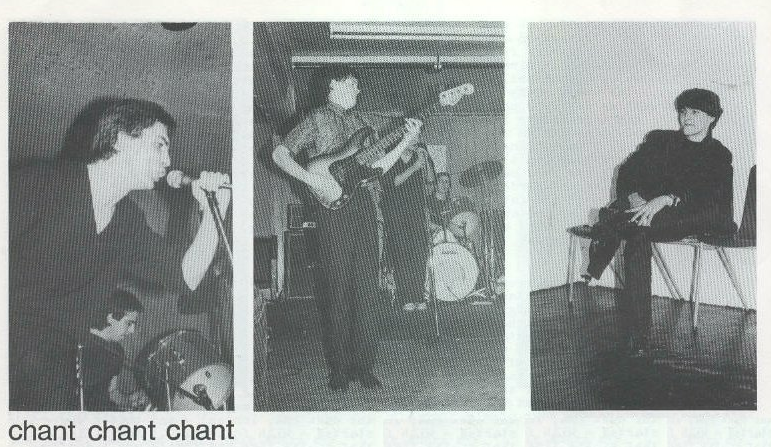
Chant! Chant! Chant! via irishrock.org

Chant! Chant! Chant! via irishrock.org

Chant! Chant! Chant! were one of the most original and exciting bands to hit Dublin’s post-punk music scene. Active from 1979 to 1982, they played a jilting sort of New Wave that would find a natural home amongst your Talking Heads, Wire, Gang of Four and XTC records.

The line up was Eoin Freeney (vocals), Robbie Wogan (bass), Larry Murphy (drums) [ex. The Threat] and Paul ‘Mono’ Monohan (drums) [ex. The Threat]

Journalist Liam Mackey reviewing the band in the Project Arts Centre(26 June 1980), on the same set as Derry’s The Moondogs and Cork’s Nun Attax, wrote:

Chant! Chant! Chant! offer glimpses of what the embryonic Talking Heads must have been like struggling to create coherent music out of all those bubbling, half realised ideas in a New York loft way back when. They’ve got something of the dark pulse of Joy Division too and their methodology – songs constructed around the startling bass runs of Larry Murphy – has a precedent in the work of the Public Image chaps…

Their recorded legacy is sparse with only a track (‘What do you know’) on The Boddis EP (1980) also featuring Big Self, Departure and the peridots ; one hard-to-find single (Quicksand/Play Safe) on DIY label Peig the Man from July 1981 and a 3-track live recording (Ballet no.1/Forty one/Say so) on the Dave Fanning Rock Show Session from the same month.

Self-described ‘writer, hack and music fan’ John Fleming has written a special account for CHTM! on the band’s 2013 reunion gig and their impact first time around when the band were a “dark force to be reckoned with.”

Grand Social, 2013

A few numbers in, it starts to flow: Quicksand. It’s May 2013 and Chant! Chant! Chant! are back on stage after 31 years. Five hundred people bought their record in 1981 on the Peig The Man label: Quicksand with its B-side Play Safe. Having been zapped through a time warp, Chant! Chant! Chant! play tightly, a gang of now older mates but still as thick as thieves. Nostalgia for lost moments is pulverised. Singer Eoin Freeney thanks the crowd, joking about this one-off reunion concert at the Grand Social venue in Dublin. “At this rate, our next gig will be in 2043,” he says. “So… See you then.” The ageing audience share the wistful smiles of mere mortals.
 
Chant! Chant! Chant! – each word followed by an exclamation mark – are temporarily back. It is the start of summer 2013 and they have returned through time’s thick ether, magnificently but momentarily. They take the stage. The lads stand nervously. The frontman’s cool, leopard-print shirt inspires the confidence they all badly need. Some conceptual music floods from the speakers. Edgy smiles fade away. Slow seconds crawl. The tape ends. The drums, the bass and the guitar crank into machine mode and Chant! Chant! Chant! begin to play. The singer stays motionless, beaming himself back from 1981 as the magical wall of sound builds behind him and he gets into character. Two camera guys dart back and forth, capturing the event with digital technology, training 21st-century lenses on every second of the legendary Dublin band’s return. (Some of these videos have now at last been posted on YouTube.)
 
Lead singer Eoin Freeney in action in 2013 in the Grand Social. Image via Youtube.

Lead singer Eoin Freeney in action in 2013 in the Grand Social. Image via Youtube.

Tune after tune bleeds out. 41. What Do You Know. Play Safe. Chant! Chant! Chant! were Dublin’s Factory band that never was. A mesh of punk and funk, they stalked the same world that produced A Certain Ratio, XTC, Wire, Gang of Four, Pil and Josef K in late 1970s Britain.
Dublin, early 1980s
The wonderful Quicksand sucks you down. Down along the damp and gritty trajectory of the last three decades. Back to Dublin of 1980 and 1981 and 1982, when this city was the small-scale capital of limited opportunity. The scratchy guitar and huge slabs of bass swirl the audience back through time like agents of Adam Eterno. They bring us to the Judge and Jury on Bolton Street, to the Ivy Rooms on Parnell Street, and, aaaah yes… remember the Magnet on Pearse Street? Nascent stars of a small firmament that will soon peter out are queuing for pints between sets – there’s the boys from Amuse who would yield Blue in Heaven and Backwards Into Paradise. There’s The End who would spawn Something Happens and a certain radio host. There’s Meelah 18 who would become Aslan, there’s The Blades, a support band Microdisney and The Atrix who will live forever.
 
It’s the summer of 1981. The gigs were full of snapped guitar strings (Cormac Wright, The End), bass drums bursting (Johnnie Bonny, also of The End) and the singer of A Further Room belting out their single Psychedelia Disco as he dangled from one arm, his fist clenched on a beam that just might break. But Chant! Chant! Chant! had the best musical mishap: a sound desk exploded. After three short tunes in the Judge and Jury that summer, electricity had the last laugh. The plug was pulled: the show was over. A noble decision to give refunds was taken, and fists of 50-pence pieces were handed back to 80 or 90 disappointed fans.
Band members and the future
 
“That was Robby who gave you your cash back all those years ago,” said drummer Paul “Mono” Monahan, three decades later at the reunion gig. “There were so many on the guest list that night we gave out more money than we took in.” That one-off gig was short and sharp too, a lesson in post-punk art economy. And the music? It transcended memory’s distortion: despite the obscurity of the endeavour, some of us knew what we were at back then.
Chant! Chant! Chant!,  1980

Chant! Chant! Chant!, 1980

 
Larry Murphy was the god of the band’s pulsing bass. He still is now, and lives in Spain. Mono had pre-gig butterflies but was delighted his offspring got to see his old man’s crew were cool. Guitarist Robby Wogan lives in England: he was relieved to be going back this time without having to give any more cost-ineffective cash refunds. And singer Eoin Freeney looked like one of the happiest inhabitants of the planet tonight, leading his team of elegant 1970s/1980s men through the matrix of music and memory.
 
Due to geography, rehearsals posed logistical challenges. But over the course of 10 European months, the fiftysomething year olds all dug in. They disinterred their sturdy tunes and collective identity. Just as they might have sunk down forever into the Quicksand of culture, they dragged themselves back out in May 2013.
Will Chant! Chant! Chant! ever play another reunion gig? “No!” the men chorused. But packing their instruments away, they seemed less certain.

Fore more information on the band’s history, check out their entry at Irishrock.org and U2theearlydayz.com. Two great resources. Also this brilliant interview with singer Eoin from Thumped.com (2013)

For more CHTM! pieces on music history, check out this link.

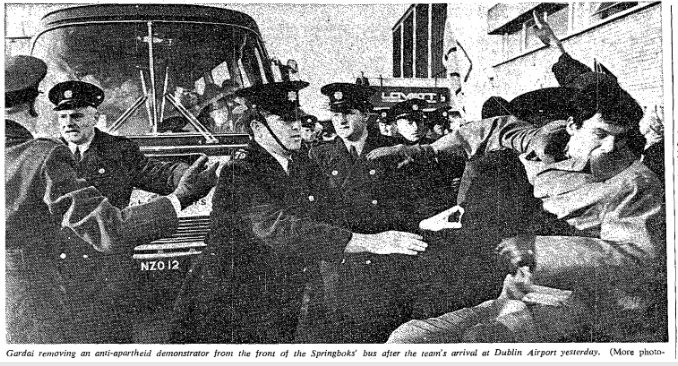
The world of politics and the world of sport have been known to collide from time to time in Ireland. In 1952 for example, Archbishop John Charles MacQuaid urged the football loving people of the capital not to attend an international friendly in Dalymount Park which saw Ireland take on communist Yugoslavia. Sporting stadiums have been used as venues in which to stage political protests too, with political banners appearing on the terraces of Croke Park during the Troubles. One particularly interesting moment in the history of controversial sporting clashes in Dublin concerns the sport of rugby, and the visit of the Springbok team to Dublin in 1970. All all-white team from South Africa, the team were seen by some to be the embodiment of Apartheid South Africa, and their tour of Britain and Ireland in 1969/1970 attracted huge protest. While the Springbok team did play in Lansdowne Road in January 1970, the game occurred behind barbed wire fencing and in front of a small attendance.

Gardaí drag protestors away from the Springboks tour bus at Dublin Airport, January 1970 (The Irish Times)

Gardaí drag protestors away from the Springboks tour bus at Dublin Airport, January 1970 (The Irish Times)

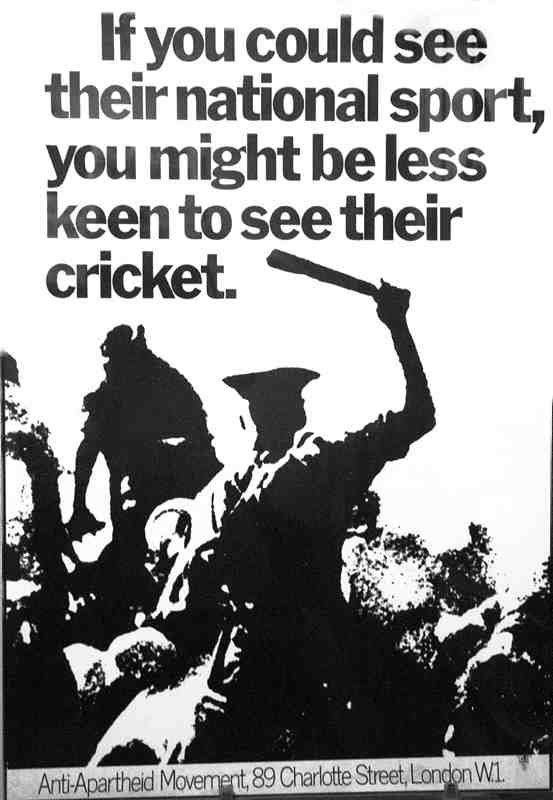
The Boks arrived in Ireland in January 1970 having completed a two month tour of Britain, a tour which had witnessed considerable scenes of protest. Opposition to their tour of Britain extended beyond anti-apartheid campaigners however, many sporting bodies and figures opposed the visit because of what was then a recent bitter memory. Two years prior to the visit of South Africa to Britain and Ireland to play rugby, in 1967, there had been shock in British sporting circles when the Apartheid government announced that they would not allow Basil D’Oliveria, a South African cricketer who played for England, to take part in England’s cricket tour of South Africa. The potential inclusion of a non-white cricketer in the team caused something of a diplomatic incident, with some senior South African figures suggesting it was a move designed to cause political embarrassment, and in the end the tour was actually cancelled. In Britain, questions around the relationship between sport and apartheid were being asked even before this rugby tour.

A poster from the British movement against Apartheid produced at the time of the cricket controversy. Via:  http://africainwords.com/2014/04/28/forward-to-freedom-anti-apartheid-movement-1959-1994/)

A poster from the British movement against Apartheid produced at the time of the cricket controversy. Via: http://africainwords.com/2014/04/28/forward-to-freedom-anti-apartheid-movement-1959-1994/)

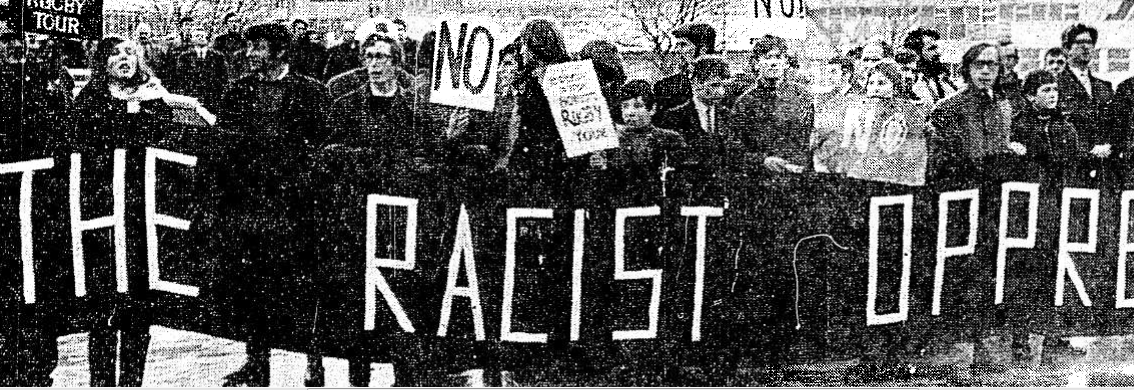
When the Springbok rugby team arrived in Britain in the winter of 1969, they faced very real protests in a number of cities. Brian Hanley has written that during December 1969 “there were 98 arrests when the Springbok side played in Aberdeen, 69 during their visit to Manchester, 26 at Murrayfield and more serious disturbances in which several policemen were injured during their game against England at Twickinham.” A young Gordon Brown, future Prime Minister of Britain, was one of the Edinburgh organisers of the opposition to the visit.

Demonstrating in Dublin against the visit of the South African rugby team (Irish Press)

Demonstrating in Dublin against the visit of the South African rugby team (Irish Press)

A particular cause of concern for the authorities was the North of Ireland, where the Civil Rights Association was gaining considerable ground and you had young and charismatic leaders like Bernadette Devlin, and where the side were due to play. One statement from People’s Democracy, with which Devlin was involved, stated that it was “no surprise that the corrupt and vicious Unionist clique admires racist South Africans.” This was a time of real heightened tensions in the North, and the authorities there were very fearful of just what could happen with the games becoming the focus of political disagreement. It was unsurprising that any visit by the team to the North was cancelled in the winter of 69, when The Joint Security Committee moved to cancel the planned match. One effect of that was turning up the pressure on the IRFU in Dublin – and there were demonstrations outside their headquarters demanding that the team not play in Dublin or Limerick as planned.

The IRFU found itself in a tough position. The organisation made its view clear, which was essentially that “cultural and sporting relations were the last links that should be broken with a country whose laws and policies incurred condemnation.” The Springbok team had actually visited Ireland only a few short years prior to 1970, and while many on the left and in the trade union movement had condemned their visit on that occasion,it had failed to spark the same level of public outcry as witnessed in 1970.

Irish Times frontpage prior to the visit.

Irish Times frontpage prior to the visit.

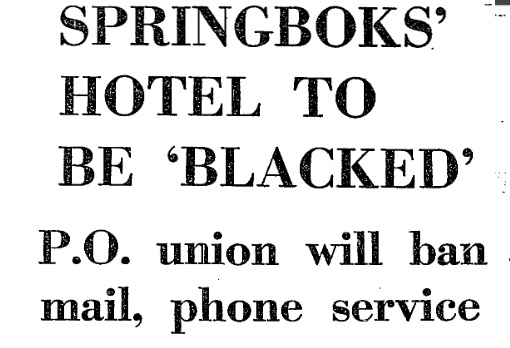
Even before the arrival of the team in Ireland, it was clear they would face organised opposition from the labour movement. In The Irish Times, an official from Post Office Official’s Association said “that if the Springboks’ headquarters hotel was known, all telephone and mail services to it would be withdrawn.” The official was quoted as saying “When we find out the hotel, we will give the telephone number to all exchanges and see that it is not serviced….Similiarly no mail will be delivered to the hotel. All other guests will be affected. The ban will last for the Springboks’ stay.” In addition to this, trade unionists in RTE were eager that the national broadcaster would not screen the match, and were adament they would not work on any transmission of the game.

When the team did arrive at Dublin Airport on 7 January 1970, they were greeted by dozens of anti-Apartheid activists in the airport itself, headed by Kader Asmal of the Irish Anti-Apartheid Movement, clutching tricolours and the flag of the ANC. The Irish Anti-Apartheid Movement had been founded in 1964, and as Diarmaid Ferriter has noted “by the early 1970s it had branches in almost all parts of Ireland. Its first chairman was Dublin barrister Ernest Wood, the honorary secretary was trade unionist and future Labour TD Barry Desmond, and its vice-chairman was Asmal, who had also been a founder member of the Anti-Apartheid Movement in London and had joined the staff of the Faculty of Law at Trinity College Dublin in 1963.” There had been protests against Apartheid in the city prior to the foundation of the IAAM, but it provided organisation and structure to the movement. Some of the earlier opposition to Apartheid here was led by members of the small South African community in Ireland, including those who were studying here. This helped in forging links with the student movement, who were to the fore in opposing the 1970 visit.

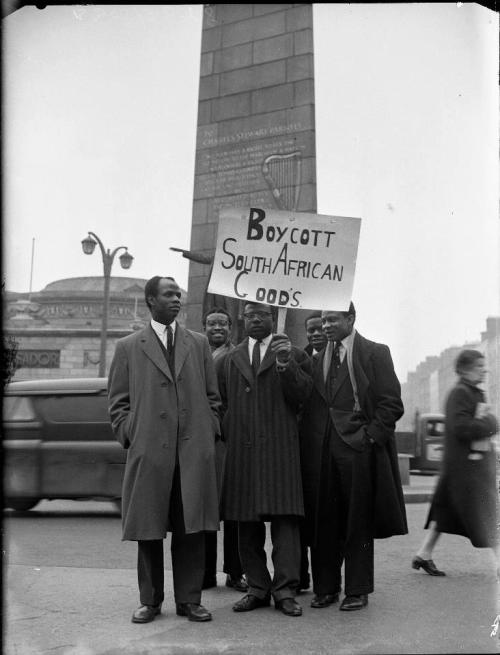
Calling for the boycott of South African goods in early 1960s Ireland. (Image: National Library of Ireland)

Calling for the boycott of South African goods in early 1960s Ireland. (Image: National Library of Ireland)

Continue Reading »

A plaque upon one of the Glasnevin watch towers. (Image: CHTM)

A plaque upon one of the Glasnevin watch towers. (Image: CHTM)

There are many to ways to make a living, and not all of them noble. A profitable enterprise for some in the eighteenth and early nineteenth centuries involved the physical digging up of freshly buried bodies, which could be sold to medical schools where they were in considerable demand. Far from being just the stuff of fanciful folklore, we have plenty of evidence that this was a real problem for the authorities in Ireland, in the form of newspaper reports of scuffles in cemeteries and unusual towers constructed in cemeteries with the aim of allowing ‘watchmen’ to catch any would-be thieves in the act.

Dublin was, in many ways, a city leading the way in the nineteenth century in the field of Medicine. As Gerard Maguire noted in the 1960s, “she was the first city to establish a guild of medical practitioners, first with the voluntary hospital, and first with the maternity hospital. The names of Graves, Stokes, Carmichael, Corrigan, Colles and Wilde, and the medical schools they are associated with, are familiar to every student of medicine and are as much respected today as they were then.”

The term of choice for those who engaged in this activity today is often ‘resurrectionists’, though in their day they were frequently known as ‘sack-em-ups’ here in Ireland. There was, of course, great educational importance in the bodies of the dead to those studying medicine, and for centuries the bodies of criminals had been dissected. Indeed, there was a Murder Act in the 1750s which noted that only corpses of executed murderers could be used for dissection. This was a fairly gruesome act, with the full title ‘An act for better preventing the horrid crime of murder’, and it actively encouraged “that some further terror and peculiar mark of infamy be added to the punishment”of those who murder others.

Resurrectionists (1847), by Hablot Knight Browne.  (Wiki)

Resurrectionists (1847), by Hablot Knight Browne. (Wiki)

As Rónán Gearóid Ó Domhnaill has noted by the nineteenth century “the number of people studying medicine had risen and demand far exceeded the supply, thus corpse robbing developed into a profitable business.” This greater demand for bodies meant that the focus was no longer strictly on the physical remains of dead criminals, but acquiring bodies of totally innocent people to meet the growing demand. Bodies were provided not alone to medical schools, such as the Royal College of Surgeons, but also to Trinity College Dublin. Removing a body from the ground frequently involved utilising a hook to pull the body from the coffin, having first smashed a hole into the wooden box. Early Dublin resurrectionists received only a guinea for a ‘subject’, but as the trade developed into something of a profession prices rose, with prices as high as £10 or even £20 secured on occasion. Bodies of children were frequently sold by the inch, while hair and teeth could be sold separately. As Gerard Maguire has written, owing to the strange legal situation at play, “a peculiarity of the profession was that if a resurrectionist was caught in the act of body-snatching he was brought to justice and charged only with stealing the shroud in which the body was wrapped. Hence, the professional sack-em-up always took the precaution of removing the shroud before carting the body off.” Christopher Dixon, who served as porter at the Royal College of Surgeons in Ireland in the early years of the nineteenth century, was caught in Bully’s Acre on one occasion by a mob and “after tying a rope around his waist the mob dragged him to the Liffey into which he was ducked repeatedly.” John T. Kirby, son of the President of the College of Surgeons, was reportedly killed by another such mob!

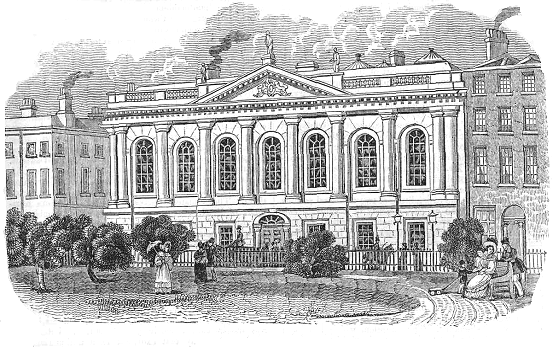
An 1830s illustration of the Royal College of Surgeons.  (Source: http://www.libraryireland.com/articles/royalcollegesurgeonsDPJ1-19/)

An 1830s illustration of the Royal College of Surgeons. (Source: http://www.libraryireland.com/articles/royalcollegesurgeonsDPJ1-19/)

There seems to have been a much greater degree of violence towards the ressurectionists in Dublin than in London, indeed the Professor of Anatomy in Trinity College Dublin, a Dr. Macartney, gave evidence before a Committee of the House of Commons in which he stated “the common people frequently of late have assaulted the Resurrection-men: one of these men died in consequence of a severe beating… I may add, that lately also, even medical men and medical students were assailed by the people, and that at present the Resurrectionery men go to a great number of graveyards, some distance from Dublin, provided with firearms, and are accompanied frequently by several students armed in the same manner.”

Sometimes, the resurrectionists didn’t even wait until the body was buried before making an attempt to acquire it. In 1831 a rather morbid account of bodysnatching in Dublin appeared in The Times newspaper:

On Friday evening last, about six o’clock, a party of resurrectionists rushed suddenly into a house in Bow Lane, where the corpse of an aged female, named Carrol, was being ‘waked’ by her friends and neighbours….and succeeded in possessing themselves of the body, which they bore off, before the persons present could offer any effectual resistance. The ruffians acted with the most revolting indecency, dragging the corpse in its death clothes after them through the mud in the street, and unfortunately baffled all pursuit. Information was shortly after given at College Street police office of the transaction, and an officer with some constables immediately visited the College of Surgeons. They were informed that the body had not been brought there, but they were not permitted to search. Several of the fellows engaged in this outrage are well-known resurrectionists, but though the police are acquainted with their haunts, strange to say that none of them have been apprehended yet.

Continue Reading »

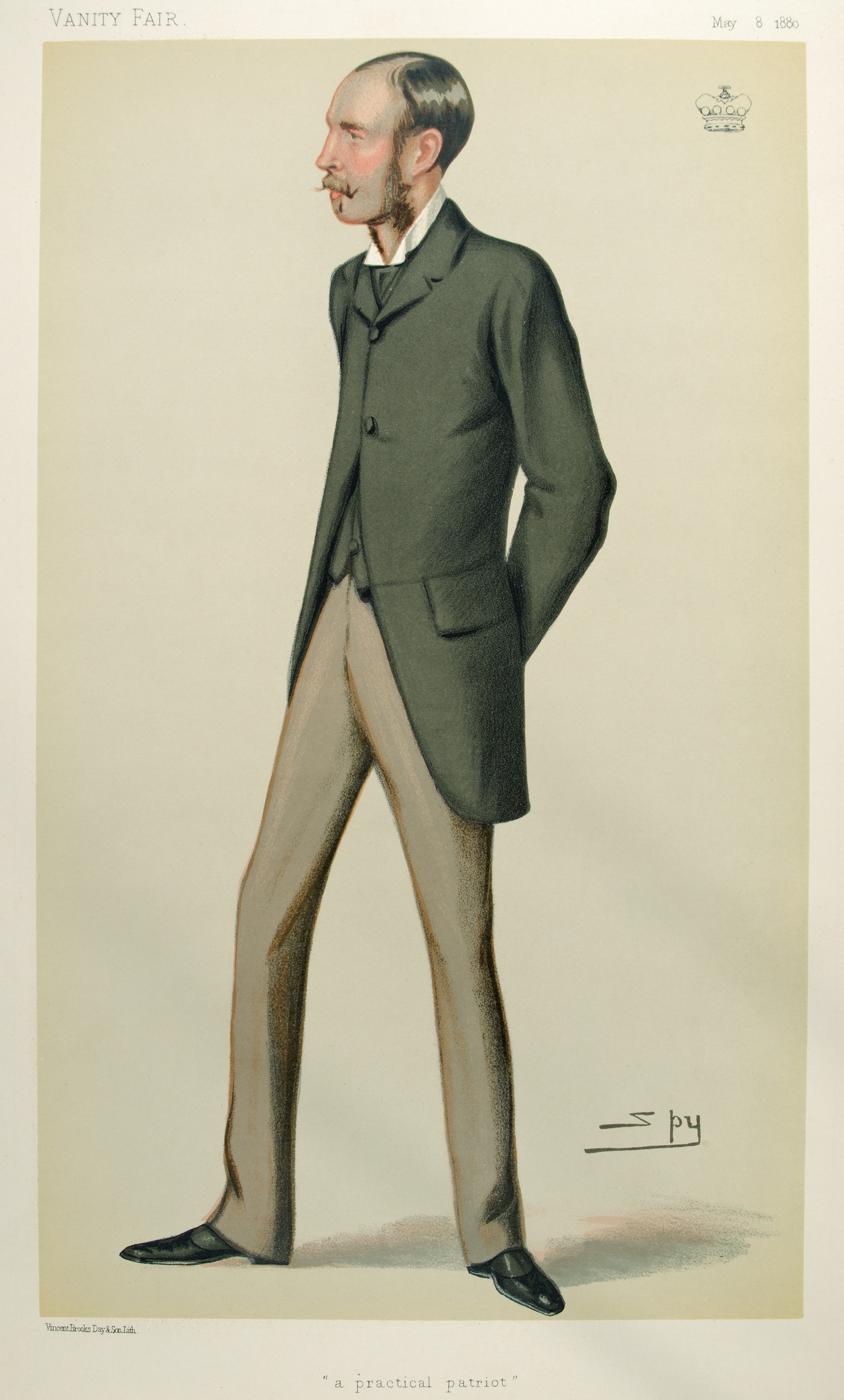
1880 illustration of Arthur Edward Guinness, Lord Ardilaun (Vanity Fair/Wiki)

1880 illustration of Arthur Edward Guinness, Lord Ardilaun (Vanity Fair/Wiki)

Today marks the centenary of the passing of Arthur Edward Guinness, better known as Lord Ardilaun. Ardilaun is perhaps best remembered for donating St. Stephen’s Green to the people of Dublin, and on Sunday I appeared on RTE’s The History Show and talked about Arthur with Myles Dungan. A brief discussion, we touched on Ardilaun and his place in Guinness family history, as the son of Benjamin Lee Guinness, who put himself into the history books by paying for the restoration of Saint Patrick’s Cathedral in the 1860s. Time was against us and as such the discussion didn’t really get around to Ardilaun’s brother, Lord Iveagh (or Edward Guinness), another significant philanthropist in Dublin’s history.

We have looked at Lord Ardilaun’s monument before on the site, in this 2012 post. There, it was noted that while Arthur was crucially important to opening Stephen’s Green to the public, he did not actually attend the park opening.

Lord Ardilaun himself did not attend the opening of the park. Within a week of its opening, a young 16-year-old by the name of Patrick Grennan, listed in the newspapers of the day as being an ashpit cleaner by trade, became the first youngster charged with malicious damage in the park for tearing up plants! Ironically, his home was Arthur’s Lane.

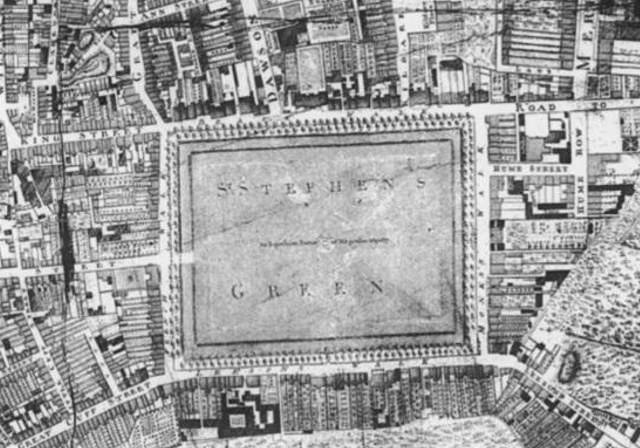
The park we enjoy today is in many ways unrecognisable to the park of centuries past, with the landscaping Lord Ardilaun financed dramatically changing the physical appearance of the space, giving us the wonderful artificial lake for example. In addition to the striking lake, the fine cottage home, Ardilaun’s Lodge, better known as the gardener’s cottage, is also evidence of his investment in the park. It remains for me the dream house, a stones-throw from Grafton Street with the best front garden in Dublin!

St. Stephen's Green as it appeared in the eighteenth century.

St. Stephen’s Green as it appeared in the eighteenth century.

Last year marked the fiftieth anniversary of the passing of Brendan Behan, and with it there was much focus on the literary output, and indeed the life story, of Dublin’s ‘Laughing Boy’. Particularly welcome aspects of the anniversary included RTE’s documentary feature on Behan and a revival of Borstal Boy at The Gaiety.

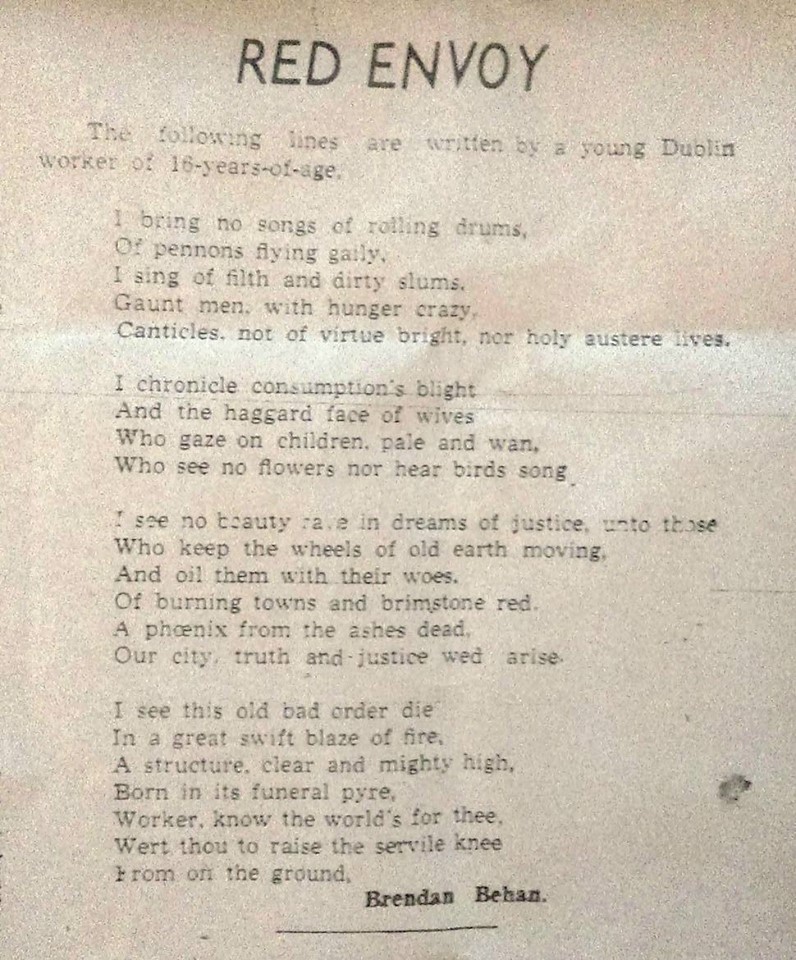
The Workers' Republic, August 1938.

The Workers’ Republic, August 1938.

Last week, I stumbled on a work of Behan’s that significantly predates Borstal  Boy,  in the form of a poem written by him while “a young Dublin worker of sixteen”. Red Envoy, a scathing attack on capitalism, was printed in the August 1938 edition of The Workers’ Republic, a monthly journal of the Communist Party of Ireland in the 1930s.

The journal took its name from an earlier radical paper, which was edited by James Connolly. The party produced a weekly in the form of Irish Workers’ Voice, but The Workers’ Republic provided a space for essays and indeed cultural content too. The poem is one of Behan’s earliest published works, and it gives great insight into the mind of the young developing writer and his political outlook. The image on the right is of poor quality, so I have typed the poem below.

The following year after the publication of this work, while still a teen, Brendan was destined for a Borstal in England for a three year stay as a result of a failed bombing mission. He had travelled  to Liverpool  as a young idealistic republican with the intention of  bombing the docks there.

We’ve looked at Behan several times on the site before, with a particular favourite piece being an article on Behan’s monument along the Royal Canal. At the unveiling of that monument in 2003, Bertie Ahern was on duty to do the honours. Paudge Behan questioned the logic of Bertie Ahern being there, and asked:

What has Bertie Ahern in common with Brendan Behan, other than they are both Irish? When you see what is happening with the fat cats in this country, with Bertie Ahern and his Government, I can’t think of anyone further from the spirit of Brendan Behan!

Below is the 1938 poem in full:

RED ENVOY:

The following lines are written by a young Dublin worker of 16 years-of-age.

I bring no songs of rolling drums
Of pennons flying gaily
I sing of filth and dirty slums
Gaunt man with hunger crazy
Canticles, not of virtue bright, nor holy austere lives.

I chronicle consumption’s blight
And the haggard face of wives
Who gaze on children, pale and wan
Who see no flowers nor hear birds song.

I see no beauty rave in dreams of justice, unto those
Who keep the wheels of old earth moving
And oil them with their woes
Of burning towns and brimstone red
A phoenix from the ashes dead
Our city, truth and justice wed arise.

I see this old bad order die
In a great swift blaze of fire
A structure, clear and mighty high
Born in its funeral pyre
Worker, know the world’s for thee
Wert though to raise the serville knee
From on the ground.
Brendan Behan.

There’s not much left by the way of pre-boom buildings on Sir John Rogerson’s Quay. Row upon row of mis-matched shining steel and glass structures tower over the few remaining Victorian warehouses and enginehouses, relics of an era when Dublin’s docks bustled with industry. One warehouse that has managed to survive, a double gabled redbrick building that sits where the Samuel Beckett bridge meets the Southside boasts two unusual and very original features.

The warehouse at 30- 32 Sir John Rogerson’s Quay was built in the 1890’s and was once home to the Dublin Tropical Fruit Company, who occupied the premises for decades. It has played host to plenty of drama in its lifetime; in the mid-thirties, a young teenager fell to his death from the roof, the sixties saw a long running strike on the premises and the eighties saw a fire come close to gutting the building. On 16th April 1950, a ship named the Abraham Lincoln arrived into Dublin bearing tonnes of bananas bound for the warehouse. When the ship made port, it was discovered that its cargo of fruit was already too ripe for sale, leading the company to refuse it and the ship’s crew to dump tonnes of black skinned bananas overboard. Alexandra basin was lined with scores of people waiting for the chance to grab any that might float ashore, whilst rowboats set out from Ringsend with the aim of getting to the booty first. Gardaí struggled to maintain order as hundreds of children tried to force entry into the basin. (Irish Press, 17/4/1950.) The building later housed offices belonging to U2 and is now home to a software company.

annalivia

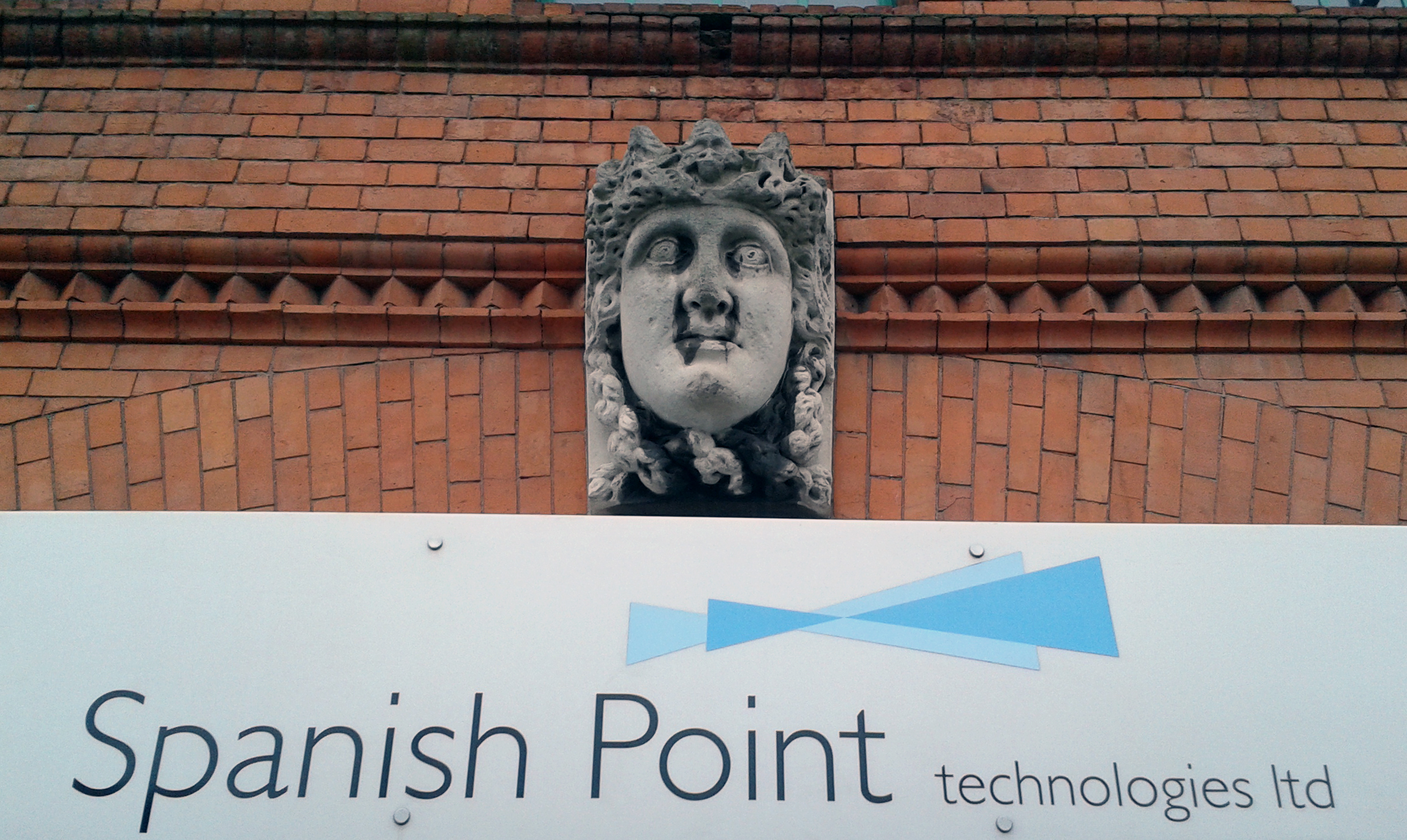
Representation of Anna Livia, photo credit- Simon Conway

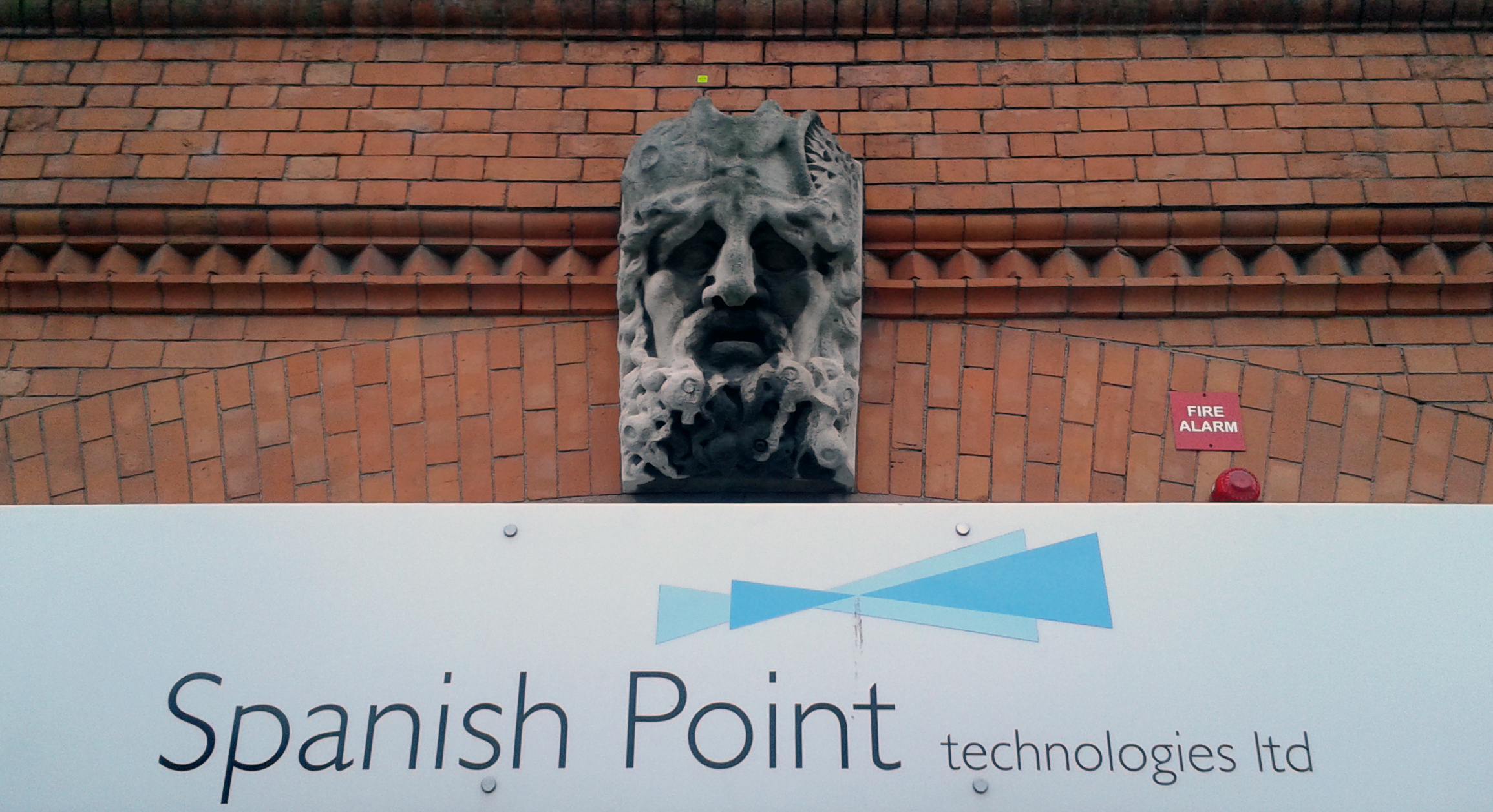
Anyway, to the point of the piece. Over the doors of the building, hang two recognisable figures- two granite keystones representing Anna Livia and the Atlantic, replicas of which appear elsewhere along the River Liffey. Originally sculpted by the eminent (though self-effacing as some records state!) Edward Smyth, they had once adorned the archways of Carlisle Bridge, the structure that predated what we now know as O’Connell Bridge. The bridge was remodeled in the late 1870’s and the granite keystones were removed- Carlisle Bridge having had three arches with a hump rising high above the water below, Anna Livia and Atlantic were deemed too large to fit the lower elliptical arches of the bridge. The new bridge had arches which sat much lower over the water, and the keystones would need to be replaced. They were remodeled by Charles W. Harrison and the originals sculpted by Edward Smyth somehow ended up on the facade of the warehouse on Sir John Rogerson’s Quay.

atlantic

Representation of The Atlantic, photo credit- Simon Conway

Smyth (1749- 1812) was a sculptor and modeler who served an apprenticeship under Simon Vierpyl (Clerk of Works  for the Casino building in Marino) and later worked for a Dublin stone cutter named Henry Darley. His work was mainly ornamental, according to the Dictionary of Irish Architects, that is until Darley recommended him to one of the leading architects working in Ireland at the time, none other than James Gandon in the early 1780’s. James Gandon being one of the most sought after architects of the time, Smyth rose to prominence under his patronage and went on to sculpt some of the most recognisable features on some of Dublin’s most famous buildings. From humble beginnings he was to become a wealthy man.

The building at Sir John Rogerson's Quay, photo credit- Simon Conway

The building at Sir John Rogerson’s Quay, photo credit- Simon Conway

Looking out over College Green from the roof of the Old Parliament, stand his figures of Justice, Wisdom and Liberty. His works are dotted around the Custom House; the 14 keystones representing 14 Irish rivers on the building are his, along with the Arms of Ireland- a Lion and a Unicorn standing either side of the Irish Harp. He was also responsible for work on a number of churches throughout Dublin, ornaments, statues and coats of arms at Kings Inns and you can add his name to the debate on something we’ve looked at before- who sculpted the anthropomorphic figures playing billiards and other parlour games on the windows of The Kildare Street Club? In her “This Ireland” column in the Irish Times in March 1975, Elgy Gillespie noted that it wasn’t until the 1950’s that discovery of Smyth’s keystones on the building at Sir Rogerson’s Quay was made, quoting Harold Leask (architect responsible in part for the reconstrucion of the GPO) in the Royal Society of Antiquaries Journal on their discovery. That column, and anything I’ve read on the subject, neglects to mention how the heads managed to make their way from Carlisle Bridge and onto the facade of a building on Sir John Rogerson’s Quay. Another reason why, when walking around this city, you should keep your head up because who knows what you might find!

Vera Breslin (née Shortall), a great-grandmother and sixth generation street seller of fish in Dun Laoghaire, has passed away. Her death marks the end of an era leaving few, if any, old-style Dublin street hawkers left in the coastal town. Hundreds of people have taken to Facebook to share their memory of Vera, who died in her early 80s in Blackrock Hospice.

Vera at her stall. Photo credit : Michael Merrigan/Andrew Gerard Ball.

Vera at her stall. Photo credit : Michael Merrigan/Andrew Gerard Ball.

A family steeped in fishing and martime history, the 1901 census shows her fisherman father Richard and mother Ellen Shortall living at 15.3 Lower George’s Street with their three sons and three daughters. Ten years later, the family had moved to nearby 5.5 Clarence Street with son Henry joining in his father’s footsteps. Richard and Ellen raised a total of five sons and nine daughters.

Born at 11 Clarence Street in circa 1931, Vera began her working life at the age of seven helping her father cast nets for herring and accompanying her mother selling fish door-to-door.

Tragedy struck the family in December 1934 when her two older brothers, Richard (20) and Henry (19), drowned in Dublin Bay with their bodies washing up in at Sandymount Strand. A friend John Hughes (20) of 8 Bentley Villas also died in the accident. They were described in a 1988 article as “hobblers, nuggety men who went out to sea in all kinds of weather in skiffs to be the first to get their hook on arriving ships and get paid for tying them up in Dublin.”

A similar catastrophe occurred in 1916 when two local men, Harry Shortall (an uncle of Vera’s) and his friend “Rover” Ward, were lost at sea while hobbling.

For well over seventy years, Vera sold fresh fish on the streets of Dun Laoghaire. She started on Upper George’s Street but after the trams were discontinued she moved to Convent Road where she was based from the 1940s until very recently.

Every Wednesday, Thursday and Friday morning, Vera pushed her pram from her home in Bentley Villas to her pitch on Convent Road. It was said that you could set your watch by her and locals valued her as the best source for local news and gossip.

Throughout the 1980s, a weekly Friday customer was the Italian Ambassador to Ireland who would pull up in a chauffer driver car to purchase fresh fish for his traditional fish-on-Friday meal.

A 2000 Irish Times piece described Vera’s typical working day:

6am … Vera’s husband Paddy, a retired dock worker, cooks breakfast for the pair. Vera’s nephew then drives her to the fish auction at the Dublin Corporation wholesale market while Paddy and their sons assemble the market stall … Vera assembles her post by 9.45am. Selections vary according to market availability, but there are often less-glamorous but delicious-tasting fish such as red gurnet, mullet and ling sharing space with delicate plaice, sole, fresh and smoked ray wings and hake …

During lulls, Vera sips tea from her thermos, or sits on an overturned milk crate on the sidewalk, smoking a cigarette. Paddy brings her a hot dinner at noon. The stall closes at 6pm at which time Paddy carts away the disassembled stall to a nearby storage area, using the old pram.

Last Summer, a photo of Vera was posted on a Facebook group for current and former Dun Laogahire residents attracting hundreds of comments. As Vera was not an active Social Media user, all the comments were printed off and presented to her.

Vera with printed out Facebook comments. Picture credit - Don Mc Manus.

Vera with printed out Facebook comments. Picture credit – Don Mc Manus.

While her four grown up children chosen different career paths, Vera’s nephew George Rogerson of George’s Fish Shop in Dun Laoghaire is continuing the family’s proud fishmonger tradition which dates back to the 1800s.

Vera’s removal will take place on Saturday to St. Michael’s Church, Dún Laoghaire, arriving at 9.45am for 10am. Funeral Mass followed by burial will take place in Dean’s Grange Cemetery.

Sources:
Pram Women of Dublin, Ireland of the Welcomes (Jan-Feb 1988).
Elizebeth Field, Alive Alive-O: A day in the life of a fish trader, a modern-day Molly Malone, The Irish Times (17 June 2000).

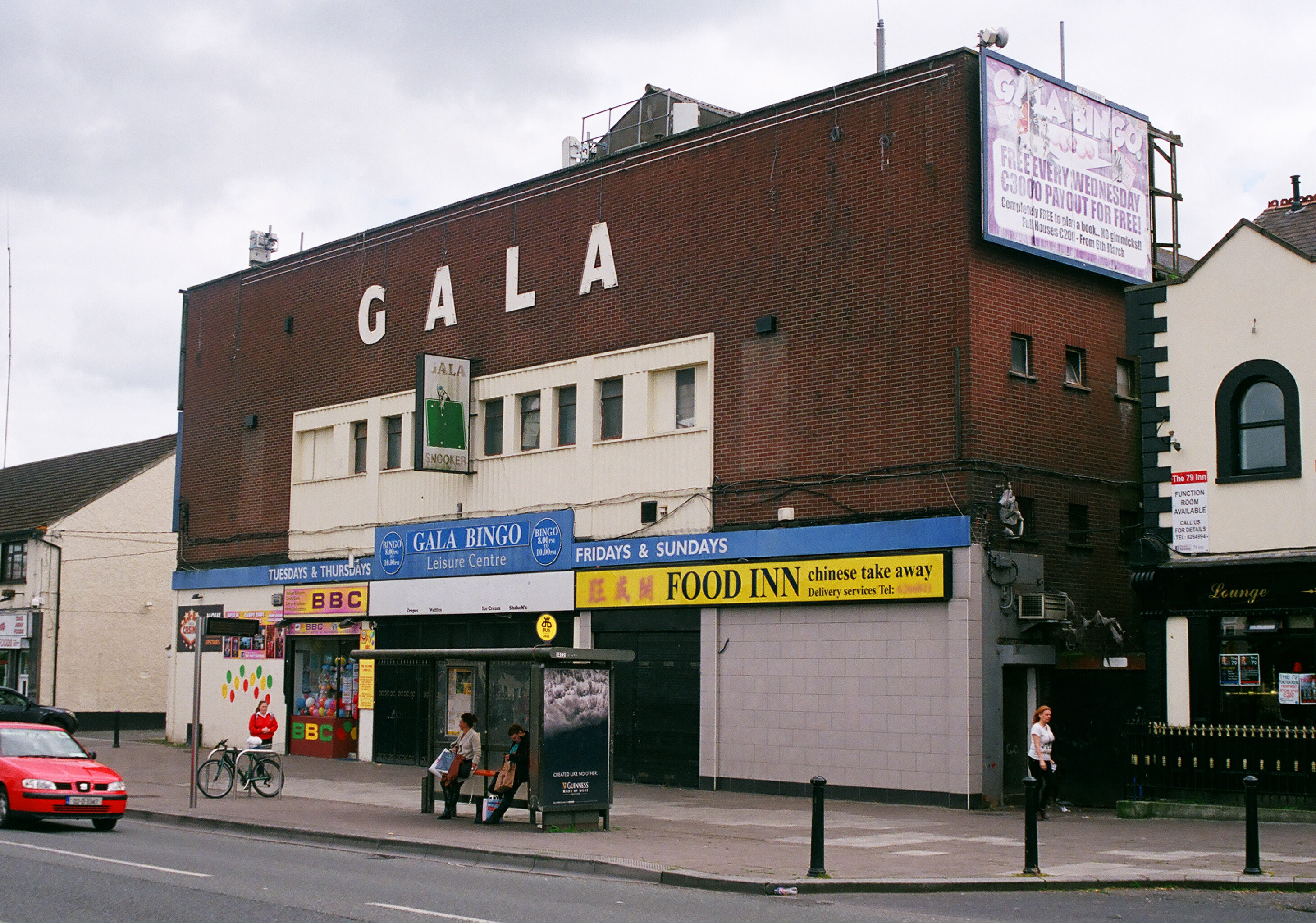
The Gala in Ballyfermot (Image: Luke Fallon)

The Gala in Ballyfermot (Image: Luke Fallon)

Note: This article originally appeared in SET, a quarterly publication concerned with the relationship between cinema and its architecture. Check them out and give them a ‘Like’ here.

In 1961, Ireland was changed forever with the launch of Telefís Éireann, a national state television station. Lagging behind the rest of the world, television was something of a cultural shock in Ireland, with one conservative politician boldly stating that “there was no sex in Ireland before television.” If television brought the world into Irish homes, it also had some negative effects, in particular playing a central role in bringing about the demise of the suburban cinema phenomenon.

Dublin was home to a staggering sixty cinemas in the mid-1950s, between city and county. Jim Keenan, who has produced a comprehensive pictorial history of these cinemas, has noted that “today, the Savoy in O’Connell Street is the only cinema to survive from that era.” Suburban cinemas do still exist in Dublin today, though rather than the architecturally interesting picturehouses that once dotted Dublin, they are largely confined to shopping centres and run by multinational companies.

Dublin’s first full-time cinema opened its doors to the public in 1909, named the Volta, after a picturehouse in Trieste. Overseeing the entire project was a certain Mr. James Joyce, who had been inspired by his continental travels. A small plaque marks the location of this cinema today on Mary Street in the heart of the city centre, though it makes no mention to the fact for Joyce it was a failed and costly commercial enterprise! None the less its place in history was secured, and it was the first of a wide range of purpose-constructed cinemas that would emerge in the city, being followed for example by the Grafton Cinema on Grafton Street in 1911 and the Dorset Cinema on Granby Row in that same year. Within five years of Joyce’s enterprising idea, Dublin had its first cinemas beyond the city centre with a cinema opening in the wealthy and fashionable suburb of Blackrock (Blackrock Cinema Theatre, 1914) and another in Phibsboro (Phibsboro Cinema, 1914). Sadly demolished in 1953, Keenan has noted that the Phibsboro cinema “had an attractive brick and terracotta facade and an auditorium richly embellished with fibrous plasterwork.”

The  Fairview Grand Cinema, January 1971. (Image: Dublin City Public Library and Archives, http://dublincitypubliclibraries.com/taxonomy/term/215/all?page=1)

The Fairview Grand Cinema, January 1971. (Image: Dublin City Public Library and Archives, http://dublincitypubliclibraries.com/taxonomy/term/215/all?page=1)

Many of Dublin’s suburban cinemas were constructed in the decades that followed Irish independence, both in middle class and working class districts, with a golden age of construction in the 1920s and 30s. In some cases the premises’ were designed with multiple functions in mind, for example the Stella cinema in Rathmines which included a dancehall within it. Opened in 1923, it was envisioned as something of a luxurious cinema, though simpler cinemas were constructed in working class districts. Cinemas in Dublin thrived despite an aggressive conservative Catholic agenda in sections of society that viewed them with distrust, with both the Catholic Truth Society and the Dublin Vigilance Association lobbying for strict film censorship in the 1920s. The pressure of bodies like these contributed to the passing of an incredibly restrictive Censorship of Films Act in 1923, allowing the film censor to refuse certificates to films deemed “indecent, obscene or blasphemous.” While the cinema, jazz music and drinking were all condemned by conservative elements in Irish life in the 1920s and 30s, historian Diarmaid Ferriter has correctly and light-heartedly noted that “It is surely ironic, given the constant references to ‘alien influences’, that the Irish population became one of the heaviest cinema-going populations in the world, and were keen to drink as much as possible and dance from one end of the country to the other.”

From Maureen O’Hara to the Ramones: The Cabra Grand

As a case study, the Cabra Grand cinema in the working class Dublin 7 suburb of Cabra is worthy of examination. Dublin Corporation had constructed hundreds of homes for the working class of the city here in the early 1930s, moving Dubliners from dilapidated tenement accommodation in the city centre into a new expansive suburban environment which would continue to grow in future decades. The opening of the Cabra Grand cinema in 1949 was the subject of much excitement in the suburb, captured in the pages of the local and national media. The Lord Mayor of Dublin formally opened the cinema, while a local parish priest was on-hand to bless the premises, indicating the strong role the church continued to play in Irish life, and a cooling in church opposition to the cinema industry.

A 1,600 seater cinema, the Grand was managed by a veteran of the Easter Rising named Louis Marie, and opened with a feature film starring the ever-popular Maureen O’Hara. The Grand was capable of drawing very significant crowds throughout the decade that followed its opening, though interestingly one official warned in 1959 that the biggest problem for it and other cinemas in Ireland “would be the advent of television on a national basis.”

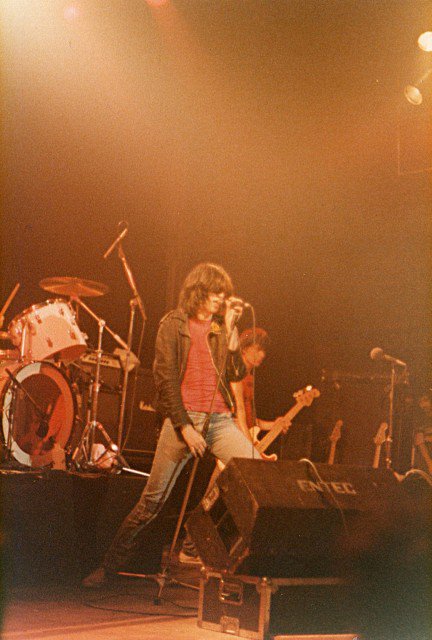
The Grand was one of several suburban cinemas that were bought in 1975 for the purpose of becoming bingo halls, and it still cuts an imposing shape on Quarry Road in Cabra, where the historic signage remains visible through bingo advertising. In addition to welcoming in gambling grannies, it also became a popular location for concerts, with legendary U.S punk rockers The Ramones performing there in 1980, at a gig marred by violence in the vicinity of the venue. So legendary was the violence at punk and rock concerts at the Grand that Dublin District Court decided in 1980 that no further rock concerts could be held at the venue. Other bands to have taken to the stage of the one-time cinema in Cabra include Siouxsie and the Banshees, while an up-and-coming boyband named Boyzone packed a thousand people into the venue in 1995. A surprisingly (and impossibly) high number of people claim to have been there to see The Ramones of course, a significant event in the folklore and mythology around the cinema, while witnesses to Boyzone’s sold out concert are somehow harder to come by.

Joey Ramone in a Dublin cinema. Phibsboro. Former cinemas took on a new lease of life in the 1970s as gig venues. (Image Credit: Bullpost on Pix.ie, http://pix.ie/bullpost/album/320532/goto/2074180)

Joey Ramone in a Dublin cinema. Phibsboro. Former cinemas took on a new lease of life in the 1970s as gig venues. (Image Credit: Bullpost on Pix.ie, http://pix.ie/bullpost/album/320532/goto/2074180)


The uncertain future for Dublin’s suburban cinema buildings.

Like clockwork, many of Dublin’s suburban cinemas closed their doors in the early 1970s, unable to survive in a changing world where visual entertainment could be obtained without stepping outside the front door. Evidently, suburban cinemas also struggled to compete with those in the city, with the owners of several suburban cinemas jointly claiming to the media in 1973 that “discriminatory practices by certain major film distributors were resulting in a delay of up to nine months before new films shown in city-centre cinemas could reach the suburbs.” Fergus Linehan, a film critic with The Irish Times, wrote in 1974 that cinema going had become a “lost habit” in Ireland, and complained that with the exception of the O’Connell Street area, there wasn’t a cinema to be found on the northside of Dublin still in operation. Linehan drew on British statistics, which showed that “in 1952 there were 1,312 million cinema admissions in Great Britain, and 9.3% of British homes had television. By 1962 admissions had declined to 395 million – but 77.1% of homes had TV.” A similar correlation could be drawn in Ireland, though television was a slightly newer phenomenon.

In recent years, the architectural merit of many of these cinemas has finally been acknowledged, though historical neglect has contributed to the speedy demise of some buildings. The beautiful historical signage has been removed from some cinemas, with Stella in Rathmines only losing its signature signage in December 2013. Modern developments saw shopping centres and Tesco’s emerge on the site of old cinemas, while some remain in limbo, for example The Gala in Ballyfermot, a fine cinema premises opened in 1955 that later became a bingo hall and snooker hall but has closed its doors in recent times. An integral part of its community, locals still recall the famed (and rather portly) cinema usher ‘Harry The Hippo’ of the 1960s and 70s with great affection!
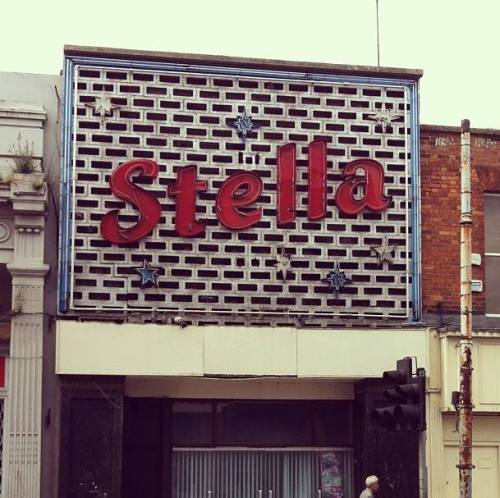
The historic Stella signage in Rathmines (Image: Paul Guinan)

The historic Stella signage in Rathmines (Image: Paul Guinan)

The suburban cinema, from the late 1920s through to the 1970s and in some cases beyond that, was an integral part of many Dubliners lives, across socio-economic classes. Of course communities today do not feel the same connection to suburban cinemas that are awkwardly lumped in with multi-million Euro shopping centre developments in Blanchardstown or Clondalkin. By the turn of the millennium, there were only 10 single-screen cinemas remaining in Ireland, with multiplex (and multinational) operations removing smaller competitors en masse. For younger generations of Dubliners, stand-alone suburban cinemas are now just unusual and decaying features of the landscape around them.

With Christmas just around the corner, we look at some of the best Irish and Dublin history books published this year.  Apologises about the short reviews but I wanted to ensure this list was out before Christmas. I plan to expand on these descriptions over the holiday period when I’m off work and have more time on my hands.

Top picks:

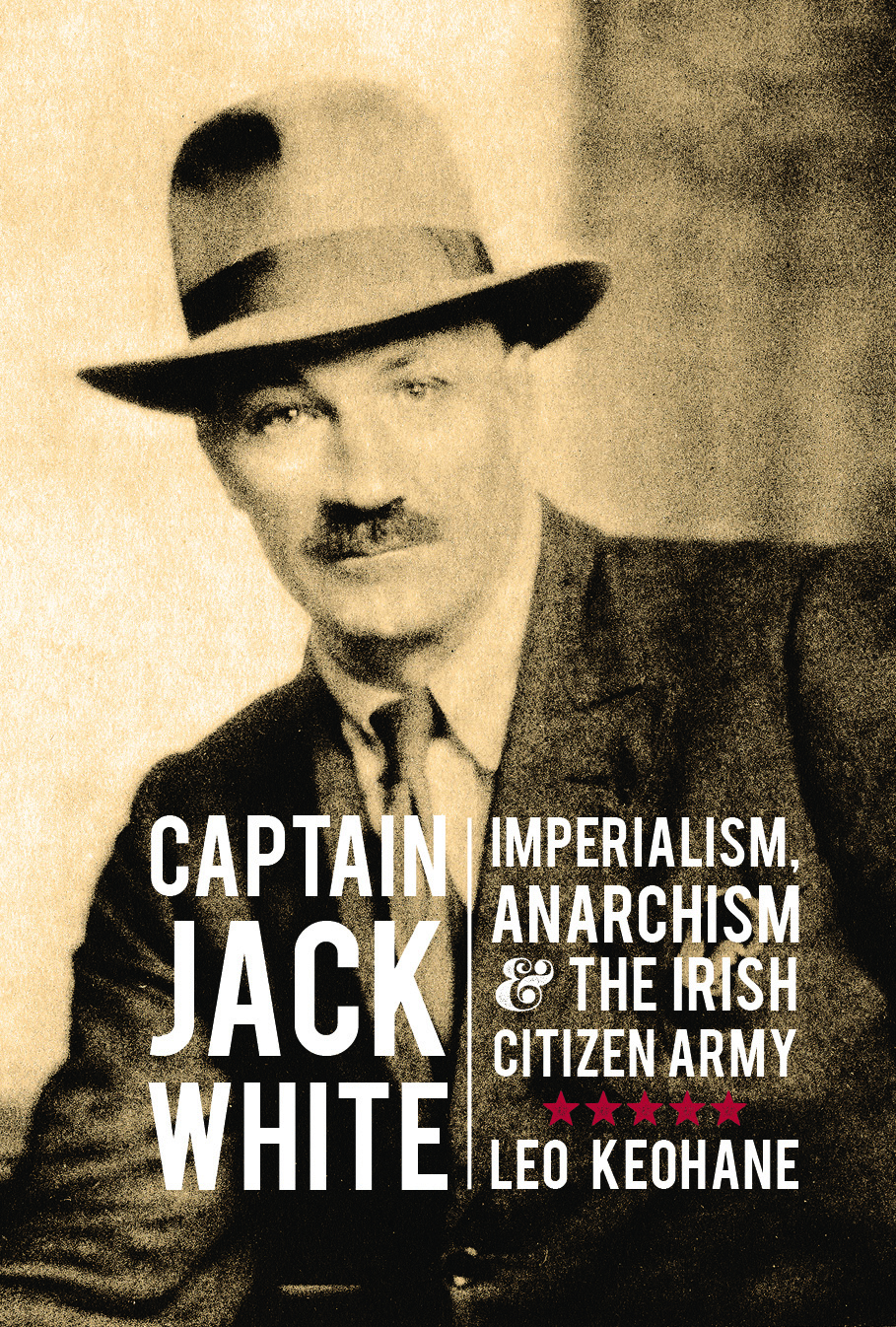
Captain Jack White: Imperialism, Anarchism, and the Irish Citizen Army – Leo Keohane (Irish Academic Press, 2014)
288 pages. €20 RRP.

The first proper biography of a fascinating Irish historical figure – Boer war hero, protestant Home Ruler, socialist convert, first Commandant of the Irish Citizen Army, Republican Congress activist in the early 1930s (during which he was physically attacked by both the IRA and the fascist Blueshirts) and finally, an anti-Fascist medic in Republican Spain during the Civil War.

Described accurately as “one of the few notable figures in Ireland to declare himself an anarchist”, author Leo Keohane introduces the reader to the theory of Anarchism in a honest and impartial manner. A rare feat.

Reviews from the Irish Story and An Phoblacht.

Captain Jack White: Imperialism, Anarchism, and the Irish Citizen Army - Leo Keohane

Captain Jack White: Imperialism, Anarchism, and the Irish Citizen Army – Leo Keohane

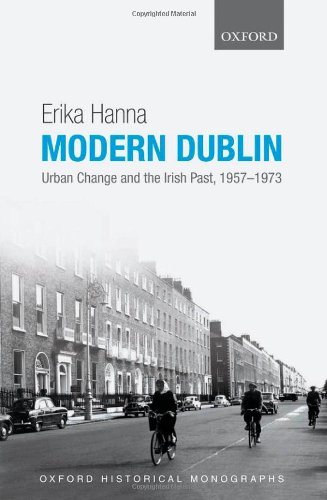
Modern Dublin, Urban Change and the Irish Past, 1957-1973 – Erika Hanna (Oxford University Press, 2013)
240 pages. €75 RRP.

The price (due to its limited print run and academic audience) will unfortunately be a barrier to most but this is a fantastic book which will be of interest to anyone with an interest in modern Dublin history.

Most importantly the book analysises the political and social differences and similarities between the work of the middle-class Irish Georgian Society, dedicated to saving Dublin’s Anglo-Irish architecture from destruction, and the activist-led Dublin Housing Action Committee (DHAC) whose short but explosive existence saw an inspirational campaign of squatting and an attempt to build links with the civil rights struggle in the North.

Reviews from the Irish Arts Review and the Dublin Review of Books.

Modern Dublin, Urban Change and the Irish Past, 1957-1973 - Erika Hanna

Modern Dublin, Urban Change and the Irish Past, 1957-1973 – Erika Hanna

Secret Dublin : An Unusual Guide – Pól Ó Conghaile (Jonglez Publishing, 2013)
256 pages. €18 RRP.

A perfect guide for both local and visitor. Well-produced and accessible. Personal highlights Blessington Street Basin, the Hungry Tree in Kings Inn, the chapter house in St. Mary’s Abbey, bullet holes in the Daniel O’Connell monument, the City Hall murals, St. Kevin’s Park, Freemason’s Hall, animal carvings on the old Kildare Street Club, Challoner’s Corner cemetery in Trinity College, the Coombe Monument and the Jewish Cemetery.

x

Secret Dublin : An Unusual Guide – Pól Ó Conghaile

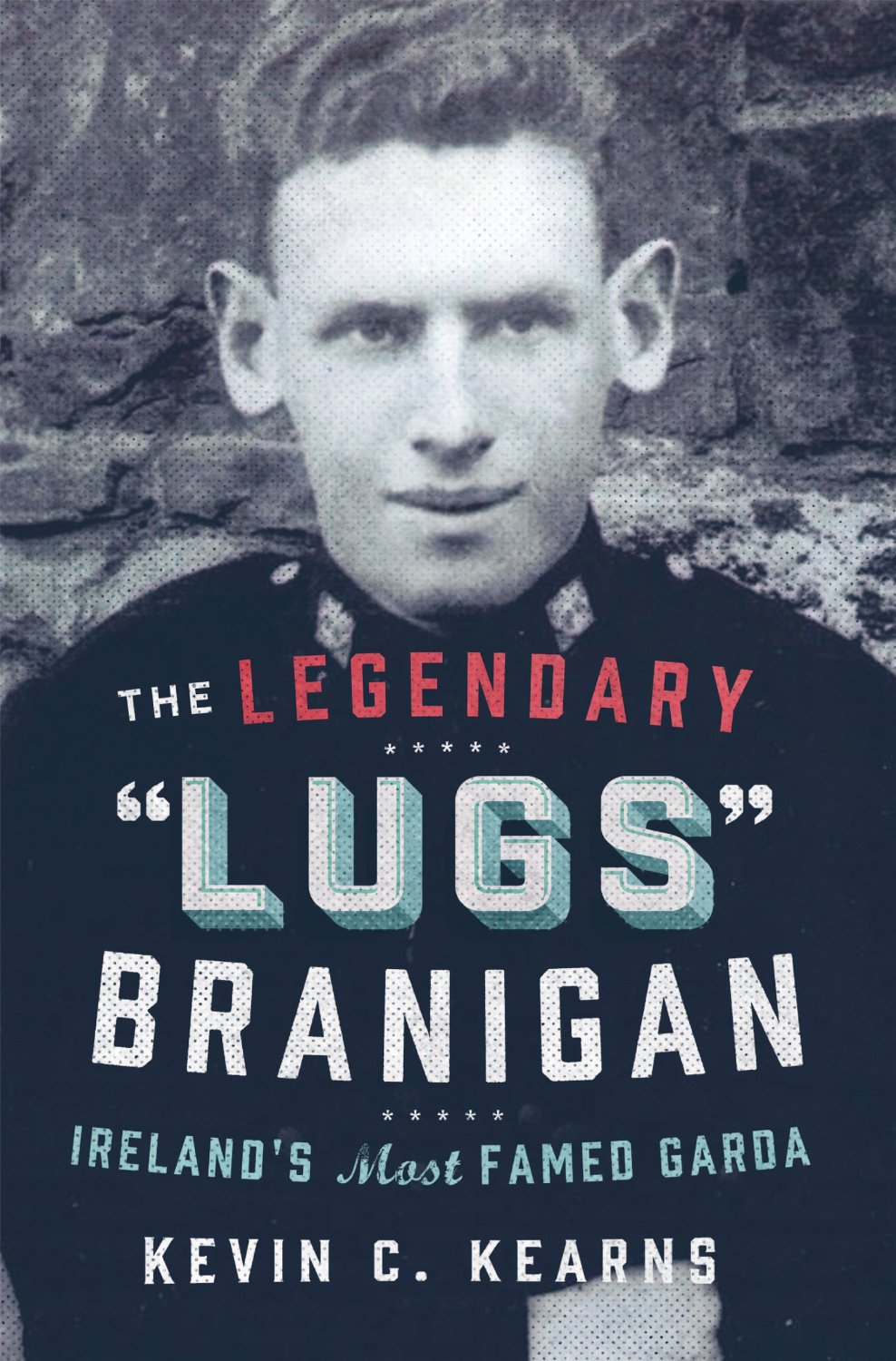
The Legendary ‘Lugs Branigan’ – Ireland’s Most Famed Garda: How One Man became Dublin’s Tough Justice Legend – Kevin C. Kearns (Gill & Macmillan, 2014)
384 pages. €25 RRP.

One of the most interesting history books that I’ve read for sometime. I finished it in a couple of sittings. A policeman on the beat in South Inner City from 1931 to 1973, boxing champion Lugs went head to head against the Animal Gangs (1930s/40s), Teddy Boys (1950s), skinheads and football hooligans (1960s/1970s) and any innocents unlucky enough to get in his way. A fantastic social history of the capital.

Review from the Irish Independent.

The Legendary ‘Lugs Branigan’ – Ireland’s Most Famed Garda: How One Man became Dublin’s Tough Justice Legend - Kevin C. Kearns

The Legendary ‘Lugs Branigan’ – Ireland’s Most Famed Garda: How One Man became Dublin’s Tough Justice Legend – Kevin C. Kearns

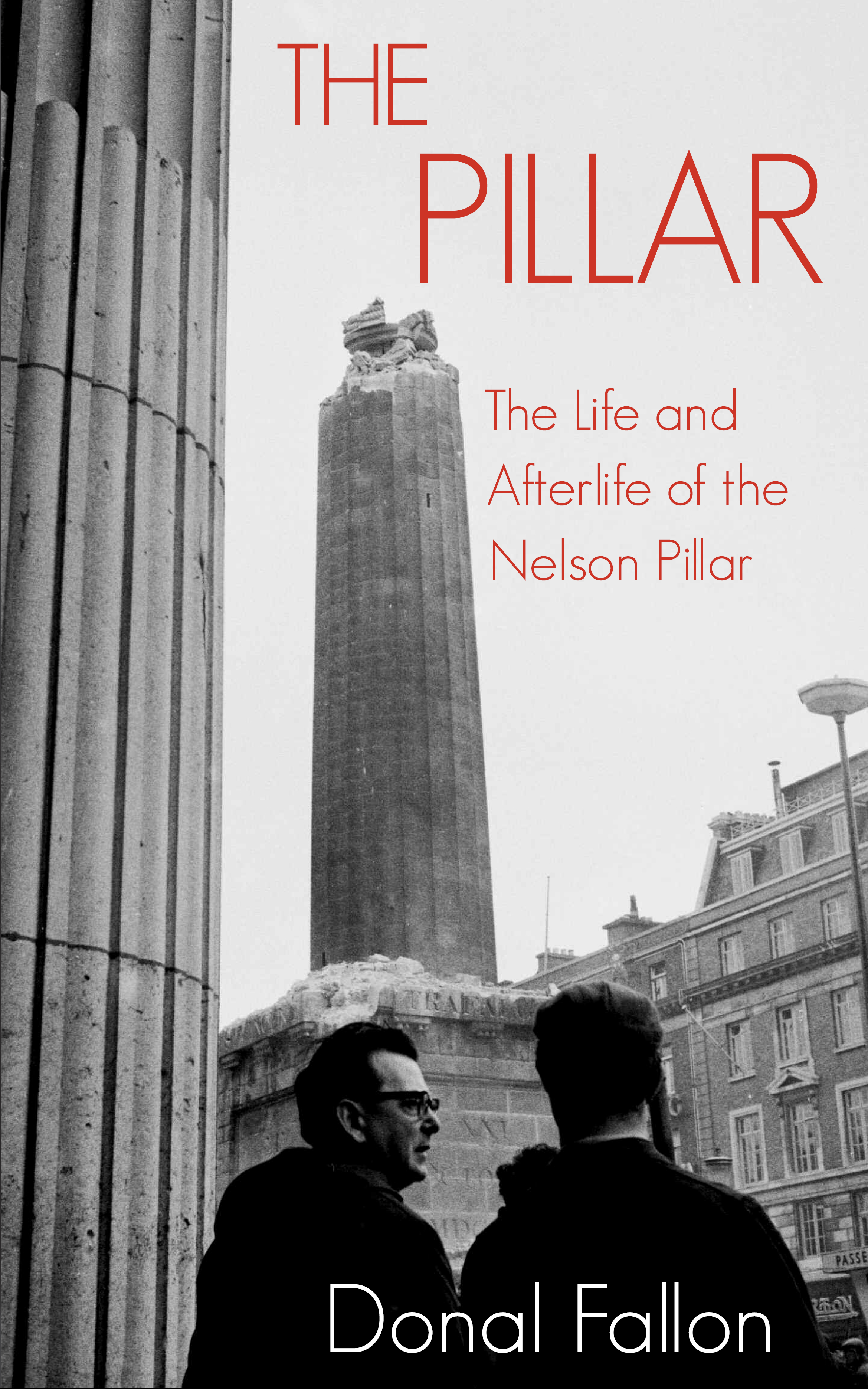
The Pillar: The Life and Afterlife of the Nelson Pillar – Donal Fallon (New Island, 2014)
154 pages. €15 RRP.

The most comprehensive account published on Dublin’s most iconic piece of street architecture. A real gem of a book. Written by Donal of this parish.

Review from the Dublin Review of Books.

 The Pillar: The Life and Afterlife of the Nelson Pillar - Donal Fallon

The Pillar: The Life and Afterlife of the Nelson Pillar – Donal Fallon

Continue Reading »