Feeds:
Posts
Comments
The New Versions: Bibby, Moylett, Kiang & Byrne in 1978. Credit - Irishrock.org

The New Versions: Bibby, Moylett, Kiang & Byrne in 1978. Credit – Irishrock.org

Thirty-three years after its release, a rare and essential Dublin New Wave single has finally made it online. The New Version’s ‘Like Gordon of Khartoum’ was released by Mulligan Records in 1981. It has somehow evaded a digital airing until now. Thanks to the uploader.

Personnel

The New Versions (1978-82) were:

– Ingmar Kiang (aka Iggy Kiang) on Vocals and Guitar
– Johnny Byrne (1956-97) on Bass
– Regine Moylett on Keyboards
– Paul Bibby on Drums

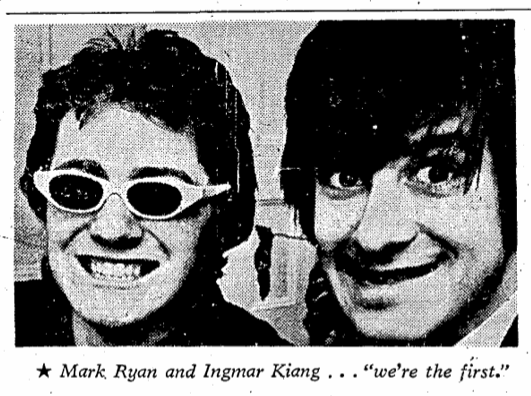
Ingmar Kiang, son of Chinese-born Irish astronomer Professor Tao Kiang, was a Trinity College student when he co-launched “Dublin’s first mobile Punk Rock disco” in early 1978 with his pal Mark Ryan who worked in a “Grafton Street hamburger restaurant”. Presumably the recently enough opened McDonalds or Captain Americas?

Ryan & Kiang. Credit - The Sunday Independent (8 January 1979)

Ryan & Kiang. Credit – The Sunday Independent (8 January 1978)

Fed up with 70s disco music, the pair launched a DJ night called Snots in TCD’s New Library offering Punk/New Wave and 1950s Rock n Roll. They told the Sunday Independent (8 January 1978):

We’re in it for the fun, we don’t charge in … We toyed first with calling our disco Scabies until a girl friend of mine came up with Snots. [Our posters say] ‘Snots will be appearing under your nose’.

Regine Moylett with her sister Susan launched their ‘New Romance’ punk/new wave clothing store in the Dandelion Market in July 1978. Their brother John (aka Johnny Fingers) found fame as keyboard player with The Boomtown Rats while another brother Pat was the original drummer with Berlin and later became their manager.

Band

Originally a trio called Sordid Details, playing their first gig supporting U2 and Revolver on 17th March 1978 in the Project Arts Centre, the band added Moylett on keyboards and changed their name to the New Versions in the summer of ’78.

During their four year careers, the band played all the main live music venues in Dublin, supported a number of touring bands and were part of one of the first New Wave tours of Ireland with fellow Dublin band Berlin.

They appeared on the definitive Irish Punk/New Wave sampler ‘Just For Kicks‘ released in 1979 with ‘Tango of Nerves’.

Continue Reading »

(Image Credit: Thanks to Garry O'Neill, 'Where Were You')

(Image Credit: Thanks to Garry O’Neill, ‘Where Were You’)

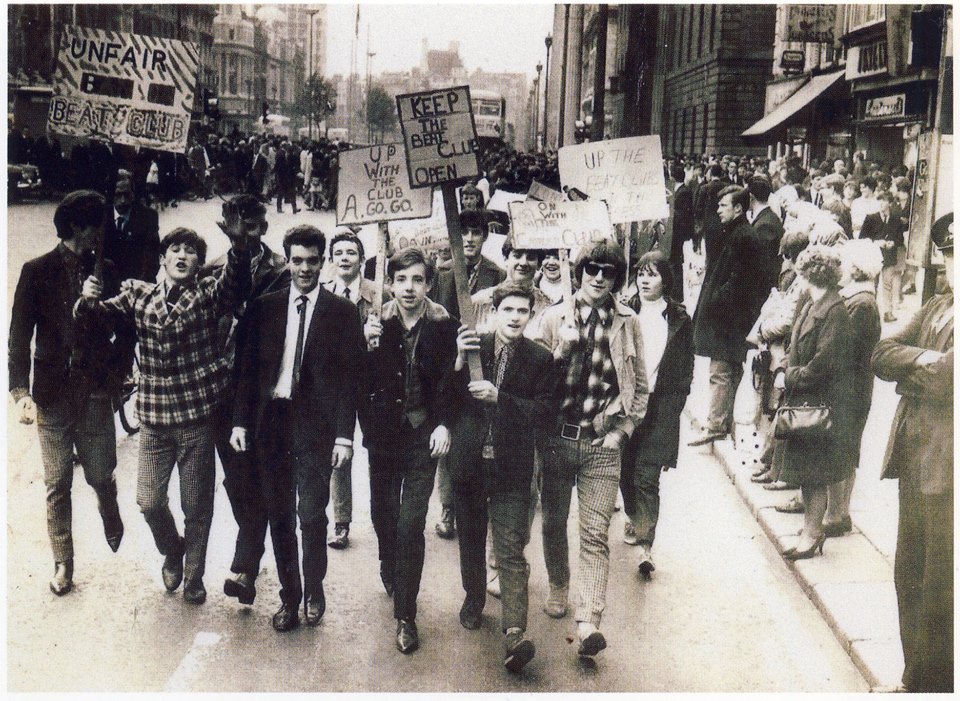
In October 1966, young teenagers grabbed national media attention by demonstrating on the streets of Dublin against the hugely negative attention that was being brought onto ‘Beat Clubs’ by the press and authorities. A part of the popular ‘Mod’ youth culture of the period, these were clubs were youngsters danced away to the popular hits of the scene. Amidst scare stories that these emerging popular youth music clubs were attracting drug users and trouble makers, a small determined band of teens paraded down O’Connell Street and other city centre streets with placards proclaiming “WE ARE NOT DRUG ADDICTS”, WE KIDS ARE ALRIGHT” and “THIS IS 1966 NOT 1906”. One placard even proclaimed that “IT’S A MOD WORLD.” Teenagers handed a petition with 2,500 signatures on it into Leinster House for the attention of the Minister for Justice

The Sunday Independent noted that “onlookers who watched yesterday’s marchers were left in little about about how the city’s teenagers feel about the accusations which have been levelled against them both by the Garda authorities and in Dail Éireann.” To the paper it was Dublin’s “most colourful and possibly most enthusiastic protest”, with “mini skirts and trouser-suits, long hair and beards: blasting loudspeakers, chanting teenagers and screaming motor cycles.”

The issue of Beat Clubs was raised in the Dáil on more than one occasion in the 1960s. On one occasion a Fine Gael TD, Paddy Harte, asked a government Minister to clarify just what ‘Beat’ and ‘Beat Clubs’ meant. Unsatisfied with the response, he stated “obviously the Minister does not know. He is a square.”

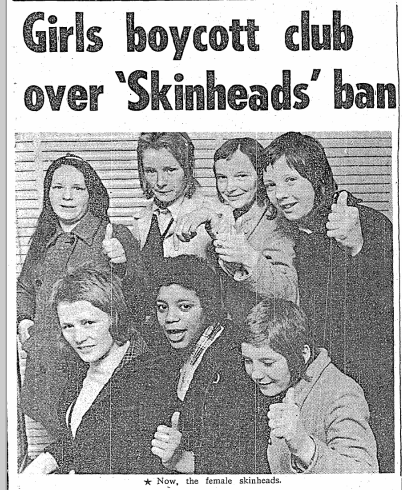
The media interest in teenagers and the places they congregated in the 1960s and 70s makes for interesting reading material today. In 1970 it was reported by the Sunday Independent that “”fifty teenage girls from Finglas are to boycott a Dublin Beat Club were they dance six times a week and spend about £2 each, because the club has banned Dublin’s newest cult, “girl skinheads.” One of the girls told the press that “we go with boys who are skinheads and weirdos, but we are definitely not looking for rows because we got our hair cut like this.”

Sunday Independent 19 April 1970.

Sunday Independent 19 April 1970.

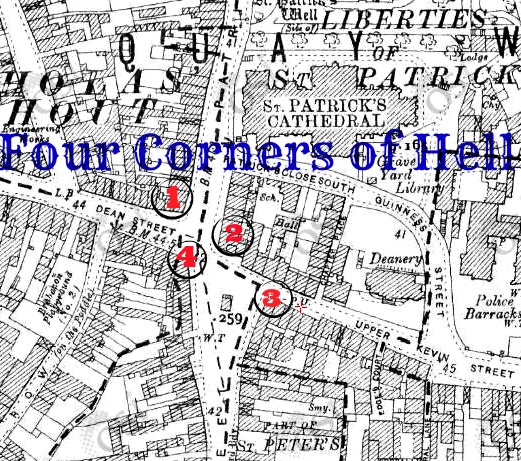
The Four Corners of Hell was the colloquial name given to the junction where New Street, Patrick’s Street, Kevin’s Street and Dean Street met in The Liberties, Dublin 8.

In the shadow of St. Patrick’s Cathedral, this crossroads was infamous for having a public house on each corner and the immediate area after closing time was legendary for its rowdy crowds and punch ups. Revelers from rival neighborhoods or families would pour out onto the streets when the pubs shut and would settle old scores and new disputes with their fists. Famed local cop Lugs Brannigan and his men based out of nearby Kevin Street Garda station would often have their work cut for them. Its heyday was from the 1950s to the early 1980s.
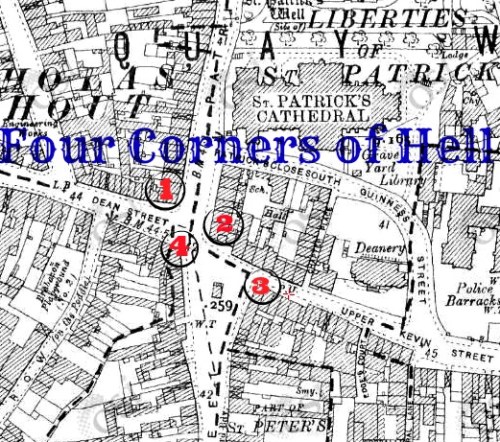
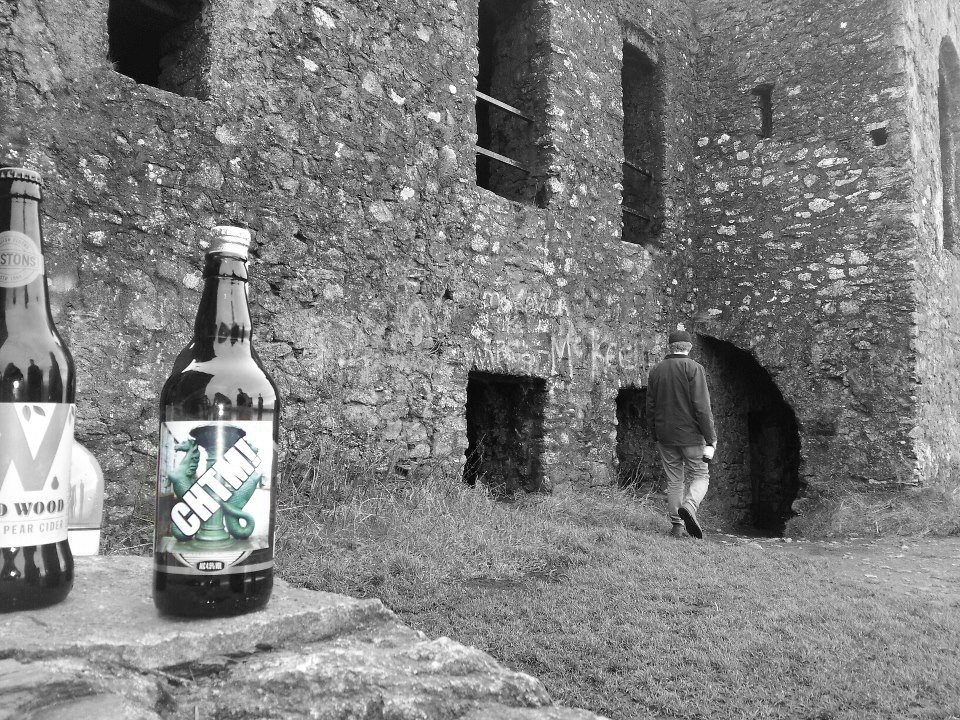
Illustration of The Four Corners of Hell. Credit - Sam (CHTM!)

Illustration of The Four Corners of Hell. Credit – Sam (CHTM!)

The cross-roads is almost unrecognisable today now due to the demolition and road widening that occurred in the 1980s.
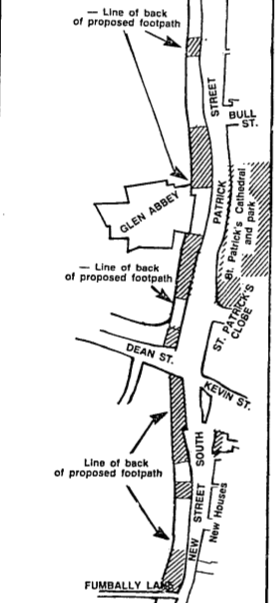
The shaded buildings were demolished. Credit - Irish Times (13 May 1985)

The shaded buildings were demolished by the council. Credit – Irish Times (13 May 1985)

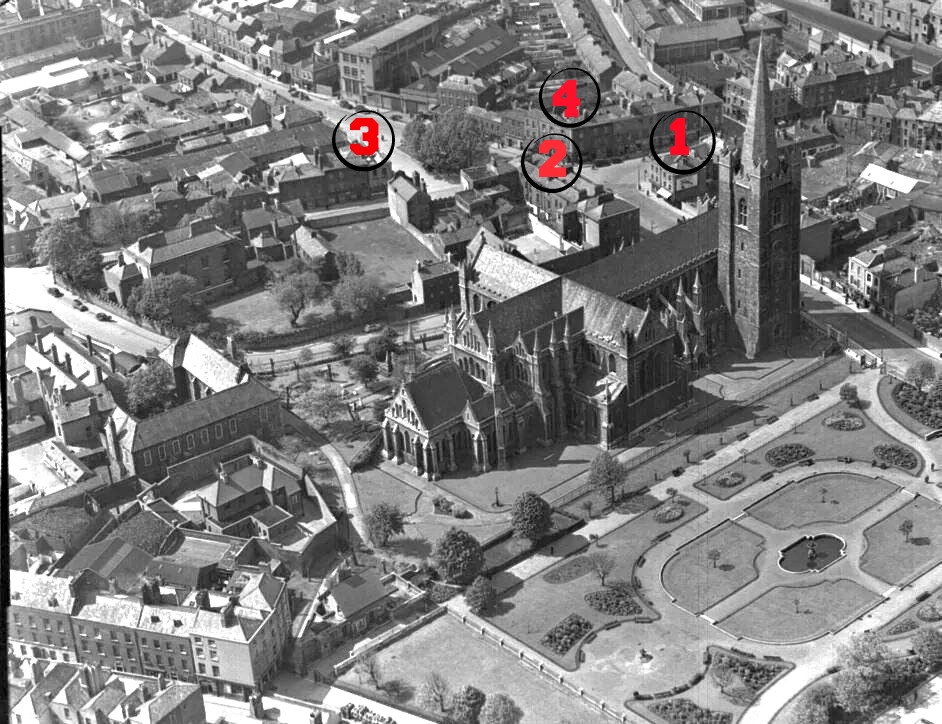
The four pubs were as follows:

1. Kenny’s
2. Quinn’s
3. O’Beirne’s
4. Lowe’s
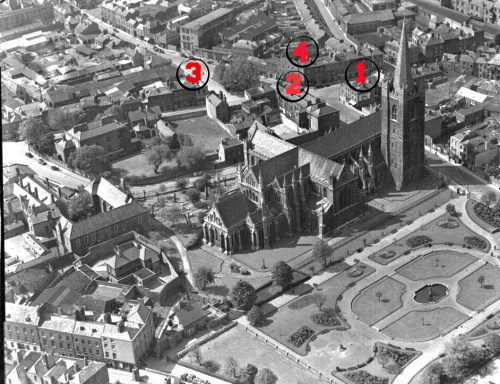
Arial shot of the Four Corners of Hell, nd. Credit - 'Growing up in the Liberties's' FB page

Arial shot of the Four Corners of Hell, nd. Credit – ‘Growing up in the Liberties’s’ FB page

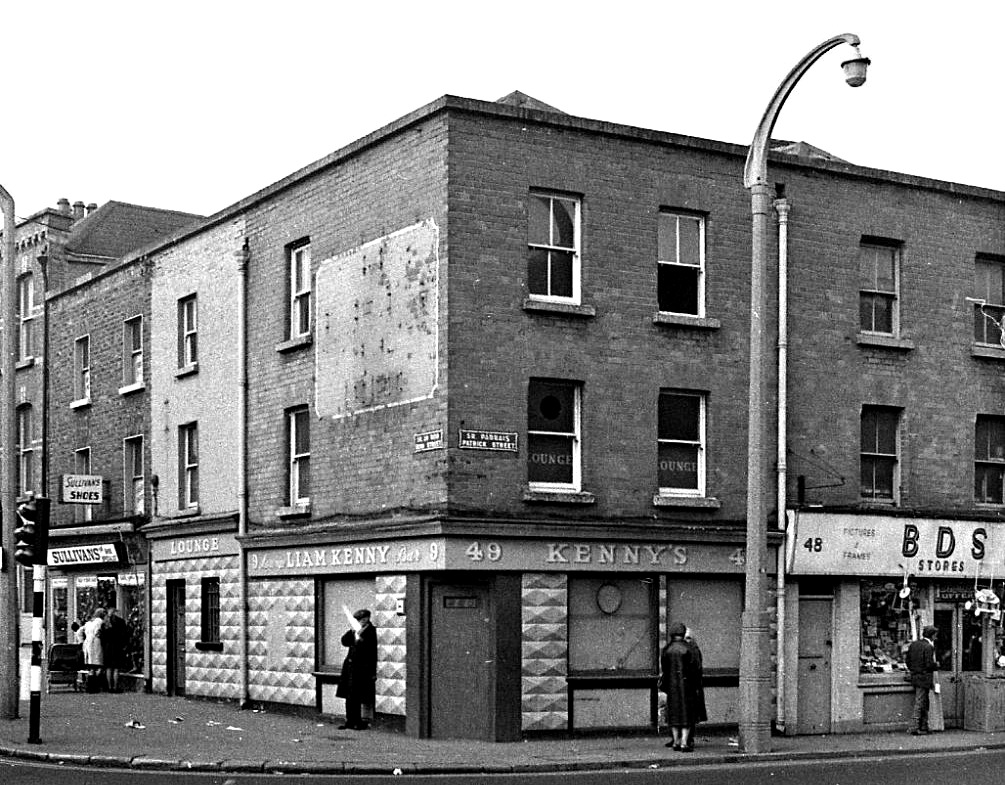
1. Liam Kenny’s on the corner of 49 Patrick Street and 9 Dean Street. Status – Building demolished and currently the site of a 99c store.

In the 1920s, the pub was run by a F. Martin and was known as Martin’s Corner. In February 1921, he was robbed at gunpoint by a man who made off with £10.

Publican Joseph Cody took over the premises around 1950. He had previously ran a pub at 21 Braithwaite Street in the nearby inner city area of Pimlico.

The Irish Times (12 January 1949) reported that two local men late one night the previous August had produced a pistol, forced themselves into the bar, asked for a dozen stout and whiskey and then shot and broke a bottle of wine and a mirror. Christopher Dunne (32) and Laurence Tierney (26), both of New Street, were found guilty of being in a possession of a firearm without a certificate. Dunne was sentenced to six months hard labour while Tierney was given a suspended sentence of nine months and bound to keep the peace for three years. The duo were found not guilty of possession of a firearm with intent to endanger life, conspiracy and armed robbery.

[The aforementioned Christopher Dunne was father of career criminal Christy ‘Bronco’ Dunne Jr. whose brothers were chiefly responsible for flooding the city with heroin in the late 1970s and 1980s].

On 5 October 1949, landlord Cody was fined £12 for having opened his pub during prohibited hours on April 10th (Good Friday) last. Twelve men were found on the premises by police. On 3 January 1951, now based in Dean Street in the Four Corners of Hell, Cody was again fined (£1) for allowing two women to drink in his bar after closing time.

On 21 November 1953, William Jackson (24) of Dowker’s Lane off Lower Clanbrassil Street was sentenced to nine months imprisonment for having stolen £7 from a cash box in Cody’s pub. Two others, Patrick Dandy (24) of Oliver Bond House and Thomas Claffey of Cashel Avenue, Crumlin were sentenced to 12 month’s imprisonment each.

On 14 September 1954, Kilkenny-born John Kelly (40) with an address on Cork Street was sentenced for four months imprisonment for assaulting Joseph Cody. The publican was shoved down the stairs, kicked repeatedly and received two black eyes in the attack.

On 9 August 1955 it was reported in The Irish Times that Mrs. Breda Cody, landlord Joseph’s wife, was brought before the District Court to “answer a complaint that she had taken a widow’s pension order book in exchange … for intoxicating liquor … and had failed to return it”. She was bound to be of good behaviour for two years. His husband was fined 10- for opening his premises on Good Friday on which the incident involving the pension book occurred. The family were going through a difficult patch. Mr. Cody admitted that:

… they were unable to make ends meet … (and) unable to pay a mortgage on the premises … They had not even a home now and were allowed by the purchaser of the premises to leave their furniture temporarily in them.

As far as I can tell, Liam Kenny took over the premises in 1963 and it was known as Kenny’s thereafter.
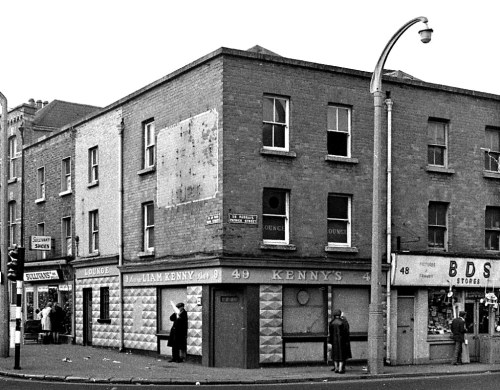
Liam Kenny's, 1970. Credit - Dublin City Photographic Collection.

Liam Kenny’s, 1970. Credit – Dublin City Photographic Collection.

In the mid 1980s, a large area of Patrick Street and Dean Street was taken over and demolished by the Council using compulsory order. Patrick Street was to be widened and lands to the west of Patrick Street to be used for housing and development purposes. After years of stalled building work and planning objections, the seven-story apartment block ‘Dean Court’, comprised of 200 apartments in eight separate blocks, was put on the market in 1994.

The shop front where Kenny’s once stood was a Chartbusters video rental shop and is currently a 99c discount newsagent.
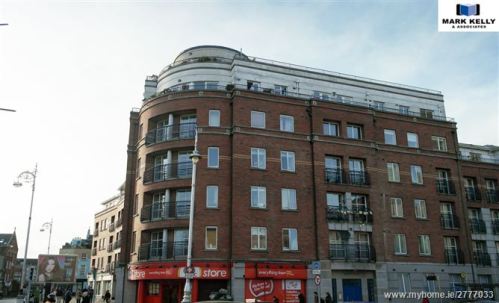
Where Kenny's once stood. Corner of Dean Street and Upper Patrick Street. Credit - myhome.ie

Where Kenny’s once stood. Corner of Dean Street and Patrick Street. Credit – myhome.ie

2. Quinn’s on the corner of 50 Patrick Street and 31/31A Upper Kevin Street. Status – Demolished, replaced by pub (now closed) and apartments.
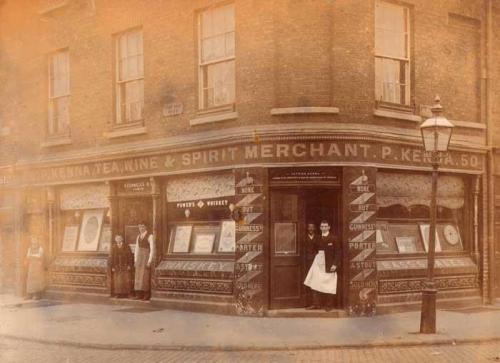
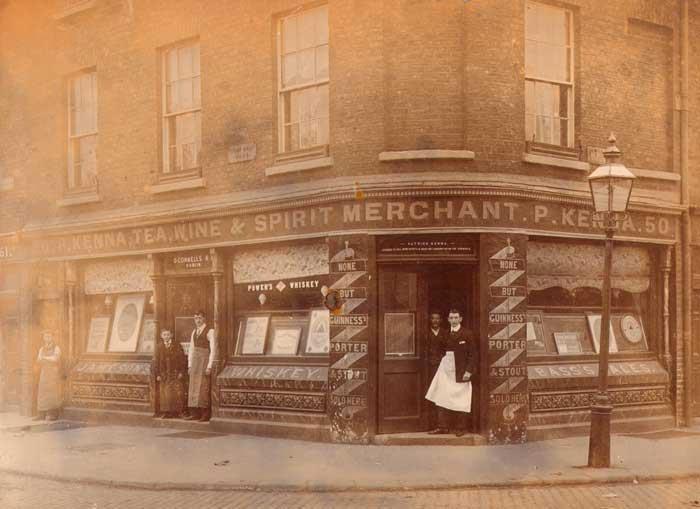
P. Kenna, Tea Wine & Spirit Merchant 50 Patrick Street Dublin. c. 1900. Credit - @OldDublinTown

P. Kenna, Tea Wine & Spirit Merchant 50 Patrick Street Dublin. c. 1900. Credit – @OldDublinTown

This pub was previously known as P. Kenna’s (see above), Kiernan’s (c. mid 1900s – 1920s), Cahill’s (1930s), Brannigan’s (mid 1940s) and Hamilton’s (late 1940s).

Continue Reading »

184539_471007652976549_1057136523_n

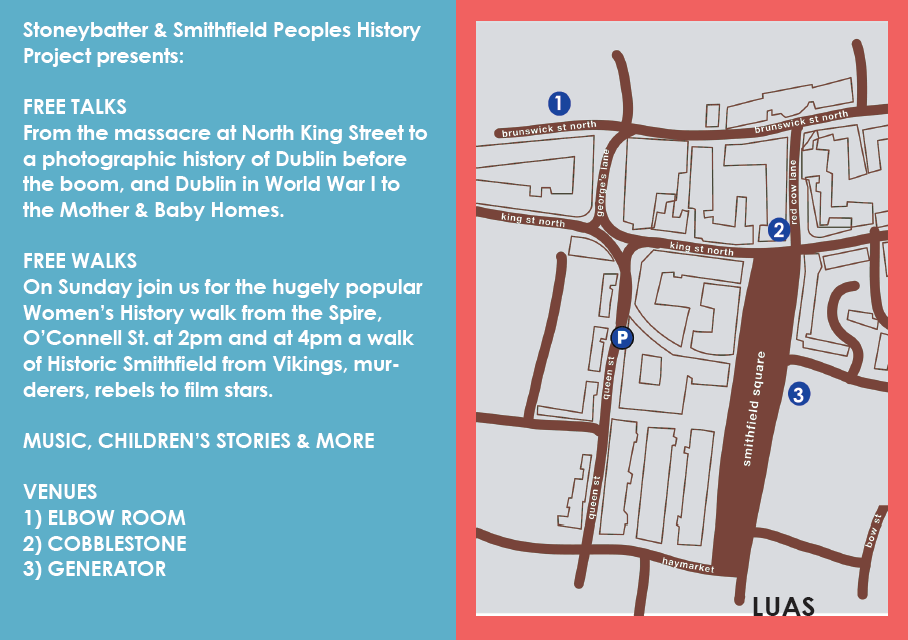
This weekend sees the inaugural Street Stories Festival happening in Stoneybatter and Smithfield. There’s a wide variety of talks, walks, gigs and more taking place over the weekend, beginning tonight and carrying right through to Sunday. The majority of the events are free to attend and below we’ve listed a few we think are particularly interesting, along with the information on venues and times.

Tonight sees it all begin with David Jazay, a photographer and film maker, talking about photographs he took in a Dublin before the Celtic Tiger. Jazay took many photographs of Dublin life in the late 1980s and early 1990s, showing a city that would witness huge change in the decade ahead. From shop owners to long-since redeveloped streets, the images mostly compromise Dublin’s inner-city areas.

Tonight in the Cobblestone, 7.30pm.

William Gallagher of Martin+Joyce's Butcher shop, Benburb Street (David Jazay)

William Gallagher of Martin+Joyce’s Butcher shop, Benburb Street (David Jazay)

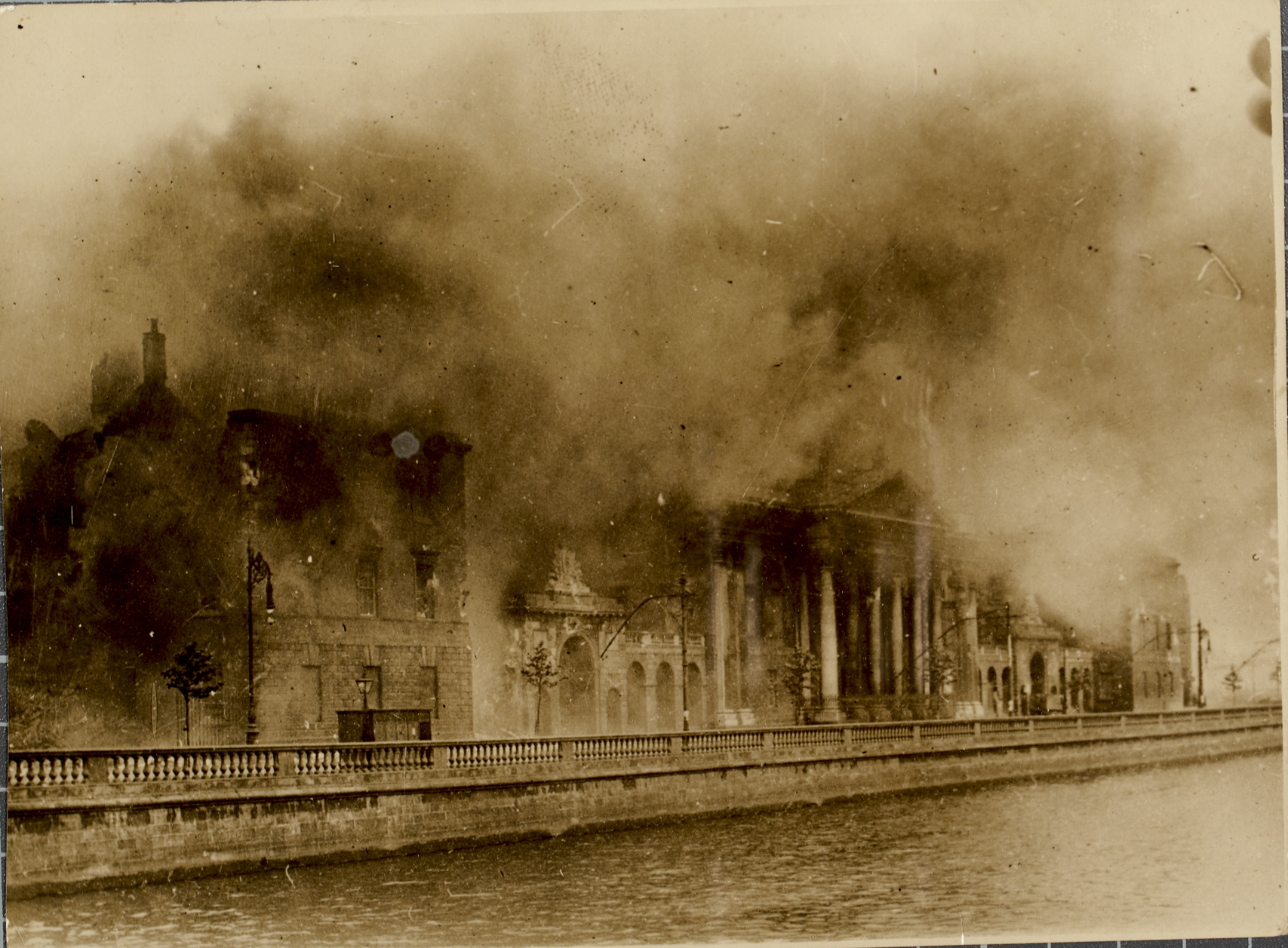
Tomorrow there are a wide variety of historical talks, covering both local history and the larger picture. At 12.30PM Liz Gillis, author of ‘The Fall of Dublin’, will be discussing the North King Street Massacre in 1916 in The Cobblestone. Brian Hanley is talking at 2.30PM on Dublin in the First World War, with that talk taking place in The Generator, Smithfield. 2.30PM also sees archaeologist Franc Myles discuss ‘Smithfield Through The Ages’ in The Cobblestone. One of the very first meetings hosted by the local history society, Myles packed the pub out before on the theme of Smithfield’s early development and history. At 4.30PM Las Fallon will be talking about ‘Dublin Fire Brigade and the Irish Revolution’, revealing that some firefighters were in the business of starting fires and not stopping them during the revolutionary period! That talk takes place in the Elbow Room, at 32 North Brunswick Street.

The Four Courts ablaze in 1922.

The Four Courts ablaze in 1922.

On Sunday two walks have been organised to coincide with the festival. Firstly, there is a walk looking at the role of women in the Irish revolution leaving from the O’Connell Street Spire at 2pm. At 4pm, the ever-entertaining Alan MacSimoin will be taking people on a walking tour of historic Smithfield, covering everything from Vikings to film stars and back again.

More information on the festival and the wide variety of talks taking place can be found here.

To give an idea where the venues are, this map should come in handy. They are all a handy stroll from one another.

10687008_725670544154833_7542553792162419833_n

King Billy on the chain.

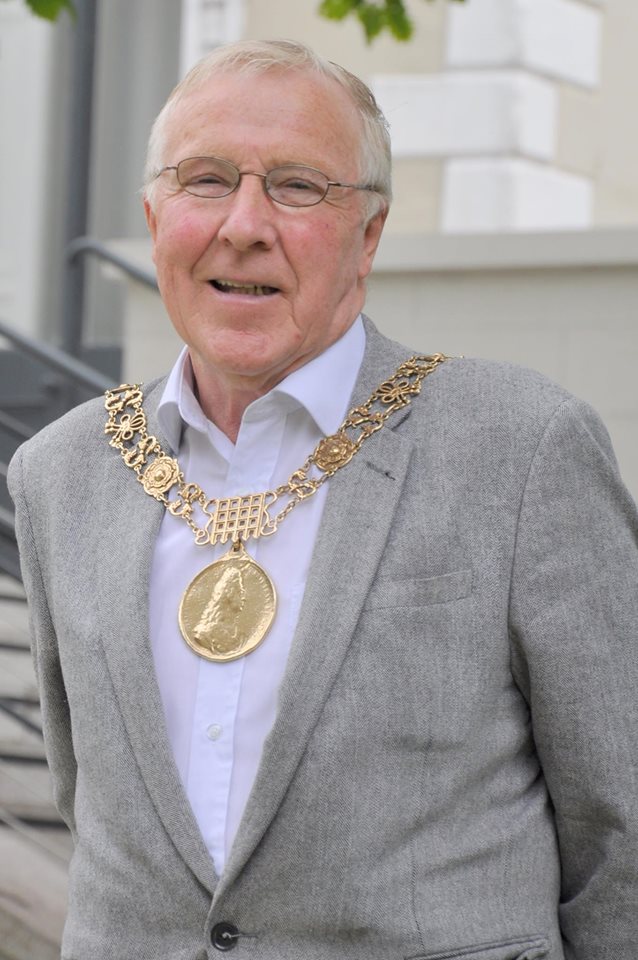
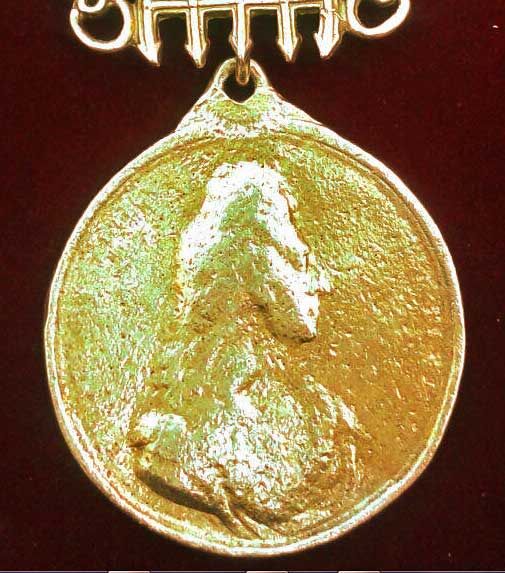
The office of the Lord Mayor have an official page over on Facebook, which I recently stumbled upon. It reminded me of something I’d wish to look at briedly on the site before, which is the Lord Mayor’s chain. It is photographed here on  our current Lord Mayor, veteran republican Christy Burke.

What people tend not to notice is the presence of a certain William III on the chain, better known to us today as King William of Orange. The current Lord Mayor’s chain of Dublin was completed in 1698, only eight short years after the Battle of the Boyne and within the lifetime of William. The previous Lord Mayor’s chain showed Charles II upon it, who commissioned the first Lord Mayors Chain for the city.

The original Lord Mayor’s chain, according to W.G Strickland, was taken by Sir Terence McDermott, Lord Mayor of the city who who fled to France during the religious wars of the  late seventeenth century. What became of it remains a mystery. Bartholomew Van Homrigh, the Lord Mayor of Dublin following William’s victory at the Boyne, was first to wear the William III chain, and it  was valued at the time at £1,000.  A Dutch merchant, Van Homrigh expressed his hope that “in everlasting memory of the great services of William III to the Protestant inhabitants and as a mark of his royal grace and favour” William would bestow  such a chain upon the city.

Thanks to Póló for this image showing clear detail of William III.

Thanks to Póló for this image showing clear detail of William III.

Kathleen Clarke, widow of 1916 leader Tom Clarke, made headlines in Ireland and further afield by refusing to wear the chain during her time in office. Dublin’s first female Lord Mayor, Clarke objected to the symbolism of the chain. Clarke also removed a portrait of Queen Victoria from the Mansion House, stating that “I felt I could not sleep in the Mansion House until  she was out of it.”  During her time in office Northern unionists asked the city of Dublin, perhaps tongue-in-cheekly, to hand over both the William city chain and the portrait of Victoria. Perhaps they were unaware that the words ‘Erin Go Bragh’, or ‘Ireland Forever’ in English, are inscribed on the Belfast Lord Mayor’s equivalent, but that’s a story for another blog….

Archive footage of Clarke speaking has been uploaded by RTE to YouTube:

Dear, Dirty Dublin.

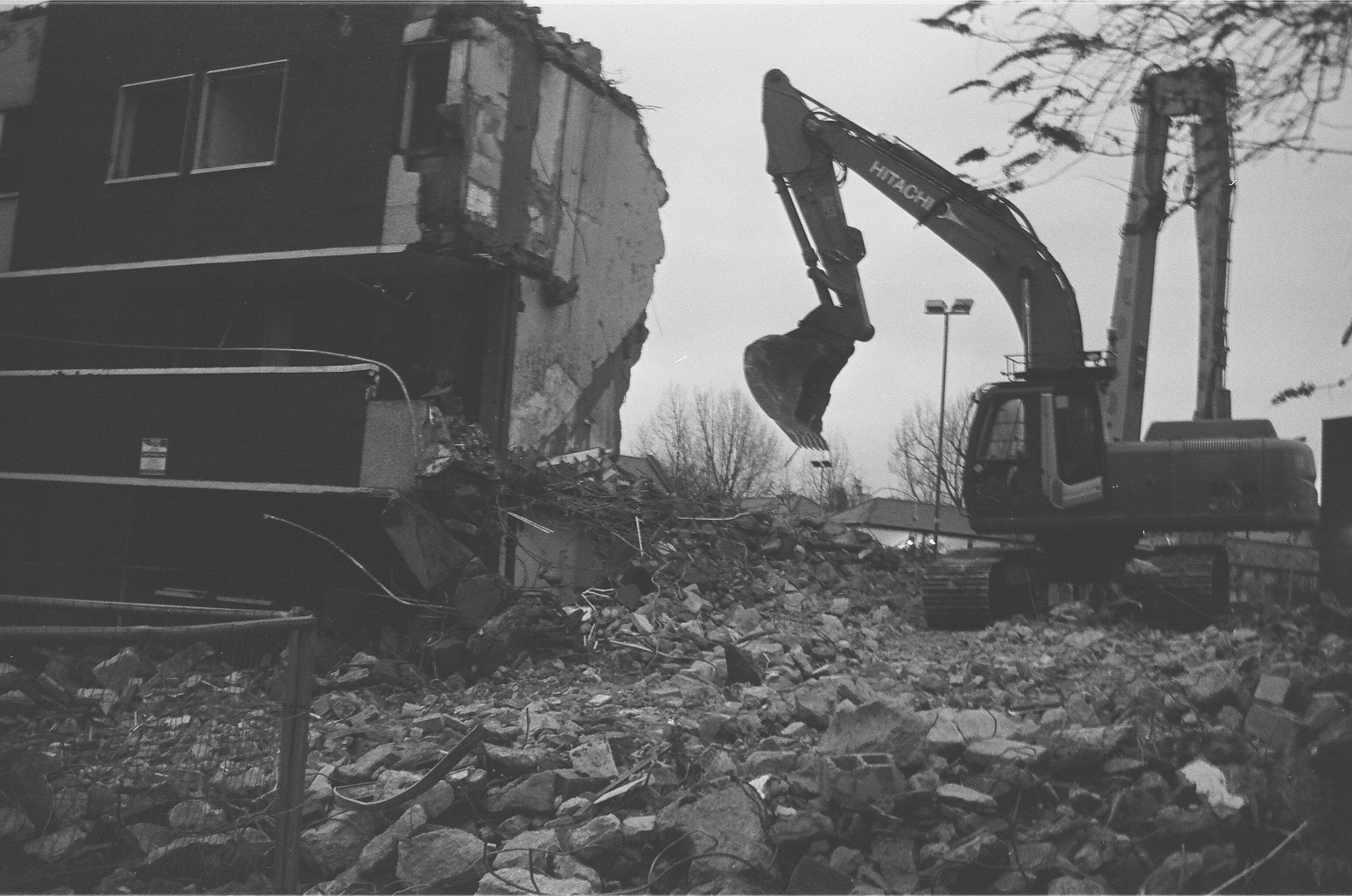
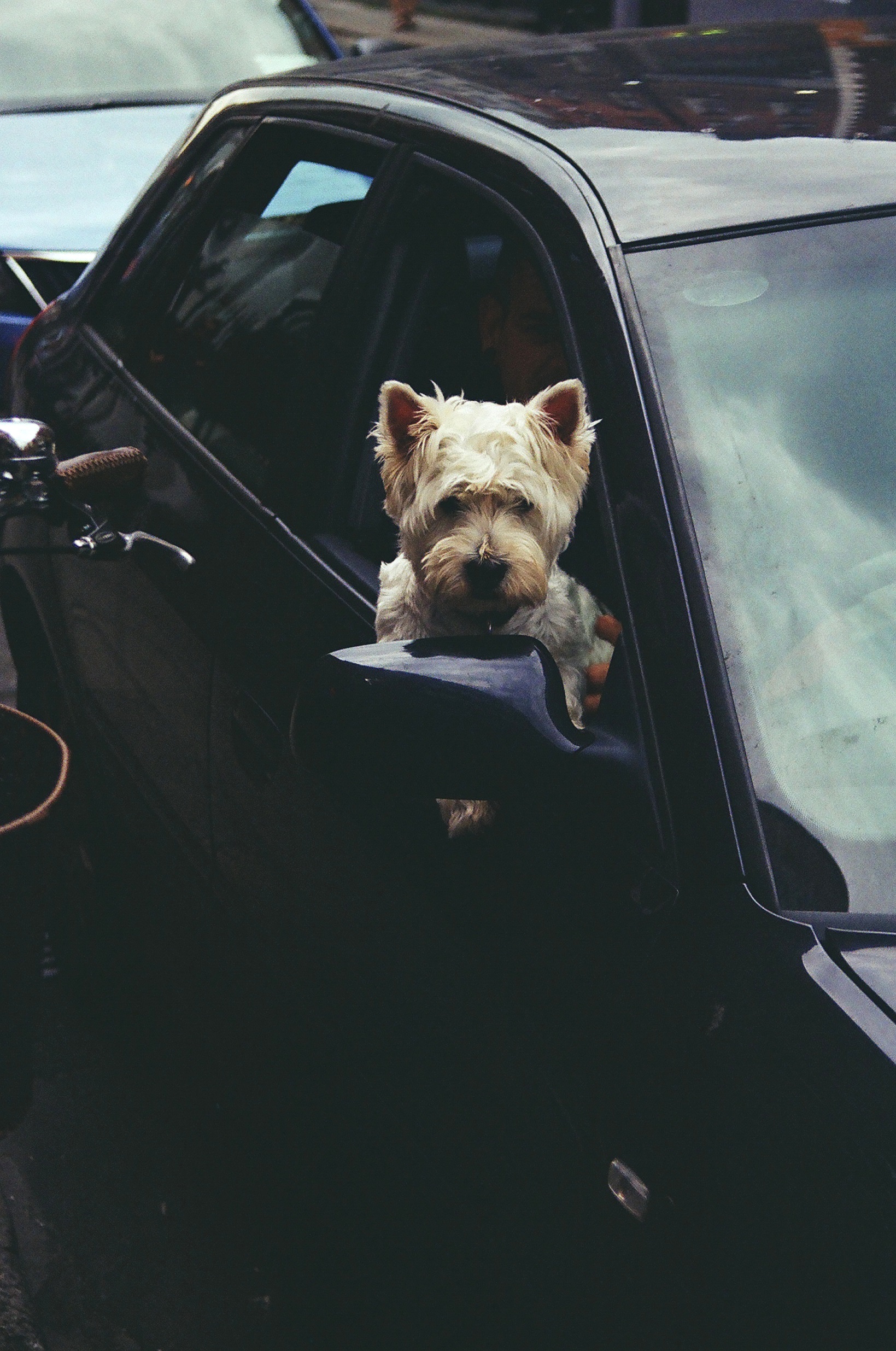
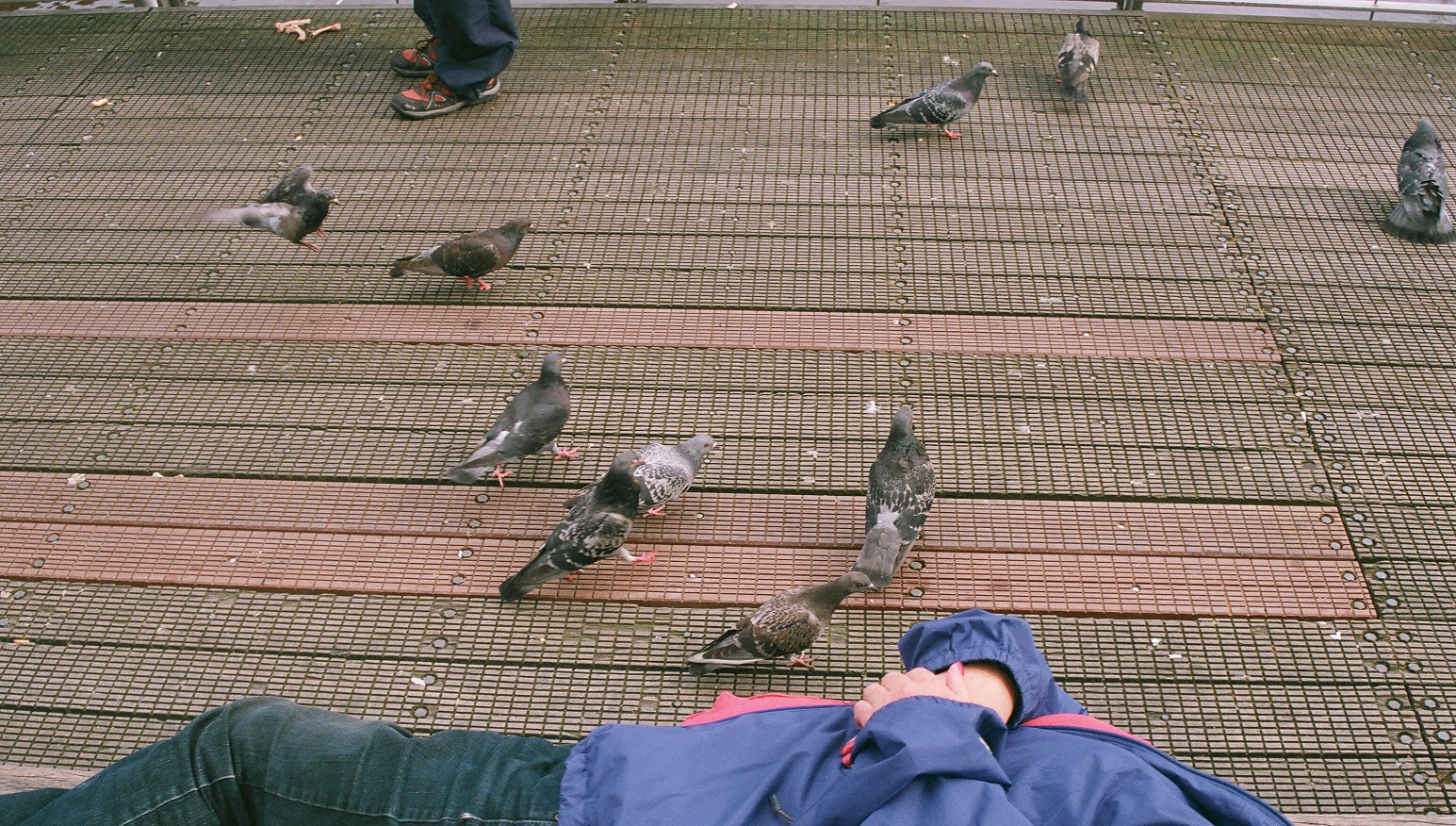
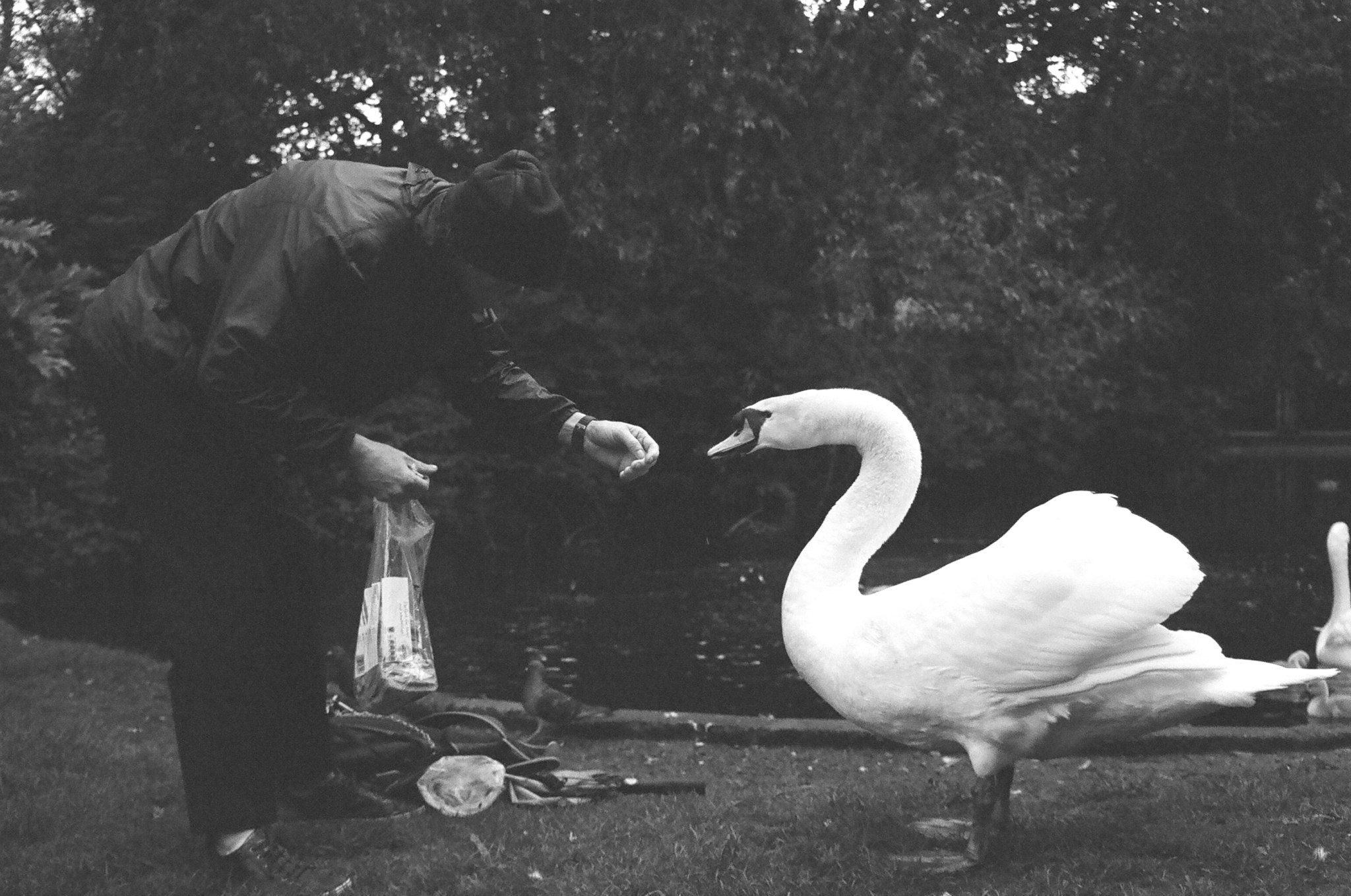
My thanks to Luke Fallon for providing these images, we’ve posted some of his images before on the site (for example the Croppies Acre memorial) and it’s a nice dimension to the blog that looks at Dublin today and not just the historical city.  Included here are some recent events in the city, such as the demolition of the Charlemont Street flats and the All City Tivoli Jam, along with images of life in the city.

Charlemont Street flats demolition.

Charlemont Street flats demolition.

A posing dog.

A posing dog.

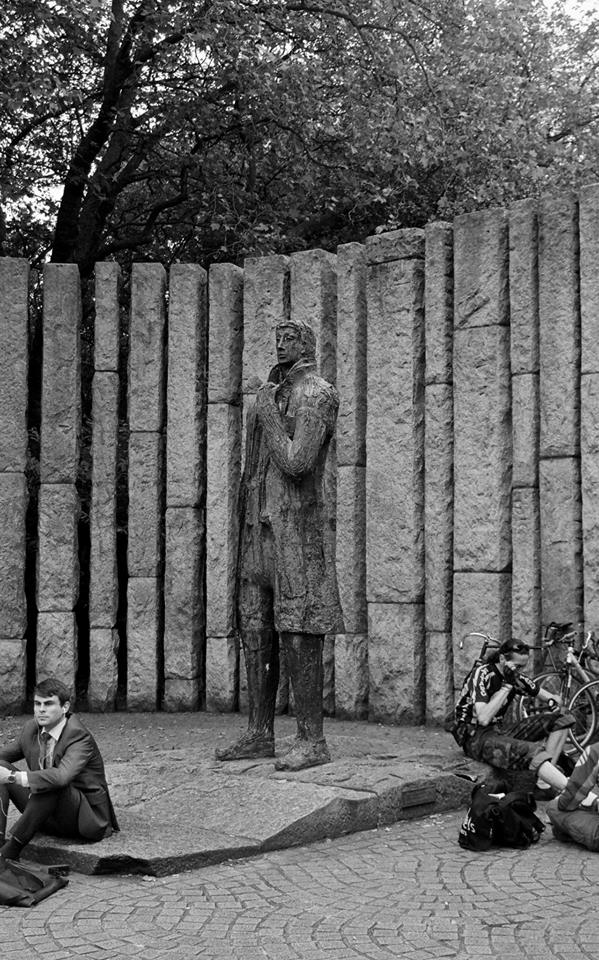
Theobald Wolfe Tone memorial, Stephen's Green.

Theobald Wolfe Tone memorial, Stephen’s Green.

Liffey boardwalk.

Liffey boardwalk.

Stephen's Green.

Stephen’s Green.

Continue Reading »
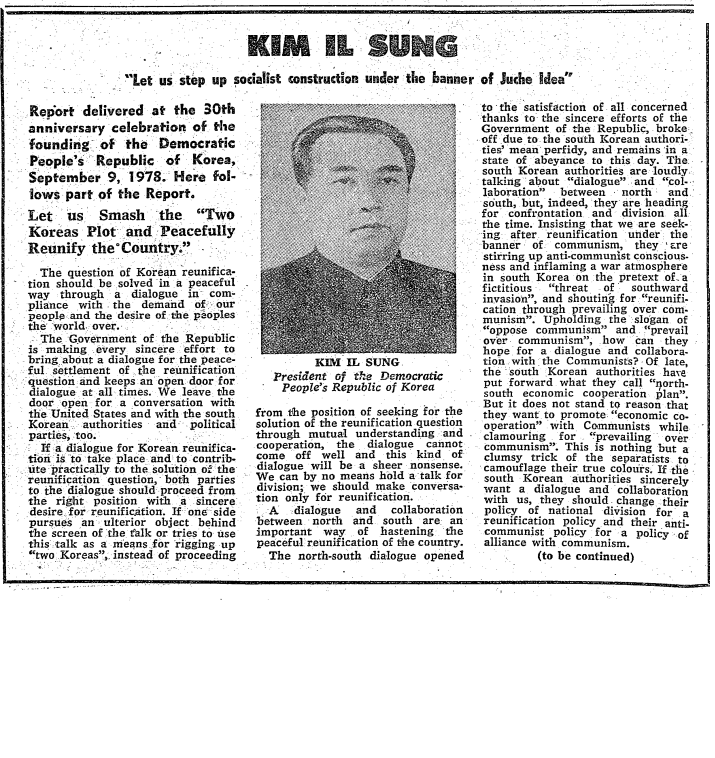
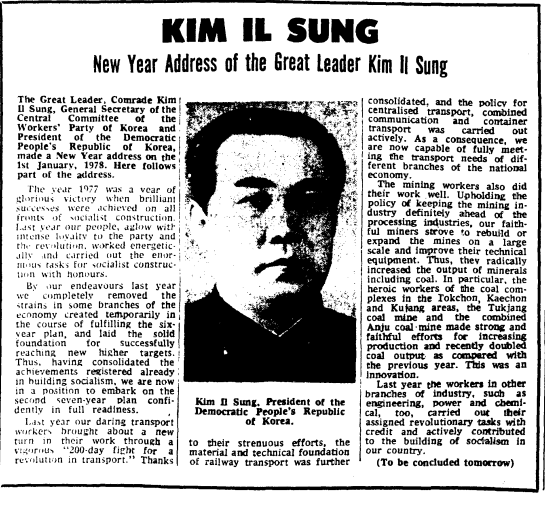
A curious feature of The Irish Times in  the late 1970s was the frequent appearance of advertisements paid for by the North Korean state, detailing Kim Il-Sung’s thoughts and ideological positions on a wide range of issues. The advertisement below, which declared Let Us Smash The Two Koreas Plot and Peacefully Reunify The Country! is a typical example, showing a picture of Kim Il-Sung alongside a message read at “the 30th anniversary celebration of the founding of the Democratic People’s Republic of Korea”

The Irish Times, 22 February 1979.

The Irish Times, 22 February 1979.

Kim Il-Sung’s face would have been a regular sight for readers of the paper, appearing sometimes on a monthly basis.  The advertisements referred to him by a variety of titles including ‘Great Leader’ and ‘Comrade’. The first reference I found to these advertisements was within The Lost Revolution: The Story of the Official IRA and the Workers’ Party. In the book, Sean Garland, a leading figure in the Official Republican movement, talked about visiting North Korea and informing authorities there that “putting full-page ads into The Irish Times of Kim Il-Sung’s thoughts was a waste of money because nobody fucking read them.” Curiously, The Irish Times itself reported in April 1976 that “after spending a fortune on propaganda material extolling its economic achievements in recent years, North Korea is now virtually bankrupt….the propaganda mainly took the form of advertisements, many of them in western papers.”

The Irish Times, 16 February 1978.

The Irish Times, 16 February 1978.

The Irish Press wrote about the advertisements in April 1976 calling them “indescribably boring”, and noting that the advertisements were “carefully camouflaged to resemble the paper’s own editorial matter.” Readers of the Dublin-based newspaper saw only the same official state portraits of Kim Il-Sung. In the North Korean media, it was common practice to reprint these Western advertisements as if they were news reports and not paid content. Certainly, they are some of the most unusual advertisements to ever appear in Irish newspaper history.

An interesting comment followed us posting this piece on Facebook. It was highlighted there that in the 1970s the library of Trinity College Dublin was presented with a series of books on Kim Il-Sung by the “State Central Library of the Democratic People’s Republic of Korea.” Images of the books have been posted to Facebook by DH History, the history society of the university.

A gift to TCD from the DPRK. Via www.facebook.com/duhistory

A gift to TCD from the DPRK. Via http://www.facebook.com/duhistory

Meet me on Misery Hill…..

The area around the Grand Canal Theatre (I refuse to call it anything else, sorry Bord Gáis) is largely speaking unknown territory to me with regards the history of the city. Recently I was taken aback by a street sign informing me I was standing at ‘Misery Hill’, a name that seems totally at odds with the fashionable area around the theatre today. In a time before theatre and cappuccinos the area looked rather different indeed, and one writer in the Freeman’s Journal in 1920 wrote:

How many Dubliners know Misery Hill? The name itself is a stroke of genius,whoever invented it, and the bare thoroughfare, running between grimy walls, over which peer huge gasometers, with in the distance orange plums of acrid smoke drifting from the chimneys of a chemical factory, shows that Dublin, when it sets itself to it, can outrival Wigan!

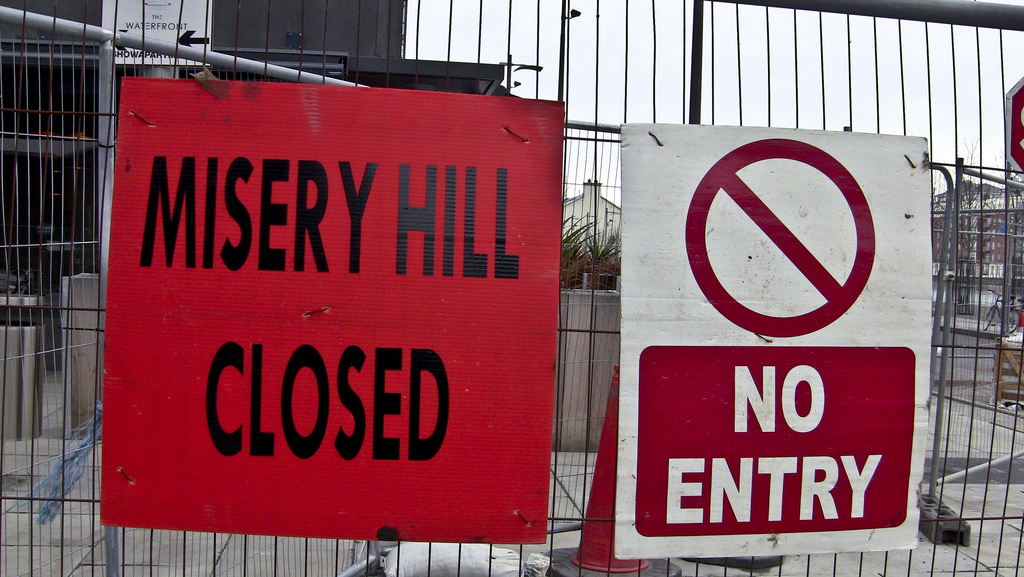
"Misery Hill Is Closed."  (Image by William Murphy: https://www.flickr.com/photos/infomatique/4446399832 )

Misery Hill Is Closed. (Image by William Murphy: https://www.flickr.com/photos/infomatique/4446399832 )

Paul Clerkin’s wonderful little book Dublin Street Names (Published in 2001 by Gill and Macmillan and right up the street of a lot of CHTM readers I imagine) gives good insight into this bizarre name, noting that “in the early 13th century, there was a leper hospital close to the junction of modern Townsend Street and Hawkins Street. Sufferers who were unable to gain entrance to the hospital would spend the night at Misery Hill, well away from the town and its citizens.”

The inimitable Éamonn Mac Thomáis spoke about Misery Hill in a paper for the Old Dublin Society in the late 1960s,  and like Clerkin points to the historic leper hospital, stating that “it was sometimes referred to as Lazor Hill, Lazy Hill, Lazars Hill and Lepers Hill.” He also states however that another possible meaning for the name comes from the fact that those executed on Gallow’s Hill (“a common place for execution”)   often had their bodies taken here,  where morbidly enough “they were left hanging in chains for a period of six months to a year.” The example Mac Thomáis provided were  two pirates name Gidley and McKinley, whose bodies were hung up here in 1766.

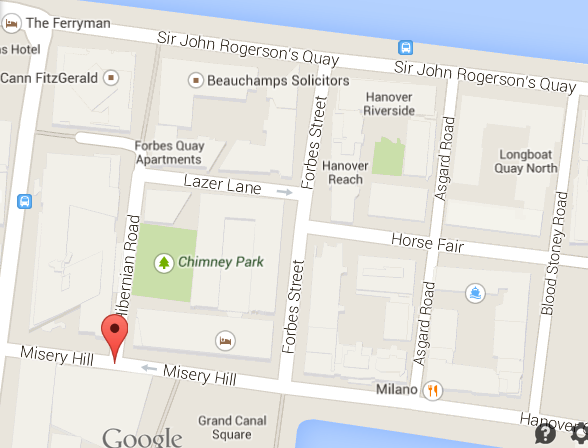
Google Maps showing the location of Misery Hill in Dublin's docklands.

Google Maps showing the location of Misery Hill in Dublin’s docklands.

An interesting short history of  leprosy in Ireland, mentioning Misery Hill, has appeared on the Facebook page Wistorical and can be read here, and it includes a lot of interesting detail on the history of the disease in Dublin.

A historic street sign for Misery Hill pops up briefly in this video of Ronnie Drew performing Ratcliffe Highway, at 00:56. This is a great video I’d not seen before, and my thanks to Shane Fitzgerald for pointing it out to us on Facebook.

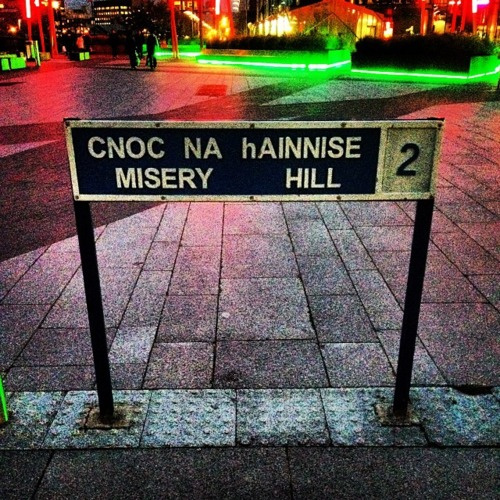
A nice little nod to the streetname comes from Dublin band Tujacques, who in December 2013 used the street sign for an EP cover. That the title of a previous EP was Obedientia Civium Urbis Felicitas (the somewhat ironic city motto of Dublin, implying that obedient citizens make for a happy city) makes us think they’ve a soft spot for the history of Dublin too!

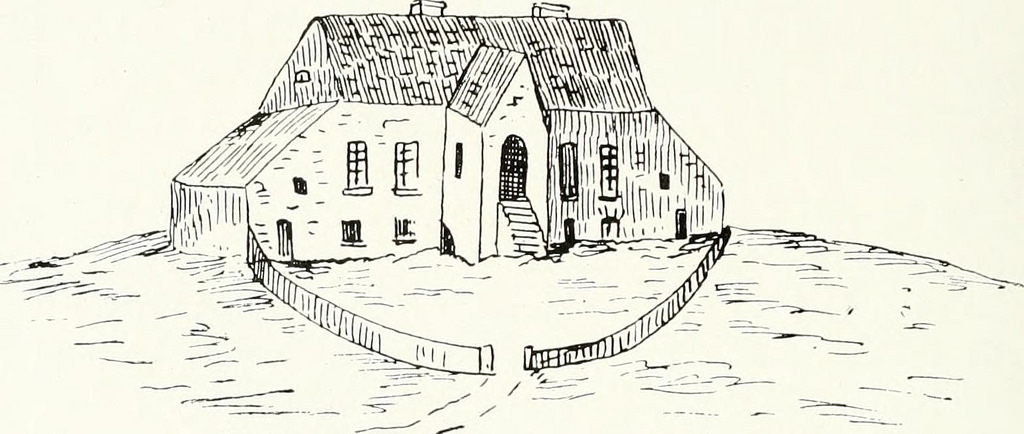
(Image from: A history of the County Dublin; the people, parishes and antiquities from the earliest times to the close of the eighteenth century" (1902))

(Image from: A history of the County Dublin; the people, parishes and antiquities from the earliest times to the close of the eighteenth century” (1902))

Recently I found this 1902 illustration of the ruined building that stands on top of Mountpelier Hill in the Dublin mountains, uploaded to Flickr by the Internet Archive book images.  We’ve long been interested in these ruins and wandered up to them in December 2012, something I’d recommend for any readers who haven’t done it.

1

The history of the ruins is mysterious, and a belief that the site is haunted dates right back to the eighteenth century. Joseph Holt, an important figure in the revolutionary United Irishmen, hid there while on the run in 1798 and wrote about his experiences:

I lay down in the arched room of that remarkable building, on Montpelier Hill. I felt so confident of the protection of the Almighty, that the name of enchantment, and the idle stories which were told of the place had but a slight hold of my mind; I thought there could be nothing worse there than myself, and having returned thanks, and praying for a continuance of God’s blessing and protection, I composed myself, and soon fell into as profound a sleep as if I had been, as formerly, reposing in my own comfortable bed, in quiet times, with my happy family about me.

In his wonderful book ‘Blasphemers and Blackguards: The Irish Hellfire Clubs’, David Ryan noted that it “remains uncertain if there was an actual connection between the club and this building”, he noted that “in the 1820s there were rumours that a murder had been committed there” quoting one contemporary source which stated about the hill “on the crown of this hill is a lodge falling to ruin, not having been inhabited for thirty years: it is called the haunted house, and the hill Bevan’s Hill: local tradition states  that in this house a man, named Bevan, murdered his wife.”

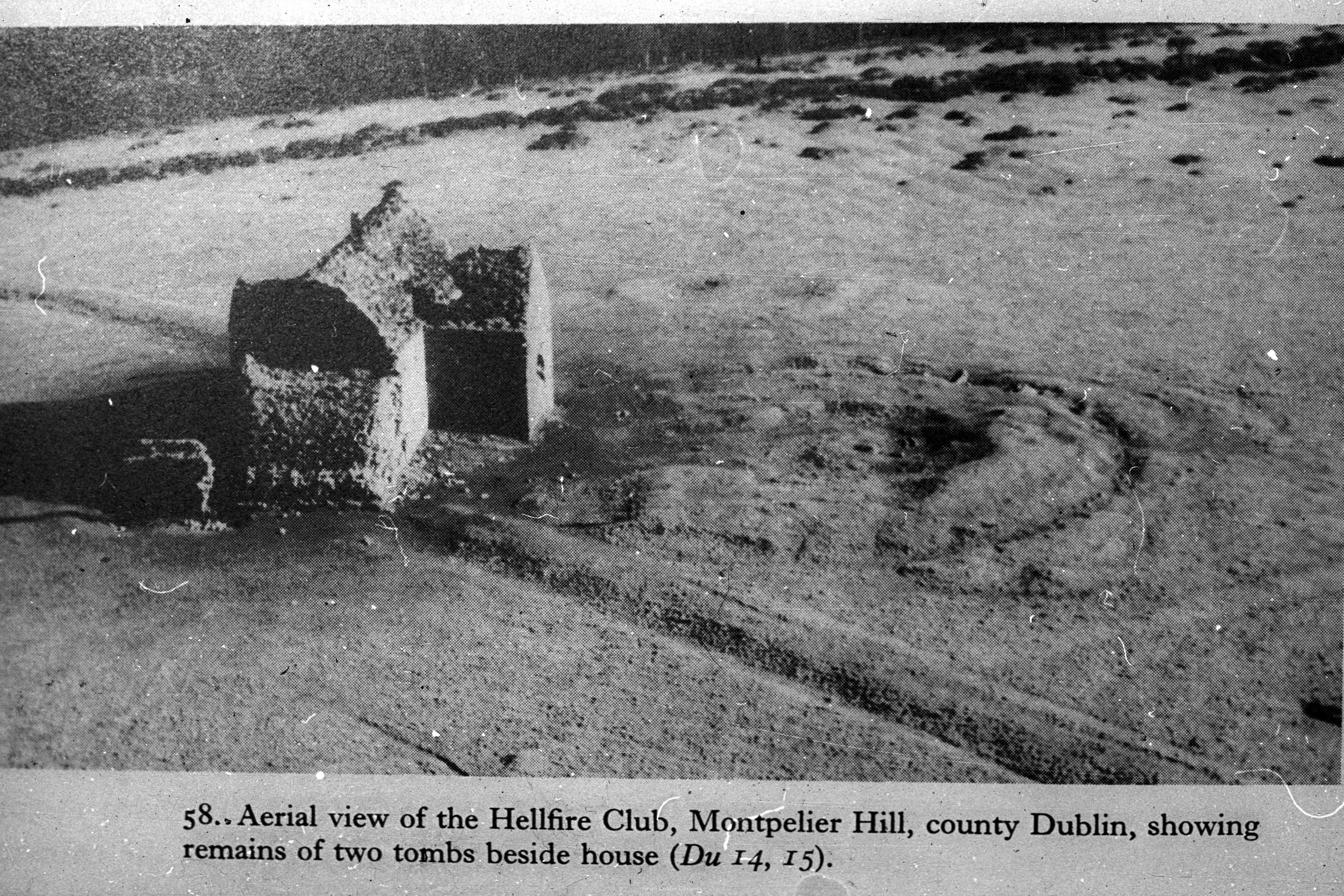
Ryan notes in his book that the lodge was constructed for William Connolly, speaker of the House of Commons, and that “the lodge may have been designed by Edward Lovett Pearce, architect of Connolly’s mansion, Castletown House in County Kildare, and the Parliament House on College Green.” Ryan’s work tells us that by early twentieth century this ruin was very much central to the folklore of the Hellfire Club, and that by the late twentieth century it was even appearing as ‘Hell Fire Club’ on Ordnance Survey maps of the area.While the Hellfire Club may never have utilised the site, other stories in the immediate area of the ruin and the mysterious nature of the site himself ensure it’s still a spooky trip. The wall around the lodge, shown in the 1902 illustration, is no longer there, and this great aerial shot from South Dublin County Libraries collection gives some idea how it has changed:

South Dublin County Libraries aerial view of site. (Credit – source.southdublinlibraries.ie.)

South Dublin County Libraries aerial view of site. (Credit – source.southdublinlibraries.ie.)

Lastly,  when I posted the above illustration on CHTM’s Facebook (Give us a like as we post a lot of content there) the first reply referenced a rave that occurred at the site in the 1990s, one of many. This sparked a wave of coverage in local and national media, and we’d be interested in getting our hands on some of this if anyone has any of it! It’s an interesting part of the history of the ruin. A comment on the CHTM Facebook page remembered a rave in the 1990s.

I remember there was a good crowd up there, and there was strobe lighting emanating from windows of the ruins. At one point during the night at least 3 cop cars arrived at the summit. This resulted in lots of people dancing in the headlights

A great video giving a tour of the ruin can be found on YouTube, uploaded by thebettyfordclinic who have uploaded some excellent videos of abandoned buildings in Dublin.

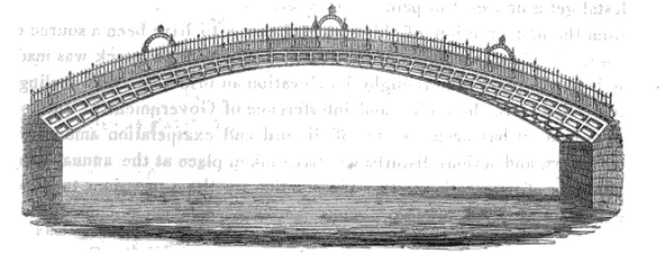
An 1816 illustration of the Ha'penny Bridge, the year the bridge opened to the public.

An 1816 illustration of the Ha’penny Bridge, the year the bridge opened to the public.

Since May 1816, Dubliners have been walking over what we now popularly know as the Ha’penny Bridge, though the bridge is formally known as the Liffey Bridge. Today, it carries an average of 30,000 of us from one side of the city to the other on a daily basis.  Contemporary sources praised the bridge at the time of its unveiling, with one noting “it has a light and picturesque appearance, and adds much to the convenience and embellishment of the river”. At £3,000, the bridge was a costly replacement for a ferry service operated at the site previously, though costs were recuperated  through the half penny toll, which would give the bridge its popular title. The mooring point for the historic ferry service on the south bank was as Bagnio Slip, with the historian Frank Hopkins noting that “the name bagnio is believed to originate from an early eighteenth-century Temple Bar brothel.”

The bridge in 1929, decorated to mark the centenary of Catholic Emancipation (Image: Dublin Tenement LIFE)

The bridge in 1929, decorated to mark the centenary of Catholic Emancipation (Image: Dublin Tenement LIFE)

The idea for the construction of the bridge came from John C. Beresford, a member of Dublin Corporation, and William Walsh,  the ferry operator. The bridge was  to be christened the Wellington Bridge, in honour of the Duke of Wellington, victor of the Battle of Waterloo only a year previously and a native Dub. The Dublin Evening Post, barely able to contain themselves, reported on the opening of the bridge that:

A testimonial to the Hero of the British Army has at last been erected – a Testimonial at once creditable to the name with which it is to be honoured,greatly ornamented to the City of Dublin, and eminently useful to her inhabitants. We allude to the arch of cast iron thrown over our river, from Crampton Quay to the Bachelor’s Walk, opposite to Liffey Street, and which, we understand, with the express permission of the Illustrious Duke, is to be called Wellington Bridge. This Arch, spanning  the Liffey, is one of the most beautiful in Europe: the excellence of its composition, the architectural correctness of its form,the taste with which it has been executed, and the general airiness of its appearance, renders it an object of unmixed admiration.

Wellington, a son of Dublin, after whom the new bridge was to be named.

Wellington, a son of Dublin, after whom the new bridge was to be named.

Interestingly, for something so associated with Dublin, the bridge itself was cast at Shropshire in England. Some Dubliners refereed to it not as the Wellington Bridge but rather the Triangle Bridge, which Frank Hopkins has noted was bestowed on it owing to the controversial background of John C Beresford, one of the men who had brought the bridge into being. Beresford was a former Tory parliamentarian who had twice sat in Westminster, but controversially was also active in a yeomanry which opposed the United Irish rebellion of 1798. His riding school premises in Dublin became synonymous in the mind of republicans with torture and the practice of flogging rebels upon a triangular scaffold.

The practice of torture was described in one nineteenth century history of Ireland thus:

The triangle was a wooden instrument made in the form of the letter A, about twice the height of a man, to which the person to be punished was tied, hands and feet, and lashed with wire cords knotted. In the midst of this torture, questions about the conspiracy were asked, and if the answers not satisfactory, the punishment was renewed!

In 1861 a letter writer to The Irish Times asked if the “miserable impost” of the fee to cross the bridge would ever be abandoned, insisting that “the general public are often obliged to go out of their way in going from one side of the city to the other to avoid the payment of the toll.”

Continue Reading »

In San Francisco in 1973, gay activist Harvey Milk successfully petitioned gay bars in the Castro District to stop selling Coors beer. This was in response to an appeal from the Teamsters union who called for a boycott of Coors as the company refused to sign a Union contract. The gay community were themselves hostile to the company as Coors implemented a strict employment discrimination policy and refused to hire gay workers. With the help of a coalition of Arab and Chinese grocers the Teamsters had also recruited, the boycott was successful. In return, the Union hired more gay men to drive Teamsters beer trucks. It was a splendid example of solidarity.

A year later in Dublin, a very minor but compelling event brought together trade unionists and gay activists. Even if was just for fifteen minutes!

On Saturday 27th June 1974, ten lesbians and gay men protested in Dublin in what was the first ever public demonstration of LGBT Pride on the island of Ireland. The group included Northern Irish gay political activist Jeff Dudgeon and the then Trinity Lecturer David Norris.

Gay activist outside the Department of Justice, 27 June 1974. Credit - declancashin.com

Gay activist outside the Department of Justice, 27 June 1974. Photo – Gareth Miller. Credit – Irish Queer Archive (Facebook)

The protestors first picketed the British Embassy in Ballsbridge where one of the group organisers, the Sexual Liberation Movement (SLM) handed in a letter to the British Embassy in protest against the existing anti-gay legislation in Northern Ireland.

The group then marched to the Department of Justice on St. Stephen’s Green holding signs such as ‘Homosexuals are Revolting’ and ‘Lesbian Pride’. The small group of brave men and women literally stopped traffic as bus drivers and bicycle messengers slowed down or came to a screeching halt while trying to get a better look.

Gay activist outside the Department of Justice. Credit - Irish Queer Archive (Facebook). David Norris Collection.

Gay activist outside the Department of Justice, 27 June 1974. Credit – Irish Queer Archive (Facebook). David Norris Collection.

David Norris, in his autobiography, recalls an incredible incident when a lorry pulled up outside the Department during the picket:

A large roll of carpet was flung out the back of the lorry and a burly man descended. He took one look at us and shouted back to his colleague in the driving seat, ‘Jesus, Mick, they’re fuckin’ queers!’

A head appeared at the window and took in the situation. Then a deep bass voice shouted back, ‘Whorrabowra sure I don’t give a bollicks, a picket’s a fucking picket mate’ and with that an even larger and more muscular lorry driver jumped out of the cab and joined our picket for a quarter of an hour, leaving the minister’s carpet stranded on the pavement.

A splendid example of worker solidarity.

For more photographs and memories, check out the Irish Queer Archive on Facebook.

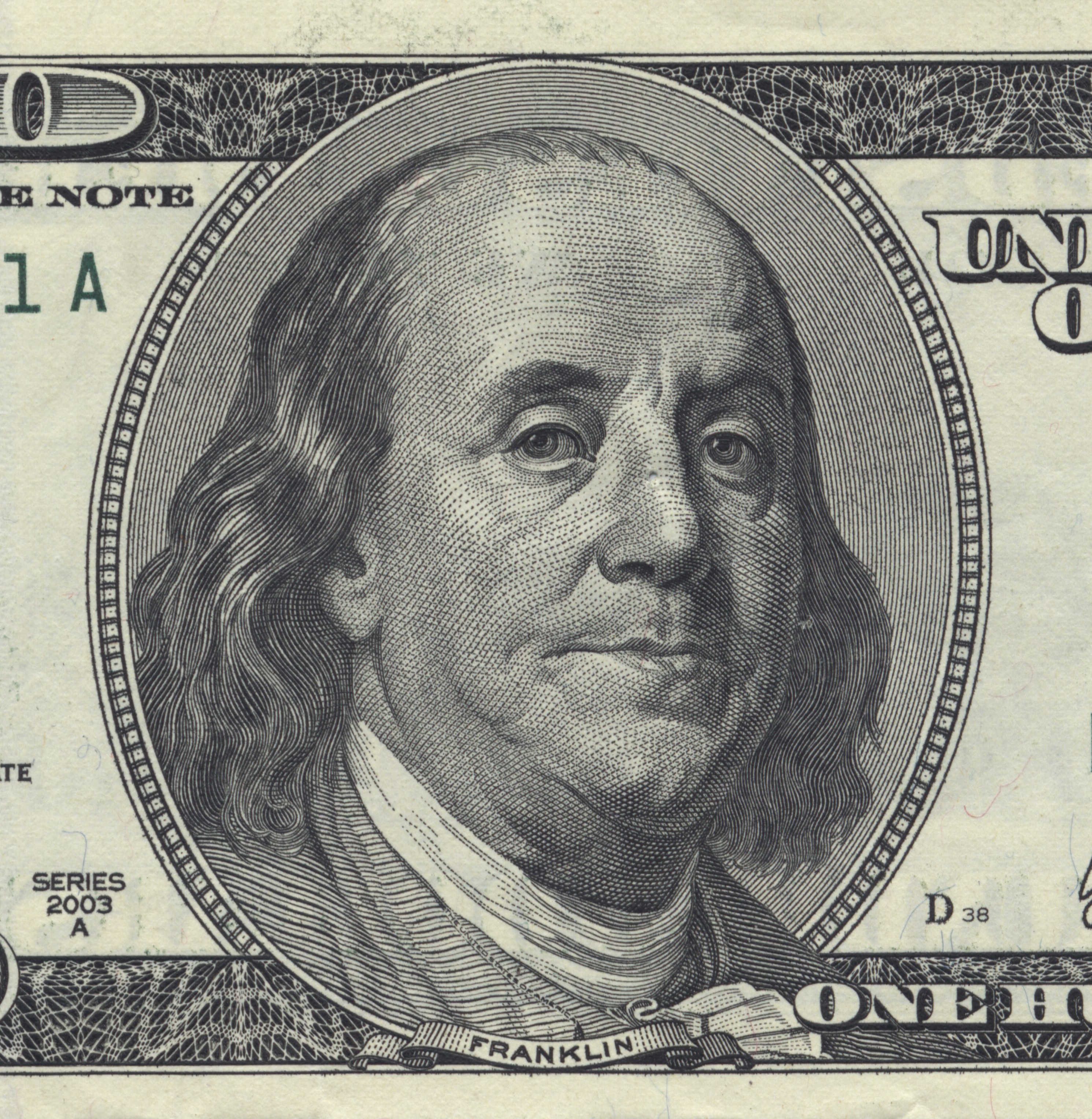
Benjamin Franklin as he appears in the wallets of Americans (Wiki Commons)

Benjamin Franklin as he appears in the wallets of Americans (Wiki Commons)

In  September 1771, Benjamin Franklin arrived in the city of Dublin, in the company of colonial agent Richard Jackson.  One of the Founding Fathers of the United States, Franklin is a signatory of the United States Declaration of Independence of 1776, though five years earlier he was based in London, attempting to negotiate on behalf of the American Colonies. Franklin detailed his views of Dublin and Ireland in a letter to Thomas Cushing, a lawyer and statesman from Boston, Massachusetts.  Franklin had a keen interest in Irish affairs, writing in a letter two years prior to visiting the country that “all Ireland is strongly in favor of the American cause. They have reason to sympathize with us.”

While in Ireland, Franklin was struck by the contrast between the grandeur of Dublin city itself and the intense poverty of those beyond its core. He commented to Cushing that:

Ireland is itself a poor country, and Dublin a magnificent city; but the appearances of general extreme poverty among the lower people are amazing. They live in wretched hovels of mud and straw, are clothed in rags, and subsist chiefly on potatoes. Our New England farmers, of the poorest sort, in regard to the enjoyment of all the comforts of life,  are princes when compared to them.

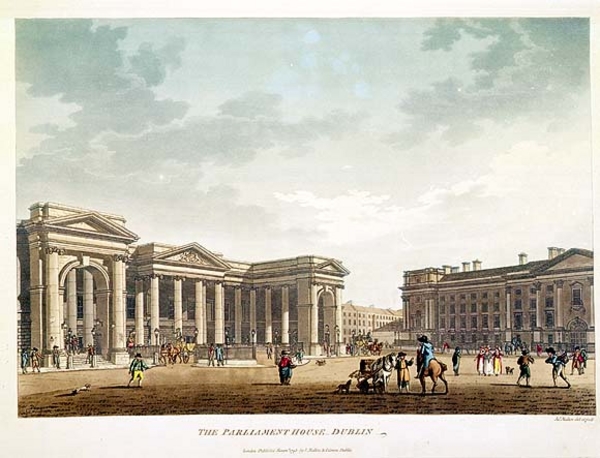
Franklin visited the Irish parliament at College Green, and was granted the honour of sitting in the chamber of the parliament alongside the elected Irish parliamentarians.  To Franklin, this was “a mark of respect for our country.”  It should be noted that the Irish parliament of the time was off-limits to the Catholic majority in Ireland, and was an entirely Anglican assembly, something later parliamentarians would seek unsuccessfully to reform. Franklin wrote of the parliament on College Green, telling Cushing:

Before I left Ireland I must mention that being desirous of seeing the principal Patriots there, I stayed till the Opening of their Parliament. I found them disposed to be friends of America, in which disposition I endeavored to confirm them, with the expectation that our growing weight might in time be thrown into their scale, and, by joining our interest with theirs, might be obtained for them as well as for us, a more equitable treatment from this Nation. There are many brave spirits among them, the gentry are a very sensible, polite and friendly people. Their Parliament makes a most respectable figure, with a number of very good speakers in both parties, and able men of businesses.

Parliament on College Green, which Benjamin Franklin visited. (NLI)

Parliament on College Green, which Benjamin Franklin visited. (NLI)


While in Ireland, Franklin spent three days at Hillsborough, County Down. He was a guest to Lord Hillsborough, the Colonial Secretary and a political opponent (frequently described as a nemesis) who he had encountered in Dublin. Walter Isaacson in his biography of Franklin writes that this was an “astonishingly friendly visit”, with Franklin writing to Cushing that he believed Hillsborough was not genuine in his friendliness but rather “he apprehended an approaching storm and was desirous of lessening beforehand the number of enemies he had so imprudently created.”

Franklin traveled on from Ireland to Scotland, where he was again shocked by an intensely poor peasantry. Following his trip to Scotland and Ireland he returned to London,  though he returned to the United States in March 1775. The rest, as they say, is history.

In 1977, the American Ambassador presented a bust of Benjamin Franklin to the Bank of Ireland to commemorate the visit. Speaking at the unveiling of the bust, the Ambassador (Walter J.P Curley) noted that

Franklin’s friendship for Ireland was no fleeting whim.  He had said “You have ever been friendly to the rights of mankind and we acknowledge with pleasure and gratitude that your nation has produced patriots who have nobly distinguished themselves in the cause of humanity and America.”