Feeds:
Posts
Comments
1939 headline from The Irish Times.

1939 headline from The Irish Times.

With the rise of late night spots like the Vintage Cocktail Club and the Liquor Rooms in Dublin, there seems to be quite a market for cocktails at the moment. Interestingly, in the 1930s, cocktails in particular were targeted by the temperance movement here, who saw them as a threat because of their appeal to the middle class and female drinkers. Cocktails were routinely denounced by some within the religious community, often lumped in with jazz dancing, gambling and other such risks to faith and morals.

The temperance movement in Ireland has a long and interesting history, with Father Theobald Matthew central to its story. In April 1838, Father Matthew established the ‘Cork Total Abstinence Society’, which quickly became a nationwide movement. Individuals took ‘The Pledge’, which saw them pledge that “I promise with the divine assistance, as long as I continue a member of the teetotal temperance society, to abstain from all intoxicating drinks, except for medicinal or sacramental purposes, and to prevent as much as possible, by advice and example, drunkenness in others.” Thomas O’Connor, in his entry on Father Matthew for the Dictionary of Irish Biography notes that:

His crusade rapidly developed into a mass movement whose organisation, given its scale, was necessarily loose. For this reason, it never became a structured, national organisation. This may be how Father Mathew preferred things, partly, perhaps, out of a fear of losing control, partly out of the conviction that the movement was divinely directed.

Father Matthew is today honoured with a monument on O’Connell Street, which was unveiled by the Lord Mayor of Dublin in 1893, when huge crowds thronged the streets. After Father Matthew’s movement, the most significant to emerge was the Pioneer Total Abstinence Society in 1898, though it should also be noted that the movement for abstinence was not limited to Catholic organisations, with sizeable Protestant equivalents active both in Ireland and Britain.
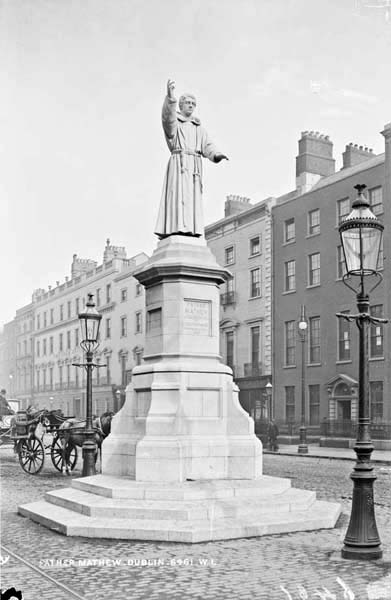
A historic image of the Father Matthew monument, O'Connell Street. (Image Credit: National Library of Ireland)

A historic image of the Father Matthew monument, O’Connell Street. (Image Credit: National Library of Ireland)

At the 1938 centenary celebrations of Father Matthew, where Éamon de Valera presided in front of a packed room in the Mansion House, the Bishop of Kilmore warned that:

I am told of a danger, not from the good old glass of whiskey, but rather from a new thing I have heard of called the cocktail, and I am told is not workmen you will see going after cocktails, but people who have some claim to education and better positions in life than the workmen, and that these people are falling more or less into the cocktail fashion. I have not seen it with my own eyes, but I have heard stories, which, if they are true, make me very sorry. If what I have been told is true, we should get busy about it, and open the eyes of fathers and mothers to it.

The appeal of cocktails to young female drinkers was often identified by those in the temperance movement. At the annual meeting of the Irish Association for the Prevention of Intemperance in 1936, it was noted that “appalling revelations have been made in the press lately about cocktail and sherry parties even among business girls in their own apartments.” This well attended meeting, which was held at Bewley’s on Grafton Street, called for “the discontinuance of cocktails and the elimination of drinking clubs”, as well as seeking “the elimination of drinking at public dances.”

Of course, the very idea of a young woman drinking was shocking to many. At a packed meeting in the Theatre Royal in 1932, hosted by the Pioneer Temperance Association, “the advent of the modern girl” was discussed, with one speaker noting that “she loudly proclaimed herself a post-war creation. She was certainly a post-war sensation. The Irish Independent reported that “They knew the type he meant – a feather headed, immature creature who talked a lot of being independent, emancipated and ‘flap doodle’ of that sort.”

The Irish Times denounced the cocktail in 1932, warning readers that the cocktail “fulfils no useful function. It is supposed by the many to induce an appetite and to stimulate intelligent conversation; in fact, it absorbs the pancreatic juices and encourages cheap wit.” Never one to over-sensationalise things in the 1930s, the paper reported the belief of a doctor from Clare Mental Hospital in 1937 that “now that women have taken with avidity to tobacco and cocktails, one can visualise the most appalling results for the human race at a not far distant date.”

In 1930, one writer in the pages of the same newspaper wished a quick demise to the cocktail trend in Ireland, hoping that it would not alone be put to rest but would remain there. “May earth lie heavy on the cocktail, for its influence has been heavy on the earth”, he hoped. Today, it seems the cocktail has never been more popular.

Below is the excellent 1976 RTÉ documentary on Irish involvement in the Spanish Civil War (Spanish Anti-Fascist War, 1936-1939) uploaded by our good friend and grandson of brigadista Michael O’Riordain, Luke in the last couple of days. Presented and produced by Cathal O’Shannon, the documentary features contributions both from Irishmen who fought for the International Brigades on the Republican side and those who travelled with Blueshirt Eoin O’Duffy’s Irish Brigade to support Franco and Fascism.

The documentary title was inspired by poet Charlie Donnelly, who remarked that ‘even the olives are bleeding’ shortly before he died fighting for the Republic at the Battle of Jarama in February 1937.

The documentary features some amazing footage, including an Eoin O’Duffy address from the balcony of the Ormond Hotel on Dublin’s Ormond Quay. Other notable contributions, apart from those with Michael O’Riordan and his great comrade Bob Doyle, came from Terry Flanagan, ex-baker and Saor Eire member and Alec Digges, a brigadista who returned to Ireland from Spain, before going on to fight in the Second World War, where he lost a leg.

Mural of Brigadista, Bob Doyle, installed on the Cobblestone Bar, Smithfield, (since removed.) From An Phoblacht.

On the fascist side, there is contributions, amongst others, from George Timlin, an NCO in the Irish Army who gave his reasons for going to Spain as “the spirit of adventure” and to quote “to oblige a friend… Eoin O’Duffy who wouldn’t have asked me if he didn’t want me to go” and Padraig Quinn, veteran of the War of Independence and the Civil War who, encouraged by the anti-communist sermon of his local bishop, joined Eoin O’Duffy’s legion.

Its sometimes easy to forget that there were Irishmen on both sides in an at times brutal war, and this documentary gives a good account of both.

Lyrics from the two Blades LPs

"Nice photo of Brian, Paul, Conor and Jake from the archives." - The Blades official FB page

l-r Brian Foley, Paul Cleary, Conor Brady and Jake Reilly. From The Blades official FB page. Photographer – Conor Horgan (www.conorhorgan.com)

As I continue to transcribe the interview that I did with Paul Cleary of The Blades the other week, I thought it would be worth collating the band’s lyrics in the run up to next weekend’s two gigs in the Olympia Theatre.

Friday is completely sold out but there’s a few tickets left for the Saturday night via Ticketmaster. Copies of both albums are available on CD via Reekus or via Itunes.

The lyrics to the 15 songs from Raytown Revisited weren’t included in the sleeve notes to the LP so I spent a couple of enjoyable hours listening to the album and trying to make out the words. Thankfully I got a lot of help from other members of The Blades fan group on Facebook.

The lyrics to the 11 songs from ‘The Last Man In Europe’ were included with the sleeve notes so it was just a case of writing them up.

If you see any mistakes, please leave a comment.

Lyrics from Raytown Revisited 1980-85 – LP – Reekus Records, 1985

1. Ghost of a Chance

Long weekend
When boredom takes a grip
I’m in Dublin
She’s on a working trip
Cause she send me postcards
Every now and then
Yes, she send me postcards

To put the blame on education
Call it separation

Ghost of a Chance
We never had
Ghost of a Chance
We never had

United Nations
They sit with headphones on
Hearing speeches
Protect the Lebanon

To hear her talking  (talking)
Sweet sincere
To her her talking  (talking)

This situation
Doesn’t need interpretation

Ghost of a Chance
We never had
Ghost of a Chance
We never had x 2

2. Animation

I dreamed I had a dream
And in that dream
I turned to stone
I woke up in the park
Under a statue in the dark
Then the statue walked away

Full buses, busy streets
No-one lost and no-one found
Can’t tell if my heart beats
I never hear a sound

Though it’s funny how I go into
Animation, when I see that girl walking by
Animation, with the single blink of an eye
Animation,  though I’m usually so shy

Long nights and longer days
And all that trouble that they bring
Stare through a coloured haze
I never seen a thing

Though it’s funny how I go into
Animation, when I see that girl walking by
Animation, with the single blink of an eye
Animation,  though I’m usually so shy

Animation, when I see that girl walking by
Animation, with the single blink of an eye
Animation,  though I’m usually so shy

3. Muscle Men

What a compliment, they say he’s got chiseled features
A face like granite would be fair
Wrestled with the thought, he may be one of God’s creatures
I’d rather wrestle with a bear

Muscle Men

Go and do your duty
And if anyone complains

Muscle Men

Make them understand
That muscle men have got no brains

I had to pinch myself just to see if I was dreaming
Woke up in hospital today
What a poor excuse when they asked him for the reason
“He wasn’t dancing the right way”

Keep the place in order
Shirt and suit and black bow tie

Muscle Men

Say it’s provocation
Muscle Men don’t ever lie

Muscle Men x3

Keep the place in order
shirt and suit and black bow tie

Muscle Men don’t ever lie

MUSCLE MEN!

4. Stranger Things Have Happened

Don’t…… try to hide
Your feelings
The way that I do
Please…. open your mind
And let…. me in it with you
Waking up together
Imagine it it this way
We could both swap memories
And stay in bed all day

Stranger things have happened x2

If… you go away
I won’t cry
And I won’t grieve
Faith… is a word
It means nothing
If you refuse to believe

We could say I made you and stop these silly games
In a foreign country, where no-one knew our names

Stranger things have happened x2

This is self-inflicted
Why must our hearts be blue?
Sometimes when out drinking I fool myself that…
I’ll forget you

Stranger things have happened x5

Continue Reading »

Citizen Tone

Citizen

I’ve always enjoyed the classic British comedy Citizen Smith, the work of John Sullivan, who later gave the world Only Fools and Horses. I think anyone who has spent any time in left-wing politics in particular can only laugh at poor Walter Henry Smith, or ‘Wolfie’, as he attempts to bring revolutionary inspiration to the people of South London.

A great Dublin dimension to it all is the fact that Walter Henry Smith’s nickname in the programme, Wolfie, is taken from Theobald Wolfe Tone. While in Paris, Theobald Wolfe Tone operated under the alias of Citizen Smith, with ‘James Smith’ appearing on his fake American passport. Tone had travelled to the United States in 1795, and while there attempted to drum up the support of the French Minister for the cause of Ireland.

Ralph E. Weber, in his study of United States diplomatic codes and ciphers, details a very interesting letter received by James Monroe in 1796, as a sort of introduction to the revolutionary Dubliner. Monroe, who would become the fifth President of the United States, was at that point serving as the Minister to France. As Weber has noted:

The text of the letter introduced the bearer to Monroe as a friend, Mr. James Smith, “who has been about two years in our Western Country in pursuit of lands, and now visits Europe in search of a good market.” The enclosed portion of the letter, however, revealed the bearer’s name to be Theobald Wolfe Tone, and that “the bearer hereof is an agent from Ireland in whom you may confide. His object is to obtain of France aid in favor of his distressed country what that aid should be and the manner of giving it he will mention.”

The real Citizen Smith.

The real Citizen Smith.

Sadly, I’ve been unable to find any reference to Sullivan explaining just why he took Theobald Wolfe Tone as the inspiration for naming the character. Neither Citizen Smith the secretive Irishman, or Wolfe the London revolutionary, ever brought about the change they envisioned for their respective people sadly. For anyone who has never watched the classic comedy, it is available to view on YouTube today. Below is the pilot episode, which even opens with The Red Flag.

I stumbled upon this hilarious personal account, of four tongue-tied students and a bewitching girl from the early 1910s, in the Witness Statement of Robert Brennan. The story is centered around a house in Lennox Street in Portobello and is worth reading in full:

“I had traveled to Dublin for an examination and I was met at the railway station by three Wexford friends of mine, John Moloney, his brother Peter, and Fred Cogley, all students. They were all staying at the same digs in Portobello and they had arranged for me to stay there also. We were hardly well inside the house when the three of them rushed to the front room crying, “Here she is”. I joined them and saw a very good looking girl. She came up the steps of the house and entered and the attentions of all three of them were transferred to the doorway through which she could be seen tripping lightly up the stairs. They said to me

“Isn’t she grand?”

I agreed and asked what she was like.

Well, haven’t you seen her for yourself?”

“But what is she like to talk to?”

They didn’t know. They had never spoken to her, because they had not been introduced. She was a lodger like themselves. Her name was Kiernan and she was a native of Carlow. I thought it strange that in the course of several weeks they were unable to strike up an acquaintance. They wanted to know how.

“Well” I suggested, “you could, for instance, run up the stairs when she’s coming down … bump into her and ‘beg your pardon’ and there you are”.

“But” said Peter, “what could we talk to her about?”

“I don’t know” I said, “maybe if you get talking to her you could think of something”. I suddenly remembered she was from Carlow. “Why not talk about Carlow?”

They knew nothing about Carlow, did I?

“The only thing I know bout it,” I said “is that they have electric light there.”

At the time Carlow was the only provincial town in Ireland so blessed.

The next day I left the library and walked up into Grafton Streer. What was my amazement when I saw Peter Maloney on the opposite side of the street standing talking to Miss Kiernan, or rather he was standing looking at her, his round, fair, innocent face like the rising sun. When he saw me he sent out signals of distress and I joined him and was introduced.

“This is Mr. Brennan, Miss Kiernan”.

I looked at her and saw the bluest eyes I had ever beheld. They were paralysing. I managed to say:

“How do you do?”

“I’m well, thanks” she said, and she was blushing too. I made a violent effor to concentrate.

“It’s a fine day” I said

“Yes” she replied

Then I tried in vain to think of any further word in the English, Irish or any other language. The silence was sold. At last I blurted out:

“Which way are you going?”

She indicated the direction of Stephen’s Green.

“That way” she said.

So am I”

The three of us walked towards Stephen’s Green. I tried to think of something to say and Peter’s obvious embarrassment did not help me. At last I had an idea. Of course, I could not know that Peter had said it already.

“I understand” I said “that you are from Carlow, Miss Kiernan”.

“Yes”

I saw now that Peter had already said it, but it was too late to draw back.

“I believe”, I said, and there was desperation in my voice, “that you have electric light there.”

“Yes.”

We entered Harcourt Street without another word. The perspiration was rolling off me. It was clear that what Peter was saying to himself should have blasted me from the earth.

We were halfway up Harcourt Street when we saw Cogley coming down. I thanked God.

He stopped and was introduced.

“How do you do”, he said and I was horror stricken to see that her eyes had the same effect on him.

“I’m well thanks”

He managed to say “It’s  a fine day.”

“Yes”

After a very long pause, he said: “I think I’ll go back with you”.

And the four of us walked on. The silence was now fourfold.

Of course, Fred got the same idea. I saw it dawning in his mind and I kicked him. This only spurred him on.

“I believe, Miss Kiernan” he said, “that you come from Carlow”.

“Yes.”

He knew now. It was evident from the quiver in his voice.

“I understand” he said “you have electric light there.”

“Yes.”

It was terrible. There was not a word spoken till we turned into Lennox Street. John Maloney was sitting on the steps of house. I hastened on in front.

“John” I said in a tragic whisper, “don’t say anything about electric light in Carlow”.

And aloud he said: “What about electric light in Carlow?”

She heard him and she passed indoors, her head held high. She never looked at any of us again.”

It was fantastically written so I was not surprised that the author, Robert Brennan, wrote several novels, plays and a well-received memoir.

Brennan was a founder member of the Wexford branch of the Gaelic League, Wexford IRB organiser in 1916, commanding officer of the Sinn Fein Press Bureau from 1918- 21, director of publicity for the anti-Treaty IRA during the Civil War, a founding member of the Irish Press and Fianna Fail, Irish Minister to the United States from 1937 to 47 and later director of broadcasting at Radio Éireann.

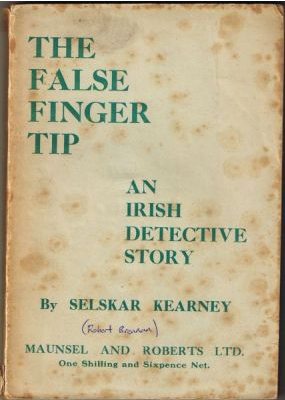
He published his first novel, The False Fingertip, in 1921 under the pen name ‘R. Selskar Kearney’ followed by a crime novel The Toledo Dagger, in 1926 under his own name.

The False Fingertip (1921). Credit - yvonnejerrold.com

The False Fingertip (1921). Credit – yvonnejerrold.com

In the 1930s his play about the life of convicts in an English prison, The Bystander, was performed in the Abbey, and later in the decade his comedy on the disappearance of the Irish crown jewels, Goodnight Mr O’Donnell, was performed at the Olympia Theatre.

The Bystander (1930). Credit - yvonnejerrold.com

The Bystander (1930). Credit – yvonnejerrold.com

After his retirement, he wrote and published his memoir Allegiance in 1950. The following year he wrote another novel, The Man Who Walked Like A Dancer, that was set in Washington. Through 1956 and 1957 Brennan published a weekly column of reminiscences in the Irish Press entitled Mainly Meandering. He passed away in 1964 and is buried at Mount Jerome cemetery.

His daughter Maeve Brennan was a celebrated New Yorker columnist (1954-81), called the Long-Winded Lady, who was almost unknown in Ireland until her work was revived to critical acclaim in the late 1990s. Described by one journalist last year as “The greatest Irish writer you’ve never heard of”, Maeve grew up at 48 Cherryfield Avenue, Ranelagh (the setting for almost half her forty plus short stories) but moved to New York in her late teens after her father became secretary of the Irish legation in Washington DC.

Her entry in the Dictionary of Irish biography by Angela Bourke discusses her early work and the build up of her image:

From 1943 to 1949 she wrote fashion copy for [Harper’s Bazaar] and its offshoot Junior Bazaar, often accompanying photographers on assignment, and also completed her novella ‘The visitor’. Her strikingly glamorous image, with dark lipstick, high heels, and hair piled on top of her head, dates from this period, while her trained observations of fabric, cut and colour would lend characteristic detail to all her fiction, and to her ‘Long-Winded Lady’ essays in the New Yorker’s ‘Talk of the town’.

Recruited to the New Yorker in 1949 by William Shawn, Brennan first wrote fashion notes and book reviews, but fiction editor William Maxwell soon began to publish her stories about Dublin. Maxwell later said of her: “To be around her was to see style being invented”. Some believe she was the inspiration for the character of Holly Golightly in Truman Capote’s Breakfast At Tiffany’s. The two had worked together at both Harper’s Bazaar and The New Yorker.

Maeve Brennan at home. Photo by Karl Blissinger. Credit - http://thelicentiate.com

Maeve Brennan at home. Photo by Karl Blissinger. Credit – http://thelicentiate.com

Journalist Colin Murphy picks up the story:

She married a colleague, St Clair McKelway, but he was even more unsettled: he had been married three times, and was a drinker, womaniser and depressive. Their five years together were chaotic; they had no children and, after they split, Brennan remained single.

Her sardonic observations of New York life  in her The Long-Winded Lady column in The New Yorker and her fiction criticism, fashion notes, and short stories were widely praised throughout the 1950s and 1960s. However, by the 1970s she became increasingly isolated and unable to take care of herself. She was mired in debt, thanks to her generosity, extravagance and a habit of abandoning apartments to stay in hotels. Brennan became homeless, and took to sleeping in a cubicle at the New Yorker, where she nursed a sick pigeon she had rescued. Her last New Yorker piece, ‘A blessing’, appeared on 5 January 1981. She died, in 1993, aged 76, in a nursing home.

It was only after he death that she became to be appreciated in her home country. Thanks mainly to a series of posthumous collections and biography of her written by Angela Bourke. Two plays about aspects of her life have been performed by Emma O’Donogue (‘Talk of the Town’, 2012) and Eamon Morrissey (‘Maeve’s House’, 2013) in recent years. The latter of whom met her in 1966 in New York as a 23 year old after he found out he was living in that house she grew up in. Eamon explained to the Irish Examiner back in September:

She is a neglected author in the Irish canon. And she is very definitely an Irish writer, even though she lived most of her life in New York. She’s in that difficult situation where the Americans regard her as an Irish writer and the Irish regard her as an American writer. Both nations should be proud to claim her.

Stealing the Brian Boru Harp.

In March 1969, one of the most unusual and important items in the Old Library of Trinity College Dublin vanished. Known as the Brian Boru Harp, the celebrated harp of Trinity College is believed to date back to the 15th century. The story of its taking grabbed huge media attention both in Ireland and abroad, and was caught up in the politics of the day. The harp was presented to Trinity College Dublin by William Conyngham in the late 18th century, and was restrung in the British Museum in 1962. This particular instrument is perhaps most famous for serving as the model for not only the insignia of the present Irish state, but also serving as the model for the Guinness trademark logo, which was registered in 1876.

The celebrated harp can be seen here, on display, during the visit of Queen Elizabeth II to Trinity College Dublin in 2011 (Credit: www.tcd.ie)

The celebrated harp can be seen here, on display, during the visit of Queen Elizabeth II to Trinity College Dublin in 2011 (Credit: http://www.tcd.ie)

The background to this amazing robbery is told in The Lost Revolution, Brian Hanley and Scott Millar’s study of the rise and demise of The Workers’ Party as a power in Irish political life. In that book, readers learn of Joseph Brady, a one-time member of the Irish Republican Army. Brady, an ex-British soldier, was recruited into the republican movement in 1967, joining the IRA and becoming a training officer to the Dublin Brigade. In the book it is noted that

During early 1969 Brady raised the idea of stealing the Book of Kells from Trinity College and holding it for ransom, but found no support. On 24 March he broke into the College himself and, unable to gain access to the Book of Kells, stole the Brian Boru Harp instead. A few weeks later he contacted the college and demanded £20,000.

Irish Independent (26 March 1967)

Irish Independent (26 March 1967)

On 26 March 1969, the Irish Press broke the story to their readership, outlying the concerns of T.C.D authorities with regards to the handling of the object:

The 600 to 700 year old Brian Boru harp, the oldest and most elaborately carved Irish harp in existence, has been stolen from the library of Trinity College. Dublin. It was discovered that the harp was missing yesterday morning. The thief broke in through a window by forcing the catch, and he forced open the case in which the harp was stored. Yesterday, College authorities appealed to the person who has the harp to handle it with extreme care as it is very fragile. They also asked that it be returned through whatever means would be safe in the handling of the 600-year-old harp. “It is not much use to anyone,” he said. “It is an antique, easily recognisable, and can barely be handled. Therefore,its sale is hardly likely. Maybe some person has it for a responsible cause, but we would ask them to please, please handle it carefully.”

International coverage was plentiful, and in some cases highly colourful versions of the truth were told. The Milwaukee Journal proclaimed the harp to be an astonishing 1,300 years old for example.

The harp photographed in 1962, following restoration at the British Museum (The Irish Times)

The harp photographed in 1962, following restoration at the British Museum (The Irish Times)

Henry Giltrap, the Secretary of Trinity College Dublin, began to receive calls in the aftermath of the robbery, requesting a sum of money in return for its safe exchange. The issue caused huge embarrassment for the authorities at Trinity College Dublin, with many questioning how a library which served as home to so many priceless works could be broken into with such relative ease.

When the harp was ultimately recovered, on 17 April, there was a suitably dramatic conclusion to the story. Indeed, as one journalist noted at the time, it was recovered “amid a series of episodes which could have come straight from the pages of a James Bond novel.” A threat was made via a ransom note that unless money was left in a dustbin at Bull Wall at 1 a.m, the instrument would be destroyed. Eleven Garda cars were stationed at a discreet distance from this bin, and when a man was seen to approach it, a decision was made to move in. The Irish Independent reported that:

As they did so a car which had been parked nearby accelerated from the scene and a chase followed. The driver was captured shortly afterwards. The other man, who is believed to be British, then drew a gun but threw it away as he made his escape. The harp which had been taken to Pearse Street Garda station was handed over by Inspector O’Brien to Mr. G. H. Giltrap, Secretary, T.C.D. “I am delighted that it has been recovered. This represents a great deal of hard work on the part of the detectives and Gardai,” said Mr. Giltrap.

The Long Room of the Trinity College Dublin old library, where the harp can be seen today (source: Wiki)

The Long Room of the Trinity College Dublin Old Library, where the harp can be seen today (source: Wiki)

In May 1970, R. Tynan, a young man from Drimnagh, pleaded guilty to receiving the harp knowing it was stolen. He was given a suspended sentence of two-years imprisonment for his role in the crime. During his court case, the story of the actual recovery of the harp was told. Gardaí noted that Tynan had co-operated with Gardaí and brought them to a “sand pit about two miles from Blessington. There, with Mr. Giltrap standing beside him, he unearthed a shovel and went to an overhanging ledge nearby and started digging until he uncovered something wrapped in black plastic material. It turned out to be the missing harp.”

What became of Joseph Brady? The Lost Revolution tells us that there was suspicion within the movement that he was a provocateur, indeed Brady was so distrusted that he was picked up at gunpoint by members of the IRA but managed to escape, dispute being shot twice. During his case, it was reported in the Irish Press that he had been in contact with Gardaí “for some years prior to the present case”, and it was noted that he had passed on information. Brady’s solicitor attempted to make the case in court that his life would be in danger in prison, and that he should be given a suspended sentence “which would allow him to go abroad as he would not be safe in this country and would always be branded as an informer.” He was sentenced to two years imprisonment.

—-
The Lost Revolution is available to purchase, with free delivery worldwide, from Kennys.ie

The murals of City Hall.

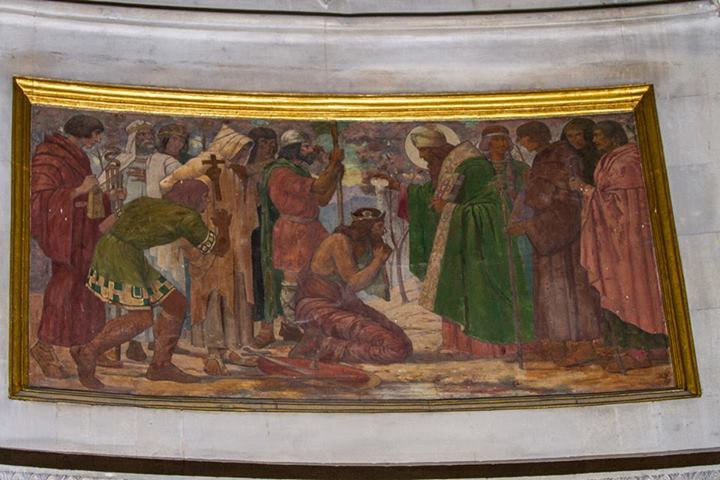
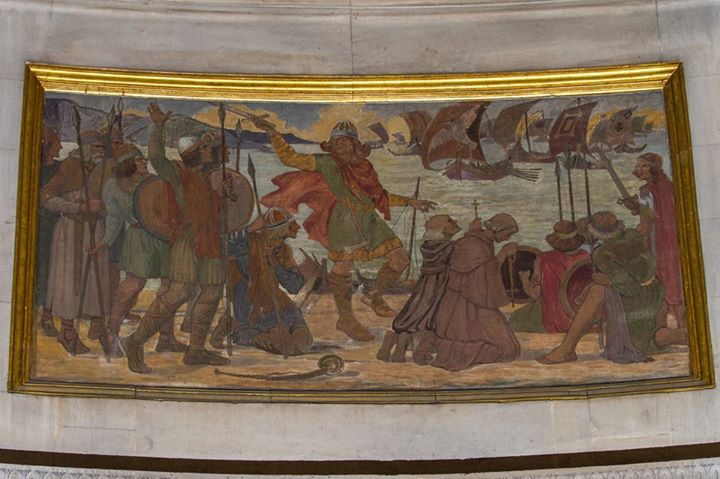
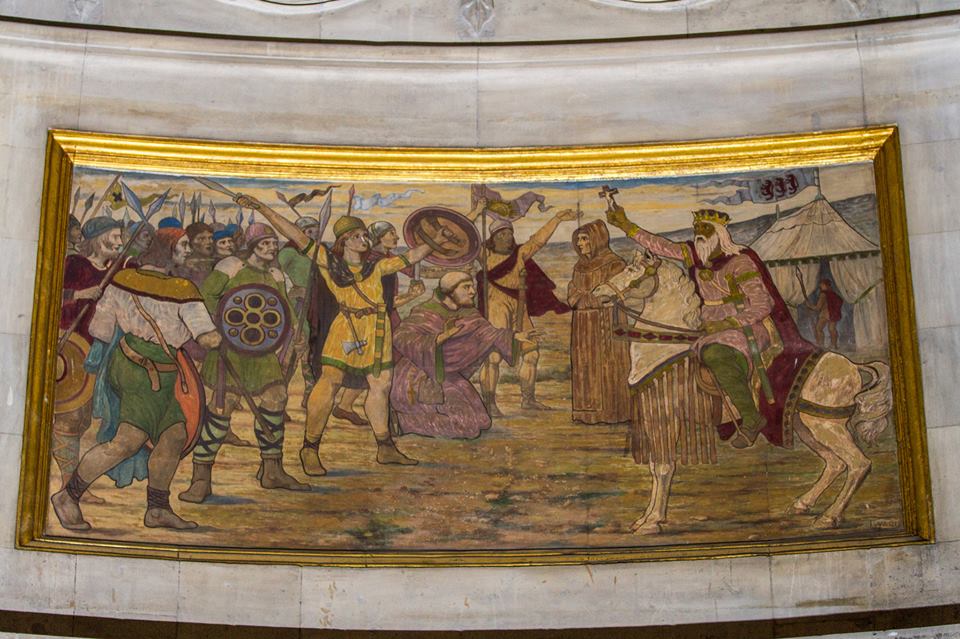
City Hall is an open door, but like most open doors in the city the locals don’t tend to wander in. If you do walk in though you’re rewarded by the sight of a beautiful rotunda, the centrepiece of the 1779 building designed by the architect Thomas Cooley. There are a whole series of excellent murals to view inside the building, telling the story of Dublin. Work on these murals began in 1914, and was undertaken by students of the Dublin Metropolitan School of Art, under their Headmaster James Ward. I sent Paul Reynolds of Rabble fame in to photograph them, lacking anything even resembling a camera myself!

Philip McEvansoneya has noted that “The subject matter was suggested by Alderman Thomas Kelly, the senior Sinn Féin councillor on Dublin Corporation.” The Corporation would have had a strong nationalist prescence even in the years prior to the Easter Rising, refusing to officially welcome several Royals to Dublin in the early twentieth century. McEvansoneya has noted in Irish Arts Review that there seems to be three themes running through the murals – “Dublin legends and history, Irish christianity and the historic struggle for Irish independence.”

'Saint Patrick Baptising the King of Dublin in 448 A.D' (Paul Reynolds)

‘Saint Patrick Baptising the King of Dublin in 448 A.D’ (Paul Reynolds)

The first reference to the murals I can find is a letter from James Ward to the Dublin Corporation in October 1913 offering to provide students and designs for paintings in the Rotunda of City Hall. The Irish Times reported that “On the motion of Alderman T.Kelly, it was resolved to accept the offer, provided the designs were of historical subjects connected to the city, and that the Corporation approved of them.”

Irishmen oppose the Landing of the Viking Fleet, 841 A.D (Image: Paul Reynolds)

Irishmen oppose the Landing of the Viking Fleet, 841 A.D (Paul Reynolds)

By January, 1915, the same newspaper were reporting that the first two of the murals were in place. The first depicted the arrival of Saint Patrick in Dublin, while the second showed the coming of the Norse.The murals were not completed until 1919, when the Corporation thanked Ward at a function below the paintings, over which the Lord Mayor presided.

Brian Boru and the Battle of Clontarf 1014 A.D (Paul Reynolds)

Brian Boru and the Battle of Clontarf 1014 A.D (Paul Reynolds)

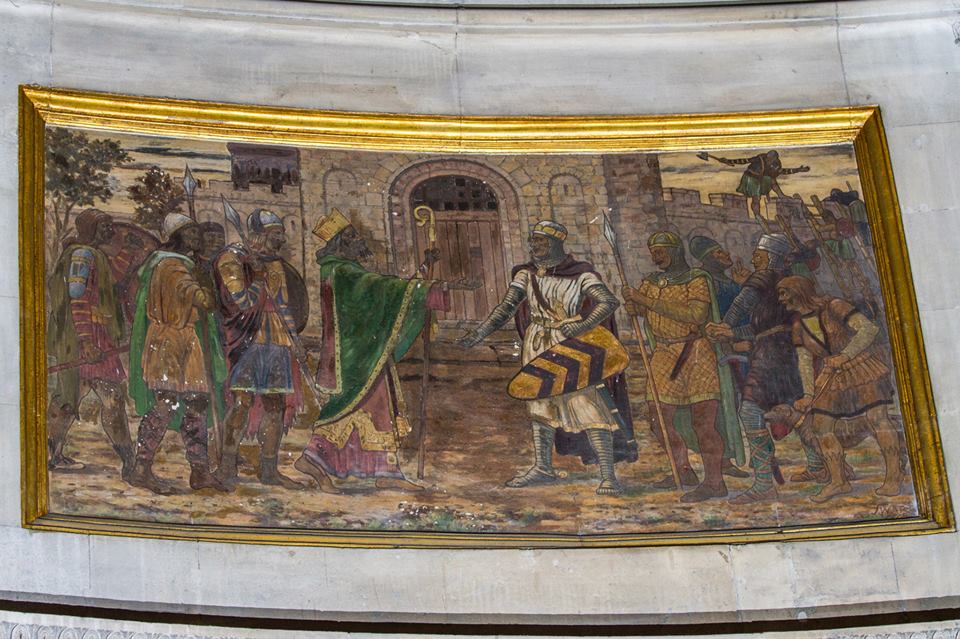
My favourite of the murals depicts the Battle of Clontarf in 1014, and shows an aged Brian Boru upon a horse. There will be much focus on this moment in Irish history next year, an event around which much mythology and folklore has grown. The arrival of the Anglo-Normans is also depicted, with Richard de Clare, or Strongbow, arriving at the gates of Dublin.

Parley between St Laurence O'Toole and Strongbow outside Dublin, 1170 A.D (Paul Reynolds)

Parley between St Laurence O’Toole and Strongbow outside Dublin, 1170 A.D (Paul Reynolds)

Continue Reading »

Since the publication of our article ‘Jewish community during the Revolutionary period (1916-23)‘, a number of people have left comments, emailed me directly or posted on external sites with new information and leads on the subject.

They are as follows:

1) 1901: Two Jewish workers listed as being active in James Connolly’s Irish Socialist Republican Party (ISRP).

2) 1908: Establishment of the short-lived Judaeo-Irish Home Rule Association.

3) 1919-1921: Philip Sayers (1876 – 1964) Jacob Elyan (1878- 1937) and Dr. Edward  ‘Eddie’ Lipman (1887-1965) as Sinn Fein supporters.

4) 1920: Death of Russian-born Jew Sarah Medalie at the hands of the Black and Tans in Cork.

5) 1924: Arrest of Polish Jew Idel Weingarten who later admitted to being a gunrunner for the Republican movement.

6) 1926:  Release of the film Irish Destiny which was written and produced by Dr. Isaac ‘Jack’ Eppel, a Jewish pharmacist.

7) Late 1920s/early 1930s: Involvement of Herman Good with the James Connolly Workers’ Clubs and the Irish Labour Defence League.

8) 1939: Arrest and imprisonment of Jewish IRA member Harry Goldberg in Liverpool.

9) late 1960s: Anecdotal evidence that many older working-class Jews in Dublin read the Manchester Guardian and the Moscow Times.

1.

Discovered in the Irish Socialist Republican Party (ISRP) minute book of 23 July 1901 and first publicised by Manus O’Riordan in a 1988 Saothar article – two Jewish workers living in Pleasant Street, Dublin 8 were active with this organisation. They were Abraham Volkes and an individual by the name of Barnet. O’Riordan also informed us that the pair had previously been involved with the Social-Democratic Federation (SDF) in Salford. This was the organisation that James Connolly spoke for during his two public speaking trips (1901 and 1902) to the city.

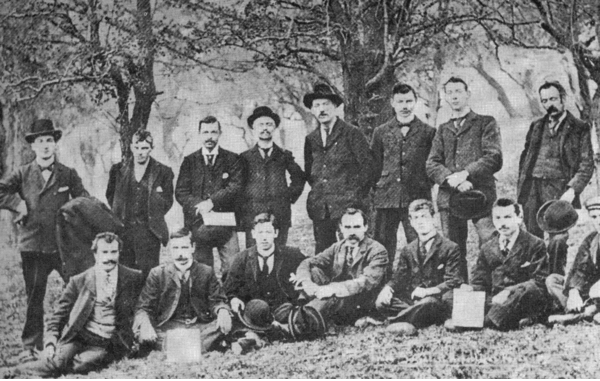
Members of the Irish Socialist Republican Party (ISRP) photographed in the Phoenix Park, May 1901. Credit - http://multitext.ucc.ie

Members of the Irish Socialist Republican Party (ISRP) photographed in the Phoenix Park, May 1901. Credit – http://multitext.ucc.ie

Unfortunately, I cannot find anyone by the name of Barnet or Volkes living in Pleasant Street in 1901. Though they are a number of Jewish families including Greenfield, Abrahams, Werner and Goldstone. Only one person with the surname Volkes seems to be living in the city at that time and he was an American Catholic. Also, there is only one Barnet but he was a Catholic Dubliner. Perhaps Barnet was his first name? There is one Jewish individual with the first name Barnet but he was only a baby at the time. Volkes is a German name and there is one German Jew with the first name Abraham in Dublin in 1901 but his surname is Cohen. At the time, he was a tailor living on Auburn Street off the Phibsboro Road.  The 1901 census was taken on 31st March 1901 so there’s a slight possibility that the two arrived into the city after this date and so were not present for the census.

If anyone can shed any light, please get in touch.

2.

The Irish Judaeo Home Rule Association was founded on 10th September 1908 at a meeting in the Mansion House that attracted around sixty Jews and three Irish Parliamentary Party MPs. The group was formed by Jacob Elyan and Joseph Edelstein and was believed to have contained about two dozen core supporters. MPs John Redmond and John Dillon sent their best wishes to the organisation and the names of Daniel O’Connell and Michael Davitt were recalled at the meeting as great friends of the Jewish people. Speakers at the meeting, besides Elyan and Edlestien, included Arthur Newman and the three Irish Parliamentary Party MPs – William Field, Timothy Charles Harrington and Stephen Gywnn.

An Irish Jew with Unionist sympathies was ejected from the meeting after trying to disrupt proceedings and a fight broke out amongst at least a dozen people towards the end. The Irish Times (11 September 1908) reported:

It appears that some of the Jews who were not in sympathy with the object of the meeting proclaimed their views rather loudly, with the result that they were rather roughly treated at the hands of their co-religionists, who were supported by a number of United League Leaguers.

The organisation seemingly only lasted a few months and didn’t receive any media coverage except for their inaugural meeting. Elyan is the only known original member who continued to be active in Home Rule politics, joining the United Irish League and becoming a member of its Dublin executive.

3.

I’ve been made aware of three more Jewish individuals who were supporters of Sinn Fein in the War of Independence period.

The first of these was Philip Sayers, described as a “Lithuanian-born early Sinn Feiner” by the Irish Independent (19 April 1943). When he passed away at the age of 88 in 1964, his short obituary included the line that he “took part in the Sinn Fein movement and was a life-long sympathiser with the national movement”. His Dublin-born son Michael was a well-known and celebrated poet and writer with strong political sympathies who married Mentana Galleani, daughter of the militant Italian anarchist Luigi Galleani. When he passed away three years ago, it was noted that Michael had “vivid childhood memories of [IRA] fugitives being hidden in the house and of police raids”.

Jacob Elyan (1878- 1937), who we mentioned earlier as having been a founding member of the Judaeo-Irish Home Rule Association in 1908, was also a close supporter of Sinn Fein. He had been invited by John Redmond to stand for election but declined due to ill-health. For the same reason, he was unable to take take a seat in the Free State Senate of 1923.

Dr. Edward ‘Eddie’ Lipman (1887-1965) was close friends with Count Markievicz, Arthur Griffith, James Stephens and other figures in the world of politics and the arts. He took up medical practice in London in the early 1920s where he and his Mayo wife Dr. Eva Kavanagh Lipman “ministered generously, both in matters of health and in personal affairs, to Cockney proletarians and working-class Irish migrants and their families” as the Irish Times of 7th January 1965 noted.

During the Anglo-Irish Treaty negotiation in London in 1921, Arthur Griffith used to frequently call on Eddie Lipman for a “talk and walk through the streets of the English capital”. He worked in the East End until retirement when he returned home to his native Dublin. He died there after a short illness  in June 1965.

4.

In December 1920, a Russian-born Jew Sarah Medalie died of a heart attack after the Black and Tans burst into her bedroom in her home in Cork.

In 1901, the Medali family (spelt without the ‘e’ in the census) were living at 8 Elizabeth Terrace on the southside of the city. Husband David (36), a pedlar, lived with his wife Sarah (32) and their three children Lena (7), Joseph (2) and Harrey (8 months). All were born in Russia except for the youngest two children. Here they are in the 1911 Census  – thanks Yvonne Cohen for the tip in 2023)

Manus O’Riordan who has done much research into the case wrote:

By 1915 David Medalie’s economic circumstances and occupation had improved from that of peddler to draper, and the family moved home into rooms above his own city centre shop in Tuckey Street.

During a massive search operation in Cork that left a trail of destruction, the Black and Tans forcibly broke into the Medalie’s home at 23 Tuckey Street. The Cork Examiner reported on 13 December 1920:

Mrs. Medalie, a Jewess, died suddenly in her house in Tuckey Street, Cork … on Friday night as military entered her bedroom. ‘We are Jews’, she said, when she saw the soldiers, ‘and have nothing to do with the political movement’. Then she exclaimed, ‘Oh my heart!’ and … collapsed.

She was 53.

The fact remains that the only three Jewish killed during the revolutionary period (1916-23) were at the hands of the Black and Tans (Sarah Medalie in 1920) and anti-Semitic former Free State officers (Bernard Golderg and Ernest Kahn in 1923).

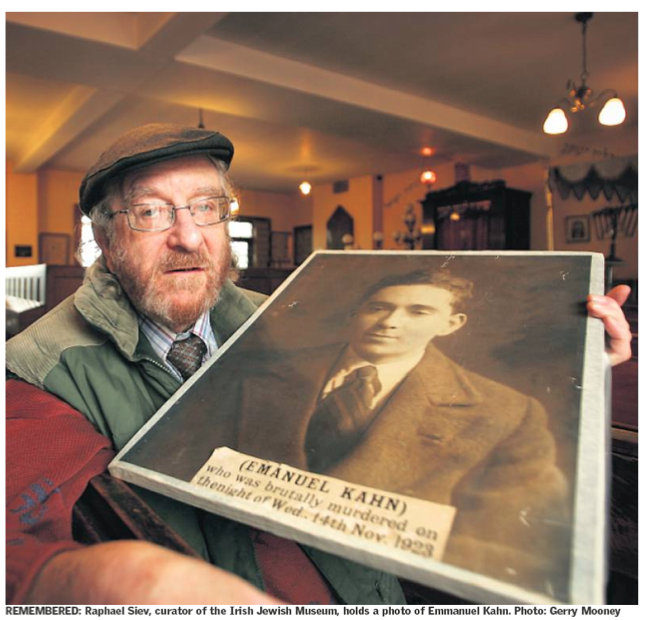
Raphael Siev (RIP), former curator of the Jewish Museum, with a picture of Ernest Kahn. Credit - The Sunday Independent (24 June 2007)

Raphael Siev (RIP), former curator of the Jewish Museum, with a picture of Ernest Kahn. Credit – The Sunday Independent (24 June 2007)

Some fiction writers, most noticeably Roddy Doyle’s A Star Called Henry, have portrayed the IRA as having anti-Semitic murderous elements. However it is according to Manus O’Riordan an:

uncontestable historical fact … that Ireland’s War of Independence, in which members of the Jewish community themselves participated, never saw a single Jew killed by the IRA, whether deliberately or even accidentally.

Continue Reading »

A forgotten Dublin census.

It’s likely many of you have lost hours of your lives to the 1901 and 1911 census returns. Both digitised and freely available online, they are a great insight into life in Dublin over a century ago. We’ve looked at them in some detail on the site, for example exploring foreign nationals in the 1911 census, and unusual religions.

For those interested in the population of Dublin historically however, there were surveys carried out long prior to the two census’ online today. One such brilliant source is ‘Whitelaw’s Survey’ from 1798. The story of that undertaking is caught up in the political violence of the time. Some of this amazing survey is available to read online today, and it is linked to later in this piece.

Essay

1798 has entered Irish history and consciousness as being synonymous with revolutionary agitation and the cause of the Society of United Irishmen. Backed military by France, 1798 saw attempts at revolution in the Irish countryside, spearheaded by a revolutionary organisation which included Protestants, Presbyterians and Catholics in leadership positions. In the tradition of Irish rebellions is was both romantic and brief, though the 1798 rebellion did lead to an intense security crackdown from those in authority. As a security measure, the Lord Mayor of Dublin issued an order to the populace of the city, that they would affix a list of inhabitants for each home to the front of their dwellings.

The problem, naturally, was that huge chunks of the population were still illiterate. This led to the task of collecting the details of the inhabitants of Dublin being given to an individual, in the form of the Rev. James Whitelaw. What he carried out would come to be known as ‘Whitelaw’s Survey’. Good information on Whitelaw himself comes from A Compendium of Irish Biography, published in 1878:

Whitelaw, James, Rev., author and philanthropist, was born in the County of Leitrim, about 1749. He was educated at Trinity College, Dublin (where he took his degree of B.A. in 1771), and entered the Church. The living of St. James’s, in the Liberties of Dublin, and afterwards the vicarage of St. Catherine’s in the same locality, were conferred upon him. He laboured indefatigably among the poor, establishing schools, industrial institutions, and loan funds.

Owing to the lack of education among sections of the population, Whitelaw himself explained that:

…my assistants and I, undeterred by the dread of infectious diseases, undismayed by degrees of filth, stench and darkness inconceivable, by those who have not experienced them, explored, in the burning months of the summer of 1798, every room o these wretched habitations, from the cellar to the garret, and on the spot ascertained their population.

Dublin in 1798. Via the excellent resource http://dublin1798.com/

Dublin in 1798. Via the excellent resource http://dublin1798.com/

There has been some examination of Whitelaw’s work in recent times. Tommy Graham, editor of History Ireland magazine, examined some of Whitelaw’s findings in a 1994 edition of the popular magazine. Graham has noted the sheer level of detail in Whitelaw’s findings, in particular on the subject of population density. Whitelaw’s findings indicated that the real centres of poverty where in the west of the city, within its ancient heart. As Graham noted:

Whitelaw was particularly concerned with the density of population not only to highlight the extent of the poorer districts but also to derive mathematical rules of thumb which could be applied to calculate the populations of other comparable European cities. His calculation of population density applied to buildings only and he outlined precise geometric procedures for the exclusion of open spaces such as Stephen’s Green, for example. The parishes within the old walled city were much more densely populated than the newer up-market suburbs, ranging from a claustrophobic 439 persons per acre in St Michael’s (opposite Christchurch) to a more comfortable 87 per acre in St Thomas’ (Sackville Street/Gardiner Street area) (By way of comparison, the population density of Dublin in 1981 [according to the Central Statistics Office] was only 20 persons per acre [approximately], but calculated over the whole city, open spaces included.) Whitelaw contended that, provided accurate maps were available, the populations of other cities could be geometrically determined by extrapolating from the actual Dublin experience.

Whitelaw himself was shocked by the levels of poverty in the city, noting that:

I have frequently surprised from ten to 16 persons, of all ages and sexes, in a room, not 15 feet square, stretched on a wad of filthy straw, swarming with vermin, and without any covering, save the wretched rags that constituted their wearing apparel. Under such circumstances, it is not extraordinary, that I should have frequently found from 30 to 50 individuals in a house.

Some of his findings were published in 1805,as An essay on the population of Dublin being the result of an actual survey taken in 1798, with great care and precision, and arranged in a manner entirely new. Today, this work is freely available to be read online. Observe the level of detail present in the work. Here is an entry for York Street, notice that Whitelaw has noted the number of the house, the number upon the door, the state of repair, how many stories high the home was, the social class of the inhabitants, their names and their occupations.

An excerpt for the work.

An excerpt for the work.

Tragically, the 1805 published work was only the tip of the iceberg of Whitelaw’s research. His research on York Street and the Poddle is thankfully in the public domain today, and some other research of Whitelaw’s was summarised in the Georgian Society Records, but the vast bulk of it is now beyond the researcher. Like so much priceless Irish archival material, it was a victim of the Irish Civil War. The Public Records Office within the Four Courts complex was lost to the destruction of the conflict between republicans and Free State forces, with a debate still raging to this day over where the blame should rest! Whitelaw, who had attempted to highlight the obscene poverty in the city, ultimately lost his life by coming into contact with it. As the above biographical entry notes:

He was constant in his ministrations at Cork Street Fever Hospital, where on one day he administered the sacrament separately to six patients in the last stages of malignant fever. The result was that he caught the disease himself, and died, 4th February 1813, aged 64.
The Public Records Office within the Four Courts. (Image: National Archives of Ireland)

The Public Records Office within the Four Courts. (Image: National Archives of Ireland)

In 1955 and 1956, rival student societies from Queens University Belfast and Trinity College Dublin launched ‘raids’ on each others campuses, attempting to steal items of significance from each other.

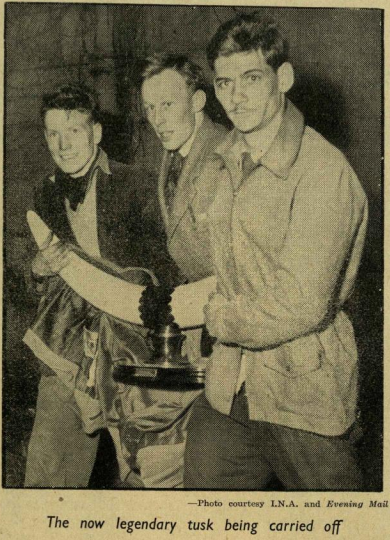
There was shock in Trinity College in May 1955 when prized possessions of the Phil (Philosophical) and Hist (Historical) societies were removed from the college grounds by Belfast students. The college newspaper, Trinity News, ran the below image of three northern students fleeing with an elephants tusk, which belonged to the Phil Society. In addition to the tusk, the students also stole a print of Theobald Wolfe Tone from the Hist Society, of which he had been an active member of during his time as a student there. Tone had even served as auditor of the society in 1785.

Trinity News (12 May 1955)

Trinity News (12 May 1955)

The newspaper noted that:

The whole raid was conducted efficiently and rapidly, and the insurgents were across the border before the customs could be warned. However, the Garda, unnecessarily summoned by the shaken college authorities, with the assistance of the R.U.C., quickly recovered the valuables, which have not yet arrived back in Dublin.

One of the raiding party was quoted as stating “our only regret is that Trinity refused to take up the challenge to recapture the prizes, and called in the police. Can it be that the southern university has lost the spirit of adventure?”

The answer to that question was no. A year on from the Dublin raid, the paper ran a front page article that noted “Vengeance Is Ours!” The paper reported that four Trinity students, representing the major societies, had raided the Union Society Building of Queens University without detection. “With cold and efficient ease”, they removed four trophy cups from a display cabinet, before returning to Dublin with their loot. “The booty was on display at the ball last night”, the paper bragged, ending the piece by stating the items would be returned to a visiting Queens team. The rivalry between Irish universities and colleges is nothing new then.

Trinity News (7 June 1956)

Trinity News (7 June 1956)

This story was only possible thanks to the excellent resource that is the Trinity News Archive.

The Whitefriar Street Carmelite Church is a popular spot with visitors to the city, especially in February.

The church has never had any difficulty in attracting tourists owing to the ‘Shrine of Saint Valentine’ within it. It is noted by the Church that Pope Gregory XVI gave the relics of Valentine to Fr John Spratt, an Irish Carmelite associated with the church, who visited Rome in the 1830s, making this one of several churches internationally to claim to hold relics relating to Saint Valentine.

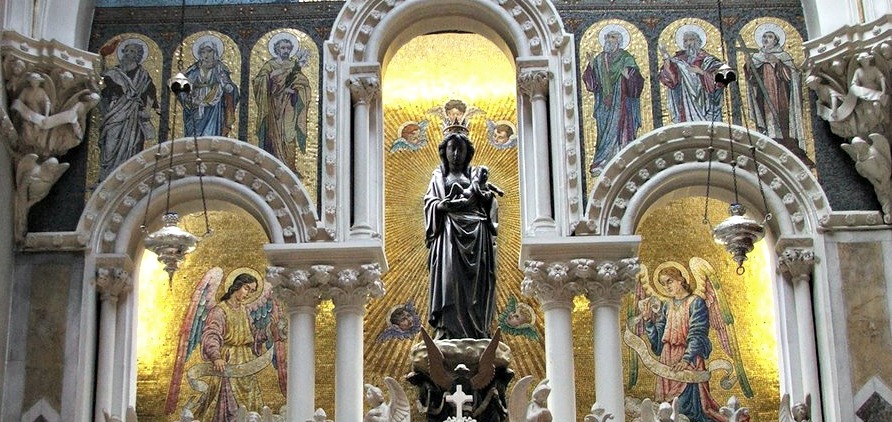
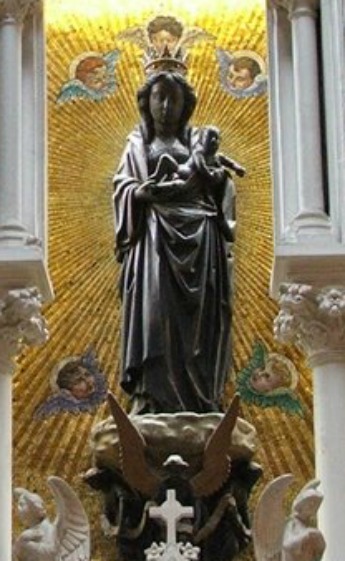
Recently though I learned of a statue in this church that tells a pretty interesting story itself, covering centuries in Dublin’s history. The story seems to be a mix of legend and historical fact like so many others in the city. The story relates to ‘Our Lady of Dublin’, a Marian statue carved of oak in the church believed to date to the fifteenth or early sixteenth century.

'Our Lady of Dublin' as the statue is known.

‘Our Lady of Dublin’

My interest in this statue was sparked by a newspaper article from the 1830s, published in the Dublin Literary Gazette. “There is now preserved in the Carmelite Church, in Whitefriar Street, Dublin, a very interesting ancient piece of sculpture”, the article noted. “It was originally a distinguished ornament in St. Mary’s Abbbey, at the northside of Dublin, where it was not less an object of religious reverence than of admiration for the beauty of its construction.” The article noted that “Its glory, however, was but of short duration. The storm of the reformation came – the noble religious structure to which it appertained was given to the Earl of Ormonde for stables for his train, and the statue was condemned, and, as it was supposed, consigned to the flames.”

The newspaper claimed that while one half was burnt, “the other half was carried by some devout or friendly hand to a neighbouring Inn yard, where with the face buried in the ground, and the hollow trunk appearing uppermost, it was appropriated, for concealment and safety, to the ignoble purpose of a hog-trough.”

Our-lady-of-dublin_110922-01 (1)

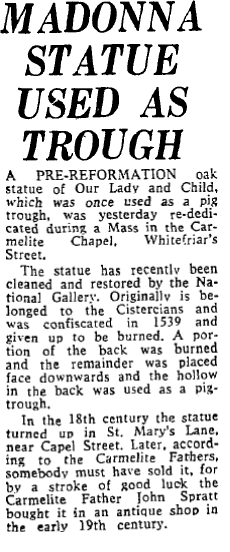
It appears the statue returned to a church in the early years of the eighteenth century, when it was placed inside the Mary’s Lane Chapel, yet according to the 1830s source, it was no longer seen as “an object of admiration to any, except the curious antiquary”, and it claimed that parts of the statue were sold, for example an “ancient silver crown” upon Mary’s head. An Irish Independent article on the statue in the 1960s claimed that when the Jesuits, who maintained the Mary’s Lane Chapel, moved to a new church in Anne Street the statue was simply left behind. The legend of the statue has it that in the 1820s the statue was purchased from an “ordinary sale shop” on Capel Street by Father John Spratt, a story that was repeated in The Irish Press in 1947 when the statue went on display in the National Museum of Ireland, exhibited as an example of a Catholic statue to survive the Penal days in Ireland.This legend was often repeated in Dublin, for example in 1974 when the statue was rededicated in the presence of the Lord Mayor of Dublin and others:

1974 Irish Independent article on the statue.

1974 Irish Independent article on the statue.

In 1931 a letter writer to The Irish Times highlighted the statue, and rather bizarrely made an argument that a replica of this figure should take pride of place on the O’Connell Street Pillar that had been erected to Admiral Nelson in the early nineteenth entury. There was discussion at the time regarding the removal of the Pillar, but the writer asked:

Would not a replica of this figure be a suitable crown to that noble piece of architecture which all agree the Pillar itself is? The citizens of Dublin, visitors from all parts of the world, the young and hopeful, the old, the weary and heavy-laden, could not fail to find comfort and hope in the contemplation of a figure representing her chosen by God for his purposes towards mankind.

While the exact facts surrounding the statue are more than a little unclear, and the pig trough story is lacking in hard evicence, the fact it is a survivor of the reformation and dates back centuries makes it a fascinating and unique part of Dublin’s history worth taking the time to view regardless.

Thursday, April 20th 1916, and with days to go until the Easter Rising, the Aud arrived in Tralee Bay, two days earlier than expected. The Rebellion was imminent, and with this in mind, Padraig Pearse along with his brother Willie made his way to Rathmines; with St. Enda’s not far away, they turned down Castlewood Avenue and into Doran’s Barbers. There they sat in silence as one after the other got their hair cut for the last time; it’s not so hard to believe that one of the brothers at least knew his fate.

 They did not speak much as they awaited their turn in the chair: but then, they never did, he remembers; and, whatever thoughts were in the minds of Patrick and Willie Pearse, the 20-year-old John had no foreboding that he was giving the brothers their last haircut.

John Doran, interviewed in the Irish Independent, March 28th, 1973.

The Pearse brothers are only a small part of the history of a business stretching back over a century. John’s brother James opened the shop on January 2nd 1912, then aged twenty four. The 1911 census lists him as a hairdresser, as it does John quoted above, fifteen when the census was taken. They were sons to Christina, (listed a widow on both the 1901 and 1911 census returns) and lived in a house on Chancery Lane, not far from Christchurch Cathedral. Their father was a hackney owner, and kept horses stabled nearby until his death sometime prior to 1901. John and James were just two of a family of thirteen.

Annual rent on the premises at Castlewood Avenue in 1912 was £52, and on opening, a haircut in the shop cost fourpence and a shave thruppence. Along with his wife, four girls and two boys, James lived above the barbers until the early 1930’s when the family moved around the corner to Oakley Road; born and reared above the shop, Jimmy and William  would go into the family business. Their father James didn’t retire until his late seventies and it wasn’t until then in 1966 and at fifty years of age that Jimmy took on the role of proprietor.

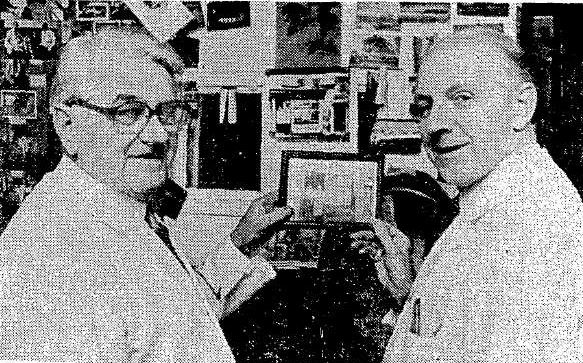
James and Willie Doran

James and Willie Doran

Jimmy, born in 1916, started cutting hair in 1930 at fourteen years old, with Willy starting at the same age five years later. Rathmines, and Castlewood Avenue was a different place then, the number 18 tram with it’s red triangle identifier passing the front door of the shop. The township of Rathmines existed as a seperate entity to Dublin City until 1930, when it was amalgamated into Dublin City Council.

I was born upstairs eighty six years ago, in 1916. I’m not a Dubliner though, I’m a Rathmines man. The oldest one around they say, though I’m not saying that. Dublin didn’t come here, to Rathmines, until the 1930’s. Rathmines Urban District Council made their own electricity until then.

Jimmy, in an interview with Rose Doyle, Irish Times, October 16th, 2002.

The tramlines were taken up in the forties, but Jimmy and the shop remained, unchanged. In the same manner as his father, Jimmy worked in the shop for sixty eight years, only retiring in 1998 and passing on the mantle to the shops current owner Robert Feighery who served his time in the Merchant Barbers, itself running for over half a century. Jimmy remained a regular visitor to the shop after retiring, dropping in a couple of times a week for a chat with the barber and his customers until his death on New Years Eve, 2010.

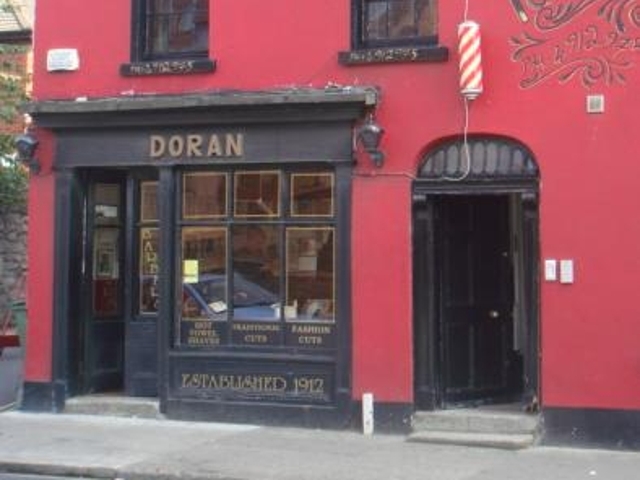
Doran Barbers.

Doran Barbers, estd. 1912.

The shop remains largely as Jimmy left it, with a polished wood floor, benches lining two walls, two wash basins and a large collection of historical memorabilia connected with the shop including framed electricity meter reading cards dating back to the shop’s opening, stamped with “G.F. Pilditch, M.I.E.E. at the Electricity Works, Town Hall, Rathmines,” a picture of Jimmy and Willie with Brendan Gleeson, and various clippings of the shop from books and newspapers it has appeared in.  Also on the wall is a large portrait of Padraig and Willie Pearse, and a selection of Bohs newspaper clippings, including one from the day after the League win in 2001; the Red and Black exterior evidence of Robbie’s footballing allegiance.

In the same interview with Rose Doyle quoted above, given in the shop in 2002, Jimmy said:

Sometimes a fella comes in and says ‘you cut my hair 30 years ago.’ Some are fifth generation customers, and there a number who are fourth generation. Famous people come and go, but everyone’s the same importance here. When a fella pays, and goes out the door, he’s all the same!

The Waldorf stakes a brave claim that it is Dublin’s oldest barbers, but I don’t think it can beat that.