Feeds:
Posts
Comments

A very enjoyable Storymap on the Easter Rising, from John Gibney. John is the author of an upcoming biography on Sean Heuston as part of the 16 Lives series, and as a walking tour guide I suppose there’s a decent chance you’ve passed him on the street at work.

Sean McLoughlin is a fascinating and often overlooked character of the period. As well as discussing his role in the evacuation of the GPO, Gibney tell’s the story of the British officer who may well have saved young McLoughlin’s life. He also talks of how McLoughlin went on to become a communist activist. McLouglin’s politics feature in an interesting brief article here on the role of communists in the Irish Civil War.

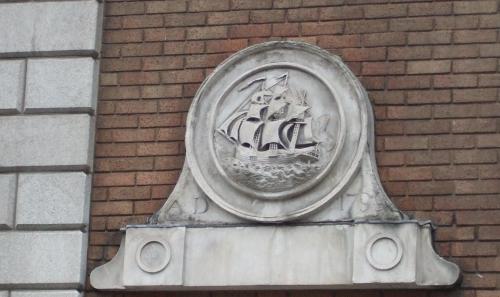
The Ouzel Galley plaque is one I pass several times a week, but never investigated. It tells the story of a famous Dublin merchant ship that it was said set sail from Ringsend in 1695, on route to the port of Smyrna in the Ottoman Empire. She was to return the following year, having engaged on a trade mission on behalf of the Dublin company Ferris, Twigg & Cash. Eoghan Massey of Waterford captained the ship.

When three years had passed in 1698, and there had been no word of the ships faith, a panel of Dublin merchants settled the question of instance, by ruling that the ship had been lost with her crew of 40 on board, and that compensation should be paid out to the owners and insurers of the ship.

The story goes that in 1700, to the amazement of Dubliners, the ship returned up the River Liffey. Massey claimed that his men had spent five years in captivity at the hands of Algerian corsairs, who had used the ship to engage in acts of piracy. Rumours and allegations spread, and it was claimed Massey and his men themselves had engaged in such acts. The ship was loaded down with an impressive booty upon its return, which naturally raised questions in light of the fact insurance had been paid out two years prior.

John Moran wrote a fantastic account of the ships return in The Irish Times in 2005, noting that

…. five years after she sailed away, a battered and torn Ouzel listed up the River Liffey, and was greeted by first a sense of disbelief, then to scenes of wild dockside jubilation. Exhausted oarsmen rolled to the strains of an old sea shanty as they heaved her toward the howling crowd on the quay.
The ownership of the ship’s cargo became a huge matter of debate and controversy. The same panel of merchants which had settled the debate in 1698 on the ships fate met once more, and his time decided that all monies remaining following the proper compensation of the owners and insurers should go towards a fund for the alleviation of poverty among Dublin’s “decayed merchants”.

Out of this case, emerged ‘The Ouzel Galley Society’, a society founded for the purpose of determining commercial differences by arbitration. The 1818 History of the City of Dublin, its Present Extent, Public Buildings, Schools, Institutions, etc details the foundation of this society, and notes that “its members consist of a captain, lieutenants and crew who always have been, as they are now, the most respectable merchants in Dublin.” The society would meet two or three times annually it was noted, and the costs decreed against the parties “who submit to their arbitration are always appropriated to charitable purposes.” Arthur Guinness was among the individuals to serve time with the society.

Interestingly, historian Lisa Marie Griffith noted in a recent article for History Ireland on the subject, that:

While there is no doubt that an arbitration body called the Ouzel Galley Society was established in the early eighteenth century, the veracity of its origin-myth is a different story. I could find no eighteenth-century records referring to the incident of the pirates.

She goes on to note that the first reference to the involvement of pirates in the affair comes from a nineteenth-century novel, The Missing Ship, by William Kingston. This novel was first published in 1887 under the prior mentioned title, and then later in the same year as The Ouzel Galley. The novel, she notes, “certainly added layers to the story of the foundation of the Ouzel Galley Society.”

The Dublin Chamber of Commerce, founded in 1783, largely subsumed the Society, and the stone plaque on College Green today marks the spot where the Chamber of Commerce met historically, at Commercial Buildings. The Ouzel Galley Society was wound up in 1888, though in the year of Dublin’s millenium in 1988 it was reestablished, primarily as a charitable institution.

My favorite part of the popular story is that when the men of the Ouzel Galley, presumed dead, returned to Dublin they were met by remarried wives and brand new children. Children born illegitimately in Ringsend were supposedly jokingly refereed to as ‘Ouzellers’ in the aftermath of the incident!

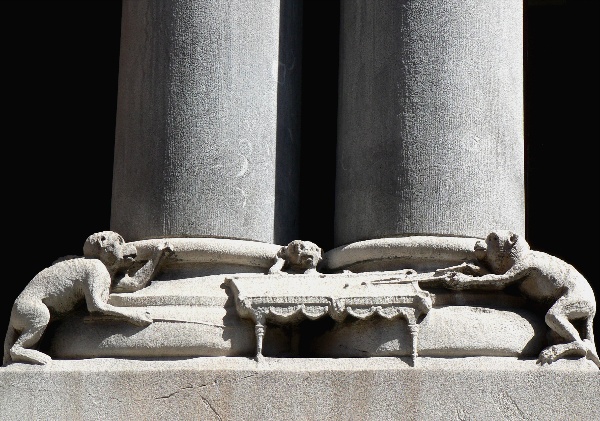
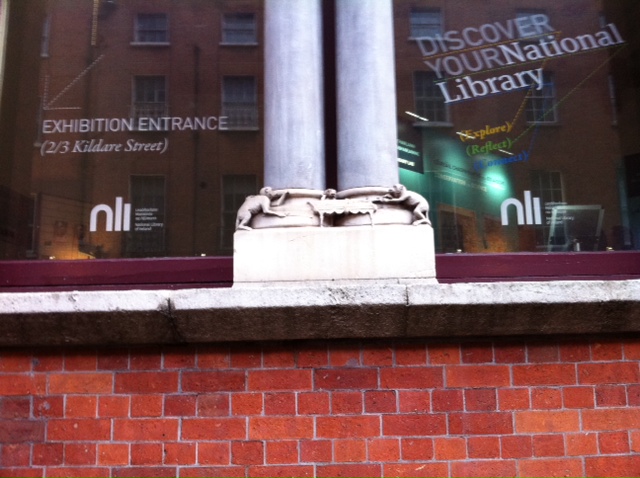
One of the most unusual and amusing architectural details in the city, in my opinion, is the stone carving of monkeys playing billiards on a window column at No. 1 Kildare Street.

Monkeys playing billards (c) Flickr user ramson

Now housing the the Alliance Française, the beautiful building was built for the Kildare Street Club in 1860-1 by architects Thomas Deane and Benjamin Woodward. Founded in 1782, the club was based at No. 6 Kildare Street from 1782 – 1860 and then at No. 1 Kildare Street from 1861 – 1977.

A fire ripped apart its original premises on 11 November 1860 killing three maid-servants and destroying their 15,000 volume library. A superstitious person might see something in the fact on May 4 1967, a fire swept through the top floor of No. 1 Kildare Street causing extensive damage.

The club merged with the Dublin University Club in 1976, thereafter sharing the premises of the latter at 17, St Stephen’s Green. However it still owns No.1 Kildare Street and currently leases the building out to a Heraldic Museum and the Alliance Française.

(c) A wider shot showing the monekys. From ‘http://deise-dispatches.blogspot.com/’

Debate on who the actual sculptor of the monkeys was as been going on for several decades. The three main candidates being Charles W. Harrison, the O’Shea brothers and Charles W. Purdy (Purdy & Son).

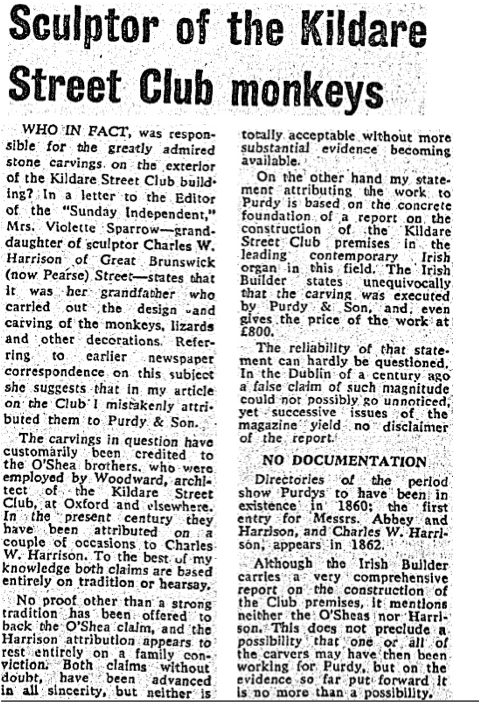
This author of this Sunday Independent article from 1969 is of the opinion that that they were the handywork of Purdey & Son.

Sunday Independent. Nov 02, 1969.

While an Irish Times article (Nov 25, 1961) alleges it was the O’Shea brothers and a piece from the Irish Press (Nov 7, 1975) states that it was Charles W. Harrison. For the record, it seems our friends over at Archiseek are on the pro O’Shea side.

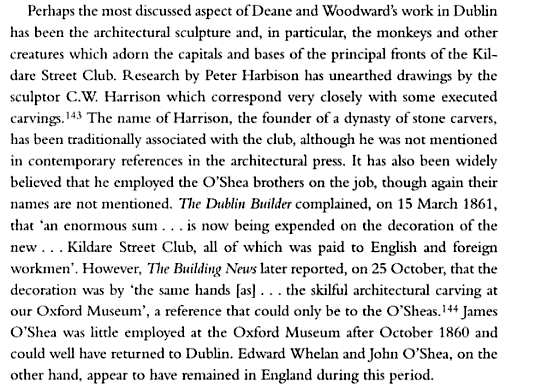
Frederick O’Dwyer in his 1997 book The Architecture of Deane and Woodward gave his own opinions on the matter:

Frederick O’Dwyer, The Architecture of Deane and Woodward (Cork, 1997), 336.

Either way, the monkeys are a wonderful piece of work. They themselves have been the source of many jokes, table quiz questions and riddles as this Irish Times piece from August 15 1928 suggests:

Quidung. An Irishman’s Diary. August 15, 1928.

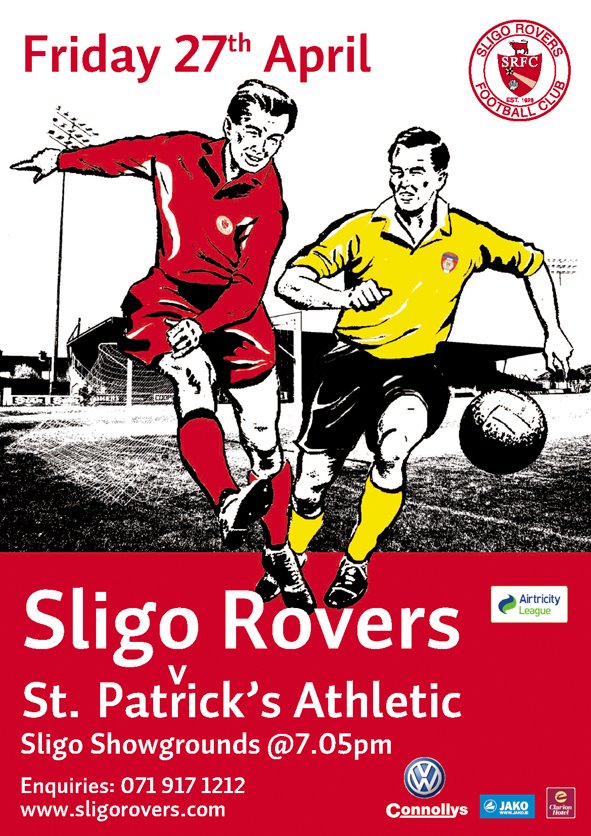
I love these match posters from Sligo Rovers, advertising their clashes with two Dublin sides. The first poster is for an upcoming clash with Shamrock Rovers, and the one below it last weeks clash with ourselves. I’d love to see match posters like this in Dublin, a fantastic effort worthy of praise.

If only they’d drop a few points somewhere along the way……

The Paris Bakery, Moore Street.

We dropped into The Paris Bakery on Moore Street today, and it is worth the rave reviews. The food is delicious, the desserts look pretty tempting too.

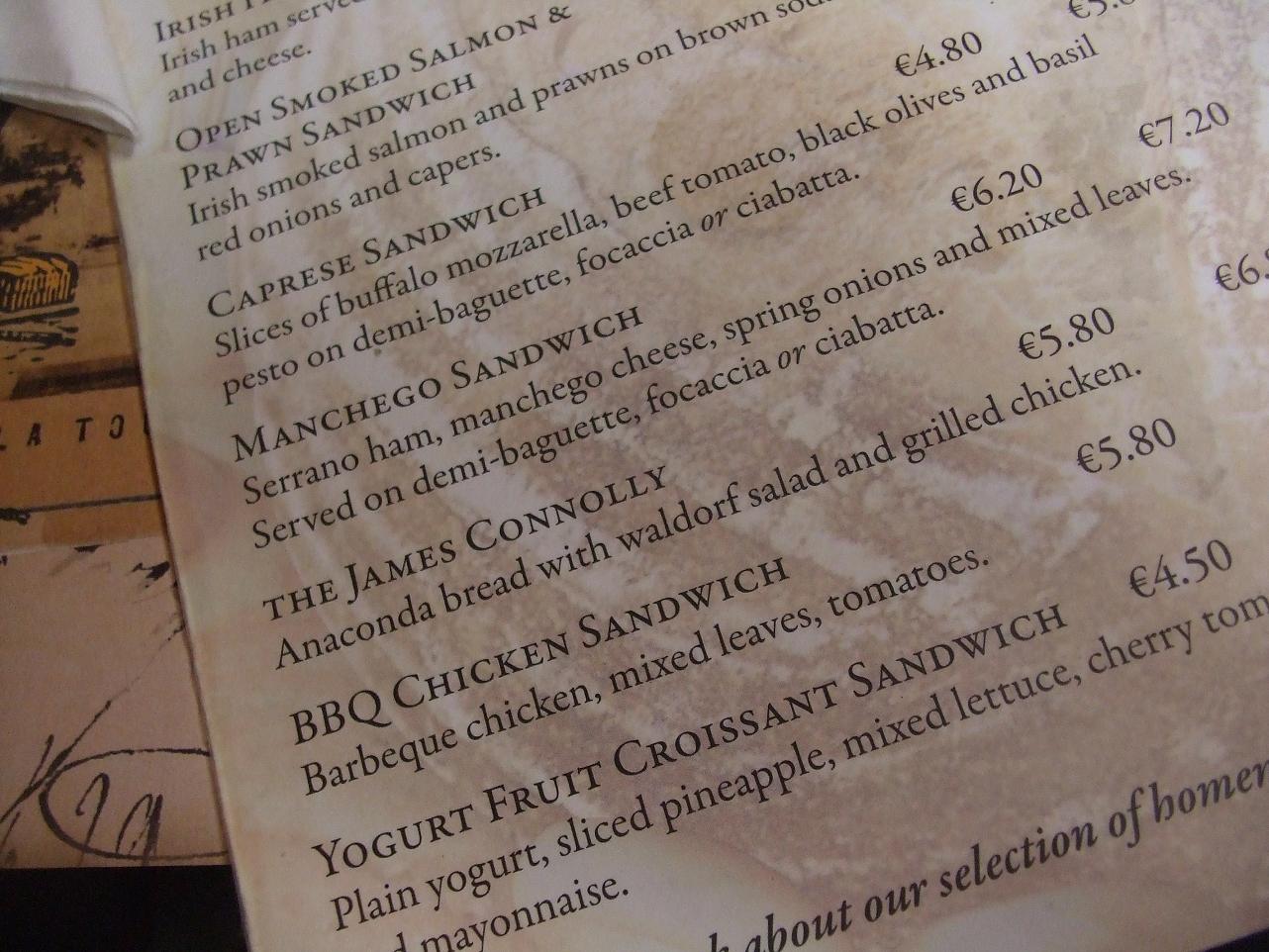
Glancing over the menu, quick as a flash jaycarax noticed that they’ve paid tribute to the socialist James Connolly! Right next door to 16 Moore Street, this packed little cafe shows that businesses can prosper on this street. Well worth popping into if you haven’t yet.

‘The James Connolly’

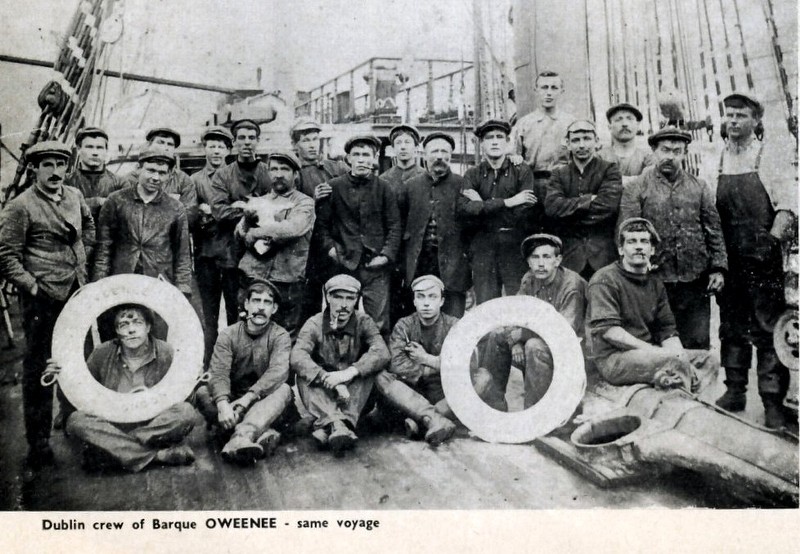
The Dublin Dockworkers Preservation Society exhibition will be in Liberty Hall later in the month for anyone who hasn’t had a chance to see the collection yet. It is always worth taking the time to see these photos where they belong, hung up and on display.

You can explore the fantastic archive online here, and they’re a fantastic insight into an important aspect of Dublin’s working class history.

From Dublin Dockworkers Preservation Society online collection.

From Dublin Dockworkers Preservation Society online collection.

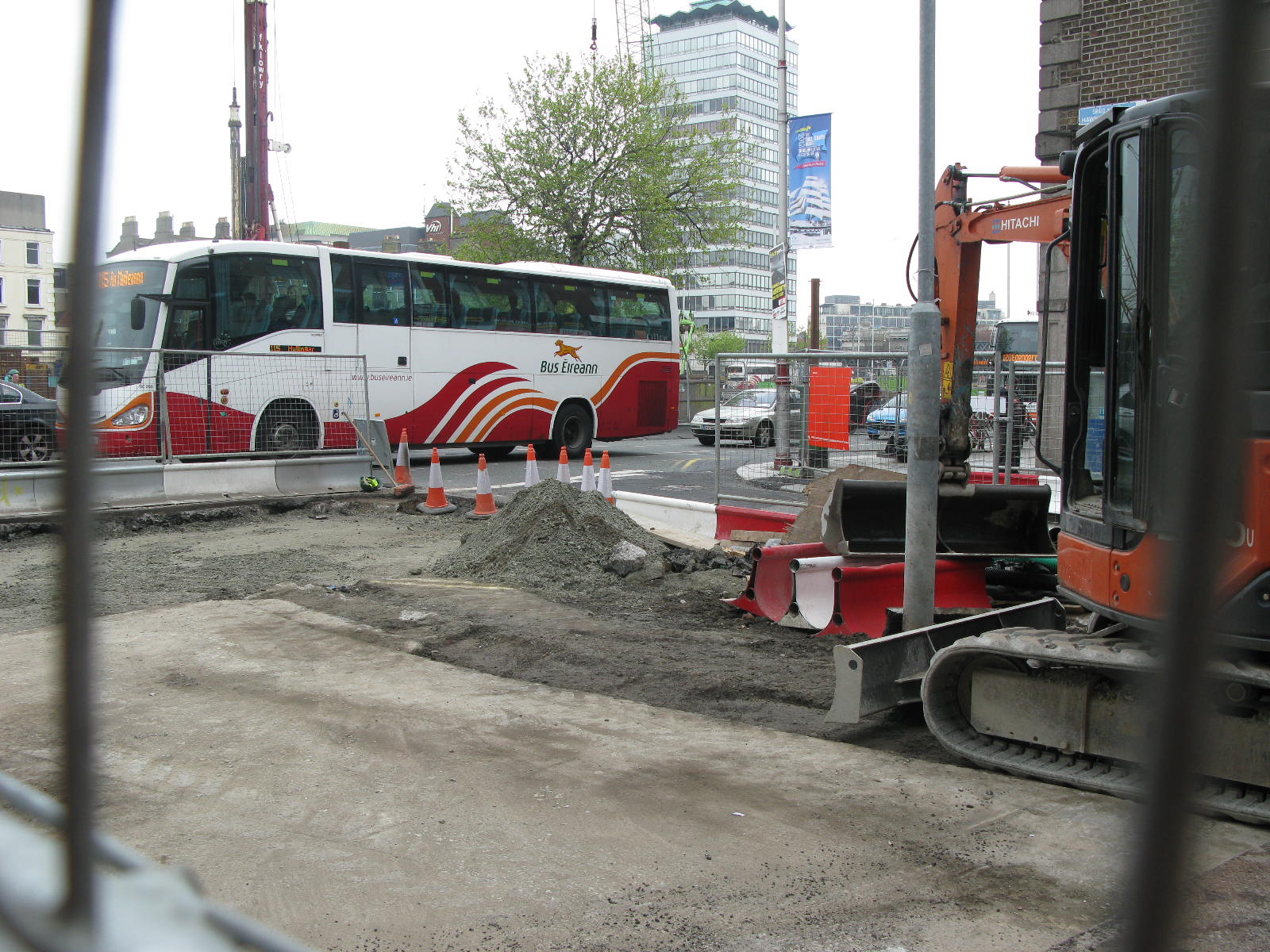
Walking down Hawkin’s Street today taking pictures for another project and had to double take when I got to the Junction with Burgh Quay- The Sheehan monument has vanished! No doubt removed to make way for what seems to be Dublin’s least required bridge connecting Marlborough Street and Hawkin’s Street, does anyone have any idea where they’re putting it?!

Above is the memorial as it was. It’s going to be redundant anywhere else, given that it is a memorial to Patrick Sheehan, a member of the DMP who entered an open sewer in 1905 to rescue a workman named John Flemming who was overcome by fumes. He succumbed himself and both men died. Listed as helping are Tom Rochford, Clerk Of Works and Kevin Fitzpatrick, a Hackney driver. Below is the scene today:

So… Does anyone know the memorial’s fate?

I collect old postcards of Dublin, in particular postcards of the monuments and statues of the city. It’s a cheap and cheerful hobby really, and I’ve accumulated a nice enough collection more for the love of it than anything. They go well with some posts on here, such as the ‘Statues of Dublin’ series, and they’re generally nice to look at. The city has changed in many ways of course and that is always evident. In some cases, they come with scrawled writing on the back and an indication of a former romance or the like.

Below are a few favourites from my own collection.

The O’Connell Statue.

The O’Connell Statue is surely one of the most iconic Dublin images. We featured it rather unusually on the site, by looking at the time it was bombed by Northern Irish loyalists.

Nelson’s Pillar

When Nelson’s Pillar was blown up in 1966,its head was stolen from storage by a group of students from the NCAD. It ended up in a London antique shop, under the ownership of Mr. Benny Gray. At one stage it had appeared on stage with The Dubliners at the Gate Theatre.

In September of 1966 Gray arrived in Dublin on O’Connell Street atop a lorry, with the much sought after head alongside him. He was also joined, for the hell of it, by The Dubliners folk band. The Dubliners launched into ‘Nelsons Return’, a rewritten version of their popular smash hit ‘Nelsons Farewell’, composed at the time of the explosion. He inquired to a bemused crowd through a megaphone if anyone among them was a trustee of the pillar who could accept the head, a Corporation official came forward. Mr.Gray said it was “lots of fun” having the head in his shop, but the Corporation failed to see the funny side. A spokesperson made it clear the head was not to do anymore travelling.

I recently heard Nelson jokingly referred to as Admiral Blownapart.

Gough Monument, Phoenix Park.

The unfortunate Gough monument has featured on Come Here To Me before. It was infamously bombed in 1957, leading to the emergence of a great poem, something we talk about in the post I’ve linked to:

There are strange things done from twelve to one
In the hollow at Phaynix Park,
There’s maidens mobbed and gentlemen robbed
In the bushes after dark;
But the strangest of all within human recall
Concerns the statue of Gough,
’Twas a terrible fact, and a most wicked act,
For his bollix they tried to blow off!

Continue Reading »

Brendan Behan in Time Magazine (1959). Hulton Archive / Getty Images.

An absolutely hilarious court proceeding involving Brendan Behan that has to produced in full.

It reads like a carefully worded, polished courthouse comedy-drama.

The Irish Times, March 7 1959

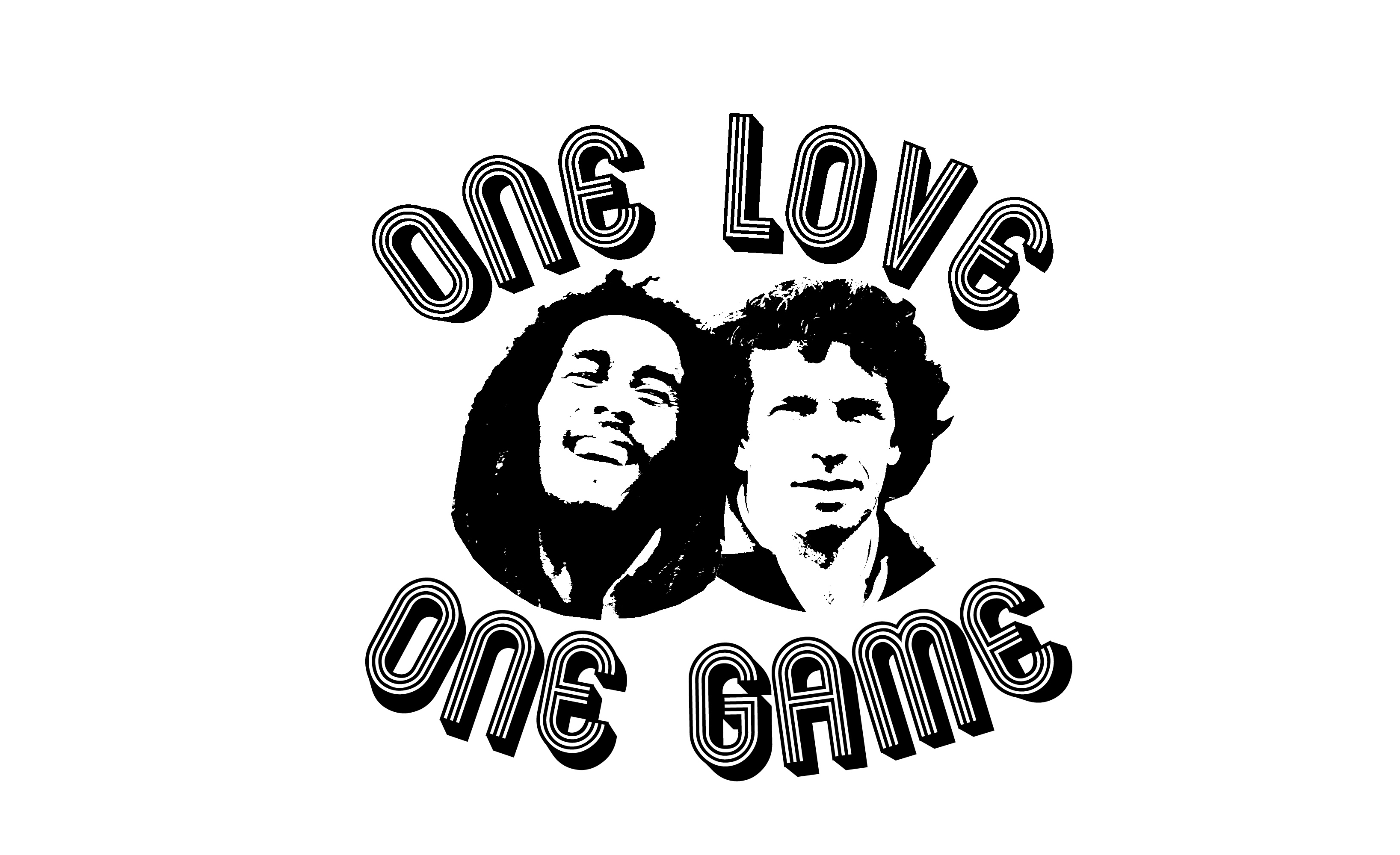
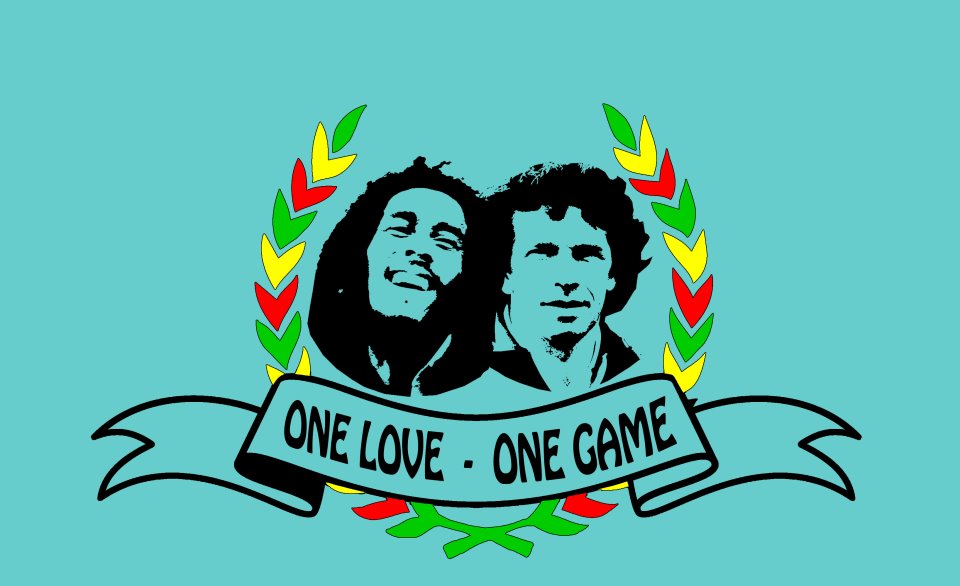
Our friend Kevin has designed some cool images in response to last week’s story about Johnny Giles and Bob Marley. A story that should be taken with a (large) pinch of salt! 🙂

Design – Kevin Squires

Design – Kevin Squires

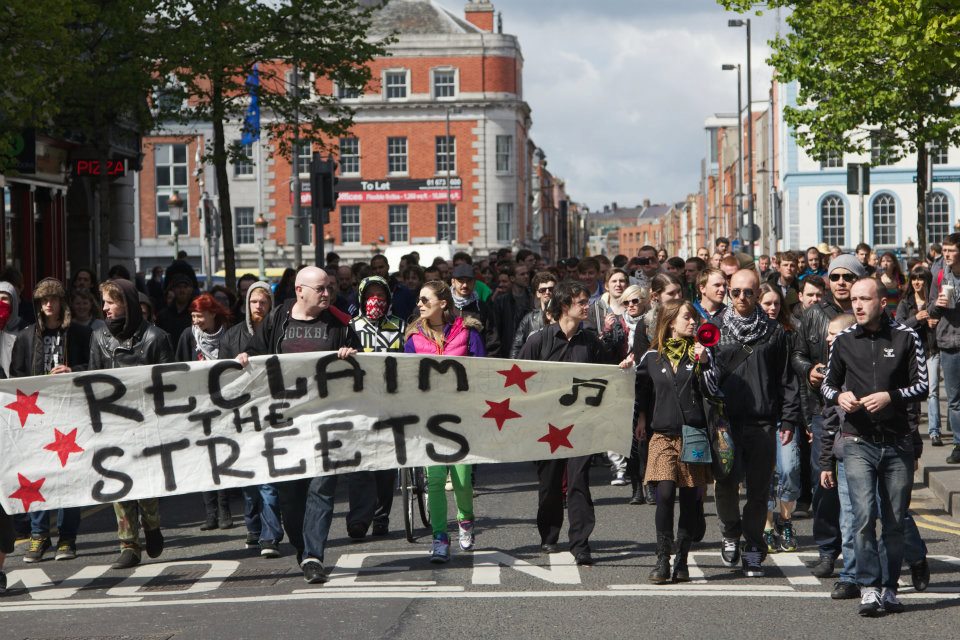
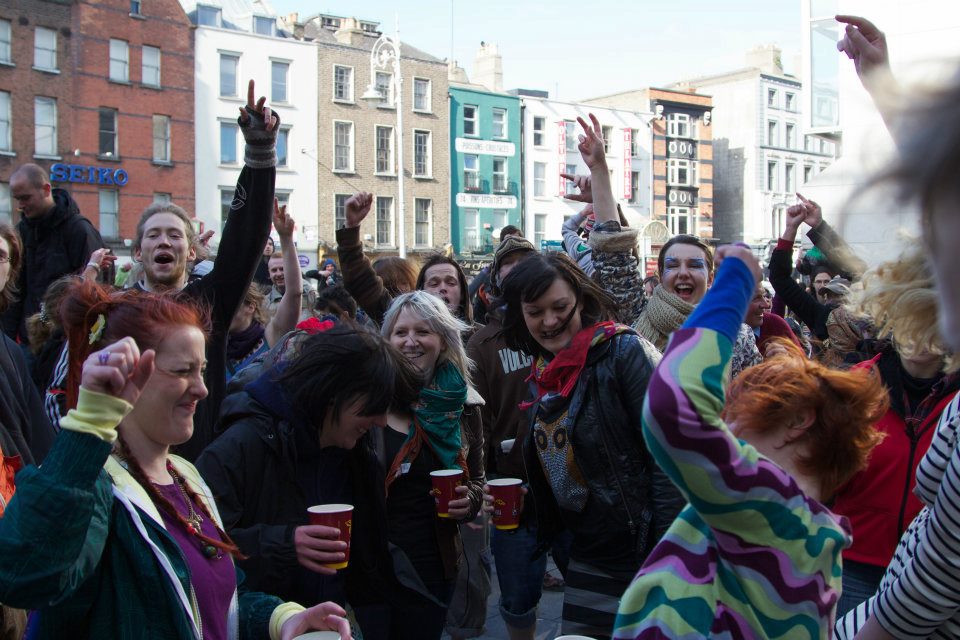
Up to five hundred people on Saturday took over, the once grassy mound, beside City Hall on Dame Street for a 3.5 hour street party.

The event was organised by Reclaim the Streets to mark the 10th anniversary of when police attacked partygoers at a similar event on Dame Street in 2002.

Here are some pictures and videos from the day:

Crowd making their way down Parliament Street. They had met originally at 2pm at the spire.

(c) Workers Solidarity Movement

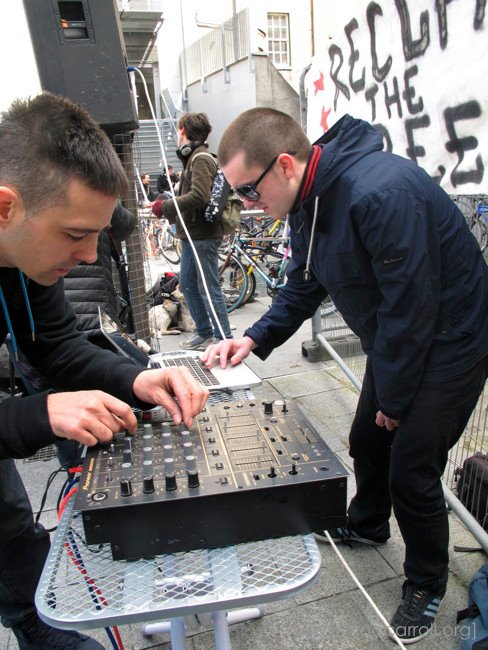
A number of DJs played throughout the day:

(c) Workers Solidarity Movement

Section of the crowd:

(c) Workers Solidarity Movement

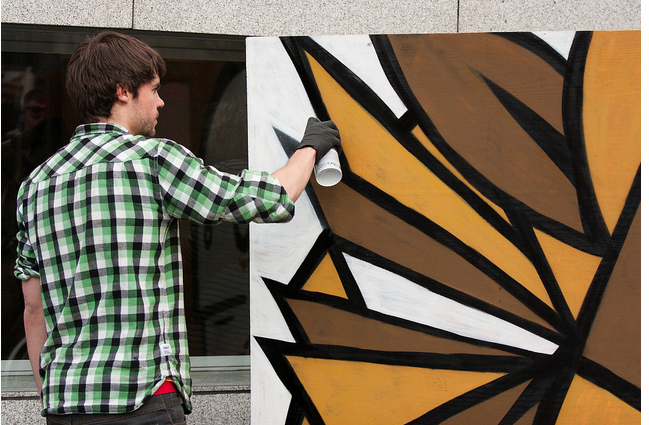
Boards were erected for people to graffiti:

(c) Paul C Reynolds

Continue Reading »

Via 'A Visual Feast'

(A Visual Feast Facebook)

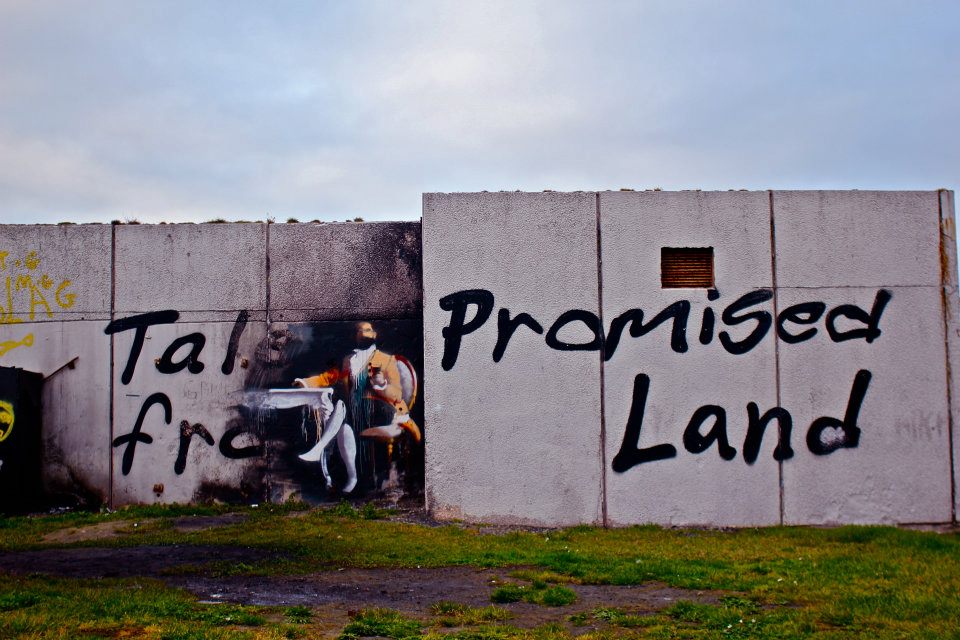
It’s fantastic to see an artist like Conor Harrington, who has brought so much colour to the walls of the city centre, move out a bit and into new territory in the capital. This piece in Inchicore is fantastic, all the moreso due to being out on its own in ways.

‘Black Herds of the Rain’, a short film documenting some work Conor did in Summer 2011, is essential viewing if you haven’t seen it.