Feeds:
Posts
Comments

I thought this great fake New Years Eve poster worth sharing, it’s been doing the rounds online and I had to smile. There are posters designed like this all over the city weekend after weekend, not least around Temple Bar. Have a good one whatever you do, and normal service will resume here in 2012!

Xmas swag

Over recent years, my Dad and myself have come to a great arrangement where I go out and buy a few books for Xmas and then he gets me back. It avoids any sort of hassle (for him) and any disappointment (for me). This is what I got this year, all from Hodges & Figgis.

Jammet’s of Dublin: 1901-1967 by Alison Maxwell and Shay Haurper (The Lilliput Press, 2012) €15 paperback
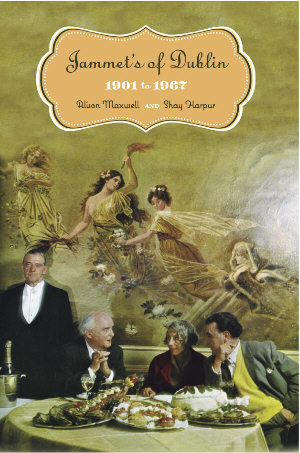
With the paperback coming in at only €15 and with 249 pages, you’re definitely getting value for your buck (no pun intended). Beautifully designed (Niall McCormack yet again), this book traces the history of what was Dublin’s most famous restaurant.

Particularly interesting are the stories of Jammets getting through WWII (extremely well by all accounts except for a small incident when their windows was broken by a group of nationalist UCD students on an anti Allied rampage), of the Jammet staff football team who won the Hotels Cup and League many times in the 1940s and 1950s, of Brendan Byrne’s shop on South Anne which was visited by the mega wealthy including Aga Khan when he visited the city and finally the personal accounts and stories of former Jammet’s waiters Shay Harpur, Jimmie Beggan and Victor Hurding.

The News from Ireland : Foreign Correspondents and the Irish Revolution by Maurice Walsh (I.B. Tauris & Co. Ltd., 2008) €16.35 paperback
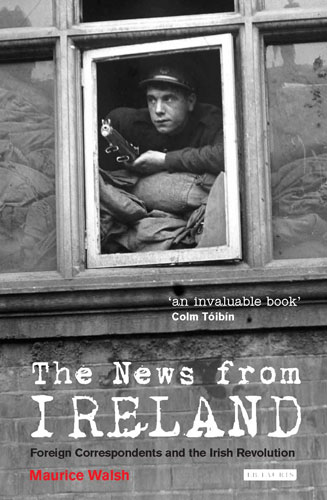
A fascinating but quite academic book looking at the role of foreign journalists and writers, particularly British and American, in the Anglo-Irish war of 1919 – 1921. The chapter focusing on ‘literary tourists’ – G.K. Chesterton, Wilfred Ewart and V.S. Pritchett is particularly interesting. All three spent time in Ireland and wrote upon their experiences. Another issue that jumped out was the effect that WW1 had on the ‘ascendancy families in the South’. The writer Lennox Robinson observed that ‘the Big Houses were emptied of all men of a fighting age [the Great War being] the last chapter in the history of the many families’ while Mark Bence-Joyce said by the end of the war ‘in all too many Irish county houses in 1919 the Young Master was no more than a memory and a photograph in uniform on a side-table’.  All very Downton Abbey.

Irish Republican Women in America Lecture Tours, 1916-1925 by Joanne Mooney Eichacker (Irish Academic Press, 2003) €4.99 paperback
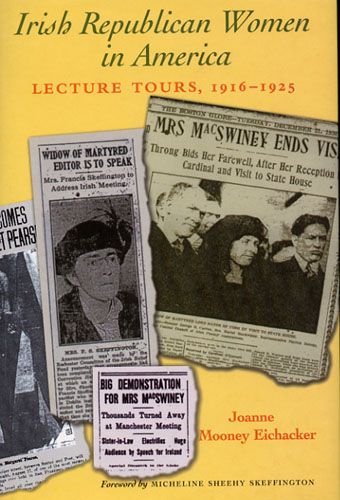
Found in the bargain basement, this book is well worth a read for anyone with an interest in Irish republican or Irish feminist history. Particularly interesting were the revelations that Hanna Sheey Skeffington established close friendships with a number of IWW activists including Elizabeth Gurley Flynn and Marie Equi and for the passing mention that in Butte, Montana in June 5 1917, the local Pearse-Connolly club ‘led a large and unruly anti-draft protest’ ending in a riot and the Montana National Guard being called in to assist the ‘federal, county and city police’ when the disturbances accelerated and more than 25,000 citizens congregated in the streets.

Victorian Dublin Revealed: The Remarkable Legacy of Nineteenth-Century Dublin by Michael Barry (Andalus Press, 2011) €24.99
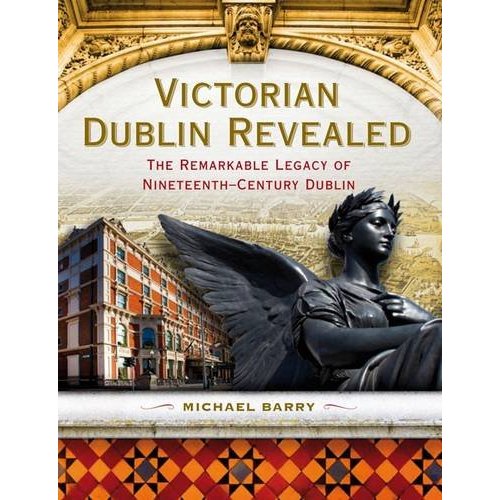
Beautiful full colour 192 page photography book focusing on Victorian Dublin, 1837 – 1901. Besides a few minor design errors (p. 32 and p. 36), the book is a treat on the eye. The Prince Albert statue (1871) on Leinster Lawn, the Zodiac mosaic floor at the entrance of the National Museum (1890), the columns of the Kildare Street Club (1859) [now Alliance Francaise], the entrance floor of the former Masonic Girl’s School (1880) in Ballsbridge [now Bewley’s Hotel], the synagogue at Adelaide Road (1892) and Nearys on Chatham Street (1900) are some of the most interesting examples that feature.

Memories of Baggotonia: Bohemian Dublin from Wilde and Joyce to Beckett and Behan by Brendan Lynch (The Liffey Press, 2011) €19.95
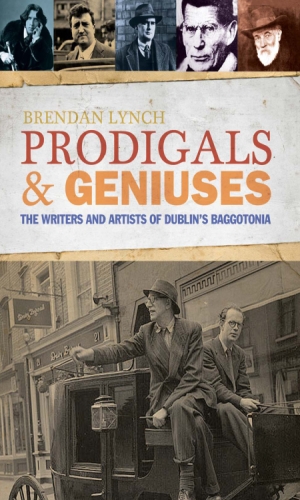
Well-written, engaging book focusing on the writers, artists and journalists that lived around the Baggot Street area. There are chapters focusing on individuals like John Butler Yeats, Brendan Behan, Patrick Kavanagh, Bertie Smyliee and Harry Kernoff and on places like the United Arts Club, Parsons Bookshop and the bars that were frequented by the residents of Baggontia.

I never knew anything about the ‘Catacombs’ before reading the book. This was a shebeen based out of the basement of 13 Fitzwilliam Place which boasted of a ‘maze of dark pantries and windowless rooms’ and regularly attracted ‘up to sixty imbibers, eager to prolong the night after pub-closing’. It was run by Richard ‘Dickie’ Wyeman, English-born former nightclub manager who had fled to Dublin after his army officer boyfriend was killed in the war. (More on the Catacombs here)

Damien Dempsey dropped in on Occupy Dame Street last night, performing Celtic Tiger, Negative Vibes and new one Community inside the ‘Yellow submarine’. Damo has just come off the back of three sold-out nights in The Workman’s. After playing a few tunes, he took a tour of the site.

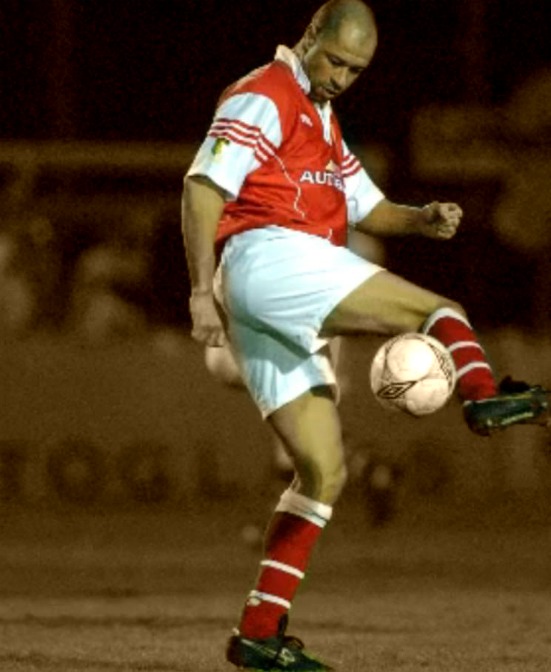
This is something else, a blast from the past in the form of Watch Your House, a 1994 tribute to Ireland (and Saint Patrick’s Athletic!) legend Paul McGrath. Well done to Youtuber Cushens for booting this onto Youtube from the original tape. Enjoy.

Wishing you a good one.


Two drinking Santas, lifted from The Irish Press of old.

It’s likely things will go quiet on this front and many others in the coming days. We wish you all a very Merry Christmas and all the best to you and yours over the holiday period. Be careful not to stamp anyone to death during the stampede for the January Sales (which tragically start earlier and earlier every year) and try to make the most of the period.

As in other years, we’ll leave it to Damien Dempsey’s version of O’Holy Night. Despite not setting foot in a church for anything but a departure in recent years, I’ve always loved this.

I stumbled across this poem recently and thought it worth sharing, from George Bernard Shaw. Not too long back, we posted a link to a fascinating Irishmans Diary on the story of the plaque on Synge Street marking the birthplace of Shaw. While a Dubliner of course, upon leaving Dublin it is fair to say Shaw had little plan to return. “We’re a fair race” Shaw remarked, “we never speak well of each other.”

At last I went to Ireland
‘Twas raining cats and dogs:

I found no music in the glens,
Nor purple in the bogs.

And as for angels’ laughter in
The smelly Liffey’s tide-

Well, my Irish daddy said it,
But the dear old humbug lied.

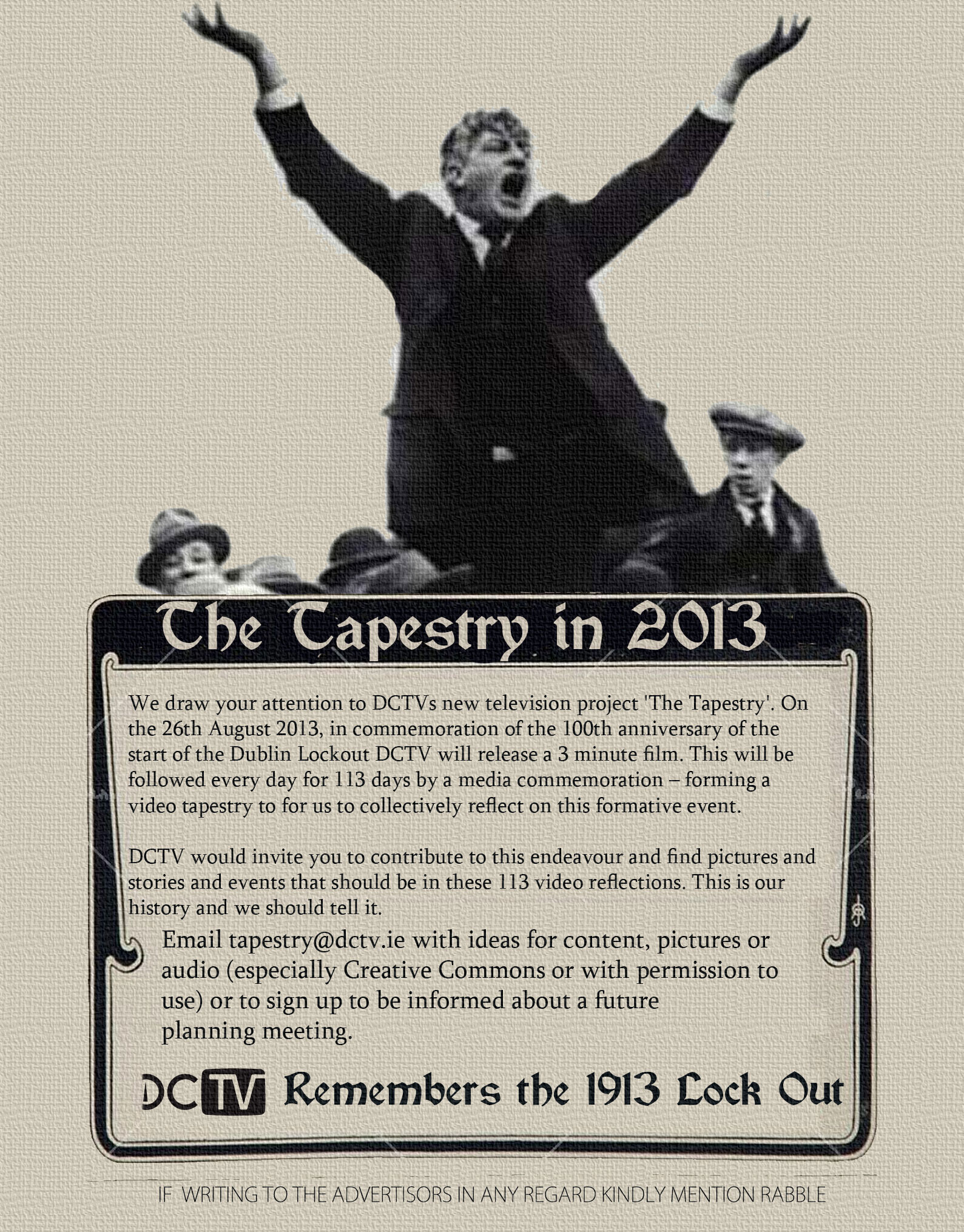
DCTV remembers the Lockout.

Sirs, I address this warning to you, the aristocracy of industry in this city, because, like all aristocracies, you tend to grow blind in long authority, and to be unaware that you and your class and its every action are being considered and judged day by day by those who have power to shake or overturn
the whole social order, and whose restlessness in poverty today is making our industrial civilisation stir like a quaking bog.
-Jim Larkin’s Speech to the Askwith Inquiry, 4 October 1913

This is a great project from Dublin Community Television (DCTV) and something we’re more than proud to support. It’s undeniable that the ‘decade of centenaries’ we have entered will be a contentious one politically. Already we’ve seen the Labour Party using their annual Connolly commemoration to preach austerity this year for example, and the tug-of-war ahead for the legacy of 1916 will be fascinating to watch, if not tragic.

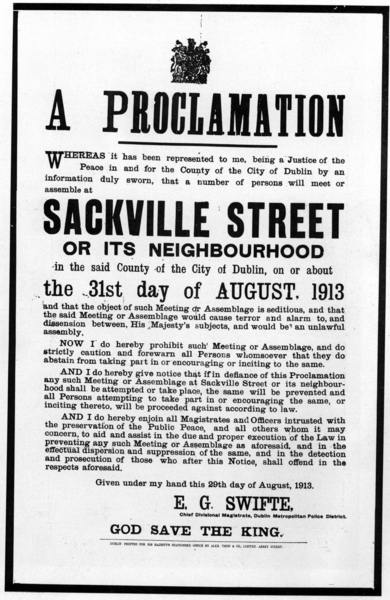
The lockout has always sat awkwardly for many in the story of revolutionary Ireland, yet it is an incredibly important part of the story. Out of the lockout emerged the Citizen Army of course, but the lockout itself emerged out of a growing sense of class stuggle in Dublin at the time. The likes of the Jacobs strike of 1912, which saw three thousand women workers at Jacob’s factory withdraw their labour.

If 2016 will be about Enda Kenny, Bertie Ahern and their sort observing tanks roll down O’Connell Street, what will 2013 be about? If we want to have a say in how the event is commemorated, it’s time to get moving.

Oldest hotel in Dublin city?

One of my favourite posts on the blog so far was about trying to identify the oldest restaurant in the city. The comments, arguments and people’s memories that followed were brilliant.

This morning  I had the idea to try to find out Dublin city’s oldest hotel. As you do.

Google brought up a whole range of contradictory answers. The Ormond Quay Hotel was described as “Dublin’s oldest hotel”, The Gresham as “Ireland’s oldest hotel”, The Shelbourne as the “oldest hotel in Dublin”, Wynns as “Dublin city centre’s oldest hotel ” and The Castle Hotel as “the oldest hotel in Dublin”

The Ormond (Quay) Hotel if  still open, it closed in 2005, could not be Dublin’s oldest hotel. It was opened in 1900.

The Gresham Hotel on O’Connell Street would have a good chance, it was established in 1817.

The Shelbourne on St. Stephen’s Green, which many people may think was Dublin’s oldest hotel, opened its doors in 1824.

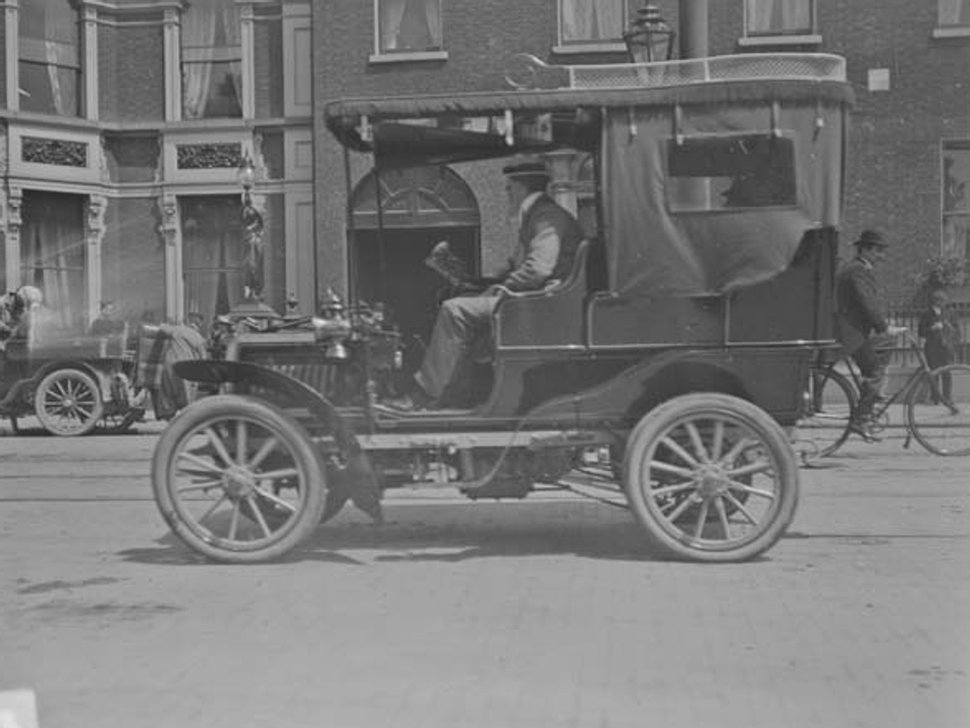
“Car outside the Shelbourne Hotel, St Stephen’s Green. Clarke Collection: 1890-1910 “

Wynn’s on Upper Abbey Street, which I personally did not think was particularly old, was in fact established in 1845.

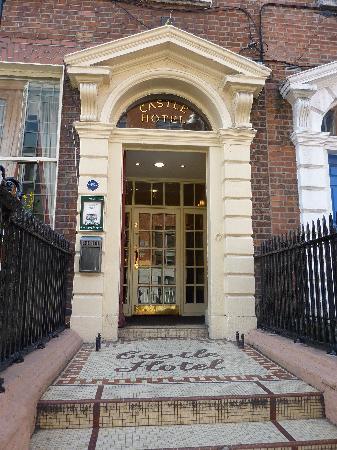
However, it’s the relatively unknown Castle Hotel on Great Denmark Street which wins the prize for the oldest hotel in Dublin in continuous existence.  It was opened by a Mrs. McCrory in 1809.

The nondescript Castle Hotel, the oldest in Dublin, on Great Denmark Street.

Buswells (estd. 1882) on Molesworth Street deserves an honourable mention. As does perhaps The Clarence on Wellington Quay which, though completely renovated in 1992, was originally opened in 1852.

Then there are others like The Westbury (estd. 1984), The Merrion (estd. 1995) and The Westin (estd. 2001) who I thought had been on the Dublin landscape for a lot longer.

The Blades (Live, 1984)

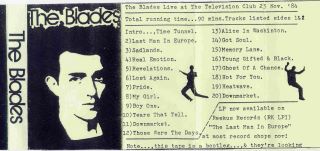
Audio of The Blades playing the TV Club, Harcourt Street on 23 November 1984 has made it online. The bootleg was uploaded by Bill Kealy who runs the For Dancers Only Northern Soul nights in Wexford. Though the audio isn’t crystal clear the tape, which runs at 90mins, really captures the atmosphere of the crowd and gig. Various people shouting things like ‘Get out of me way!’ can be heard throughout.

Side one / Side two.

The Blades live at the SFX on 9 November 1985 can be heard here on the brilliant Fanning Sessions blog while the second part of a 1985 live broadcast of the band can be heard here.

Released last week, The Blades feature on the Reekus Records compilation ‘Too Late To Stop Now’ which marks the 30th anniversary of the influential record label. The Blades feature four times while Paul Cleary features as many times himself with solo material.

[We’ve featured The Blades a number of times on this blog before;  Revelations (Of 45s), The Blades Are Sharp,  os Blades? and  The Blades singles.]

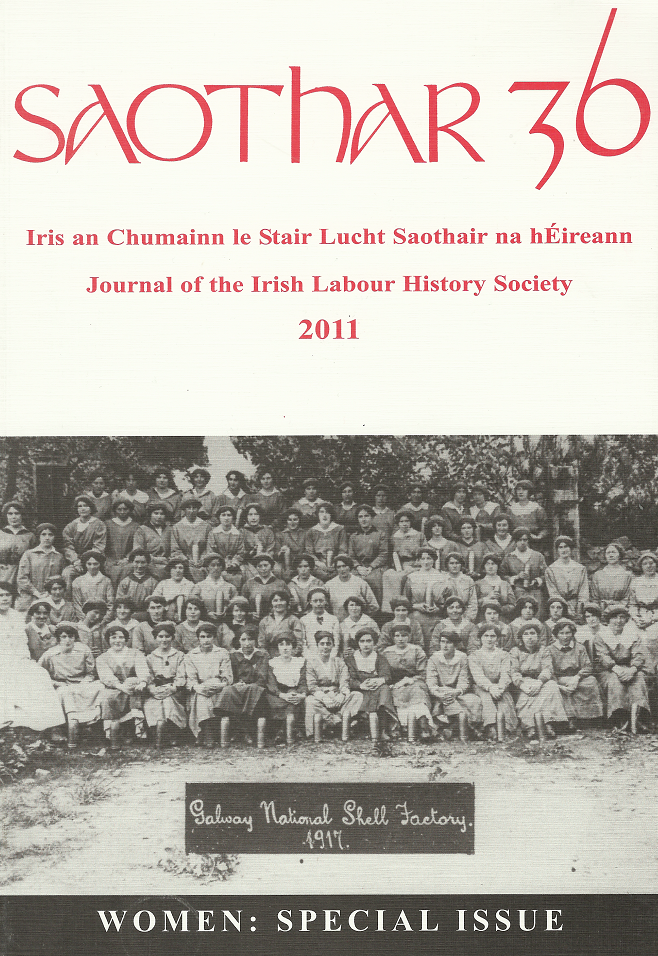
There are, in my own mind, few journals as important as Saothar, from the Irish Labour History Society. It is dedicated to the study of Irish working class history, looking not only to the role of the working class in revolutionary periods but also the evolving everyday lives of Irish workers. The society was founded in 1973, and the first Saothar published two years later.

The latest issue, 36, is hugely important. It focuses on the history of working class women.

Among its contents one finds articles such as:

‘The Irish women worker and the Conditions of Employment Act 1936: Responses from the women senators.

‘Second class citizens who are being subsidised by the men….’: Women in the Irish Transport and General Workers’ and Workers’ Union of Ireland 1945-1960

‘Sighle Humphyreys: A case study in Irish socialist feminism, 1920s-1930s’

Remarkably, along with the emphasis on female subjects, many of the historians contributing to this issue of Saothar are themselves female, something which is of course to be welcomed.

Recently, the Women’s History Association of Ireland invited four distinguished voices in Irish history to discuss four leading female historians. Remarkably, the four professors invited to contribute on the day were all men, greatly influenced by the female historians discussed. They were:

Professor Diarmaid Ferriter, UCD, on Margaret MacCurtain
Professor Thomas Bartlett, University of Aberdeen, on Helen Landreth
Professor Tom Dunne, UCC, on Maureen Wall
Professor Eunan O’Halpin, TCD, on Dorothy Macardle

The recent focus on women’s history and the role of women in not only making history but writing it is certainly something to be welcomed. Saothar can be obtained by joining the Irish Labour History Society, with membership priced at €30 annually or €20 concession rate. The society are online here.

There’s just certain things Dubliners, both native and adopted, should know about this city. Lets start with an obvious one.

The cafe on the top floor of Easons is like a 1913 soup kitchen, only it’s not lines of starving workers before you but shoppers on the verge of collapse. It’s midday, but clearly some of these people have been on the go since the shop doors opened at 9am, and they’re probably a few dodgy jumpers off finishing their Christmas shopping. Stuck for time, we make the call to head elsewhere. The better-half has a bus to catch soon from Parnell Street, but there’s time for a quick coffee. The bus is just too soon to enable a trip to the likes of the Lovinspoon up by Parnell Square, but just long enough to allow for a coffee on O’Connell Street.

Cafe Kylemore is much the same. It’s not really an option to settle on this place with crowds out the door. Town is absolutely mental, it’s like the yanks on what they term ‘Black Friday’, where frenzied showdowns for toasters and DVD players and all sorts of goodies make it to YouTube, showing that mankind isn’t as far removed from the animal kingdom as we sometimes think. People push by and head down Talbot Street carrying more bags than you’d think possible, and across the street at the GPO the preachers continue to preach like this was any other Saturday, everything from repression in China to the word of God, from the need for socialism to the Hare Krishna mantra spouted into megaphones at uncaring shoppers.

The Gresham, we’ll pop in there. Two coffees. They drop them down too, how fancy. There’s two lovely biccies on the side too. Toddy’s Bar and Brasserie, how often I’ve passed it and never walked in. We chat happy, sip the hot goodness and with ten minutes to go until the departing bus, decide it’s time to make a move.

I head back to the barcounter (“You can pay at the end”) and hand over a tenner. She gives me back a single Euro. I instantly feel like a gobshite. At €4.50 a coffee, perhaps this one is best avoided. Yet being told The Gresham is expensive is as unsurprising as being told Copper Face Jacks attracts off-duty Guards and schoolteachers. It’s my own fault. We’ve all heard the little old ladies on Liveline giving out about their lunch in The Gresham, folks take it from me. Just get into the line at Easons and hope for the best.

On the beat.

I’ll leave it to jaycarax to give you a better taste of what’s in issue 2 of Rabble, several thousand copies of which just hit the streets of the capital.

Above is a sketch of Garda Jim Branigan, or Lugs as he’s known in Dublin folklore. It’s the work of the younger Fallon (Luke, over here), and features in the current Rabble alongside a brief biographical piece on Lugs.

I thought it worth giving the piece a platform here, I love the detail in the piece like the Wild Westesque Sheriff’s badge and, well, the lugs of Lugs. I’ve wanted to post it here for some time but decided it best to wait til the mag hit the streets, trust me there’s much, much more to be seen and read inside it. Well done to all involved in the process.