During lockdown, I researched and wrote a long article on the history of gay-friendly pubs and venues in Dublin over a fifty-year period – from the early Irish Free State in 1923 to the emergence of the first proto-gay rights group in 1973. I’m delighted that this work has now been published as a chapter in The Irish Pub: Invention and Re-Invention, the first book-length academic study of the Irish pub. Credit to editors Moonyoung and Perry for sticking with an ambitious project and getting it across the line.
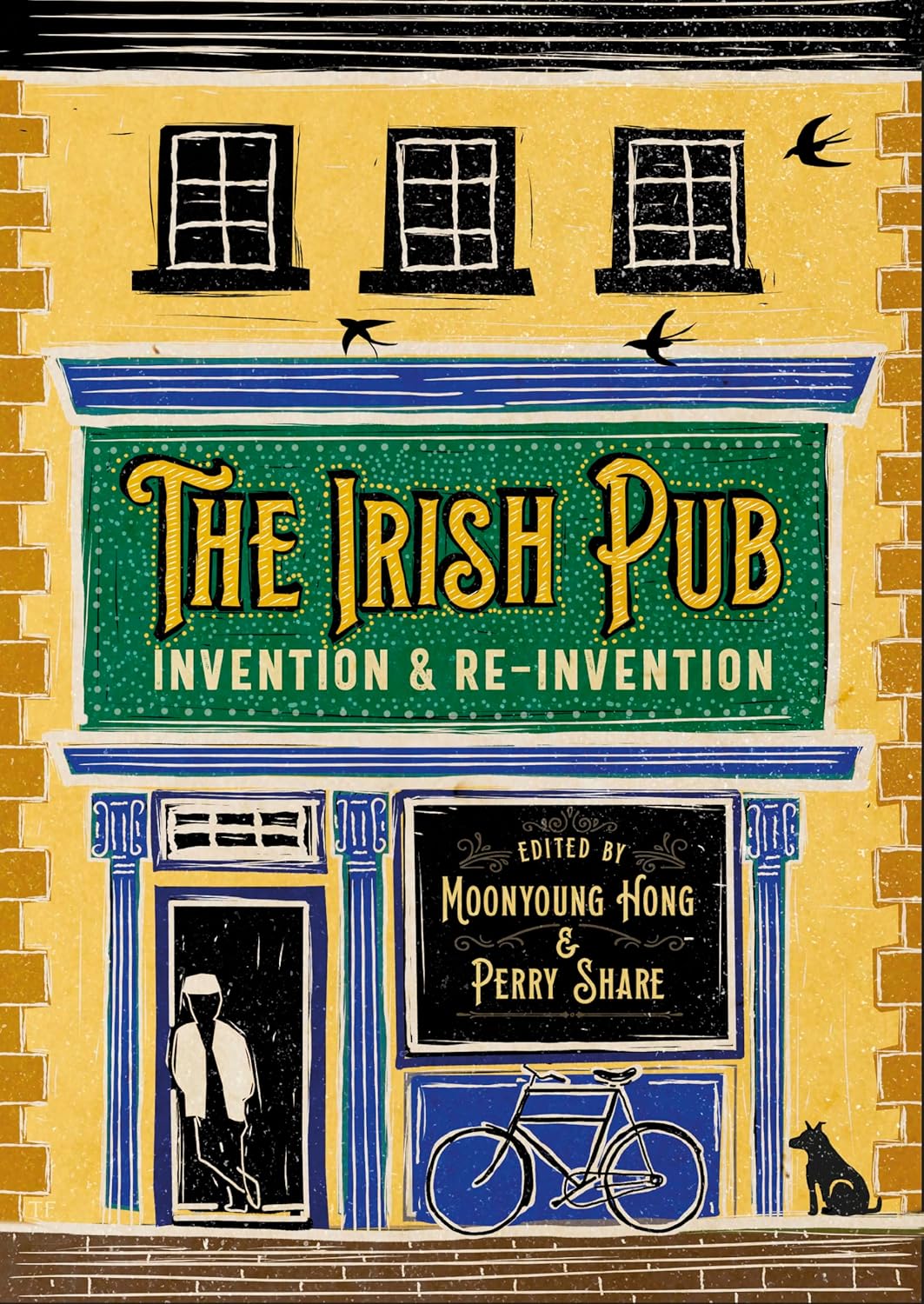
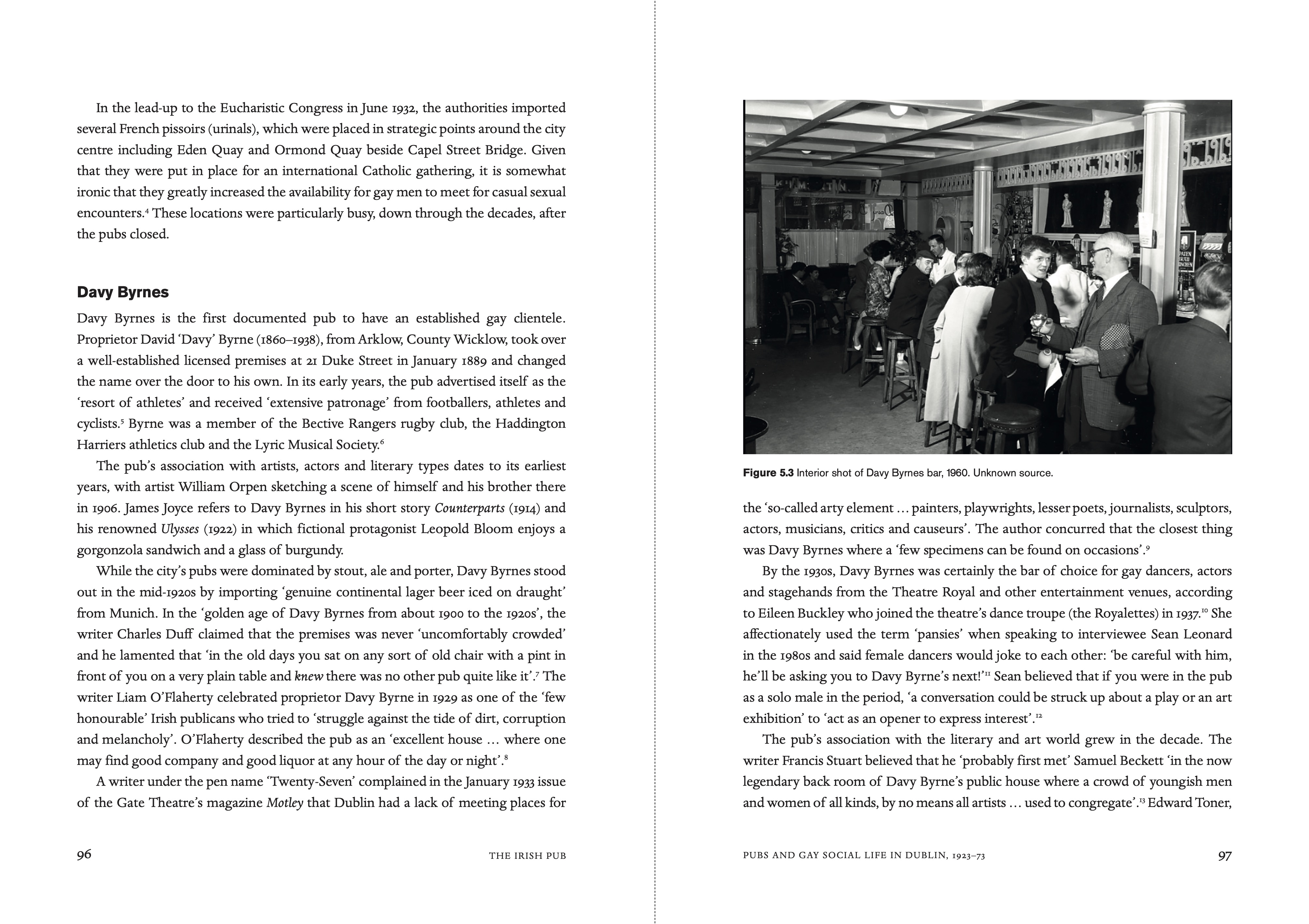
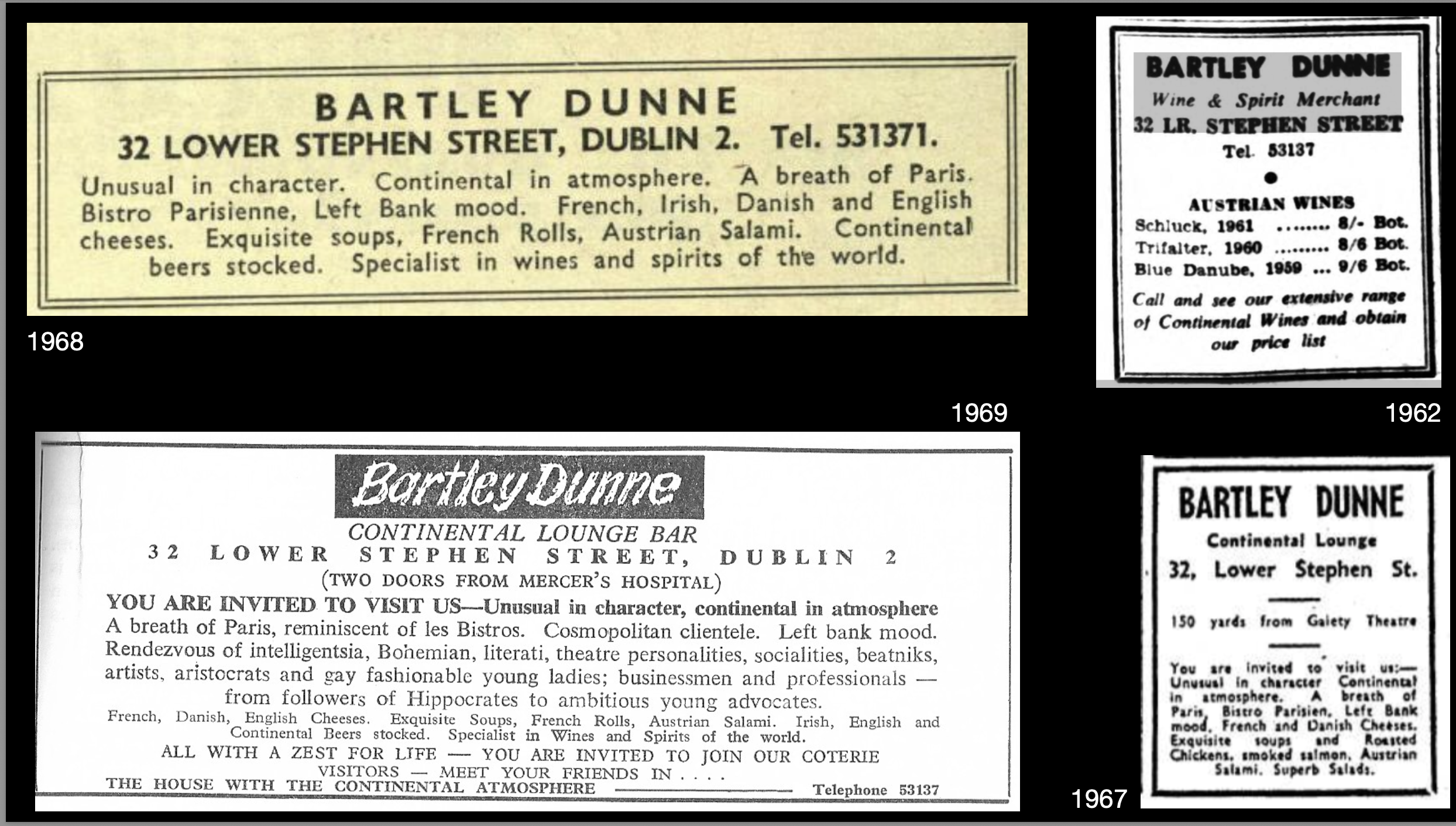
My chapter examines the history, importance and legacy of public houses where gay men socialised – primarily Davy Byrnes, the Dawson Lounge, the Bailey, Bartley Dunne’s and Rice’s – in the Grafton Street and St Stephen’s Green area of the south city centre. It also looks at some of the hotel bars, restaurants, late-night cafés, private clubs and basement shebeens that served as meeting points for a small social scene that was criminalised and underground. I’m thrilled that the chapter was given a generous layout, with 29 pages featuring 19 full-colour historical images and advertisements.
It has its origins in a 2013 CHTM! blog article on Bartley Dunne’s and Rice’s which became one of the website’s most-read articles. It proved that there was a keen audience for this kind of social history.
Why did I take an interest? First, the topic hadn’t been examined in detail before – a strong motivation in itself. Most histories of gay life in Dublin focus on political organising and activism from the early 1970s onwards. A hugely important era but I wanted to uncover the community’s social life before the first campaign groups, early discos, the Hirschfeld Centre (est. 1979), and The George pub (est. 1985). Second, I was drawn to the underground nature of the pre-liberation scene – the coded language, discreet signals, and a community socialising hidden in plain sight. Third, I felt strongly that this was an important part of the city’s wider social fabric, and that gay/LGBT+ history should not be treated as separate from Dublin’s history as a whole.
I was fortunate to interview several older gay men with memories of their social lives in the late 1950s and 1960s. They spoke about the fear of blackmail and arrest, but equally about camaraderie, a lively social calendar, and building lifelong friendships and partnerships. For instance, one couple, whom I interviewed in their Portobello home, met in Bartley Dunne’s in 1966 in their mid-twenties and have been together ever since. Harold Clarke, who passed away in 2022 a year after our interview, met his partner in 1956 and remained with him until his death in 2014.
The project opened all sorts of avenues to the history of Dublin’s bustling nightlife scene, which will be of interest to Dubliners of all persuasions. I spoke to Wladek Gaj, whose remarkable mother, Margaret Gaj, ran Mrs Gaj’s café on Lower Baggot Street from 1963 to 1980; to Arthur Gilligan Jr, whose father owned the Dawson Lounge from 1951 to 1969; to Eddie Hernon, who worked in the Bailey’s fish restaurant in the early 1960s; to Tara Higgins and her father Reg Woods Jr, whose family operated the Manhattan all-night café from 1951; and to Stephen Corcoran, a former barman at the Wicklow Hotel who later established his own gay bar in Paris.
I encourage you to buy the book or request it at your local library. Onto the next project now!
– Sam McGrath
PS – Others are doing excellent work in this similar field, see Averill Earls’ Love in the Lav: A Social Biography of Same-Sex Desire in Ireland, 1922–1972 which was published in July 2025, and Tom Hulme’s Belfastmen: An Intimate History of Life Before Gay Liberation due in April 2026.







 Click on the book for more.
 Click on the book for more.
 Donal
Donal Ciarán
 Sam
Sam


 Come Here To Me!