Feeds:
Posts
Comments

Archive for the ‘Dublin History’ Category

A friend of ours Andrew has created this fascinating google map of sites of significance to current and historical radical struggles.

While the map covers the whole island, it focuses particularly on Dublin. It’s particularly apt to post in the run up to Sunday’s radical walking tour of the city.

The markers are as follows:

Green – Old History (Pre 20th century)

Red- History (1900-1980)

Yellow – Recent (1980-yesterday)

Blue – Current (Locations that are still active in some sense)

Purple – Stops on the Feminist Walking Tour 2010

Read Full Post »

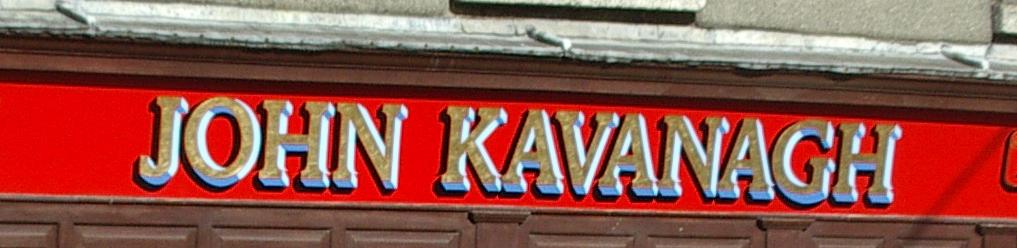
As much as I love this pub, I must love reading reviews of this pub even more.

It’s amazing how much people, especially younger people, can seem taken aback by the place.

The Porterhouse she ain’t. The taps when you walk in are a no nonsense affair. Not quite Henry Ford and the famous “..any colour you want as long as it’s black” comment, but not a million miles off. Let’s be honest, for ninety percent of the punters here at any given time, it’s black.

Yet , there is quite a bit more to a pub like this than the pints. Colm Tóibín was on the money when he stated that, when it came to Dublin pubs, “There are four or five that have survived the ravages of new money”

When a pub remains in the hands of one family for so long, as this one has, tradition becomes so firmly implanted in the place you’d need to knock it down and build some dire three floor disco-pub to undo it at this stage.

Glasnevin Cemetery is the rowdy next door neighbour to the quiet, content Kavanagh’s.

In any other community, the cemetery and pub might be the other way around. Still, only a stones-throw (literally) from the front door of this pub, you have the burial place of over one million individuals. Frank Ryan and Eoin O’ Duffy, Jim Larkin and William Martin Murphy, Cathal Brugha and Kevin O’ Higgins- all together. Not to mention a Big Fella and a Long Fellow.

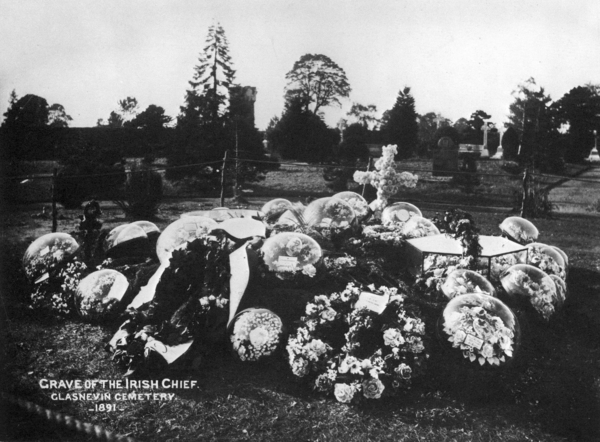
1891, Parnell is laid to rest in Glasnevin.

Only recently on the fantastic Glasnevin Cemetery Tour did I fully stop and appreciate the surreal nature of the manner in which old and bitter Irish conflicts are at rest there. A pub can not grow up on the edge of such an amazing place and not be shaped by it.

Stories, legends or otherwise, have spread. The best is surely that of the Cemetery staff in years long past arriving to find a number of coffins sitting outside the pub, as opposed to inside the gates. I don’t doubt such tales for a second. A pub on the edge of a graveyard is, to me, akin to a fireworks factory beside an incinerator.

So, the place naturally has character in excess. If this was in the city centre, you wouldn’t be able to see for all the flashing photographty you’d no doubt have to put up with from tourists. Swinging doors, a true staple of a sort of Irish pub long gone, make you long for something you never knew in reality and could only read about. The pub is authentically old. There are publicans all over the island battering tables with objects to make them look old (Well, not literally…I hope) to create some sort of old ‘Oirish’ pub experience. You can’t create it but, especially not when you’ve put 5 widescreen televisions into your pub and half your customers are only there to watch Manchester United.

There isn’t a telly in sight here. Nor can you hear a Lady Gaga song, or any song for that matter. It’s a reflection on the punters and regulars that the sound of chat and laughter is enough to carry the day in a pub like this. Some pubs probably need the television sets to be honest. I’ve been in pubs where silence would be the only thing worse than the music selection on offer.

While O’Donoghues and a few other gems have sadly succumbed to the suits and faster pace of a new Dublin, a new faster paced Dublin has to slow down when it enters Kavanagh’s. Let us hope a few more generations will rise to the challenge of running the place. It’s in good hands.

Read Full Post »

Sunday week, the 30th of May, I will be one of the guides on a walking tour taking in some of the radical history of Dublin city centre.

The Walking Tour is taking place as part of the Fifth Dublin Anarchist Bookfair, hosted by the Workers Solidarity Movement. Many of our readers here have a keen interest in radical history, and talks like “A History of Irish Revolutions” (Conor Kostick) and “The Lost Revolution – the Success & Failures of the Workers Party” (Brian Hanley and Scott Millar) at the bookfair are of particular note in that field.

The tour is completely free (I felt the need to ‘bold’ that, students eh?) and I would hope will end with some good discussion. Many of my own chosen sites have a particular focus on Dublin through the revolutionary years, with some unusual War of Independence and Civil War sites. Union history, feminist history, student history and much more besides will feature.

So, come meet dfallon in real life ( “Him? Really?”), learn something new, and enjoy a walk around our lovely and historic city.

The tour has a Facebook event page, here.

Read Full Post »

The annual Match Programme Fair is coming up again, at St Andrews Parish Centre on Pearse Street.

It takes place on Sunday, May 30th

I only recently uncovered a box of copies of the SuperSaint programme from 1998-1999 and 1999-2000 under the bed, absolute gems. Every programme from 1999-2000 in particular opens with a 1,000 word essay from Pat Dolan on whatever was getting on his nerves that week.

For example,in Issue 13 of the campaign, Galway United at home, Dolan noted that

It is certainly not satisfactory for our youth to believe that supporting their team is about sitting in front of the TV. It is something bordering almost on fraud for RTE’s over exposed Premiership to rely on opinions of people not qualified to comment. As someone who has analysed games for TV and radio, both live in the stadium and ‘live’ in the studio in front of the telly, I can tell you that you can only truly appreciate the pattern of the game and the wider picture if you actually attend the match! How gullible as a nation have we become that we accept people pontificating about the merits of English soccer and decrying the merits of Irish soccer, who attend neither.

Indeed.

As well as a trip to Pearse Street, you could do worse than to make a trip out to the Phoenix Park for a free month long exhibition there on the history of football in the park.

“The exhibition was launched to mark the FAI taking over the lease for the football facilities in the Phoenix Park, which are known as ‘the Fifteen Acres’. The exhibition contains photographs documenting the history of football in the Fifteen Acres, beginning with the foundation of Bohemian Football Club at the Gate Lodge of the Phoenix Park on September 6th 1890 and including photographs of football clubs from the late 19th century right through to the present day”

Do both on the same day and then go home, stick the scarf on, play some Subbuteo and give Jack’s Heroes a spin.

Read Full Post »

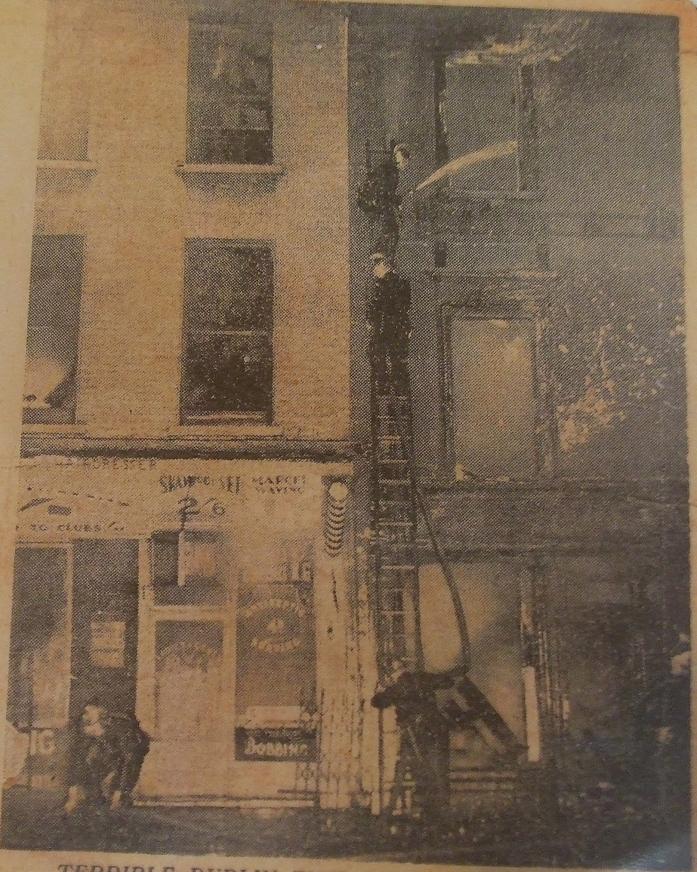
This article aims to provide a brief overview of the Pearse Street Fire of 1936. It is by no means a complete overview of events and I recommend anyone seeking more information on the incident consult ‘A Triple Tragedy in Dublin, The Pearse Street Fire, 1936’, by A.P Behan. That paper was published in the Dublin Historical Record (ISSN 0012-6861, Spring 1997). I have relied on it, and newspapers of the period, for much of the information below.

Men fight the blaze, image taken from Independent. This image was taken moments before an explosion in the premises.

Writing in the Irish Independent in the immediate aftermath of the event , Anthony Flynn wrote of the risks men in the Dublin Fire Brigade faced in the line of work.

The fireman himself thinks only of duty. That duty is clear and defined. And our Dublin firemen do not hesitate. In Pearse Street, as on countless other occasions, these men faced death. Three of them died, displaying a courage equal, if indeed, it does not transcend, that of the battlefield.

The premises of Exide Batteries, at 164 Pearse Street, had been the site of a horrific blaze on the night of Monday October 5th. Due to the proximity of Tara Street Fire Station, it took less than two minutes for the men to arrive on scene. The fire had been detected by the tenants above Exide Batteries at 10.50 p.m. In the definitive history of the Dublin Fire Brigade (The Dublin Fire Brigade: A History of the Brigade, the Fires and the Emergencies, by Trevor Whitehead and Tom Geraghty)they note that

Number 163 housed a barber’s shop at ground level and a private hotel occupying the upper floors. Number 164 had a retail shop belonging to Exide Batteries Ltd. on the front ground floor, vacant offices on the first floor and a family of seven living on the top floor. The basements, although not connected,were the location of a factory in which Exide batteries were assembled….

The fire was fought in terrible conditions. The water supply in the area was nowhere near adequate, for example. A.P Behan stated in his paper ‘A Triple Tragedy in Dublin, The Pearse Street Fire, 1936’ that

There was practically no volume of water and no pressure. Onlookers were incensed at the firemen having to fight such fire in these conditions, and the absence of adequate water supply had the result that the firemen had to get so close to the fire that their uniforms were scorched

Two explosions ripped the premises apart. Initially, two firemen were thought missing in the premises, but quickly it became apparent a third was missing. It was not until about 10 in the morning the next day that the third body was found. The three Dublin firefighters killed in the line of duty were:

Fireman Robert Malone– a veteran of the 1916 Rising who had served as a Lieutenant with “D” Company 3rd Battalion at Bolands Mills Garrison, under Eamon de Valera. He left a wife and child behind.

Fireman Thomas Nugent– who was engaged to be married.

Fireman Peter McArdle– who left a wife and seven children (His funeral mass card is shown below)

(more…)

Read Full Post »

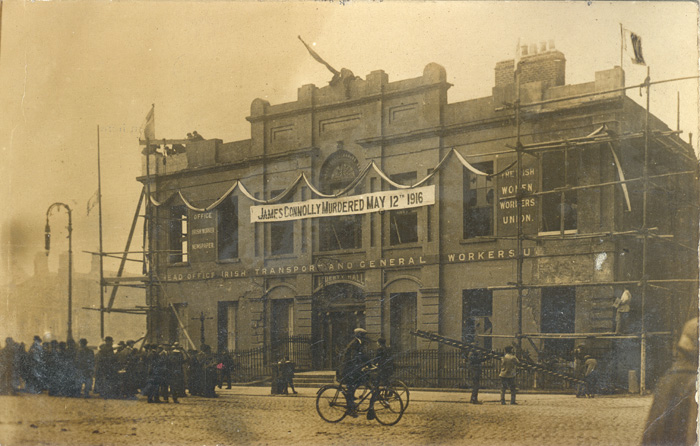
The banner outside Liberty Hall, 1917

The text below is taken from the Bureau of Military History Witness Statement provided by Miss Rose Hackett, a member of the Irish Citizen Army. Rosie had been involved in the Jacob’s biscuit factory strike which took place near the end of August in 1910, ending in success for the workers. She was also involved in a later strike at Jacob’s when in September 1913 three workers were sacked for refusing to remove their trade union badges. During the Rising Rosie was positioned at Stephen’s Green under Commandant Michael Mallin.

Document No. W.S 546

“On the occasion of the first anniversary of Connolly’s death, the Transport people decided that he would be honoured. A big poster was put up on the Hall, with the words: “James Connolly Murdered, May 12th, 1916”.

It was no length of time up on the Hall, when it was taken down by the police, including Johnny Barton and Dunne. We were very vexed over it, as we thought it should have been defended. It was barely an hour or so up, and we wanted everybody to know it was Connolly’s anniversary. Miss Molony called us together- Jinny Shanahan, Brigid Davis and myself. Miss Molony printed another script. Getting up on the roof, she put it high up, across the top parapet. We were on top of the roof for the rest of the time it was there. We barricaded the windows. I remember there was a ton of coal in one place, and it was shoved against the door in cause they would get in. Nails were put in.

Police were mobilised from everywhere, and more than four hundred of them marched across from the Store Street direction and made a square outside Liberty Hall. Thousands of people were watching from the Quay on the far side of the river. It took the police a good hour or more before they got in, and the script was there until six in the evening, before they got it down.

I always felt that it was worth it, to see all the trouble the police had in getting it down. No one was arrested.

Of course, if it took four hundred policemen to take four women, what would the newspapers say? We enjoyed it at the time- all the trouble they were put to. They just took the script away and we never heard any more. It was Miss Molony’s doings.

Historically, Liberty Hall is the most important building that we have in the city. Yet, it is not thought of at all by most people. More things happened there, in connection with the Rising, than in any other place. It really started from there.

Signed: Rose Hackett,
26/5/51.

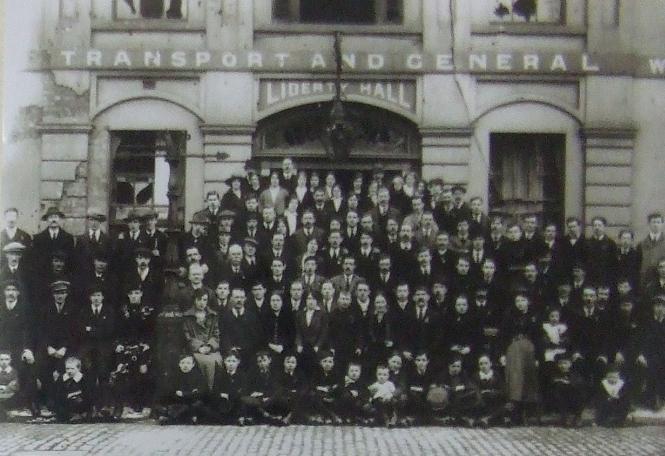
Irish Citizen Army outside Liberty Hall, 1917.

Read Full Post »

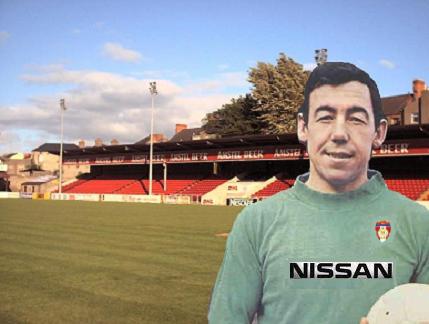
Gordon Banks, World Cup Winner.

Much more than that actually. *That* save against Pele will go down in football history, in fact in 2002 he remarked to FourFourTwo magazine that “It’s something that people will always remember me for. They won’t remember me for winning the World Cup, it’ll be for that save. That’s how a big a thing it is. People just want to talk about that save.” In another interview, with The Observer Sport Monthly, he commented that “As I got to my feet I tried to look as nonchalant as possible, as if to say that I make that sort of save all the time.”

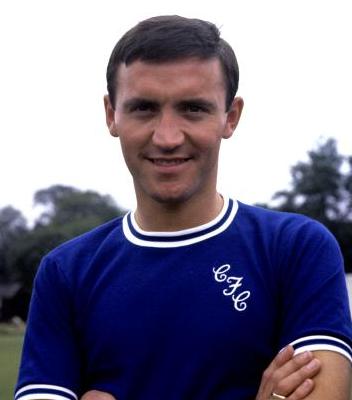
Gordon Banks defended more nets than just the English national one however. A quick glance at his C.V shows Stoke City, Leicester City , Chesterfield , The Fort Lauderdale Strikers, Cleveland Stokers and, believe it or not, Saint Patrick’s Athletic.

Banks played one game for the Saints, a home match against Dublin rivals Shamrock Rovers. Barry Bridges was managing the Saints at the time, as player manager. The year previously, in 1976, Pats had gained some attention by picking up Neil Martin, a former Hibernan F.C, Sunderland and Nottingham Forest striker, among other clubs. In fact, English player manager Bridges had an impresive record himself, including but not limited to spells at Chelsea, Milwall and QPR.

Barry Bridges

The Irish Times of October 1st 1977 noted that Barry Bridges stated there was a “fifty fifty” chance Banks would line out the next night in Richmond Park. Picked up from Fort Lauderdale, it all depended on clearance from the American F.A. The paper noted that

“The signing, which is likely to extract a sharp response from St. Patrick’s first choice goalkeeper, Mick O’ Brien, represents the Dubliners’ most entreprising move since Neil Martin joined the club last seaon”

Amazingly, Gordon Banks had returned to goalkeeping despite losing sight in one eye following a car crash. It was common enough at the time for English players to semi-retire in the U.S game, and Banks signing to Pats was a surprise to many. In the end, he was given clearance to perform and maintained a clean seat, in a one nil home victory over Rovers. He would never grace the pitch at Richmond Park again, and returned to the United States.

Barry Bridges remained at Pats until February 1978, moving on to become player manager of Sligo Rovers. Banks remains just one former English international to briefly play in the Irish league. Geoff Hurst, Terry Venables (another Saint), Carlton Palmer and Bobby Charlton are just a small selection of others who have done the same.

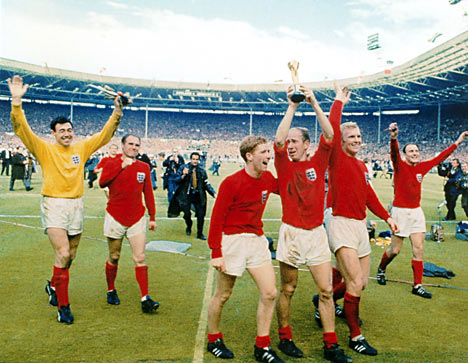
 Gordon played alongside future Waterford United player Bobby Charlton in 1966.

Read Full Post »

May 24th marks the end of the National Library of Ireland’s wonderful W.D Hogan photo exhibition at the National Photographic Archive. Below are two samples from the NLI Facebook page to promote the exhibition, and I’ve also included a wonderful W.D Hogan snap of Liam Mellows delivering the oration at Bodenstown cemetery during a Wolfe Tone commemoration.

Opening times are below the images, seize the day and get into this one before it’s too late. Due to the nature of W.D Hogan’s work (He was in the company of the Free State Army during much of the civil war) there is, of course, a greater amount of images from one side of the civil war conflict than the other, but it is the shots of civilian life that make this exhibition what it is.


“Man examining remains after the fire at the Custom House, 26 May 1921”


“National Army troops shell the occupied Four Courts”


Liam Mellows addresses rally at Bodenstown, County Kildare.

National Photographic Archive, Temple Bar.
Mon – Fri: 10am – 5pm
Saturday: 10am – 2.00pm

Read Full Post »

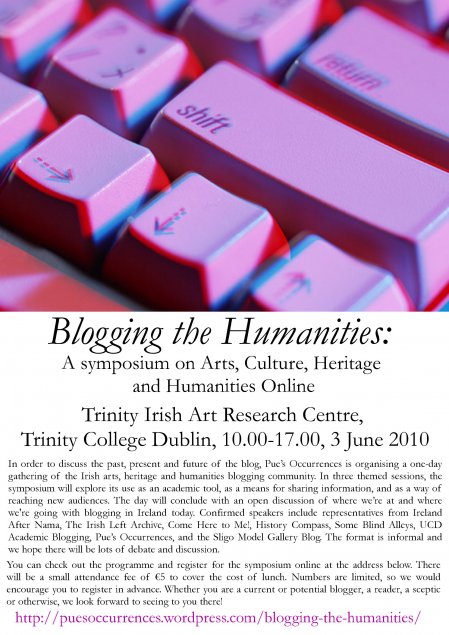
Our friends at Pue’s Occurences are organising a one day symposium under the title ‘Blogging the Humanities’. I’ll be there to do what I do best, talk about myself. Or the blog, I’ve yet to decide. In all seriousness, it looks like a great day with a fine variety of blogs taking part.It’s a worthwhile discussion no doubt, and one we look forward to partaking in.

It’s nice for Come Here To Me to be asked to partake in these things, still being a somewhat new blog, and I hold the other blogs participating in very high regard so we’re in good company.

Pue’s have set up a page specifically for the symposium (where you can register to attend) here.

“We welcome the input of all voices – from history, arts, culture, heritage and beyond, sceptics and otherwise”

Pue’s is almost a year old and, we thought, what better way to celebrate than to organise a symposium on the arts, culture, heritage and humanities blogging community in Ireland – where we’ve come from, where we are, and where we’re going in future. Hosted in the TCD Irish Art Research Centre, the day is intended to provide an informal format that will stimulate lots of debate and discussion, led by a group of speakers from Ireland After Nama, The Irish Left Archive, Come Here to Me!, History Compass, Some Blind Alleys, UCD Academic Blogging, Sligo Model Gallery Blog, and, of course, your very own Pue’s. We welcome the input of all voices – from history, arts, culture, heritage and beyond, sceptics and otherwise – so if you’re interested, have a look at our dedicated conference page and keep an eye out on Pue’s for more details closer to the event. Registration is via our online form only and numbers are limited, so we would encourage you to do so early. We look forward to seeing you there!

Pue’s Occurences is a group history blog, mainly Irish in scope, with a wide variety of contributers. It’s the kind of blog you’ll lose an hour on, and I have on many occasions. Everything from the diaries of Phd students (Terrifying reading for an Undergraduate) to a ‘soap box’ for opinion pieces, it’s worth a click.

I look forward to the conference, and congratulate Pue’s on taking the initiative.

Read Full Post »

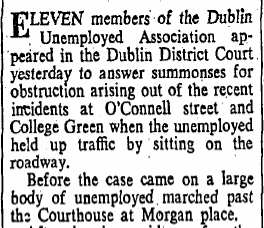
Another gem from the British Pathe website showing a Dublin unemployed march from the mid 1950s.

When I first watched the clip, I nearly fell off my chair as the first seconds show something that resembles the Spire in the background. Any idea what it is?

It quickly cuts to a man holding the Starry Plough walking past the GPO who is followed by hundreds of men doing a U – turn at the bottom of O’Connell St. by the bridge and marching back up the other side of the road.

At 18seconds in, the leader of the ‘Dublin Unemployment Association’, Thomas Pearle claps his hand and starts a sit down protest “halting all traffic for half an hour”

One placard reads ‘Get off your knees – March with us’, presumably a reference to the famous labour slogan, “The great only appear great because we are on our knees. Let us rise” which has been accredited to many people including James Connolly, Jim Larkin and Max Stirner.

The scene at 31 seconds is quite amazing with both side of O’Connell St. and the bridge blocked. Though it looks like there’s more people observing the demo than there is sitting down!

Jubilant scenes follow when the news is spread that the march will make its way down to the Dail, “the first time such a protest has been held at its gates”.

Dozens of men were charged and fined for causing obstructions by their sit-down protest.

Court told 'wide issues involved', The Irish Times, Saturday, July 11, 1953

Read Full Post »

I love this photo. Taken in 1900, it shows two tug-of-war sides. On the left, and boasting some quality custom ‘DMP’ shirts, we have the Dublin Metropolitan Police. On the right, and winning the war of the mustaches, the Dublin Fire Brigade.

Tug-of-war was a hugely popular sportstime in the early twentieth century, and The Irish Times of October 17th, 1908 noted that the Dublin Metropolitan Police team became the “World Champions” of the sport by overcoming the Liverpool Police at Ballsbridge during the August Bank Holiday.

In 1924, the Dublin Metropolitan Police team returned home from England with the ‘City of Hull Tramways Challenge Cup’ and, The Irish Times noted, were recevied by a large crowd which included Mr. Kevin O’ Higgins, Minister for Home Affairs.

Another 1924 report indiciates that along with the DMP, the Gaelic Athletic Association and the Royal Ulster Constabulary among others had strong tug-of-war sides.

While I don’t know the outcome of the 1900 encounter between the DMP and the Dublin firemen, the track record of the DMP in the sport means it doesn’t look good for the firemen. I’d love to hear from you if anyone knows more of their encounters!

Read Full Post »

In the Dublin of the revolutionary period, ‘G Men’ would have been a familiar sight on street corners, never quite as inconspicuous as they sought to be. G Division of the Dublin Metropolitan Police served as the eyes and ears of the intelligence community, tasked with observing political subversives in the city. Their ‘Movement of Extremists’ files record the whereabouts of republicans, socialists and other radicals in the city, noting where they loitered and who they talked to.

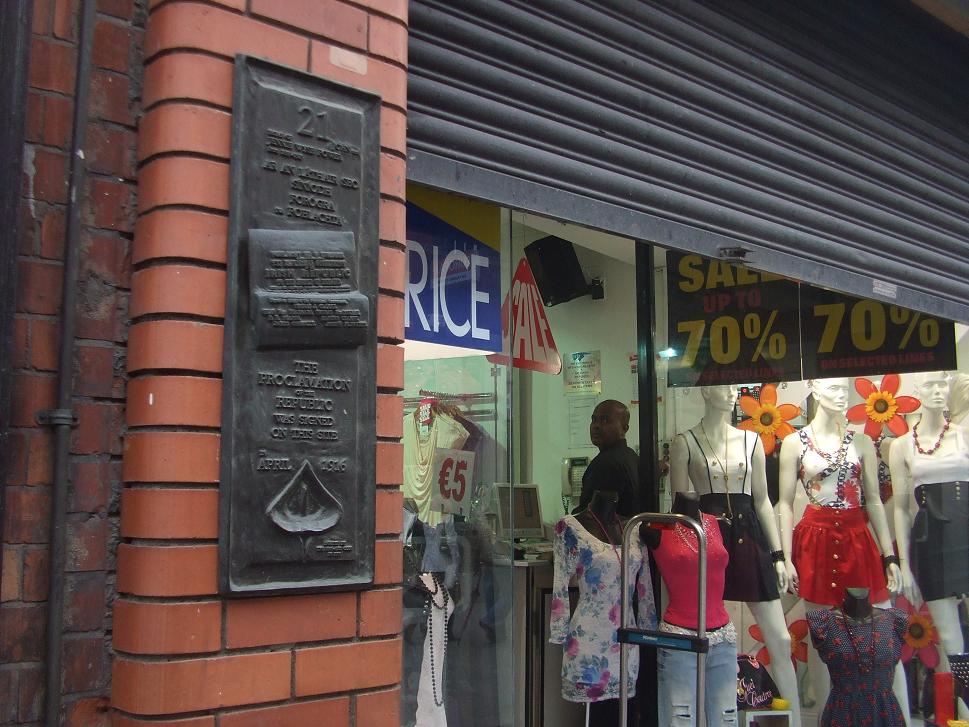
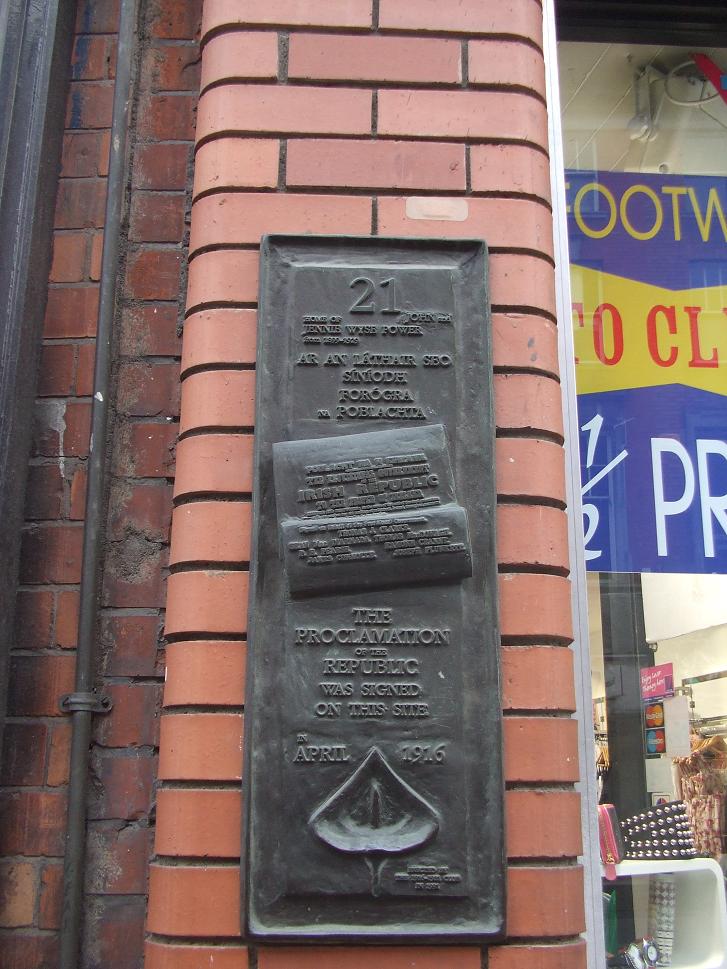
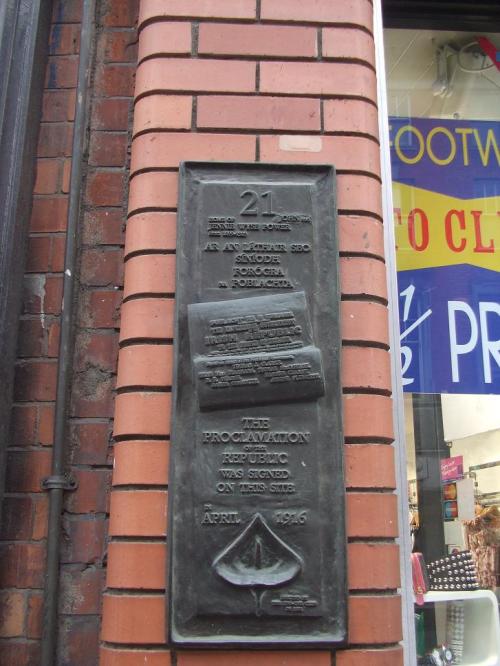
One business they would have come to know quite well was found at 21 Henry Street, the location of the Irish Farm Produce Company, a shop and restaurant (specialising in vegetarian cuisine) run by veteran nationalist campaigner Jennie Wyse Power. It was popular with Dublin’s small Indian community (and perhaps even smaller vegetarian community) but owing to its proprietor it also became a rendezvous point for advanced nationalists. A plaque on the site today marks the fact that the drafted 1916 proclamation was signed on the premises days before insurrection.

Amidst the wave of cultural nationalism of the late nineteenth and early twentieth centuries, an ‘Irish Ireland’ movement emerged which sought to promote the native language, native games and native culture over that of the neighbouring island; Archbishop Croke (he of Croke Park fame) complained that the Irish were importing from England, “her fashions, her accents, her vicious literature, her music, her dances, and her manifold mannerisms, her games also and her pastimes” among other corrupting influences. But what about what was on our tables? The Irish Farm Produce Company boasted of its “all-Irish produce”, a reminder that even dinner could be a political choice.

Jennie Wyse Power, born in Baltinglass in 1858, moved through the ranks of many important political movements in her lifetime, and had earned the respect of the men and women who frequented her business. Active in the Ladies Land League of the 1880s, which sought to advance the rights of Ireland’s tenant farmers, she was later a founding member of the Sinn Féin political party and close to Countess Markievicz.  While serious about her politics, Wyse Power was also regarded as one of the friendliest faces in Irish nationalism. Sinn Féin Executive member Seamus ua Caomhanaigh remembered that “she always left out the Wyse part of her name. She said there was nothing ‘wise’ about her. She was a remarkably able woman, very brainy, full of fun and a great teller of humorous stories.”
Some of the most watched individuals in the city frequented her restaurant in the years before the Rising, including Major John MacBride, who had fought in the Second Boer War alongside his Irish Brigade. Seán T. O’Kelly, later President of Ireland, remembered holding court there most days in the company of MacBride and Arthur Griffith. Wyse Power’s business remained popular after the Rising too, though unsurprisingly the authorities were still vigilant. P.J Paul, a prominent republican in Waterford, remembered visiting the restaurant while in Dublin, as “most of the Volunteer and Irish-Ireland people went there.” On one occasion during the War of Independence, he was having a meal “when suddenly a number of Auxiliaries rushed into the shop and began turning the place upside down.”

Dublin’s small Indian community, primarily formed from medical students in the city, would be drawn towards Wyse Power’s restaurant too, at a time when there was little in the line of vegetarian offerings in the city. Dublin’s first vegetarian restaurant, The Sunshine (advertised as ‘vegetarian dining rooms’), had opened its doors in the 1860s on Grafton Street, though such endeavours tended to be short-lived. Indian students in the capital during the revolutionary period included V.V Giri, later President of India, who studied under the poet and revolutionary separatist Thomas MacDonagh. As historian Conor Mulvagh has suggested, “in searching for routes of entry for Indian students into Irish radical politics, it is perhaps the dinner table as much as the lecture theatre that provided them with introductions.” The cause of the Indian people received sympathetic coverage in Irish nationalist newspapers, including Arthur Griffith’s Sinn Féin and The Irish Volunteer.

While the female republican body Cumann na mBán flatly rejected the Anglo-Irish Treaty of 1921, Jennie Wyse Power came to support it, which created friction between her and many former comrades. In 1923, her business premises was entered by young men who at first appeared to be ordinary customers, but “as the tea was about to be served the raiders suddenly took petrol bottles from their pockets and announced their intention of setting the house on fire.” Her other business premises, located on Camden Street, had already been attacked by republicans, with “bombs being hurled through the plate glass window.”

Despite her support for the Treaty, Wyse Power later joined the Fianna Fáil party, and elected for the party in the 1934 Seanad elections.  She died in January 1941, and was buried in Glasnevin Cemetery. The plaque on Henry Street today honours the signing of the proclamation on the premises, but in truth there was much more to the story of the Irish Farm Produce Company, and its place in Dublin’s political and culinary history should be noted.

Read Full Post »

« Newer Posts - Older Posts »