Feeds:
Posts
Comments

Archive for the ‘Dublin History’ Category

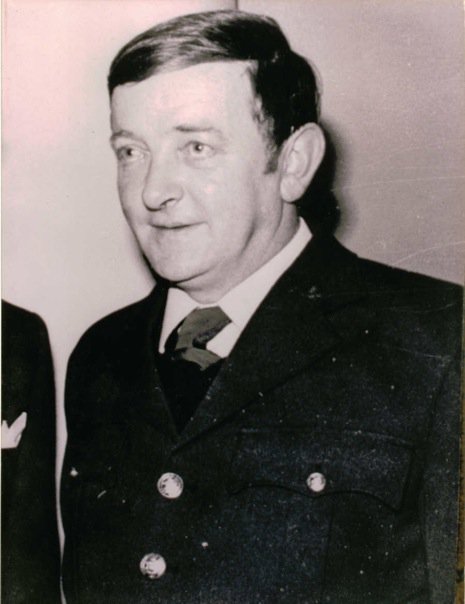
I’ve had the image below for quite a well now, a fantastic old press snap of two Gardaí inside Connolly House (located on Great Strand Street) after the attack on the premises in March 1933 by an anti-communist mob. Accounts of the night are always chaotic, for example in Pat Feeley’s wonderful article “The Siege of 64 Great Strand Street” (Old Limerick Journal,Vol. 9, Winter 1981) it is noted that:

“As the house filled with smoke and the mob began to occupy it, the defenders were making their escape across the rooftops. The fire brigade tried to rescue two women who were in difficulties on the slates but they were prevented by the crowd who slashed their water hose”

The fact a Webley and Colt. 45 Revolver were found by the Gardai behind the shop counter perhaps best indicates the political tension and state of fear at the time.

Feeley’s article also mentions a meeting held a number of days later where Maud Gonne McBride condemned those behind the scenes at Connolly House, to which a voice in the crowd responded that those involved were Catholics. When she continued to speak, and condemned the broader attacks of the street mobs:

Again the voice repeated, “It was Catholics”. To which this time she replied, “They were hooligans”

Bob Doyle, one of the men who was in the mob that attacked Connolly House, would go on to join the International Brigade forces opposing fascism in Spain. In his memoirs Brigadista, he wrote that:

“I had attended the evening mission on Monday 27 March 1933 at the Pro-Cathedral, during the period of Lent where the preacher was a Jesuit. The cathedral was full. He was standing in the pulpit talking about the state of the country, I remember him saying – which scared me – “Here in this holy Catholic city of Dublin, these voile creatures of Communism are within our midst.” Immediately after the sermon everybody then began leaving singing and gathered in a crowd outside, we must have been a thousand singing “To Jesus Heart All Burning” and “Faith of our Fathers, Holy Faith”. We marched down towards Great Strand Street, to the headquarters of the socialist and anti-Fascist groups in Connolly House. I was inspired, of you could use that expression, by the message of the Jesuit. There was no attempt by the police to stop us”

This, and other insightful accounts, can be read on the fantastic ‘Ireland and the Spanish Civil War’ website located here.
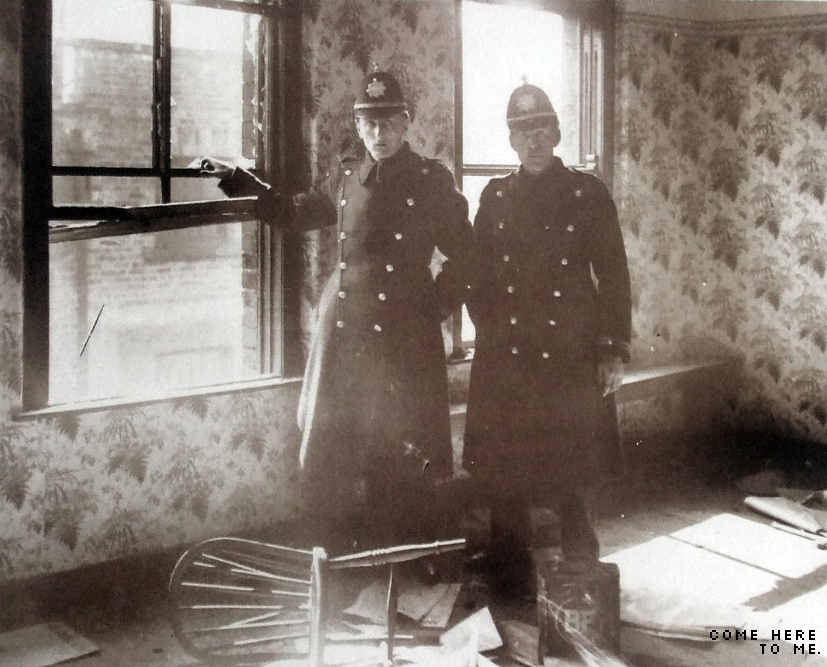
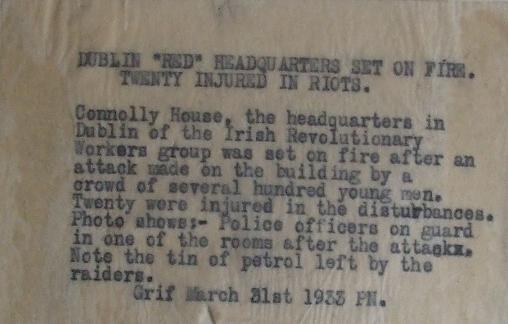
Connolly House, the headquarters in Dublin of the Irish Revolutionary Workers Group was set on fire after an attack made on the building by several hundred young men. Twenty were injured in the disturbances.

Photo shows:- Police officers on guard in one of the rooms after the attacks. Note the tin of petrol left by the raisers.

Grif March 31st 1933 PN.

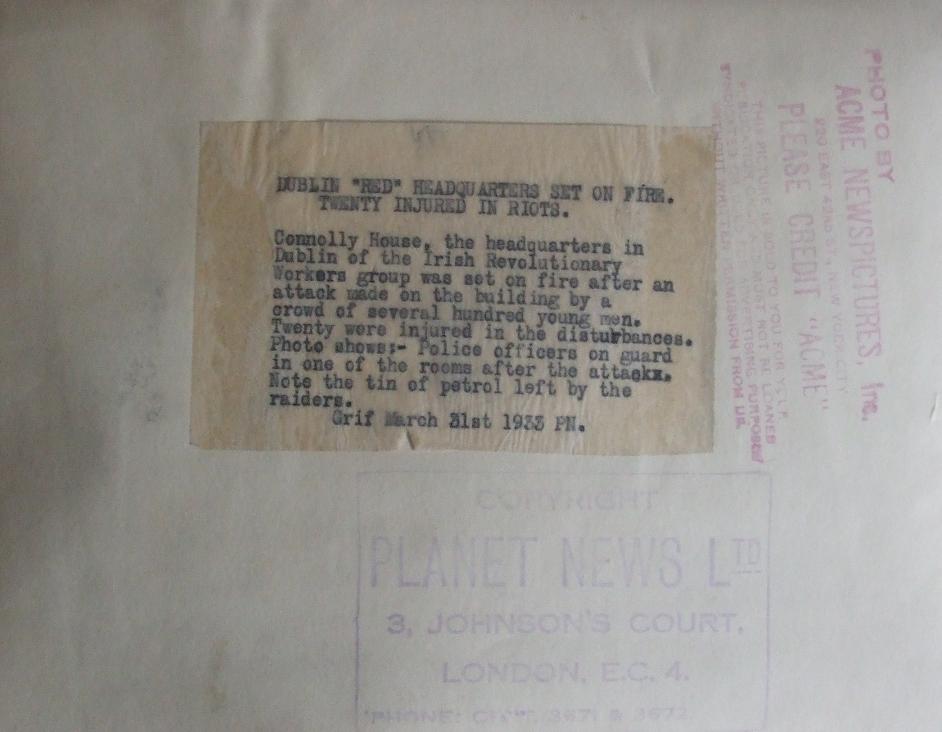
Two stamps on the back of the photograph point to News Media companies in both London and New York.

ACME, Newspictures, Inc.
220 East 42nd St. New York City
‘THIS PICTURE IS SOLD TO YOU FOR YOUR PUBLICATION ONLY AND MUST
NOT BE LOANED OR, SYNDICATED OR USED FOR ADVERTISING PURPOSES
WITHOUT WRITTEN PERMISSION FROM US.

COPYRIGHT
PLANET NEWS LTD.
3, JOHNSON’S COURT
LONDON, E.C 4
The Communist Party of Ireland site notes, in its biography to Charlotte Despard (an unlikely rebel, owing to her brother being none other than Lord Lieutenant of Ireland John French) that:

“On the 29th the mob attacked Charlotte Despard’s house at 63 Eccles Street, also home to the Irish Workers’ College and Friends of Soviet Russia, but a defence had been prepared in the form of a large crowd of workers, and it escaped with broken windows. Also attacked were the offices of the Workers’ Union of Ireland in Marlborough Street and the Irish Unemployed Workers’ Movement in North Great George’s Street.”

On a lighter note, notice the can of petrol left behind by the mob is ‘BP’, or British Petroleum. You couldn’t make it up.

Read Full Post »

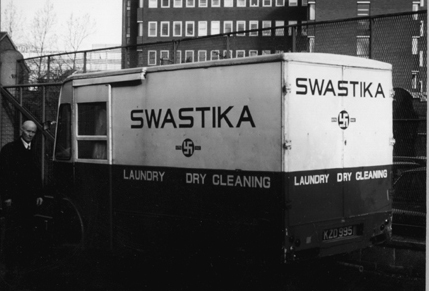
The Swastika Laundry operated from the Shelbourne Road in Ballsbridge, Dublin 4 for 75 years.

It was founded by John W. Brittain (1872 – 1937) from Manorhamilton, Co. Leitrim who was one of the “pioneers of the laundry business in Ireland” having founded the Metropolitian and White Heather Laundries in 1899. He was also the owner of a famous horse called Swastika Rose which was well known “to frequenters of the Royal Dublin’s Society’s Shows“. (The Irish Times, March 27, 1937)

(c) Life Magazine. David E. Scherman, 1943.

(c) Life Magazine. 1943, David E. Scherman.

An Irish Times advertisement from Thursday, March 15, 1928

The fact that people still talk about the laundry today is, for the most part, based on the fact that a swastika was used for their logo. As you can see from the title and picture above, the laundry was founded in 1912, eight years before the German Nazi party decided to formally adopt the symbol. (This important detail was promoted by the company at the outbreak of WWII when they changed the company’s name to The Swastika Laundry (1912) to distance themselves from the NSDAP)

Swastika Laundry van. Date unknown.

"A street scene in Dublin during the war". Marshall Cavendish Corporation, History of World War II, 2005, p. 610
In his travel memoir Irisches Tagebuch (Irish Diary) (1957) the future Nobel Laureate, Heinrich Böll had an unpleasant run in with a Swasika Laundry van. He notes that he
was almost run over by a bright-red panel truck whose sole decoration was a big swastika. Had someone sold Völkischer Beobachter delivery trucks here, or did the Völkischer Beobachter still have a branch office here? This one looked exactly like those I remembered; but the driver crossed himself as he smilingly signalled to me to proceed, and on closer inspection I saw what had happened. It was simply the “Swastika Laundry”, which had painted the year of its founding, 1912, clearly beneath the swastika; but the mere possibility that it might have been one of those others was enough to take my breath away.

The vans used by the Swastika Laundry didn’t operate on diesel or petrol, they were electric, quite ahead of their time.

"Observed in Shelbourne Road, Dublin, 1960s" - http://www.photopol.com/signs/swastika.html

The Spring Grove Laundry bought the company out in 1987 and sold the land for redevelopment in the early 2000s. The only reminder of the Swastika Laundry at the site today, now known as The Oval, is the huge chimney, now a protected structure, which was emblazoned with a huge swastika until the late 1980s.

The Oval. Chimney on the right. (The Irish Times, Wednesday, March 28, 2007)

Read Full Post »

With the government set to introduce measures to tackle the growing problem of ghost and unfinished estates that have blighted many parts of the country, I’ve been musing over a few pieces that discuss how many vacant or half built estates there are out there. And to be honest, the result is shocking; It does go someway to explaining why the economy has gone arse over tits, when it placed it’s future on a building industry that was obviously over-supplying a demand that was sure to run out; A recent report by the National Institute for Regional and Spatial Planning estimated that there were over 600 “ghost estates” and a figure of 300,000 empty, newly built properties in Ireland. Mainly located in the midlands and west of the country in towns that were heralded as “commuter” and “gateway” towns like Mullingar and Tullamore, they were built to serve a steady stream of workers who, rather than pay the extortionate property prices in Dublin, preferred to pay the slightly less extortionate prices and commute the couple of hours every day. Madness.

What does this have to do with “Dublin Life & Culture” I hear you ask? Well, for while the Irish landscape is littered with ghastly looking ghost estates, we have ghostly looking mansions, castles and buildings of historical importance that are left to the throes of time also. “Abandoned Ireland” is a website I’ve been championing for a while now. The website is a personal project, started in June 2008 by Tarquin Blake. The idea is to document these buildings before age and rot erase them from our landscape forever. The website has the tagline; “Record it. Document it. Before it’s gone; Touch nothing. Take nothing. leave only footsteps.”

Bolands Mill, as Dev left it? Credit: Tarquin Blake, Abandoned Ireland

Phoenix Park Magazine Fort. Credit: Tarquin Blake, Abandoned Ireland.

I’ve spent hours trawling this website, there are some fantastic pictures here, covering everywhere from Bolands Mills and the Magazine Fort in Phoenix Park Magazine Fort (two examples above) to abandned mines in Wicklow. You wonder somehow, in two hundred years, will the ghost estates of Dublins sattelite towns induce the same sense of wonder as the buildings AI is documenting? Somehow I doubt it.

Check out www.abandonedireland.com.

Read Full Post »

Ah, Mr. Duignan. What were you at.

Quite the find this.

Using a variety of Windows Movie Maker sound effects, toy guns that make noise and doing their best not to laugh and ruin the whole thing, this effort is crude, historically all over the shop and a bit strange. Still, it is compelling, and I lol’d, as we say on the internet.

I spend a great deal of time flicking through Witness Statements, newspapers and other odds and ends to do with the Rising, but obviously think it’s important to be able to laugh at something that is, by the look of it, a school project. Some don’t agree:

“this is an appaling insult to a greatman”,

“If this was a kind of project the teacher should be made to clean the school´s lavatories and recite Yeats´s “Easter 1916″ a hundred times at least”

and

“they’re probably too stupid to take in any form of criticism against either the movie or their moral as well”

Are among the comments this production has produced from the general public, amazing. In Devs day, they’d be well and truly missing by now. I would have given anything to be sitting in that class when this was shown.

Have a look:

“An action packed satire on the shocking Easter day that James Conolly lead an army of rebels against the British Black and Tans”

Read Full Post »

“Willie Bermingham described graphically the awful scene he encountered in that chalet on that bitter cold February day. A frail, old man, blind in one eye, lying dead on a wet bed with an old blanket gripped in his left hand, two cold rooms in that timber chalet, no fuel for the fire and no food in the press and he half naked, stiff in his death sentence, alone and in misery”

This piece is taken from the fantastic The Dublin Fire Brigade: A histoy of the Brigade, the Fires and the Emergencies by Tom Geraghty and Trevor Whitehead, recounting the time Willie was sent into a residence in 1977 as a routine part of his job. The residence was located at Charlemont Street.

Below the picture of Willie I have posted a wonderful and quite witty piece he wrote on himself, which always brings a smile to my face when I read that last line. I think it only right to allow characters of such magnitude to speak for themselves.

Don’t just think of him when a fire engine goes roaring past you on the street, but rather when you encounter an elderly neighbour in need of aid of any sort, including company.

Willie will be twenty years gone from us this Friday.
ALONE continues to work on behalf of the elderly people of Dublin.

“Willie Bermingham landed at the Rotunda Hospital, Dublin 29th March, five years before the big snow of 1942.

One of a family of seven with a father -a farmer, merchant, dealer, turf cutter, scrap man or just a hard worker, and a mother- a great woman to milk cows, feed pigs, cut turf or feed the nation.

Educated at Goldenbridge, St Michael’s Inchicore, on the streets, in the bog and at the university of life itself. Married with 5 children from 17-5 years. Hobbies include hoarding junk and curios and foreign travel.

Joined the Dublin Fire Brigade in 1964 and spent a long time pushing for the pension. Favourite food, good old irish stew and lots of fish. For breakfast several mugs of tea at work. Also loves to eat lots of red tape to teach the bureaucrats a little manners.”

Read Full Post »

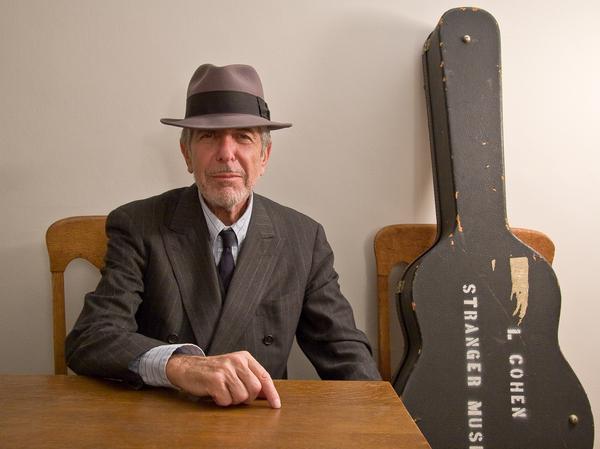
An unusual and very rare one, from Leonard Cohen in Dublin 1972.

Perhaps even more unusual than a recent rendition of the song ‘Kevin Barry’ posted here, by Paul Robeson.

Update: Since this post, we’ve ran a piece on Kevin and his fellow UCD student Frank Flood, both executed during the War of Independence.

Read Full Post »

Robin Hood and Little John
Walkin’ through the forest
Laughin’ back and forth
At what the other’ne has to say

With the upcoming release of Robin Hood (May, 2010) starring Robin Crowe, it’s fitting to look at the enduring but surprisingly little researched local legend that suggests that Little John of Robin Hood fame visited Dublin in the 12th century.

The first reference I could find comes from Richard Stanihurst who wrote in in 1577 that:

“In the yeere one thousand one hundred foure score and nine … little John was faine to flee the realme by sailing into Ireland, where he sojornied for a few daies in Dublin. The citizens being done to understand the wandering outcast to be an excellent archer, requestd him hartilie to trie how far he could at randon; who yeelding to their behest, stood on the bridge of Dublin, and shot at the mole hill, leving behind him a monument, rather by his posteritie to be woondered than possiblie by anie man living to be counterscored” (1)

Joseph Cooper’s Walker’s Historical Memories of the Irish Bards (1786) fleshes out the story:

“According to tradition, Little John (who followed his master to this country) shot an arrow from the old bridge to the present site of St. Michan’s Church, a distance of about 11 score and seven yards, but poor Little John’s great practical skill in archery could not save him from an ignominious fate; as it appears from the records of the Southwell family, he was publicly executed for robbery on Arbour Hill.” (2)

The “old bridge” mentioned is the Father Matthew Bridge which has been there in one shape or another for over 1,000 years. A very interesting article on the history of this bridge by Frank Hopskins, which mentions the Little John legend, can be read here.

Father Matthew Bridge where Little John allegely shot an arrow all the way to Oxmanstwon.

The Dublin University magazine (1857) suggests that “after the dissolution of the band in Sherwood forest … (Little John) while jouring for a few days in Dublin exibited to the citizens by shooting an arrow from the Old Bridge to a distant hillock on the northern side of the city, thence styled in after time ‘Little John’s shot'” (3)

The historical memoirs of the city of Armagh (1819) mentions in passing that “Little John … had visited Dublin about the year 1188 and had shot an arrow from Dublin – Bridge to the little hill in Oxmantown” (4)

The wonderfully named Pat Chat wrote in the Irish Times in 1882 that “Little John … exihbited feats of archery … (but) was then hanged at Arbour Hill for robbery” (5)

Earliest known image of Little John.

D.H.W in his article entitled ‘Little John in Ireland: An Exile from Sherwood” (1928) proposes that Little John and his followers “lived in the woods outside Dublin, round Arbour Hill” and reiterated the the tale that “he was caught in Dublin … (and) was publicly executed on Arbour Hill”. (6)

Like most of things concerning Robin Hood, little can be backed up by historical evidence. For example, Little John is reputed to be buried in a churchyard in the village of Hathersage, Derbyshire. A modern tombstone marks the supposed location of his grave, which lies under an old yew tree.

However, I much prefer the version that he was hanged at Arbour Hill and is buried a few feet below Connolly.

Footnotes:

(1) Richard Stanihurst cited in Jeffery L. Singman, Robin Hood: the shaping of the legend, (Westport, 1998), p. 27

(2) Joseph Cooper, Walker’s Historical Memories of the Irish Bards, cited in James Collin’s, Life In Old Dublin (Dublin, 1913), p. 53

(3) Dublin University Magazine (Vol. 50), (Dublin, 1857), p. 108

(4) James Stuart, The historical memoirs of the city of Armagh, (Newry,1819), p. 201

(5) Pat Chat, The Irish Times, Saturday, May 20, 1882, p. 1

(6) D.W.H, The Irish Times, Friday, June 22, 1928, p. 4

Read Full Post »

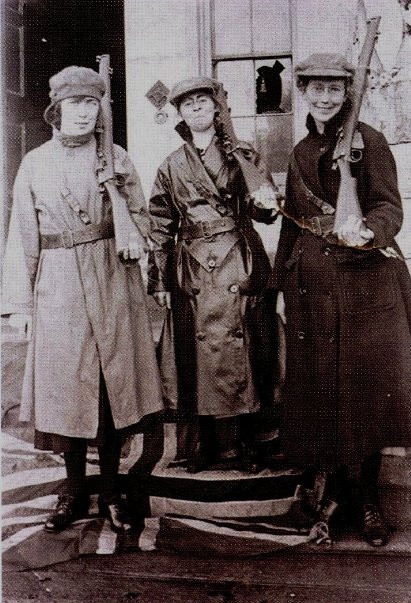
Shortly after escaping. Mae Burke, Eithne Coyle and Linda Kearns, Carlow 1921. Notice that they are standing on the Union Jack flag.

It’s been a good week for me as far as documentaries go. Along with the fantastic Seamus Ennis effort from RTE linked to below, TG4 has been on the ball too, with Ealú, a brilliant effort revolving around Nurse Linda Kearns.

Link to documentary online, at TG4 Beo.

Only two days into the 1916 Rising, Nurse Kearns set up a temporary hospital at North Great George’s Street. This hospital was designed to provide medical aid to both British and Irish wounded. This temporary hospital was closed by military orders. Linda was to become a more active part of the republican movement after the Rising.

Interesting information on her activity on behalf of the IRA can be found in Sinead McCoole’s No Ordinary Women. Linda was never a member of Cumann na mBan for example, though did provide lectures to the women of the movement, as Doctor Kathleen Lynn had before the insurrection. The nursing home Linda ran in Gardiner Place also functioned as a sort of hiding spot for republican men on the run.

Cal McCarthy’s excellent study of Cumann na mBan (Cumann na mBan and the Irish Revolution) quotes the report of the Sligo County Inspector following the arrest of Linda Kearns in November 1920.

“On 20-11-20 a police and military patrol stopped a motor car driven by nurse Belinda Kearns of 29 Gardiner Palace Dublin and found therein ten service rifles, four revolvers, 403 rounds of service rifle ammunition, 23 rounds of revolver ammunition and a quantity of equipment.”

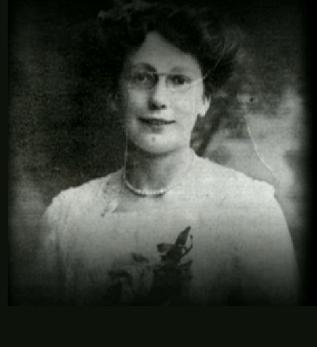
Linda Kearns

The report went on to state that three male suspects were arrested in the motor car, and that crown intelligence ascertained that “…Miss Kearns has for the past two years been the medium of communication between Head Quarters IRA Dublin and County Sligo”

Linda did time in a number of Irish prisons before being sent to Walton Prison in Liverpool, where she went on hungerstrike. From here she was sent to Mountjoy Prison.

In The Jangle of the Keys, her highly regarded personal history of her time in a variety of British and Free State run Irish prisons, Margaret Buckley wrote at length about the 1921 escape from Mountjoy.

Linda Kearns was largely responsible for the planning of the sensational Mountjoy escape, and entered with great glee into organising it”

A sympathetic wardress had seen to it that the girls were able to get their hands on a wax-mold of the key needed for their escape.

“It was Hallowe’en. Word was sent out; signals agreed on; and time and place fixed…”

The female prisoners were participating in a football match, Cork versus the Rest of Ireland. The Rest of Ireland won, but that was irrelevant. The prisoners created plenty of noise, and the four female prisoners plotting their escape seized the moment. Linda Kearns, Eithne Coyle, Mae Burke and Eileen Keogh made their move. Throwing a small perfume bottle over the wall at the agreed spot, a rope ladder was returned. Linda went first, due to ill-health, followed by Eileen Keogh, Mae Burke and lastly Eithne Coyle. Linda Kearns would find shelter at an IRA training camp in Carlow until the signing of the Anglo Irish Treaty.

Amazingly, Linda Kearns was to play a role in the Civil War too, ensuring she earned all her republican stripes! Having failed to gain entry to the Four Courts, she found herself in a variety of locations throughout Dublin tending to the wounded. When the focus of the battle in Dublin shifted entirely to O’ Connell Street, the stretch from the Hammond to the Gresham Hotel was occupied by something in the region of 100 republican combatants.

Margaret Ward noted in her study of the role of women in Irish nationalist history (Unmanageable Revolutionaries) that Cathal Brugha himself had to appeal strongly to the 30 women to leave, as the fight looked doomed. Three remained. Alongside Kathleen Barry and Muriel MacSwiney (The widow of Terence, The Lord Mayor of Cork who died on hunger strike) was Linda Kearns.

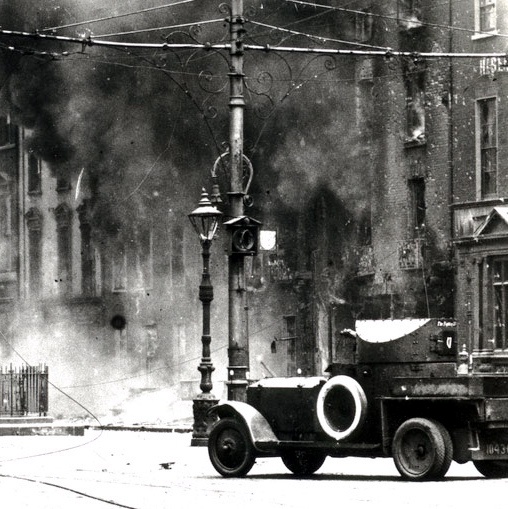
Free State armoured car, photographed during the Civil War in Dublin.

Linda Kearns witnessed the wounding of Cathal Brugha, who had refused to surrender to the forces of the new state. She held his severed artery between her fingers as he was driven to hospital, but he would die two days later. Cumann na mBan activists stood guard over Brugha when his body lay in state.

Her story is an amazing one, and by no means ends there. Nor does it start on North Great George’s Street.

In his wonderful biography of Kevin Barry (Kevin Barry And His Time), Donal O’ Donovan wrote that “Linda Kearns of Sligo, a trained nurse, is one of those people who was in everything during the War of Independence and the Civil War, but has not yet got her due meed of praise”

This fantastic effort from TG4 is most worthy of your time, and finally sees to it that Linda Kearns gets some of the attention she deserves.

Read Full Post »

(Update May 2012: I will be presenting my work on Arthur ‘Neal’ Wicks on May 26 at the 7th annual bookfair)


This is how Charles Saurin (Irish Volunteer 1914 – 16 and Officer IRA 1917-21) described an individual called ‘Neale’, an English socialist who was stationed with Saurin in the Hotel Metropole during Easter Week. Neale, who saw action in Fairview on Easter Monday and the Vitriol Works on Tuesday, was to be fatally wounded on the Thursday during the evacuation of the GPO.

However, you won’t find his name on many of the Easter Week rolls of honour and you certainly won’t find any plaques dedicated to him in the city.

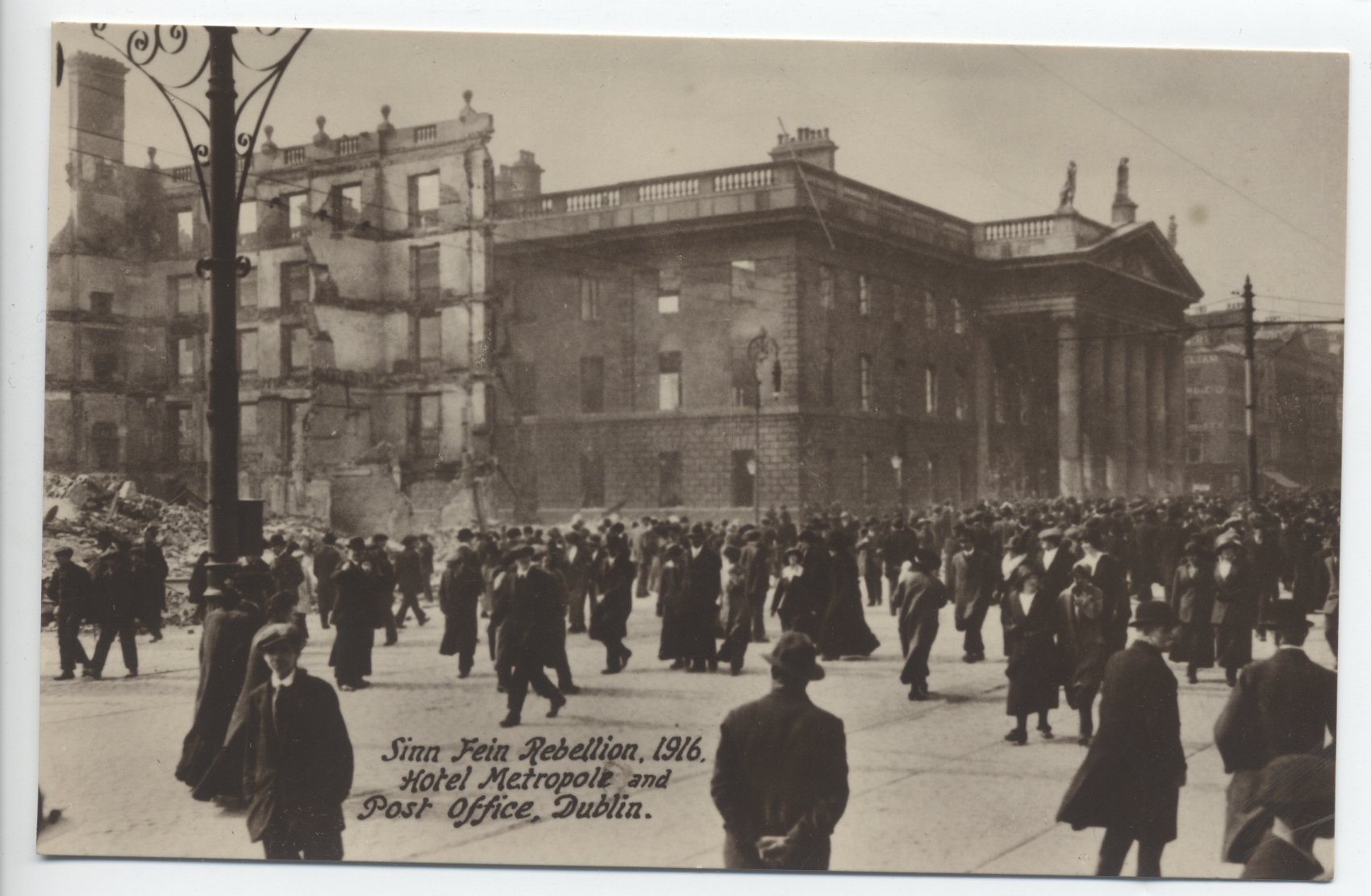
The Hotel Metropole after the Rising.

For approximately two years I’ve been trying to research the life of this character who I think grew up in Norwich nd was involved in a hotel strike in London in 1913. I believe that his real name was Arthur Wicks and that he was known to by his comrades as Neal/Neale. The many variations of his name and the fact that he was commonly known by a nickname has been a considerable obstacle in trying to research his early life.

By this stage, I’ve completely exhausted all secondary sources. I’ve managed to collate a lot of information on his movements in Easter Week and a little bit on his early life. My next objectives are to cross reference the 1916 Witness Statements for references of Neale, try to access British state archives to see if he was under any sort of surveillience during his trade union activity in London in 1913 and go through the English left publications of the period to see if there were any mentions of him during his time in London or to mark his death in 1916.

With study, work and everything else it’s been hard to find time to research the life of this elusive individual, let’s just hope I’ll have something written by 2016.

Read Full Post »

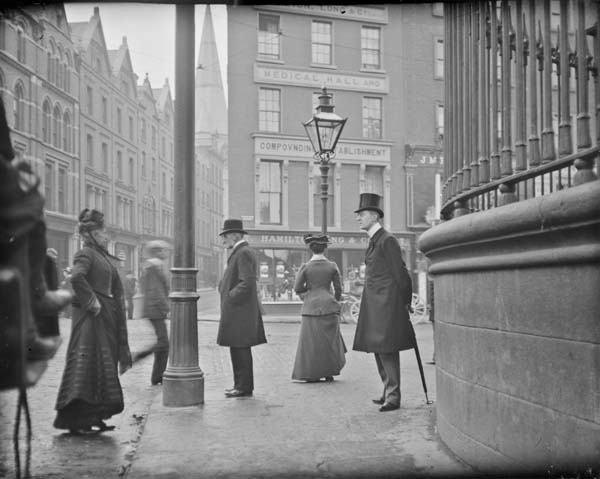
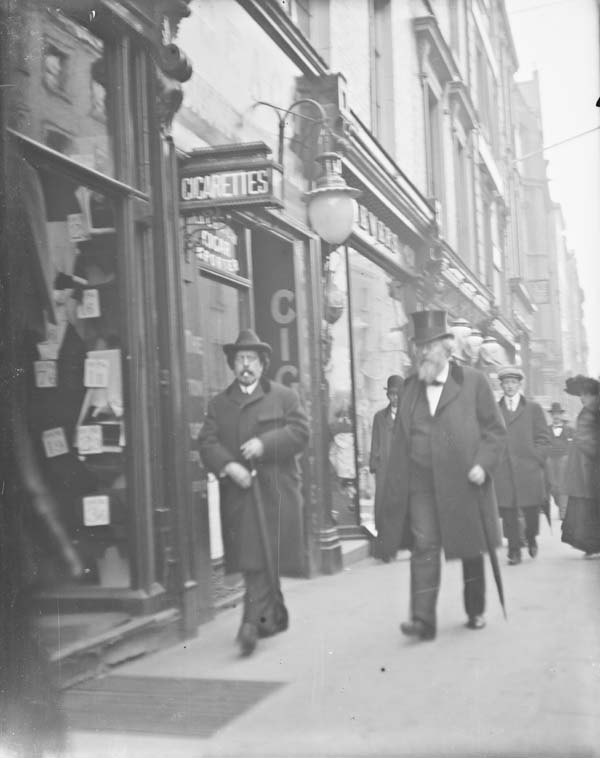
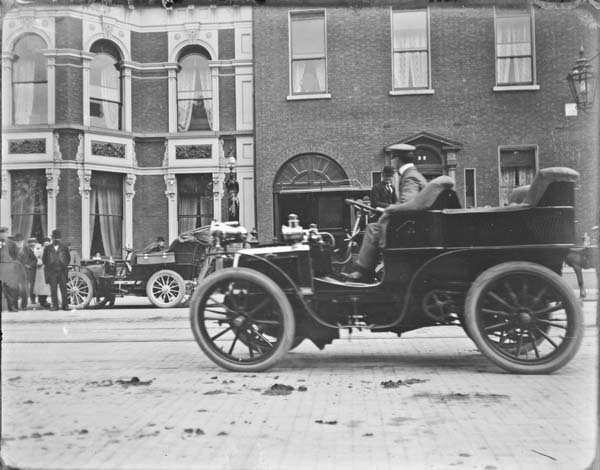
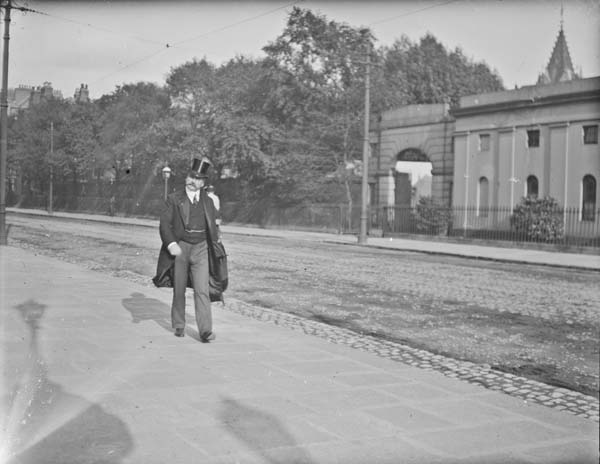
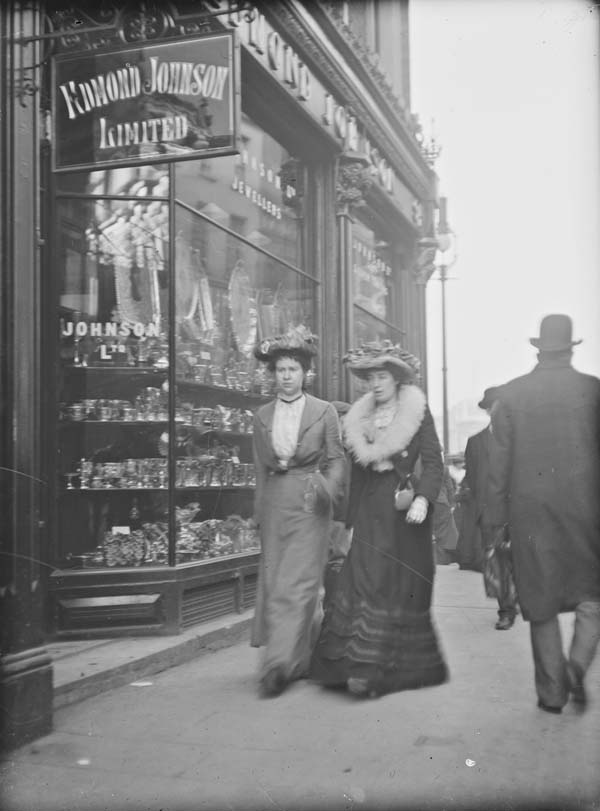
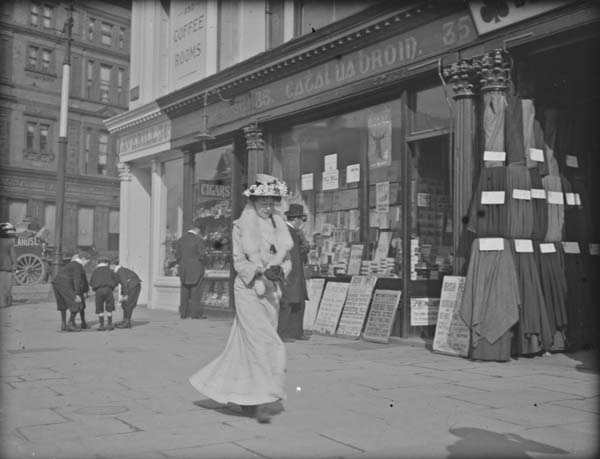
In 1897 J.J. Clarke left Castleblayney, Co. Monaghan, to study medicine at the Royal University, Earlsfort Terrace, Dublin. He was a keen amateur photographer and the pictures here were all taken between 1897 and 1904. What is most remarkable for the time is his almost journalistic eye for catching people in candid shots rather than photographing formal poses or streetscapes. He died unmarried at the age of 82, and 300 original prints or glass negatives survived to be donated to the archive by his nephew, Brian Clarke.

You can view the whole collection here .

Can you work out what modern watering hole the women are walking past in the last photo?

Man with umbrella standing at the junction of Nassau Street, Grafton Street and Suffolk Street. Hamilton, Long and Co., Apothecaries, No. 107 Grafton Street in background.

Men walking outside cigar shop on Grafton Street. Two men in foreground, walking past No. 67 Grafton Street, R. G. Lewers, ladies outfiting and baby linen warehouse, and No. 66, Tobacconists.

Car driving past the Shelbourne Hotel, St. Stephen

Man in top hat strolling on Earlsfort Terrace. Building in the background is possibly no 1A or No. 1 Earlsfort Terrace. The spire of the Magdalen Asylum and Church on Leeson Street is visible in the background.

Two women, both wearing hats, one wearing fur collar, walking outside Nos. 94 & 95 Grafton St., Edmond Johnson Limited Jewellers.

Woman walking past stationery shop, O

Read Full Post »

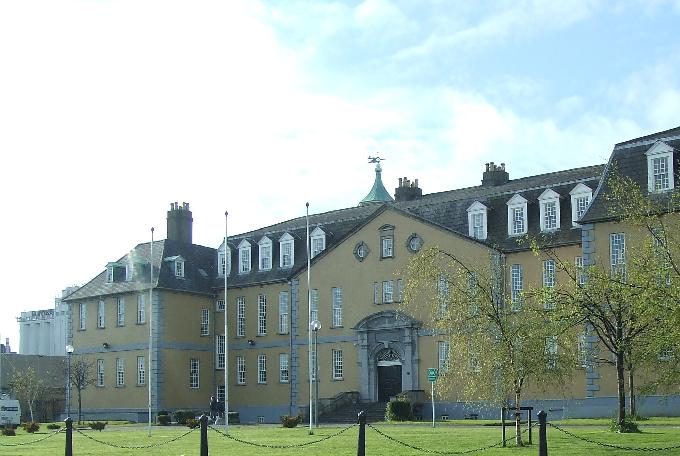
The Hospital today...

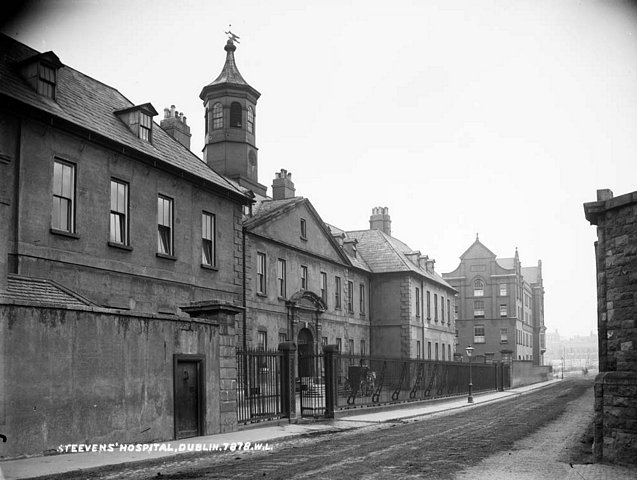
...and as it would have looked at the time.

Images of graves below.

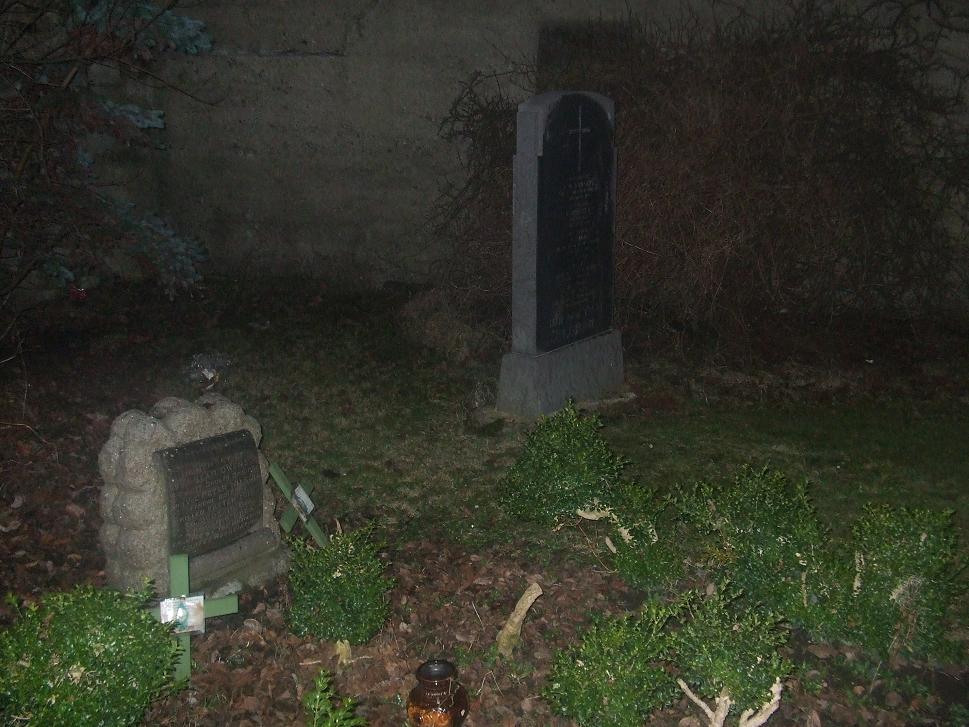
Seven men, two members of the Irish Volunteers and five British Army soldiers, are buried side by side in what is literally the back garden of Dr. Steeven’s Hospital.

This is not a graveyard, but as stated above quite literally a garden. The two graves could not be physicially closer, or more symbolically diffferent, than they are.

Of the British Army men, almost all belong to Irish Regiments.

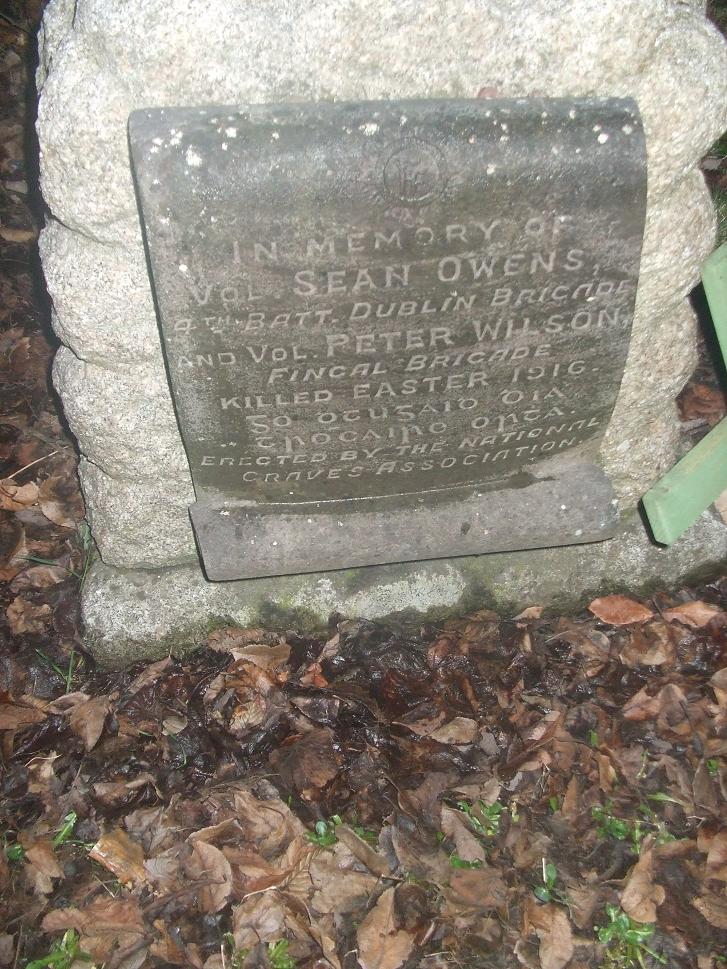
The names of the men are provided in the images below underneath their respective headstones. Of the rebel casualties, one belonged to the Fingal Battalion and one to the 4th Battalion Dublin Brigade. The Fingal Battalion, or ‘North Dublin Battalion’, for the most part fought with Thomas Ashe during the insurrection. His burial here shows that sometimes people ended up in random locations owing to their time of arrival or other commitments, or simply due to the need for reinforcements in parts of the city. The 4th Battalion are associated with the action at the South Dublin Union where they served under Éamonn Ceannt. His Battalion is said to have numbered around 120 men. Volunteer Sean Owens, who belonged to that Battalion, was twenty four years old at the time of the insurrection, and from the Coombe area of Dublin.Interesting information regarding the fight leading to his death can be found in Uncommon Valour by Paul O’ Brien, published by Mercier Press. He is said to have been killed less than two hours into the taking of the South Dublin Union, and is therefore one of the earliest casualties of the Republican side.

Volunteer Peter Wilson, a Swords native, was shot after the surrender of the Mendicity Institution. This group of Volunteers were to hold the position for a number of hours, but managed to hold out until Wednesday. Despite emerging under a white flag, Wilson was shot and killed. He was 40 years old at the time.

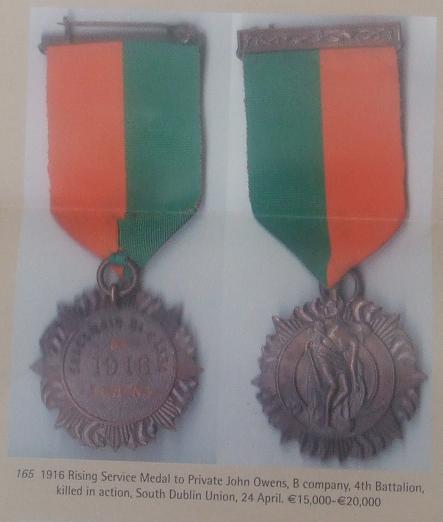
By pure chance, the 1916 service medal of Volunteer Owens is currently listed in an upcoming auction at Whytes auction house in Dublin City. It is valued, amazingly, at €15,000 to €20,000.

Lot 165, its description reads:

“1916 Rising Service Medal to Private John Owens, B Company, 4th Battalion, killed in action, South Dublin Union, 24 April. €15,000- €20,000”

The medal of one of our Volunteers below

This amazing photograph below from the gravesite at Steeven’s Hospital is included in the lot, and more information is available here at invaluable.com

Photo of a memorial service in the hospital grounds, from the Irish Press September 1935

Notice that one of the British Army men buried here is a Lancer who died on the 24th of April, 1916. Lancers came under fire on the first day of the rebellion from the Four Courts Garrison and, more famously, the rebel headquarters at the General Post Office. Other Lancers are buried in Grangegorman Cemetery today, where one grave notes that the man was “Killed during the Irish Rebellion”

Three of the men buried here belonged to the 3rd Battalion of the Royal Irish Regiment, which was based at Richmond Barracks, under Lt.Col R L Owens. Their strength at the time of the insurrection was 18 officers and 385 other ranks.

Ceannt photographed with Irish Volunteers

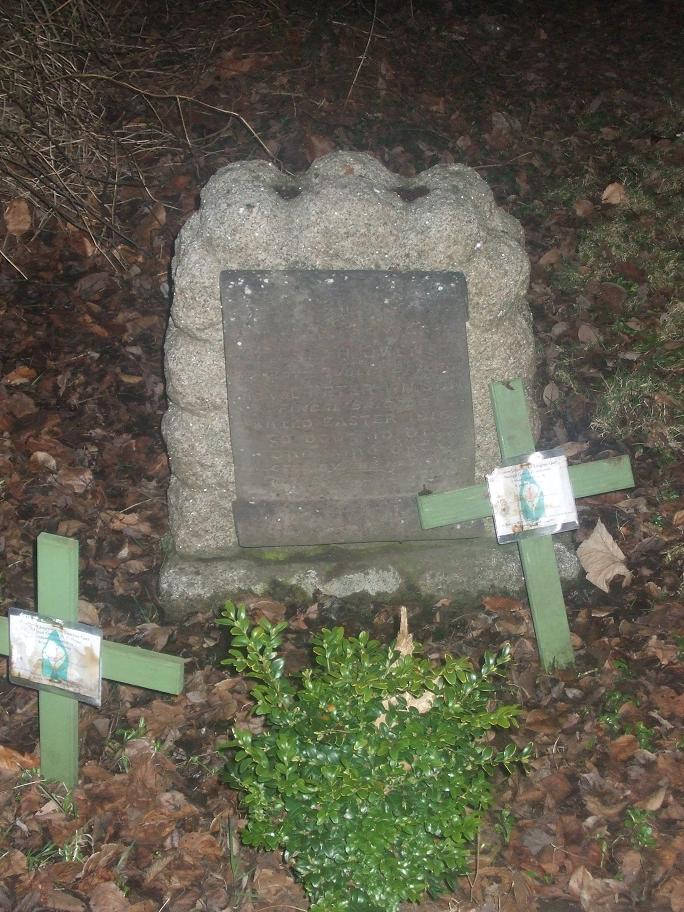
A grave holding two Irish Volunteers sits right next to one holding five British Army soldiers (Four from Irish Regiments)

Easter lillies on the grave of the two Irish Volunteers

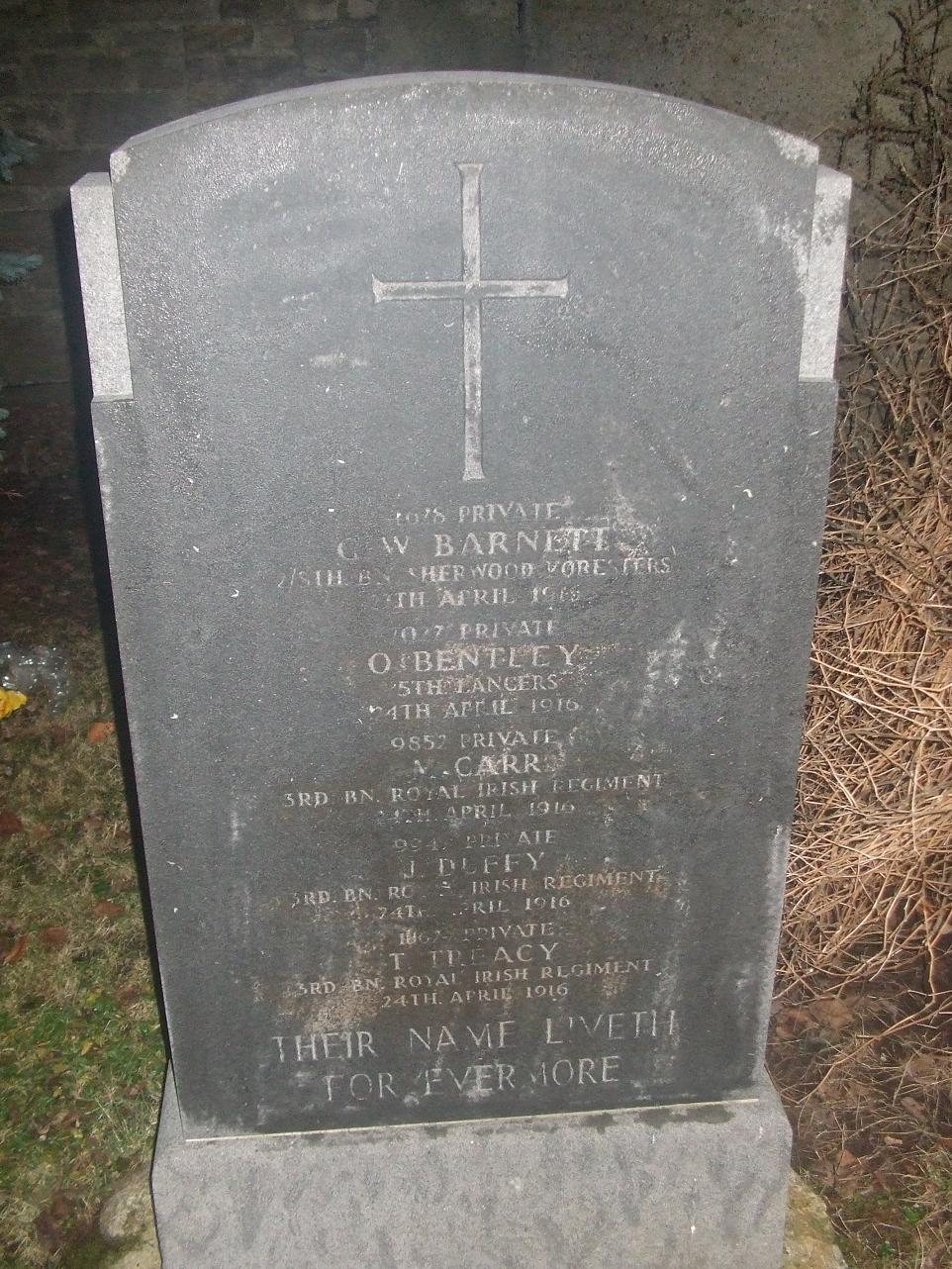
We had to rub the British Army headstone down with a wet cloth to be able to read the text, which I think you can see clearly below.

The headstone to the British Army casualties

G.W Barnett
Sherwood Foresters
27th April 1916

O. Bentley
5th Lancers
24th April 1916

M. Carr
3rd Bn. Royal Irish Regiment
24th April 1916

J. Duffy
3rd Bn. Royal Irish Regiment
24th April 1916

T.Treacy
3rd Bn. Royal Irish Regiment
24th April 1916

The text of the Volunteers gravestone. Notice the 'Oglaidh na hÉireann' logo.

Vol. Sean Owens
4th Batt. Dublin Brigade

Vol. Peter Wilson
Fingal Brigade

Want to visit the graves? Dr. Steeven’s Hospital is the building right across the way from Heuston Station.

Read Full Post »

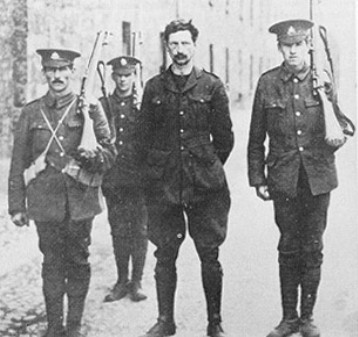
Sherwood Foresters photographed with captured rebel leader, Eamon de Valera.

A nice piece this, an eyewitness account from Captain A.A Dickson of the Sherwood Foresters. It, and other accounts like it, are available in ‘True World War I Stories’ published by Robinson Press. While many of the tales deal with trench life, for some the first combat they would see would be street fighting in Dublin.

Then, Easter 1916, at 2 a.m came another entrainment order.

Half the battalion didn’t believe it: many a one had no razor in his kit when the next chance to shave came. For the trains that we really did entrain into sped off not south-westward for the Plain of France, but away and away up the “North Western”, and it wasn’t until they disgorged us on Liverpool Docks that rumours could be swopped about “Sinn Fein gentry- broken bottles and shillelaghs.”

It was a baptism of fire alright, with flintlocks, shot-guns, and elephant rifles, as well as more orthodox weapons. And 100 casualties in two days’ street fighting was a horrible loss to one battalion: the more so since my one friend from the ranks, commissioned same day, was shot through the head leading a rush on a fortified corner house, first day on active service, and it was my job to write and tell his mother, who thought him still safe in England.”

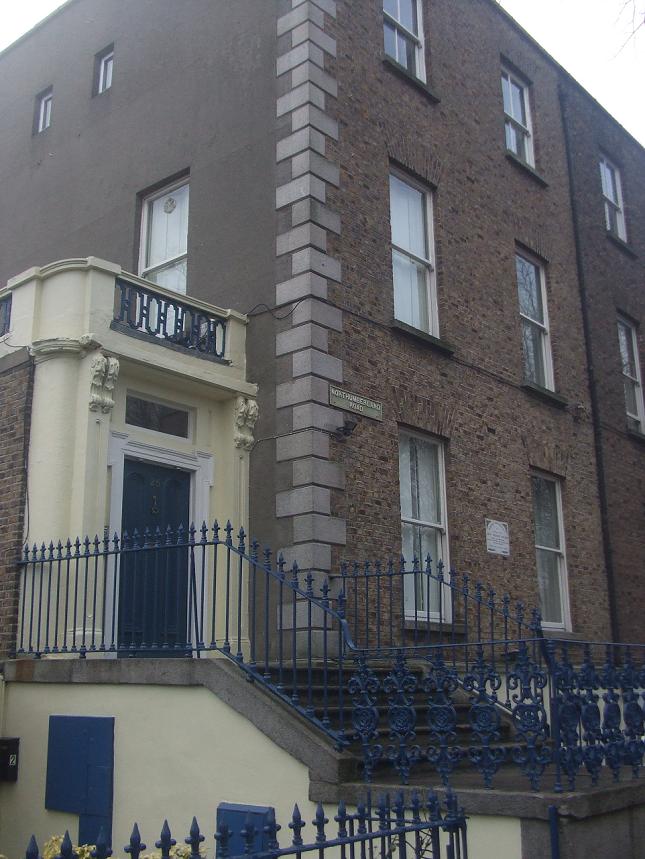
That “fortified corner house”, of course, is 25 Northumberland Road.

25 Northumberland Road Today. I took a series of photographs of the battle area recently.

I have dealt briefly with events at Mount Street Bridge in a previous piece published before the launch of the latest work from Paul O’ Brien, Uncommon Valour. In short, a small grouping of well placed Volunteers, situated in a small number of buildings strategically, managed to inflict almost half of the overall British Army casualties of the insurrection. Ultimately, Michael Malone and James Grace would hold 25 Northumberland Road alone after Malone dismissed younger Volunteers for their own safety. This ‘fortified corner house’, and Clanwilliam House on the far side of Mount Street Bridge, provided serious resistance to Sherwood Foresters wishing to advance onwards in the direction of Trinity College Dublin.

General Sir John Maxwell himself noted that:

“Four officers were killed and fourteen wounded and of the other ranks, 216 were killed and wounded”

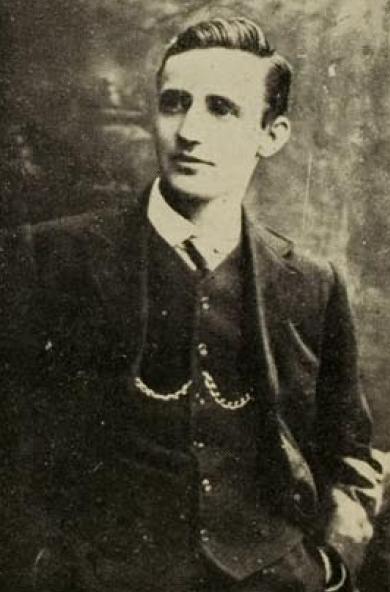
Lieutenant Michael Malone, who died at 25 Northumberland Road. His fellow Volunteer James Grace survived.

A checkpoint is established on Mount Street Bridge after the bloody battle

Perhaps nothing humanises the conflict more than when A.A Dickson goes on to state

“A hateful task: so was another duty of one misty dawn soon after, when four young officers had to command four firing parties, and four rebel leaders stood in turn blind-fold against a wall”

On the 94th Anniversary, perhaps it’s time to stop and think of the experiences of the Sherwood Foresters and Regiments like them over the course of the rebellion. A.A Dickson finally made it to France, in January 1917. Wounded in April 1918 during a German attack, he was demobilised from hospital in January 1919.

Read Full Post »

« Newer Posts - Older Posts »