(Regarding crime and Dublin, the blog has previously looked at 18th century gang violence; joy-riding in Dublin from 1918-39; War of Independence bank-robberies; the 1920s ‘Sons of Dawn‘ who were rounded up by the IRA; the life of career criminal Henchico who died in 1968; Animal Gang violence in 1942; vigilante violence in Dublin (1970 – 1984); the Bugsy Malone gangs of the 1970s and Triad gang violence in 1979)
Note: I added the murders of Christy Shannon (1979), Patrick Garland (1986) and Barney Murray (1986) after I had published the first version of this article. All of the following information was gleaned from online archives of the Irish Press, the Irish Independent, the Sunday Independent, the Evening Herald, the Sunday Tribune, the Irish Examiner and (rarely) the Sunday World. I also utilised ‘Smack’ (1985) by Sean Flynn and Padraig Yeates and ‘Badfellas’ (2011) by Paul McWilliams.
Recent gangland feuds in Dublin and other Irish cities have made newspaper headlines worldwide. The Hutch-Kinahan conflict resulted in the deaths of c. 19 people alone between 2015 and 2018. Many see the starting point of modern gangland carnage as the shooting dead of crime boss Martin Cahill (‘The General’) by the Provisional IRA in 1994 and the murder of journalist Veronica Guerin by criminals two years later. The early 1990s did certainly mark the start of a new bloody chapter. Over the four years between 1991-94, there was 11 gangland murders altogether in Ireland but the first six months of 1995 saw seven killings alone. The numbers rose exponentially in the 2000s and 2010s as criminals became more ruthless and more liable to murder rivals in tit-for-tat killings.
This article is the first in a series on gangland killings that occurred in Dublin pre-1994. It does not seek to eulogise anyone but instead explores Dublin’s criminal underworld of 30-40 years ago. It maps stories of old Dublin – flat complexes that have been torn down, pubs that have been redeveloped and the names of many young men all but forgotten except for family and close friends. But it sadly also illustrates that many of the same impoverished working-class areas affected by gun violence in the 1970s and 1980s are still some of the same neighbourhoods hit hardest today.
There were certainly cases of criminal gangs in Dublin using guns to injure and maim rivals in the 1960s and 1970s but the first murders that I can identify occurred in the late 1970s. The list does not include:
- police officers, security guards or civilians killed by criminals during robberies or other incidents
- victims of internal feuds or suspected informers killed by Republican paramilitaries
It includes only individuals who were killed by criminals or suspected criminals. They were for the most part premeditated ‘hits’ and firearms were used in all but one of the murders. If you are aware of any other cases, please email me or leave a comment.
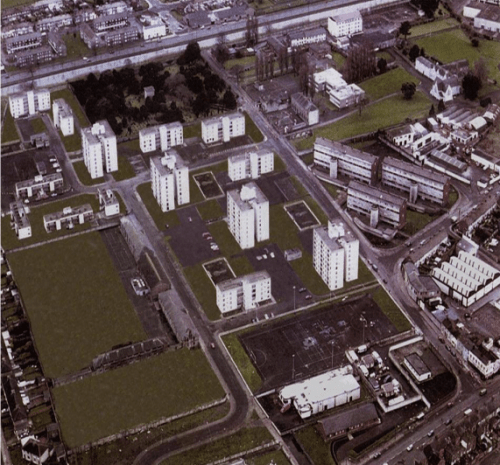
I have identified 13 such murders in Dublin the 1978-89 period. The youngest victim was 15 and the oldest 47. The attacks took place on both sides of the River Liffey in the inner city and Dublin suburbs in the south (Crumlin), west (Blanchardstown) and north (Ballymun, Killester, Cabra).
19 March 1978 – Christopher McAuley (Christy McAuley)
Christy McAuley, of 38 Millbrook Road, Kilbarrack, was arrested in 1976 and charged with conspiring with another person to import arms but he was not convicted of the offence. The following year he was fined for possession of cannabis and cocaine. Police also linked him to a number of armed robberies in the city.
On the night of 19 March 1978, Christy McAuley (25) met another criminal Eamon Saurin (36) in the Celebrity Club night spot on Upper Abbey Street. McAuley gave Saurin and his friend Laurence Maguire (Clicky) a lift home. At the junction of Craigford Avenue and Killester Avenue, Saurin asked that the car be pulled over. He drew a small .32 automatic pistol and shot McAuley twice in the head. McAuley somehow managed to open the door and stagger out onto the road. Saurin followed and fired two more shots. The paranoid Saurin had mistakenly thought that McAuley (who was actually gay) had slept with his girlfriend while he had been on the run. The authorities caught up with Saurin in July 1981 and he was charged with the murder of McAuley. The chief prosecution witness Laurence Maguire (Clicky) refused to give evidence and was imprisoned for a month for contempt. Saurin’s trial was rescheduled but Maguire failed to turn up and the case subsequently collapsed.
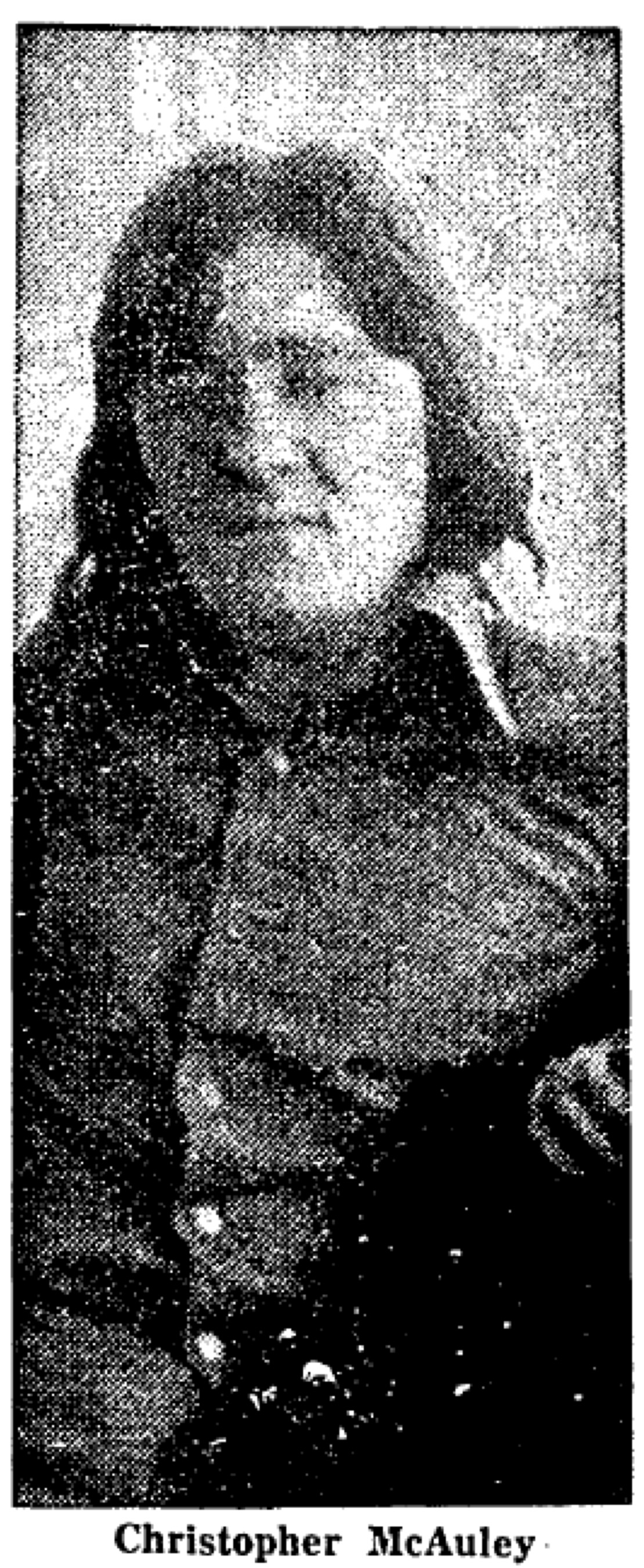
Christy McCauley. The Irish Press, 21 March 1978.
Saurin was described in the book ‘Smack’ (1985) by Sean Flynn and Padraig Yeates as a “well-known robber” originally from Liberty House off Sean MacDermott Street. The family moved out to 8 Glencorp Road, Whitehall and the teenage Saurin picked up his first conviction in 1964. He was based at 25 Clanree Road, Donnycarney in the mid 1970s. Saurin was described in ‘Badfellas’ (2011) by Paul McWilliams as “one of the first criminals credited with smuggling commercial shipments of cannabis and heroin from Amsterdam into Ireland in the late 1970s”. While he got away with the McAuley murder, Saurin was immediately extradited to England where he was jailed for life in 1983 for the murder of his former neighbour Kenneth Adams (32) in Birmingham on 6 Nov. 1972.
In Sep. 1981, Christy McAuley’s brother Anthony was injured in a shooting in O’Neill’s pub, Summerhill Parade. On 19 Sep, two masked gunmen – armed with a .32 automatic pistol and a sawn-off shotgun- entered the premises looking for one or two specific people. In the incident, a total of four men were wounded – Anthony McAuley, Andrew Corbally, Nicholas Wynne and Kevin Brennan. It’s unclear as to who the original targets were but police told the Irish Press (18 Sep. 1981) that it was linked to a gangland feud.
25 April 1979 – Basil English
Basil English, of 95 Harmonstown Road, Artane had a long criminal rap-sheet history going back to 1964. On the night of 25 April 1979, he was shot through the head at point-blank range inside the doorway of an eight-story flat in a Ballymun tower block addressed 184 Sillogue Road. English (33) was rushed to hospital but was pronounced dead on arrival. The Evening Herald (26 April 1979) described it as a “gangland slaying” and reported that the police believed the murder was connected to an “internal gangland feud”.
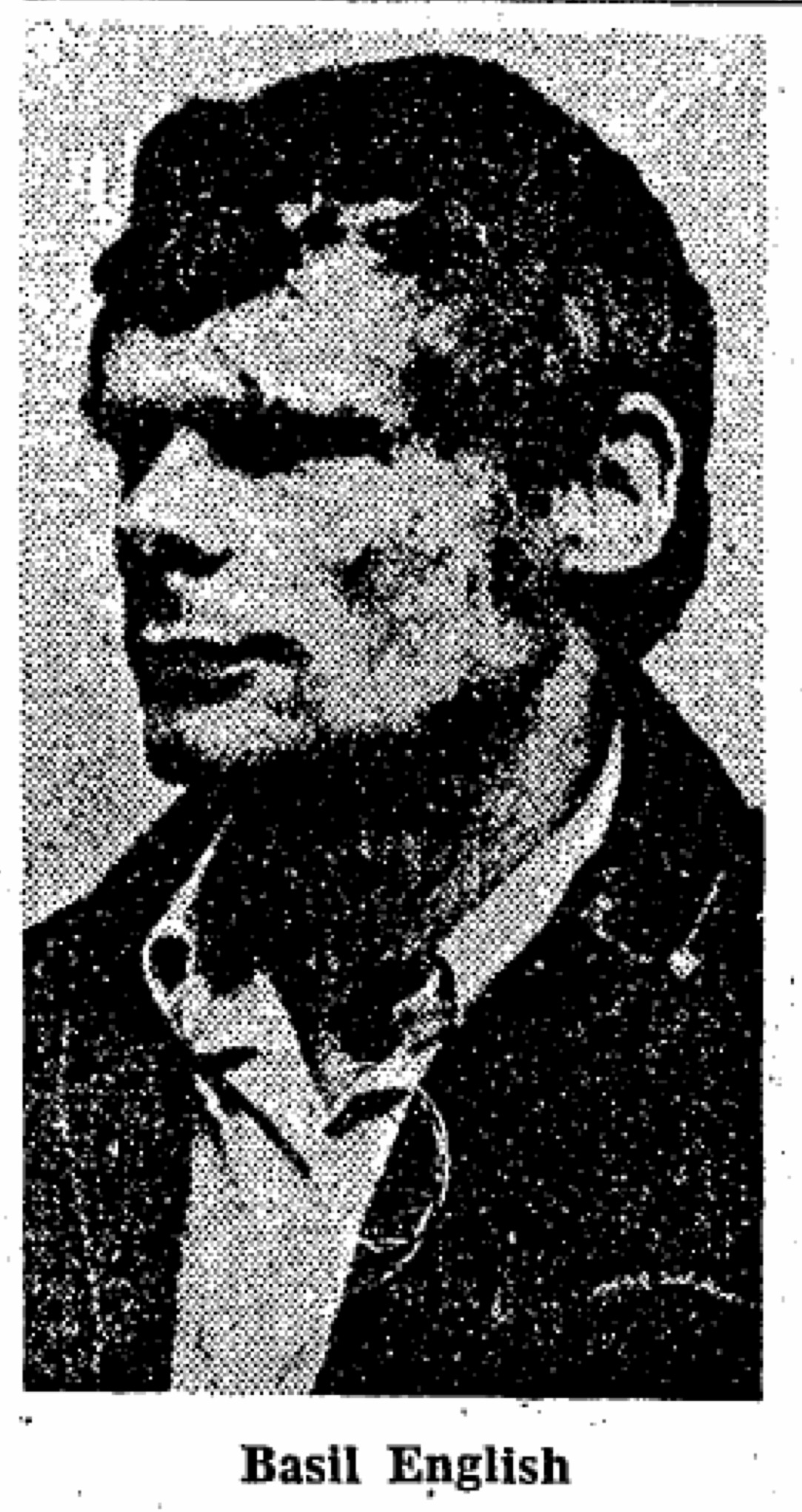
Basil English. The Irish Press, 27 April 1979.
The main suspect, Thomas Tyrell (21) (aka Tommy Tyrell), of 47 Ribh Road, Artane, barricaded himself into a Ballymun flat for five days and threatened to kill himself before he eventually surrendered to the Gardaí. It transpired that Tyrell was dating English’s ex. girlfriend so there might have been a jealousy/personal aspect to the killing. Both men were supposed to have been heavily intoxicated on the night in question. Tyrell was sentenced to three years imprisonment for possession of a .32 revolver and ammunition but the manslaughter charge sentencing was postponed to July 1980 following psychiatric treatment and evaluation.
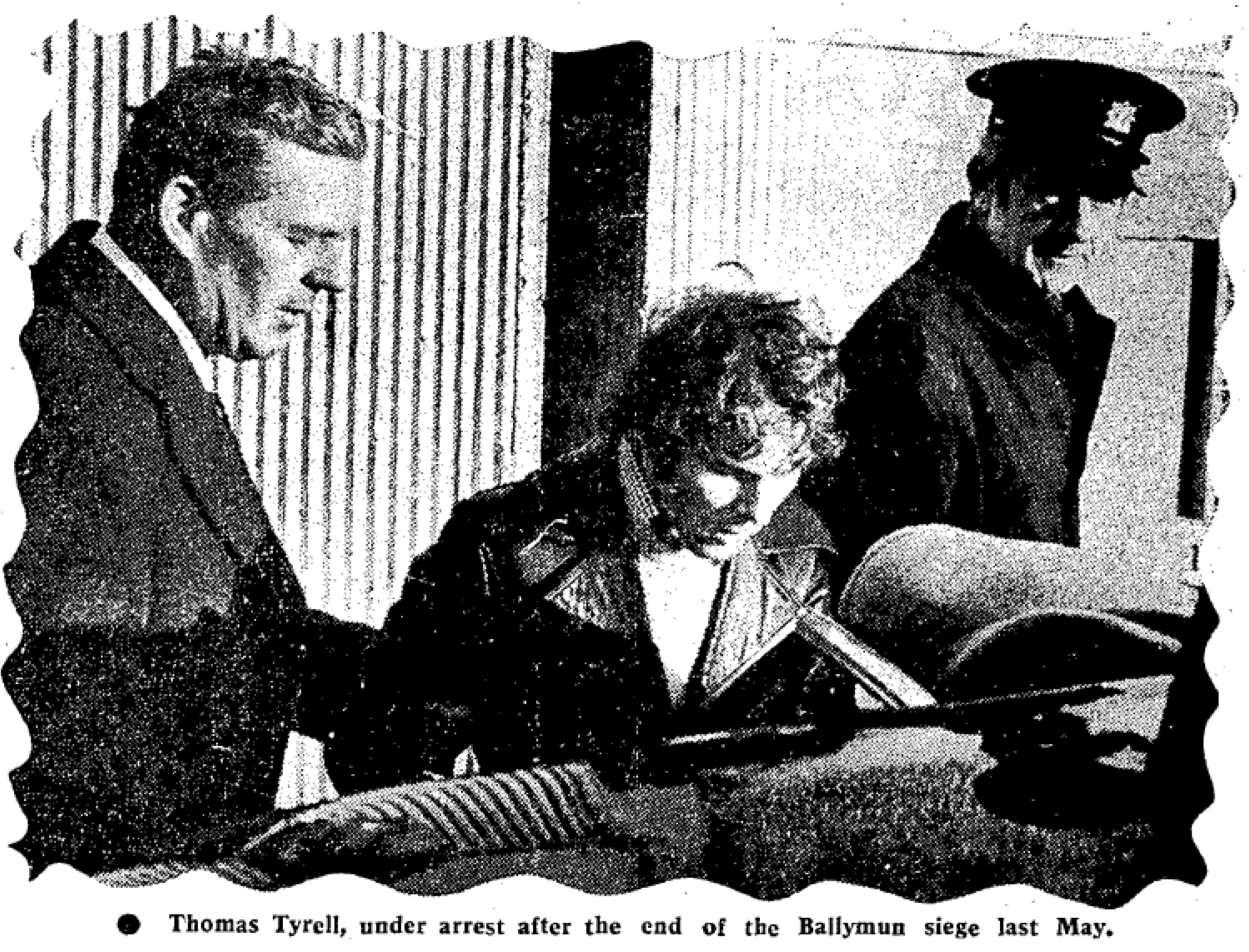
Thomas Tyrell following the five-day siege. The Irish Independent, 16 Oct. 1979.
Tyrell was released on 13 Jan. 1982 after serving two years for the manslaughter of Basil English. He was involved in another shooting incident just weeks after he was let out of prison. On 25 Feb. 1982, Tyrell shot and wounded Edward Charles McGuinness with a double-barreled shotgun at the doorway of McGuinness’ flat at 324 Sillogue Road, Ballymun. Tyrell, who had 25 previous convictions, pleaded guilty to the charge of malicious wounding and was sentenced to four years imprisonment.
18 Oct. 1979 – Christopher Shannon (Christy Shannon)
Christy Shannon was originally from Lower Dorset Street in the North Inner City. In the 1970s, he lived with his wife Breda and seven children at 3 Shangan Gardens, Ballymun.
In Sep. 1977, Mrs. Breda Shannon (38) went missing and the strange case was covered in the national press. The Irish Independent (27 Sep. 1977) stated that she had “not been seen since she discharged” herself from the Cuan Mhuire rehabilitation centre for recovering alcoholics in Athy, Co. Kildare on 9 Sep. In the Evening Herald (20 Sep. 1977), her husband Christy Shannon “appealed” to his wife to “return home and look after the children”. Nothing further was reported in the press over the next two years.
On 18 Oct. 1979, the body of Christy Shannon (43) was found by police in a stolen Ford Granada car in a laneway behind the Nally Stand, Croke Park. He had been shot twice in the face and neck at point-blank range with a shotgun by somebody in the driver’s seat. Shannon had previous convictions for burglary and larceny. The Evening Herald (22 Oct. 1979) noted that the police were searching the “homes and haunts of known Dublin criminals” to question about the murder.
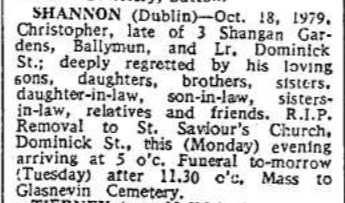
Death notice for Christopher Shannon. The Evening Herald, 22. Oct. 1979.
The Irish Independent (03 Nov. 1979) published a photograph of Mrs. Breda Shannon under the heading: “‘Come home’ plea to Croke Park murder wife”. The piece claimed that Mrs. Shannon “disappeared from her home” in Ballymun and “has not been seen since”. The Cuan Mhuire rehabilitation centre was not mentioned. The police believed that she “may still be in the country but it is thought she may be unaware that her husband is dead”. The Irish Press (04 Nov. 1979) claimed that the police believed that she “might have gone to England”.
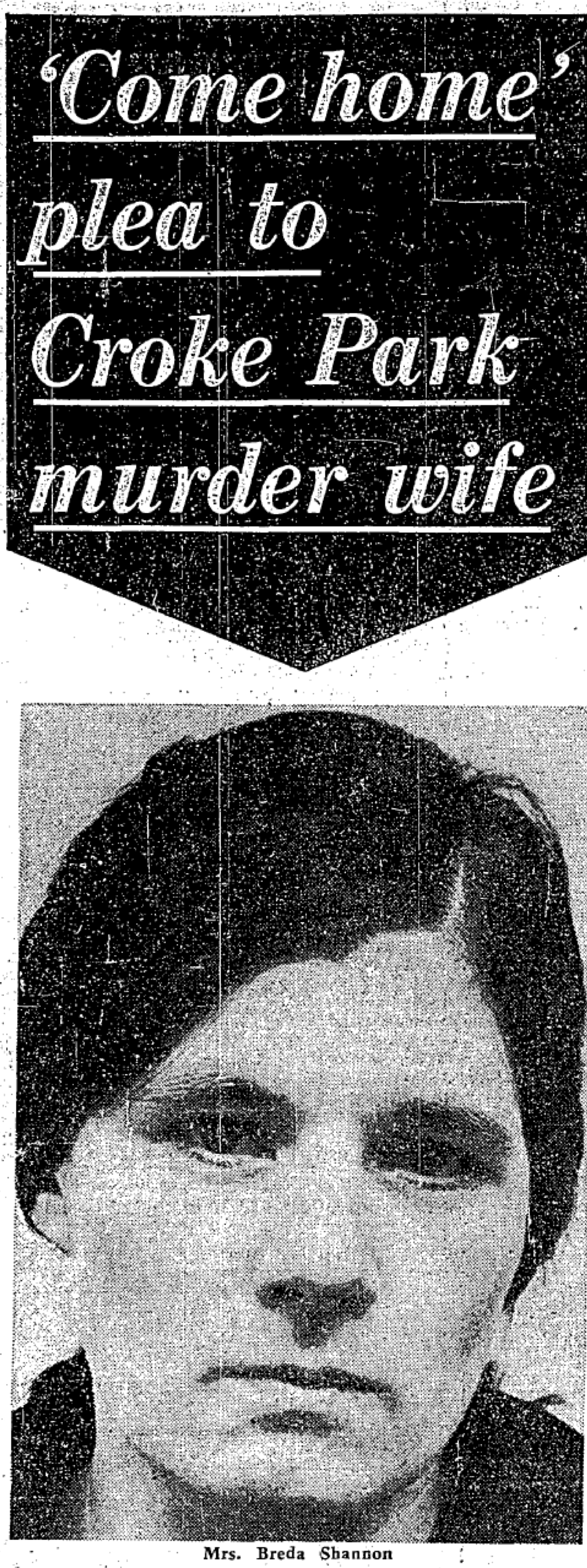
But then the Evening Herald (12 Dec. 1979) included a one line buried in a larger piece about the murder indicating that “Mrs Shannon’s wife was contacted in London, but she was not able to shed any light on her husband’s activities or associates”. So it appears that Breda Shannon left her husband and children in Dublin in 1977 and was found by police in London two years later but there doesn’t seem to be any other evidence besides that one short mention.
It was reported in the Irish Examiner (27 Jan. 1981) that the Gardaí had interviewed between 400 and 500 people in relation to the Christy Shannon murder case and had considered up to 30 people as possible subjects. The police arrested Laurence Cummins (Larry Cummins) (32) of Summerhill Parade and charged him with the murder. Cummins had multiple convictions going back to 1961. The police found a set of keys in Cummins’ home which belonged to the Ford Granada car in which Christy Shannon’s body had been found.
In court, Cummins denied that he was responsible but admitted that he had lent his shotgun and a car to a criminal associate named Frank Hughes. The Irish Independent (20 July 1982) stated:
The accused said that his friend Frank Hughes remarked that Shannon was dangerous and there was only one way to finish him and “to finish him right”. Cummins said that on the day Christy Shannon was killed he was in the pub about 9.30pm when Frank Hughes came in (and) said he had done the message, and the accused knew Christy Shannon had been killed.
The Irish Independent (22 July 1982) reported that Cummins had told police that Christy Shannon had been charged for breaking up a taxi owned by the father of Frank Hughes. The jury “failed to reach a verdict” in the first trial in Jan. 1981 and Cummins was found ‘not guilty’ and acquitted of the murder in a second trial in July 1982. It is unclear whether Frank Hughes was arrested.
Cummins served many prison sentences in the 1980s and 1990s and had convictions for drug dealing, armed robbery, possession of firearms, assault and receiving stolen goods. He was sentenced to 15 years imprisonment in July 2006 for his role in the robbery and shooting of the publican Charlie Chawke at the Goat Grill pub in Goatstown in 2003. Cummins died after a long illness in 2009 while serving his sentence in Mountjoy Prison.
17 Sep. 1980 – John Kelly (Jackie Kelly)
Jackie Kelly, of 9 St Andrew’s Court off Fenian Street in Dublin’s South Inner City, was married and had a two-year-old son. He had worked for about eight years as a postman in the Donnybrook area. He started a position as a telephone operator for the Irish Taxi Owners Co-Op in the summer of 1980. On the night of 17 Sep. 1980, Kelly (24) was watching a UEFA cup match between Polish club Widzew Łódź and Manchester United on the television in Grace’s pub at the corner of Townsend Street and Shaw Street near Pearse Street. There were about 15 other customers in the bar. At around 10.50pm, a man in a motorcycle helmet walked into the premises and fired a number of shots at Kelly who was sitting with two friends at a lounge window. The gunman left the bar but immediately returned and shot Kelly again.
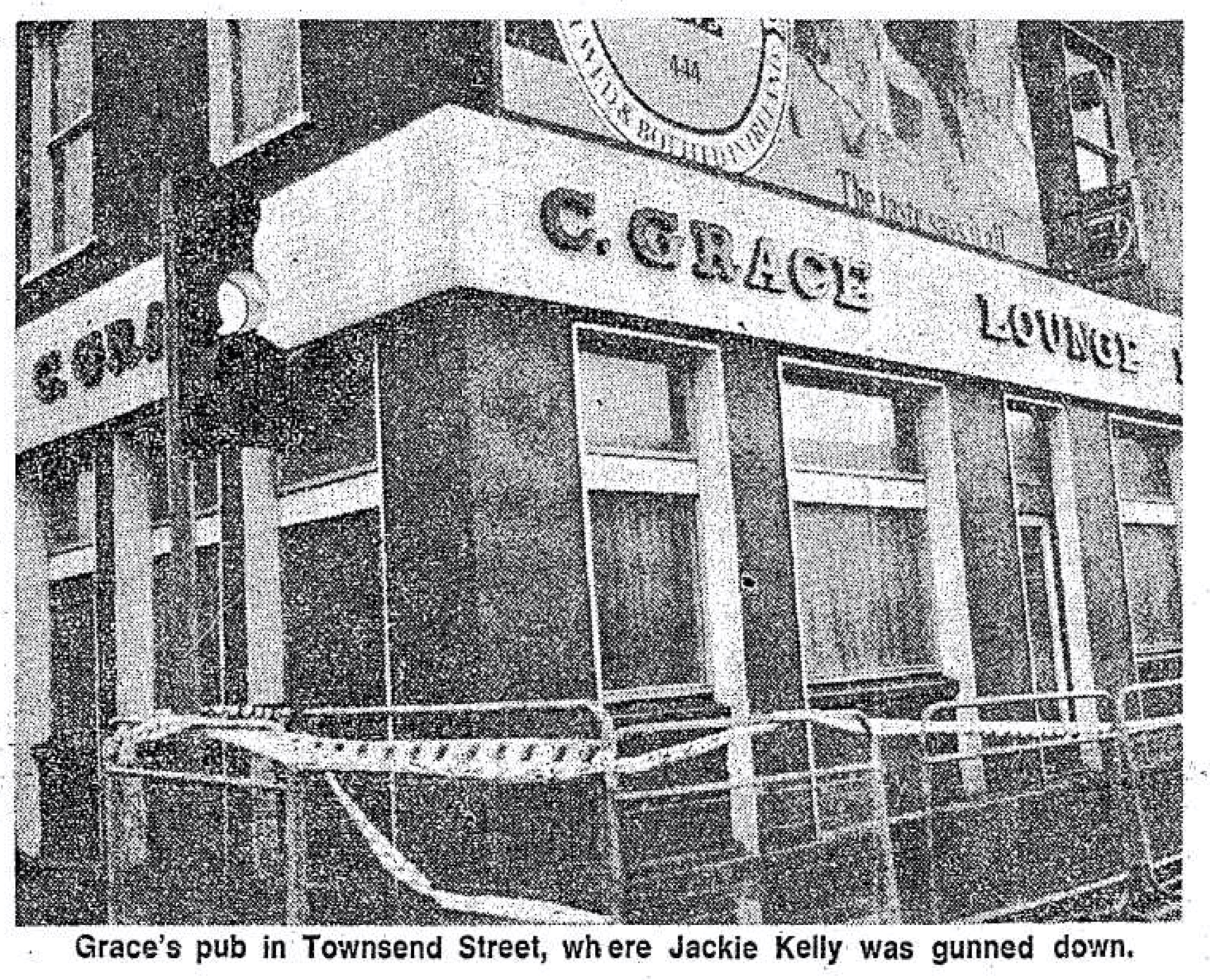
Scene outside Grace’s pub on Townsend St. where Jackie Kelly was murdered. The Evening Herald, 18 Sep 1980.
The assassin’s mask, motorcycle helmet, jacket and a sawn-off shotgun (not used in the attack) was found in a rubbish chute in nearby Markievicz House. The .32 pistol used in the murder was later discovered in a county council dump in Ballyogan near Dundrum.
Kelly, who was shot a total of five times, was interviewed by police in his hospital bed but died of his injuries ten days later on 27 Sep. 1980 in St. Vincent’s Hospital.
Kelly’s widow described her husband as a “quiet family man” who “played football” but “devoted most of his spare time to his family”. He had no known connections to organised crime and Gardaí were unable to find an apparent motive for the killing.
Grace’s pub was destroyed in a suspicious fire in Nov. 1983. Another pub on the street, The Countess, had burnt to the ground earlier that same year. A local criminal gang engaged in protection rackets were suspected.
The Irish Press (18 April 1993) described the Kelly murder as an “underworld killing” and stated that the police were “convinced a notorious south city gang leader personally carried out the killing as a favour for a friend”. Nobody was ever convicted of the murder.
26 May 1982 – Gerard Morgan
Gerard Morgan (15) was shot dead as he came to the front door of his family home at 22 Lismore Road, Crumlin on 26 May 1982. It is believed that his older brother Alan Morgan (17) was the intended target. Alan had allegedly fallen out with a criminal gang over the missing proceeds of a bank robbery in Drumcondra in Feb. 1982. There had been a previous gun attack on the Morgan home on 9 March 1982 when five shots were fired.
Patrick Conroy was sentenced in 1983 to seven years in jail for being an accessory to murder by providing shelter to the killer. Michael McDonnell, of 6 Dermot O’Dwyer House, Hardwicke Street, was arrested for the murder but the state dropped the charge and he was not convicted.
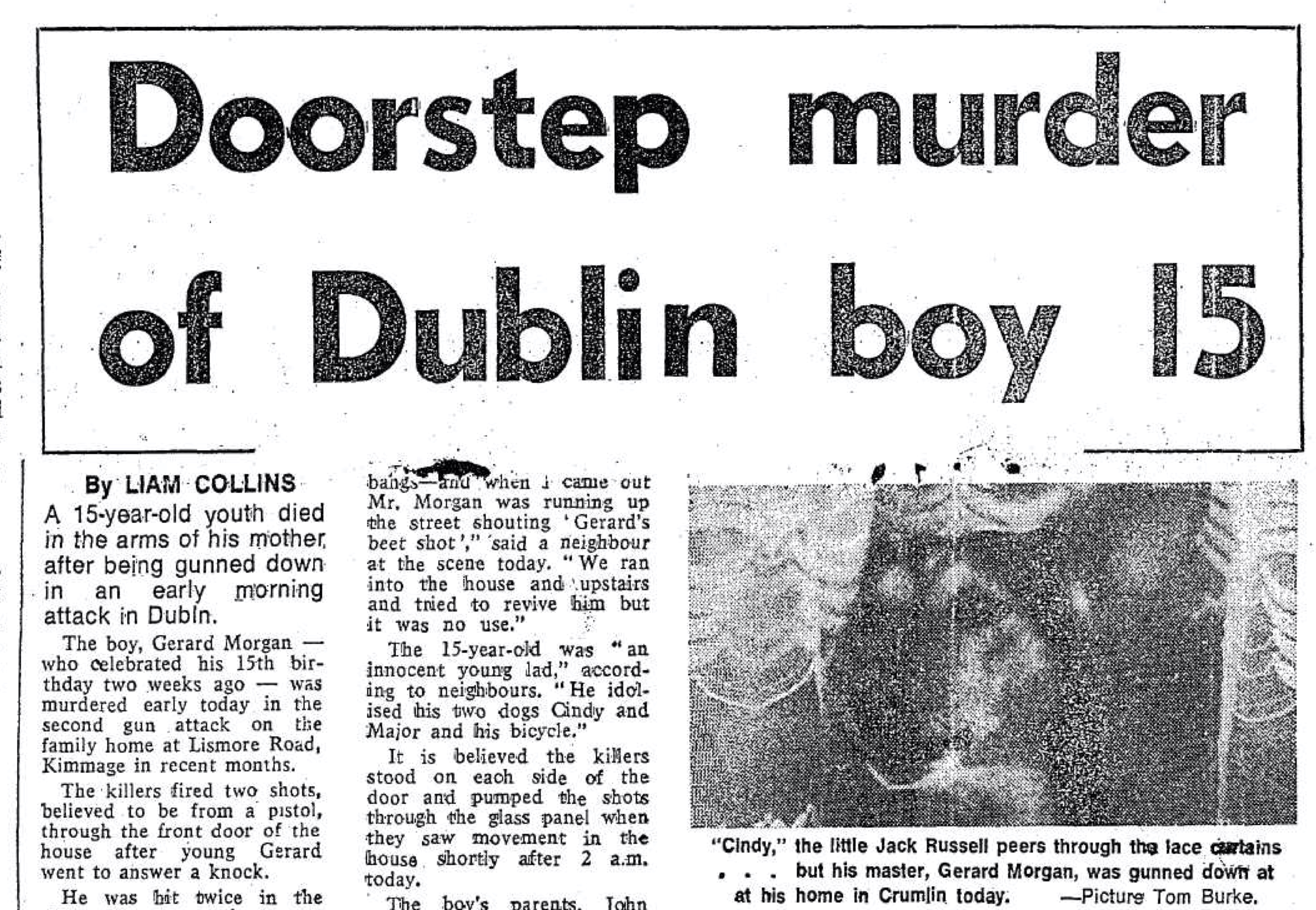
Front page story regarding Gerard Morgan’s murder. The Evening Herald, 26 May 1982.















 Click on the book for more.
 Click on the book for more.
 Donal
Donal Ciarán
 Sam
Sam


 Come Here To Me!