Feeds:
Posts
Comments

Archive for the ‘Dublin History’ Category

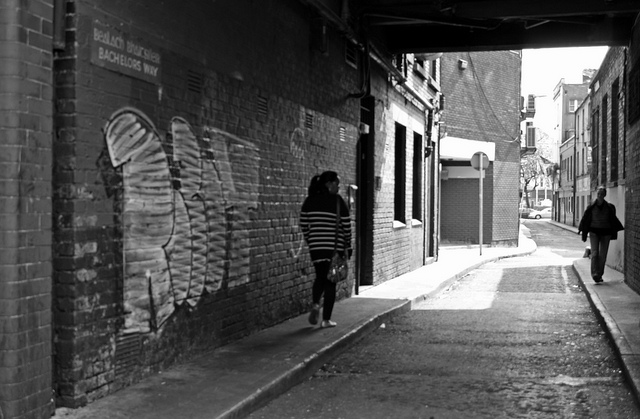
Bachelors Way, looking down to Middle Abbey Street and the Oval (Picture credit - Eve Andersson)

A dingy but practical little lane that links Bachelors Walk (entrance just beside the Bachelor Inn pub) on the quays and Middle Abbey Street (entrance between Supermacs and Book Worms).

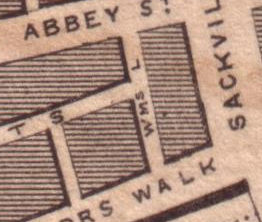
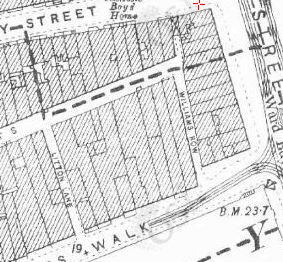
According to some maps, it used to be called Williams Lane. Confusing as there still is a Williams Lane a stone throws away. Other map mark it as Willams Row.

It is by Williams Row that the lane gets a fleeting mention in Joyce’s Ulysses (1922):

‘Mr Dedalus, tugging a long moustache, came round from Williams’s row. He halted near his daughter.’

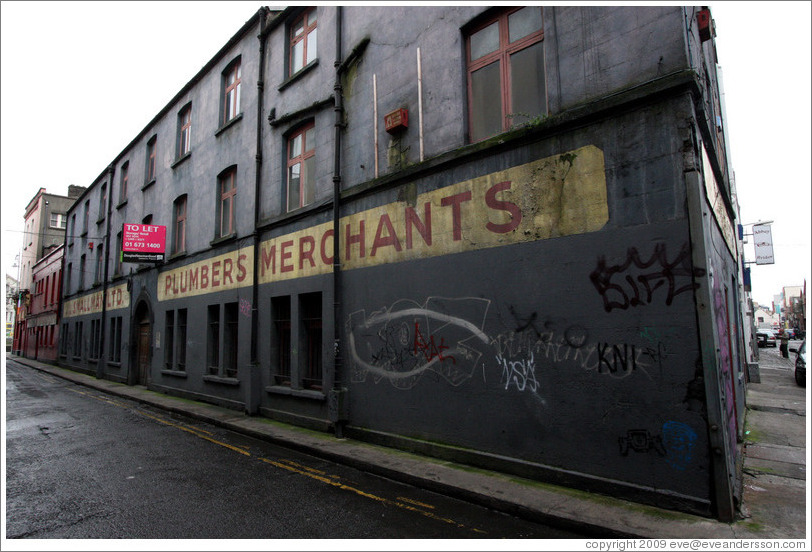
Bachelors Way. Bachelors Inn to the left (Photo credit - Eve Andersson)

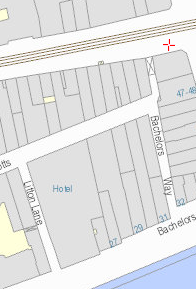
Tracing the history of the lane through maps:

1848, Williams Lane.

1907, Williams Row

2011, Bachelors Way

Not a particularly picturesque lane, I reckon most people today associate it as a public toilet and a place where junkies occasionally loiter.

Bachelors Way, looking down from Middle Abbey Street. (Photo credit - Ester Esther Moliné)

Read Full Post »

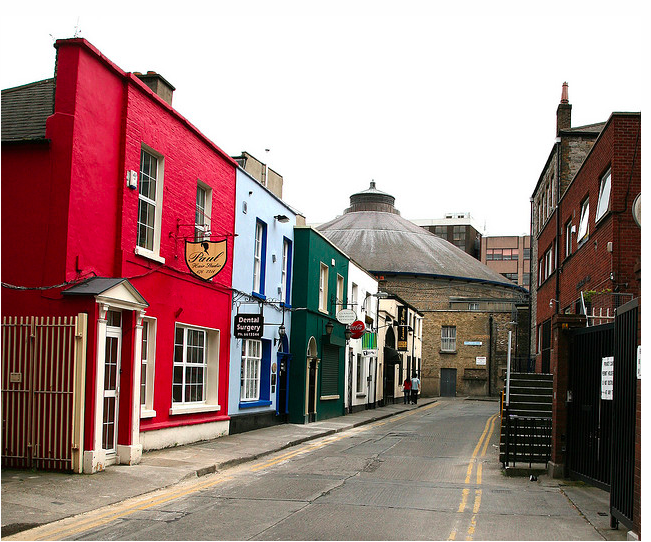
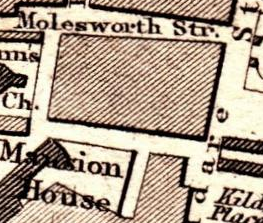
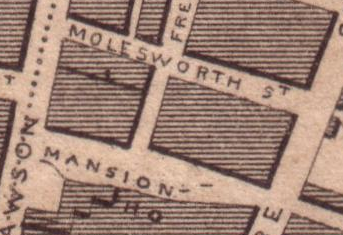
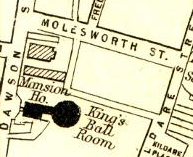
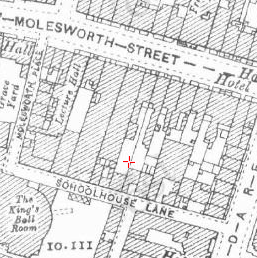
Looking from Molesworth St. down to Molesworth Place. (Picture - Kieran Murphy)

A pretty ugly (the Schoolhouse Lane side anyway) but none the less useful shortcut that links Kildare St. (entrance between the Department of Industry and Commerce and Clerkin Lynch Solicitors) and Molesworth St. (entrance between Whytes Auctioneers and the Irish EU HQ).

Molesworth Place joins into School Lane East. Presuming the latter was named after a school, I wonder where it was and what it was called? (Thanks to comments, I’ve found out there used to a be a school on Kildare Street called ‘Kildare Place National School’)

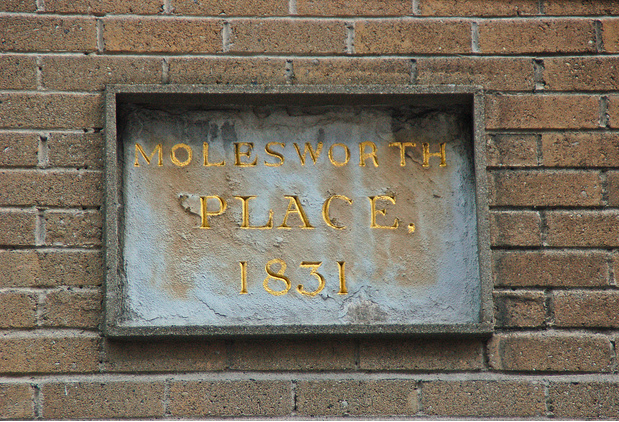
Beautiful plaque to Molesworth Place (Picture - Monceau)

Now home to the Dawson Car Park, Molesworth Court apartment, One Pico restaurant and Paul’s hair studio. Apparently it’s also been used by protesters in the past (particularly students) to slip by cops and get towards the Dail!

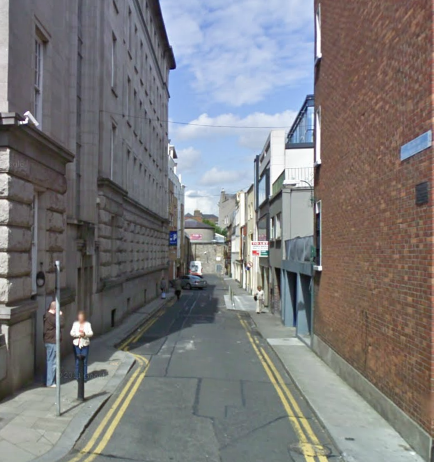
Looking from Kildare St. down to Schoolhouse Lane East

Charting its history using a number of maps:

Looking prominent in 1836 map

Still looking well in 1848

Looks like it was made more narrow and dropped to 'lane status' by 1885

View by 1907

Read Full Post »

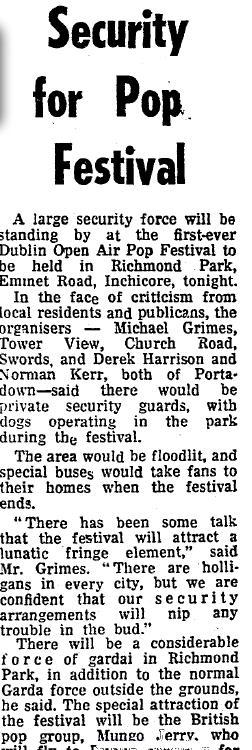
I was taken aback recently to read that Richmond Park, home of Saint Patrick’s Athletic, hosted what was supposedly Ireland’s first ever outdoor Rock Festival on September 4, 1970. The event was headlined by Mungo Jerry, but also included a performance from Dubliners Thin Lizzy. Researching it further, I found some interesting newspaper reports from the time which suggested that there was a real fear of what kind of element would be attracted to outdoor music festivals in the capital.

Irish Press. September 4 1970

Reports like the one above from The Irish Press appeared throughout the media in the days and weeks leading up to the festival. The Irish Independent reported that something in the region of 4,000 people had been expected to attend the festival, and that the ground could potentially hold double that. Repeating the sort of tone of The Irish Press piece, the paper wrote that “fears of rowdyism” were dispelled by officials at Saint Patrick’s Athletic.

In the end, the festival proved to be an absolute disaster. “I’ve been to better wakes” was a quote from one discontented young punter in The Irish Times, which ran with the headline ‘Open Air Festival Hardly Pops’. The paper noted that only several hundred young people had attended the festival, perhaps unsurprising giving the scare-tactics in the media in the run up to the event.

Mungo Jerry headlined the show, yet The Irish Times did not have much to say of their appearance, noting that “they appeared finally, like post-Christmas tinsil, on a shabby stand.”

Of course while Thin Lizzy are a legendary Dublin band today, at the time they were a new prospect having only formed in late 1969 and released their first single The Farmer/I Need You only two months prior to the Richmond Park performance.

Read Full Post »

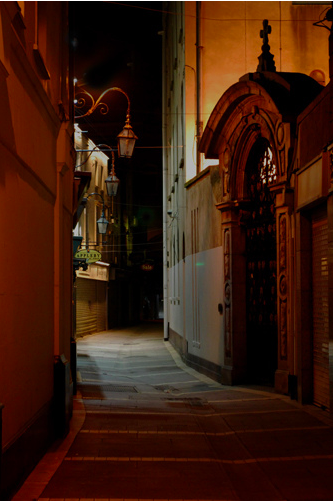
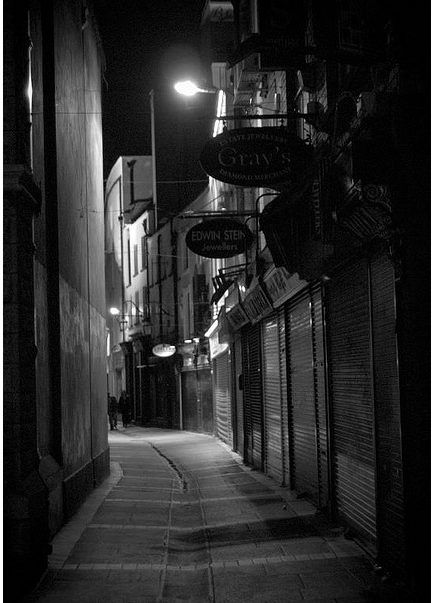
Johnsons Court, looking from Grafton Street. (Photo credit - Paul Feeney)


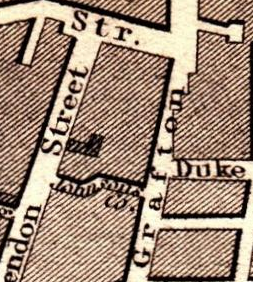
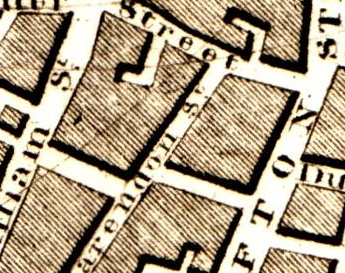
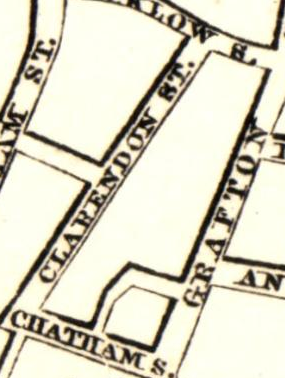
A beautiful little, narrow lane linking Grafton St. and Clarendon St., probably best known for its regular buskers, its jewellery stores and for the side entrance to St Teresa’s Church.

Visible in 1836

Visible but without title in 1840

Disappared from 1885 map


Still AWOL in 1912

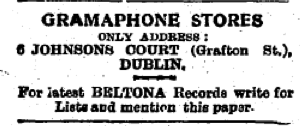
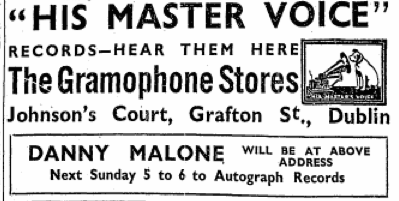
As far I can tell, it was also the site of HMV’s first Dublin store, 6 Johnsons Court, dating back to at least the mid 1920s.

Dec 19, 1925. Nenagh Guardian

May 12, 1933, Irish Independent

View from Clarendon St. (Picture credit - hc1916)

Read Full Post »

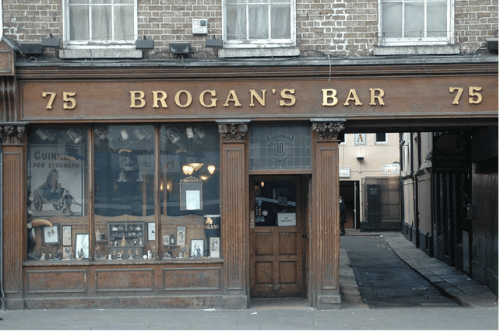
View from Dame Street down to Crampton Court (Photo credit - Trevs Photos)

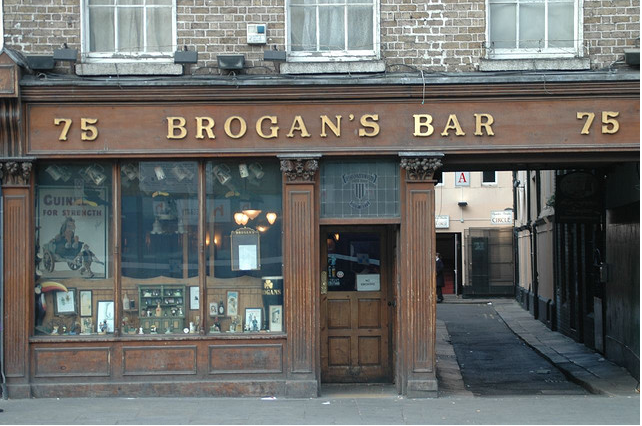
This is probably my favourite little lane or passage way in Dublin. Not least because it’s not featured on any maps, it was the site of two of Dublin’s most famous 18th century coffee houses – ‘Little Dublin Coffee House’ and ‘Royal Exchange Coffee House’ and as I’ve had some memorable personal experiences in the lane (nothing dirty!)

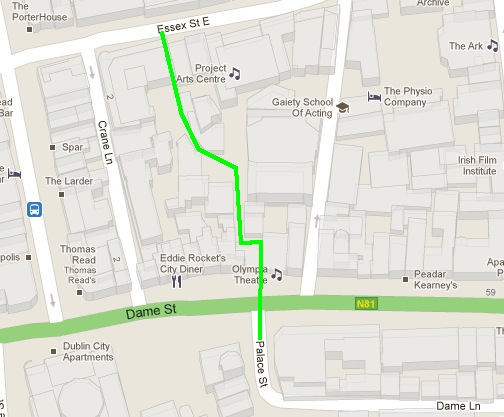
Crampton Court links Dame Street (entrance just under ‘BAR’ in the sign for Brogans BAR) and leads right down, past the back entrance to The Olympia Theatre, to Essex Street East (entrance just beside the Dublin Theatre Festival office)

Flora H. Mitchell in her excellent Vanishing Dublin (1966) described it as being

“… the unofficial “exchange” of Dublin until the “commercial buildings” were opened in 1799. No 20, “The Little Dublin Coffee House” provided the merchants with a meeting place prior to this. Crampton Court had been used as a short cut from the Olympia Theatre to the well known Dolphin Restaurant prior to it being demolished in 1963.”
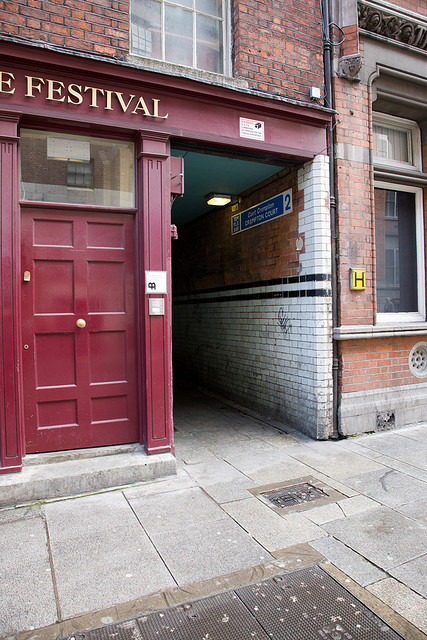
Entrance to Crampton Court from Essex St. East (Photo credit - infomatique)

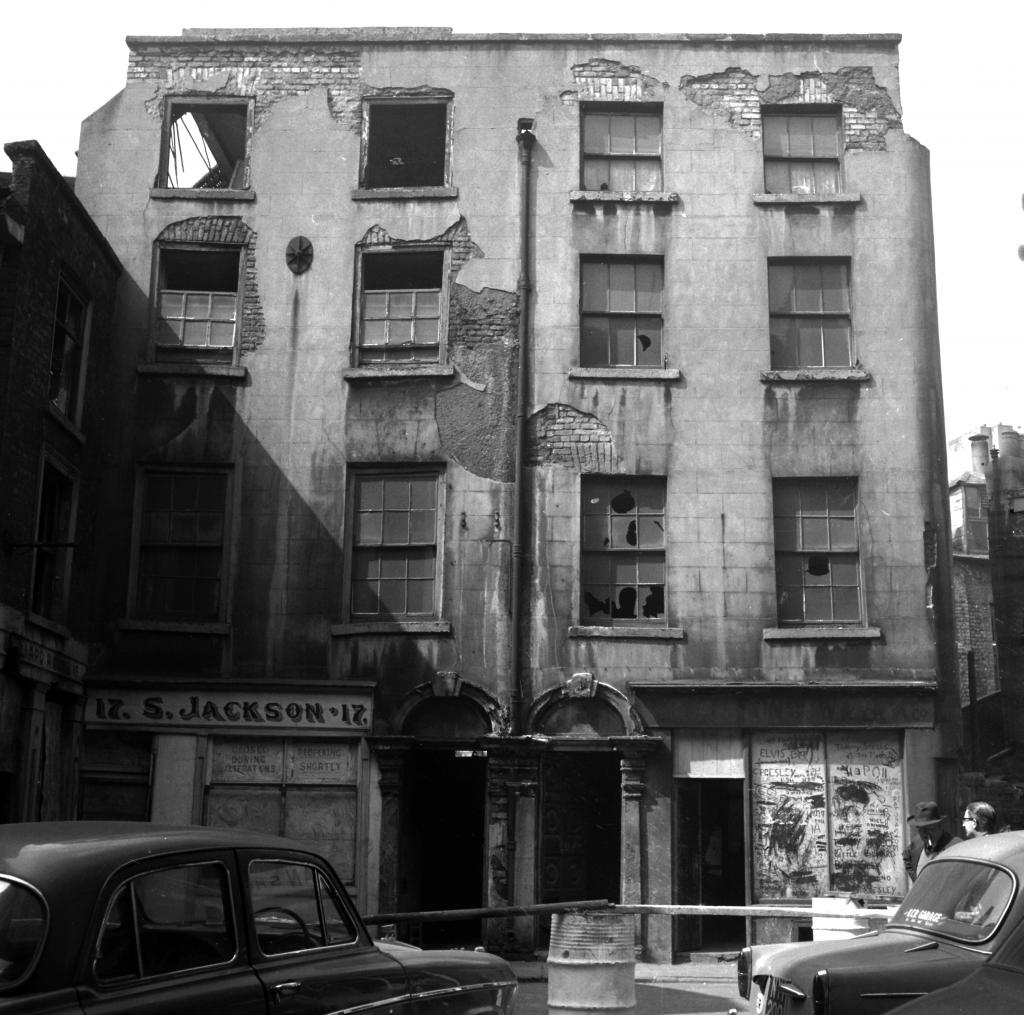
The doors in Crampton Court were famous in their own right:
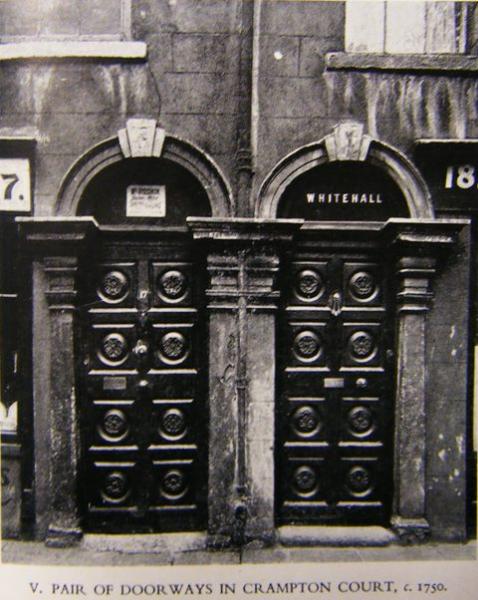
Uploader credit - Jimmymac

This is how it looked in the 18th century when the court was bustling with trade and housing:
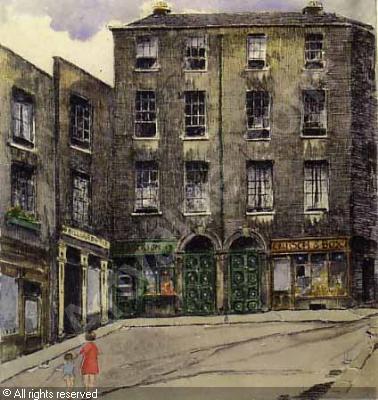
Artists interpretation of those doors (and buildings) in 18th century

Like so many beautiful and historical sites, it fell into decay in the 1950s and 1960s:
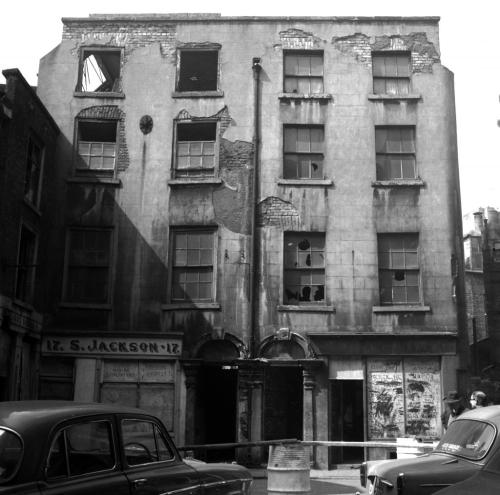
How it looked in 1959. Photo - Dublin City Library

A real pity. An anonymous letter to The Irish Times (May 23rd, 1931) described it as ‘a part of Dublin which still seems to suggest its ancient history’.

No doubt at one stage Palace Street used to run right across Dame Street and into Crampton Court:
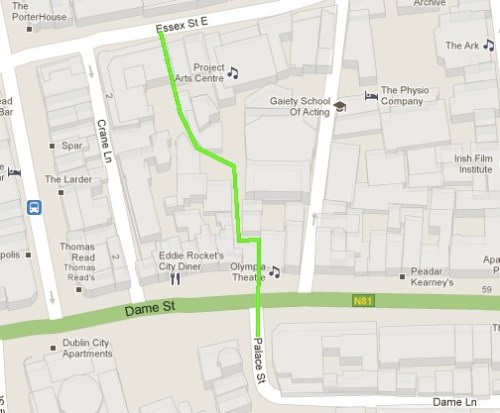
While Palace St. is still visable on maps, Crampton Street has been lost.

So next time your heading down Dame Street, when not pop through Crampton Court and have a gawk at an old, forgotten part of Dublin.
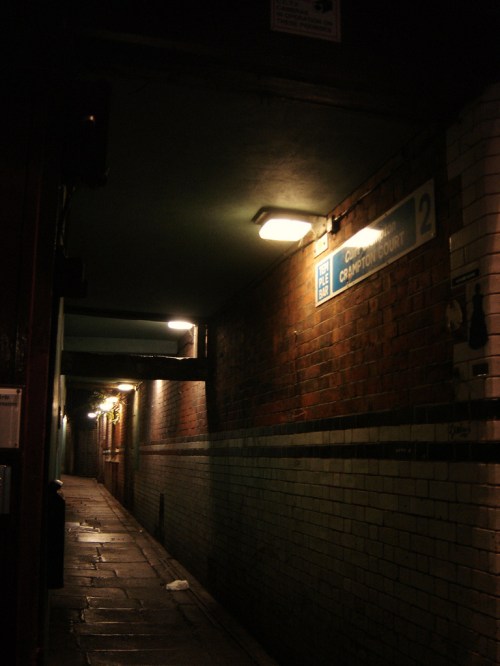
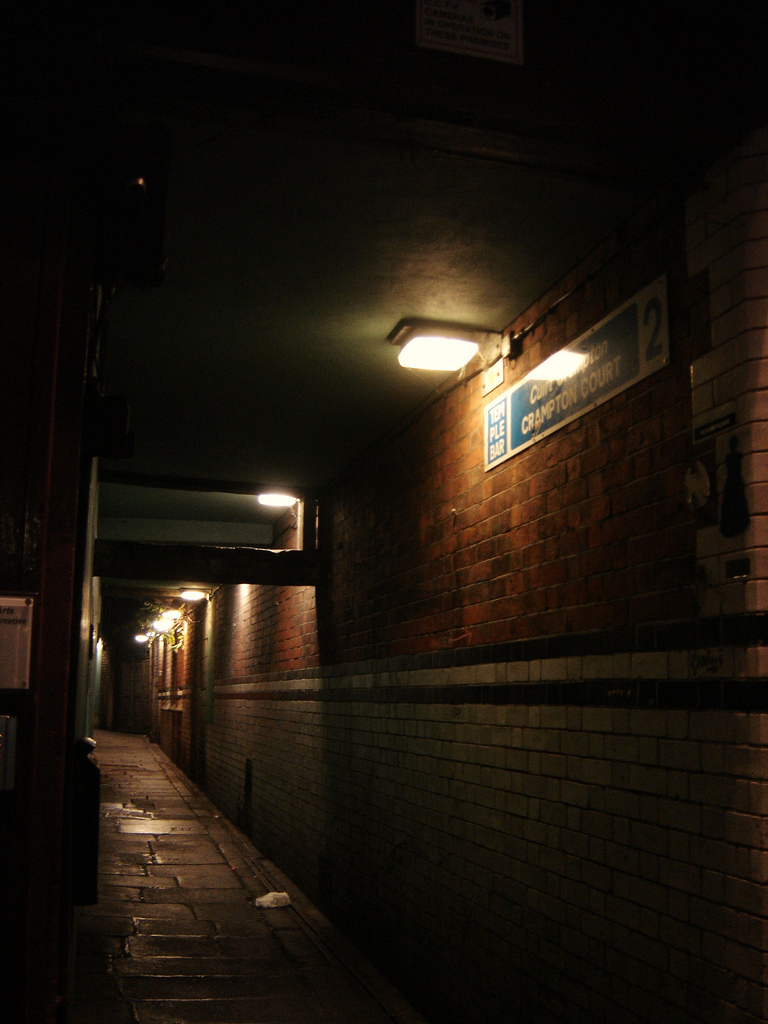
Entrance just beside Dublin International Theatre Festival Essex St. East. Notice wooden rafter across frame (Photo credit plattbridger)

Plus see if you can spot the wooden rafter above your head, as you come from the narrow Essex St. East side, that looks especially old! Perhaps original?

Read Full Post »
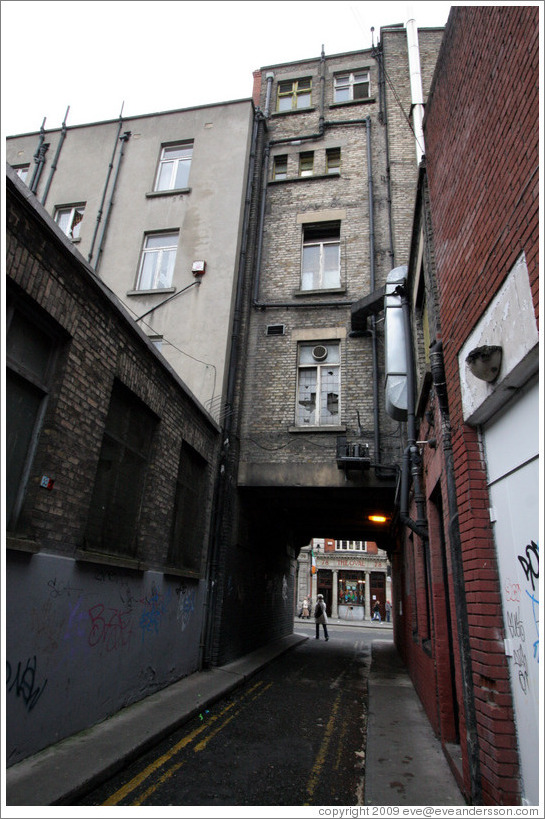
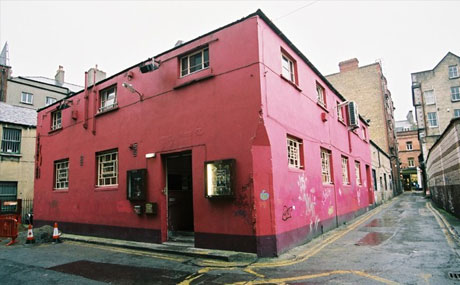
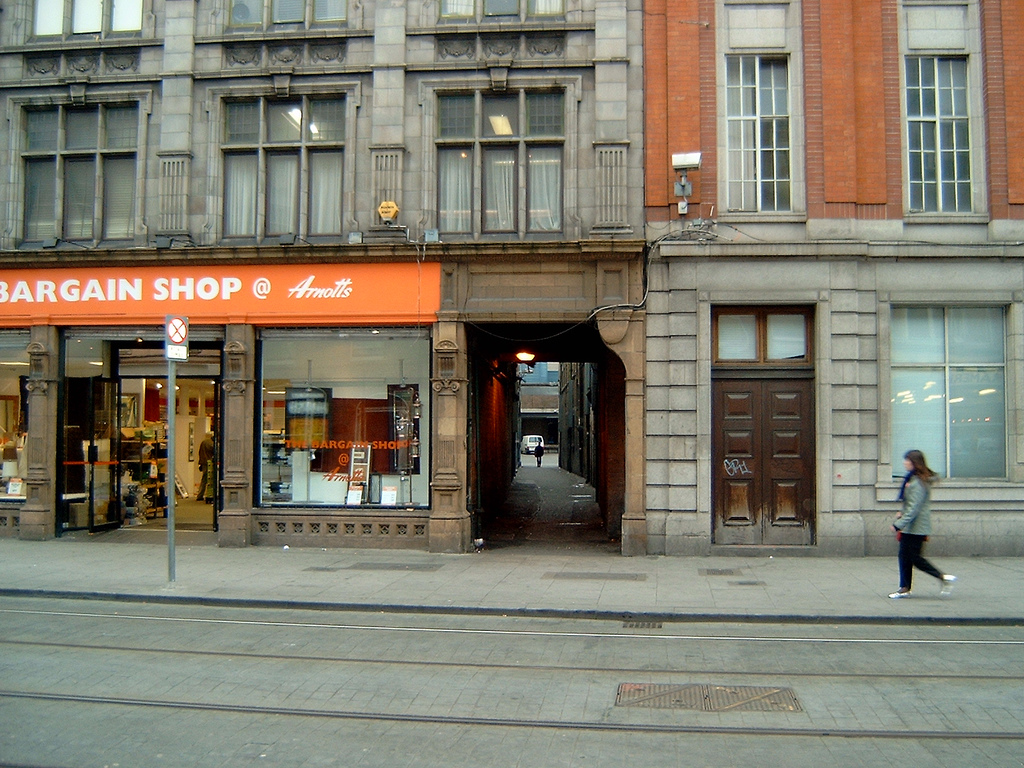
View looking up to Exechequer St.

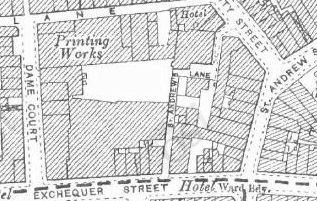
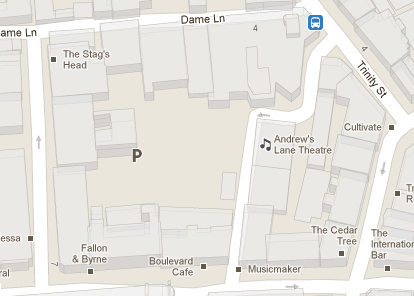
A bendy little lane that links Exchequer St. (entry is between Boulevard Cafe and Music Maker) and Trinity St. (entry is between Hilfiger Denim and Leon: The Pastry Cafe), synonymous with the Andrew’s Lane nightclub, Maser graffiti and Grift’s old Batman piece.

Cars still drive through it, so you have to be careful while walking down it (especially at night) because it’s very narrow.

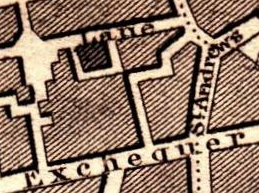
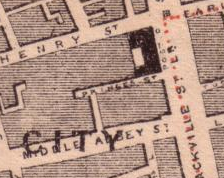
Bendy as ever, 1818

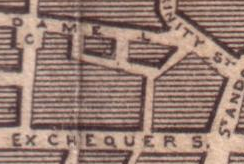
Showing how the courtyard on Dame Lane and St Andrews lane nearly touch, 1836

Showing how the courtyard on Dame Lane and St Andrews lane nearly touched, 1836

In 1863, apparently that courtyard lane on Dame Lane linked up with St. Andrew's Lane.

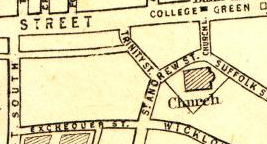
In 1885, the lane disappeared!

Clear view of it in 1907

View in 2011, featured on Google Maps because it's not pedestrianised

Read Full Post »
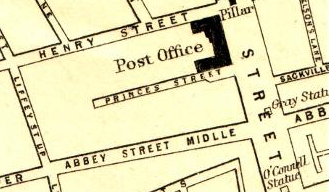
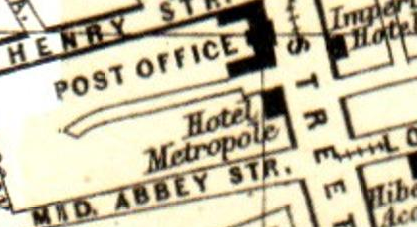
1. Williams Lane

Looking from Middle Abbey Street. Photo credit - Matthew S.

One of my favourite little lanes in Dublin is Williams Lane which (handily) links Princess Street North and Middle Abbey Street. It’s one of those hidden lanes that actually takes a good few minutes off your journey if your coming from Middle Abbey Street and want to head up the north side of O’Connell Street or when your coming from that direction and are heading towards Liffey Street and the ha’penny bridge. (It’s also handy for finishing your last can before heading into the Twisted Pepper across the road! Shhhh)

The view from Princes' North Street. Photo credit - Matthew S.

As you can see, it’s clearly marked (though not named) in these maps from the early/mid 19th century.

Visible in 1818

Visible in 1836

Visible in 1863

Visible in 1863

Then suddenly it disappears from all the maps!

Oh, where did it go? 1885 map

Still missing in 1913

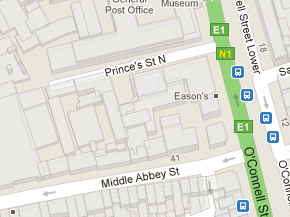
According to Google Maps (2011), there's no lane!

Odd isn’t it? Anyone have any ideas? Anyone know why it’s known as Williams Lane? Answers on a postcard.

Read Full Post »
I wouldn’t have a great deal in common with YouTuber OrangeDemocrats, but this is a fascinating piece of Dublin social history. Jaycarax posted notice of this radio documentary prior to its airing on RTE, and here it is in full. This is well worth a listen, notice one of the first men speaking describes himself as a ‘working class Dublin Protestant’ from the north inner-city, perhaps not the stereotypical member of the Orange Order!

Read Full Post »
122 Emmet Road

Tomorrow at 3pm a brand new and very important plaque will be placed on 122 Emmet Road, Inchicore.

This is of course very near to number 125, the official home of Saint Patrick’s Athletic which sits in front of Richmond Park. Emmet Road is a street that means a lot to me and all saints, and is a street I’ve seen evolve and change in my years following Saint Patrick’s Athletic.

122, Emmet Hall, was the home of 1913 strike leader and Irish Citizen Army officer Michael Mallin, who was executed for his role in the 1916 Rising. It was also the branch headquarters of the Irish Transport Workers Union.

Inchicore has a great radical and hidden history, indeed Emmet Road alone has a fascinating story to tell. William Partridge, a leading trade unionist who fought in the 1916 rising for example, was an organiser with the Amalgamated Society of Engineers who would meet in the Workman’s Club on Emmet Road. Jim Larkin purchased the Emmet Hall in 1913, appointing William Patridge as manager of the premises.

The Irish Citizen Army had an active section in the area (Inchicore-Crumlin, No. 3) of which Michael Mallin was Commandant. Dr. Ann Matthew’s has compiled an incredibly useful Irish Citizen Army membership list, and among the names one finds residents of St. James Park, St. Mary’s Terrace, Park Street and other parts of Inchicore.

Michael Mallin was executed for his role in the rebellion of 1916. At his court-martial appearance, Police Constable John O’Connell of the DMP would state:

I know the prisoner Michael Mallin. There is a paper called “The Workers Republic” in which it has been stated th the prisoner is Chief of the Staff of the Citizen Army. I have known the prisoner about 9 or 10 months. I have seen marching with the Citizen Army and he has marched with James Connolly and the Countess Markievicz…..

Mallin was survived by his wife, three sons and two daughters. They continued to live at the premises on Emmet Road after his death.

There will be a number of speakers tomorrow including Jack O’Connor of Siptu, labour-historians, member of the Mallin family and local TDs including United Left Alliance TD Joan Collins and Sinn Féin TD Aengus O’Snodaigh from the left.Great credit should go to the Kilmainham and Inchicore Heritage Group for their efforts.

Read Full Post »
ICA mobilisation for Easter Sunday

There is confusion over the official list of ICA members and supporters who were killed in action in the Easter Rising. Some erroneously name The O’Rahilly (Irish Volunteers) and Daniel Murray (A Company, 3rd Battalion, Dublin Brigade, Irish Volunteers) as ICA members. Other lists omit John O’Reilly (second-in-command to Sean Connolly at City Hall) while most exclude James Corcoran and Arthur ‘Neal’ Wicks. (The latter of whom I have been researching for some time and hope to publish my work on early next year. I think he was an actual member of the ICA and will argue this in my essay).

After comparing several sources including Ray Bateson’s excellent They Died By Pearse’s Side (2010) and R. M. Fox’s The History of the Irish Citizen Army (1943), I think I’ve come up with a definite list.

Fifteen ICA members were killed in action while Michael Mallin  (8 May) and James Connolly (12 May) were executed afterwards.

1916 ICA Roll of Honour

1) Adams, John Francis (38) – 25 April 1916 – St Stephen’s Green – Buried St Patrick’s, GC
2) Byrne, Louis (46) – 24 April 1916 – City Hall – Buried St Paul’s, GC
3) Clarke, Philip (40) – 25 April 1916 – St Stephen’s Green – Buried St Bridget’s, GC
4) Corcoran, James (33) – 25 April 1916 – St Stephen’s Green – Buried South Section, GC
5) Connolly, Sean (33) – 24 April 1916 – City Hall – Buried South Section, GC
6) Cosgrave, Edward (45) – 25 April 1916 – GPO – Buried St Paul’s, GC
7) D’Arcy, Charles (15) – Henry & James Building, Parliament St (City Hall Garrison) – Buried St Paul’s, GC
8) Fox, James Joseph (18) – 25 April 1916 – St Stephen’s Green – Buried Knockmark, Drumree, Co Meath
9) Geoghegan, George (35) – 26 April 1916 – Parliament St (City Hall Garrison) – Buried St Paul’s, GC
10) Lynch, Patrick (46) – 28 April 1916 – Moore Lane (GPO Garrison) –
11) McCormack, James (38) – 26 April 1916 – Beresford Palce (GPO Garrison) – Buried St Paul’s, GC
12) O’Reilly, John (28) – 24 April 1916 – City Hall/GPO – Buried St Patrick’s, GC
13) O’Reilly, Thomas Joseph (21) – 27 April 1916 – Liberty Hall (GPO Garrison) – Buried St Paul’s, GC
14) Ryan, Fred (23) – 26 April 1916 – Harcourt St (St Stephen’s Green Garrison) – Buried St Paul’s, GC
15) Wicks, Arthur (30) – 29 April 1916 – Metropole Hotel (GPO Garrison) – Buried St Paul’s, GC

16 Connolly, James
17 Mallin, Michael

Read Full Post »

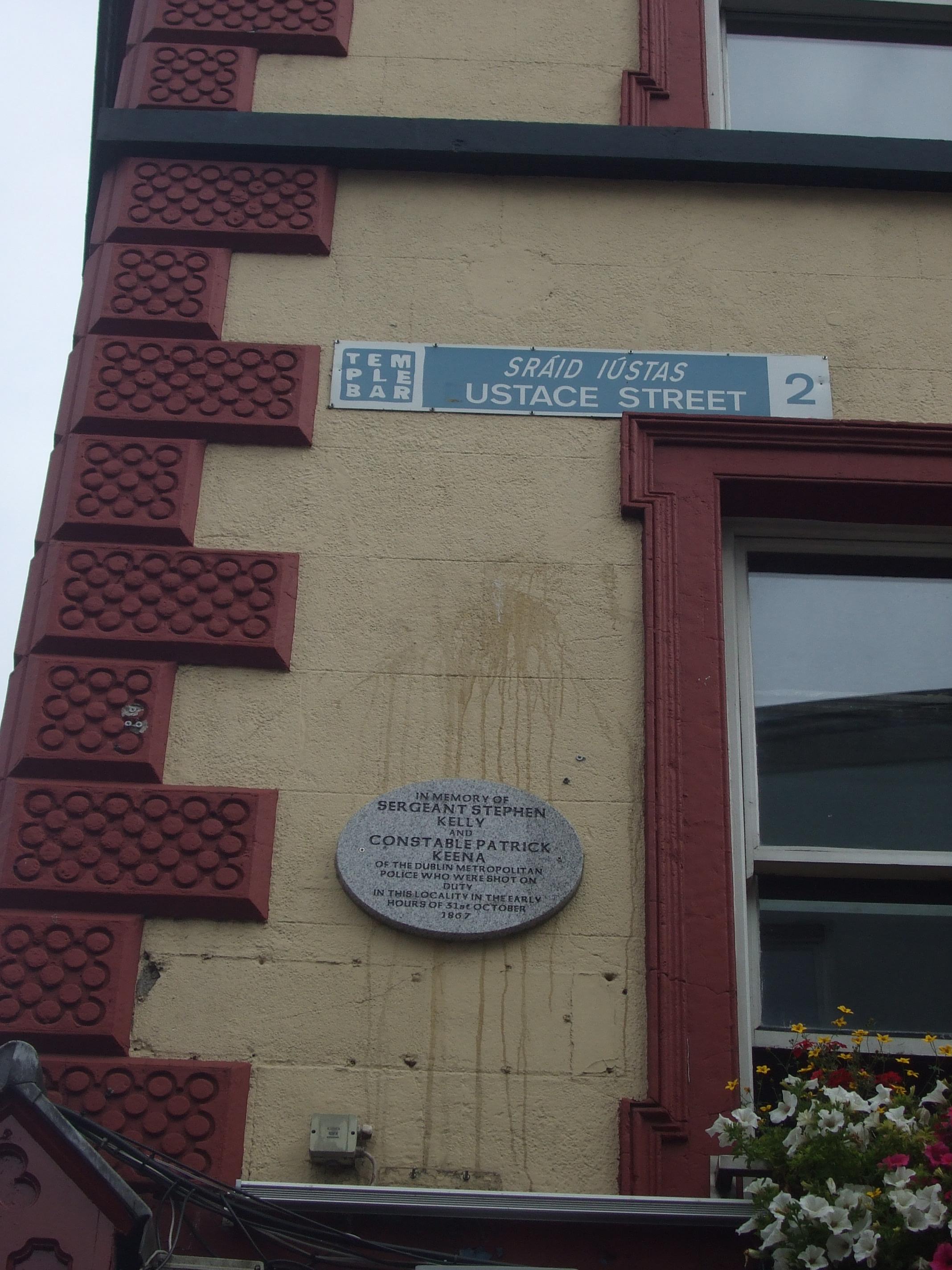
There’s a rather unusual plaque found above Farrington’s pub in Temple Bar, unusual in that it commemorates an event many with an interest in the history of the capital will be familiar with, yet the plaque itself is easily missed and many are unaware of its presence.

The plaque commemorates Constable Patrick Keena and Sergeant Stephen Kelly of the Dublin Metropolitan Police, shot on duty in the area on October 31st, 1867. While Kelly would survive, Kenna would lose his life. Of course that was the year of the Fenian Rising of 1867 which occurred months prior, a rising which had seen the Fenians issue a radical proclamation which proclaimed a provisional republican government,and a proclamation which read of its solidarity with republicans of the world, noting “our cause is your cause”

We appeal to force as a last resort… unable to endure any longer the curse of a monarchical government, we aim at founding a Republic based on universal suffrage, which shall secure to all the intrinsic value of their labour. The soil of Ireland, at present in possession of an oligarchy, belongs to us, the Irish people and to us it must be restored. We declare also in favour of absolute liberty of conscience and the separation of Church and State. We intend no war against the people of England; our war is against the aristocratic locusts, whether English or Irish, who have eaten the verdure of our fields.

Barry Kenerk has written a wonderful and engaging work on the shootings entitled ‘Shadow of the Brotherhood: The Temple Bar Shootings’, and John Dorney of The Irish Story has written a fine review of the work here, which provides great context to the events of that day.

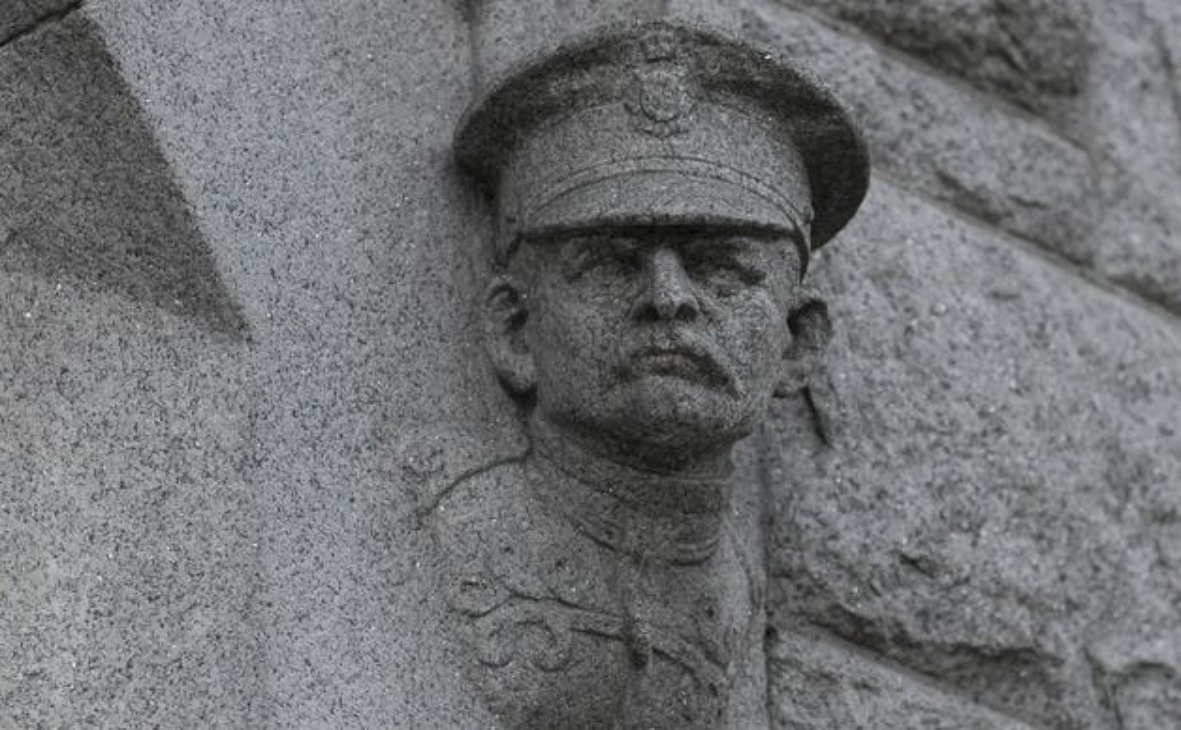
Of course, the plaque is not the only feature in Dublin marking the history of the DMP. A constable and officer of the force are represented today in stonework above the doors of Pearse Street Garda Station, or Great Brunswick Street Police Station as it was once known. Both these figures, and the Temple Bar plaque, are easy to miss.

Read Full Post »
A round up of Dublin related news stories for this week.

1.  First English edition of Ulysses among attractions at new Dublin museum

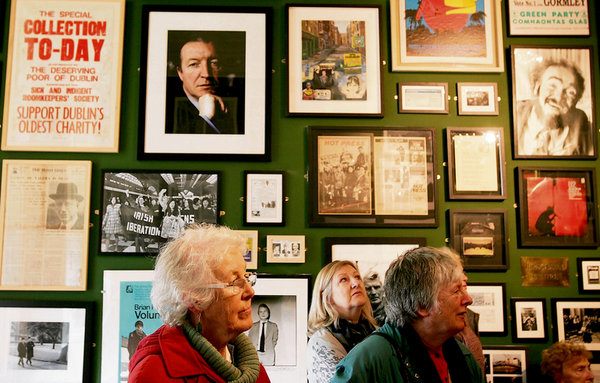
The first English language copy of James Joyce’s Ulysses is among attractions at a new Dublin museum opened to fill the gap left by the closure of the capital’s civic museum nearly a decade ago. A death mask of the writer himself is also one of the 400 artefacts – all of which were donated by the people of the city – on display at The Little Museum of Dublin.

Director Trevor White said: “This is the people’s museum of Dublin.” Sited on St Stephen’s Green, he said it served as a biography for the city, mapping its history during the 20th century. “It charts the social, cultural and political history of the city through artefacts donated by ordinary Dubliners,” he explained. Dublin Civic Museum on South William Street closed down in 2003 after 50 years. Mr White said its closure had left a huge void. “Since the civic museum closed, Dublin hasn’t had a museum of its own,” he said. The project, supported by Dublin City Council, has been just five months in the making. – The Irish Independent (21/10/11)

The Little Museum of Dublin. Photograph: Alan Betson

2. Veteran (Dublin) journalist Cathal O’Shannon dies at 83

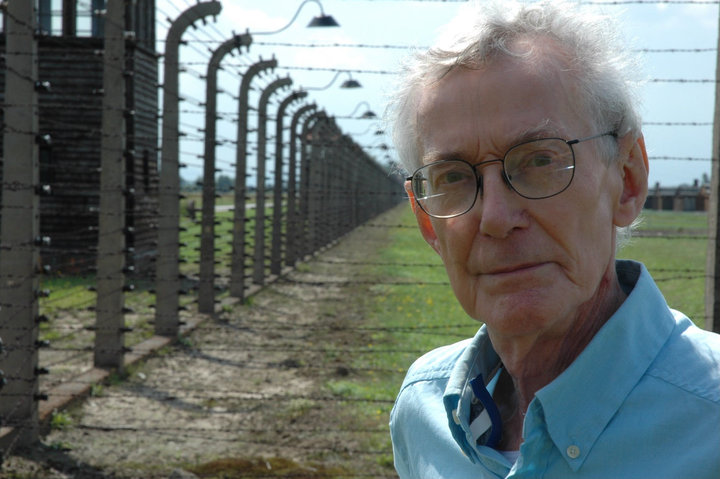
Cathal O’Shannon, who has died aged 83, was a mould- breaking journalist in the print and broadcasting media over several decades. He worked with The Irish Times , RTÉ and the BBC and as a public relations consultant in a long and distinguished career.

Born into what he described as a “household full of books” in Marino, north Dublin, he lied about his age and joined the Royal Air Force in the second World War with his friend Fred O’Donovan, who later became chairman of the RTÉ Authority. After three years in the Far East he returned to Dublin and was hired on the journalistic staff by Irish Times editor RM Smyllie in 1949. For some years he used the name Cathal Óg O’Shannon to distinguish himself from his father, Cathal O’Shannon, a trade unionist and columnist with the since defunct Evening Press . – The Irish Times (24/10/11)

Cathal O'Shannon (1928 - 2011)

3. Flash floods spark emergency in Dublin 

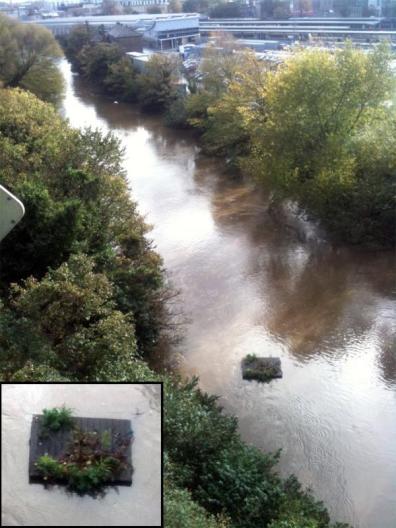
Two people died and hundreds were stranded in Ireland after torrential rain closed roads and rail lines, left shops and homes under water and led to Dublin being put on an emergency footing. More than one month’s rain fell on Dublin in 24 hours, causing rivers to break their banks and flooding the country’s largest shopping centre. – The Guardian (25/10/11)

A piece of garden decking, still with pot plants intact, floats down the Liffey near Heuston Station, Dublin. Image: @AlanWall77

Read Full Post »
« Newer Posts - Older Posts »