Feeds:
Posts
Comments

Archive for the ‘Social History’ Category

*I always get around to things. It might take me a while, but I do. I’d intended to post this up the weekend of our trip up North to see FCUM take on Cliftonville FC, but a truly good Saturday will always see to it Sunday is unproductive.*

We frequently discuss and deal with archives here on Come Here To Me, examples including my recent posting of a Socialist Party leaflet from the time of the last Royal visit to Dublin, or a more recent post from Sam on some of the gems he’s come across working at the Irish Labour History Museum.

A recent symposium with the title ‘Archives in Crisis’ saw more than 250 people pack out a lecture hall at Trinity College Dublin to discuss the state of Irish archives, the event being moderated by Professor Diarmaid Ferriter from UCD. That symposium was addressed by, among others, Fintan O’ Toole and Professor Eunan O’ Halpin. An excellent report of it is to be found over on Pue’s Occurrences, a group history blog many of our readers will be familiar with. There is clearly a passion for archives among the Irish public, and anyone who has had to wait around for a seat at either the National Archives or Library will no doubt agree!

I was recently forwarded this excellent speech from Caitriona Crowe, the Senior Archivist at the National Archives of Ireland, speaking at NUI Maynooth at the launch of the Irish Qualitative Data Archive. It is a defence of archives and archivists, and much more besides.

In these days of cutbacks, one can only hope our archives will not find themselves under the guillotine.

Read Full Post »

“For they give us a four-minute warning
When the rockets are on their way
To give us time to panic, and Christians time to pray”

The Dubliners- Protect And Survive.

Surely there is one of these hiding in every house in Ireland, the excellent 1965 Civil Defence ‘Survival in a Nuclear War’ booklet? The page above is particularly silly and worthy of posting, but it doesn’t get much more sensible elsewhere.

Read Full Post »

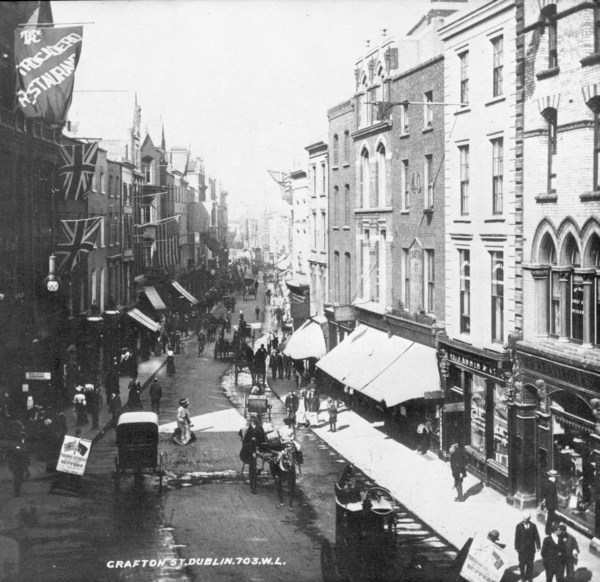
Grafton Street, 1911.

A timely gem this, from the National Archives online site.

I have gone from a weekly visitor to the Archives to never having time to set foot in the place owing to work,and you’d miss it. This leaflet is taken from 1911, and written by James Connolly. It can be read by expanding the image below.

Fellow-workers, stand by the dignity of your class. All these parading royalties, all this insolent aristocracy, all these grovelling, dirt-eating capitalist traitors, all these are but signs of disease in any social state – diseases which a royal visit brings to a head and spews in all its nastiness before our horrified eyes. But as the recognition of the disease is the first stage towards its cure, so that we may rid our social state of its political and social diseases, we must recognise the elements of corruption.

(more…)

Read Full Post »

I recently did a wonderful module in college which took in early Dublin life, and the walled viking town. After any degree of research into Viking Dublin, one can’t help but see the Civic Offces at Wood Quay as perhaps the greatest defeat of Irish historians and archaeologists.

Today, I stumbled across this gem on YouTube from 1979.

Excellent, and a YouTube gem providing interesting insight into long and hard fought political campaign.
For anyone interested in this period of history, you could do worse than to check out the Irish History Podcast homepage, where you’ll find a series of podcasts on the Vikings.

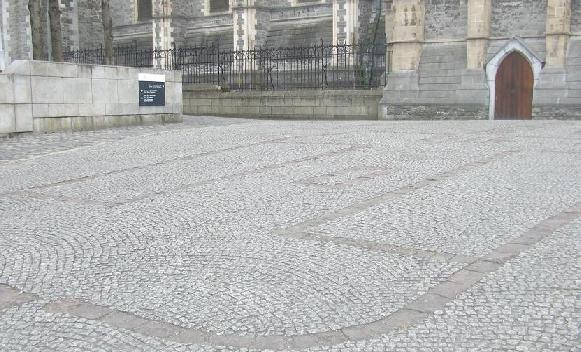
Outline of a viking plot today, beside Christchurch at Wood Quay.

Read Full Post »

It’s a good question for a pub quiz- How many bridges span the Liffey from Heuston Station to where Dublin meets the sea? No doubt you’ll get a plethora of answers, but you’ll rarely get the right one. You can guarantee people will forget that two bridges traverse the water at Heuston, they’ll forget about the little Rory O’Moore Bridge that has more history than most of them, or the DART Loopline at Butt Bridge. They might even forget the ugly abomination that is the East Link, the last connection between Northside and Southside before Dublin Bay separates the two…

Perhaps Dublin's best known bridge, The Ha'Penny Bridge.

The correct answer, if you want to know, is seventeen, starting at Sean Heuston Bridge and working all the way along the river to the Eastlink Bridge at Dublin Port. I’m not going to cover them all in this piece; I won’t be covering the bridges we all know, like O’Connell Bridge or the Ha’penny Bridge for that matter. What I will do is take a look at some of the ones to the west of O’Connell Bridge; ones I find interesting mainly due to who they’re named after or because of their historical importance.

-Sean Heuston Bridge (ex-King’s Bridge, Sarsfield Bridge) 1829

The first incarnation of the bridge was built in 1828/ 9 and named Kings Bridge to commemorate a visit by George IV to Dublin in 1821.  After the declaration of the Free State  in 1922, it was renamed Sarsfield Bridge, in memory of Patrick Sarsfield, leader of the Jacobite Rebellion of 1641. (I’ll talk about the 1641 Rebellion later.) In 1941 the bridge was again re-named, this time after Sean Heuston, a member of Na Fianna h-Éireann who played a prominent role in the Easter Rising of 1916.

At 19 years of age, Seán Heuston was Captain of a twenty three strong company of men, mostly Fianna h-Éireann members around his own age, who were directed by James Connolly to take “The  Mendicity (Institute on Ushers Island) at all costs”. Their goal was to prevent British re-inforcements coming into the city from The Curragh Camp and the West. They held out until Wednesday afternoon, until they were scattered by the 10th Battalion of the Royal Dublin Fusiliers. One of the more striking stories of the Rebellion (or one of countless stories to tell of that week) is that of the Liutenant of the 10th Battalion, Lieutenant Gerald Aloysius Neilan who was shot and killed by a sniper from the Mendicity, while his brother Anthony Neilan took part in the Rising on the Rebel side. He was one of two Liutenants killed in Dublin that day, with another nine members of the 10th Batt. killed at the Mendicity,  as per a report to Prime Minister Asquith by General Sir John Maxwell.  Seán Houston was captured with 22 other men and executed by firing squad on May 8, 1916 in Kilmainham Jail on the charge that he “… did take part in an armed rebellion and in the waging of wars against His Majesty the king such act of being of such a nature as to be calculated to be prejudicial to the defence of the Realm and being done with the intention and for the purpose of assisting the enemy.”

 Kingsbridge Station was later renamed Heuston Station in his honour.

Nothing like this anymore of course, theres more silt than water under it, and the LUAS runs across it!

The Bridge itself was reconstructed in 2003 and now carries the LUAS from Tallaght to the Point.

– Rory O’Moore Bridge, (ex- Victoria & Albert Bridge, Queen Victoria Bridge) Watling Street to Ellis Street, 1859 (Previous structures: 1670, 1704)

“Oh lives there the traitor who’d shrink from the strife, who would add to the length of his forfeited life. And his country, his kindred, his faith would abjure; No we’ll strike for old Ireland and Rory O’Moore.” (more…)

Read Full Post »

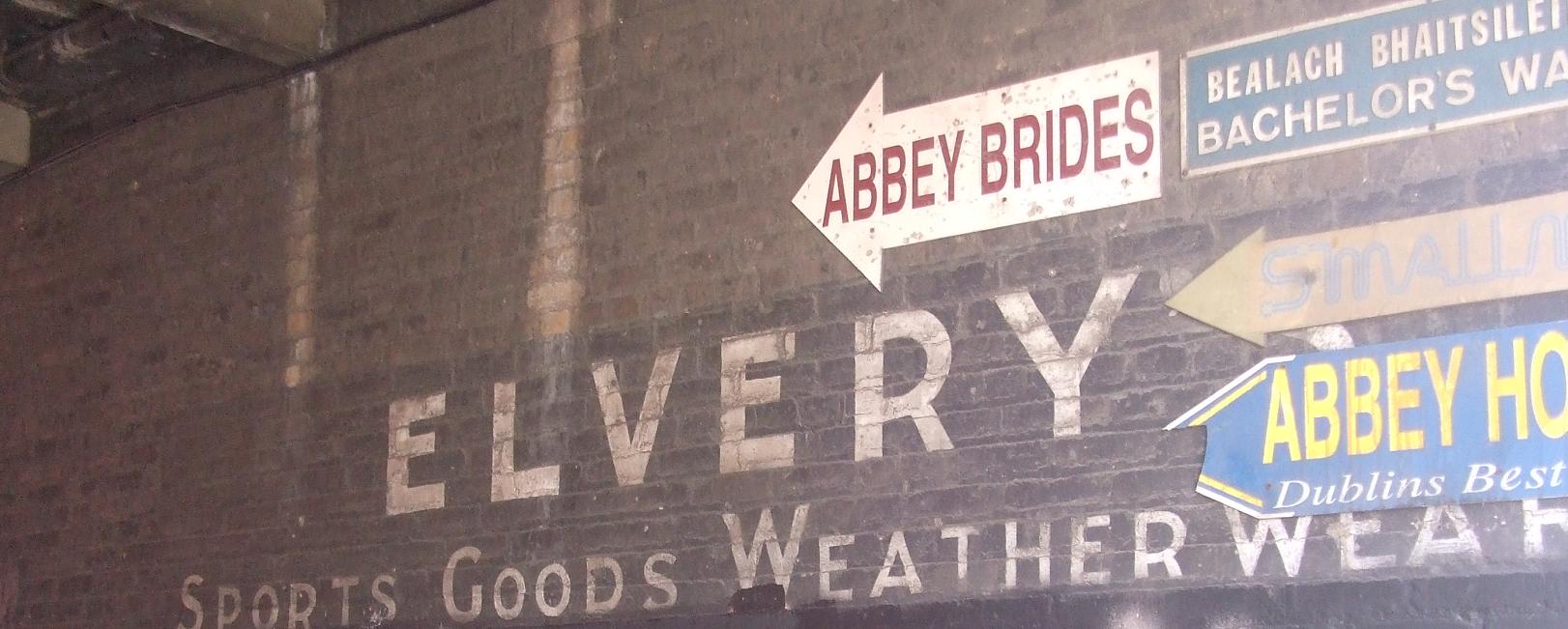
I’ve always liked this old school advertisement for Elvery Sports, in the laneway opposite The Oval pub. Elvery’s is Ireland’s oldest sports shop, founded in 1847. It’s long been a staple of Dublin and indeed Irish life, with strong links to domestic sports. The Elvery’s at the bottom of O’ Connell Street was one I always had a soft spot for, owing to the reappearing Saint Patrick’s Athletic F.C jersey in the window. Behind enemy lines, looking pretty on the northside.

There is a great story told in the wonderful Forth The Banners Go book, taking in the reminiscences of William O’ Brien, where he retells a tale about James Connolly being arrested outside this Elvery’s for a series of public speeches he had given in Dublin, breaking a proclamation forbidding any meetings being held.

That Elvery’s is gone now, making the above a ‘ghost sign’.

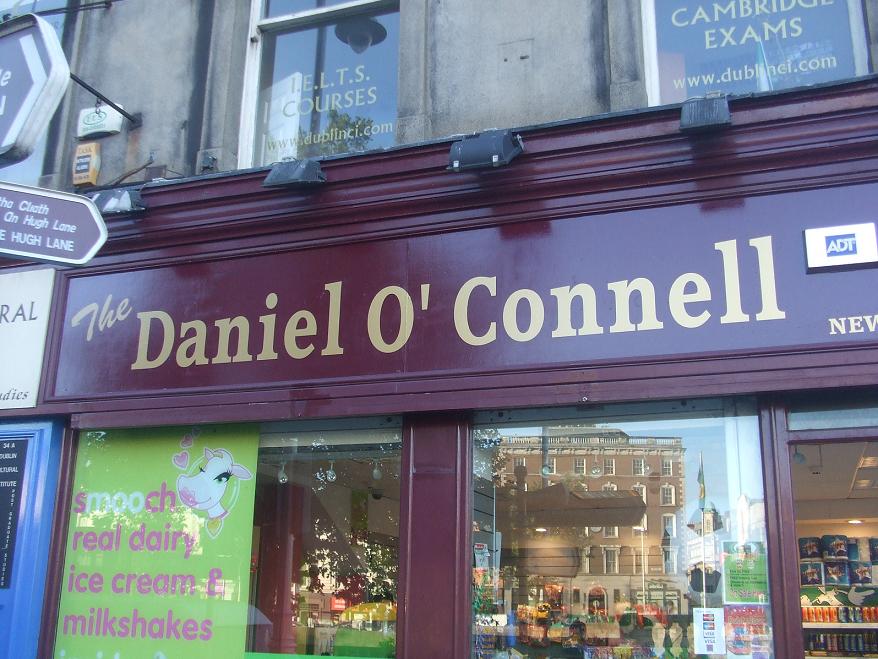
It’s been replaced with this:

A newsagents named after ‘The Liberator’, and former Lord Mayor of Dublin Daniel O’Connell. Directly opposite his statue, it’s sure to do a roaring trade in postcards, miniature busts of the man himself and student bus tickets.

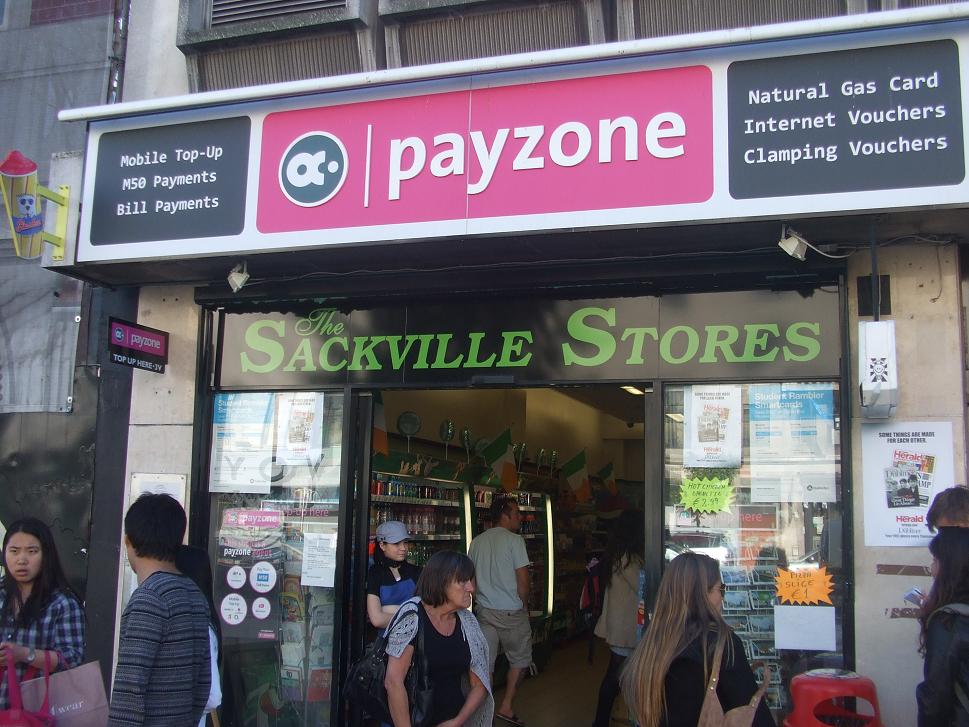
It’s not the first newsagents on the street to tip its hat in the direction of history however. Further down the street, and on the same side, you come to this:

Sackville Street was, of course, the name of O’ Connell Street before the establishment of the Irish Free State.The name ‘Sackville Street’ was in honour of one time Lord Lieutenant of Ireland Lionel Cranfield Sackville, Duke of Dorset.

The ruins of Sackville Street, 1916.

Interesting nods to the past, from the most unlikely of sources.

Read Full Post »

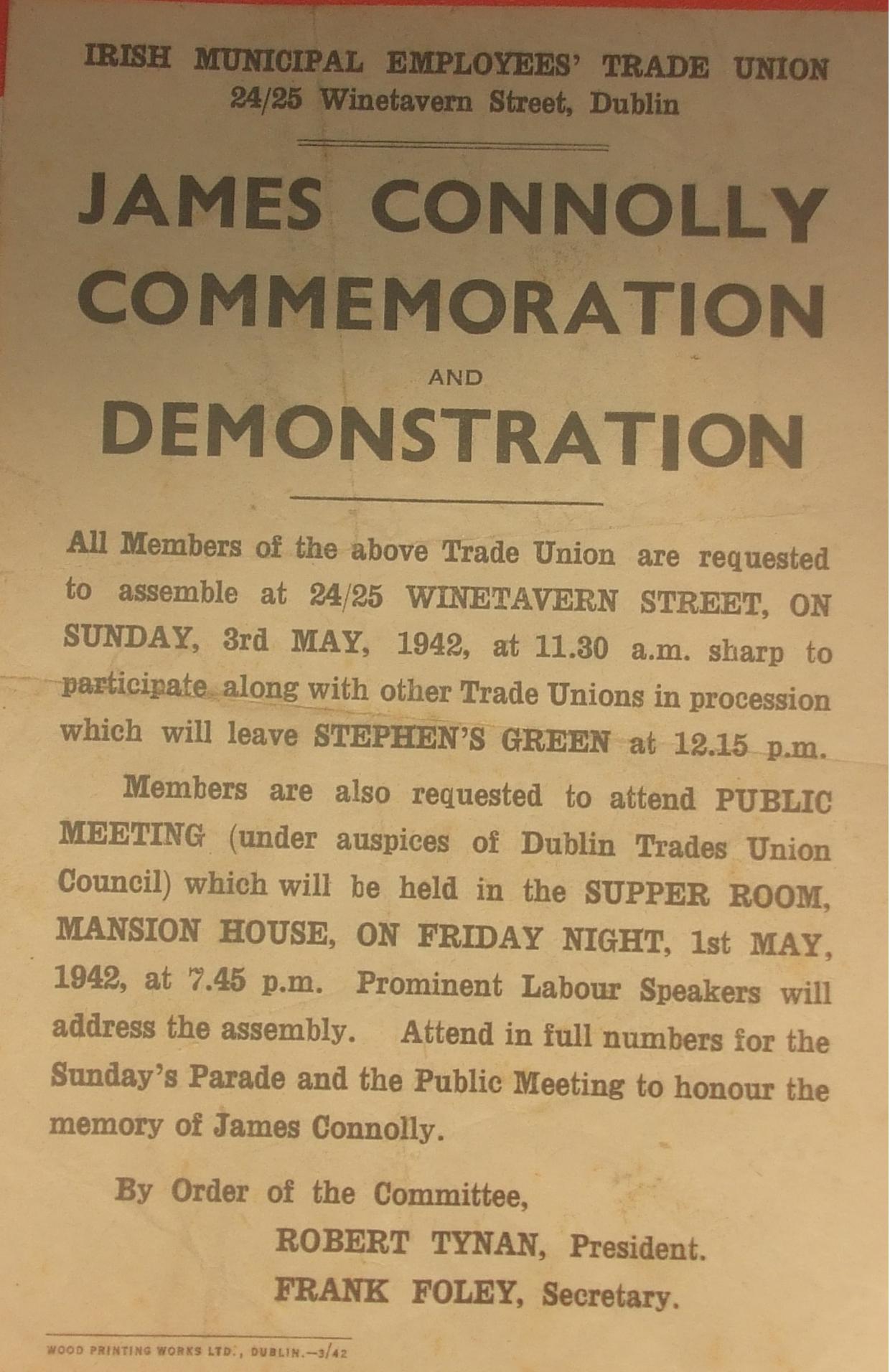
This is a nice find, from the Irish Municipal Employees’ Trade Union, 1942.

The back of the leaflet was clearly used in 1942 by someone dealing with union finances, as it is littered with figures and sums.

Union members are encouraged to attend a commemoration in memory of Connolly on May Day, and also to show up a demonstration on the 3rd of May, “…to participate along with other Trade Unions in procession, which will leave STEPHEN’S GREEN at 12.15 pm”

Of all places, it showed up recently in the books of the Dublin Fire Brigade Union, loaned to the DFB Museum. The things that show up in books eh?

Read Full Post »

“He is a man of lofty character and of high ideals, and evokes in men of the most diverse opinion a common admiration of his chivalry and honour”
Irish Literature-Volume 7 (1904), taken from the entry on John O’ Leary

Recently, we posted a series of images and audio recordings from the launch of a plaque to the memory of the Connolly siblings of the Irish Citizen Army. That plaque was put in place by the excellent North Inner City Folklore Project.

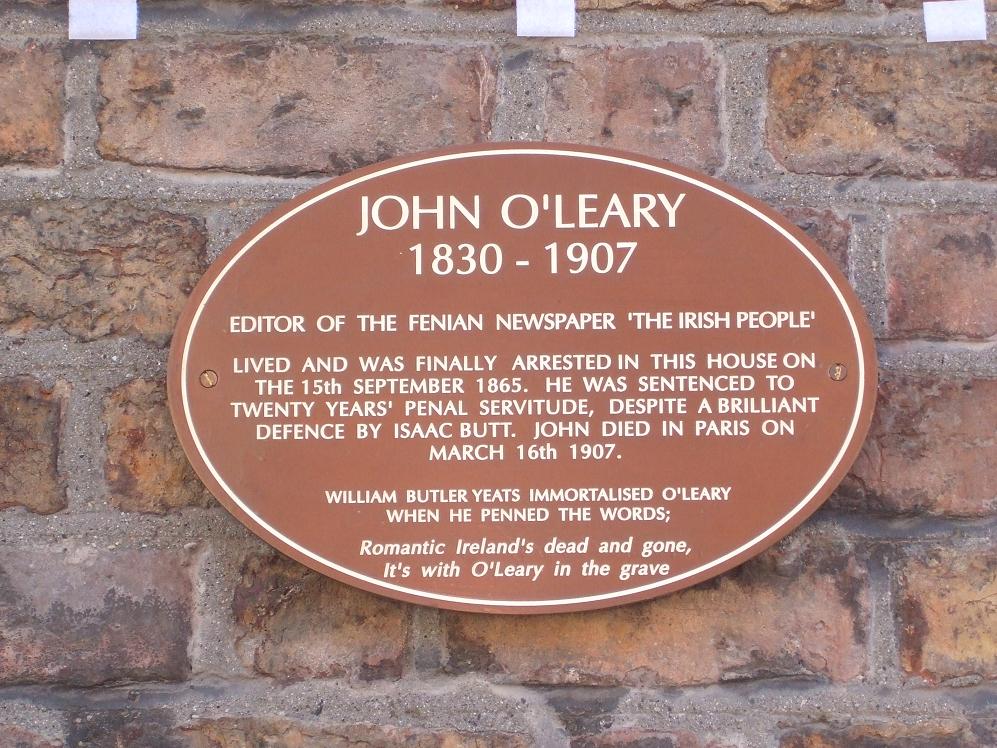
Yesterday, another most welcome plaque was unveiled north of the Liffey, this time in Palmerston Place. The plaque marks the home of Tipperary born Fenian leader John O’ Leary, and acknowledges his role as editor of The Irish People newspaper.

“…O Donovan Rossa, O’ Leary, Luby and others long associated with separatism and republicanism were regularly to be found in or around the Irish People office. And the paper always made the most of the fact that the Fenian Brotherhood in the United States was not a secret organisation…”
– Taken from The Green Flag by Robert Kee

(more…)

Read Full Post »

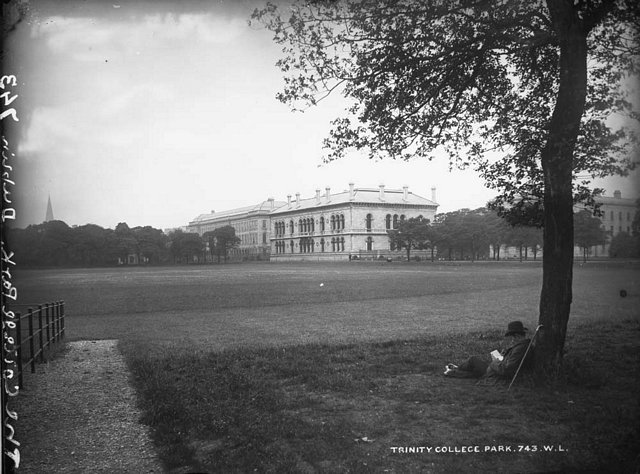
Trinity College Dublin c.1900

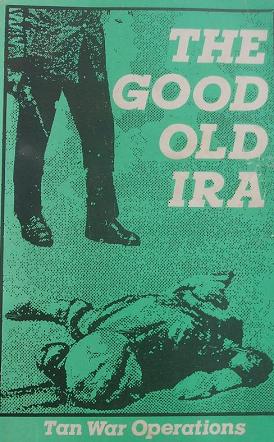
I recently began reading a work titled The Good Old IRA, which was issued by the ‘Sinn Féin Publicity Department’ in November 1985. It lists ‘Tan War operations’ which injured or in some cases killed civilians in an attempt to highlight the hypocrisy of those who honoured the republicans of old while attacking their contemporaries.

The works introduction slates Labour Party leader and “Free State deputy-premier” Dick Spring for example, noting that he was

tongue-tied in attempting to explain the differences between the IRA gun-runner Roger Casement (in whose honour he was unveiling a statue at Ballyheigue, County Kerry) and those IRA gun-runners on the Marita Anne who had been arrested by his government’s forces off the Kerry coast 24 hours previously.

One incident detailed in particular, from 1921, stood out for me. It is listed on page 56 of the work.

Not Cricket

One woman spectator, Miss Kate Wright, a student of Trinity College, was killed and another wounded in an attack by armed civilians on military officers playing in a cricket match at Trinity College Dublin on June 3rd. A man fired shots on to the field of play from the railings at Nassau Street from which the pitch was visible.

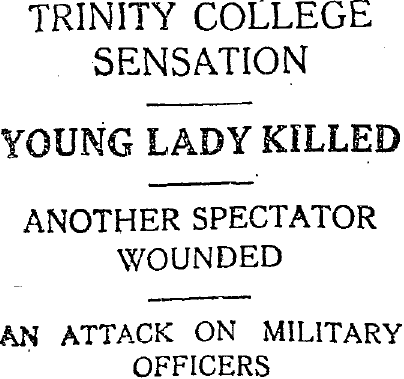
The Irish Times reported on the day following the shooting that

The occasion was one of festivity and enjoyment in the College Park. A cricket match in connection with Warriors’ Day was in progress. The teams were the Gentlemen of Ireland versus the Military of Ireland. The general belief is that the latter were the objects of the murderous attack which resulted so tragically

From the contemporary newspaper reports, we can establish quite a lot about Miss Wright. Aged only 21 (based on an Irish Independent report of the inquiry into her death),Kathleen Alexanderson Wright was engaged to be married to a young man who was also a student at the Dublin university. His name was Mr. Geo Herbert Ardall, and he was a native of Sligo. He was studying Science at the University, and was with Kathleen enjoying the cricket match, on what was said to be a lovely summers day in Dublin.

From the following days Irish Independent.

Kathleen was the daughter of the Rev. E.A Wright of All Saints Clapham Park in London, and the Irish Independent of June 4 1921 noted that he had “before going to England filled curacies in Cahir and Seapatrick”, both in county Down. At the time of the shooting she was living on Pembroke Road in Rathmines, but before hand had lived in digs at Trinity.

The Irish Independent reported how he told the inquiry into his fiance’s death that

When the shots were fired he pulled Miss Wright down on the ground as quickly as he could. She was moaning, but he was not certain she was hit until a few moments afterwards when he saw blood on the front of her blouse. Three doctors attended her, and one told him that the case was absolutely hopeless. He did not hear her make any remark. He accompanied her to hospital, where he was told she was dead

The Irish Times report into the inquiry noted that

Another witness stated that he was in the cricket pavilion, and heard someone remark that shots were being fired outside in the park. He went out immediately, and ran to where a crowd was collecting inside the park railings opposite the Kildare Street Club. A few of his friends told him what had happened and said that the shots came through the railings (…) When witness arrived at where the girl was lying on the ground the crowd who are usually gathered in Nassau Street outside the railings to watch the game had all cleared off.

Perhaps the most surreal details about the shooting come from the statement issued by Dublin Castle in the immediate aftermath of the event. The official reported noted that another female was wounded during the shootings, and provided great insight into the initial reaction of those on the green.

As soon as the shooting began,the players, realising what was happening, threw themselves flat on the field. A regimental band, which was on the field at the time, threw down their instruments and also lay prone. The spectators were not so quick to realise what was happening until a number of shots had been fired and persons were hit.

The attackers made good their escape.

Nobody was ever tried for the shooting of Miss Kathleen Wright, and little was written about her after her body returned home. Her story is just one of many told in The Good Old IRA, with other tragic events unfolding on the streets of Dublin over the course of the War of Independence.

I’ll no doubt think of her and her story next time I wander through Trinity College.

Read Full Post »

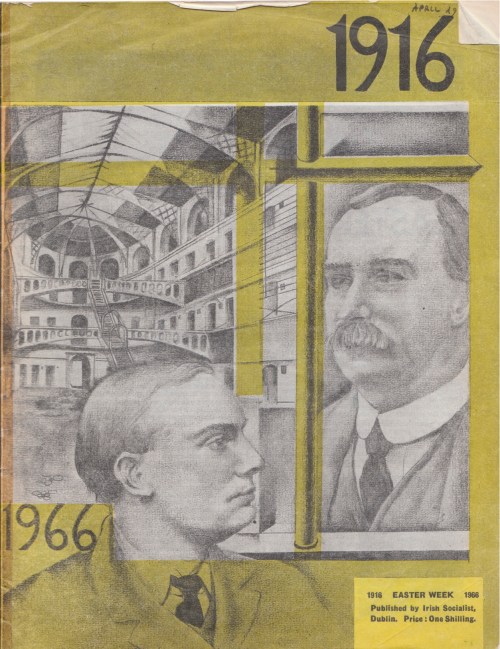
A 24 page commemorative magazine published on the 50th anniversary of the 1916 Easter Rising, kindly passed down to me by my uncle Donal.

1916 Easter Week 1966.
This publication is issued by “Irish Socialist” on the occasion of the Golden Jubilee Anniversary of the 1916 Easter Uprising. It has been assembled and edited by Sean Nolan, at 37 Pembroke Lane, Dublin 4, Ireland. 4/66.
Price: One Shilling.

Articles:

Easter Week 1916 – Sean Murray
1916 Re-Examined – A. Raferty
1913 – 1916: Similar Battle Lines – Joseph Deasy
With James Connolly In America – Elizabeth Gurley – Flynn
Some Recollections of James Connolly – Hanna Sheey-Skeffington
1916 Proved Britain Not Invincible – H. Moore & A. Barr
The Connolly Road should lead to… Labour Republican Unity – A.J. Coughlan
I Appointed Myself… ‘War News’ Courier – Donal O’Reilly
Connolly In Belfast – Betty Sinclair
Citizen Army Vetran’s Memories of 1913-1916 and Connolly – John O’Keefe
Scots Socialist on Connolly – Tom Bell
Connolly – Liam MacGabhan
Lenin Supported The Men Of Easter Week – Michael O’Riordan
1916 And Education – A Secondary Teacher
Women and Easter Week – Marion Jeffares

*CLICK ON THE FRONT COVER BELOW TO READ THE FULL MAGAZINE*

1916 - 1966. (Click to read full magazine)

Read Full Post »

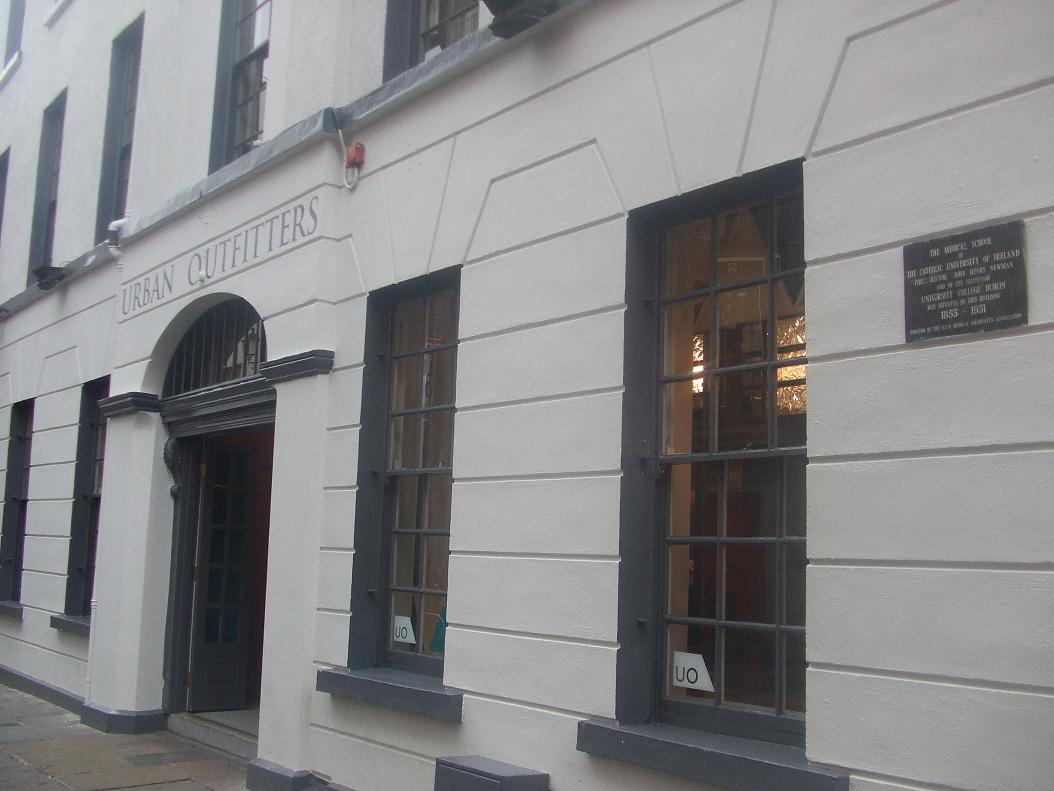
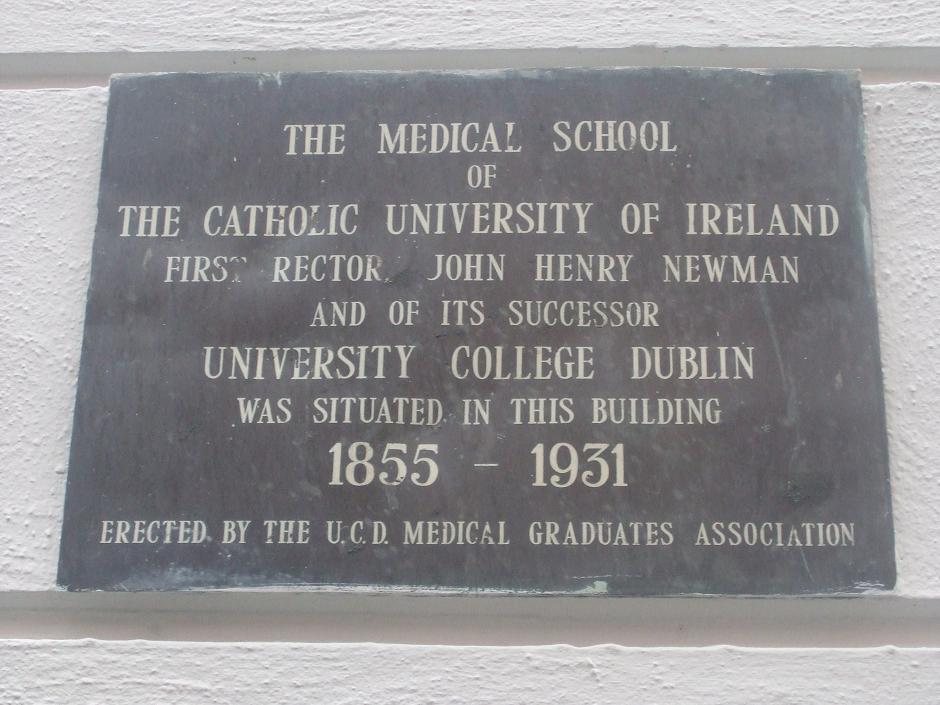
This plaque, marking the old home of the Medical School of ‘The Catholic University of Ireland’, illustrates perfectly to me the fact one can literally walk past history every day and not notice. The plaque is located at the side entrance to Urban Outfitters on Cecilia Street, Temple Bar.

The Irish Times of May 30 1930 noted that

The building was originally a theatre, in fact, the principal one in Dublin during the mid-eighteenth century, and, curiously enough, was once used in 1754 for an exhibition of anatomical waxworks, now preserved in Trinity College

Catholic University of Ireland

So, there you go. Always look up, and always look closely.

Read Full Post »

I reckon I should open this piece with a bit of an apology.

Up until this point, whether on pub crawls or Random Drop Inns,  we’ve stuck with pints of plain. We have, article by article, gone some way towards drinking a pint of it in every pub in the city. But we just could not touch a drop of the stuff the day of the crawl, which turned out to be the hottest day of the year in Dublin City Centre; what else could make that day any better only an ice cold pint of cider and a nice perch outside.

This turned out to be the deciding factor in us hitting eight rather than the regular five pubs- not that any of us minded of course, it turned out to be a great day, with a couple of minor irks rather than anything majorly wrong with any of the places we visited. It does leave us with the problem though; How can you judge how good or bad a pint of cider is? Is it cold? Check. Wet? Check. Taste like apples? Check. Every pint is a winner.

The Bull and Castle. By Nathan A, from Flickr

So… Waiting for an exam-laden DFallon to turn up at Christchurch, we ventured into The Bull & Castle on Lord Edward Street. I’ve often passed this place by in favour of its lesser frequented neighbour, The Lord Edward as I’d assumed this Gastro-Pub effort would scorn on people like ourselves looking only for a cold drink and solace from the sun. Thankfully not as the barman dispensed with ciders and beers without a qualm. I’ll be honest and say I was a bit dazzled at first- the pub is quite dark inside, and with a cloudless sky outside, it made it difficult to work out what was what behind the bar. They have a wide range of beers, only to be matched by the Porterhouse I reckon, but none of us was brave enough to venture a try. Nice pub inside, a bit of an olde-worldy feel to it. Very clean also, a must obviously with the place doing a fine trade in grub. But the best thing about the place was the bench outside. I’ve remarked a couple of times this week, and I don’t think I’m off the mark. Dublin in the sun has to be one of the best places on the planet. So perched on a bench, not far away from where the vikings made their mark on this city, with a pint of (relatively expensive at €4.80) cider in hand and the world passing by, I’d have happily stayed there for the evening.

The Legal Eagle. By Infomatique, from Flickr.

But with the arrival of DFallon, we reluctantly gave up our spot and headed across the Liffey to The Legal Eagle, on Chancery Place. Now this pub was a pleasure for a reason- Half Price Sundays! From when doors open at 12:30 on Sunday morning to when they close at an unusual 10pm, everything in the pub sells at half price. This meant an unbeatable €2.20 for a pint, and should we have wanted it, a carvery dinner for €5.50. DFallon tried the Guinness here and said it wasn’t to be faulted but would be following suit in joining us on beer or cider at the next stop such was the heat. The bar was busy enough, I reckon the cheap booze the draw for many. For while it was a nice place, it didn’t set the heart racing and you couldn’t imagine getting comfortable on the hard benches and seats, provided for a quick turnover of diners rather than a slow swell of drinkers- problematic of a lot of pubs selling lunches.

O'Sheas Merchant. By Gianluca 61, from Flickr.

So with that, we upped and out the door, we had miles to go before we slept tonight. Back across the Liffey and into O’Sheas Merchant, on Lower Bridge Street. Cracking pub this. DFallon had been here on a session before, said the doors were closed pretty early and getting out them was prohibited unless you sang a song. Now thats the kind of place I like. It’s a bit of a schizophrenic pub, falling somewhere in between an “old man” spot and a tourist joint. Pint bottles here rather than pints, and a reeling out of the “and its still a pint” line. Images of one of dFallons heroes, Seamus Ennis, adorned the wall, and a member of an Garda Siochana propped up the bar. Off duty of course. A nice pub indeed, one to think about if we’re down this neck of the woods again. We didn’t stick around long here, for while it was nice, the formica tables and blaring telly with the Simpsons on didn’t exactly add to the charisma of the place. Maybe they turn the telly off for the sing- song at seven o’clock or something…

Pifko, from their official site.

So with a few nudges and giggles we made our way to the next spot, Pifko on Ushers’ Quay. This is an odd one. We’ve never been in a pub in Dublin where we were the only Irish people in the place but this was the case with PiFko. Primarily a Czech bar, the place was full of Slovakians watching the Ice Hockey World Cup. We weren’t mad on their “all tables must be reserved” rule; even though there were a number of empty tables, we were forced to stand under the telly. I actually liked the place apart from that, it was a bit of a laugh cheering when Slovakia scored, the whole place went mad. Nice cold pints of Paulaner, cheap at €4. Lovely. Funny looks from everyone else in the pub when we started singing Olé Olé Olé, not so. Was mad to try out the “Beaked Pork Lion” on the menu though. Being made stand while tables sat empty did nothing to entice us to stay so we made our way up to The Liberties and into a pub I’ve passed a million times, The Clock, Thomas Street.

The Clock. By dmckenna, from Flickr.

Not imposing looking from the outside, the place is pretty huge when you walk in, nicely decorated and well laid out. The punters were glued to the box, with “Reeling in the Years” on. As we reached the bar, Packie Bonners save against Romania in Italia 90 (Brilliantly portrayed in this clip from the Van) was on. myself and DFallon were only too delighted, I’ll never get sick of seeing it; The nerves, the save, and those stupid jumps he does afterwards. Pity about his Fianna Fáil connections, he used to be a hero to me! Anyways, we headed out the back to the most unusual smoking area I’ve ever been in. Well it wasn’t the smoking area itself, rather than what inhabited the smoking area- a huge cage containing around fifty twittering and cheeping birds of all shapes and sizes- canaries, budgies, cockateels, even a guinea fowl legging it around in the bottom. Mad stuff. Nice boozer, €4.60 a pint, not to be faulted.

1850's (?) Thomas Street. From Archiseek.

Nows around where it starts to get hazy. Lucky we didn’t have far to go,  only to Bakers of Thomas Street, just across the road. The three pubs we hit around the Liberties all came across as being very much locals spots. It doesn’t help that when we come to these places, more often than not, its only for one or two pints and because of that, its hard to get a proper feel, and a proper welcome from the locals. I liked this place, though Britains Got Talent made it feel less authentic than it might. Again, €4.60 a pint (cold, wet- check) what more could you ask for. A nice pub inside, with low seating, and aging memorabilia adorning the walls. Whilst most of it had seen better times, it kept us interested and deep in discussion.  Onwards drunken soldiers.

Tom Kennedys. Again from the excellent Archiseek.

Tom Kennedys of Thomas Street, right across the road from the Thomas House. What can you say about this place only it was truly terrifying. The walk to the jacks was a scary one, not because the punters were in any way threatening but because Sunday night in Kennedys is Karaoke night. And the MC took a liking to one of our crew, and kept demanding that she come up and sing! Not tonight mate… Again, a locals joint in every sense of the word, the woman behind the bar had the pints on before the locals got to the bar, that sort of place.  The place you might get looks of beleagured astonishment for sitting in “Shielas seat.” Lucky enough, we were well mannered, drank our fill and headed off. I think the pints were €4.50 here, I really need to write them down as I’m doing them. This was JFloods pubcrawl though, so I wasn’t expecting to be doing the write up!

My home away from home... Brogans Bar. By Ester Moliné, from Flickr.

The night could have ended here, but no- We had one more stop to make; Brogans on Dame Street. I really don’t want to write too much about this place because for personal reasons, its my favourite pub in Dublin. Its as close to a local as I’ll get, and is oft frequented by a large crew of my mates. Theres no particular reason its my favourite pub in Dublin, apart from some stories I could tell that you wouldn’t believe. One of the only pubs I can walk into on my own, sit at the bar on my own, order a pint and not feel like a loner/ escaped mental patient/ alcoholic/ all three combined on my own. It really is a scrap between here and Mulligans for the best pint in Dublin, and when I’m drinking it, the Guinness rings in at €4.30. I can’t describe it, just go for a drink here on a sunny afternoon and you’ll see its allure. I’ll stop now!

Right. The hardest write up I’ve ever done, what with a million things coming up between the event itself and me getting a chance to write it up. But it was a great day, amongst the best of the pub crawls we’ve done. Major kudos goes to JFlood for the choices, and to Hammy and Bookie for coming along. Next pints are on me, Sunday fortnight. Give us a shout!

Read Full Post »

« Newer Posts - Older Posts »