Feeds:
Posts
Comments

Jesus is coming, look busy.

Ah, the things people hand you in town.

Keep the day free.

The day Jesus comes back is on a Saturday, and the day after a Dublin derby with the Saints and Bohs playing in Dalyer. It’s also the weekend of ‘The Adventure Weekend’ at the RDS which promises “world
class live demonstrations.”

Interesting….

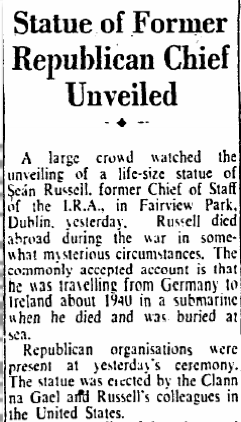
In 2001 Saoirse, the paper of Republican Sinn Fein, published a very interesting Special Branch report on the Seán Russell Memorial unveiling that took place in September 1951. It is said that a writer found it in the Archives during his own research into Russel.

The branch report lists in detail the attendees, their vehicles and their movements. The long list of IRA members and a separate list of “fellow travelers” should be of interest to students of history in the not so distant future.

The Irish Times. Monday, September 10, 1951.

I’ve always loved the cinema. I enjoy nothing more than escaping from life for a couple of hours and watching a decent film.

The only thing that has stopped me going regularly is the price. I can’t afford to pay €9 (Savoy, 15 and over) €8.60 (Cineworld, student after 5pm) or even €6.50 (Screen, student) nearly every week to see a film.

After considerable debate and cost analysis, I decided in October to sign up to Cineworld’s Unlimited Card which costs €19.99 a month. For that price, I can go to as many films as I want per month at their cinema on Parnell Street. I’m really glad I did it. I’ve saved a considerable amount of money, saw films which I wouldn’t have seen in the first place and have used the card to my advantage on many cold or wet winter days.

Since October 16, I’ve gone to 13 films in Cineworld. I’ve kept a little movie diary to keep account of my savings:

Oct 16 – The Social Network (€8.60)
Oct 25 – Red (€7.10)
Oct 27 – Easy-A (€8.60)

OCT: €24.30 – €19.99 = €4.31

Nov 11 – Jackass 3D (€8.60)
Nov 15 – Another Year (€7.10)
Nov 19 – Harry Potter and the Deathly Hallows: Part 1 (€8.60)
Nov 24 – Chico and Rico (€8.60)
Nov 30 –  London Boulevard (€8.60)

NOV: €41.50 – €19.99 = €21.51

Dec 3 – The American (€8.60)
Dec 10 – Unstoppable (€7.10)
Dec 15 – The Tourist (€7.10)
Dec 20 – Monsters (€7.10)
Dec 22 – Meet the Parents: Little Fockers (€7.10)

DEC €37.00 – €19.99 = €17.01

Total Costs: €102.80 – 59.97 = €42.83

If i had paid each time to see every film above, it would have cost me just over €100. With the Unlimited Card, it cost me just under €60.


(c) Cian Ginty

I’ve done my best to give a critical and honest look at the advantages and disadvantages of the card.

Continue Reading »

Letters Lives & Liberty

For all you students and dolies, you can visit the new exhibition in the GPO for free by printing out the following page. Why not use the €2 saved to buy yourself a nice bar of chocolate?

The exhibition reopens on January 4th and is open Monday to Friday (10am to 5pm) and Saturday (10am to 4pm).

Once a month, myself and jaycarax head to The Workman’s Club and spin some tunes. Skaturday is a tribute to the music we love, and while ska is obviously central to proceedings, the broader family tree gets a look in too. Reggae, dancehall, soul, punk and more besides features.

Drop in Saturday night and say hello. The Workman’s Club is located right next to The Clarence, and the ska is upstairs.

Harcourt St. Squatting ’69

A different time altogether.

A time when three young families were forced to squat an empty hotel for somewhere to live.

I wonder will we see these days return?

The Irish Independent. August, 01 1969.

I absolutely love this cover image, from Sing (‘Britain’s Folk Song Magazine’) No.55, June 1966.

It’s just one of the lovely things which arrived in the post today, along with heaps of newspapers, pamphlets and magazines from the 1960s. I will scan them all up in a post exam world.

A few things I forgot….

Our recent review of 2010 included vanishing penguins, trucks at the Dail, famous Italians in Tallaght, Mary Byrne and spraypainted Ballymun towers. Since writing it, it’s dawned on me I forgot a couple of things.

1: Culchies of the year:

Crystal Swing, to the credit, were actually lovely people and did a lot for charity. It was great to see them get their five minutes, and feck the begrudgers.

Still, we won’t be forgiving these t-shirts in a hurry.

2: Odd man of the year:

No comment on that one….

Continue Reading »

Not your normal Christmas Eve.

Every Christmas Eve, a group of my friends organise an event they’ve taken to calling ‘Real Dubs’.

Like 28 Days Later, the streets of Dublin empty as those from beyond the pale return to their farms and creameries, leaving just us. Waking up in a friends flat over in Smithfield, I was half tempted to make my way home and pop back in for the ‘Real Dubs’ session later, but a friend told me he was heading up to ‘the picket’ on Grafton Street for a while.

Picket on Grafton Street? I couldn’t place it at first. I’d heard so much of the Laura Ashley picketers, but I’d yet to see them as I’m not frequently on Grafton Street. I head up with Jimmy, to have a look.

We stop off outside Marks and Sparks, where ‘Talk To Joe’ Duffy himself is presenting his show live on Grafton Street. It really is stomach turning stuff when none other than Uachtarán Máire Mhic Ghiolla Íosa arrives, to tell us all we can ‘overcome’ the recession, and we’re ‘fighting people’ and every other cliché she can chuck at us. I turn to Jimmy and ask, is there any other country in the world where the IMF can roll into town, yet the President would have the cheek to address Christmas shoppers? Probably not. We shuffle off, past the RTÉ vans and cheering crowds.

We get up to Laura Ashley, and one of the workers there fills me in. Since October they’ve been here, every single day. The company made pre-tax profits of £10.5 million in the first half of this year, and this branch was their flagship. 22 workers, members of the Mandate Union, have remained a thorn in the side of the company since losing their jobs at short notice, and it’s hard not to be reminded of events at the bottom of this very street in Thomas Cook not too long ago.

Continue Reading »

Someone picked me up a series of 1916 press cuttings from the English papers of the day at Christmas. These two are great. Some of you may have seen the images before, but for those who haven’t, look at the man just casually observing the situation in the first, while in the second we have a few true Dubs out for a quick buck before the smoke settles. We’d all have done it too.

Redrawing Dublin

A large five-bedroom outer-suburban house is not necessarily the first preference housing choice of all; for the real urbanist it rarely is”
-Page 255.

God, any book that interviews Liam Carroll (“Dublin Bus: Needs Competition”) and sports journalist Bertie Ahern T.D (“Liberty Hall: Should Be Gone”) is surely not worth reading you’re asking? Well no, you’re wrong. Redrawing Dublin is such a strong book that not even two pages of Bertie could ruin it.

The book is the end product of a collaborative project between an architect and an urban planner. It offers interesting, and on occasion provocative, analysis of the city and where she is (or should) be going. Broken down into nice sections, it looks at life beyond the pale, ‘invisible walls’, the question of just who is a ‘true Dubliner’, ‘apartment apartheid’ and more besides.

As a Maynooth student, the very first pages were interesting to me. Route 66. “Edge City”. The writers look at what is termed ‘Contiguious Metropolitan’, the rapid expansion of Dublin into parts of neighbouring counties, like North Kildare. “Might it have been done differently?” they ask. Why is there not more quality apartment living in the capital itself? Just who does live in the city, and more importantly: who doesn’t want to?

“If potential new urban dwellers are to be attracted to the city and not ‘lost’ to distant towns and suburbs in Kildare, Meath or North Dublin, a radical overhaul of the ambition and vision of what is possible in city-centre living needs to be communicated”
-Page 180.

One of my favourite sections of the book deals with the idea of what would make a neighbourhood great. What do you want within 10 minutes of the front door. Among the 25 things you do, we find an ATM, a local supermarket and a local public park. Among the 25 things you don’t, cycle lanes inside bus lanes, narrow pavements and locked local parks feature.

In ‘Postcards from Dublin’, some very interesting statistics regarding Dubliners are thrown up. Almost 1 in 12 Dubliners listed themselves as non-religious on the 2006 census. In Ballyfermot, we learn that 92% of residents identify as Catholic, and fewer than 1 in 40 as non-religious. One of the most interesting statistics on life in Dublin for me is the fact that women and girls outnumber men and boys in Dublin as a whole, yet in the city centre men are on top with a ratio of 52:48.

On occasion the historian may disagree with the writers. Many historians objected to the Digital Hub South project for example, on the grounds that, as the Bord themselves noted, it was not “…sufficiently sympathetic to the historic character” of the Liberties area. Yet on other occasions, like School Street and Bridgefoot Street, one would find it difficult to disagree on the need to build up. It’s a great irony that at the start of the Celtic Tiger the highest building in the city was Liberty Hall, and today it remains so.

This is a fascinating read. Statistics, graphs and research that really gets you thinking about your city. I can see it on the coffee table for a long time to come.

The challenge, Redrawing Dublin notes, is to make Dublin a “..world-class city for all its citizens”. The great debate is just how we do that.