Feeds:
Posts
Comments

“There will be a gig in The Button Factory on Jan 12th.with The O’Catháins, Frankie Lane,Noel Heavey, Davoc Rynne, Andy Rynne,Tom Tuohy,Ann Egan agus mise.The gig is part of the County Sessions and will feature songs and music from Kildare.It will be hosted by Luka Bloom”

-christymoore.com

The Button Factory in Dublin has been playing home to fantastic ‘county nights’ now since last year, with several counties including the capital down so far. Guests to date have included Matt Molloy of The Chieftains and ‘THAT pub’ fame and Colin Mac Con Iomaire.

Next Tuesday sees Kildare rise to the Dublin stage. The night, hosted by Luka Bloom, features the likes of Tom Touhy and Noel Heavy, along with the classic Christy Moore.

Tickets are €17.50 and available now from tickets.ie. The three of us from CHTM! made our way to the Dublin night last month and enjoyed every minute of it, so another trip may well be in order….

Doors: 8PM, Show: 9PM

27th & 28th December 2009

(A review of of the pubs, clubs and gigs)

Sunday, 27 December:

As cabin fever was setting in after a full 48 hours with my Christmas obsessed mother, I decided to meet up with my friend Paul for a drink on Sunday evening, the day after Stephens Day.

We met at the top of Grafton Street and strolled down to Ruaille Buaille on South King Street (formerly called both Major Tom’s and Down Under) as we heard they were doing €3 drinks. To our disappointment, it was closed. For good. Another victim of the recession.

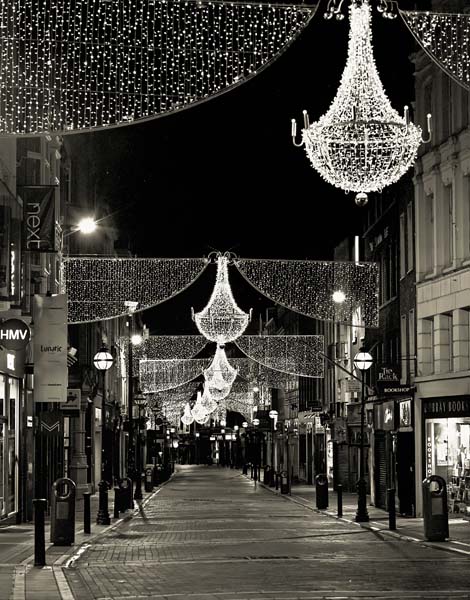
Grafton Street (contemporaryphotograph.com)

Our Plan B was the ‘Restaurant Royale’ on Upper Stephens Street which I read online were doing €3.50 pints. It also turned out to be closed.

Thankfully our Plan C, ‘Karma’ on Fishamble Street was open. Usually a popular spot for its drink deals, the place was empty on this particularly night.

While we were sipping our drinks, a French couple weighed down with luggage walked into the bar. With them was their Dublin taxi driver. The three of them seemed a bit stressed. From what we could gather, the couple had booked online to stay in the connected George Frederic Handel Hotel back in early December. However, no one had told them that the hotel shut up business three weeks ago and now they were stranded on a cold, Sunday evening in Dublin without accommodation. Thanks to the friendliness of the taxi driver, a few young locals at the bar and a security guard outside, the couple were able to quickly secure a room at a hotel around the corner. As of today, the hotel’s website is still online which is a bit dodgy, especially if they’re still accepting bookings.

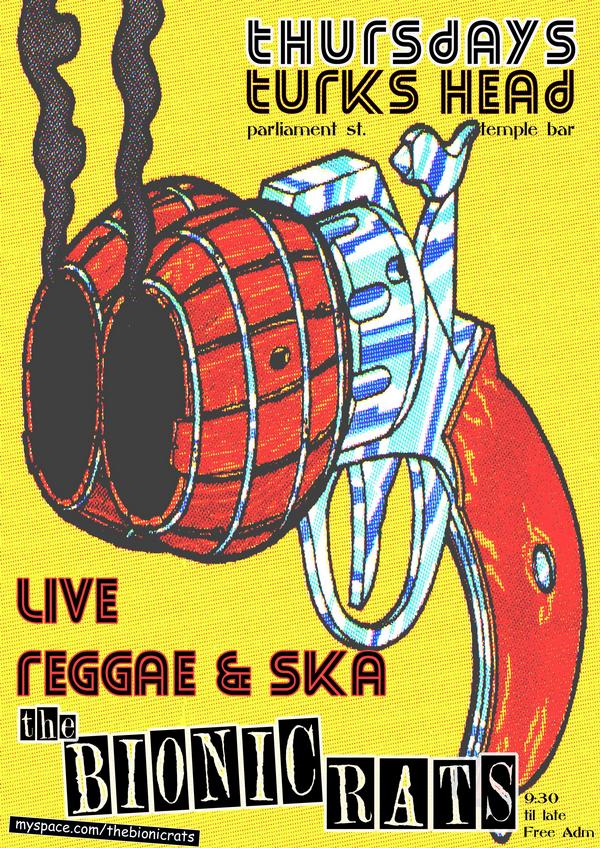
As Karma was no better than a cold, empty warehouse, we finished our drinks and headed around the corner to The Turks Head. I’ve always liked The Turks Head for some reason. The interior is lovely, the staff are always friendly, they have great ska nights on Thursdays and you can get a pint of fosters for €3.75. Though I’ve been through the doors many times, I only noticed that evening that they served food. Feeling a bit peckish I ordered a portion of Garlic Bread and Vegetarian Spring Rolls, which I shared with Paul. The servings were generous, the quality decent and at only €3 something each, they were a bargain.

The Bionic Rats @ The Turks Head. Every Sunday.

At this point, the messer DFallon walked in, on time as usual. We finished up our pints and strode up to The Lord Edward at Christ Church Place where we were to meet an old friend Oisin who was home for Christmas from London. The pub was buzzing with little clutters of friends and work mates in every corner laughing and drinking the evening away. The celeb spotter in me noticed Roddy Doyle sipping a Guinness with two friends. We had an enjoyable night of banter and reminiscing. Begrudgingly leaving at around 11.15pm in order to get the last bus. The steaming salt and vinegar chips from Burdocks being my only comfort as I traipsed down Dame Street to catch my bus.

Monday, 28 December:

On Monday evening I went to see Madness in The Point Theatre (O2) with my younger brother. My ma had won two tickets at a work raffle and passed them on to me. Though I’ve always been a Specials’ man, I always had time for Madness. They produce catchy, pop songs – ‘My Girl’, ‘It Must Be Love’, ‘Our House’ and my personal favourite ‘Deceives The Eye’. I was excited. I had never seen Madness live before and I hadn’t been to the new 02.

As we entered the venue, three separate members of security checked our tickets. It all seemed a bit over the top. I headed over to the bar to get a pint. My choices of larger were Carlsberg, Carlsberg or Carlsberg. The barman asked for I.D. No problem, I thought, handing over my Age Card, he’s only doing his job. He studied the picture, looked at me, checked the Date of Birth and then looked at me again before casually mentioning that they “only serve alcohol to individuals over the age of 21”. What a joke.

We ended up paying exorbitant prices for soft drinks. The whole mood of the place was wrong. It didn’t feel right going to Madness with groups of families scoffing Tayto crisps and big bags of popcorn all around you. Depressed looking twenty something year olds walking around the aisles selling plastic bottles of Carlsberg like it was a baseball game in the States. It was along way from when Madness played the Olympic Ballroom off Camden Street in 1980.

Jerry Dammers from The Specials acted as the warm up DJ (Dammers famously had a big falling out with the rest of the band meaning that he didn’t join them on their triumphant 30th anniversary tour). There’s no doubt that Dammers was an excellent DJ and has a unrivalled knowledge of ska particularly the early Trojan and Studio One records. However, he shouldn’t have been the one trying to warm up such a huge crowd and venue. Leave Dammers for the after show party. Madness should of got one of the many local hardworking ska bands to act as support. The Bionic Rats, Present Arms, Skazz or The Gangsters come to mind. Fact of the matter is – it doesn’t work well to have a DJ in the middle of a massive stage, playing old 45s, trying to loosen up the crowd in a venue the size of large warehouse.

Following a long wait and an anti climatic 10mins ‘short’ documentary about the early days of Madness that they shown on a screen that was too small above the stage, the band came on. As hoped, they were on form, belting out hit after hit. The crowd went nuts. Decent end to a bad start.

Afterwards, I went down to meet Dfallon and some of his school friends (who I’ve since befriended) down in Mulligans on Poolbeg Street. The place was surprisingly busy for a Monday evening. By the time I finished queuing up and had the first sip of my pint, the gang had begun to put on their coats. This was a pub-crawl and our next stop was Kehoe’s on South Anne Street. The whole place was packed. It’s no fun trying to have a pint and a chat when you risk knocking someone’s drink by turning around. After Kehoe’s, we began an ardent quest to find a nightclub that was open on a Bank Holiday. We had no luck. Everywhere decent place was closed and every kip was full. Roll on New Years Eve.

Dublin City has had it’s fair share of hell-raisers in the last century or so, mostly a product of purveyors of Arthur Guinness’ finest. But the history of hell- raising goes back well before the birth of the black stuff; most infamously in Irish history in the half-century before the good man himself poured his first pint and let it settle when Dublin was host to it’s own Hellfire Club.

The first Hellfire Club was founded by the Duke of Wharton in London in 1719 and was and was an exclusive club, mainly populated by a class of rich, landed Gentry called “Bucks” who chose to pursue a certain type of enjoyment which generally involved a pious mix of gambling, blaspheming, whoring, drinking, violence and even the odd touch of Satanism. (Though there is little evidence of this, it is something that is seen to go hand in hand with the original Hellfire Club and seems to stem from them calling each other “Devils.”) Their behaviour was seen as an affront to the ideals of the church and the sacred principles of religion; corrupting to the minds and morals of young people. Wharton’s club came to an end in 1721 when George I put forward a bill “against ‘horrid impieties'” (or immorality), aimed specifically at the Hellfire Club. (1)

Medmenham Abbey, reputed home of the first ever Hellfire Club

From their ashes, The Dublin Hell-Fire Club was founded by Richard Parsons (1st Earl of Rosse and founder of the first Irish Lodge of Freemasons,) and Colonel Jack St Leger (The son of a rich landowner from Kildare, notorious for gambling large amounts of money on ridiculous wagers.) The Club motto was “Fais ce que tu voudras,” or “Do as thou wilt,” a nod to Rabelais’ Theatre of the Absurd. Meetings started with all members sitting around a circular table upon which was placed a huge punch bowl of scaltheen, a rancid mixture of Irish whiskey and melted butter. After toasting the Devil and drinking to the ‘damnation of the Church and its prelates’ the bucks would pour scaltheen over a cat, obtained for the occasion, and set fire to the poor feline. After this, the decadence could begin in earnest.

The club had various headquarters around Dublin such as the now demolished Eagle Tavern on Cork Hill, founded by Parsons sometime around 1735. The Eagle Tavern and Cork Hill are now no more, lost in the regeneration of Temple Bar. We do know that the Tavern was situated close to the IFI and the Quakers Hall in Temple Bar. (2) Another favorite meeting place was Daly’s Club, College Green. Here, shutters were kept closed in the morning so that members with hangovers could gamble and drink by candlelight. One notorious incident occurred here when a member, Buck Sheely was caught cheating at cards. A ‘court’ was convened presided over by Buck English; His verdict was that Sheely was to be hurled through the window of the third floor gaming room- he died in the fall, impaled on the railings below.

The Hellfire Club, Montpellier Hill

Perhaps the most famous of the meeting places of the Hellfire Club was on Montpellier Hill, in the Dublin mountains, not far from Rathfarnham. It was built around 1725 on land purchased from the Duke of Wharton (founder of the first ever Hellfire Club) by William Connolly, a speaker in the Irish House of Commons. According to local legend, an ancient Cairn erected to the old pagan gods of Ireland had been demolished to make way for the lodge. Many of the stones from the Cairn were used in the construction of the house. Shortly after its completion, a powerful storm blew the slated roof away. It was replaced by a stone roof which remains intact today. For at least 20 years Mountpelier House flourished until the Bucks ruined it sometime around 1740. The story of the disaster is well known. As with the roof blowing off during its construction; local myth held that its destruction was a punishment for the desecration of the Cairn it was built upon.

At this time the ‘Principal’ of the Hellfire Club was a man of huge wealth called Richard Chappell Whaley. His nickname was ‘Burn-Chapel’ Whaley because of his hatred of religion and in particular, the Roman Catholic church. He would amuse himself on Sundays by riding around Dublin setting fire to the thatched roofs of Catholic chapels. It was he who caused the downfall of Mountpelier House. “After an unfrocked clergyman had performed a Black Mass in one of the two upstairs rooms in Mountpelier House, the ceremony ending in the usual drunken revelry, a footman picking his way through the sprawling bodies spilt some drink on Richard Whaley’s coat. Whaley reacted by pouring brandy over the footman and setting him alight. The man fled downstairs clutching at a tapestry hanging by the hall door, trying to douse the flames. Within minutes the whole house was ablaze.” (3) Many Bucks died in the fire, but Whaley managed to survive by leaping out of a window. At the age of 59, he married a woman 40 years his junior. Their son, Thomas ‘Buck’ Whaley was to become the most famous Buck of all. “Born in 1766, it was Buck Whaley who rallied the Hell-Fire club from the low ebb to which it had sunk after the burning of Mountpelier House declaring his intention of ‘defying God and man in nightly revels’.” (4)

Bucks of the Limerick Hellfire Club

Before I go into the Buck Whaley himself, here’s a piece of poetry about the Limerick Hellfire Club pictured above and it tells us a little about what shenanigans they, and the other Hellfire clubs around the country got up to:

‘But if in endless drinking you delight,

Croker will ply you till you sink outright.

Croker for swilling floods of wine renowned,

Whose matchless Board with various plenty crowned.

Eternal scenes of Riot, Mirth and noise,

With all the thunder of the Nenagh boys;

We laugh, we roar, the ceaseless bumpers fly,

Till the sun purples o’er the morning sky.

And if unruly Passions chance to rise,

A willing Wench the Firgrove still supplies’. (5)

Buck Whaley inherited a huge fortune after the death of his father, being granted a yearly allowance of £900 at the age of 16. He had an eventful upbringing, jumping between tutors in England and France before returning home having spent some time in jail. Obviously having inherited some of his fathers hatred of the church, he was thrown into jail in Marseilles, having “insulted, violently assaulted and raising his sacrilegious hands against a Priest.” He escaped a long sentence by being secreted out of the country by friends of his lawyer. While his inheritence at the time was huge, arguably, he won an even greater fortune at the gaming tables as well as partaking in some bizarre wagers. In one wager he won £25,000 from the Duke of Leinster by riding to Jerusalem and back within a year. While seeing the sights, this was not a pious pilgrimage and he later boasted of playing handball against the Walls of Jerusalem and having drunk his way there. On another occasion, for a bet of £12,000, he rode a beautiful white Arab stallion in a death-defying leap from the drawing room on the second floor of his father’s house on Stephen’s Green, over a carriage parked outside the door, and onto the street, 30-odd feet below. He won his wager, surviving with a broken leg, but killed the horse.

Remorse, however, befell Buck Whaley as his life went on and so he resolved to seek absolution for his sins. Whilst praying in St Audoen’s Church, just off modern day Thomas’ Street, he had a vision of the Devil creeping down the aisle towards him. Seized with terror, he ran from the church and fled Ireland forever.

He lived the last few years of his life, with his mistress, now his wife, in a mansion he built on the Isle of Man, where he wrote his memoirs. Repentant in his sickness and misery, he wrote “I thought that a faithful picture of my youthful eccentricities, drawn with justice and impartiality, would not be unacceptable to my country- men, and particularly to my younger friends, who will find some few examples which they may follow with advantage, but many more which they ought to avoid.” (6)

He died at the age of 34 of sclerosis of the liver. With his death the Dublin Hell-Fire Club ceased to exist.

Footnotes:

1: http://en.wikipedia.org/wiki/Hellfire_Club

2: http://homepage.eircom.net/%257Eseanjmurphy/dublin/templebar.htm

3: Taken from Setanta Orienteers by Robert Whaley, page 1

4: http://www.archive.org/stream/cu31924028518730/cu31924028518730_djvu.txt (Whaley’s memoirs)

5: http://www.askaboutireland.ie/reading-room/history-heritage/big-houses-of-ireland/glin-castle-co.-limerick/the-four-brothers/edmond-fitzgerald-20th-kn/

6: http://www.archive.org/stream/cu31924028518730/cu31924028518730_djvu.txt

A little known link.

The Court Laundry (1903 – 1971) at 58A Harcourt Street acted out as the venue for meetings for the Spanish Aid Committee during the Spanish Civil War (1936 – 1939). [1]

Hanna Sheehy-Skeffington, the suffragette and Irish republican, acted as chairperson of the group while the secretary was John Swift, general secretary of the Irish Bakers’ Union. Other prominent members included Dorothy Macardle, the writer and historian and Nora Connolly-O’Brien, daughter of James Connolly.

The use of the laundry had been arranged by Robin (Robert) Tweedy (1853 – 1956), a Communist Party member whose family had connections with the laundry business.

[1] A. P. Behan, Dublin Historical Record, Vol. 47, No. 1, Diamond Jubilee Issue (Spring, 1994), pp. 24-45.

Time For Oscar Wilde Park?

Truth, in matters of religion, is simply the opinion that has survived.

The media is awash with reports that Archbishop Ryan Park in Dublin city centre is to be renamed. Situated in Merrion Square, opposite the Dail, the park features a good sized playground, Michael Collins bust, a fine collection of antique Dublin lampposts and most famously- a fantastic Oscar Wilde statue and art installation with some of his best pieces of wit featured.

The parks history is long and diverse to say the least. In the 19th century it served as a refuge for victims of the famine, but in the 1920s it fell into the hands of the church. Their aim was to build a cathedral on the site, but this never came about so the church (Or more specifically Archbishop Ryan) handed the park over to the city of Dublin in the 1970s.

Dublin councillers have voted to rename the park as “a gesture to all of those who suffered as a result of clerical abuse”.

Of course, Wilde isn’t the only option. George William Russell (The famous AE) and W.B Yeats both lived in Merrion Square. Still, perhaps the resident of Number 1 most deserves the accolade. What better way to show the modern worlds definition of “gross indecency” is far removed from that which made Wilde a ‘criminal’.

A FACEBOOK GROUP SUPPORTING THE MOVE HAS BEEN SET UP, CLICK HERE

A nice little find on Youtube. A 27 mins documentary in which “Brendan Behan acts as guide to Dublin as he tells tales about the city”. The programme, which was made two years after Behan’s death, was made up of ‘reconstructed’ commentary and interviews with relatives.

There are conversations with Brendan Behan’s father Stephen, his mother Kathleen and his widow Beatrice as well as beautiful old footage of O’Connell Street and the ‘Little Jerusalem’ area of Clanbrassil Street. The soundtrack is by The Dubliners.

Peter's Pub

After Mother Nature tried her best to put us off our stride, and herself and Irish Rail conspired to delay me getting back to Dublin and causing the CHTM pub crawl to kick off a little later than usual, we met at Traitors Gate, well wrapped up against a very chilly Dublin Sunday evening. Traitors Gate as its known colloquially is the archway leading into Stephens Green and is so called because the inscriptions on its underside are the names of the Irishmen who fought and died in WW1, a subject that is still the inspiration for many an argument in Irish households. We had a quick gander at the names while waiting for a new attendee, JBrophy and decided to scarper as soon as he arrived, the cold being the cause; luckily we didn’t have too far to go to our first port of call which was to be Peters Pub, around the back of Stephens Green Shopping Centre. A lovely spot this, I’d been here a few times before when ambling around during the day – When you can get a seat, it’s the business; A pint and a toasted sandwich, I don’t think there’s a better combination. Unfortunately, the place was packed to the rafters with people stopping off for a break from the shopping and bags and big coats meant a tight squeeze for all. Not to be deterred, we took position at the back door and sampled the fare. A nice pint it has to be said but not a fantastic one, and at €4.80 was a little steep. But, no matter, it was grand and warm and the company and banter was good.


the Lord Edward.

With the lack of seats an issue, we didn’t stay long and were soon on our way to our next destination, The Lord Edward just across from Christchurch. A little moment of panic hit when the place looked like it was closed but that subsided quickly when we got around to the front door and it opened like a doorway into a different world, nice and warm with the offer of a tasty scoop at a bargain price of €4. I think we’d all been in here at various stages but I’ve always enjoyed the pint, a touch soft but tasty and much needed. The location of the pub was also a factor, being next to Burdocks was a big deciding factor. We got a few stools inside the door and were joined by another new head in the shape of kbranno, bringing his experience into the mix. A nice pub for a bit of banter this, though I’m not sure how many people were watching the Tenerife game on the telly above our heads. DFallon did comment though, that those among us that are into football drifted into a dreamlike state watching the game, it has that capacity to usurp conversation really. So we snapped out of it, got back to conversation and finished the pints. Out one door we went and in another, as we left for Leo Burdocks for a battered sausage and a scoop of chips.

The Brazen Head

You don’t get that too often, the free scoop of chips thrown in, but it was much appreciated and needed as we strolled through the cold to our next stop, The Brazen Head, on Lower Bridge Street. They say this is the oldest pub in Dublin and I don’t disagree. It’s a lovely place, one that a few of us had never thought to frequent, it being a little out of the way. Plenty to look at and talk about in here as we supped our pints in the “Robert Emmett” room, with all the signed dollars of visiting tourists and ancient posters on the walls. Again, we went back above the €4.50 mark for the scoop here but I’d say it was worth it- we got some nice seats and bantered back and forth about the man who the room was named after. While his speech from the dock has been repeated a thousand times, his rebellion itself was not so much brave as… a bit mad really. There’s quirks galore in this pub, if only you had the time to explore them, but the one that stands out is the etching on the window halfway up the stairs- A visiting journeyman etched his name, his occupation and the date on the window with his ring; dated at 1796, it was only a couple of years before the rebellion of 1798… I liked this pub but the night was getting on and we still had two stops to go.

Frank Ryans

For our first foray into the North-side, we headed across to Frank Ryans, Queen Street. I don’t know how I wasn’t in this place before, as although the Frank Ryan who owned this place was of no relation to the one who fought in the Spanish Civil War, the name inspired (as it always does) no end of conversation. I love a pub with an open fire and this place provided us with one, and a pool table, good music, warmth and a more-than-decent pint for €4.30. I think we all liked this place a lot and promised a return. The kitch décor of the place wasn’t too OTT but still seemed a little out of place, as it’s a locals pub and it doesn’t need the boots hanging from the roof or the Ballybofey signpost to make it Irish. If anything, they make it Oirish, and that’s not a good thing. We stayed for a couple here, such was the welcome, good music being played at a low volume, and the quality of the stout. A nice touch was the board with the newspaper clippings over the jacks; without it, I never would have known that Ho-Chi-Min worked as a kitchen porter in London…

So onwards and upwards to the highlight of the night; How could you venture down this part of the city without visiting The Cobblestone Bar in Smithfield Square- What a pub. They say you get the best Trad sessions in Dublin here and they aren’t too far off the mark. Far enough away from town to dissuade the cheesy ‘old sod’ ballad bollocks, the musicians here are top notch. We didn’t get much of a chance to enjoy it, such were the crowds thronged around the music, leaving us in a precarious position beside the front door, and so we headed down into the bowels of the pub, and got a nice spot out of the way. The pint was without a doubt the best of the night, you know when you get a top pint as it satisfies down to the last mouthful, the head stayed creamy and white on each of the pints we had, a joy to behold and far from some of the muck you pick up around the Temple Bar area. I really like this pub, I haven’t been here enough, it’s only a ten minute walk from O’Connell Street but psychologically much further I guess… But, I reckon Sunday nights visit will be the boot up the arse we need to start heading there on a more regular basis. I don’t know how to describe it; this place just feels like a pub is supposed to feel, the hum of conversation and laughter, the musicians in the corner, top barstaff and good craic.

So there you go, part three of the CHTM pubcrawls, and a nice trip across the city it was too. Next months pubs will be chosen by JCarax, and I’m looking forward to it already!

December’s five pubs were:

1. Peter’s Pub, South William Street.

2. The Lord Edward, Christchurch Place.

3. The Brazen Head, Lower Bridge Street.

4. Frank Ryan and Sons, Queen Street.

5. The Cobblestone, King Street North.

The Oak Bar, established in 1860, at the corner of Dame Street and Crane Lane boasts a fascinating history.

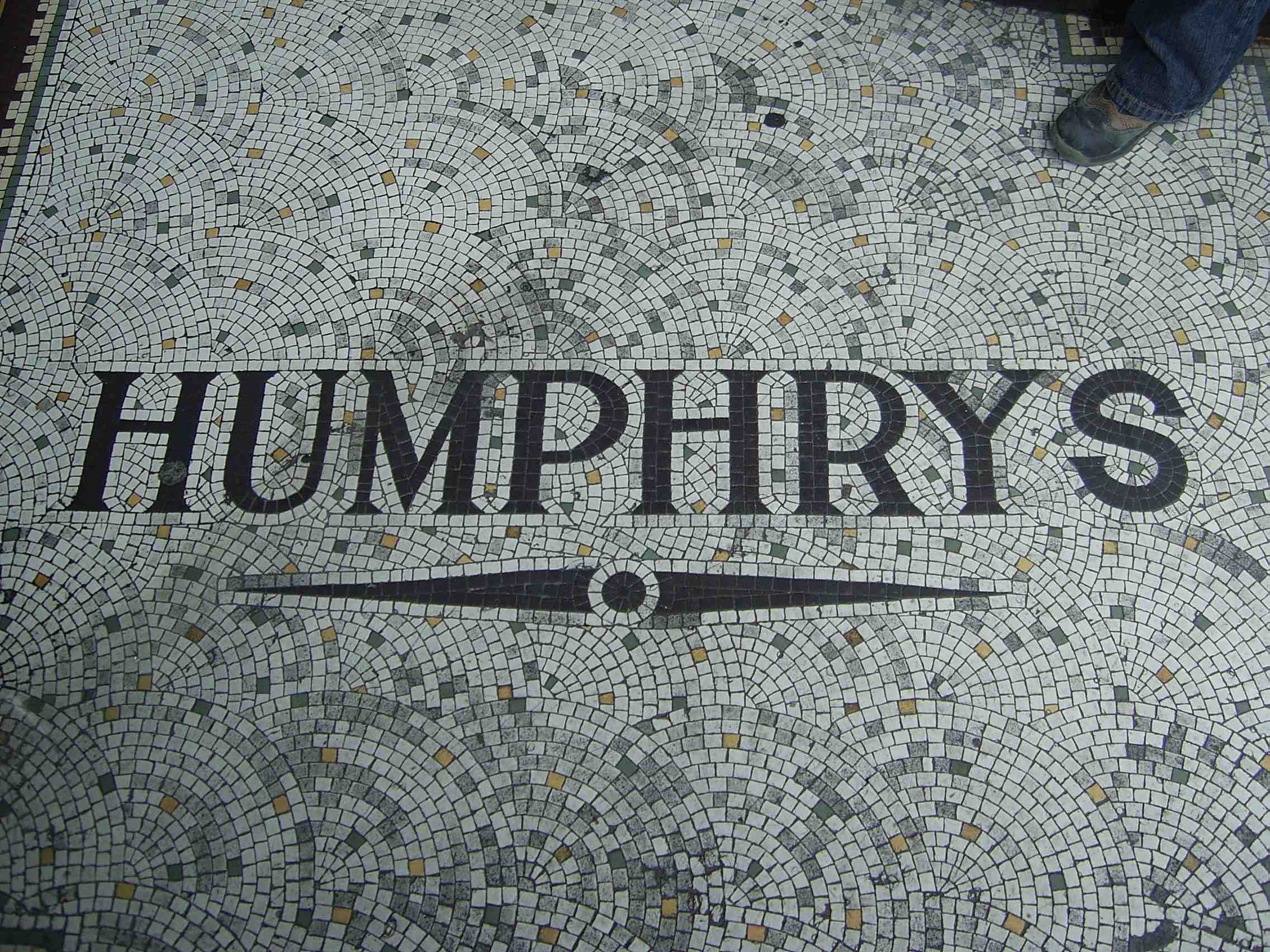
The Dublin Street Directory of 1862 shows that the occupant of 81 Dame Street was a P.J. Burke, a grocer and home & foreign spirit dealer. In the early 1920s, the bar was bought by the Humphrys family. To this day, you can still see the original tiled floor sign at the entrance reminding customers of its old name.

Photo Credit - Humphrysfamilytree.com

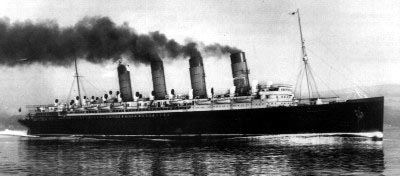
After a re-decoration in 1946, the name of the pub was changed to The Oak. Why? The oak panelled interior of the bar was made with wood savalged from the RMS Mauretania, the sister ship of the RMS Lusitania. [1]

The Oak Interior. Photo Credit - Archiseek Ireland

The RMS Mauretania was launched in 1906 and at the time was the largest and fastest ship in the world. During WW1, it served as a troopship to carry British troops during the Gallipoli campaign. The ship was withdrawn from service in 1934 and its furnishings and fittings were put up for auction. More information on the ship can be found here.

RMS Mauretania. Picture Credit - MaritimeDigital Archive Encyclopedia

Crane Lane, the little street at the side of The Oak which connects Dame Street with East Essex Street, is also historic in its own right. This narrow thoroughfare, which is now most famous for housing The Boilerhouse gay sauna, was once the primary route to Dublin Castle before Parliament Street was built. It takes its name from a public crane used to unload ships which was erected nearby in 1571 beside the old Custom House, the site of the Clarence Hotel today. A previous crane had been put in place here by the Normans in the 13th century. [2]

Crane Lane (Looking towards Dame Street). From Daft.ie

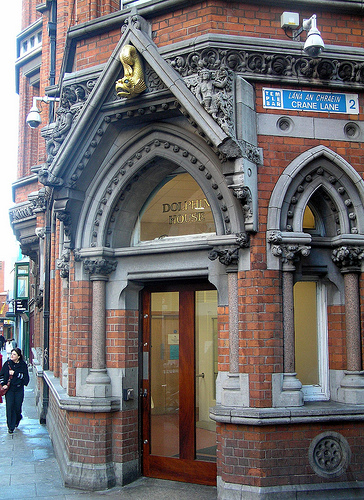
Ireland’s first synagogue was founded in Crane Lane by Portuguese Jews. It was in existence from at least 1700 [3] (some sources contend that it was in fact founded earlier in the 1660s [4] ). The prayer rooms were said to have been in the house of a merchant called Phillips. Unfortunately, it is not known which building on Crane Lane Phillips resided in.

Dolphin House (at the corner of Crane Lane and East Essex Street) Photo Credit - Flickr User 'Ilkhanid'

During the 1700s, a drinking spot called the ‘The Bear Tavern’ stood in Crane Lane. In the later half of the 18th century, another “more frequented” tavern was run here by a Freemason named David Cobert, an “excellent musician” and leader of the band of the Dublin Independent Volunteers. [5] Another bit of history is that the ‘Dublin Gazette’ was printed in Crane Lane from 1705 – 1764 by Edward Sandys. [6]

I’ll leave you with this lovely snap taken in 1968 showing The Oak Bar and a pub opposite called The Crane (now Fogarty Lock & Safe Company).

[1] http://humphrysfamilytree.com/Humphrys/mick.html
[2] Paul Clerkin, Dublin Street Names, (Gill & Macmillan 2001), 48.
[3] Katherine Butler, Synagogues of Old Dublin, Dublin Historical Record, Vol. 27, No. 4 (Sep., 1974), pp. 118-130.
[4] Pat Liddy, Temple Bar – Dublin, (Temple Bar Properties, 1991), 93.
[5] Sir John Thomas Gilbert, History of the City of Dublin (McGlashin & Gill, 1859), 167.
[6] Richard Robert Madden, The history of Irish periodical literature…, (T.C.Newby, 1867), 233

D'ya Remember Jem? Will I Ever Forget (side b)

I’d very much like to welcome the Skytec vinyl player to the Fallon household. She’s a gem. You take a 7″ vinyl, give her a spin, and via Audacity – there it is. An MP3 file. Put the song in your pocket, put it on Youtube, do what you will- you have it now. Brilliant.

So this morning, the younger lad finds Santa left this thing. A few hours later, and I’ve already hijacked it.

The ‘Official Millenium Single‘, on 7″ vinyl, has been sitting in my room for some time now. My Dad built up a great collection of 7″ traditional vinyls, ranging from the likes of Planxty and Jim Page to one off oddities like ‘The Magnificent Seven’, a rushed out propaganda type tune about the seven prisioners who escaped from the Maidstone in Belfast. All these records offer interesting historical insight. What better place to start however, seeing as this is a “Dublin blog”, than with the Millenium Single of the capital, issued in 1988 by K-Tel.

The Official Millennium Anthem- Performed By The ‘Band Of Dubs’

The Record

Performers list:
Paddy Moloney (Chieftains)
Maire Ní Bhráionáin (Clannad)
Leslie Dowdall (In Tua Nua)
Maura O’ Connell
Mary Black
Finbar Furey
Johnny Logan
Jim McCann
Christy Moore
Paul Brady
Colm Wilkinson
Ronnie Drew
Shay Healy
Tony Kelly
The Dubliners
The Fureys/Davey Arthur

While Side A, a performence of ‘Molly Malone’ does nothing for me, Side B is absolutely fantastic. A spoken word performance from the late Ronnie Drew. Witty as ever, I recommend you give it a listen. It’s amazing this 7″ hasn’t found its way online before now.

And the day we went to the Phoenix Park
To look at the deer and sit in the grass.
And you held my hand and asked for a kiss
But I wouldn’t give in, cause I knew it was a mortal sin.
And then you said you loved me and promised a ring.
Do you remember Jem? Do I remember, will I ever forget?

SIDE A: Band Of Dubs- Molly Malone

SIDE B: Ronnie Drew- Jem

Of course, with a large enough collection of vinyl, the dad couldn’t originally be entirely sure of the backstory on this one. The back of the 7″ however notes that “All royalties from this single go to ALONE” ALONE is a “voluntary action group” that was founded by Dublin firefighter Willie Bermingham. By this logic, I presume it was through the job that this vinyl arrived in the household originally.

In the Dublin Fire Brigade museum you can find a great piece Willie wrote about himself hanging on the wall, which I’ve always considered one of the best examples of Dublin wit I’ve laid eyes on:

Joined the Dublin Fire Brigade in 1964 and spent a long time pushing for the pension. Favourite food, good old irish stew and lots of fish. For breakfast – several mugs of tea at work. Also loves to eat lots of red tape to teach the bureaucrats a little manners.

Classic. So anyway, give this 7″ a play. Side B in particular.

Lastly, if you have a copy of the complete album ‘Official Dublin Millenium Album: Dublin Songs’ issued by K-Tel (cat no. Dub1000) on vinyl, get in touch!

Now run off to Tower Records to nab yourself a Skytech 😉 Expect plenty more posts like this in the coming months.

ALONE still exists today and can be found online HERE

It doesn’t get much more Dublin that that, fantastic. Have a great Christmas and take care of yourselves, thanks for the support.

Sorry Lads, I'm off to Glasgow.

While we might see a Carrolls or two close its doors in Dublin after Ireland failed to qualify for the World Cup (Every cloud and all that…) there is now plenty of excitement building over the planned friendly with Brazil in March.

Dublin won’t see a cent however, as todays Irish Independent states that Celtic Park is now one of the most likely venues for the friendly.

London (Emirates Stadium), Glasgow (Parkhead) and Manchester (Old Trafford or City of Manchester Stadium) are the more likely venues.

Arsenal’s ground is a front runner due to the fact that Brazil have played there before and also the FAI’s links to Arsenal through Liam Brady.

But there is a complication as the English FA have confirmed that England will play Egypt in a friendly in Wembley on Wednesday March 3rd.

Police would not be keen to allow two internationals go ahead in the same city on the same night so that would rule out the Emirates for Wednesday.

The same problem arises with Parkhead for that date as Scotland host the Czech Republic at Hampden on March 3rd, so if Parkhead is chosen for the Brazil game, it would have to go ahead on the Tuesday night.

The ‘Green Army’ will get to spend a few of the pennies in the South African jar then. With League of Ireland season tickets going for buttons by comparison, lets hope a few season ticket books find their way into the hands of broken hearted Ole Oles.

James Connolly lived in a number of houses in Dublin during his time in the city. How many have plaques to mark this? None.

In 1896 when Connolly first came to Dublin the family lived in a one roomed tenement at 76 Charlemont Street. The following summer they moved to 71 Queen Street (beside Smithfield) and then to an end of terrace house at 54 Pimlico in the Liberties.

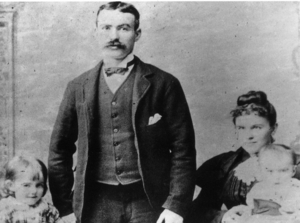
James Connolly with his wife, Lillie and daughters Mona, and Nora, c. 1895.

Before their move to the United States, they lived in a cottage in Weaver Square off Cork Street.

On his return to Dublin in 1910, James Connolly lived at 70 South Lotts Road, Ringsend. You can see the 1911 census return for the household here On his visits to Dublin in 1913 he stayed occasionally at Moran’s Hotel (now O’Sheas) at the corner of Gardiner Street and Talbot Street.

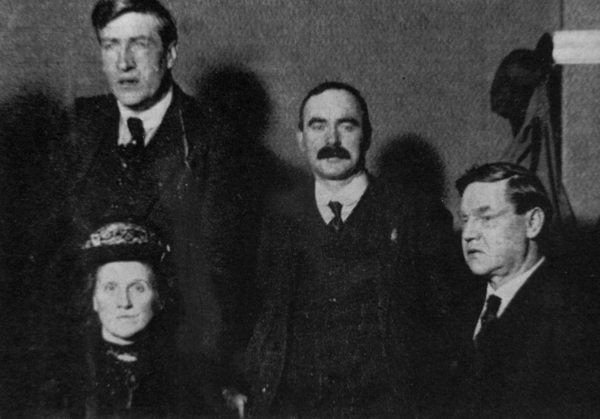
At back: Jim Larkin & James Connolly. In front: Mrs Bamber (Liverpool Trades Council) & Bill Haywood (IWW), 1913.

More frequently he lodged in 49b Leinster Road, Rathmines, (a.k.a Surrey House) the home of Constance Markievicz where several of her colleagues in the Fianna organisation also lived. (James Larkin hid in this house after he was arrested on 28 August 1913 and before he addressed the crowd from The Imperial Hotel on Sackville Street on 31 august. The house also served as Connolly’s and Markievicz’s office for The Spark and The Workers’ Republic which was also printed here.)

Some time before the Rising Connolly moved into Liberty Hall. During this time, his family stayed with Constance Markievicz’s in her cottage at the foot of Three Rock Mountain in South Dublin.

The houses in Charlemont Street, Queen Street, Pimlico, Weaver Square and South Lotts Road where Connolly and his family lived should have small plaques to mark their importance. If Dublin City Council can’t provide them, maybe all the left wing groups active in the city could raise the money?

[References:
Joseph E.A. Connell Jnr, Dublin in Rebellion: A Directory 1913 – 1923, Lilliput Press, 2009 and Donal Nevin, James Connolly: A Full Life, Gill & Macmillan, 2006.)