Introduction
The social life of a gay man in Dublin in the early 1970s was summed up as such by one contributor in the book Coming Out (2003):
As for most of us, being gay in those days was a very lonely experience. There weren’t many opportunities to meet gay people, unless you knew of the one bar – two bars, actually, in Dublin at that time, Bartley Dunne’s and Rice’s … They were the two pubs and if you hadn’t met gay people, you wouldn’t have known about these pubs; there was no advertising in those days, and it was all through word-of mouth.
Bartley Dunne’s and Rice’s proved to be critical points of social interaction and first emerged as gay- friendly pubs in the late 1950s and early 1960s. George Fullerton, who emigrated to London in 1968, was quoted in Dermot Ferritier’s book Occasions of Sin: Sex and Society in Modern Ireland (2009) as saying that:
In 1960s Dublin the [gay] scene basically consisted of 2 pubs – Rice’s and Bartley Dunne’s. I never experienced discrimination as such, probably because we were largely invisible.

Rice’s, South King Street. early 1980s. Dublin Insight Guide (1989)
There are no traces left of either establishment. Rice’s, at the corner of Stephen’s Green and South King Street, was demolished in 1986 to make way for the Stephen’s Green Shopping Centre. While Bartley Dunne’s, on Stephen’s Street Lower beside the Mercer Hospital, was torn down in 1990 and replaced with the Break for the Border pub and nightclub.
On a side note, some people may be surprised to hear that gay taverns in England date back to the 1720s (Molly houses) while more ‘modern’ establishments like Café ‘t Mandje in Amsterdam have been open since 1927.
Many in both the gay and straight community have described Rice’s and Bartley Dunne’s as deserving the title of being the city’s first gay friendly pubs. Why these two particular pubs though?
Most people point to the fact that both were in close proximity to the Gaiety Theatre and St. Stephen’s Green which at the time was a popular gay cruising area.
Paul Candon in Gay Community News (February 1996) labeled Bartley Dunne’s as “the first gay pub as we know it in the city” and also referenced Rice’s. He said there was a total of five regular gay-friendly bars to choose from in the 1960s in the Stephen’s Green/Grafton Street area. The other three being the short-lived Kings (opposite the Gaiety Theatre), The Bailey and Davy Byrne’s, both on Duke Street.
Rosemary Flowers told me via Facebook (20 Oct 2015):
My memories are from the mid 1960s but my dad worked in Renshaw’s opposite Mercer’s Hospital from 1955 and he was aware of the gay clientele in Rices, Dunne’s and The Bailey. In Rice’s. when I knew it, most of the gay men were in the front part. The ‘arty’ crowd mostly stuck to Rice’s and the younger crowd to Dunne’s. The Gardaí for the most part left them alone as they included some very famous names. The odd time they hassled the younger men in Dunne’s. Bruxelles was also a gay -friendly place for soldiers & a recruiting ground for mercenaries who were thrown out of the army. It was a much ‘butcher’ crowd in the Bailey and Bruxelles. Rice’s and Dunne’s had a very middle-class clientele.
Kevin Myers wrote in The Irish Times (18 May 1995) of his student days in UCD in the late 1960s and how he discovered that “Rice’s … (was) in part a gay bar … Bartley Dunne’s was another”. Furthermore Bartley Dunne’s was described as “the most famous and oldest gay bar in Dublin'” by Victoria Freedman in The cities of David: the life of David Norris (1995).
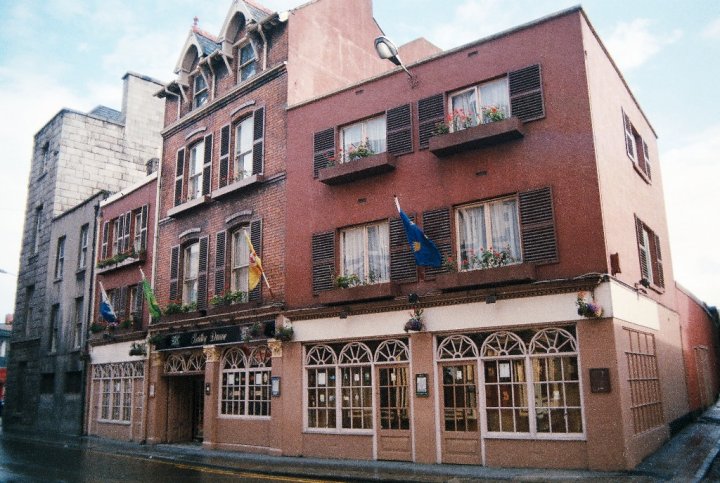
Bartley Dunne’s in 1985. Credit – blogtrotta80s.blogspot.com
One contributor to Coming out: Irish gay experiences (2003) talks about coming up to Dublin in the late 1970s from the country and spending “vast amounts of time in Rice’s, Bartley Dunne’s and the Hirschfield Centre”. Patrick Hennessy made a similar comment on an Irish Times article about the death of early LGBT campaigner in Christopher Robson in March of this year:
Yes farewell to one who fought the good fight back in the days when young and not so young men would come round to the Hirschfeld Centre nervously asking for info. Or sitting in circles exchanging their first tentative views in public about being gay. And then a few weeks later you might see one or two of them sipping a drink in a corner of Bartley Dunne’s or Bobby Rice’s.
The 1971 edition of ‘Fielding’s Travel Guide to Europe’ described “the historic Bailey, entirely reconstructed” as being full of “hippie types and Gay Boys”. It went onto say that neither it nor Davy Byrne’s would be “recommended for the “straight” traveller”.
Bartley Dunne’s, 32 Stephens St Lwr
In 1940, Hayden’s pub (“a well known seven-day licensed premises”) on Stephen’s Street Lower was put on the market after the owner James Bernard Hayden declared bankruptcy. In a related series of events, it was reported in the Irish Press (26 September 1940) that Gardaí had objected to renewing the pub’s licence on the grounds that the premises was not being conducted “in a peaceful and orderly manner'”. It had only closed one day the previous year.
The licence was taken over in August 1941 by Bartholomew ‘Bartley’ Dunne. A native Irish speaker from Kilconly, Tuam, County Galway, he had returned to Dublin after nearly 40 years of living and working in Manchester where had been prominent in the United Irish League and the Banba Branch of the Gaelic League. Bartley Dunne’s pub could “boast a distinguished clientele” in the mid 1940s according to the Nationalist and Leinster Times (23 Nov 1946). Popular with “cross-channel visitors, it frequently affords glimpses of such celebrities” as Dylan Thomas (Welsh poet); Sorley MacLean (Scottish Gaelic poet) and Valentine McEntee MP.
I assume Bartley Sr. retired sometime in the 1950s. He died on 25 June 1961 aged 85. His two sons – Bartley Jr. (known as Barry) and Gerard (known as Gerry) – had been working in the pub for sometime and took it over then. They built up a reputation for stocking exotic drinks from all over the world. Barry later recalled to The Irish Times (07 Sep 1985) that “there was a time when, if a customer wanted a particular drink and we didn’t have it in stock, he got something else for free”. We take it for the granted the range of drinks available in Dublin bars today but Bartley Dunne’s was really a trailblazer. It offered saki, tequila and ouzo before any other place in the city. Mary Frances Kennedy writing in The Irish Times (15 July 1960) was amazed at the range of wines available including Bull’s Blood of Eger (11s 6d a bottle); Balatoni Reisling (10s a bottle); Tokak Aszu (19s 6d a bottle) and Samos Muscatel (11 6d a bottle).
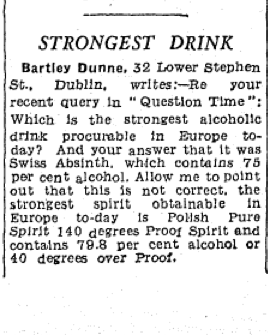
Letter from Bartley Dunne Sr to the Irish Independent (27 Aug 1959)
It would seem that Bartley Dunne’s (known to many as BD’s), which had already been attracting Dublin’s avant garde and theatre crowd, started to become gay-friendly by the late 1950s.
David Norris visited the pub as a schoolboy in his late teens circa 1961/62. In his 2012 autobiography ‘A Kick Against The Pricks’, he wrote:
Towards the end of my schooldays I started to explore a little. I had a kindred spirit in school and we occasionally visited a city centre bar called Bartley Dunne’s which was a notorious haunt of the homosexual demi-monde. It was an Aladdin’s cave to me, its wicker-clad Chianti bottles stiff with dribbled candlewax, tea chests covered in red and white chequered cloths, heavy scarlet velvet drapes and an immense collection of multi-coloured liqueurs glinting away in their bottles.
The place was (full) of theatrical old queens, with the barmen clad in bum-freezer uniforms. While not being gay themselves, as far as I know, the Dunne brothers were quite theatrical in their own way. Barry would hand out little cards, bearing the legend ‘Bartley Dunne’s, reminiscent of a left bank bistro, haunt of aristocrats, poets and artists’. Whatever about that, Saturday night certainly resembled an amateur opera in full swing. There only ever seemed to be two records played over the sound system: ‘Non, Je Ne Regrette Rien’ by Edith Piaf, and Ray Charles’ ‘Take These Chains From My Heart’.

Advertisement for Bartley Dunne’s in 1916-1966 Sinn Féin booklet (1966).
Brian Lacey in his excellent book Terrible Queer Creatures: A History of Homosexuality in Ireland (2008) noted that among the many characters that frequented the bar was the then virtually unknown Norman Scott, whose 1960s affair with Jeremy Thorpe (later to become leader of the British Liberal Party) forced him to resign from the party in 1976. Scott lived in a flat near Leinster Road while in Dublin. Ulick O’Connor mentioned in his diaries that Scott also had a long relationship with an unidentified person prominent in an Irish political party.

Bartley Dunne’s, 1980s. Credit – ‘Bartley Dunne’s Reunion’ Facebook
It was noted in The Irish Times (22 March 1967) that Moscow journalist Lev Sedin, who has visited Dublin a number of times, had recently published a book on Ireland that dealt with politics and economics as well as more “frivolous subjects”. One of these was a lyrical poem about Bartley Dunne’s and his experience there of being consulted on the correct pronunciation of the Russian wines in stock. Sedin recommended the pub to anyone in Europe “who wished to imbibe true culture”.

Daggas (a Swedish student,) Anita Casey, Barry Dunne (the proprietor) and Charlotte Leahy. Outside Bartley Dunne’s, 1967/68. Credit: Charlotte Okonji via FB.
A writer going by ‘Endymion’ in a 1968 Dublin guide book described Bartley Dunne’s as the city’s “most unusual pub'” Its clientele was an “an odd mixture of bohemians and down-to-earth Dubliners [that] creates an atmosphere which would have interested James Joyce.”
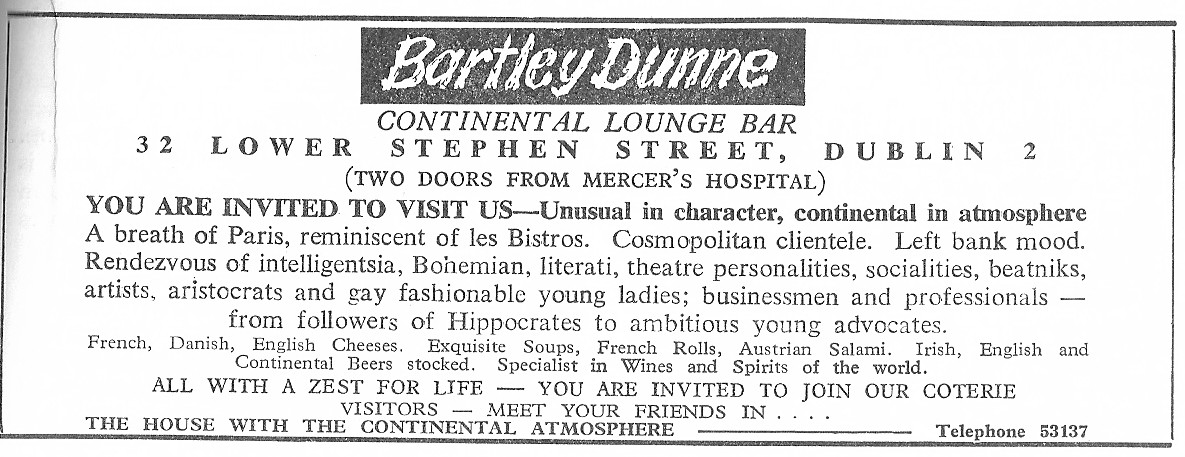
Advertisement for Bartley Dunne’s, 1969. Credit – Cedar Lounge Revolution
The pub was described by Roy Bulson in ‘Irish Pubs Of Character’ (1969) as:
one of Dublin’s most unusual pubs with its Continental atmosphere. Well worth a visit to mix with a variety of characters. Ask for the wine list which is one of the most reasonably priced and extensive in Dublin.
Bartley Dunne’s had a “French bistro ambience” with prints on the walls by Cezanne, Monet, and Picasso as well as Parisian theatre posters and photographs of film stars. It was also famous for its dimly lit nooks and crannies. Elizabeth Taylor and Richard Burton drank there regularly in 1965 during the filming of ‘The Spy Who Came in from the Cold’ as did actors Kim Novak and Laurence Harvery when they took time off from filming Of Human Bondage at Ardmore Studios. Noël Coward was another visitor.

Front cover of ‘In Touch’ magazine showing a group of Irish Gay Rights Movement members outside Bartley Dunne’s in 1977. Credit – IGRM 40 Years (facebook.com/igrm40)
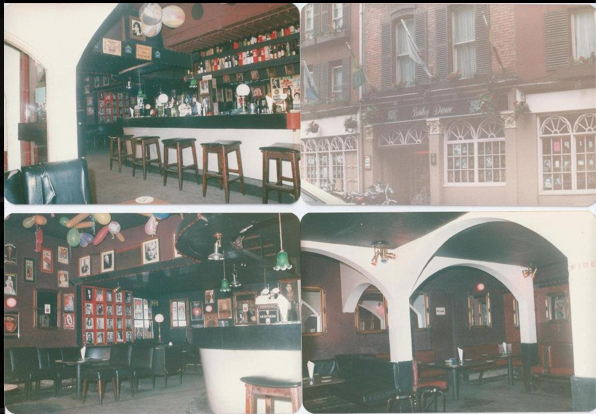
Snaps of Bartley Dunne’s, late 1980s. Credit – ‘Bartley Dunne’s Reunion’ Facebook






















 Click on the book for more.
 Click on the book for more.
 Donal
Donal Ciarán
 Sam
Sam


 Come Here To Me!