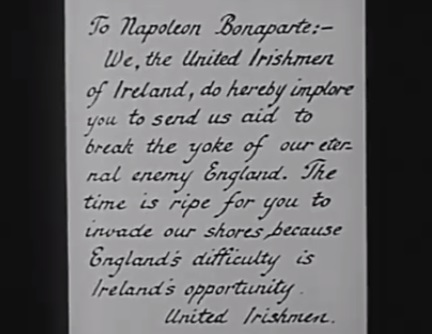
At the moment, I’m reading and enjoying Arthur Flynn’s book The Story of Irish Cinema. One film which grabbed my attention was Ireland, A Nation, a 1914 production which originated in the United States and dealt primarily with Irish history between the rebellion of the United Irishmen in 1798 and Emmet’s Rebellion in 1803. While the film contained many inaccuracies, it still enjoyed some success. It is noted in the excellent Cinema and Ireland that the film “had a remarkable run in Chicago, where it was shown for 20 consecutive weeks to huge crowds.” The film was heavily censored in Ireland, and the first print of the film bound for Ireland sunk with the Lusitania in 1915.
A scene from the film, showing a letter handed by Robert Emmet to Napoleon.
In Cinema and Ireland, we learn that when the film was first shown here, it was noted by an officer from Military Headquarters that the film was “likely to cause disaffection, owing to the cheering of the crowd, at portions of the film, the hissing of soldiers who appeared in the film, and the cries made by the audience.”
Today, we can watch 43 minutes of Ireland, A Nation thanks to the excellent work of the Trinity College Dublin Irish Film and TV Research Online team.
The film was later amended to include newsreel footage from the Irish revolutionary period of the early twentieth century.
After history, League of Ireland football is one of our great loves you could say.
Central to the beautiful game here is fan culture, be that the great travelling support enjoyed by some clubs or actions in the stands. Briogáid Dearg, the ultras group at Shelbourne F.C, turn ten this year, having been established in 2003. On Friday night, they marked their birthday with a true spectacle, a brilliantly executed show of colour and passion. Congratulations to them on ten years.
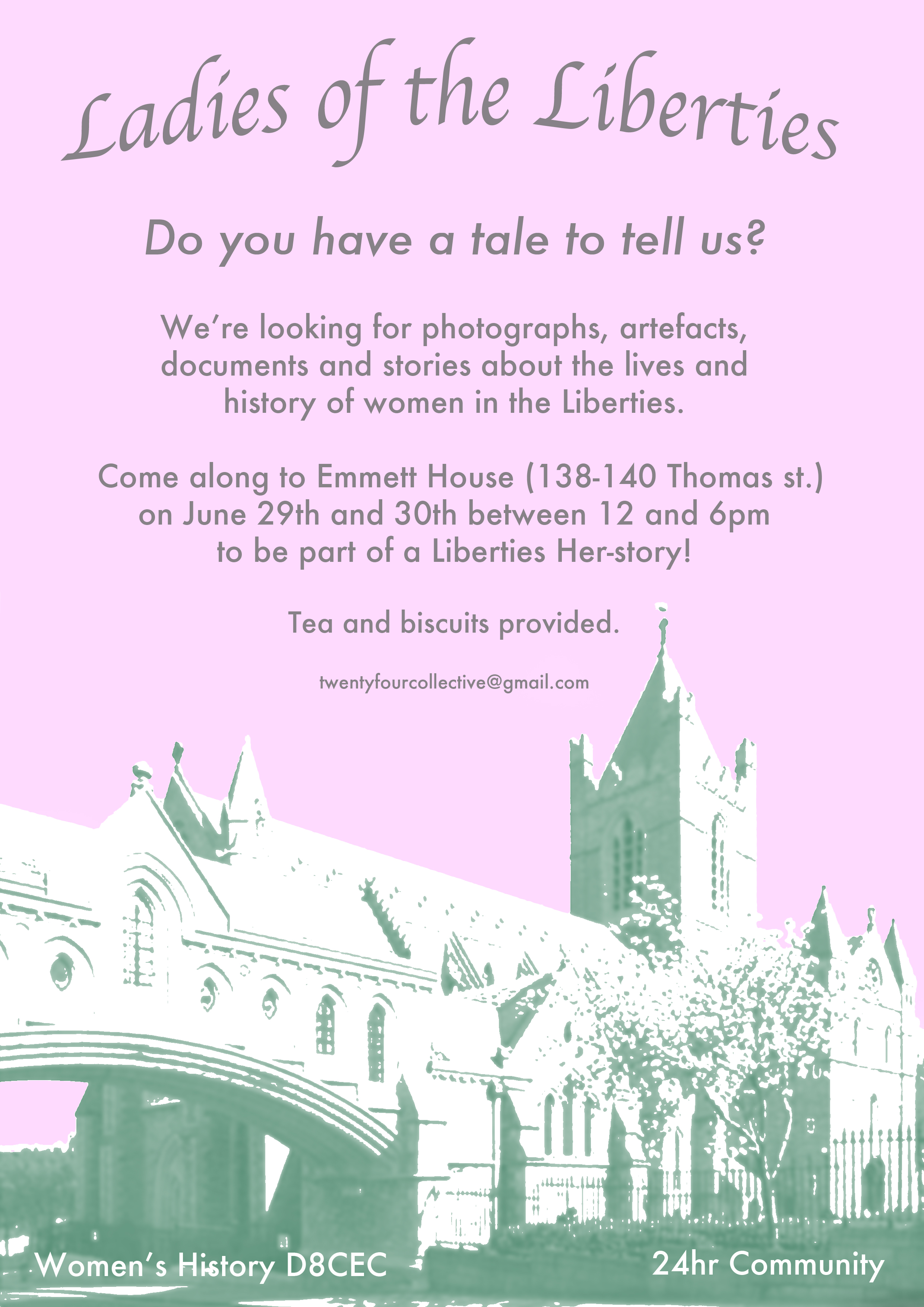
’24hr Community’, a NCAD art collective formed earlier this year, and the ‘May Day for Thomas St.’ initiative have joined forces to temporarily take over two vacant buildings on Thomas St. for the purpose of an exciting new history project.
Next weekend (June 29th to 30th) they are asking local women to come to their new studio at Emmett House with photographs, documents or other artefacts they may have, with a view to compile an archival history of the Liberties from the perspective of the women who inhabit it.
On hand will be scanners, audio recorders, and cameras to document whatever in by locals. All items will be treated with great care and will be returned immediately after the documentation process.
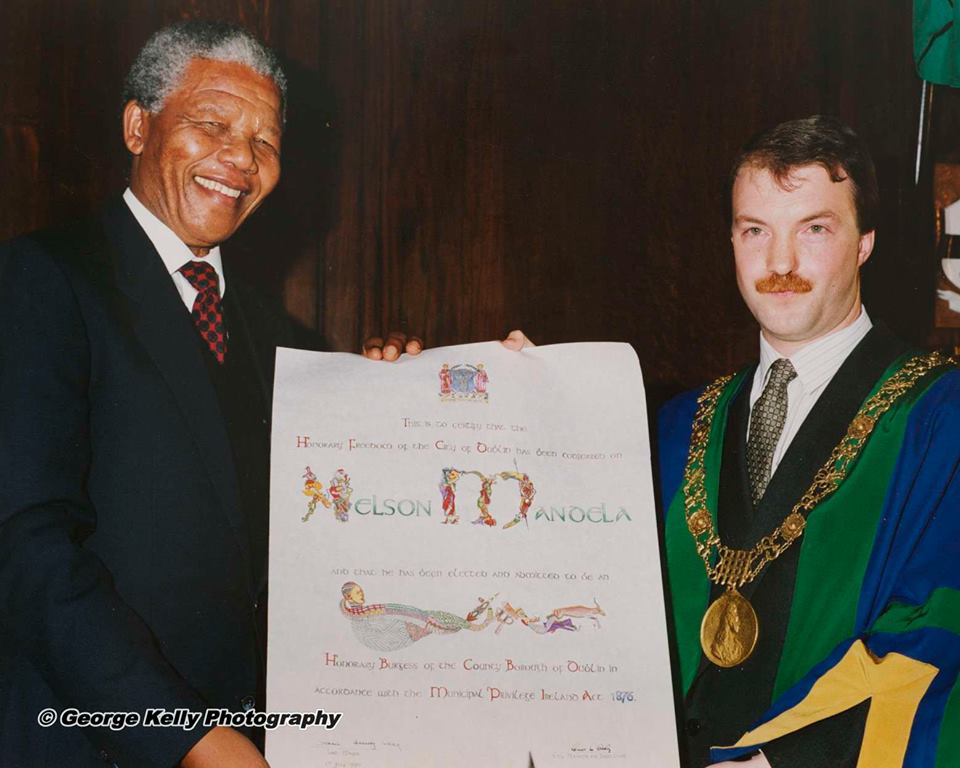
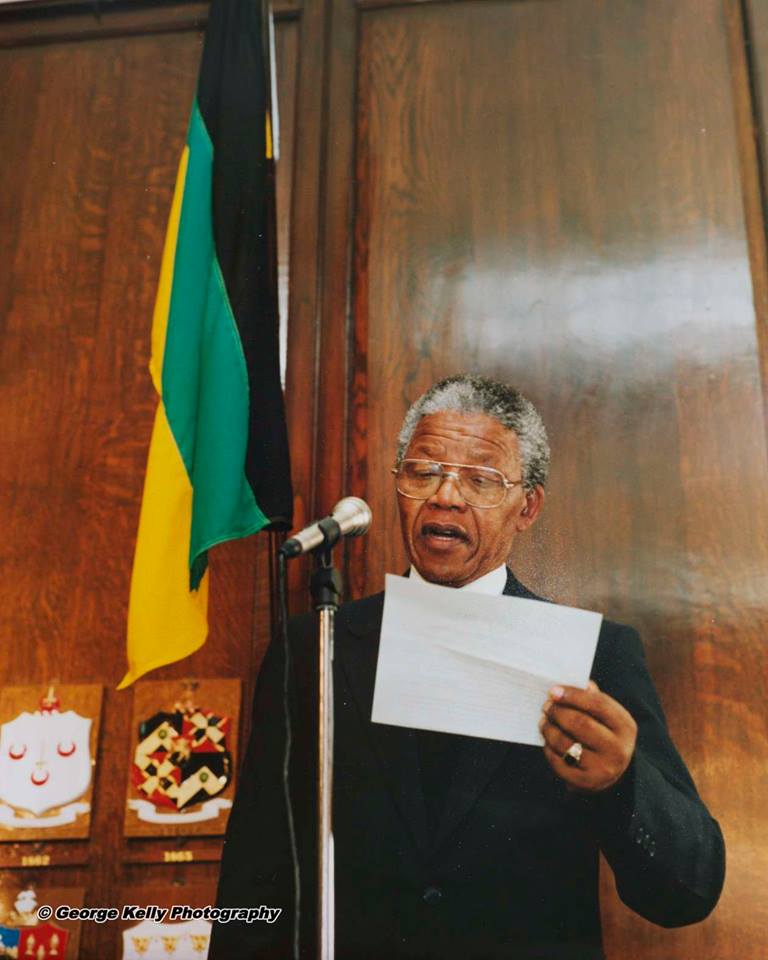
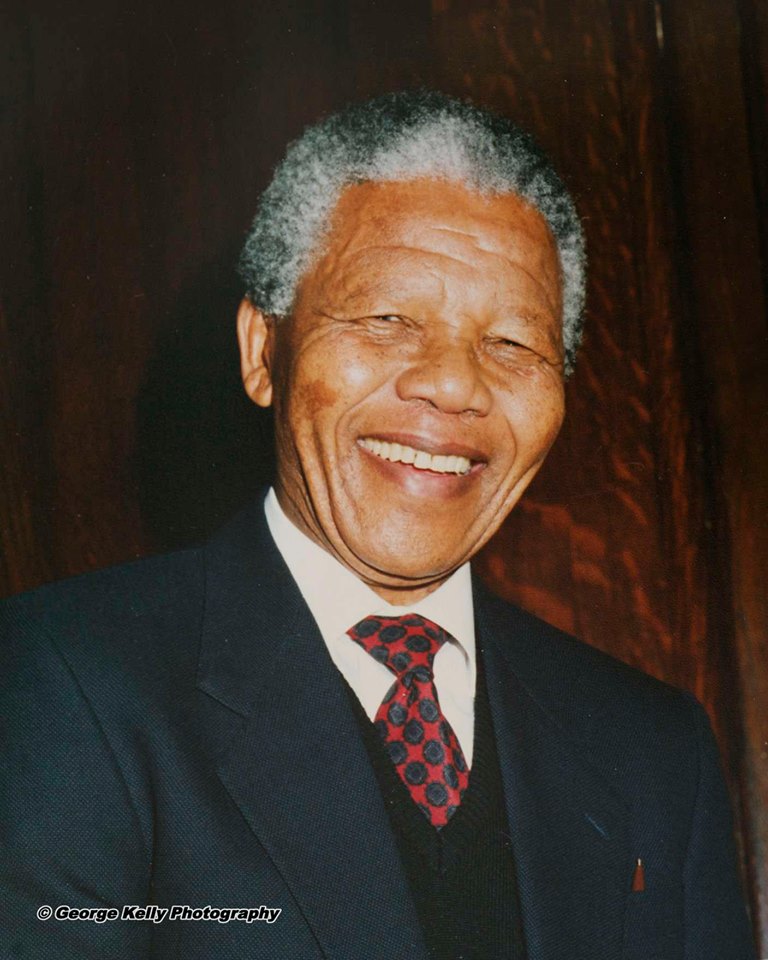
My thanks to George Kelly for permission to reproduce these brilliant images. We’ve previously posted some of George’s work in articles on Shamrock Rovers, who he follows and frequently photographs. These images come from the 1990 ceremony which presented the Freedom of the City to Nelson Mandela. The decision to grant this honour to Mandela had actually been reached in 1988, at a time when he was still imprisoned. At 94, the health of the inspirational anti-apartheid revolutionary and politician appears to be failing him, with Mandela’s condition described as critical.To date, only 76 people have been given the Freedom of the City of Dublin.
The rise and demise of Dublin is a story you can tell better on Henrietta Street than anywhere else in the city. In the eighteenth century, it was a street of the so-called ‘Second City of the Empire’, home to many sedan chair owners and members of the ruling elite, but in-time it came to define the extreme and grotesque poverty of inner-city Dublin, synonymous with overcrowded tenement life. The 1911 Census shows a street where general labourers made up a sizeable percentage of residents, those who found themselves caught up in the precarious working environment of the day.
Now, 14 Henrietta Street is about to open its doors. This is thanks to the ‘Dublin Tenement Experience: Living The Lockout’ project, a collaborative effort by the Irish Heritage Trust, Dublin City Council and the Irish Congress of Trade Unions.
By opening 14 Henrietta Street to the public from early July, Dubliners and visitors alike can explore a house which was home to an incredible 17 working class families at the time of the 1911 census. The website for the experience will go live in a matter of days, and can be visited here.
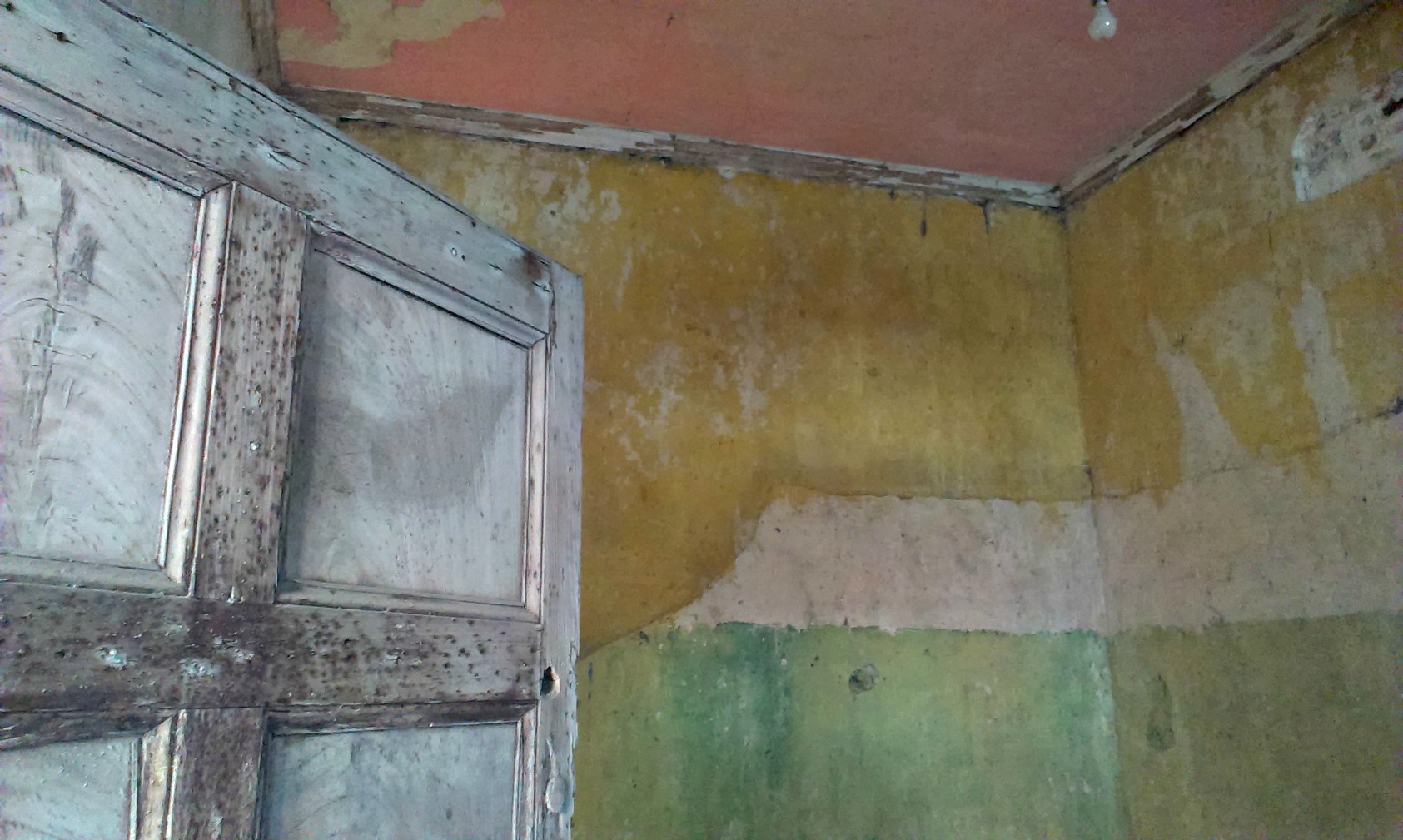
We’re delighted to post a few pictures from inside no.14, giving you a taste of what to expect. We’ll be running an article or two on Henrietta Street historically during the months of July and August. With the 1911 Census so central to our understanding of this house and those who lived in it, readers might be interested in three CHTM! articles exploring that census. Firstly, we have looked at Atheists and Agnostics in that census, while we’ve also looked at foreign nationals and unusual religions.
14 Henrietta Street (Donal Fallon)
14 Henrietta Street (Donal Fallon)
Items found during restoration of 14 Henrietta Street (Donal Fallon)
The location of the National Shell Factory today, Parkgate Street (Goggle Maps)
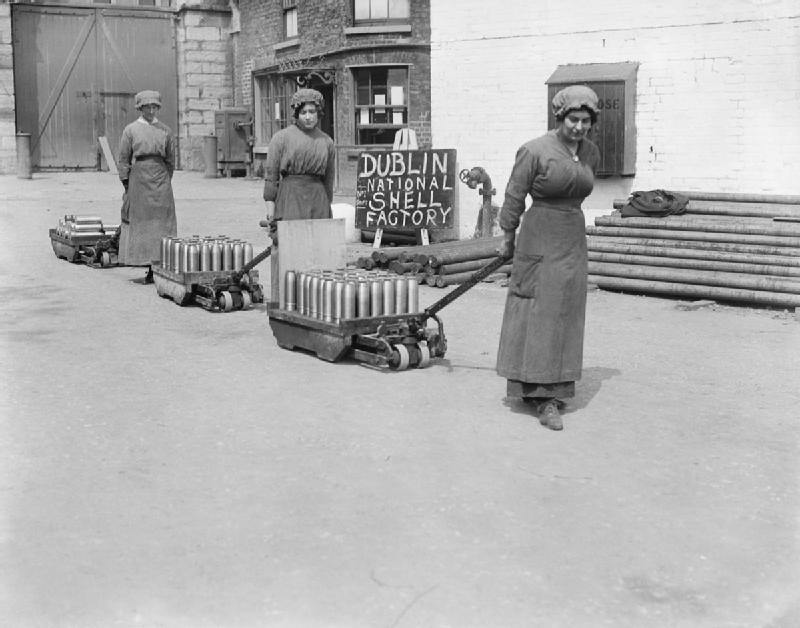
While there has been a huge amount of research done on Irish men who fought in the First World War, the stories of those at home during the conflict deserve attention too. For women, a source of employment during the conflict was the National Shell Factory at Parkgate Street. Many Dubliners will be familiar with the remains of this premises, as a popular series of Dublin Bus stops are found right outside it today. Theresa Moriarty has written on the role women played in munitions factories during the war, noting that:
By 1917 National Shell Factories were established in Cork, Dublin, Galway and Waterford…The workforce in the new shell factories was overwhelmingly female. Only five per cent of this industrial workforce could be male under government munitions regulations.
The Shell Factory also gave many young Irish women their first experience as trade unionists, with the women represented by the NFWW, the National Federation of Women Workers. There was labour agitation within the factory on occasion, with the union succeeding in bringing about improved conditions and rates of pay, but not without struggle. In September 1918 for example, almost 600 women were temporarily locked out of employment. It is noted in Our War: Ireland and the Great War, that the factory “had a nurse on full-time duty and a canteen staffed around the clock by lady volunteers”.
An external view of the National Shell Factory (Imperial War Museum)
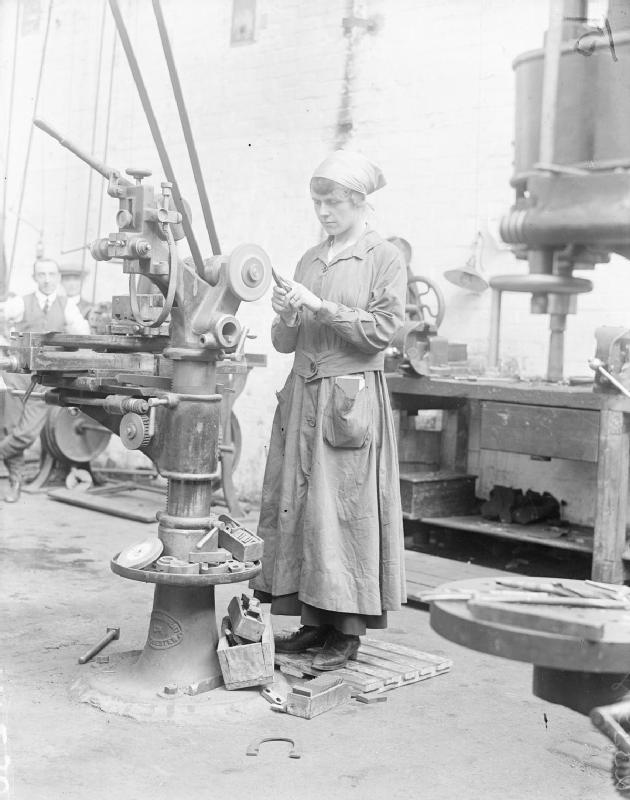
Women can be seen at work in the series of photographs digitised by the Imperial War Museum in London. Notice the presence of the Irish Harp and the Union flag on the walls of the premises, and the painted slogan encouraging the women to work as the men at war required shells urgently.
Image Credit: Imperial War Museum
Image Credit: Imperial War Museum
One of the women is listed as ‘Kathleen Nolan’. There are various shots of Nolan at work, for example “Kathleen Nolan presses a driving band onto a shell” and “Kathleen Nolan sharpens a tool on a grindstone”.
Image Credit: Imperial War Museum
What became of the Shell Factory following the end of the war? It is noted in The Dublin Fire Brigade: A History that not long after the burning of the Custom House in 1921 there was a fire at the site, which caused serious damage to the premises. by that stage, it was “housing motor cars and army lorries under repair”, making it a target for Irish republicans.
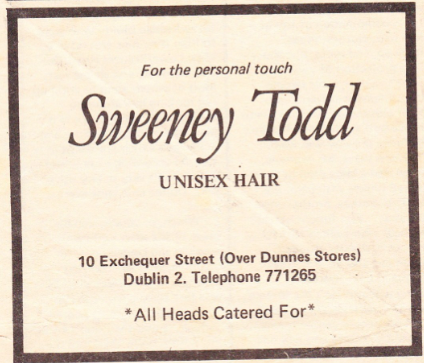
Sweeney Todd’s was a unisex hairdresser based over Dunnes Stores at 10 Exchequer Street, just off South Great George’s Street and opposite the Central Hotel.
It did a wash and shave for men and women for £3
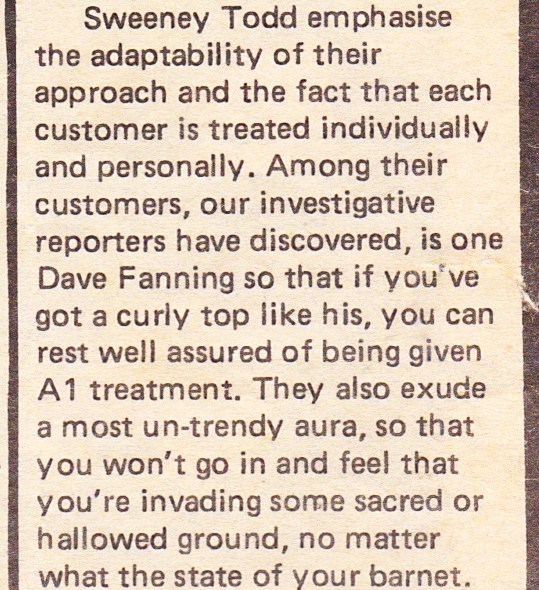
It was known for playing ska, punk and RnB over its soundsystem and was popular with a lot of Dublin’s music and left-wing radical crowd.
Sweeney Todd hairdressers
Their phone number was ‘771265’. There may have been some connection with Lillians Hairstylists, at Johnsons Court off Grafton St, as they used the same number in the late 1960s/early 1970s.
Sweeney Todd’s was certainly open up until at least 1984.
Anyone have any memories of it?
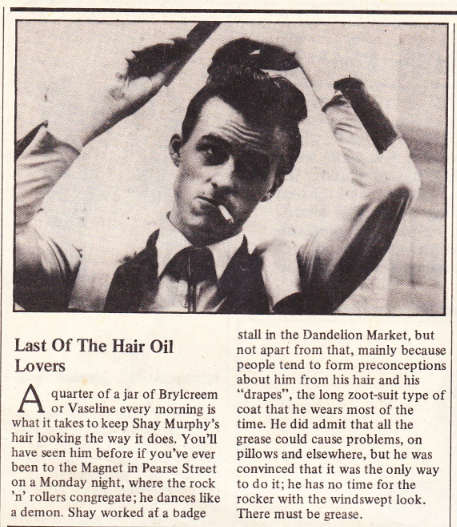
Not sure if Shay Murphy (below) frequented Sweeney Todd’s but thought it was suitable enough to post in the article. Many thanks to Mick Healy for passing on these three scanned images.
Availing of the unusually decent weather lately, I walk into the city most days. The route I take brings me over the Blackquiere Bridge in Phibsboro. The brilliant monument to an Irish Volunteer on the bridge demands the attention of those who pass over it, but the very name of the bridge is so unusual and unique it also grabs my attention. A little bit of research revealed that the name of this bridge comes from the Huguenot history of the city, making it just one location in Dublin today where the Huguenot past of the city is reflected in the names of locations.
The Huguenots were members of the Protestant Reformed Church of France, who fled the country following religious persecution against them in their native country. As noted on the Irish Ancestors section of The Irish Times site:
Small numbers of refugees from this persecution had come to Ireland, mainly via England, from 1620 to 1641, and again with Cromwell in 1649, but it was in 1685, after the revocation of the Edict of Nantes, which had guaranteed them toleration, that the main body of Huguenots began to arrive, mostly from the countryside around the city of La Rochelle in the modern region of Poitou-Charente.
Huguenots would even play a role in one of the defining moments of Irish history, with some fighting alongside King William of Orange at the Battle of the Boyne in 1690. Many Huguenots settled in the Liberties area of Dublin, renowned for their weaving abilities, skills they took with them from their native France. Huguenots became a huge part of the fabric of life in the area in the late seventeenth and eighteenth centuries, and in 1745 it was a Huguenot, David Digges La Touche, who financed the building of a new weavers’ hall in the Lower Coombe area.
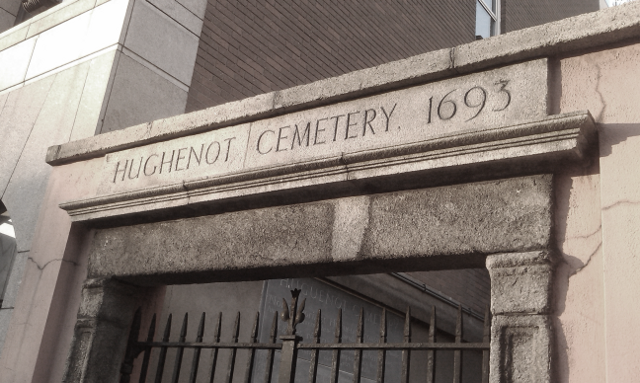
While many Dubliners are familiar with the Huguenot Cemetery on Merrion Row, at least to pass, they may be surprised to hear how many street names and bridges in Dublin point back to this period in history.
The Merrion Row cemetery, which is sadly closed to the public at most times.
Back to the start then, and what of Blaquiere Bridge? The bridge is named in honour of John Blaquiere ( 1732 – 1812), a distinguished British soldier, diplomat and politician of French Huguenot descent. He served as Chief Secretary for Ireland between 1772 and 1777. Blaquiere had been born in London of Huguenot stock, “being fifth son of Jean de Blaquiere who reached to England in 1685, and his wife Marie Elizabeth.” (Source)
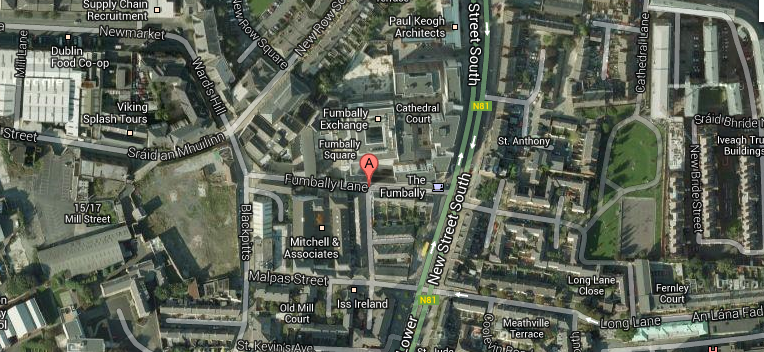
My favourite of the Dublin street names that reflects this migrant presence in Dublin is Fumbally Lane, which is quite near to Saint Patrick’s Cathedral. I only recently wandered down this lane for the first time, and there is a real sense of history to it. The area was home to a significant brewing and distilling presence historically, and the initials ‘JB’ and ‘1836’ can be seen within a modern development complex today, as a remnant of John Busby’s distillery opened in this lane in the 1830s. It is thought that the origins of the name of the laneway can be found in a French Huguenot family of skinners by the name of Fombella, who leased lane in the vicinity in the 1720s.
Fumbally Lane shown on a map of Dublin.
Maybe the most familiar street with Huguenot connotations is D’Olier Street, in the heart of the city. This street takes its name from Jeremiah D’Olier (1745-1817). A biography of D’Olier from the Royal Dublin Society notes that he was a founder director of the Bank of Ireland and governor of that institution from 1799 to 1801, and a Dublin city sheriff in 1788 and 1790. Dlier served as a commissioner of wide streets, contributing to the laying-out of the city as we know it today. D’Olier Street was named in his honour in 1800, all the more impressive given the fact he lived for 17 years afterwards.
Digges Lane is yet another place-name in Dublin which emerges from this tradition. Home of Marconi House, which houses Newstalk and Today FM among other radio stations, the name Digges Lane shows a connection to the hugely influential La Touche family, influential in the early days of Irish banking history, establishing the La Touche Bank and later central to the very foundation of the Bank of Ireland. A brief history of this family is available to read here, and notes that:
Our story opens with David Digues La Touche des Rompieres, who was born in 1671 near Blois in the Loire Valley, and whose family had embraced the Protestant faith. Following the Revocation of the Edict of Nantes in 1685 some La Touche family members fled to Holland in search of religious freedom. David soon joined them, and his uncle obtained for him a commission in General Caillemotte’s Regiment, in the army of William of Orange. In 1690 David fought in the Battle of the Boyne, but, as General Caillemotte was killed at this battle, the Regiment was disbanded and David served in the Princess Ann of Denmark’s army and in the Liverpool Regiment. He left the army in Galway, where he was billeted on a weaver who sent him to Dublin to buy worsteds.
Following the Easter Rising of 1916, a significant challenge for the republican movement was sourcing weapons and ammunition to rearm itself. One particular incident on the Dublin docks in 1918 saw the Irish Citizen Army secure a huge windfall of ammunition from an American transport vessel, the Defiance, which had served as a cargo ship in the United States Navy during the late stages of the Great War. Having first sailed from San Francisco in September 1914, she delivered cargo to Dundirk in France, and at the end of the war she briefly spent some time in Dublin, for the purpose of shipping back army huts and stores which belonged to the United States Expeditionary Force.
While in Dublin the ship fell victim to a well-planned raid carried out by the Irish Citizen Army, the small but militant workers militia that emerged first from the Lockout of 1913, and which fought in the Easter Rising. A brilliant and colourful account of the raiding of the ship is contained in R.M Fox’s 1944 work The History of the Irish Citizen Army, and here we have republished some of the account of this raid from that long out of print work. It shows the role Dublin dockers played in the revolutionary period, and gives an idea of ICA activity in the years after rebellion.
The Defiance in 1918 (Wiki)
In his study, Fox notes that the vessel attracted the attention of dockers, and that:
Dublin dockers at work loading up the boat wondered at the extraordinary precautions taken. By each gangway was an armed guard of United States Marines. Other guards were placed in position by the deck and the hold. No man could get off the ship without a permit, and he had to run the gauntlet of the guards. The dockers looked round and discovered the hold contained piled up cases of revolvers, rifles and ammunition that were being shipped from England back to America. The Citizen Army was instantly on the alert. Seamus McGowan, the arms expert, was smuggled in as a docker, to arrange about getting some of this stuff ashore.
The cases had to be broken open in the hold by dockers without being observed by the guards. Then all the stuff had to be concealed to get it across the gangway. No parcels were allowed. In spite of all the difficulties the booty was too valuable to lose, and relays of Citizen Army men were down on the quays for eight hours a day, taking the revolvers and ammunition from those who succeeded in getting the necessary shore permits. The little tin lavatories on the quays made excellent transfer stations. Soon the bag consisted of 56 .45 revolvers, 2,000 rounds of revolver ammunition, 5,000 rounds of Springfield ammunition in canvas bandoliers and an assortment of Verey lights and pistols. Arrangements were also made with a member of the crew to deliver 34 .45 automatics, which had been served out to the crew. He lowered these over the side in a canvas bucket to a boat which crept out in the darkness. Captain Poole was in charge of the boat operation.
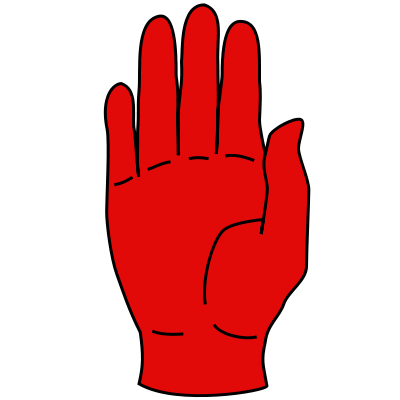
The Red Hand emblem of the Irish Citizen Army, worn by members as a cap badge.
Unfortunately the Springfield rifles proved too cumbersome to get ashore. It was easy enough to break the cases in the hold. But no one could hope to get along the gangway holding a rifle. They were left very reluctantly. Attempts were made to unscrew the butts and so reduce the length, but this proved impossible. If it hadn’t been for the length of the rifles, America would have played a still bigger part in arming Ireland in her fight for freedom!
For several days ammunition and revolvers were landed without difficulty. Then one morning the captain and his mate descended to the hold in a state of great agitation. The captain walked straight across to a dark corner which had been screened by a number of big cases. Here he saw rows of boxes, broken open and empty. The arms and ammunition had vanished. All the dockers were immediately ordered ashore under armed guard. They were taken into a shed – the same shed which had been used to receive the stores from the foodships in 1913. There they were told they were going to be searched. Indignant objections were raised, but all knew they had taken their last load. They were paid off on the spot, and the Defiance raising anchor departed without waiting for any more cargo. Suspicions had been aroused by an imprudent Irish Volunteer asking the mate if they had any guns for sale. He went back and told the captain, and they started investigations at once. Much of the stores and the equipment that they left behind was auctioned on the quays. Liberty Hall secured furniture at this auction to make up for the devastation of 1916.
From R.M Fox ‘The History of the Irish Citizen Army’ (Dublin, 1944)
Trinity College Dublin (Robert French collection, NLI.)
The antics of Trinity College Dublin students have made it into the national media on many occasions, but recently I stumbled on a particularly boisterous day out in 1914, when students went on a rampage in the city, attacking both the Mansion House and the offices of the Women's Social and Political Union among other places. A wild day out ended with ten students arrested, the Civic flag of the Mansion House ripped to pieces and Countess Markievicz, Hanna Sheehy Skeffington and others on the wrong side of student pranksters.
Trinity Monday was a traditional June day of debauchery in Dublin. On that day, scholarships were traditionally awarded to leading students through a formal ceremony that occurred on the steps of the Examinations Hall in the front square of the college. In 1914, crowds gathered here to hear the Vice Provost announce the newest Fellows, but the Irish Independent reported that "after the announcements had been made signs of some excitement became noticeable." The students made a rush for the gates of the college and towards the city, but were turned back by college authorities. Previous years had seen Trinity Monday descend into pranks and games on the streets of the city, and the college was hell-bent on preventing a repeat. It was reported however in the newspapers that there was a rush of hundreds of students for the Lincoln Place gates, with some emerging from over the railings of the university. From here, their day would take some amazing turns.
Shortly after midday, there were unexpected visitors at the offices of the Women's Social and Political Union on Clare Street. The Irish Independent reported that “a large number of the students arrived here” and that “a number of them bundled papers and banners together and threw them out of the window to a cheering crowd outside.” Not content with this, a political flag belonging to the movement was stolen, which was later carried triumphantly from the building.
Media coverage of the ‘escapades’ of the Trinity students (Irish Independent)
The real headline grabber of the day out was yet to come. Still clutching the stolen flag of the female political activists, the students made for the Mansion House, and rushed the building as a delivery was taking place.The day had taken a rather sinister turn just prior to this, with the students assault a cabman who refused to drive them to the Mansion House free of charge from outside the Kildare Street Club, and he later required hospitalisation. At the Mansion House, bizarre scenes followed.
The Irish Times reported that:
On a landing they found the municipal flag, which owing to the absence of the Lord Mayor from the city was not hoisted on the pole on the house-top. The students tore up the flag, and hoisted the ‘Suffragette’ flag upon the flagpole. For an hour this floated over the Mansion House.
Loud cheering and laughter was reported outside from the assembled students and curious Dubliners, but this was not to be the last of the days antics.
The students marched in the direction of Grafton Street, where the next victim was a bellman working at an auctioneers premises. It was noted that “his bell was commandeered and the man himself, despite his protests, was taken on the shoulders of a number of the students and a solemn procession, with the bell leading the way, was formed down to College Green.” The bellman was carried as far as the Theatre Royal Winter Gardens, where he was substituted for a large advertisement hoarding, of the music hall singer George Lashwood. The celebrated singer was performing at the theatre at the time, but for the students, the huge hoarding was destined for the River Liffey. The Irish Times reported that this huge hoarding was so heavy it took twelve students to carry it to O’Connell Bridge.
Above: A performance by George Lashwood.
The suffrage activists hadn’t had their final run-in with the students however. At Nelson’s Pillar, one student gave a sarcastic speech in which he said “Gentlemen, we are all in favour of votes for women, and we shall now proceed to the offices of the Suffragettes.” The second political offices of the day to be targeted was on Westmoreland Street, where among others Hanna Sheehy-Skeffington and the Countess Markievicz were present. These offices were also ransacked, but the students were confronted and attacked by “a male sympathiser of the Suffragettes.” Most of the mob made for Amiens Street Train Station to welcome the Trinity Athletic team into the city, but the day was about to come to an abrupt end for the partying students, as the cabman who had been assaulted earlier in the day and a number of Suffragette activists arrived to identify the ringleaders of the gang under police protection. Ten students in total were arrested, and fines were handed out for the damage done to the Mansion House flag and the Suffragette offices. The college also took action against the students, with expulsions handed out to the participants.
An unprecedented and bizarre protest followed this, with Trinity students staging a mock ‘funeral’ the following week through Dublin, with the Irish Independent estimating that between 400 and 500 students from the college marched in Dublin in costume, and that “vigorous cheering” was indulged in at the Suffragette offices on Westmoreland Street. Escorting all this were donkey ‘cavalry’ riders, dressed in the costumes of clowns. The newspaper reported that “the whole parade was characterised by fun and merriment, and provided unlimited amusement to the spectators.” Yet I wonder just how amusing the female activists who had their offices trashed by these same students a week earlier found it.
On 13 October 1970 Saor Eire member Liam Walsh, a welder and fitter by trade and father of four, was killed in a premature explosion when himself and another member Martin Casey were planting a device at a railway line at the rear of McKee army base off Blackhorse Avenue in Dublin.
Joining the Republican Movement in 1953, Walsh had been the commanding officer of the south Dublin unit of the IRA during the late 1950s and was interned for a time in the Curragh. He lived at 50 Tyrone Place, Inchicore and, at the time of his death, was awaiting trail on charge of taking part in an armed bank raid at Baltinglass in August 1969.
Liam Walsh in IRA uniform. Photograph belonged to the late Paddy Browne.
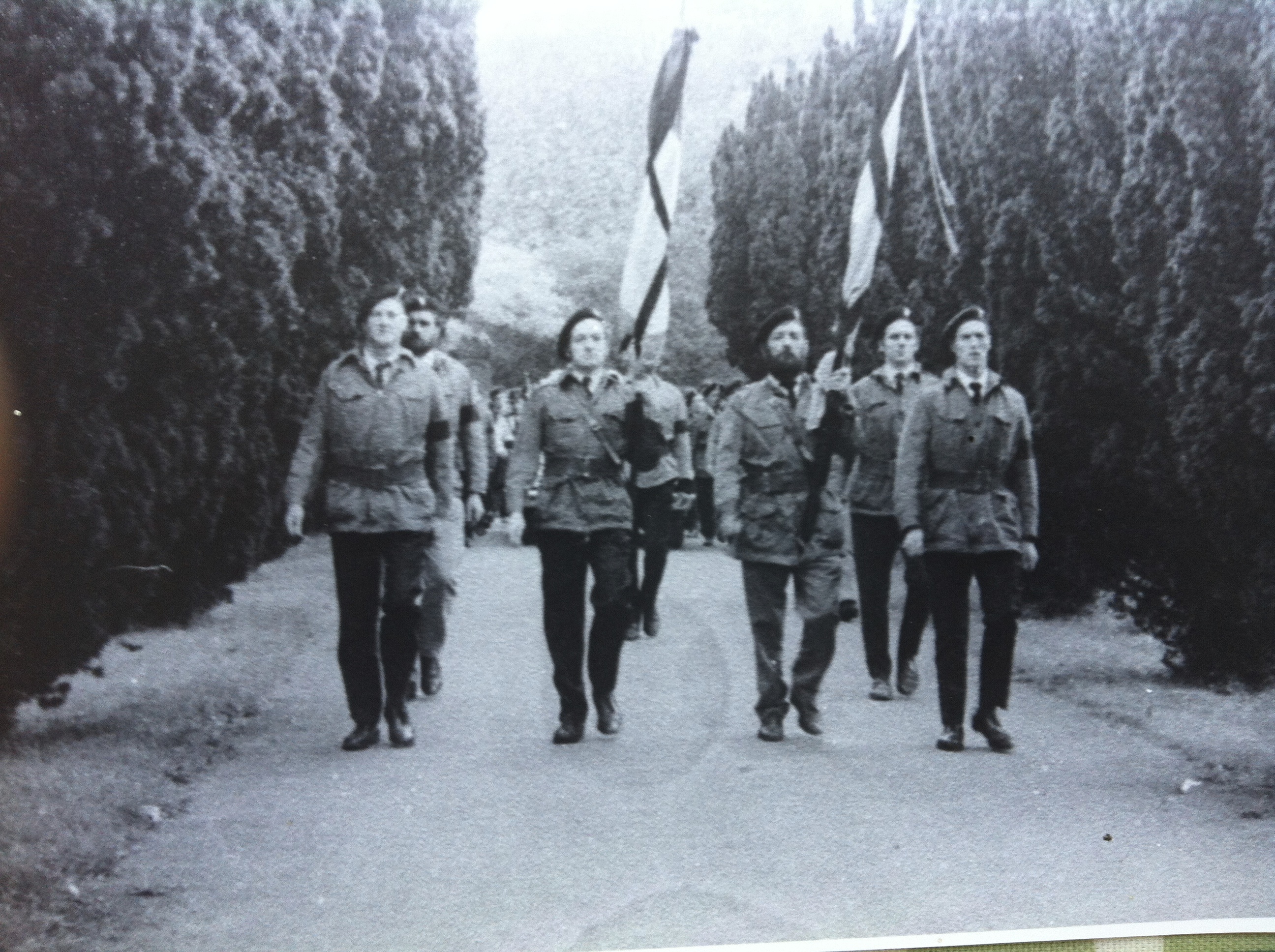
We have been passed on some photographs of his funeral by Barbara O’Reilly. The photographs belonged to the late Paddy Browne who can be seen in the third picture with beard carrying a flag at the front of the colour party .
The funeral took place on 17 October 1970 and was attended by over 3,000 people.
The cortege left from Inchicore, was diverted down O’Connell Street and marched all the way to Mount Jerome cemetery in Harold’s Cross.
Funeral of Liam Walsh (Saor Eire), 1970. Photos were in possession of the late Paddy Browne
Here is the cortege as it made its way down O’Connell Street. Note the two hands with revolvers.
The Irish Times (20 October 1970) described how after a piper played a lament:
Two men, dressed in black berets and anoraks, fired four rounds of ammunition into the air as a tribute to the dead man.
An estimated 50 gardai and a dozen special branch accompanied the cortege but no action was taken.
Funeral of Liam Walsh (Saor Eire), O’Connell St, 1970. Photos were in possession of the late Paddy Browne
Here is the colour party as it entered the cemetery. The Irish Times (19 October 1970) reported that an elderly man shouted ‘So long soldier!” as his coffin was being lowered.
Funeral of Liam Walsh (Saor Eire) arriving at Mount Jerome Cemetery, 1970. Photos were in possession of the late Paddy Browne
Recently, I bought an old second-hand copy of And Nelson on his Pillar, a retrospective history of the Pillar that was published a decade on from the explosion in 1966.
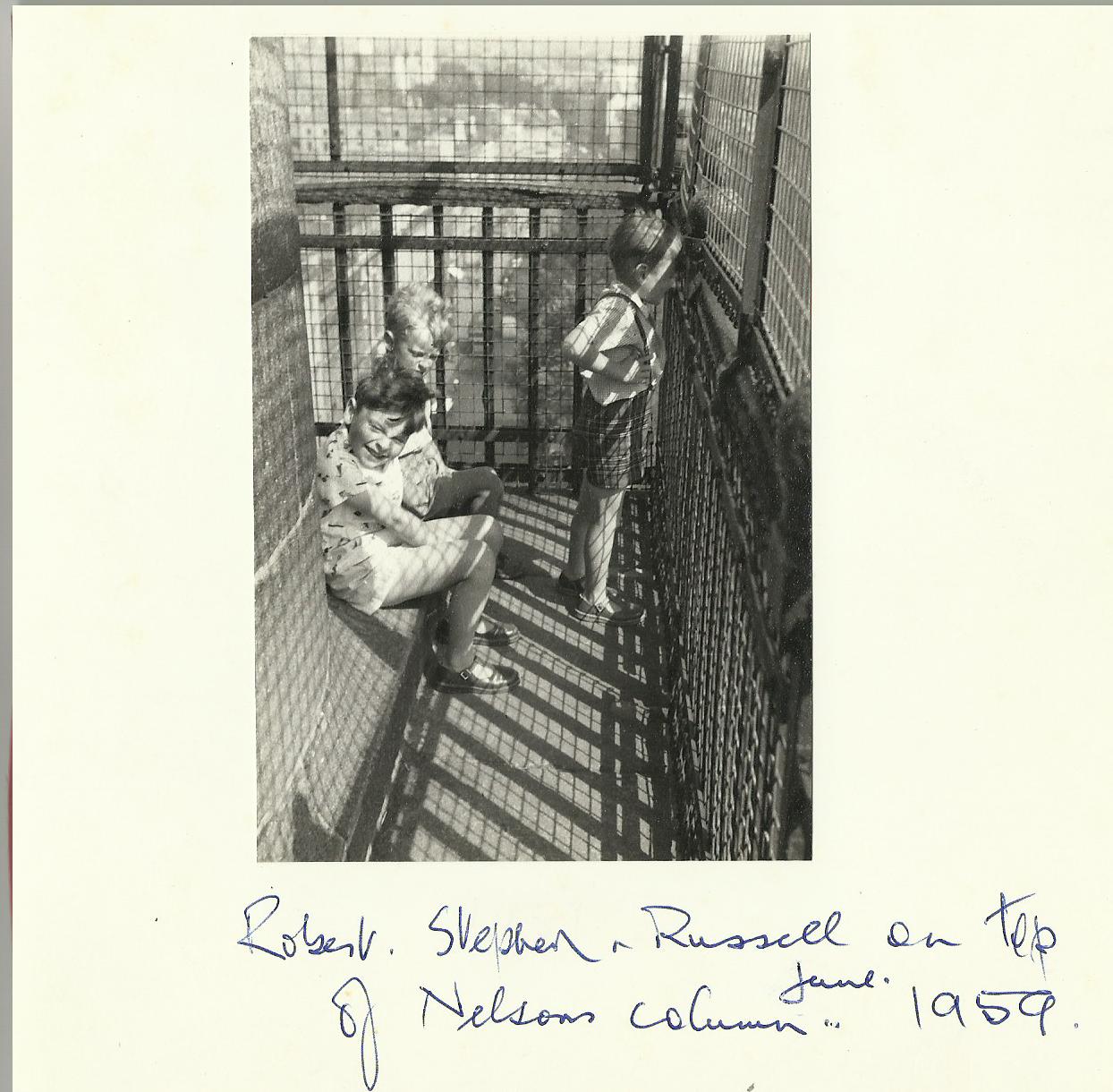
From buying second-hand books over the years, I know that anything and everything can fall out of them. Old currency, bus passes, mass cards, match tickets and you name it. Still, I was surprised when I opened this book to see a picture of three kids on top of the monument, looking down over Dublin from the viewing platform! Not alone this, but the youngsters were named as Robert, Stephen and Russell. Taken in 1959, it’s highly likely they are still among us today, but they could be anywhere in the world.I’ve a hunch the kids might be English, owing to the fact that they refer to Nelson’s Column and not Nelson’s Pillar.
Click to expand and get a better view. Do us a favour and share this one around!
‘Robert, Stephen and Russell on top of Nelson’s Column, June 1959.”


















 Click on the book for more.
 Click on the book for more.
 Donal
Donal Ciarán
 Sam
Sam


 Come Here To Me!