Oh dear.
Archive for 2011
This fella should have #occupied a taxi home.
Posted in Uncategorized on November 8, 2011| 1 Comment »

The imagery of Occupy Dame Street.
Posted in Politics, Street Art on November 7, 2011| 5 Comments »
One of the most interesting aspects of the global #Occupy movement in my eyes has been the propaganda produced. The imagery of Occupy Wall Street has already become iconic, the Adbusters poster depicting the Wall Street bull and the question ‘What is our one demand?’ has been copied by international occupations that have sprung up. I visited Occupy London last week and noticed that there, many of the posters took aim at the coalition government there and utilised London landmarks for visual purposes.
Here at home, Occupy Dame Street has produced a number of posters which have appeared both around the city and online. Below are a number of my favourites.
‘Keep Calm And Carry On’ gets a very Irish reworking, while the physical scale of the building itself features too. With Occupy Dame Street being an ongoing event, more posters and leaflets are surely ahead.

Share this:

3. Crampton Court
Posted in Dublin History, Photography on November 7, 2011| 24 Comments »
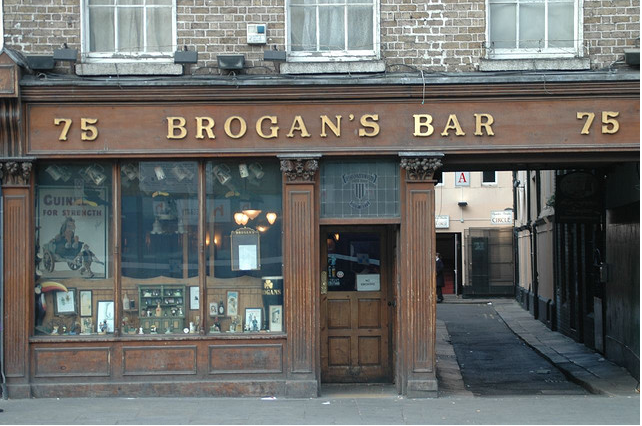
View from Dame Street down to Crampton Court (Photo credit - Trevs Photos)
This is probably my favourite little lane or passage way in Dublin. Not least because it’s not featured on any maps, it was the site of two of Dublin’s most famous 18th century coffee houses – ‘Little Dublin Coffee House’ and ‘Royal Exchange Coffee House’ and as I’ve had some memorable personal experiences in the lane (nothing dirty!)
Crampton Court links Dame Street (entrance just under ‘BAR’ in the sign for Brogans BAR) and leads right down, past the back entrance to The Olympia Theatre, to Essex Street East (entrance just beside the Dublin Theatre Festival office)
Flora H. Mitchell in her excellent Vanishing Dublin (1966) described it as being
“… the unofficial “exchange” of Dublin until the “commercial buildings” were opened in 1799. No 20, “The Little Dublin Coffee House” provided the merchants with a meeting place prior to this. Crampton Court had been used as a short cut from the Olympia Theatre to the well known Dolphin Restaurant prior to it being demolished in 1963.”
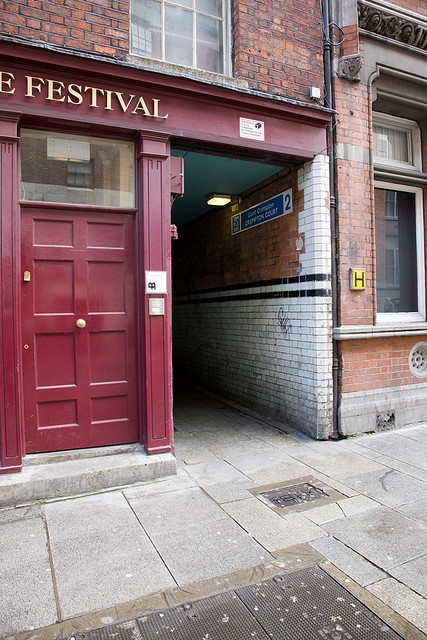
Entrance to Crampton Court from Essex St. East (Photo credit - infomatique)
The doors in Crampton Court were famous in their own right:
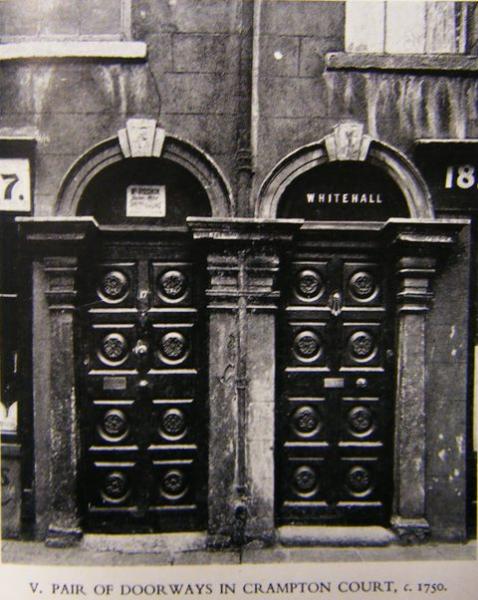
Uploader credit - Jimmymac
This is how it looked in the 18th century when the court was bustling with trade and housing:
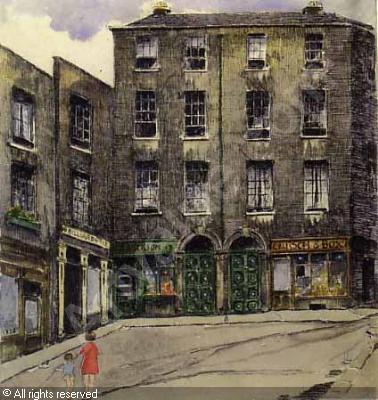
Artists interpretation of those doors (and buildings) in 18th century
Like so many beautiful and historical sites, it fell into decay in the 1950s and 1960s:
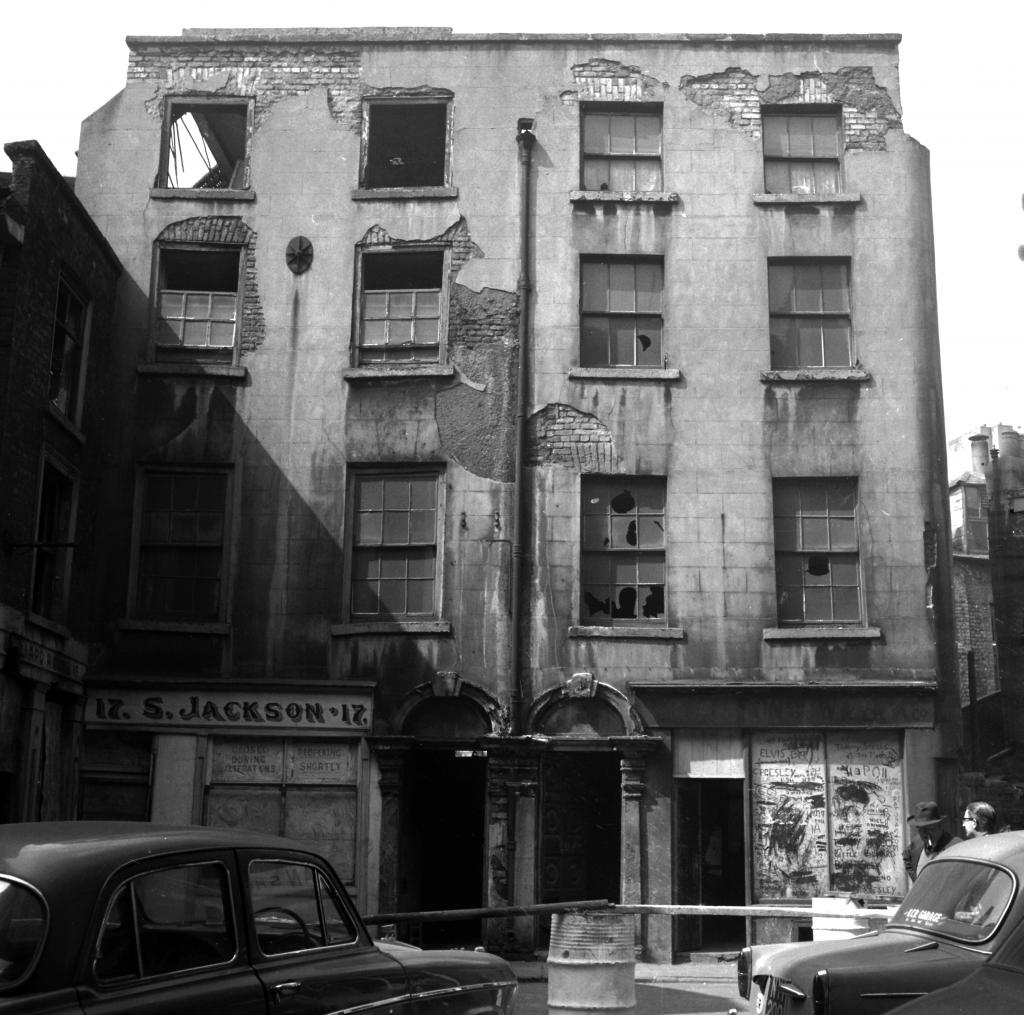
How it looked in 1959. Photo - Dublin City Library
A real pity. An anonymous letter to The Irish Times (May 23rd, 1931) described it as ‘a part of Dublin which still seems to suggest its ancient history’.
No doubt at one stage Palace Street used to run right across Dame Street and into Crampton Court:
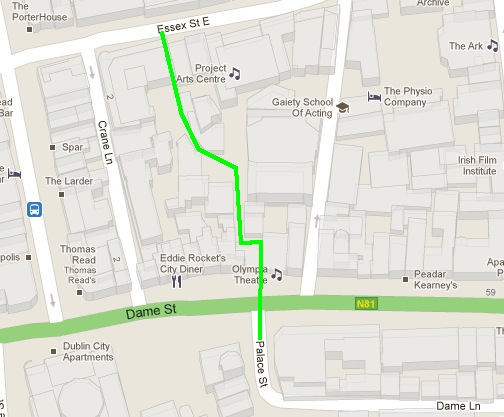
While Palace St. is still visable on maps, Crampton Street has been lost.
So next time your heading down Dame Street, when not pop through Crampton Court and have a gawk at an old, forgotten part of Dublin.
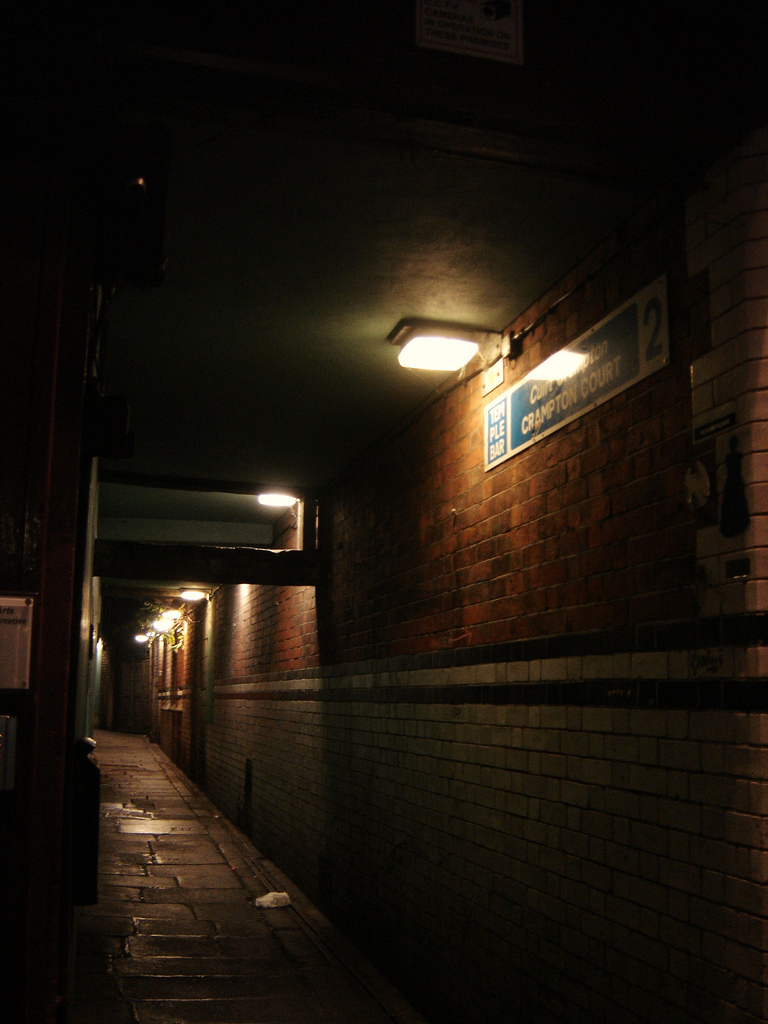
Entrance just beside Dublin International Theatre Festival Essex St. East. Notice wooden rafter across frame (Photo credit plattbridger)
Plus see if you can spot the wooden rafter above your head, as you come from the narrow Essex St. East side, that looks especially old! Perhaps original?
Share this:

We’re all here on a technicality, a technicality, a technicality….
Posted in Uncategorized on November 6, 2011| Leave a Comment »

Unbelievably, Pats are in Europe.
Despite a fourth place League finish, and a dramatic collapse in the cup against Shelbourne, the fact that a top-three team have won the FAI Cup today ensures that we’re in on a technicality. ‘We’re all here on a technicality’ has long been a favourite chant of Saint Patrick’s Athletic supporters, and everything from others financial woes to others successes have sent us abroad.
Remarkably, the club shop even flogs t-shirts which boast of the fact:

I’m sure all across the southside of Dublin Credit Union books are being dug-out from behind the couch, a technicality will do once more.
Share this:

2. St. Andrew’s Lane
Posted in Dublin History, Photography on November 6, 2011| 1 Comment »
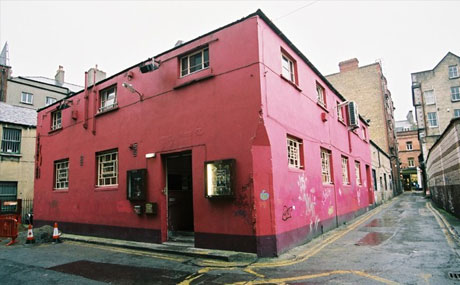
View looking up to Exechequer St.
A bendy little lane that links Exchequer St. (entry is between Boulevard Cafe and Music Maker) and Trinity St. (entry is between Hilfiger Denim and Leon: The Pastry Cafe), synonymous with the Andrew’s Lane nightclub, Maser graffiti and Grift’s old Batman piece.
Cars still drive through it, so you have to be careful while walking down it (especially at night) because it’s very narrow.

Bendy as ever, 1818
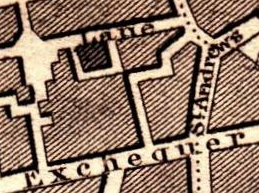
Showing how the courtyard on Dame Lane and St Andrews lane nearly touched, 1836
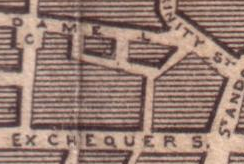
In 1863, apparently that courtyard lane on Dame Lane linked up with St. Andrew's Lane.
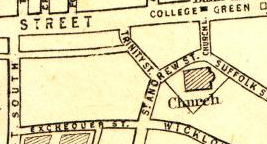
In 1885, the lane disappeared!
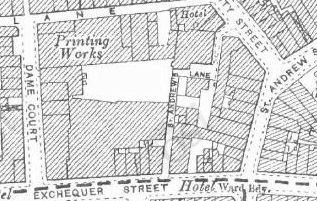
Clear view of it in 1907
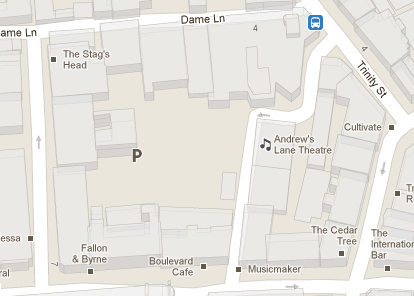
View in 2011, featured on Google Maps because it's not pedestrianised
Share this:

1. Williams Lane
Posted in Dublin History, Photography on November 5, 2011| 17 Comments »
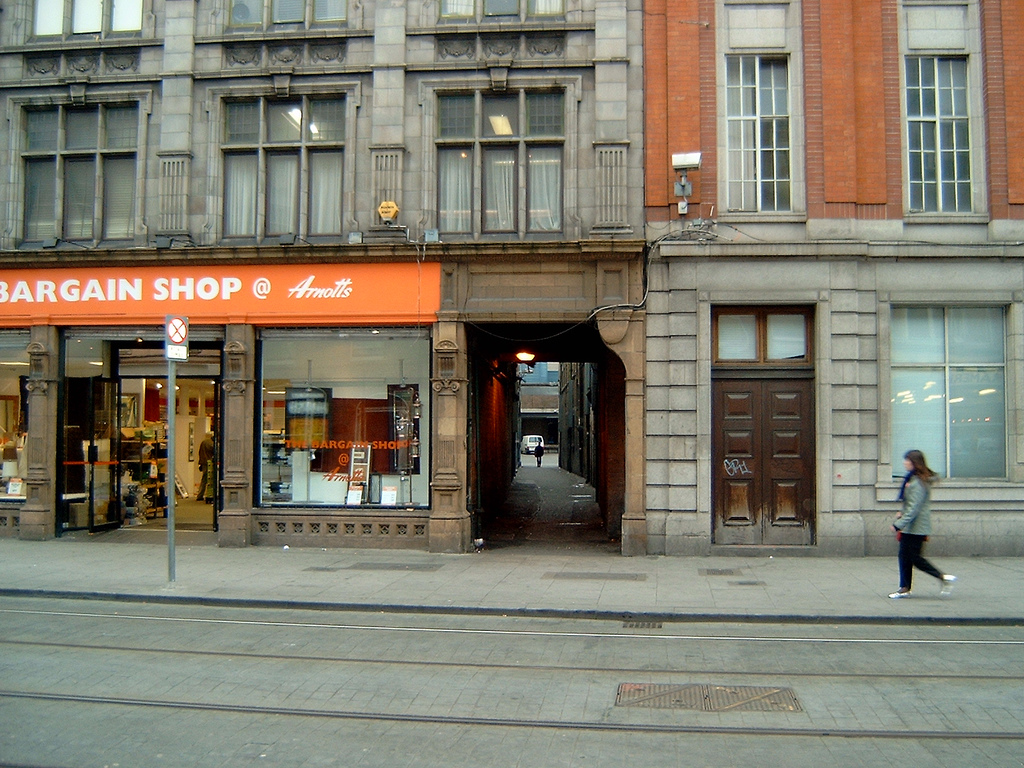
Looking from Middle Abbey Street. Photo credit - Matthew S.
One of my favourite little lanes in Dublin is Williams Lane which (handily) links Princess Street North and Middle Abbey Street. It’s one of those hidden lanes that actually takes a good few minutes off your journey if your coming from Middle Abbey Street and want to head up the north side of O’Connell Street or when your coming from that direction and are heading towards Liffey Street and the ha’penny bridge. (It’s also handy for finishing your last can before heading into the Twisted Pepper across the road! Shhhh)

The view from Princes' North Street. Photo credit - Matthew S.
As you can see, it’s clearly marked (though not named) in these maps from the early/mid 19th century.

Visible in 1818

Visible in 1836
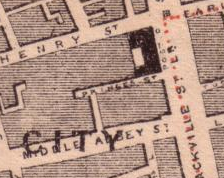
Visible in 1863
Then suddenly it disappears from all the maps!
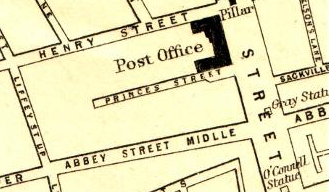
Oh, where did it go? 1885 map
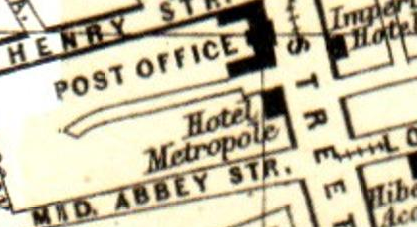
Still missing in 1913
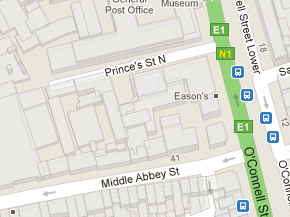
According to Google Maps (2011), there's no lane!
Odd isn’t it? Anyone have any ideas? Anyone know why it’s known as Williams Lane? Answers on a postcard.
Share this:

From Thessaloniki to Tallaght.
Posted in Uncategorized on November 4, 2011| 6 Comments »

Interesting banner from the PAOK fans in Tallaght Stadium earlier on tonight for the Europa League clash with Shamrock Rovers. The IMF isn’t too popular in Greece at the moment for obvious reasons. It’s unfortunate to note the fascistic imagery below the banner, in the form of the SS skull, but sadly that’s the case with football in many parts of Europe today.
The banner was clearly visible on television during periods of the match. I was passing through the city at 10pm or so and saw huge crowds of PAOK fans. To think they tell us there isn’t two fivers left in all of Greece!

An earlier outing for the banner in Greece.
Share this:

Roadworks Map (Dublin Contemporary)
Posted in Uncategorized on November 3, 2011| Leave a Comment »
This is an excellent Google Map for anyone with an interest in Dublin street art, showing the locations of all the pieces that make up Roadworks, a part of the Dublin Contemporary programmme in the city. While the main exhibition at Earlsfort Terrace has come to an end, these wonderful pieces of art remain around Dublin. Well worth taking the time to explore.
Share this:
‘Orangemen In Dublin- Behind Enemy Lines’
Posted in Dublin History on November 3, 2011| 1 Comment »
I wouldn’t have a great deal in common with YouTuber OrangeDemocrats, but this is a fascinating piece of Dublin social history. Jaycarax posted notice of this radio documentary prior to its airing on RTE, and here it is in full. This is well worth a listen, notice one of the first men speaking describes himself as a ‘working class Dublin Protestant’ from the north inner-city, perhaps not the stereotypical member of the Orange Order!
Share this:
122 Emmet Road
Posted in Dublin History, Social History on November 3, 2011| 3 Comments »

Tomorrow at 3pm a brand new and very important plaque will be placed on 122 Emmet Road, Inchicore.
This is of course very near to number 125, the official home of Saint Patrick’s Athletic which sits in front of Richmond Park. Emmet Road is a street that means a lot to me and all saints, and is a street I’ve seen evolve and change in my years following Saint Patrick’s Athletic.
122, Emmet Hall, was the home of 1913 strike leader and Irish Citizen Army officer Michael Mallin, who was executed for his role in the 1916 Rising. It was also the branch headquarters of the Irish Transport Workers Union.
Inchicore has a great radical and hidden history, indeed Emmet Road alone has a fascinating story to tell. William Partridge, a leading trade unionist who fought in the 1916 rising for example, was an organiser with the Amalgamated Society of Engineers who would meet in the Workman’s Club on Emmet Road. Jim Larkin purchased the Emmet Hall in 1913, appointing William Patridge as manager of the premises.
The Irish Citizen Army had an active section in the area (Inchicore-Crumlin, No. 3) of which Michael Mallin was Commandant. Dr. Ann Matthew’s has compiled an incredibly useful Irish Citizen Army membership list, and among the names one finds residents of St. James Park, St. Mary’s Terrace, Park Street and other parts of Inchicore.
Michael Mallin was executed for his role in the rebellion of 1916. At his court-martial appearance, Police Constable John O’Connell of the DMP would state:
I know the prisoner Michael Mallin. There is a paper called “The Workers Republic” in which it has been stated th the prisoner is Chief of the Staff of the Citizen Army. I have known the prisoner about 9 or 10 months. I have seen marching with the Citizen Army and he has marched with James Connolly and the Countess Markievicz…..
Mallin was survived by his wife, three sons and two daughters. They continued to live at the premises on Emmet Road after his death.
There will be a number of speakers tomorrow including Jack O’Connor of Siptu, labour-historians, member of the Mallin family and local TDs including United Left Alliance TD Joan Collins and Sinn Féin TD Aengus O’Snodaigh from the left.Great credit should go to the Kilmainham and Inchicore Heritage Group for their efforts.
Share this:

Irish Citizen Army (ICA) Roll of Honour – Easter 1916
Posted in Dublin History on November 2, 2011| 24 Comments »

ICA mobilisation for Easter Sunday
There is confusion over the official list of ICA members and supporters who were killed in action in the Easter Rising. Some erroneously name The O’Rahilly (Irish Volunteers) and Daniel Murray (A Company, 3rd Battalion, Dublin Brigade, Irish Volunteers) as ICA members. Other lists omit John O’Reilly (second-in-command to Sean Connolly at City Hall) while most exclude James Corcoran and Arthur ‘Neal’ Wicks. (The latter of whom I have been researching for some time and hope to publish my work on early next year. I think he was an actual member of the ICA and will argue this in my essay).
After comparing several sources including Ray Bateson’s excellent They Died By Pearse’s Side (2010) and R. M. Fox’s The History of the Irish Citizen Army (1943), I think I’ve come up with a definite list.
Fifteen ICA members were killed in action while Michael Mallin (8 May) and James Connolly (12 May) were executed afterwards.
1916 ICA Roll of Honour
1) Adams, John Francis (38) – 25 April 1916 – St Stephen’s Green – Buried St Patrick’s, GC
2) Byrne, Louis (46) – 24 April 1916 – City Hall – Buried St Paul’s, GC
3) Clarke, Philip (40) – 25 April 1916 – St Stephen’s Green – Buried St Bridget’s, GC
4) Corcoran, James (33) – 25 April 1916 – St Stephen’s Green – Buried South Section, GC
5) Connolly, Sean (33) – 24 April 1916 – City Hall – Buried South Section, GC
6) Cosgrave, Edward (45) – 25 April 1916 – GPO – Buried St Paul’s, GC
7) D’Arcy, Charles (15) – Henry & James Building, Parliament St (City Hall Garrison) – Buried St Paul’s, GC
8) Fox, James Joseph (18) – 25 April 1916 – St Stephen’s Green – Buried Knockmark, Drumree, Co Meath
9) Geoghegan, George (35) – 26 April 1916 – Parliament St (City Hall Garrison) – Buried St Paul’s, GC
10) Lynch, Patrick (46) – 28 April 1916 – Moore Lane (GPO Garrison) –
11) McCormack, James (38) – 26 April 1916 – Beresford Palce (GPO Garrison) – Buried St Paul’s, GC
12) O’Reilly, John (28) – 24 April 1916 – City Hall/GPO – Buried St Patrick’s, GC
13) O’Reilly, Thomas Joseph (21) – 27 April 1916 – Liberty Hall (GPO Garrison) – Buried St Paul’s, GC
14) Ryan, Fred (23) – 26 April 1916 – Harcourt St (St Stephen’s Green Garrison) – Buried St Paul’s, GC
15) Wicks, Arthur (30) – 29 April 1916 – Metropole Hotel (GPO Garrison) – Buried St Paul’s, GC
16 Connolly, James
17 Mallin, Michael
Share this:

On Friday he waved a Starry Plough…..
Posted in Uncategorized on November 2, 2011| 5 Comments »
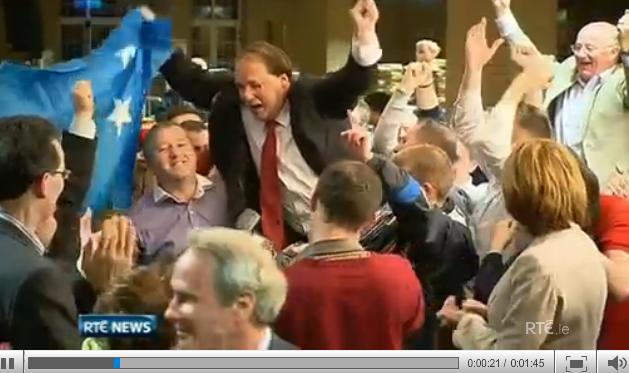
Newly elected Labour T.D Patrick Nulty
….on Wednesday he voted to block any debate or vote on the paying out of 700m euro to Anglo Irish Bank bondholders. Only in Ireland eh?
Share this:

Search CHTM
Out Now!
Now in paperback
-
Join 2,523 other subscribers
The Authors
Recent Comments
Caroline Kelly on The Pearse Street Fire Di… George Kelly on The Pearse Street Fire Di… Caroline Kelly on The Pearse Street Fire Di… stephenh1012 on 6 Lower Baggot Street 讲述 Green Day 1991 年在… on Historic Dublin pub The White… Copyright

Come Here To Me! by Sam, Donal & Ci is licensed under a Creative Commons Attribution-NonCommercial-NoDerivs 3.0 Unported License.
 Click on the book for more.
 Click on the book for more.
 Donal
Donal Ciarán
 Sam
Sam


 Come Here To Me!