Feeds:
Posts
Comments

Archive for 2012

Constable Sheahan memorial (Photo: Donal Fallon)

While many Dubliners have not heard of Constable Patrick Sheahan before, the vast majority will be familiar with the monument in his honour which until recently stood at the junction of Hawkins Street and Burgh Quay, at least to walk past. It has been removed in recent times as construction is underway on the Luas bridge which will span the Liffey. Constable Sheahan was a member of the Dublin Metropolitan Police force, hailing from County Limerick. He lost in life in tragic circumstances in May 1905 when he was overcome by deadly gas in the sewers of Dublin as he attempted to rescue unconscious workmen. The events of that tragic day are well-documented in an article by Tom Donovan for the Old Limerick Journal, available to read in full here:

On Saturday May 6th 1905, a workman named John Fleming opened a manhole- cover at the corner of Hawkins Street and Burgh Quay at around 3 p.m. He descended a ladder into the 24foot sewer to investigate a broken pipe and he was immediately overcome by the deadly gas, as were two of his colleagues who rushed to assist him. Christopher Nolan, a who witnessed the incident, ran for help. He found Constable Sheahan, of College Street Station, standing at O’Connell Bridge. Tragically for him, he was on duty to relieve a friend who wanted to go to the theatre.

Sheahan’s heroics touched the heart of native Dubliners, as this young man of only 29 had given everything in an attempt to save others. In 1906 a monument to Sheahan was erected, paid for my public subscription, and placed at the site of the tragedy. Interestingly, it contains both Irish and English language inscriptions, and notes that: “This memorial was erected in memory of Patrick Sheahan,a constable in the Dublin Metropolitan Police Force who lost his life on the 6th day of May 1905.”

Illustration of Captain Patrick Sheahan from Jim Herlihy’s excellent ‘The Dublin Metropolitan Police’ (Dublin,2001)

Sheahan was a well-known and much liked character in Dublin, and stories of his bravery had existed in the city long before his death. One of my favourite stories about Sheahan related to him ‘single-handily’ wrestling an escaped bull on Grafton Street. Wondering how much fact and how much folklore was involved in the tale, we went looking for the newspaper reports of the day.

The Irish Times of 24 March 1904 details a ‘Exciting Incident In Dublin’ during which a number of police officers wrestled an escaped bull on Grafton Street. The paper reported that:

A large roam bullock which escaped from its keeper, between six and seven o’clock last evening, while being driven along Harcourt Street, created quite a scare in the locality, and before it was finally captured and slaughtered in the vicinity of Grafton Street, after a prolonged struggle with several policemen, it injured two persons, who were subsequently removed to hospital.

The animal had made a dash from Harcourt Street station in the direction of Wexford Street, knocking down a young girl by the name of Kathleen Regan in the process. Running madly through the city, it made its way to Whitefriar Street where the five year old Christopher John Walsh was struck. Its appearance on Grafton Street caused pandemonium, and it was here that men of the Dublin Metropolitan Police confronted the animal. Sheahan was not alone, as folklore has had it, but in the company of another DMP man, Constable Kerby. A local stableman named Thomas Arbuthnot joined the two police officers, as they followed the bull into Anne’s Lane. An extraordinary twenty-minute tangle with the animal would result in the two DMP men using a rope to essentially ‘lasso’ the animal, and when they succeeded in wrestling it to submission with the assistance of bemused Dubliners, they called on Martin Tierney. Tierney was a butcher on Capel Street. The bull, marked JSC on the left hip, found itself next in an Abattoir.

Just over a year after this incredible incident, Sheahan himself was dead. On an interesting aside, Shehan is a relation of John Sheahan, a fine traditional musician who is now the longest-serving member of The Dubliners folk band!
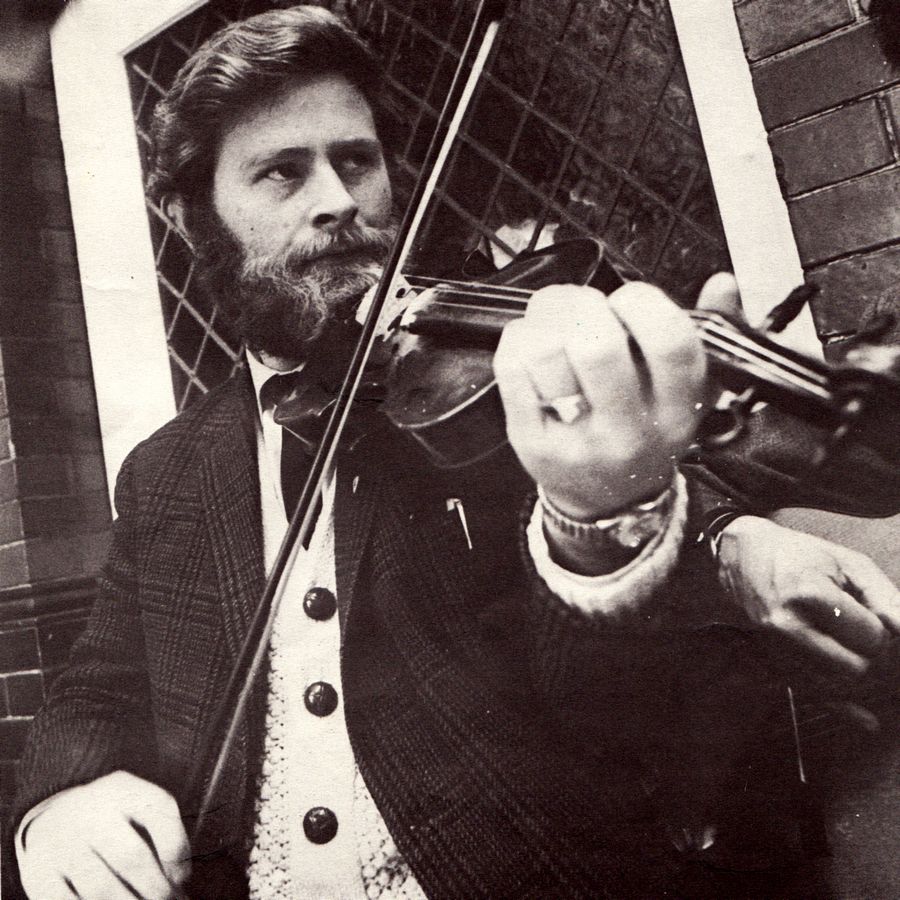
Image of John Sheahan from the fantastic It’s The Dubliners website, at: http://itsthedubliners.com

Read Full Post »

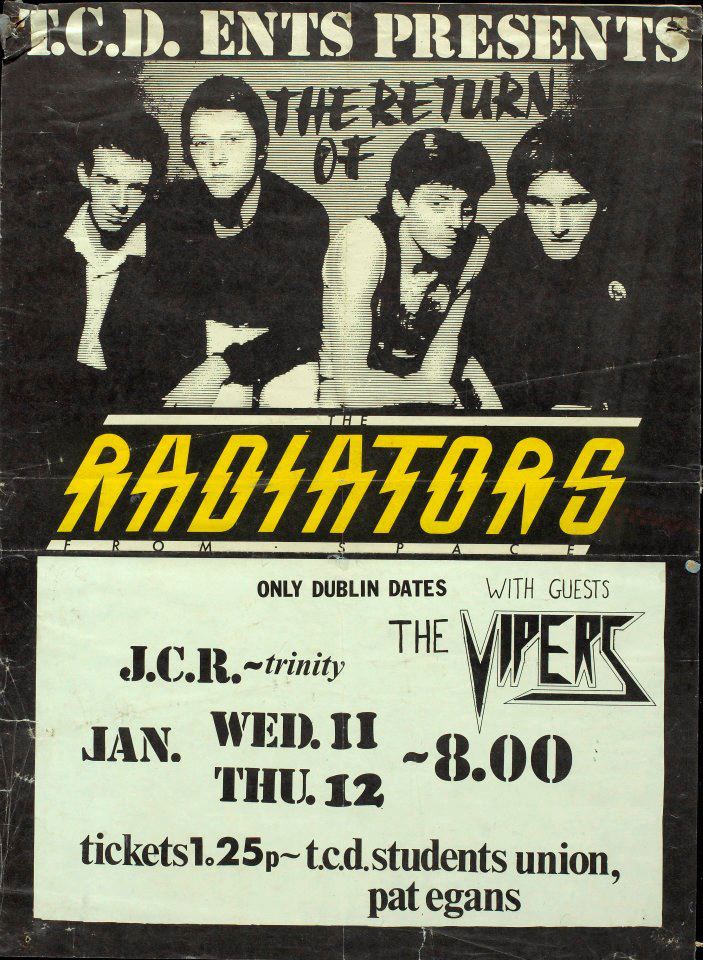
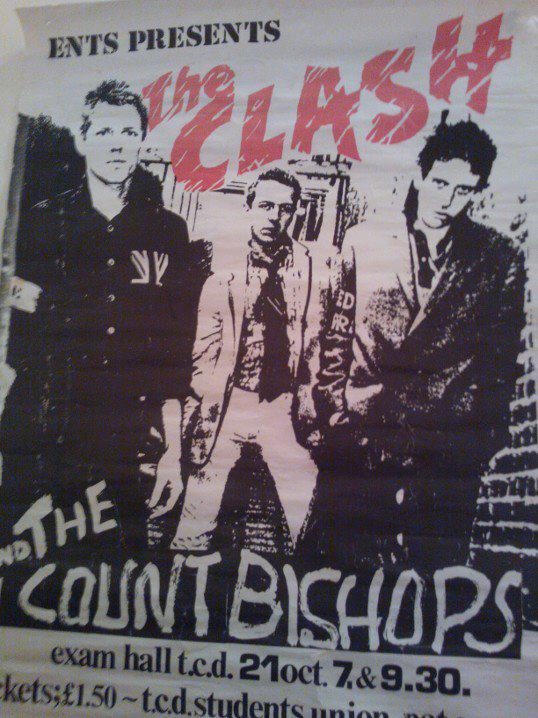
The Clash & The Count Bishops. TCD, October 1977.

A number of Facebook pages have sprung up lately for Dublin punk & new wave bands of the 1976 – 1983 period. It’s allowing former band members and fans to leave comments and post up pictures and gig posters.

If you know of any more, let us know.

The Atrix

The Radiators From Space

The Sussed

The Virgin Prunes

The Vipers

The Zen Alligators

The Radiators & The Vipers. TCD, nd.

Read Full Post »

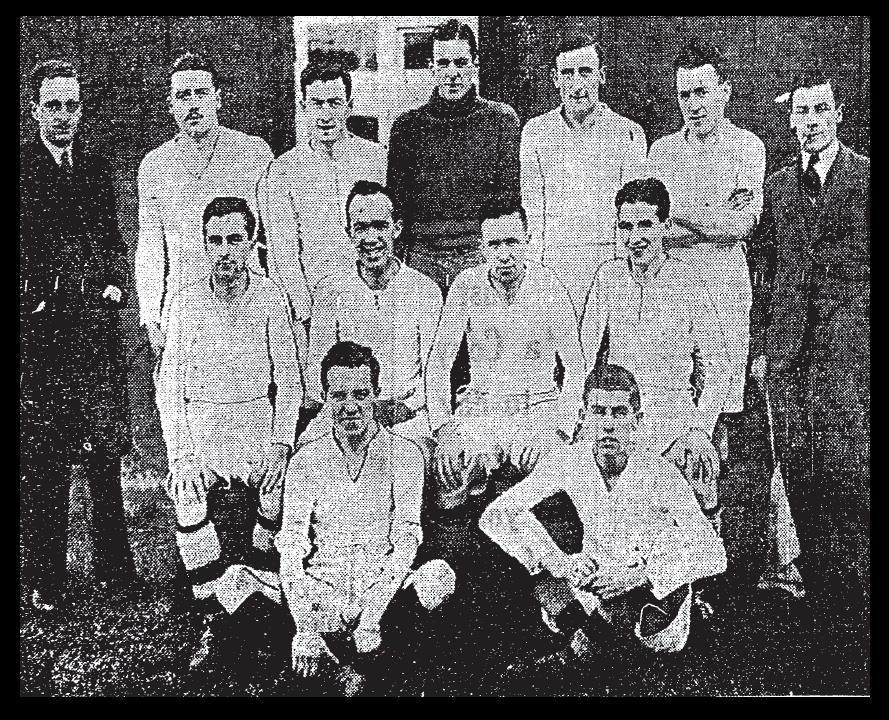
A Dublin university side (TCD and UCD) who faced Bohs in 1930.

A brief post to draw attention to an upcoming History Ireland Hedge School, taking place this Saturday at 3pm in Dalymount Park as part of the annual Phizzfest. I was chuffed to be asked to speak at this one, and hopefully I can give the perspective of a younger LOI devotee as well as looking at some of the historic aspects of the game we’ve covered on the site here. Dalymount Park really is the perfect setting to talk about the beautiful game.

In the spirit of hedge schools of yore, where wandering school masters taught pupils in improvised surroundings, this year’s History Ireland Hedge School @ PhizzFest moves to the home of Irish football, Dalymount Park, for a discussion on the history of the game. Why was it called the ‘garrison game’? What were the circumstances of the split with the Belfast-based Irish Football Association in the 1920s? Why are League of Ireland clubs so poorly supported and resourced? Join Hedge School master, Tommy Graham, to address these and related questions with the panel: Paul Rouse (sports historian, UCD); Donal Fallon (Come Here To Me blog); Brian Trench (PRO, Bohs); and David Toms (Waterford supporter & UCC).

Read Full Post »

Its easy to forget that Dublin is a town on the sea. Our relationship to the wide expanse that is Dublin Bay extends slightly farther than Dublin Port on the Northside and the Pigeon House on the Southside; but for the last few years, I’ve lived between the canals and because of that, my world has consisted of Dublin’s streetscapes,  neglecting what lies outside of those.

With the summer that was in it, you couldn’t exactly go exploring, but thankfully, this last week has looked something like a normal September might… This week so far though, I’ve been to Dun Laoghaire on Monday and out to Howth with the bauld JScully on Tuesday. Later this week, its the Hellfire Club for us, and hopefully a few pictures of that will come too. Above is Ireland’s Eye from the end of Howth Pier. For some reason, I always thought it was bigger…

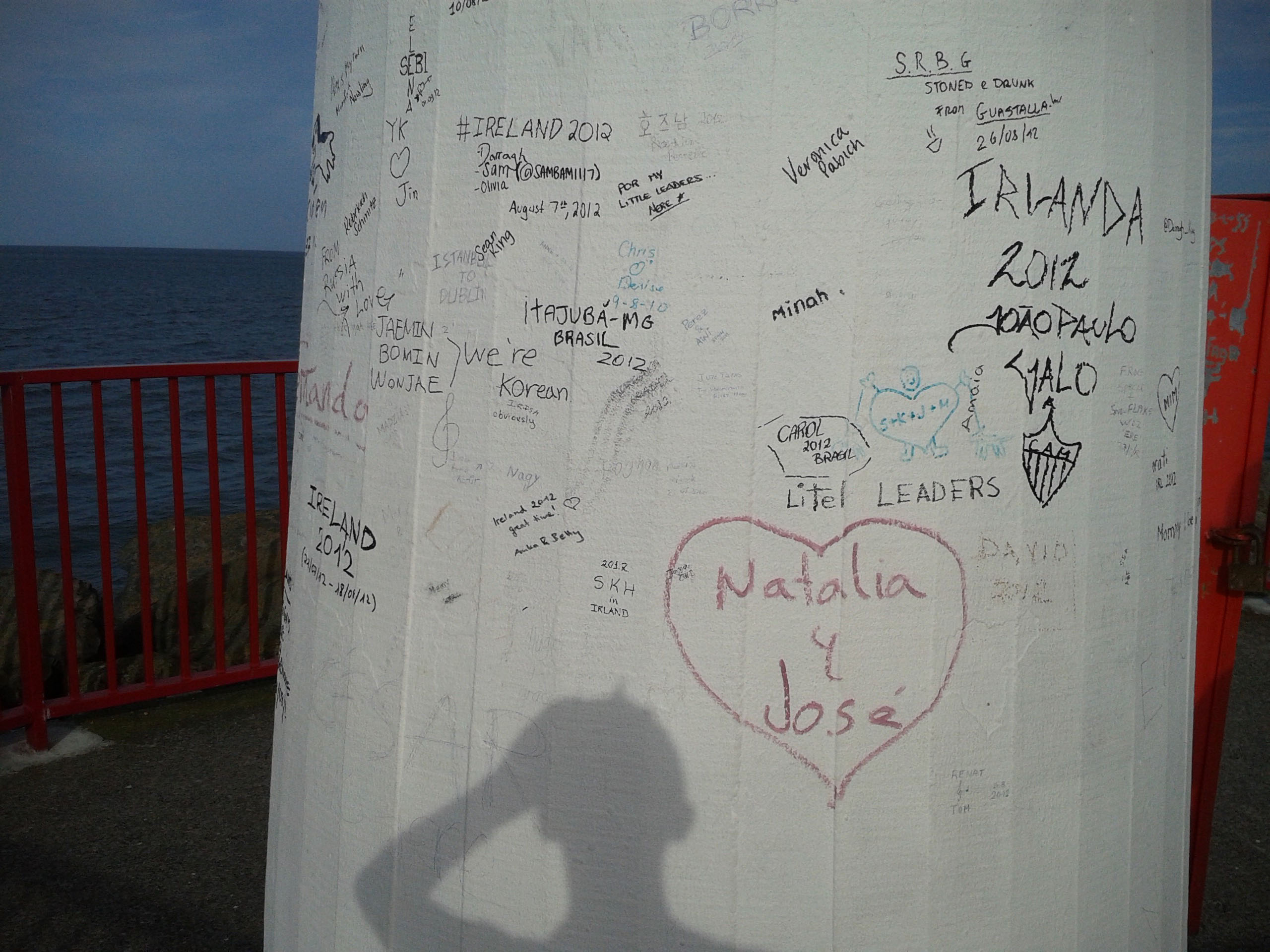
Some… odd grafitti adorning the lighthouse at the end of the pier. Tags from all over the world, from Brazil to Korea and beyond, go right around the small structure, an interesting one to see. This village lies not ten miles away from O’Connell Bridge yet I haven’t been here since I was a toddler.

Up to the summit, off the bikes (thankfully,) and a walk down to the cliffs. Have to admit, we felt more than a bit jealous looking at the people sitting outside The Summit pub drinking pint bottles of cider, but that’s for another time. Stunning views from the cliffs. (more…)

Read Full Post »

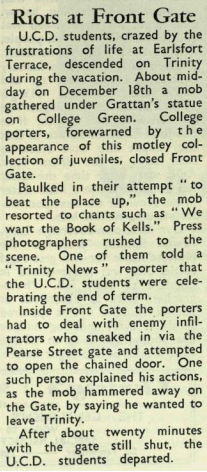
The rivalry between UCD and Trinity College Dublin is long-standing in Dublin, but with UCD now located in the suburbs the banter between the two universities isn’t quite as strong as in the past. I stumbled across this great newspaper report recently, which comes from Trinity News, a student newspaper at Trinity College Dublin. The report from January 1965 is fantastic, blaming the “frustrations of life at Earlsfort Terrace” for an incident which saw UCD students taunting the other university to celebrate the end of term!

Via ‘Trinity News Archive’ (trinitynewsarchive.com)

The Trinity News Archive website is a treasure trove of not alone news reports like the above but also images. This fantastic image for example shows the 1965 film Blue Max being shot on campus. The film, set during WWI, saw Trinity used as a German Army headquarters.

Via ‘Trinity News Archive’.

Read Full Post »

Some personal favourites!


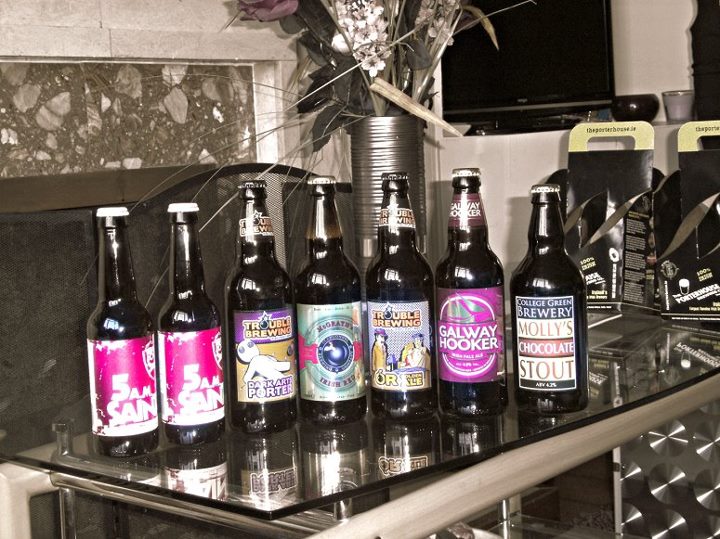
With the Tall Ships Festival and the Electric Picnic behind us now, we’ve moved into September and the days get shorter and colder, if that’s possible. Still ahead of us though is an event we’re really excited about, with the All Ireland Craft Beerfest taking place this weekend.

We’ve always given good time to Irish microbreweries on the site, and even devoted one of our pub crawls to them in its entirety. We’ve also dug up some gems from the brewing history of the city, for example this advertisement for O’Connell’s Dublin Ale, no longer found on tap anywhere in the capital.

It’s a fairly shocking indictment of the Irish pub, that CAMRA (‘Campaign for Real Ale’), the leading craft beer lovers organisation in the UK, was actually established in a pub in County Kerry. Then, it was known as the Campaign for the Revitalisation of Ale. They’ve certainly enjoyed some success. A great history of the breweries of this city has been written by the Dublin Brewing Co., who note for example that:

A city that was once host to over 30 breweries was now reduced to one. Guinness was so dominant in Ireland, that when it started its first advertising campaign in England in 1929 it felt it was a complete waste of money to spend anything in Ireland. Consumers either drank its beer or gave up drinking.

In recent years there’s been a brilliant trend in Dublin which has seen the microbrewery and the craft beer pub both flourish. Not alone craft beer specific pubs like The Black Sheep and Against The Grain, but even pubs like the Bowes and the Cobblestone (two Come Here To Me favourites) have hugely diversified their taps.

We’re certainly popping into the RDS this weekend for the festival. Most of our favourite Irish brewers are on hand, including Trouble Brewing, Metalman and Dungarvin. The festival is open on Friday, Saturday and Sunday, with more information on their site here.

Read Full Post »

What’s in a name?

An impressive seventeen bridges span the River Liffey in Dublin city, and in many cases their names honour dead nationalists of Ireland’s past. Sean Heuston, the 25-year-old rebel executed in 1916 for his role in the Easter rebellion, gives his name to the bridge next to the train station also named in his honour. Today, the LUAS passes over Heuston Bridge. It’s ironic that the bridge was first opened with the name Kings Bridge to commemorate a visit by King George IV in 1821.

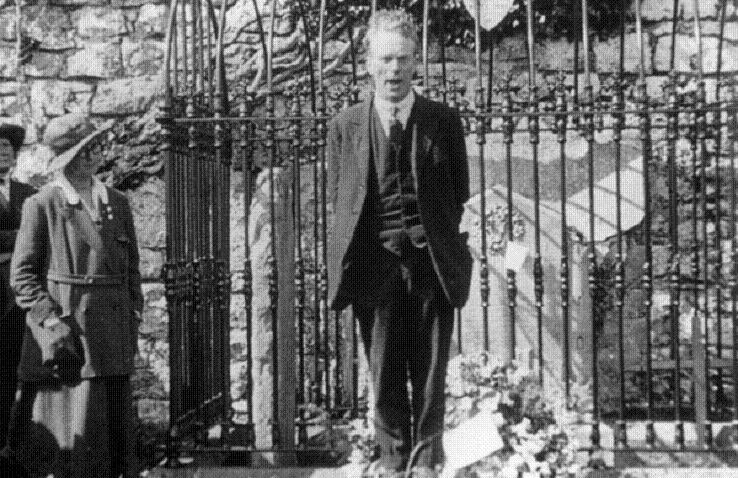
Further up the river, one finds Liam Mellows Bridge, named in honour of the progressive republican Liam Mellows, who was executed by the Free State during the civil war. As hxci has noted in an early post on this site, “at 248 years of age, Mellows Bridge is the oldest existing bridge across the Liffey.”

Liam Mellows addressing a gathering at Bodenstown. Today, Mellows Bridge is named in his honour.

Yet in recent times there has been real shift away from naming bridges in honour of political figures. James Joyce, Samuel Beckett and Sean O’Casey have seen bridges named in their honour in recent years. While of course O’Casey was a member of the Irish Citizen Army at one point and a socialist himself, the recent shift has been away from political figures and towards figures who are first and foremost cultural.

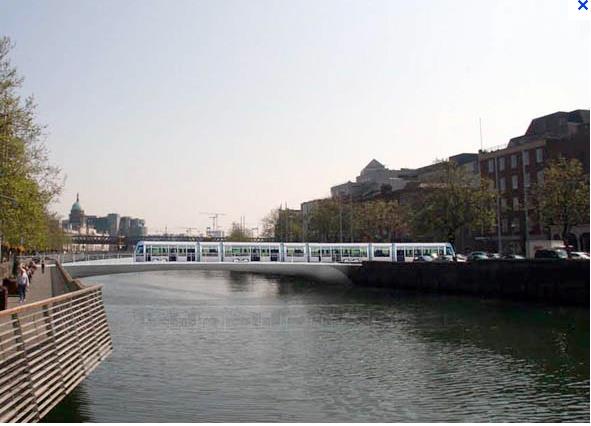
The new bridge currently under construction, spanning the River Liffey from Marlborough Street to Hawkins Street, is being built with the purpose of connecting the LUAS on both sides of the Liffey. The image below gives a good artists impression of the planned completed work:

Various names have been proposed for the new bridge. In the pages of The Irish Times Frank McNally proposed a hero of Come Here To Me, Flann O’Brien (that is Myles na gCopaleen) as being the perfect candidate. Others have proposed Bram Stoker, while others have proposed to name the bridge in honour of the Abbey Theatre next to it. The fact that not a single Dublin bridge has been named in honour of a female figure from our past has been commented on in many quarters too, and the debate continues to rage.

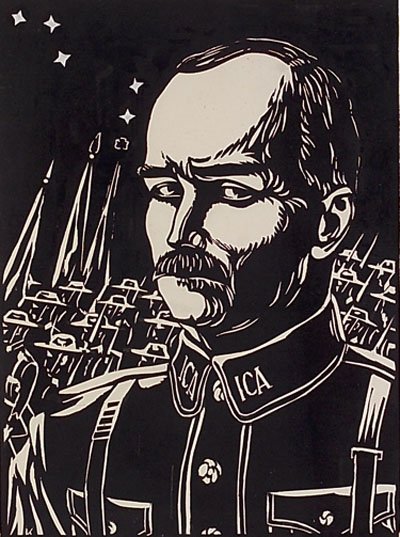
Now, the union movement have entered the debate and proposed to name the bridge in honour of the Edinburgh born trade unionist James Connolly. Connolly’s beloved Irish Citizen Army had its headquarters at Liberty Hall next to the bridge it should be remembered. What I like most about this idea however is something which many commentators may miss or even choose to ignore. Connolly played a central role in the Lockout of 1913, when Dublin tram workers were entangled in the greatest labour dispute in the history of the capital. To see the trams of Dublin today pass over Connolly Bridge would be some sight!

The committee is being led by Brendan Carr of SIPTU, who was stated that the campaign already seems to be enjoying broad political backing, an article on build.ie quotes Carr as stating:

Connolly played a crucial role in the events of 1913, when the working people of Dublin took a stand for better living and working conditions. He also personifies the link between this struggle and the later events of Easter 1916, during which he led the rebel forces.

However Connolly must also be remembered for his importance as a thinker and a writer of seminal works on Irish history and society. He would not be out of place in the modern, cosmopolitan Dublin. Connolly was himself an immigrant. Born into grinding poverty in the Cowgate area of Edinburgh to Irish parents his legacy reaches beyond Ireland to Britain and the United States, where he also worked as a union organiser.

It’s certainly a fine idea to name the bridge in honour of Connolly. I’ve heard one barstool genius already propose the Brian Lenihan Bridge, and no doubt we’ll hear all sorts of other proposals between now and the time Dublin City Council reach their decision in the Autumn, but will Connolly win the day?

Harry Kernoff’s 1936 woodcut tribute to Connolly.

Read Full Post »

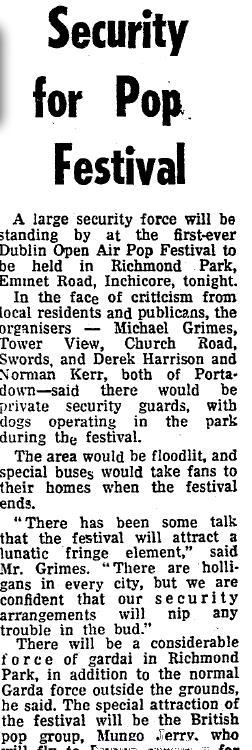
Back in November 2011, we had a post dealing with the first outdoor rock festival in Ireland, which happened in September 1970 in my beloved Richmond Park, the home of Saint Patrick’s Athletic.

Irish Press newspaper report September 4 1970

In the end, the festival proved to be an absolute disaster. This was owing to a number of factors but primarily hysteric media reports, which focused on drugs and violence in the lead-up to the event.

“I’ve been to better wakes” was a quote from one discontented young punter in The Irish Times, which ran with the headline ‘Open Air Festival Hardly Pops’. The paper noted that only several hundred young people had attended the festival, perhaps unsurprising giving the scare-tactics in the media in the run up to the event.

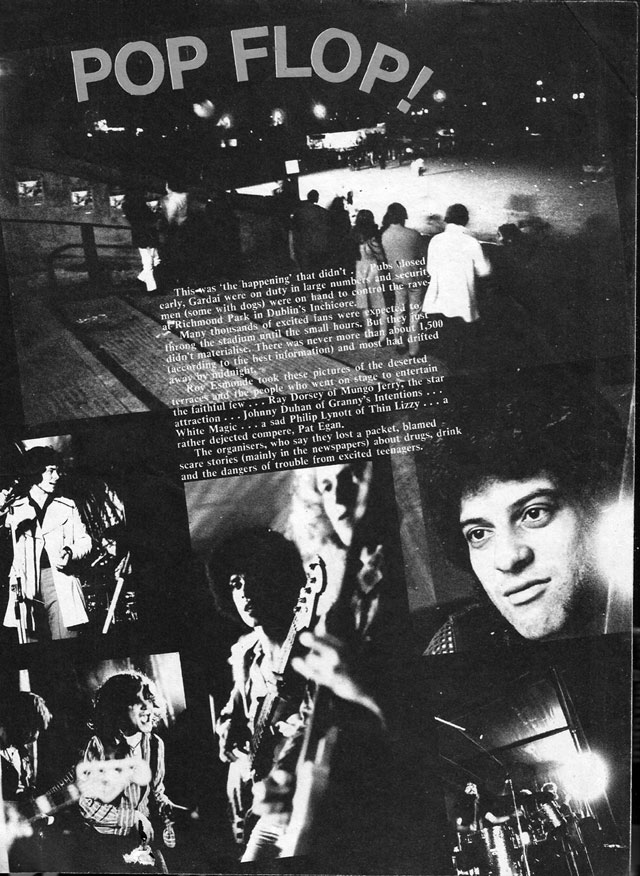
Now, one of our favourite blogs has managed to upload some images from the event.

Via ‘Brand New Retro’

Brand New Retro has scanned up some great photographs from the day. Interestingly, it seems the media chose to refer to the gig in Richmond Park as a ‘rave’. The images of a young Phil Lynott are excellent.

Read Full Post »

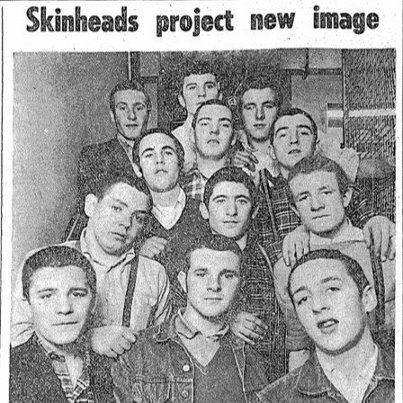
From the ‘Animal Gangs’ of the 1930s to football hooliganism in the 1970s and 80s, we’ve long had an obsession around these parts with the violent past of the capital. Even yesterday jaycarax wrote a piece on triad gang violence in the capital in the late 1970s. Gang violence and mentality is a fascinating and often revealing subject.

This year, as part of the Electric Picnic festival in Stradbally, History Ireland are presenting two Hedge Schools in the Mindfield area, both taking place on the Leviathan Stage. Essentially Mindfield is a large, spoken word corner which adds to the fun of EP in a big way for me. This is the third year of History Ireland Hedge Schools at the event.

I’m on the panel for a discussion on Sunday:

From the Liberty Boys to the Westies: gang culture in Ireland with David Donnelly (ex-Black Catholics punk gang), Donal Fallon (Come Here To Me Blog), John Gibney (History Ireland) and Niamh Hourigan (UCC).

It is due to begin at about 2.45pm on Sunday . With festivals, things naturally start and finish a little off schedule so keep that in mind but it should make for an interesting discussion. I’m going to be focusing primarily on the capital and the first half of the twentieth century. We’ll be looking not only at actual gangs, but also media hysteria and coverage of different subcultures and the like.

I’ll likely be focusing on the ‘Animals’ of the 1930’s and 40’s, as well as the various subcultures of the 1950s onwards and the violence or perceived violence around them.

A classic newspaper image of Dublin skinheads, first posted online by our own JayCarax here on site.

A 2011 Hedge School on the Animal Gangs can be heard below:

There is another Hedge School on the Saturday,on the subject of the Irish and racism. It is due to begin at 2.45, though again these times can change and shift.

Racism and the Irish: perpetrators or victims? with Mary Corcoran (NUI Maynooth), Lar Joye (National Museum), Angus Mitchell (Casement—Life and Times) and Hiram Morgan (UCC)

Read Full Post »

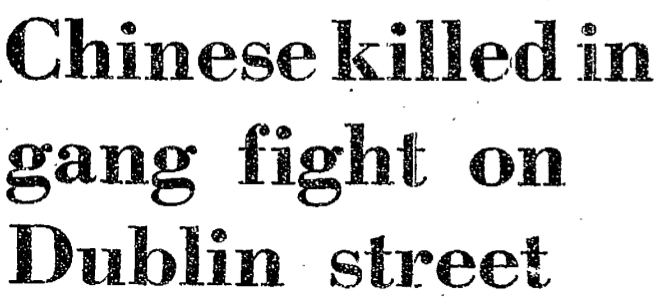
Irish Times headline. Jul 18, 1979.

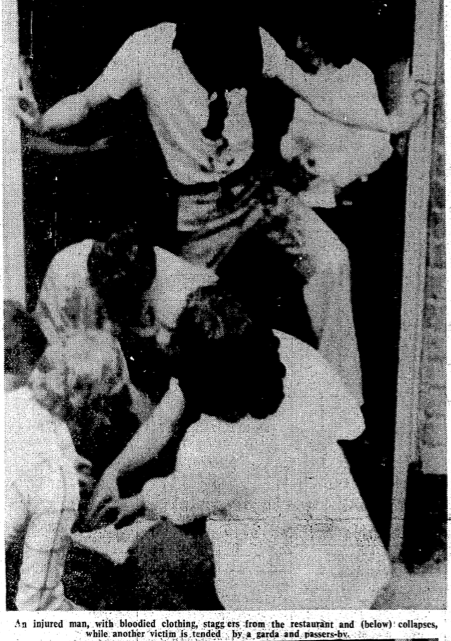
Two Chinese men died and several others were badly injured (including one blinded for life) after a bloody battle broke out between rival groups outside the New Universal Chinese Restaurant on Middle Abbey Street in the summer of 1979.

A .22 long rifle, butchers cleavers, kitchen knives and iron bars were used in the fight which left blood spattered across the road and traffic cordoned off for a number of hours.

Irish Independent, July 18 1979

Witnesses said the fight on July 17 1979 started:

when a group of about seven well-dressed young Chinese arrived in two cars and went into the New Universal Chinese Restaurant, near the corner of Liffey Street. Within minutes, eye witnessed said, there was a commotion inside inside and young Chinese were seen rushing out of the street.

The violence was the climax of a building conflict when a Triad protection gang from Cork, Belfast and England tried to muscle its way on a Dublin Chinese restaurant chain.

Cinema goers at the Curzon and the Adelphi had to run for cover when the fighting broke out. Ms Pat Keating, manageress of the Curzeon, said the scene on the street was ‘much worse than any Kung Fu film we ever showed here’.

Onlookers help a victim. Irish Independent, Jul 18, 1979.

One of the the key personalities in the affair, Tony Lee based in Cork, allegedly a ‘big boss in the 14K’ triad had his throat slashed and died shortly afterwards. His wife, Louise Lee, who was a secretary-director of a limited company set up by her husband in the early 1960s in Cork vigorously denied that he had anything to do with the Triads.

‘A frightened family group flee the scene of terror’. The Irish Independent, Jul 18, 1979.

Michael Tsin (26) from Dublin was shot dead in the brawl. Tsoi Foh Sing of Cork was charged with Tsim’s murder but was later acquitted.

It was revealed at the trial at the Central Criminal Court in November 1981 that trouble had been brewing between the two groups for at least three months before the fight. One group had demanded protection money from the other group who ran the Bamboo House restaurant on Dorset Street. There had also been a fight recently between members of the two groups outside the National Stadium after a martial arts exhibition.

In August 1983, twelve members of the 14K triad were arrested in Limerick in connection with the attempted extorting of protection money from the owners of Chinese restaurant in the city. Nine of the men were believed to have come over from Britain. During the operation a hoard of weapons including knifes, pickaxes, bars and clubs were found.

It was believed that the attempt to extract money had reached a critical point and the arrests may have ‘just managed to forestall a fight which could have been as bloody as that in Dublin’ in 1979. Contemporary newspaper reports suggested that the triad gangs – 14K, Sing Woo and Shui Fong all operated in the different parts of the country.

Refs:
The Irish Times: Jul 18, 1979; Jul 19, 1979; Nov 14, 1981; Aug 27, 1983;
The Irish Press: Nov 06, 1981; Nov 07, 1981; Nov 11, 1981

Read Full Post »

“The delights a stroll around Dublin can bring you. I’ve always carried my camera around with me, but have only recently started to take it out and not give a shite that I look like a tourist.”

Someone said of the last bunch of photo’s I stuck up that Dublin is starting to look like a proper shithole… Its not- its really not, its just that for whatever reason, I like taking pictures of graffiti, rundown buildings and, well, real Dublin. For any piece of eight or ten images, its possible to have taken fifty or sixty shots on my not very fancy camera. Subsequently, I have hundreds of shots of birds, trees, sunshine and flowers. But I still prefer the grittier side of things!

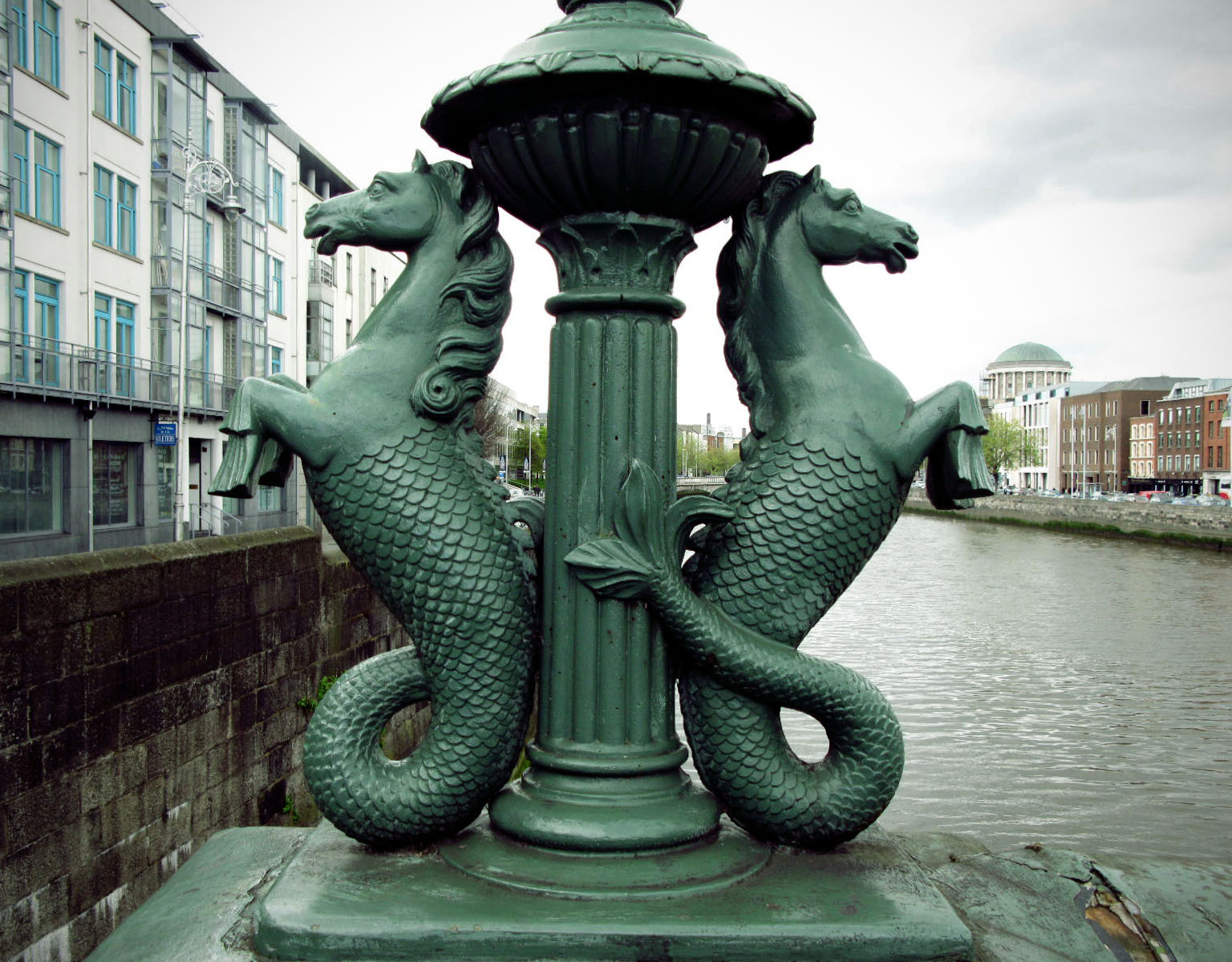
The Seahorses of Grattan Bridge. JayCarax has done some great work on the history of the Grattan statue on College Green. The  statue is, of course, surrounded by lamps bearing ornate seahorses. Grattan Bridge bears the same idols on its lamps.

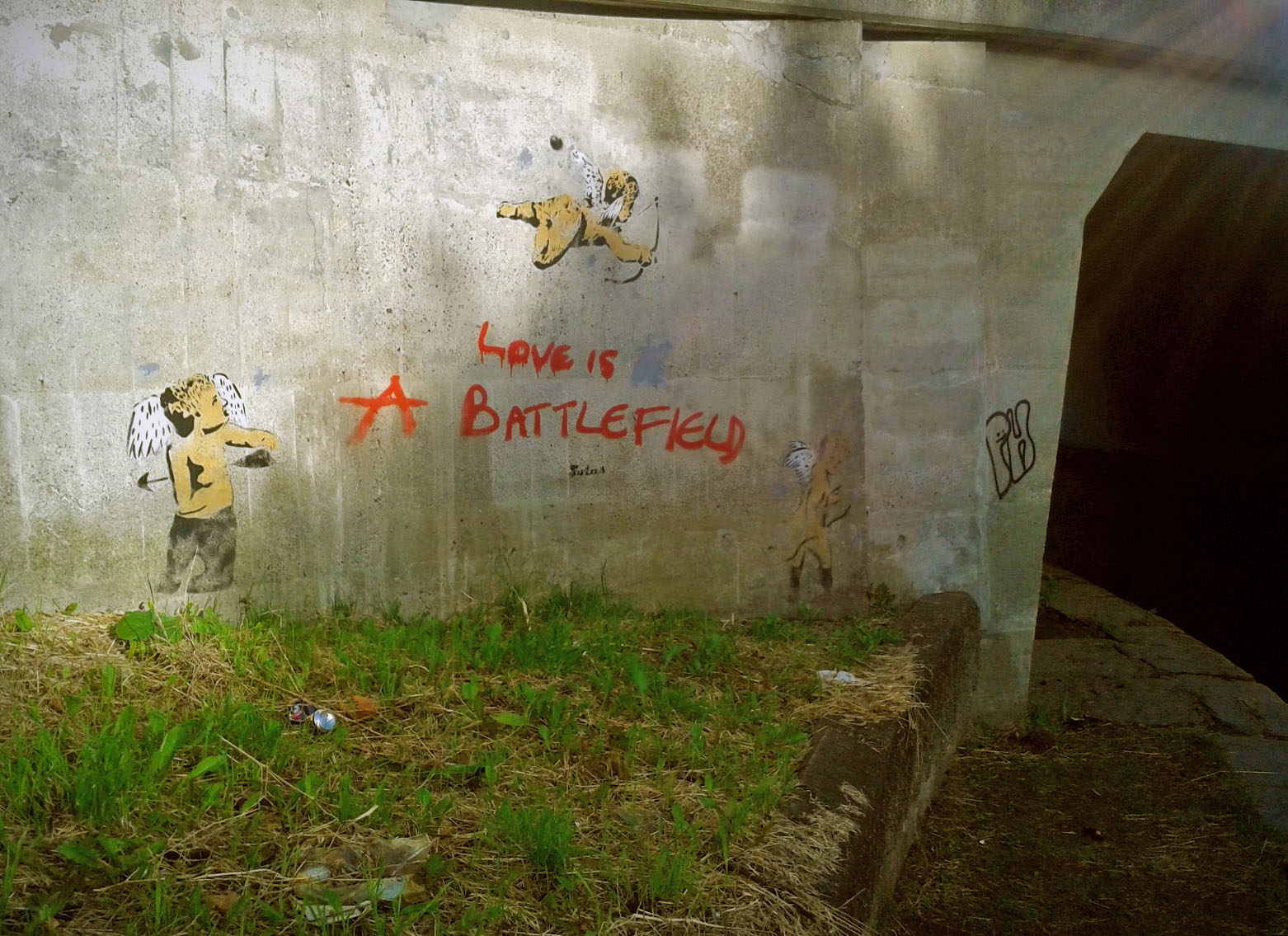
I’ve recently moved gaff, so my cycle to work takes me down along the canal, from Rathmines to Inchicore. For three months, I’ve been cycling past this spot and never noticed this piece on the side of the bridge at Herberton Road until this week. The work of Solus, I think its a belter!

(more…)

Read Full Post »

Hopalong Cassidy, a fictional cowboy hero created in 1904, was one of the most beloved characters of children worldwide for generations. The character inspired cartoons, comic books, television programmes and more besides, and even inspiring ‘Hoppyland’, an amusement park in Los Angeles, in the early 1950’s.

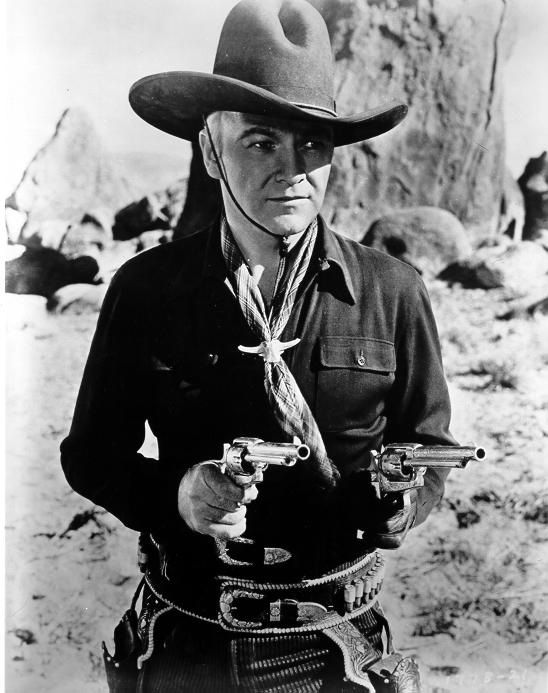
William Boyd was the actor who brought Hopalong Cassidy to international stardom. Indeed, the screening of the Hopalong Cassidy series featuring Boyd marked the beginning of a long running genre of such westerns on television, aimed at a young audience.

Boyd as Hopalong Cassidy, via /www.westernposterpage.com/

Between 1935 and 1948 Boyd would star in a total of 66 Hopalong Cassidy western films, the last 12 of which he produced himself. It was the rise of television and the screening of the films on the small screen which would make an icon of Boyd from the 1950’s onwards. Below is the trailer for the first Hopalong Cassidy western.

In Ireland, Hopalong Cassidy comic strips featured in the Irish Independent newspaper, and the character enjoyed huge popularity among the Irish youth. In July 1954, Hopalong Cassidy visited Dublin, grabbing national headlines and media attention. Boyd was joined by almost 100 youths, 48 of whom were from America and 46 from the UK. The event was advertised as being part of an “International Goodwill Tour”, which had seen the cowboy tour the UK and Ireland. Among the 100 youngsters were two Irish lads, with Norman Gedess from Belfast and Charles Vize od Decies Road in Ballyfermot.

When Boyd landed in Ireland on 27 July 1954, they landed in Dun Laoghaire and were then treated to a dinner organised by the Variety Club of Ireland in Butlin’s, Co.Meath. Among those in attendances at the dinner was Alfie Byrne, the popular Lord Mayor of Dublin. Boyd was accompanied on the trip by over 20 UK and American pressmen, giving a good idea of his international appeal.

An Irish Times journalist refered to a social function involving Hopalong Cassidy in Dublin as perhaps “one of the most curious social functions to take place in this stick-in-the-mud old town of ours”, noting that “a small, puzzled group of Dublin newspaper men stood awkwardly near the door, wondering what it was all about.” The journalist noted that so strong was the influence of American culture on young people globally, it was difficult to tell the British boys from the Americans. In the words of Boyd himself, the visit was apparently all about his “Operation Friendship”, and bringing boys of different nationalities together.

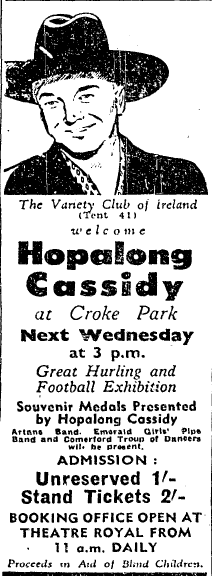
As part of the brief visit to Ireland, the world-famous cowboy visited Croke Park where the boys took in exhibition matches in native games. The teams were made up of boys from primary schools on both sides of the Liffey, and Boyd presented the winning teams with medals on the day.

Hopalong Cassidy at Croke Park, from ‘The Weekly Irish Times’.

Beyond newspaper reports, I could find precious little on this visit to Dublin, but I did see something interesting on the website of photopol, a frequent commenter of the site here. Writing about his memories of Butlins, Póló notes that:

Butlins was magic. The only disappointment in my time there was Hopalong Cassidy. The actor William Boyd had become completely identified in young minds with this fictional cowboy character. Boyd was Hopalong Cassidy. So when he was scheduled to appear at a campfire in Butlins, during his short visit to Ireland, we were ecstatic.

On the appointed night, we waited, and waited, and waited. But he never appeared. There were rumours of an excess of hospitality at a Croke Park function earlier in the day. A hero utterly destroyed for ever in the eyes of those eager young campers.

When Boyd and the ‘junior ambassadors’ were leaving Ireland, via a special flight from Dublin Airport, newspapers reported that hundreds of young boys and girls packed the airport, waving them off and creating a huge scene, as they departed for New York. The Sunday Independent captured the below image of their departure.

Hopalong Cassidy remained an international icon for children here long after he departed Dublin Airport. Wiliam Boyd passed away in September 1972 and the age of 77. Was anyone at the Croke Park games, or did you meet Boyd on his visit to Ireland?

Read Full Post »

« Newer Posts - Older Posts »