Feeds:
Posts
Comments

Archive for the ‘Dublin History’ Category

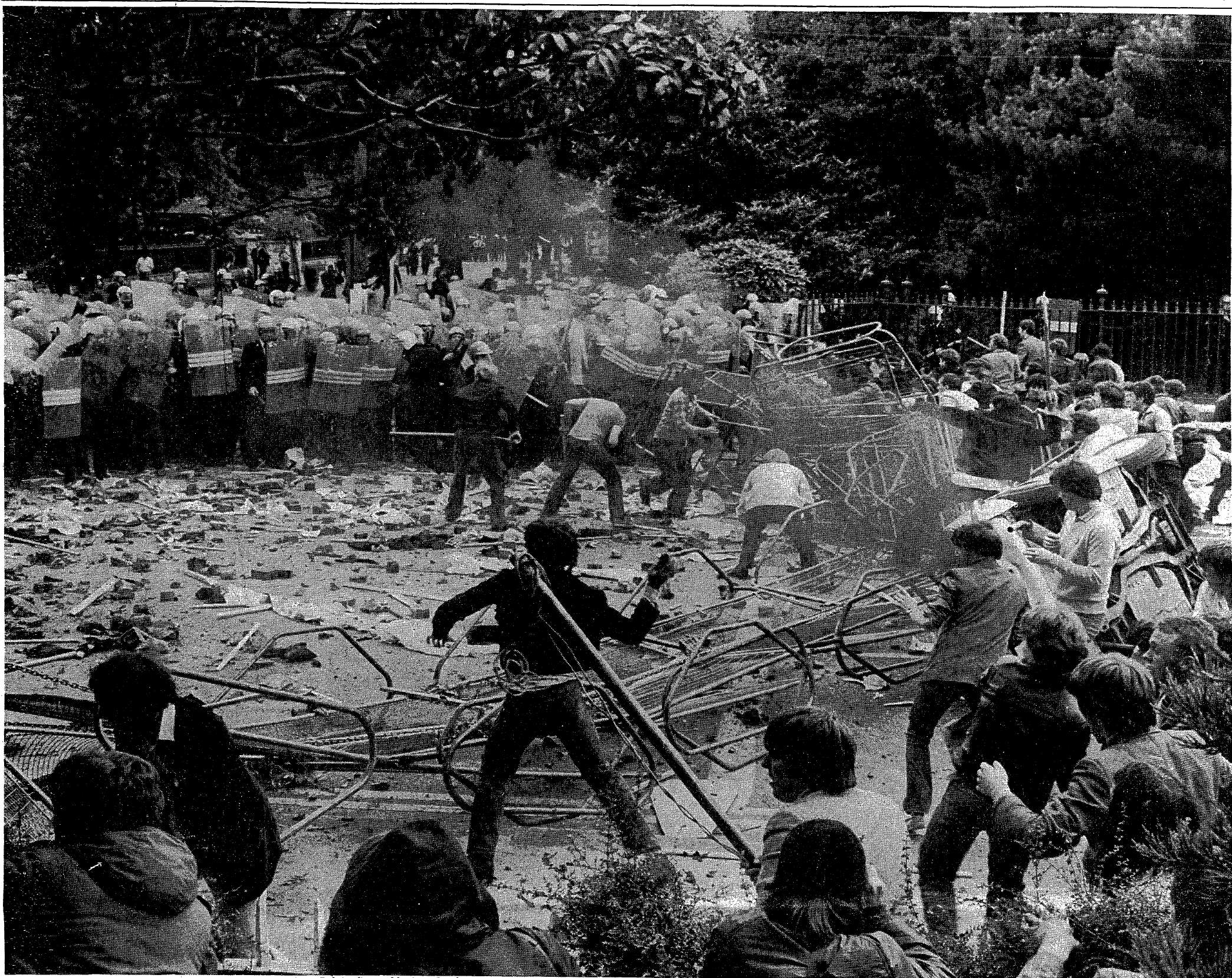
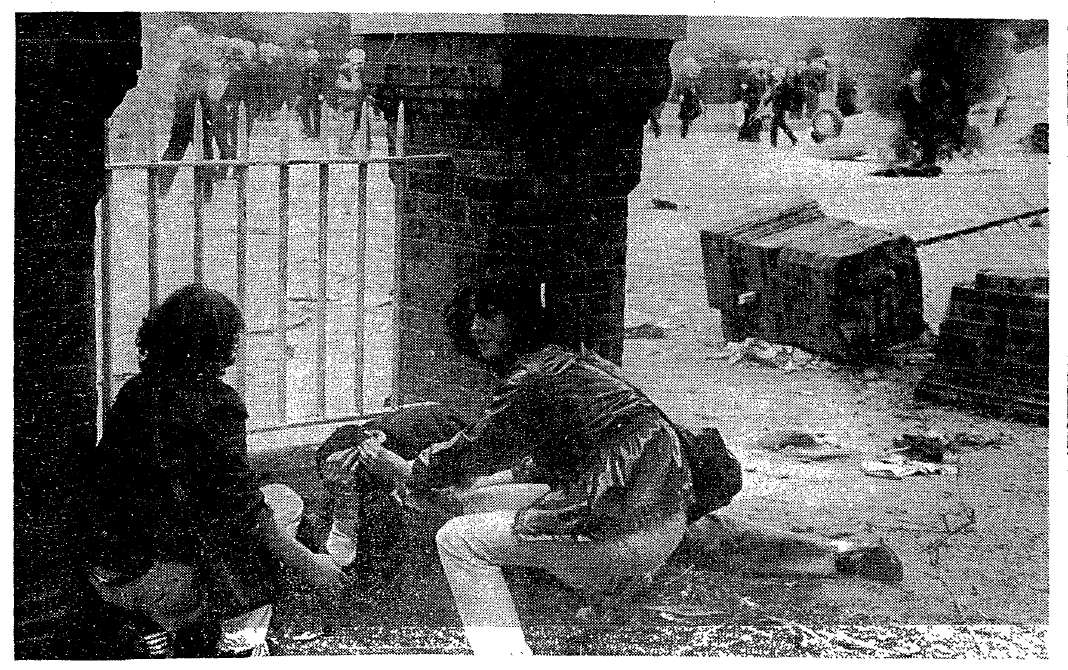
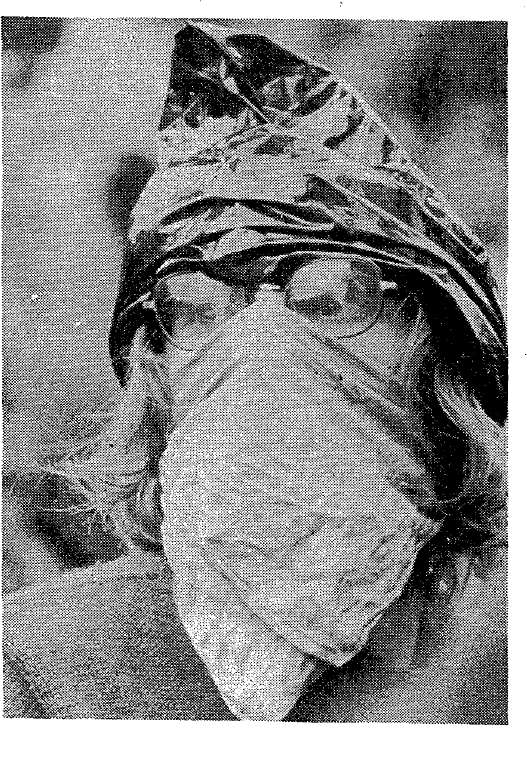
Scannal deliver again with an excellent documentary surrounding the events of 18 July 1981 when a 15,000 strong crowd of hunger sriker supporters clashed with 1,500 Gardaí in Ballsbridge. The day’s events saw over 200 people injured, 1 million pounds worth of damage caused and dozens of arrests.

The broadcast has interviews with Peter Murtagh of the Irish Times, Garret Fitzgerald, Bernadette McAliskey, Aengus Ó Snodaigh and local residents. It also includes great archive footage (that I’ve never seen before) of a H Block related evening riot on O’Connell Street in May 1981.

The programme is available to watch here until February 22nd.

Masked Protester. (c) Irish Times

The Battle of Merrion Road. (c) Irish Times

Injured man. (c) Irish Times

Read Full Post »

Mise an Fear Ceoil

Seamus Ennis

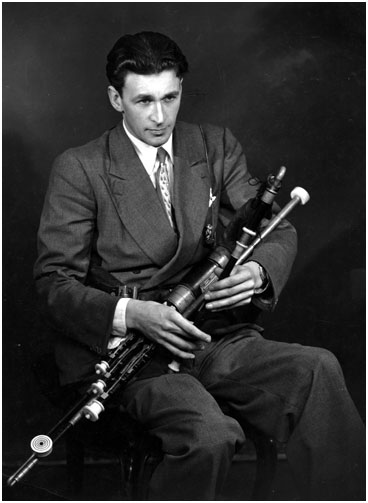
Seamus Ennis (1919-1982) from the Naul, North Dublin.

Just a short post, I’ll let the music talk.

I’ve been returning to Leagues O’ Toole’s fantastic book The Humours Of Planxty, which has opened me up completely to the music of Seamus Ennis. Ennis essentially served as a mentor to Liam Óg O’ Flynn of the legendary band, and also collected countless songs and sheets of music all over Ireland and indeed the UK.

Seamus spent his last years in a mobile home in the Naul, close to the land on which he was raised and where the sound of his fathers pipes would shape his life. Those very pipes, antique pieces in themselves, were to be played by Willie Clancy and Liam Óg later on in Seamus’ company.

He died in that small mobile home.

Those days will be remembered
Beyond out in the Naul
Listening to the master’s notes
As gently they did fall

Christy Moore, Easter Snow.

The Rainy Day/The Merry Blacksmith/The Silver Spear

Read Full Post »

Earlier this week, RTE broadcast a very well made documentary on the history of Nelson’s Pillar. The programme contains amazing archive footage along with contributions from Des Geraghty, Jimmy Magee and David Norris. If you missed it, viewers in Ireland can watch it on RTE Player until Monday, 15 February.

Though it focuses on the bombing of 1966, the documentary tells also tells the fascinating story of how in 1955 a group of UCD students, involved with the Irish National Student Council (INSC), occupied the pillar. Dropping a banner of Kevin Barry over the edge, they tried to melt Nelson’s statue with homemade “flame throwers”. Gardai used hammers to break into the pillar and tried to arrest the students but they had to be released after the gardai were attacked by sympathetic members of the public.

After the statue was blown up in May 1966, Nelson’s head was stolen by NCAD students from a storage shed in Clanbrassil Street as a fund-raising prank to help clear their debts. Wearing sinister black masks, they held a very civil press conference explaining their motives. The head made several secret appearances over the next six months including making its way onto the stage of a Dubliners concert in The Olympia Theatre!

Nelson’s head now rests peacefully in the Gilbert Library in Pearse Street.

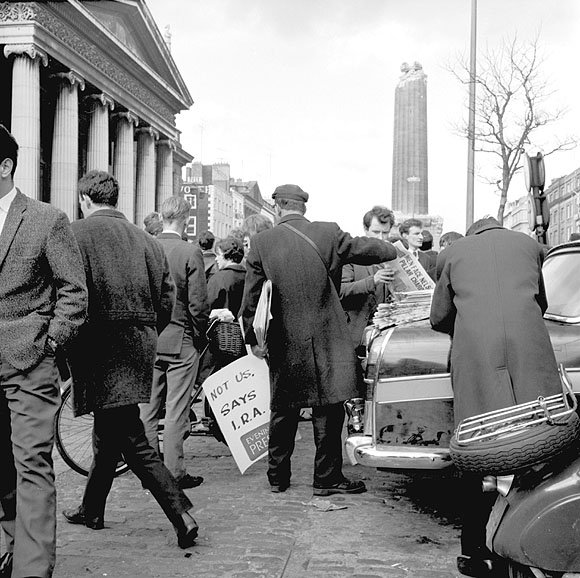
“Not us says I.R.A.” Dublin, 1966.

Read Full Post »

Dublin firefighters inspect the General Post Office, from \’The Dublin Fire Brigade\’ (2004,Dublin City Council Press)

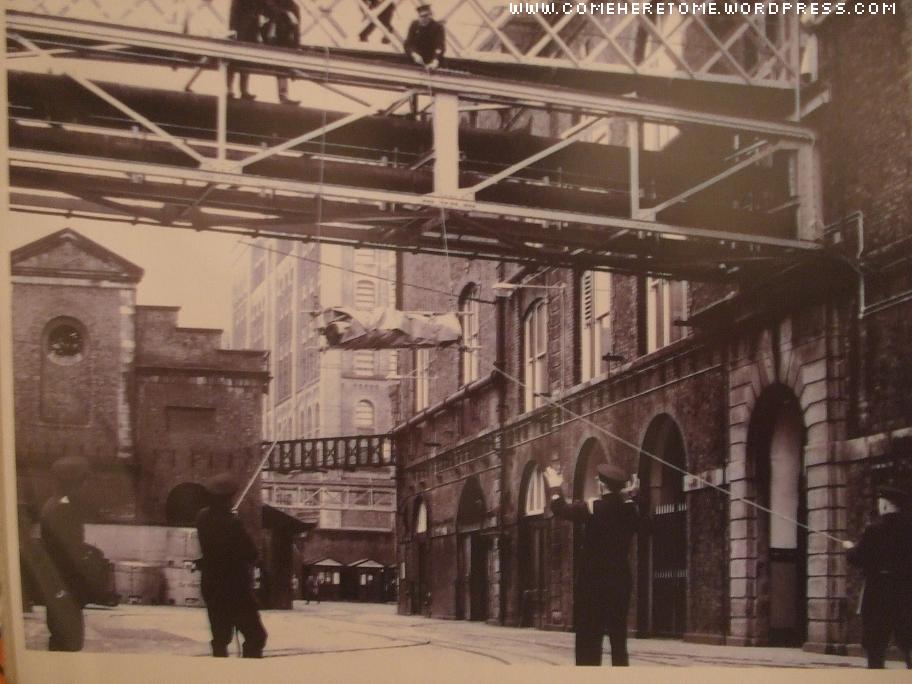
Recently, I spent painful hours online attempting to track down information on the Guinness Fire Brigade, but it was a hard task! Bass, Powers and Guinness all operated functional (and branded) fire services in their respective workplaces due to the nature of production and the risk posed. My interest in the men of what was branded the ‘Arthur Guinness and Sons’ Fire Brigade, centres around the events of Easter week 1916, but is by no means limited to that week alone.

Guinness, along with Powers Distillery , were both called out by Captain Purcell of the Dublin Fire Brigade during the 1916 insurrection to assist the city Brigade, who, along with Pembroke and Rathmines firefighters, found themselves working against the odds.

The Irish Times Focus on 1916 gives some extent of the damage caused to the city during the uprising

Fire had raged from the GPO towards the Liffey, reaching back along Henry Street to Henry Place and Moore Street, advancing towards Liffey Street, almost as far as the Irish Independent’s printing works on Middle Abbey Street. On the Sackville Street frontage, the Metropole Hotel, standing between Eason and the GPO, was gone, and with it adjoining buildings including the Oval bar. Thom’s printing works was destroyed.

On the Saturday night, well into the uprising that had, in the words of Captain Purcell, done at least £2.5 Million worth of damage to the streets of Dublin, it became apparent that there was a very real threat Jervis Hospital was going to burn to the ground. Purcell called on the fire brigades of Guinness Brewery and Powers to assist his Brigade. Occasionally under fire, they worked heroically and ensured the safety of the hospital.

Dublin Fire Brigade,1916 period standard. Las Fallon collection.

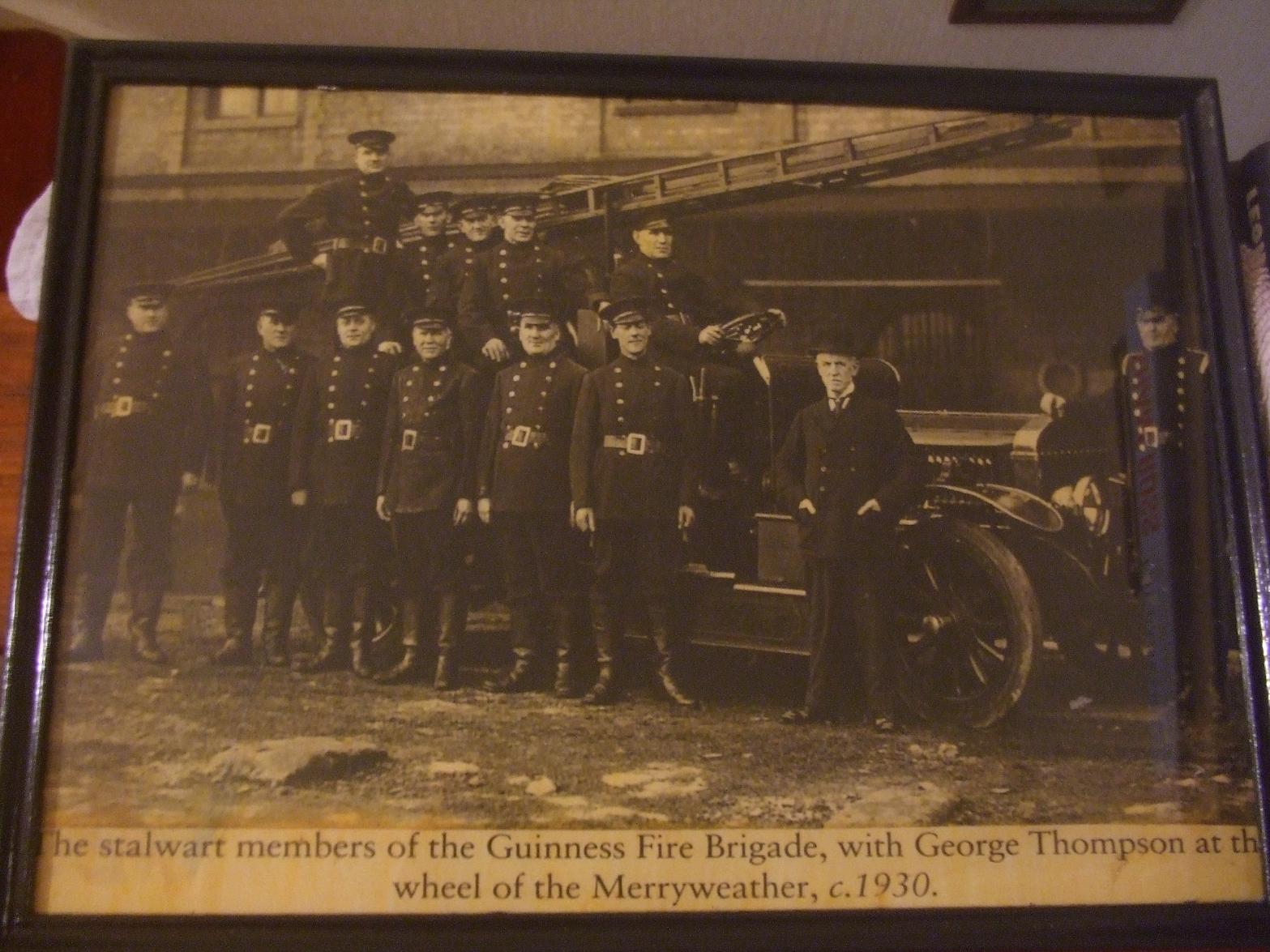
Little is known about the Guinness Fire Brigade in so far as a date of formation. Their exploits during Easter Week are documented in so far as possible in Tom Geraghty and Trevor Whiteheads ‘The Dublin Fire Brigade’ published by Dublin City Council in 2004 and an essential read for all interested in the history of the city. Yet they were a different Brigade, seperate from the Dublin Fire Brigade entirely. Thus, they have remained somewhat of a mystery.

Firefighters training at the site of what is now the Guinness Storehouse attraction

Some interesting insight can be gained into life for the Brewery fire and rescue squads from Edward J. Burkes recent The Guinness Story: The Family, The Business, The Black Stuff (O’ Brien Press, 2009) The book also provides information on the companies support for the repression of the Easter Rising, which makes for interesting reading in itself (for example a company of Dublin Fusilers were allowed set up in the Robert Street grainstore, and Guinness Daimler trucks topped with railway engine smoke boxes were a popular mode of transport and defensive/offensive tool for British forces)

Guinness firefighters, around the 1950s. Notice the \’AGS\’ branding of helmets.

From Burkes book, we can gather information of a fire at the Guinness Brewery in 1820, as reported in the Freemans Journal. All breweries and distillers in the area operated a fire-service (No surprise due to the highly flamable nature of the work) and all, along with the insurance companies of the area, helped to ensure no extensive damage occured.

One can only be reminded of recent events and the fire in the Guinness complex when they read the company press-statement which boasted…

“….the damage done is not very extensive, nor of such a nature as to stop the business of the brewery even for a day”

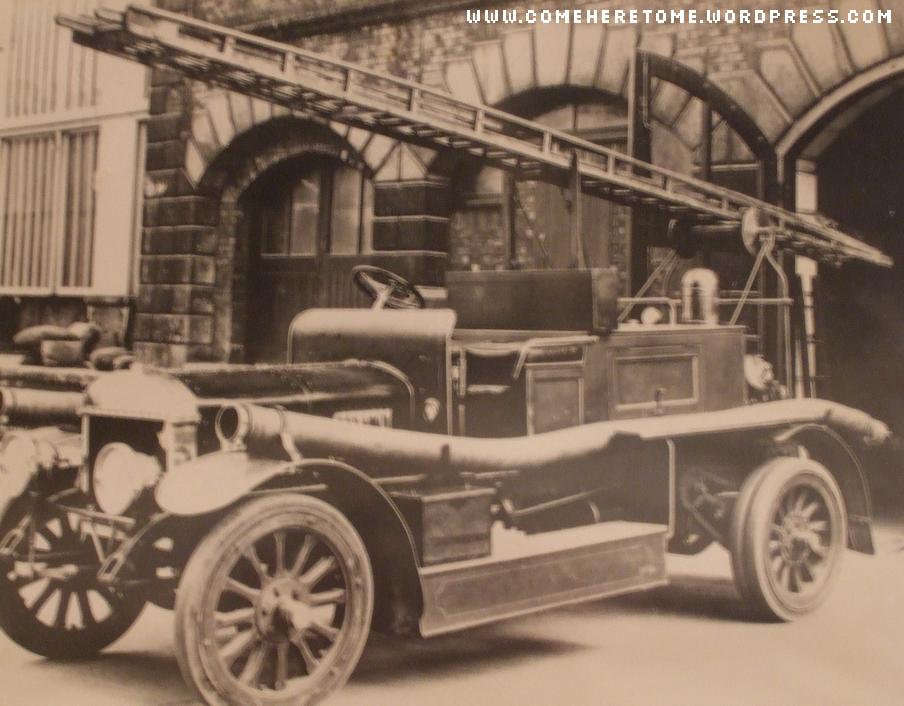
Brewery Fire Brigade piece.

The Guinness Fire Brigade in the 1930s.

The Guinness Fire Brigade in the 1930s.

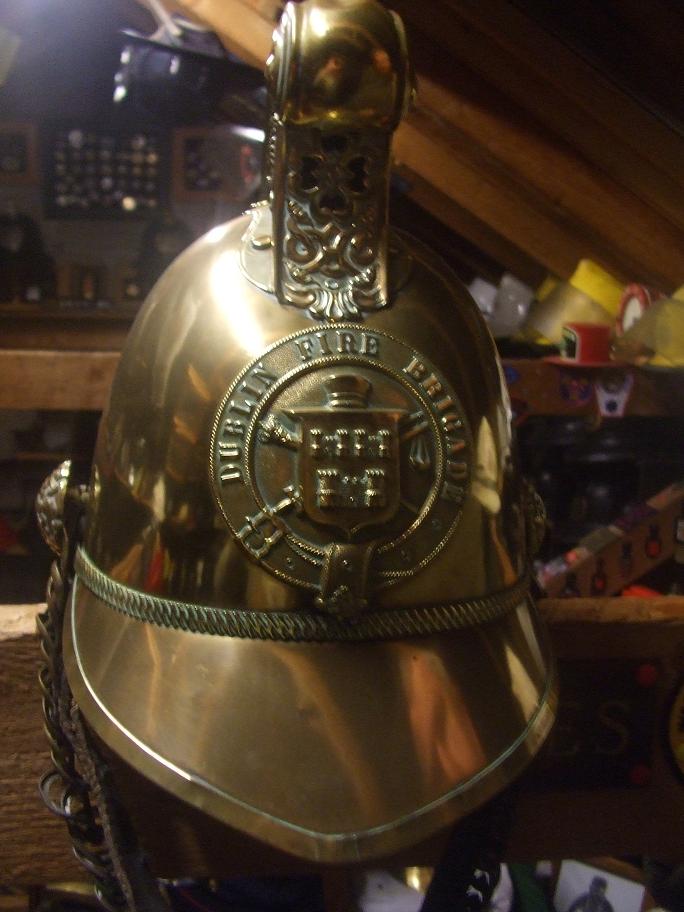
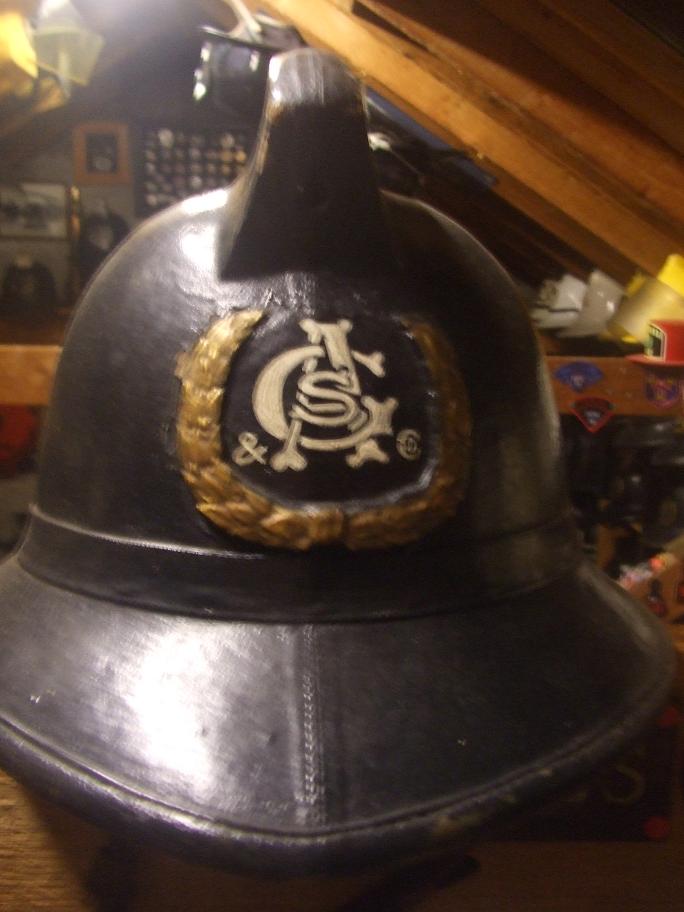
To many people,the Guinness fire-helmets are the most exciting part of the story. Below, I’ve included some snaps of Guinness helmets over the years, from the time of the Rising up until the mid 1900s. AGS, of course, stands for Arthur Guinness and Sons.

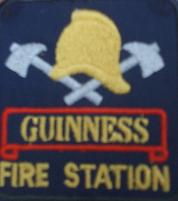
A patch from near the end of the Brewery Brigades lifetime. Las Fallon collection.

Guinness has long been a powerhouse of Dublin life, employing thousands of working class people in this city through boom and bust alike, but this is certainly an overlooked aspect of the story. The men of the Brewery Brigade, perhaps more than anyone else, show there was,and indeed remains, much more than stout at the heart of Saint James’ Gate.

\’Arthur Guinness and Sons\’ early helmet. Las Fallon collection

Helmet from mid-century period, again branded \’AGS\’ Las Fallon collection

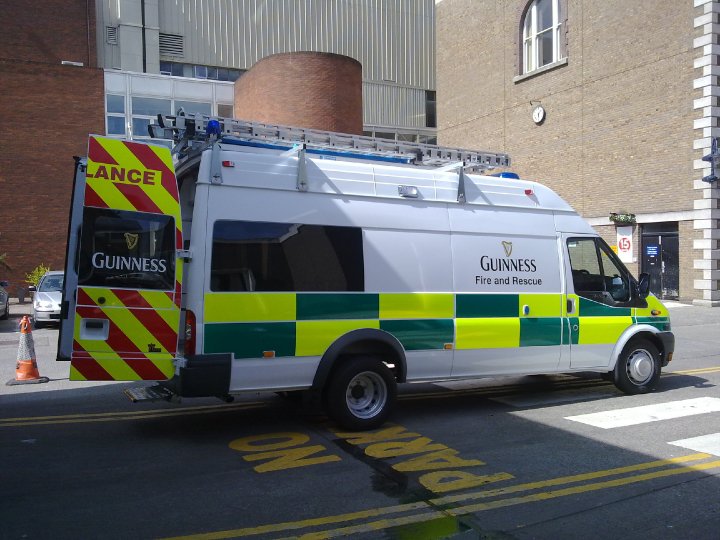
My thanks to the lads at the contemporary Guinness Fire and Rescue Service for getting in touch. This image shows the modern service Guinness operate on site.

Credit to D.Doyle for photograph

Read Full Post »

“It is Saturday evening. The week’s work is done. Five or six men who have toiled together during the week, find themselves near a tavern. They go in. After a few rounds of drink a man finds he has got to the limit of his pledge allowance. What is he to do? Stand up and walk out, after having drunk at his workmate’s expense? Far be from hum such unpardonable meanness. If a dozen pledges stood in his way, he breaks them all, in order to stand his round like a man. On then, the drinking goes, until it reaches the tenth or eleventh round”

– Irish Ecclesiastical Record (1890)

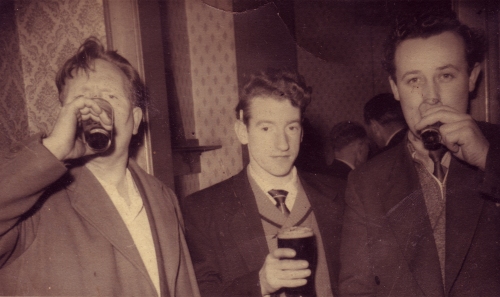
Three men in a Dulbin pub c.1950. (Picture - jacolette.wordpress.com/)

Read Full Post »

“Rainclouds shake down tribute,

for the Liffey, goods of water

to be trundled grey-green past Wood

and Ormond Quay, the traffic

in opposite direction turning

up Bridge Street right into High

into the Liberties and late afternoon.”

Dublin, The Liberties by Alfred Corn.

Ever since I spent a couple of months living on Marrowbone Lane, at the back of the Guinness Brewery, I’ve held a deep affection for this part of town. It’s often said the patrons who line the streets here are the salt of the earth and they are not far wrong; Wit and humour unrivalled, stories and gossip whispered on the corners, and “Howaya’s” roared across at neighbours the far side of the road… The pervading smell of the roasting of Hops in St. James Gate, the women selling their wares from street stalls, their voices loud, “THE STRAWBERRIES THERE, TWO EURO!” Ah, I just love it. It feels real. That’s why I was delighted to come across these documentaries shot, produced and directed by Shane Hogan and Tom Burke. Each a part of a series of 12 crafted short films, they all focus on a different character within Dublins Liberties community. Its close to a documentary film equivalent of a portrait gallery.

All twelve pieces can be found here, and they’re all worth a look; I’m always happy when I find videos like these, as its very easy for bits and pieces of social history like this to die out, and to have people keeping it alive.. It’s the business.

Read Full Post »

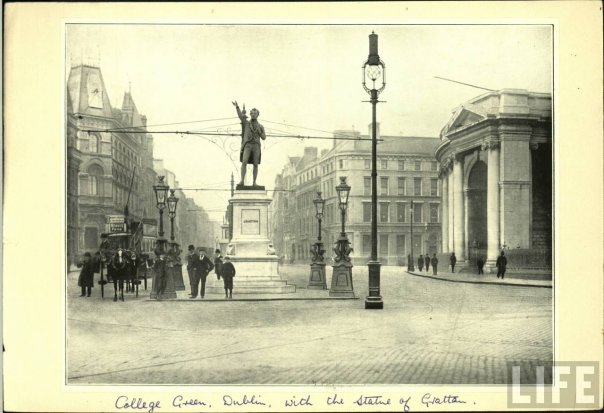
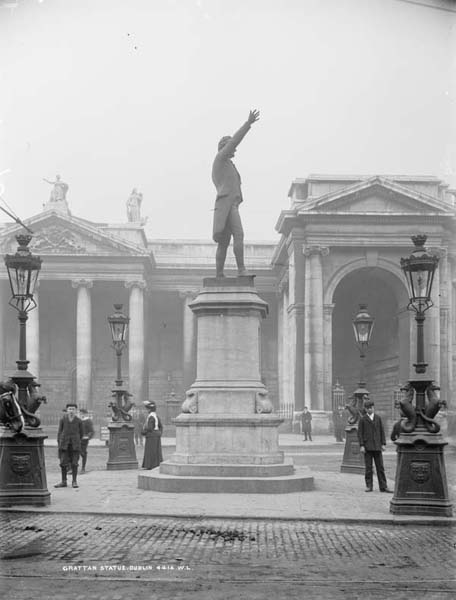
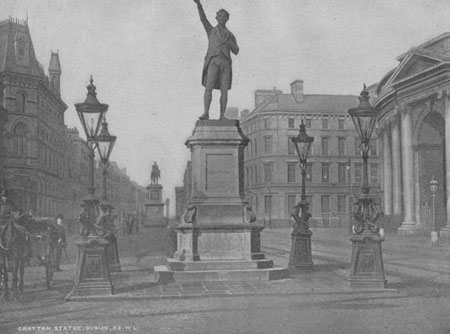
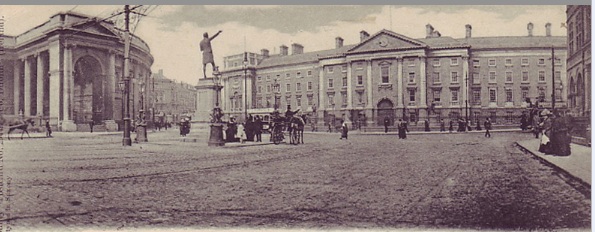
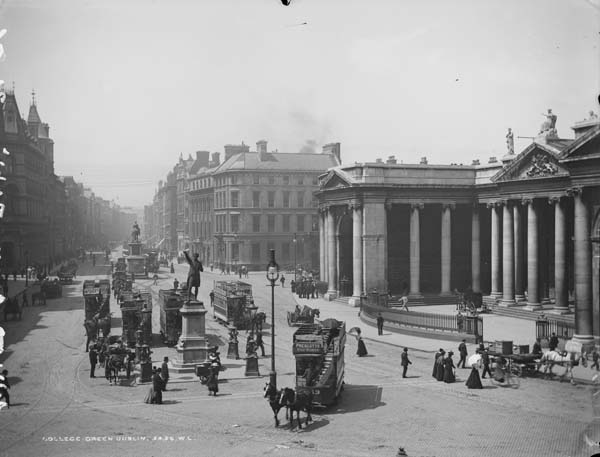
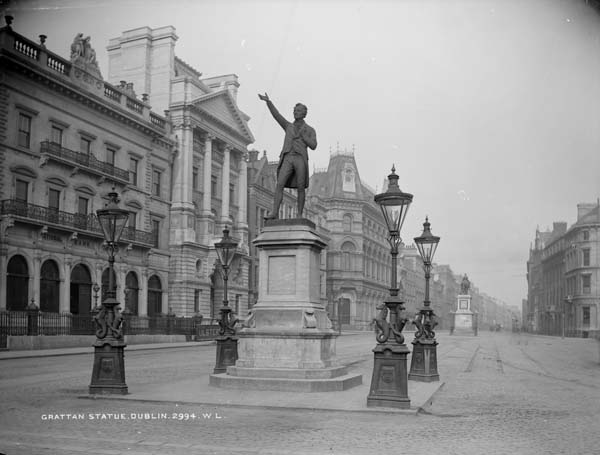
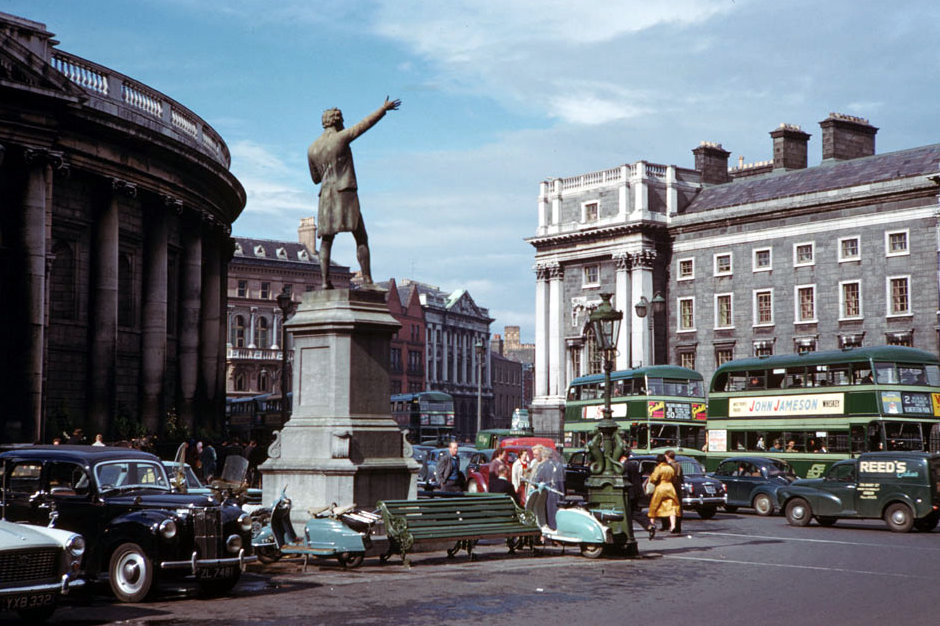
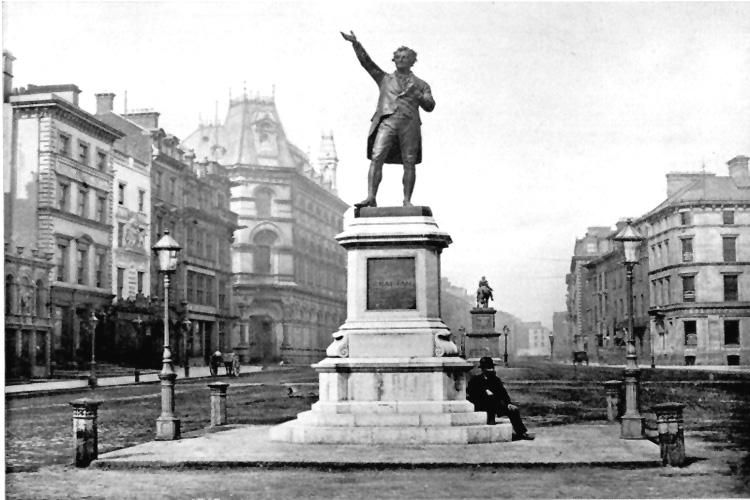
The bronze statue of Henry Grattan has been keeping an eye over the front gates of Trinity College since January 1876. Designed by John Henry Foley, a Dubliner, the spot where the statue stands was originally chosen as a site for the Prince Albert Memorial, but through the efforts of the late A. M. Sullivan, author of the “Story of Ireland,” it was reserved for Grattan’s statue, while the other was changed to the lawn of the Royal Dublin Society.

To either side of the statue’s front,  are two of the original four gas lamp standards, decorated with carved Hippocampus i.e. Sea Horses. It is believed that the other two lamps were removed in the mid 20th century but their current whereabouts are unknown. Interestingly, Grattan’s bridge which links Parliament Street and Capel Street is also furnished with beautiful Hippocampus’ lamp ornaments.

If anyone has any information on the missing two lamposts, can help me date the following photographs or can provide any more historic images of the statue, get in touch.

1870s. Before the sea horse lamps were introduced

Late 19th century.

Late 19th century?

Side view. Late 19th Century.

A quiet scene. Late 19th century?

Rear view. Early 1900s?

Early 1900s.

Busy street scene. Early 1900s?

Side view. Early 1900s?

Early 20th Century.

Early 20th Century.

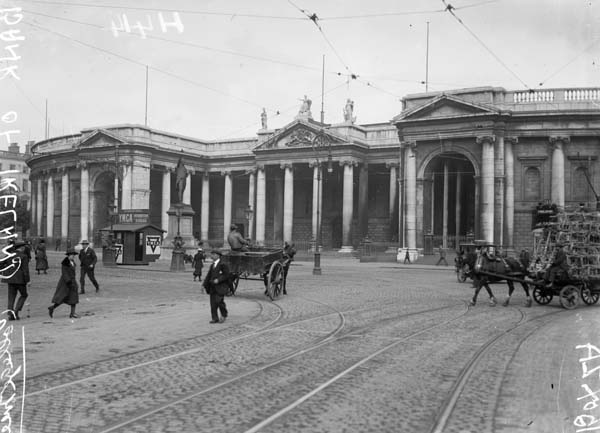
View from 1924 (Notice the little 'YMCA' sheds)

1961 (Notice two sea horse lamposts removed)

2009, Suffocated by trees. (Picture - GrahamH)

Read Full Post »

I’ve been wandering the steets of Dublin quite a bit in the last few days, and on Thursday found myself in the Castle itself. Looking up at the gates of the inner courtyard, I was reminded about a short but interesting titbit of local history. Atop the gates sits a statue of Iustitia, or Lady Justice to you and me.

Iustitia (Lady Justice,) Dublin Castle.

Now the interesting thing about this statue, erected by British Authorities in 1751, is that it betrays many of the characteristics statues of this type are supposed to adhere to. Iustitia, in representing Justice, is supposed to be blindfolded- Blind to discrimination. Here, her eyes are unbound. Her scales, are always to be in working order and perfectly level; Innocent until proven guilty- Here, they always tilt in one way; Funnily enough, they lean to the side of the gate that Revenue, and Dublin’s Tax Office is situated. Her sword, meant to be pointing downwards is held provocatively upright and she looks at it with a smile on her face.

What really got to people when she was erected however, is the direction she is faced; You will find statues of lady justice in Government buildings all over the world, and you will find her looking out over the city. Only in Dublin, does she face into the courtyard, turning her back on the people of Dublin. Just a thought; How could the tribunals held regularly in the Castle ever come out with a fair and honest representation of Justice when Lady Justice herself presides over them with her back to the people and a smile on her face?

Read Full Post »

Erich Hartmann (1922-1999). Born in Munich, Hartmann emigrated to the US in 1938. He enlisted in the US army and served in the Normandy invasion. On his return to New York, he worked as a freelance photographer and was invited to join Magnum in 1952. He served as a Board member 1967-1986 and as President 1985-86. As a photojournalist, he travelled all over the world on assignments from newspapers, magazines and corporate clients.

Hartmann took over 3,000 images during his “own journey of discovery through Dublin” in 1964 but unfortunately only a few are available online.

© Erich Hartmann / Magnum Photos

Read Full Post »

Combining my love of making lists and anecdotal Dublin history, I’ve been trying to work out what the oldest restaurant in Dublin City is. The following rules apply:

1) It has to be an actual restaurant, not a pub that serves food.
2) Restaurants within hotels don’t count.
3) It has to be in the same premises. (We’ve made one exception with The Unicorn, seeing as it only moved around the corner and remained within the same family.)

+ Beaufield Mews, Stillorgan. (Estd. 1950). CLOSED 2019

+ The Unicorn, 12B Merrion Court (Originally established in 1938 at 11 Merrion Row, it moved to Merrion Court in the early 1960s.) CLOSED 2017

+ The Trocadero, 4 St. Andrew’s Street (Estd. 1956)

+ Nico’s, 53 Dame Street (Estd. 1964) – CLOSED 2018

+ The Lord Edward restaurant, 23 Christchurch Place (Estd. 1967) –  CLOSED 2015

+ The Gigs Place, South Richmond Street (Estd. 1970) – CLOSED 2012

+ Captain America’s, 44 Grafton Street (Estd. 1971)

+ King Sitric, Howth (Estd. 1971)

+ Flanagan’s, 61 Upper O’Connell Street (Estd. 1980)

+ The Lobster Pot, 9 Ballsbridge Terrace (Estd. 1980)

+ Kingsland, 15 Dame Street (Estd. c. 1980) – CLOSED 2011

+ The Bad Ass Cafe, 9-10 Crown Alley (Estd. 1983)

+ Kite’s Chinese restaurant, 17 Ballsbridge Terrace, D4 (Estd. 1983)

+ Independent Pizza Company, 28 Drumcondra Rd Lower, Drumcondra (Estd. 1984)

+ Cornucopia, 19 Wicklow Street (Estd. 1986)

+ Da Vincenzo’s, 133 Upper Leeson Street (Estd. 1988) – CLOSED c. 2012

+ The Elephant and Castle, 18 Temple Bar (Estd. 1989)

+ Roly’s, 7 Ballsbridge Terrace (Estd. 1992)

Jammets Restaurant, Estd. 1901 on Andrews St moved to Nassau St. in 1927 and closed in 1967.

Read Full Post »

Dublin City has had it’s fair share of hell-raisers in the last century or so, mostly a product of purveyors of Arthur Guinness’ finest. But the history of hell- raising goes back well before the birth of the black stuff; most infamously in Irish history in the half-century before the good man himself poured his first pint and let it settle when Dublin was host to it’s own Hellfire Club.

The first Hellfire Club was founded by the Duke of Wharton in London in 1719 and was and was an exclusive club, mainly populated by a class of rich, landed Gentry called “Bucks” who chose to pursue a certain type of enjoyment which generally involved a pious mix of gambling, blaspheming, whoring, drinking, violence and even the odd touch of Satanism. (Though there is little evidence of this, it is something that is seen to go hand in hand with the original Hellfire Club and seems to stem from them calling each other “Devils.”) Their behaviour was seen as an affront to the ideals of the church and the sacred principles of religion; corrupting to the minds and morals of young people. Wharton’s club came to an end in 1721 when George I put forward a bill “against ‘horrid impieties'” (or immorality), aimed specifically at the Hellfire Club. (1)

Medmenham Abbey, reputed home of the first ever Hellfire Club

From their ashes, The Dublin Hell-Fire Club was founded by Richard Parsons (1st Earl of Rosse and founder of the first Irish Lodge of Freemasons,) and Colonel Jack St Leger (The son of a rich landowner from Kildare, notorious for gambling large amounts of money on ridiculous wagers.) The Club motto was “Fais ce que tu voudras,” or “Do as thou wilt,” a nod to Rabelais’ Theatre of the Absurd. Meetings started with all members sitting around a circular table upon which was placed a huge punch bowl of scaltheen, a rancid mixture of Irish whiskey and melted butter. After toasting the Devil and drinking to the ‘damnation of the Church and its prelates’ the bucks would pour scaltheen over a cat, obtained for the occasion, and set fire to the poor feline. After this, the decadence could begin in earnest.

The club had various headquarters around Dublin such as the now demolished Eagle Tavern on Cork Hill, founded by Parsons sometime around 1735. The Eagle Tavern and Cork Hill are now no more, lost in the regeneration of Temple Bar. We do know that the Tavern was situated close to the IFI and the Quakers Hall in Temple Bar. (2) Another favorite meeting place was Daly’s Club, College Green. Here, shutters were kept closed in the morning so that members with hangovers could gamble and drink by candlelight. One notorious incident occurred here when a member, Buck Sheely was caught cheating at cards. A ‘court’ was convened presided over by Buck English; His verdict was that Sheely was to be hurled through the window of the third floor gaming room- he died in the fall, impaled on the railings below.

The Hellfire Club, Montpellier Hill

Perhaps the most famous of the meeting places of the Hellfire Club was on Montpellier Hill, in the Dublin mountains, not far from Rathfarnham. It was built around 1725 on land purchased from the Duke of Wharton (founder of the first ever Hellfire Club) by William Connolly, a speaker in the Irish House of Commons. According to local legend, an ancient Cairn erected to the old pagan gods of Ireland had been demolished to make way for the lodge. Many of the stones from the Cairn were used in the construction of the house. Shortly after its completion, a powerful storm blew the slated roof away. It was replaced by a stone roof which remains intact today. For at least 20 years Mountpelier House flourished until the Bucks ruined it sometime around 1740. The story of the disaster is well known. As with the roof blowing off during its construction; local myth held that its destruction was a punishment for the desecration of the Cairn it was built upon.

At this time the ‘Principal’ of the Hellfire Club was a man of huge wealth called Richard Chappell Whaley. His nickname was ‘Burn-Chapel’ Whaley because of his hatred of religion and in particular, the Roman Catholic church. He would amuse himself on Sundays by riding around Dublin setting fire to the thatched roofs of Catholic chapels. It was he who caused the downfall of Mountpelier House. “After an unfrocked clergyman had performed a Black Mass in one of the two upstairs rooms in Mountpelier House, the ceremony ending in the usual drunken revelry, a footman picking his way through the sprawling bodies spilt some drink on Richard Whaley’s coat. Whaley reacted by pouring brandy over the footman and setting him alight. The man fled downstairs clutching at a tapestry hanging by the hall door, trying to douse the flames. Within minutes the whole house was ablaze.” (3) Many Bucks died in the fire, but Whaley managed to survive by leaping out of a window. At the age of 59, he married a woman 40 years his junior. Their son, Thomas ‘Buck’ Whaley was to become the most famous Buck of all. “Born in 1766, it was Buck Whaley who rallied the Hell-Fire club from the low ebb to which it had sunk after the burning of Mountpelier House declaring his intention of ‘defying God and man in nightly revels’.” (4)

Bucks of the Limerick Hellfire Club

Before I go into the Buck Whaley himself, here’s a piece of poetry about the Limerick Hellfire Club pictured above and it tells us a little about what shenanigans they, and the other Hellfire clubs around the country got up to:

‘But if in endless drinking you delight,

Croker will ply you till you sink outright.

Croker for swilling floods of wine renowned,

Whose matchless Board with various plenty crowned.

Eternal scenes of Riot, Mirth and noise,

With all the thunder of the Nenagh boys;

We laugh, we roar, the ceaseless bumpers fly,

Till the sun purples o’er the morning sky.

And if unruly Passions chance to rise,

A willing Wench the Firgrove still supplies’. (5)

Buck Whaley inherited a huge fortune after the death of his father, being granted a yearly allowance of £900 at the age of 16. He had an eventful upbringing, jumping between tutors in England and France before returning home having spent some time in jail. Obviously having inherited some of his fathers hatred of the church, he was thrown into jail in Marseilles, having “insulted, violently assaulted and raising his sacrilegious hands against a Priest.” He escaped a long sentence by being secreted out of the country by friends of his lawyer. While his inheritence at the time was huge, arguably, he won an even greater fortune at the gaming tables as well as partaking in some bizarre wagers. In one wager he won £25,000 from the Duke of Leinster by riding to Jerusalem and back within a year. While seeing the sights, this was not a pious pilgrimage and he later boasted of playing handball against the Walls of Jerusalem and having drunk his way there. On another occasion, for a bet of £12,000, he rode a beautiful white Arab stallion in a death-defying leap from the drawing room on the second floor of his father’s house on Stephen’s Green, over a carriage parked outside the door, and onto the street, 30-odd feet below. He won his wager, surviving with a broken leg, but killed the horse.

Remorse, however, befell Buck Whaley as his life went on and so he resolved to seek absolution for his sins. Whilst praying in St Audoen’s Church, just off modern day Thomas’ Street, he had a vision of the Devil creeping down the aisle towards him. Seized with terror, he ran from the church and fled Ireland forever.

He lived the last few years of his life, with his mistress, now his wife, in a mansion he built on the Isle of Man, where he wrote his memoirs. Repentant in his sickness and misery, he wrote “I thought that a faithful picture of my youthful eccentricities, drawn with justice and impartiality, would not be unacceptable to my country- men, and particularly to my younger friends, who will find some few examples which they may follow with advantage, but many more which they ought to avoid.” (6)

He died at the age of 34 of sclerosis of the liver. With his death the Dublin Hell-Fire Club ceased to exist.

Footnotes:

1: http://en.wikipedia.org/wiki/Hellfire_Club

2: http://homepage.eircom.net/%257Eseanjmurphy/dublin/templebar.htm

3: Taken from Setanta Orienteers by Robert Whaley, page 1

4: http://www.archive.org/stream/cu31924028518730/cu31924028518730_djvu.txt (Whaley’s memoirs)

5: http://www.askaboutireland.ie/reading-room/history-heritage/big-houses-of-ireland/glin-castle-co.-limerick/the-four-brothers/edmond-fitzgerald-20th-kn/

6: http://www.archive.org/stream/cu31924028518730/cu31924028518730_djvu.txt

Read Full Post »
A little known link.

The Court Laundry (1903 – 1971) at 58A Harcourt Street acted out as the venue for meetings for the Spanish Aid Committee during the Spanish Civil War (1936 – 1939). [1]

Hanna Sheehy-Skeffington, the suffragette and Irish republican, acted as chairperson of the group while the secretary was John Swift, general secretary of the Irish Bakers’ Union. Other prominent members included Dorothy Macardle, the writer and historian and Nora Connolly-O’Brien, daughter of James Connolly.

The use of the laundry had been arranged by Robin (Robert) Tweedy (1853 – 1956), a Communist Party member whose family had connections with the laundry business.

[1] A. P. Behan, Dublin Historical Record, Vol. 47, No. 1, Diamond Jubilee Issue (Spring, 1994), pp. 24-45.

Read Full Post »
« Newer Posts - Older Posts »