Feeds:
Posts
Comments

Archive for the ‘Social History’ Category

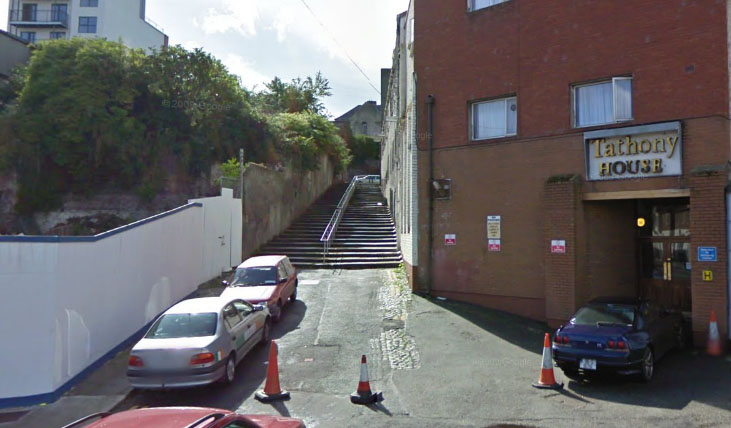
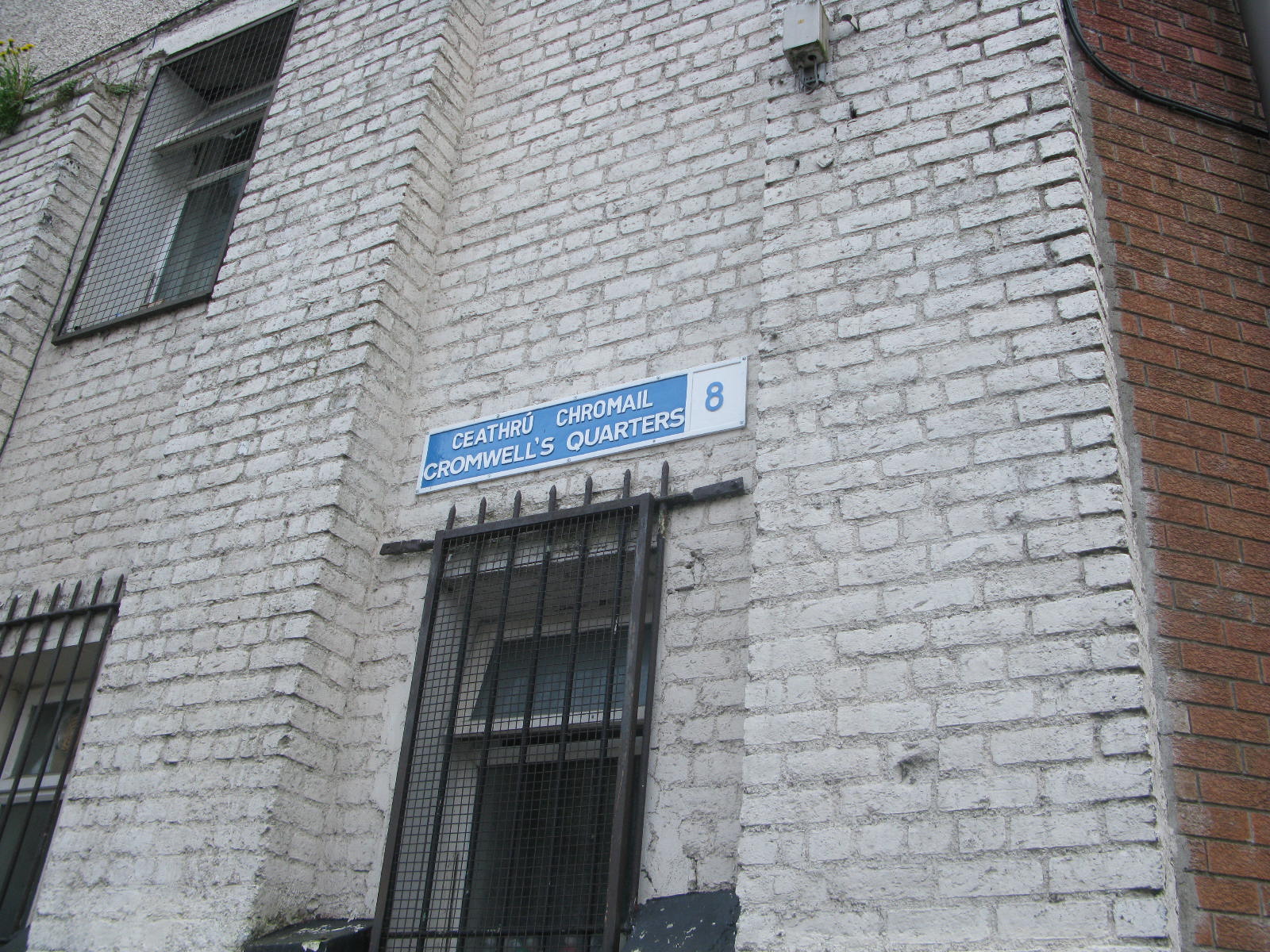
I took a swing by the aforementioned Cromwell’s Quarters earlier to get a snap of the recently replaced sign. Whether the old sign was swiped or merely kept in storage while building work was going on next to the lane, who knows, but its not there if you take a look on Google Maps…

Yup, Cromwell's Quarters!

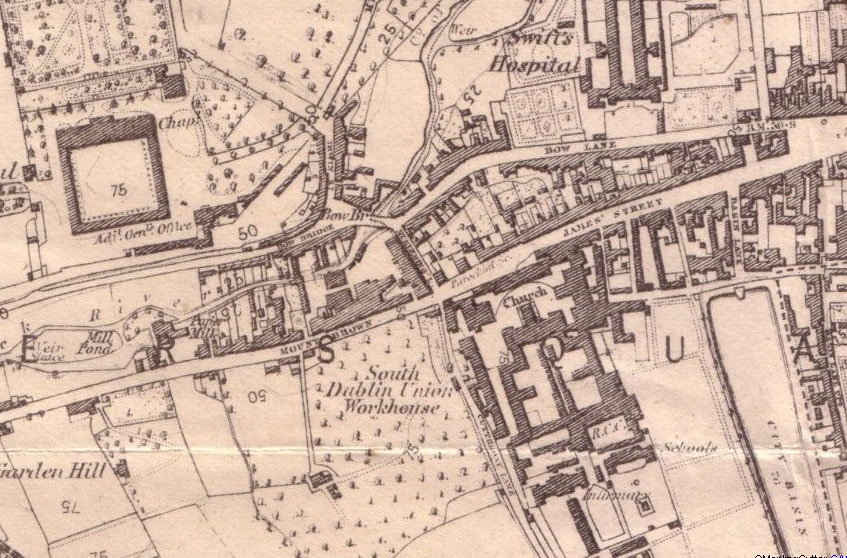
I also came across this map from 1885, seven years before the name changed to Cromwell’s Quarters on the excellent rootschat forum which marks the steps as “Murdering Lane.” Granted, you do have to squint, but there it is between Bowe Lane and the South Dublin Union.

Just beside Bowe Bridge is... Murdering Lane! Kudos to shanew147 for the upload.

Read Full Post »

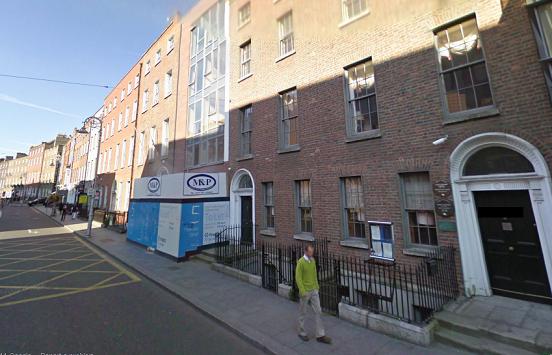
4 Harcourt Street.

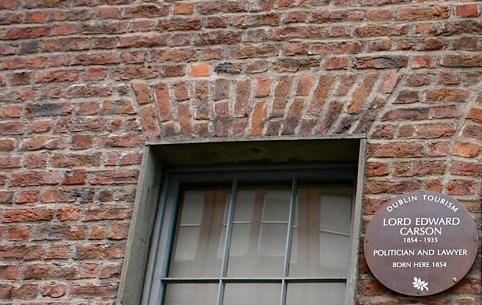
Only a few doors down from Conradh na Gaeilge, on the godforsaken street that plays home to Copper Face Jacks, there is a small plaque one could easily overlook. It commemorates Edward Carson, the father of Irish loyalism, a barrister commemorated on the walls of unionist estates in the north as the founder of the Ulster Volunteer Force, and a complex Dubliner to say the least.

Of course, we should not forget Carson himself was a keen Gaeilgoir. When coupled with his ability as a hurler, praised in the Irish Sportsman journal of his time, it is apparent Carson represents a great diversity of Irishness.

It’s a great irony that only two doors up from the father of Irish unionisms historic home is 6 Harcourt Street, famous for being the office of Sinn Féin in the time of Griffith, and indeed the location of the offices of The Irish Bulletin paper, produced by the Department of Propaganda during the Irish War of Independence.

(more…)

Read Full Post »

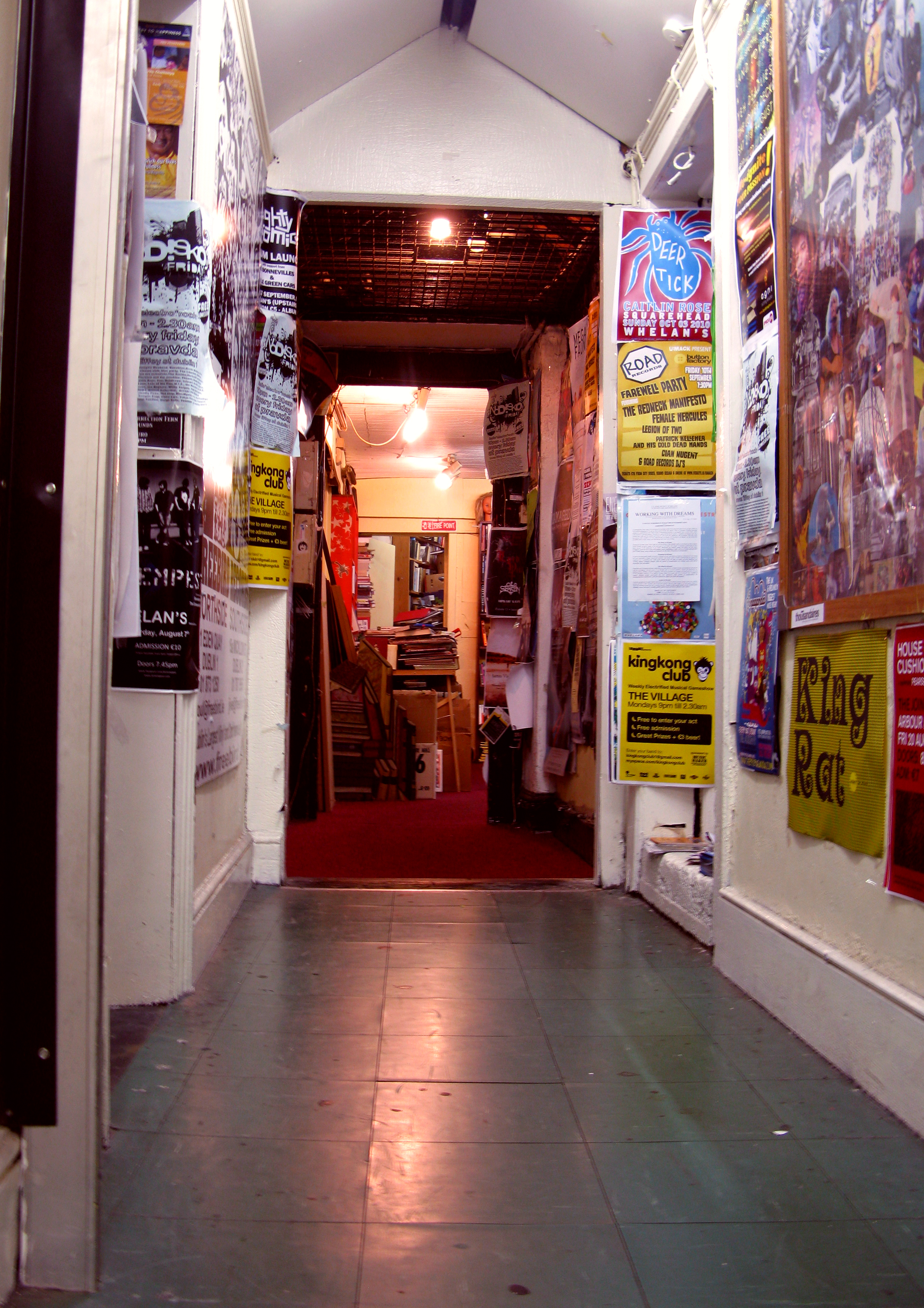
I always love venturing into the Secret Book and Record Store on Wicklow Street as it has produced some absolute gems for me down through the years. When Mero was running the record side of things, I’d make the trip up from beyond the Pale and shuffle nervously up to the counter with whatever zine or 7″ or god forbid TAPE that I liked the look of. But as I grew, Mero’s gave way to Freebird, and punk moved across to the late Red Ink at Central Bank, and my interest in this place moved to the books.

The Secret Book and Record Store

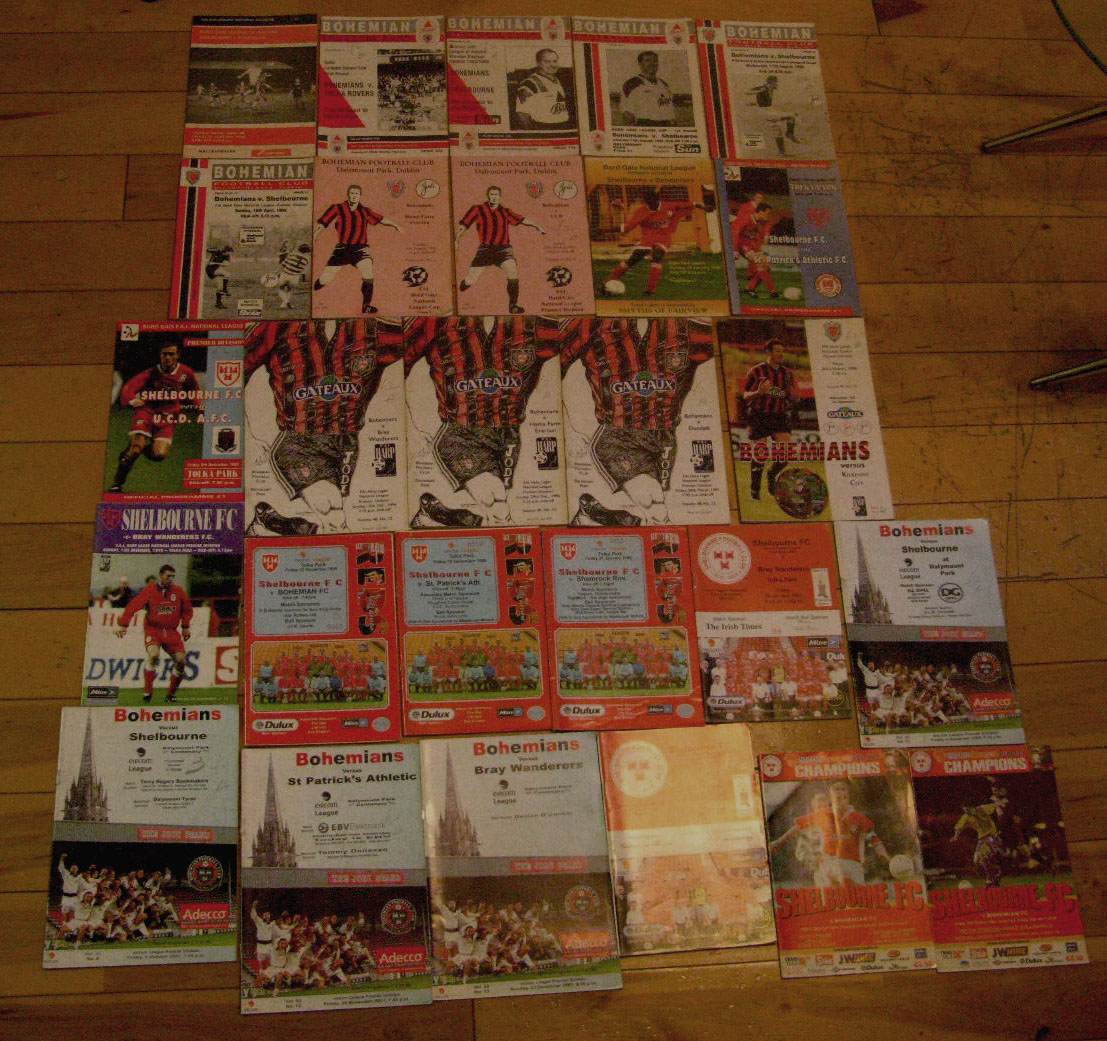
So, when I got a text from JayCarax last week saying there was a box of League of Ireland programmes going cheap, I jumped at the chance. I eventually got in on Sunday afternoon on nipped in and the result can be seen below- €20 for 27 programmes, mainly Bohs but a few Shels as well, spanning from 1992 – 2004. Twelve short years, but a lifetime in this League. Paul Osam to Peter Eccles, Gino Lawless to Avery John all feature. Owen Heary, Pat Fenlon and Stuart Byrne seem to appear ageless, bouncing back and forth between clubs and Tony Cousins appears, looking, well, pretty much exactly like he does now. Shels were a big club, and Bohs made a profit one season. Crazy times indeed.

27 programmes for a score? A steal.

I’ll scan some of the more interesting pages up over the weekend; I’ll most likely need a repetitive and non- strenuous chore to ease my Paddy’s Day hangover away so what better to kill two birds with the one stone.

Read Full Post »

I’ve read many of the memoirs of those who took part in the 1916 rising and later went to write of their experiences, but Margaret Skinnider’s work has always eluded me. It has passed me by once or twice on eBay, and library copies have vanished before I got to them.

Skinnider was born in Coatbridge, Scotland and was a member of Cumann na mBan in Scotland. She fought with the Irish Citizen Army as a sniper during the rebellion and was wounded in the battle. Her book provides interesting personal recollections on the build up to the rising and her experiences during it, and also includes a fascinating list of songs sung by rebels during and after the rebellion. Among these is the song of the Irish Citizen Army, to be sung to the tune of ‘John Brown’s Body’.

It’s an interesting read for those studying or interested in the period. It is available over here, on the Open Library site.

Read Full Post »

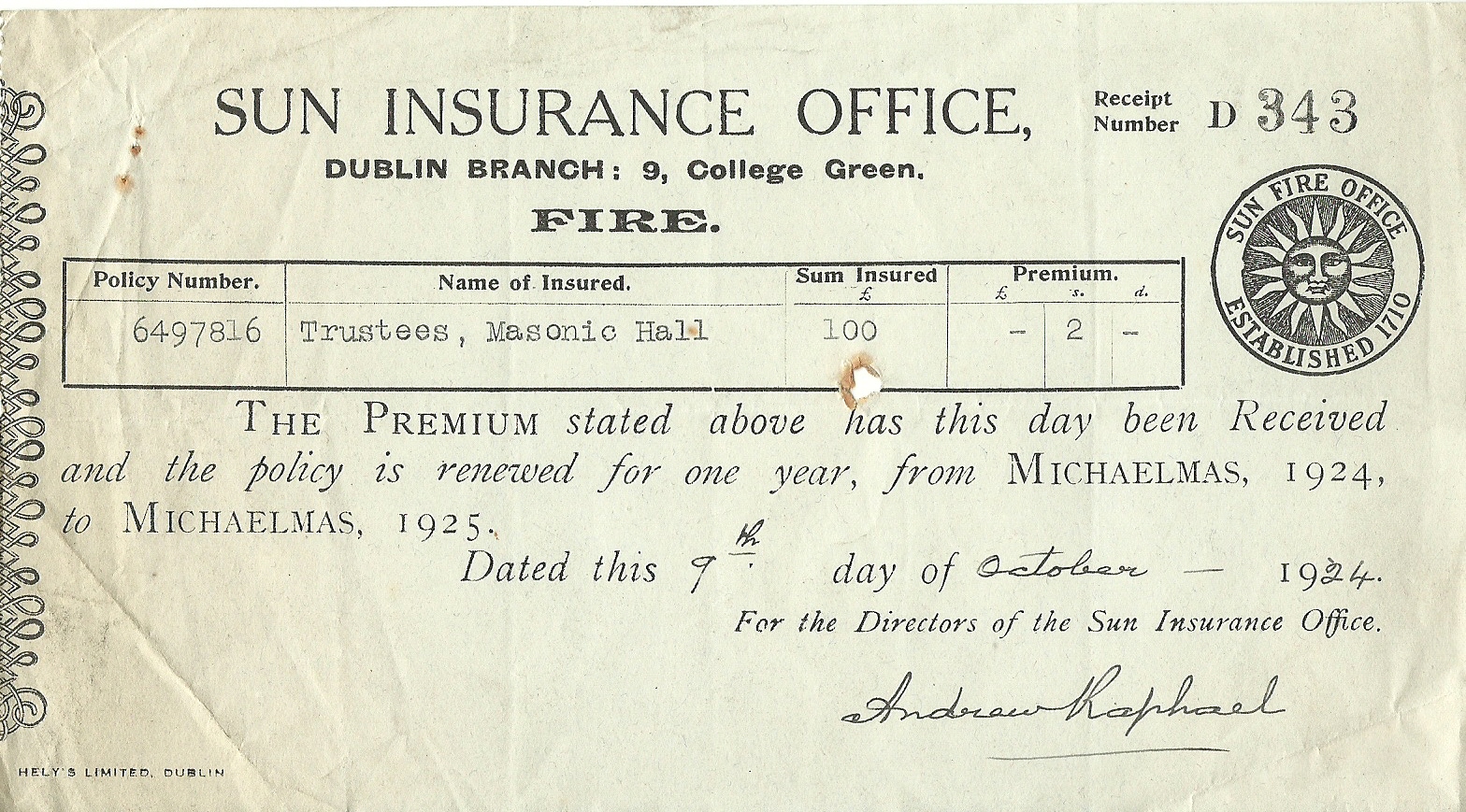
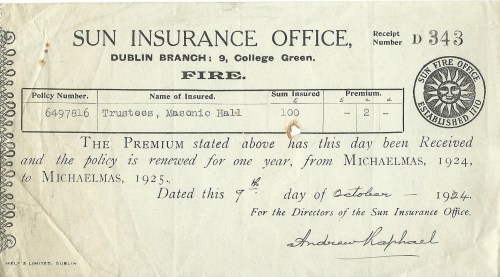
This is a great oddity, the 1924 fire insurance policy for the Masonic Hall on Molesworth Street. It’s the latest item in a long line of fascinating stuff my father has produced for Come Here To Me!

It’s interesting to note that the insurance policy was taking out with Sun. Sun had a long history in the city with regards fire prevention. They were one of the insurance companies who, before the establishment of a public fire service, offered protection to premises marked by a ‘firemark’. These were essentially emblems (usually of lead) which displayed a company logo and insurance number. Before the establishment of a public fire service, no premises was covered until a firemark was in place.

In his history of the Cork fire service, For Whom The Bells Tolled, Pat Poland noted that:

The firemark served a number of purposes: it marked the property so it was obvious to all that the building was covered by insurance, it acted as an advertisement for the insurance company, and it let firemen responding to a call in no doubt as to which particular building was insured with their office.

So while Dublin of course had a public fire service at the time this policy was taken out, the name ‘Sun’ had a long history in the fire prevention field in the capital. Notice the company logo on the right hand side of the policy, which states an establishment year of 1710.

The Masonic Hall on Molesworth Street had of course been involved in the Civil War only two years previous to this policy. The Irish Masonic Jewels website contains some information on the seizure of the building by anti-treatyite forces:

In April during the Civil war of 1922 Freemasons Hall was seized by Irregulars, along with the Kildare Street Club and held for a period of six weeks. No damage occurred at all and Colonel Claude Cane, the Deputy Grand Secretary at the time, paid tribute to the courtesy and consideration that he received from the Provisional Government during negotiations for the return of the building.

Read Full Post »
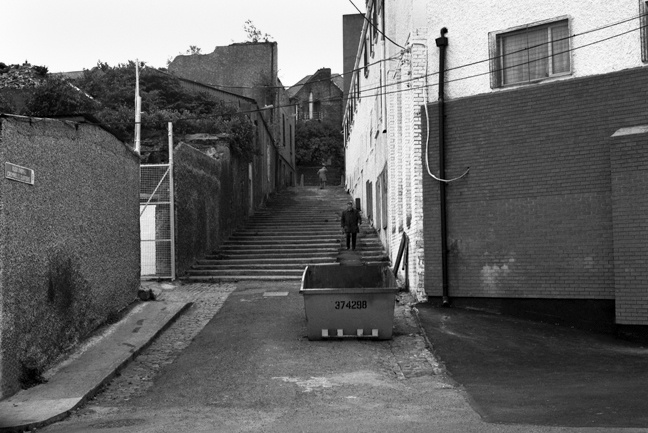
DFallon recently uploaded a great document regarding the etymology of some Dublin place names and of a 1922 proposal to change some of them. One place name that skipped the Corpo’s attention in that report, and funnily enough ever since then (given that the name involved invokes little but hatred in most Irish people,) is “Cromwell’s Quarter’s,” an unmarked alleyway connecting Bow Lane and James’ Street.

Cromwell's Quarters, 1991. By Tom O'Connor Photography

You can just about make out the street sign in the top left of the photograph, but as you’ll see below, that wall no longer exists, and the street sign has disappeared with it; I’d love to know whose attic its in! Aptly enough, the lane was only renamed Cromwell’s Quarters sometime around 1892, having been recorded in places as “Murdering Lane” in the 18/1900s and “The Murdring Lane” before that, as far back as 1603. A bone of contention this one- whilst many Dublin historians call the haunted steps around St. Auden’s the Forty Steps, Cromwell’s Quarters can also go by the same name. Either way, its not somewhere I’d like to hang around at night…

20 Years later and not much has changed!

Any other references to the man Teflon Bertie once refused a meeting with British Foreign Minister Robin Cook because of in Dublin placenames? (Ahern was due to meet Cook in a room in which a portrait of Cromwell hung. He famously walked out and refused to return until the portrait of “that murdering bastard” had been removed.)

Read Full Post »

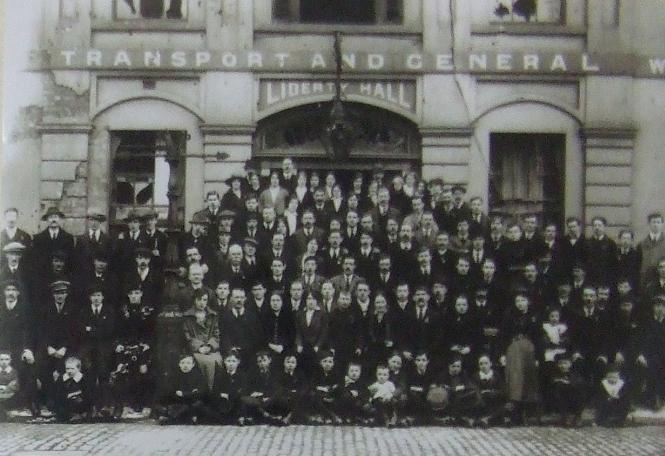
I got a text from hxci to tell me he was only about to upload that great image of the Irish Womens Workers Union when he saw I’d used it on Sunday in another post. It reminded me to upload this image of Delia Larkin, members of the IWWU and male trade unionists who made up the Jacobs Strike Committee on the steps of Liberty Hall. It’s obviously from the same day, and is a wonderful image that doesn’t show up as often.

Several people who would go on to be involved with the the Irish Citizen Army, such as Rosie Hackett, were involved in the Jacobs dispute.

One of the first women to come out in sympathy with the men was Rosie Hackett, a young messenger for the company, who had joined the Irish Transport and General Workers Union in the previous year. Two weeks after the successful Jacob’s strike, Rosie was one of the founder members of the Irish Women Workers Union, set up to protect women in the face of the appalling conditions in which many of them were expected to work.

In August 1913, when the tramworkers struck, Rosie and her fellow workers from Jacob’s again mobilised in support of the pickets and they gathered in O’Connell Street on 31 August for a rally against the employers. She was in the crowd that was baton charged by the police, resulting in the terrible injuries to the workers that made the day infamous as ‘Bloody Sunday’. On the following Saturday, three Jacob’s workers were sacked for refusing to remove their ITGWU badges and Rosie was one of the organisers of the supporting strike which began immediately afterwards.

The steps of Liberty Hall were a favourite place for the trade union movement to be photographed! The image below shows the men and women of the Irish Citizen Army at Liberty Hall in 1917, a year on from the insurrection. James Connolly’s secretary Winifred Carney is clearly identifiable in the front row on the left, next to the streetlight. It’s another great photograph on the steps of Liberty Hall.


Can you identify some of the women in any of the pictures? Leave a comment!

Read Full Post »

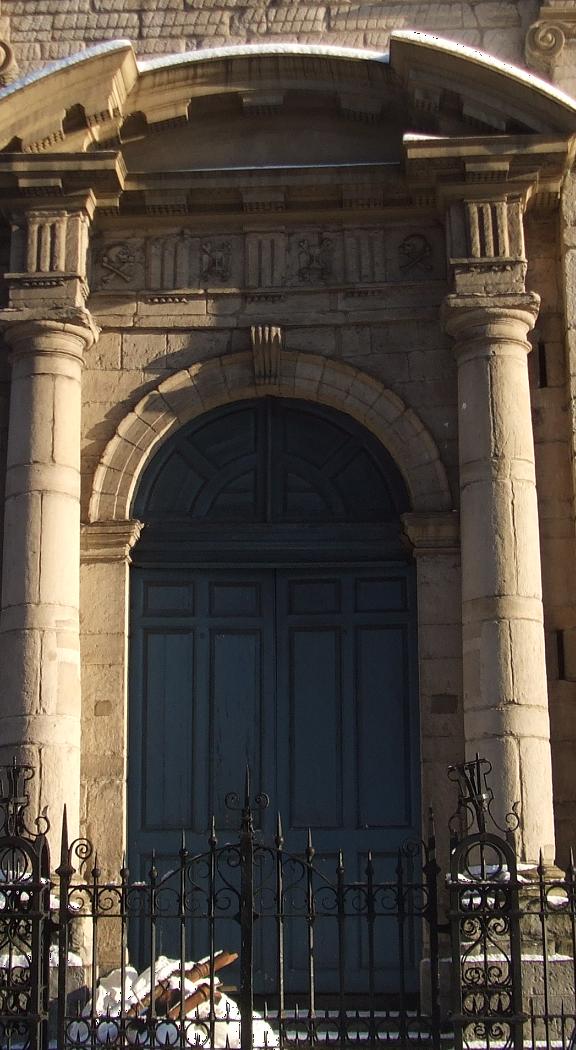
I did a brief post on Saint Werburgh’s Church (On Werburgh Street, opposite Burdocks) here before, but today I came across these images I’d taken of the church late last year and thought them worth sharing.

Saint Werburgh’s Church has, most unfortunately, fallen on hard times. It is difficult to disagree with the observations of Fiona Gartland of The Irish Times who noted in an August 2009 article for the paper that paint work inside the church was cracked and peeling, plaster work crumbling and that stucco detail in the church was badly in need of repair. In the article, the Dean of Christ Church the Very Rev. Derek Dunne noted that the once glorious church had “…been neglected for decades” and that “Saint Werburgh’s is not ours, it is in the ownership of Dublin. The work needs to be done, it is almost too late.”

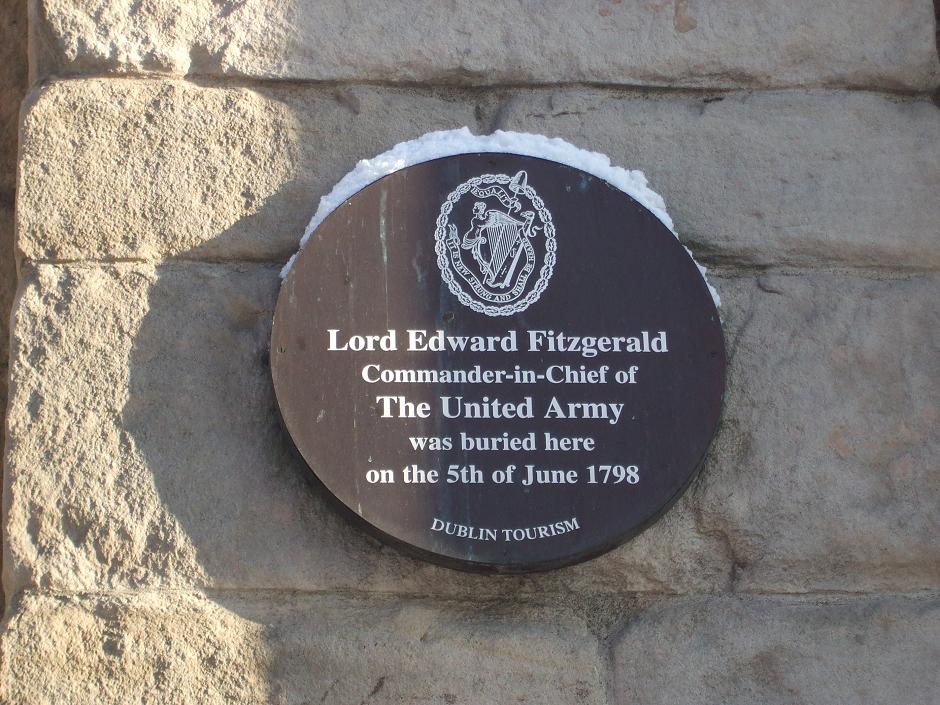
Thankfully, there is a massive restoration currently underway at Saint Werburgh’s. The small church is now closed to the public, with sections of it completely off-limits during the restoration. Yet one must feel a sense of relief that the final resting place of Lord Edward Fitzgerald, and indeed the spot were Jonathan Swift was baptised, finally seems safe for the long-term future.

I thought it worth sharing some pictures of one of my favourite buildings in the capital. Its beautiful sandstone facade is unlike anything else in the city, and I often admire Saint Werburgh’s from the upper-floor of the Lord Edward across the road! As good a spot as any…

(more…)

Read Full Post »

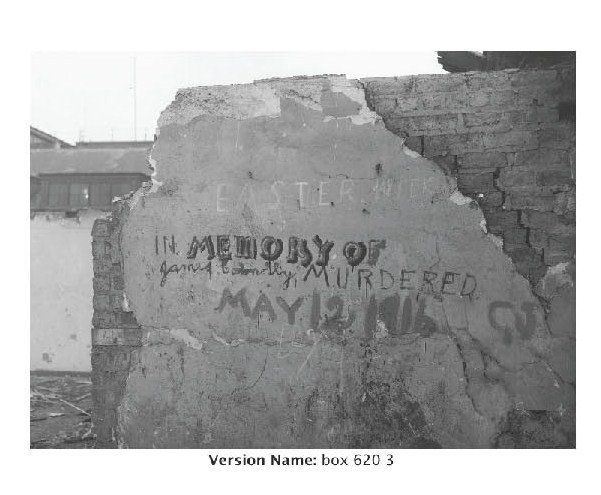
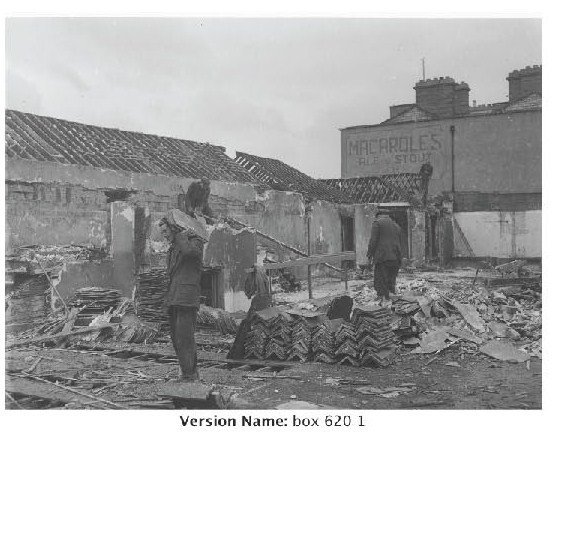
My thanks to David and Barry, who are active within the very important campaign to save 16 Moore Street, for bringing these images to my attention of the demolition of Liberty Hall in the 1950s. This was a very different Liberty Hall to the one we know today.

Back in May of last year, I posted this great little story on a banner that was draped over this Liberty Hall in 1917.

In it, Rosie Hackett of the Irish Citizen Army noted that:

“Historically, Liberty Hall is the most important building that we have in the city. Yet, it is not thought of at all by most people. More things happened there, in connection with the Rising, than in any other place. It really started from there”

Read Full Post »

I’m currently working on a project on Dublin in the 1930s, centered around the inner city and the emergence of a far-right and the religious crusades against all forms of ‘sin’ in the capital. I recently shared this 1934 anti-fascist leaflet distributed at a republican demonstration at College Green.

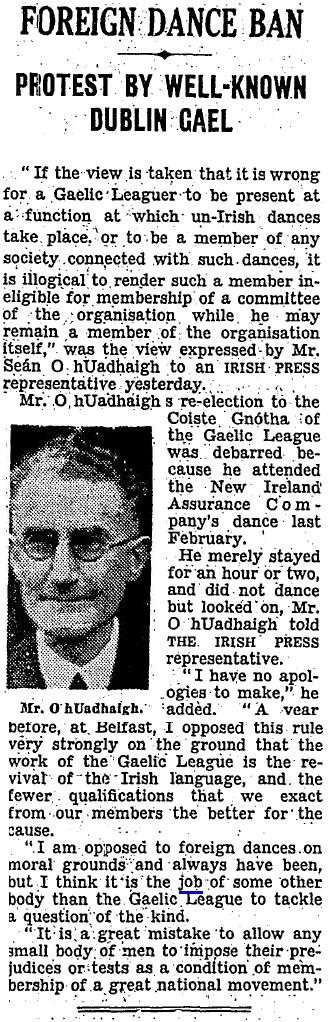
The news report below, from The Irish Press (May 09, 1933), is pretty typical for the period. The man involved was indeed at a ‘foreign dance’ event, but he only stayed an hour or so, and he wasn’t dancing, merely observing.

Read Full Post »
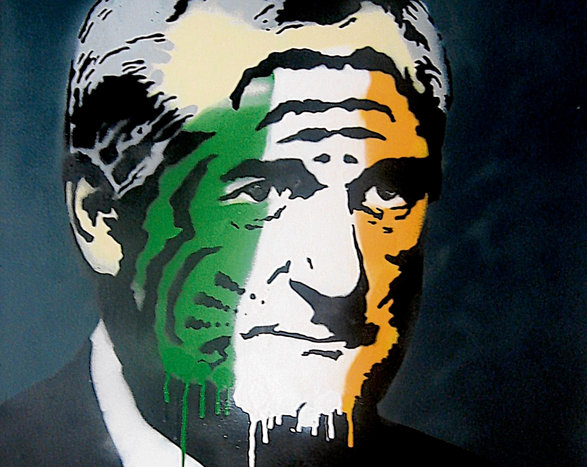
ADW's excellent take on Bertie Ahern.

I’ve a bit in the latest CrisisJam over on the excellent Politico.ie looking at the historical context of the collapse of Fianna Fail’s support in the capital. You can read it here.

Fianna Fail, Sean Lemass told a gathering of youth party members in Inchicore in November 1947, had “… more wage-earners in its ranks than any Labour Party, and more farmers than any Farmers Party.”

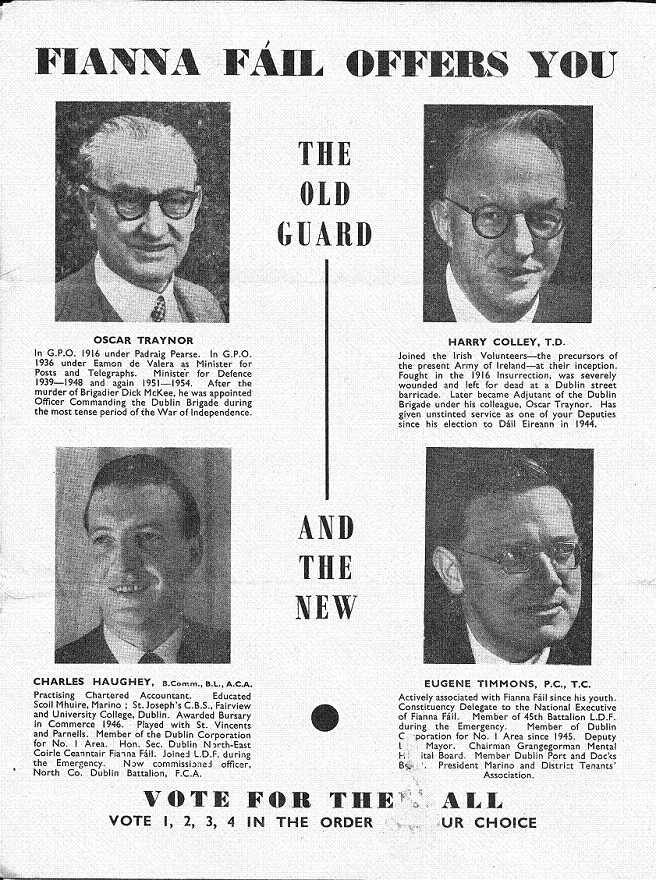
The class make-up of the party in Dublin was always a matter of considerable pride, when coupled with the historic roots of the party in the anti-treaty IRA. In 1954, when a young Charles Haughey was put before the people as a part of the “New Guard” of the party, he shared space on his inaugural election leaflet with Oscar Traynor and Harry Colley. Traynor was among the most highly regarded of the ‘men of Easter Week’, serving in the Metropole Hotel with the GPO Garrison during the rising. Harry Colley, the leaflet noted, had been “..left for dead at a Dublin street barricade.” Almost 40 years on from the rising, Fianna Fail was still presenting itself as the party, and indeed the vanguard, of Irish republicanism. New candidates like Haughey often came from the same bloodline as many of the ‘Old Guard’.

The Fianna Fail election leaflet mentioned in the piece, introducing a certain Charles Haughey to the fold, was uploaded here on Come Here To Me in the past. You can read it here.

Read Full Post »
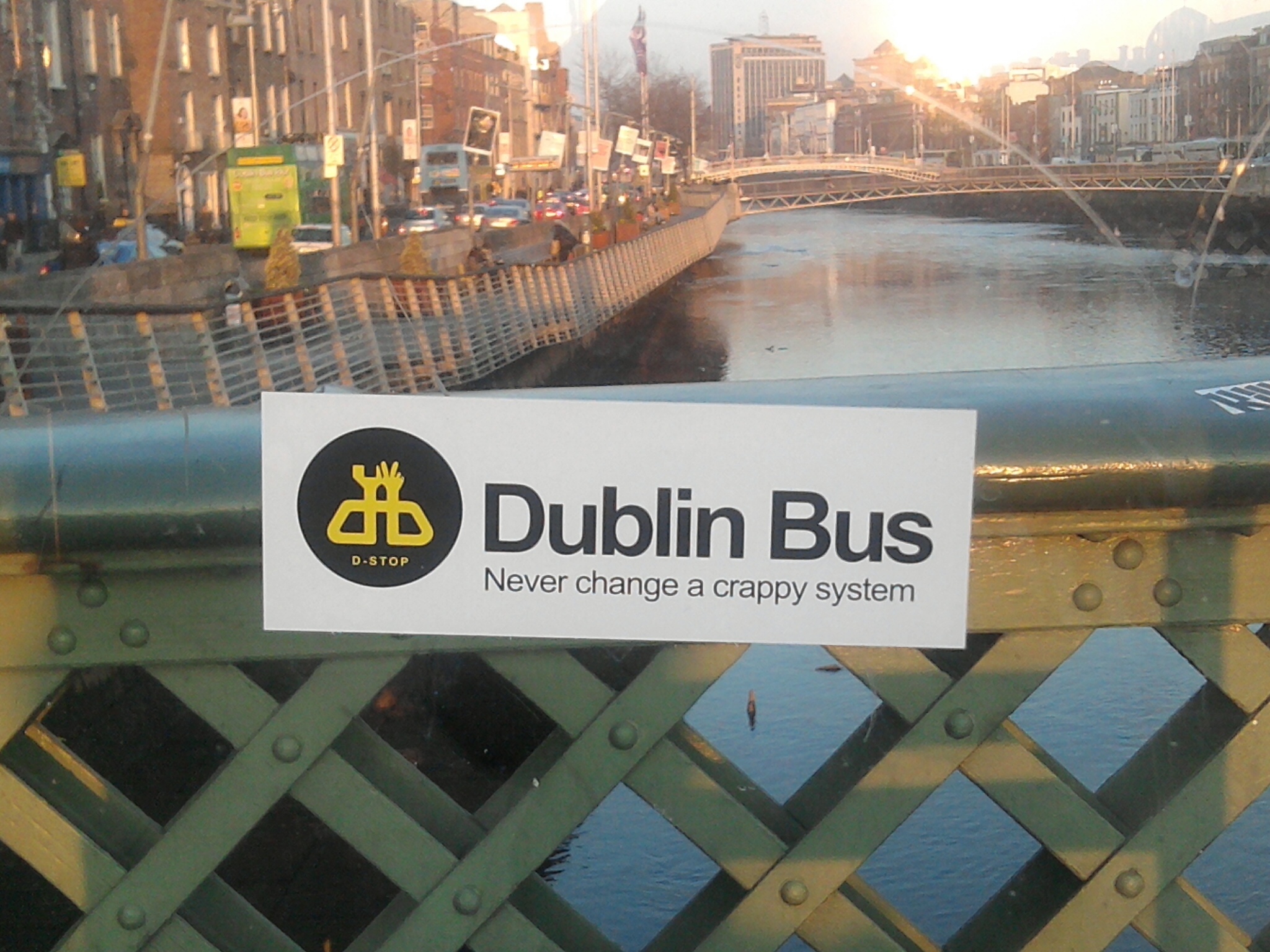
We have a few posts on here about Dublin’s Nitelink, including one of my favourite DFallon posts ever,  about his travails in Leixlip at silly o’clock in the morning having fallen asleep on one (if you haven’t read it yet, do so.) In the last couple of months, we’ve shared scary news of an impending cancellation of the service, set up a Facebook page to save it, and broken news of its current status.

Dublin Bus- Never change a crappy system.

So, when I saw the above stickers on Henry Grattan Bridge, I couldn’t help but grin and get the camera out. I don’t know how long the stickers have been about but what I do know is I WANT ONE.

Read Full Post »
« Newer Posts - Older Posts »