Feeds:
Posts
Comments

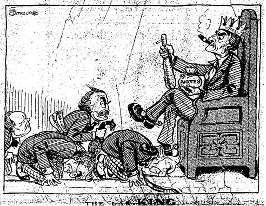
A recent post looking at some cartoons printed in the Sunday Independent during the Lockout proved popular, and in reality the cartoons we selected were only a small percentage of those that appeared in the publication. Cartoons were a form of propaganda used by both sides in the dispute, and these cartoons always ran on the front page of the newspaper. All the cartoons I have chosen for this post come from 1914, as the dispute dragged into that year before ending in failure for Larkin’s movement. The cartoons are the work of Frank Rigney, cartoonist with the Sunday Independent.

This cartoon from the month of February focused on the issue of pay for DMP men. The role of the DMP in the dispute, and in particular the events of Bloody Sunday in August 1913, ensured that their place in Dublin folk memory would not be as a revered force. The paper staunchly defended the actions of Dublin policemen during the months of strife.

1 February 1914

1 February 1914

In the same edition of the paper, this cartoon appeared, which called for a tough approach to be taken against the mob’s darling. This sinister cartoon draws parallels with the labour situation in South Africa, where military force had been used against the union movement there. A contemporary newspaper report on events in South Africa can be read here.

1 February 1914

1 February 1914

The paper routinely attacked Larkin and other ITGWU leadership figures as leading dupes into battle. A cartoon posted in the last series we ran here showed a worker awakening from the nightmare of socialism, while here the ‘Wellvpaid Socialist Leader’ is seen directing the vote of a blindfolded worker.

11 January 1914

11 January 1914

Continue Reading »

On 4 May, the Inchicore Friends of the International Brigades are erecting a plaque to the memory of six local men who went to Spain to defend the Spanish Republic against the military coup of July 1936. A Facebook event page is here.

1

From the organisers:

Seen by many as the first act of the Second World War, the Spanish conflict pitted the majority of Spaniards and their democratically-elected government against their own military, backed by troops, aviation and materiel from Hitler’s Germany and Mussolini’s Italy. A non-intervention pact arranged between the European democracies forced the Spanish government to rely on the assistance of the Soviet Union, however tensions between the disparate elements supporting the government and increasing military assistance from international fascism and global capital ensured the victory of Franco’s armies and the subjection of the Spanish people. The repression continued until the dictator’s death in 1975.

Inchicore is unusual because of its development around the railway works and for the multiplicity of religious faiths (and none) represented in its workforce. Perhaps as a result of this mixture of socialism and non-conformity, Inchicore had a unique concentration of volunteers in the ranks of the International Brigades. Of the six men commemorated, two came from a protestant background and all had republican or communist connections. Three died in Spain and one survivor was to write perhaps the most significant first-hand account of the early fighting (Joe Monks, With the Reds in Andulusia, London, 1985).

Continue Reading »

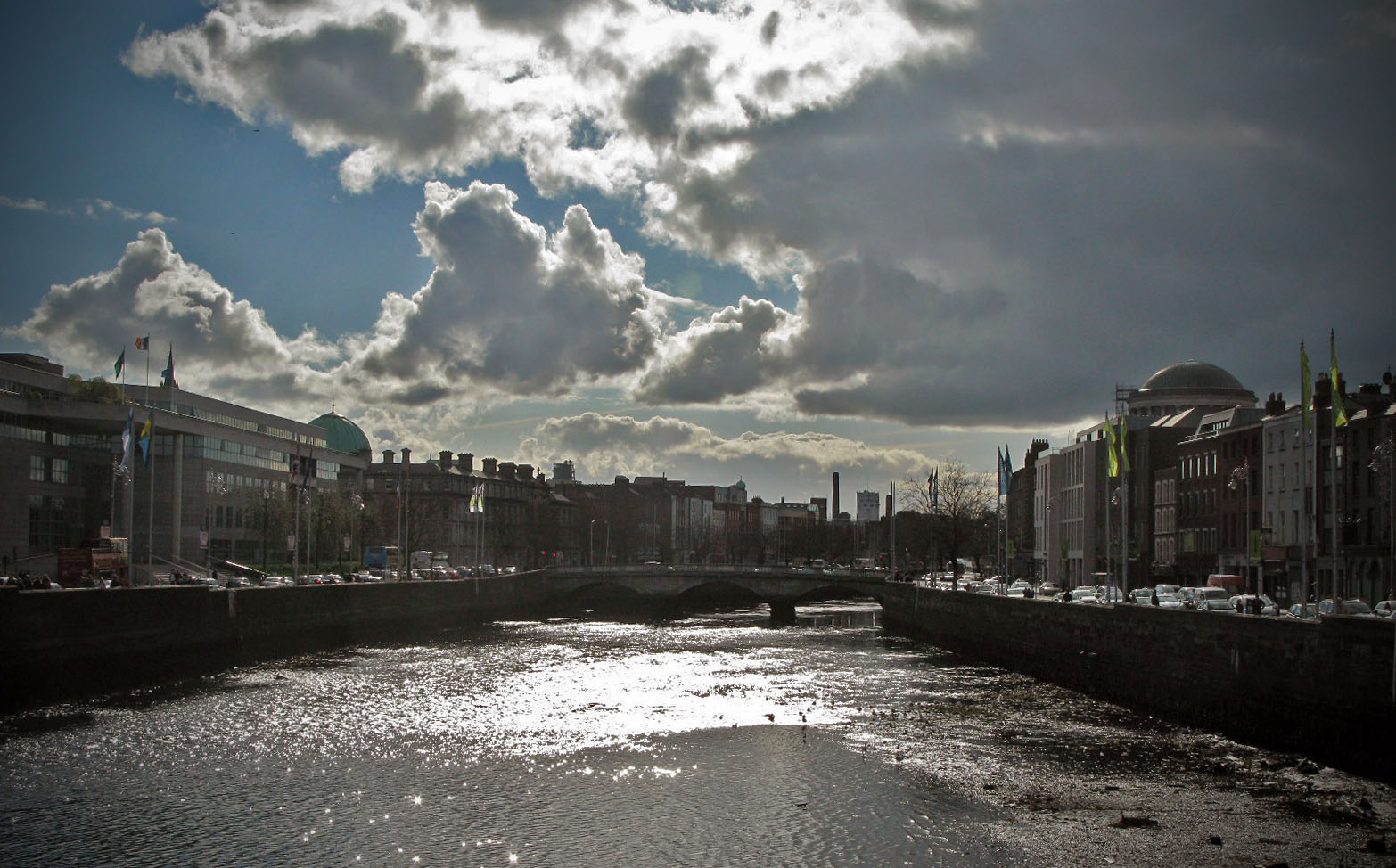
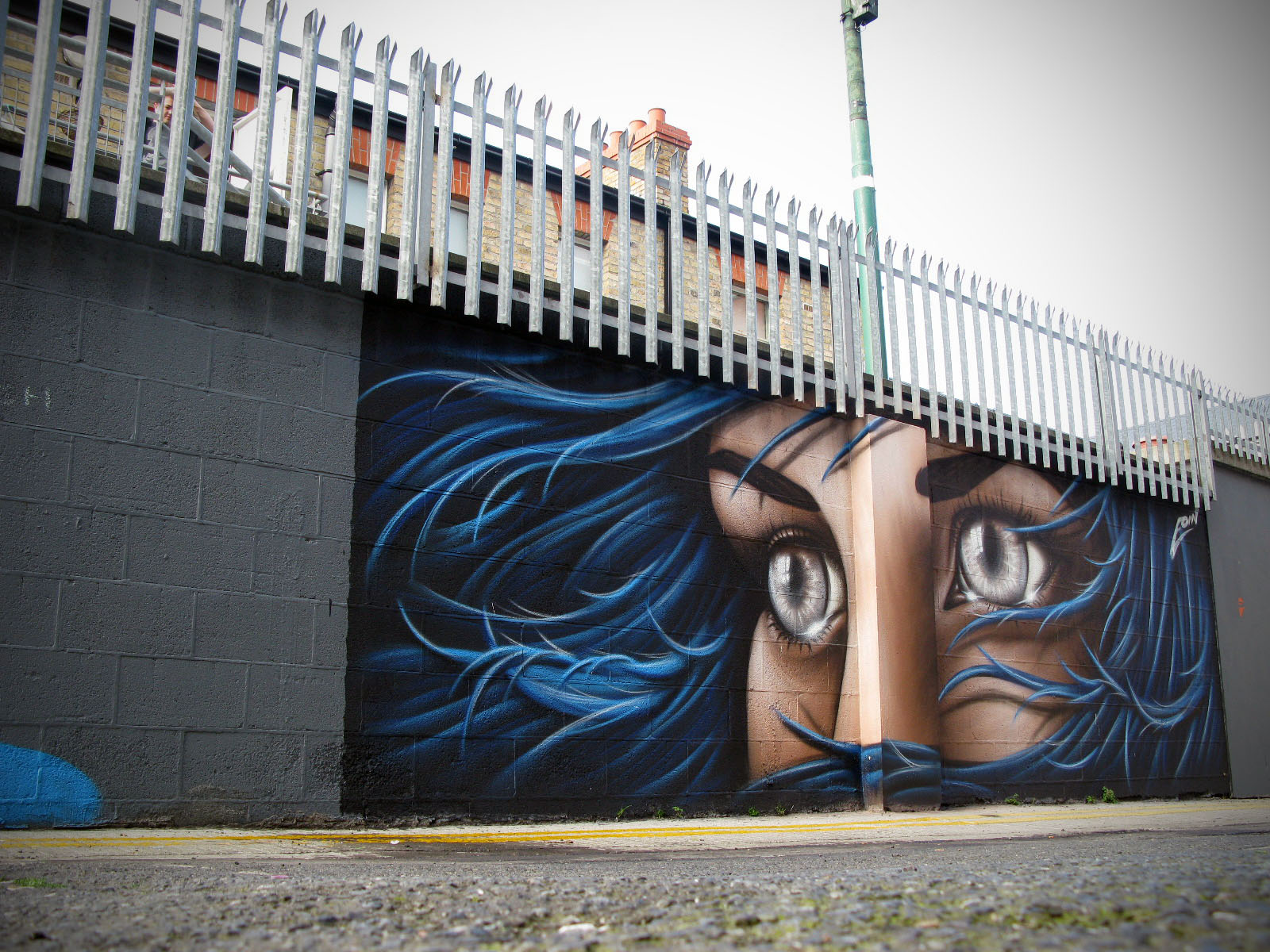
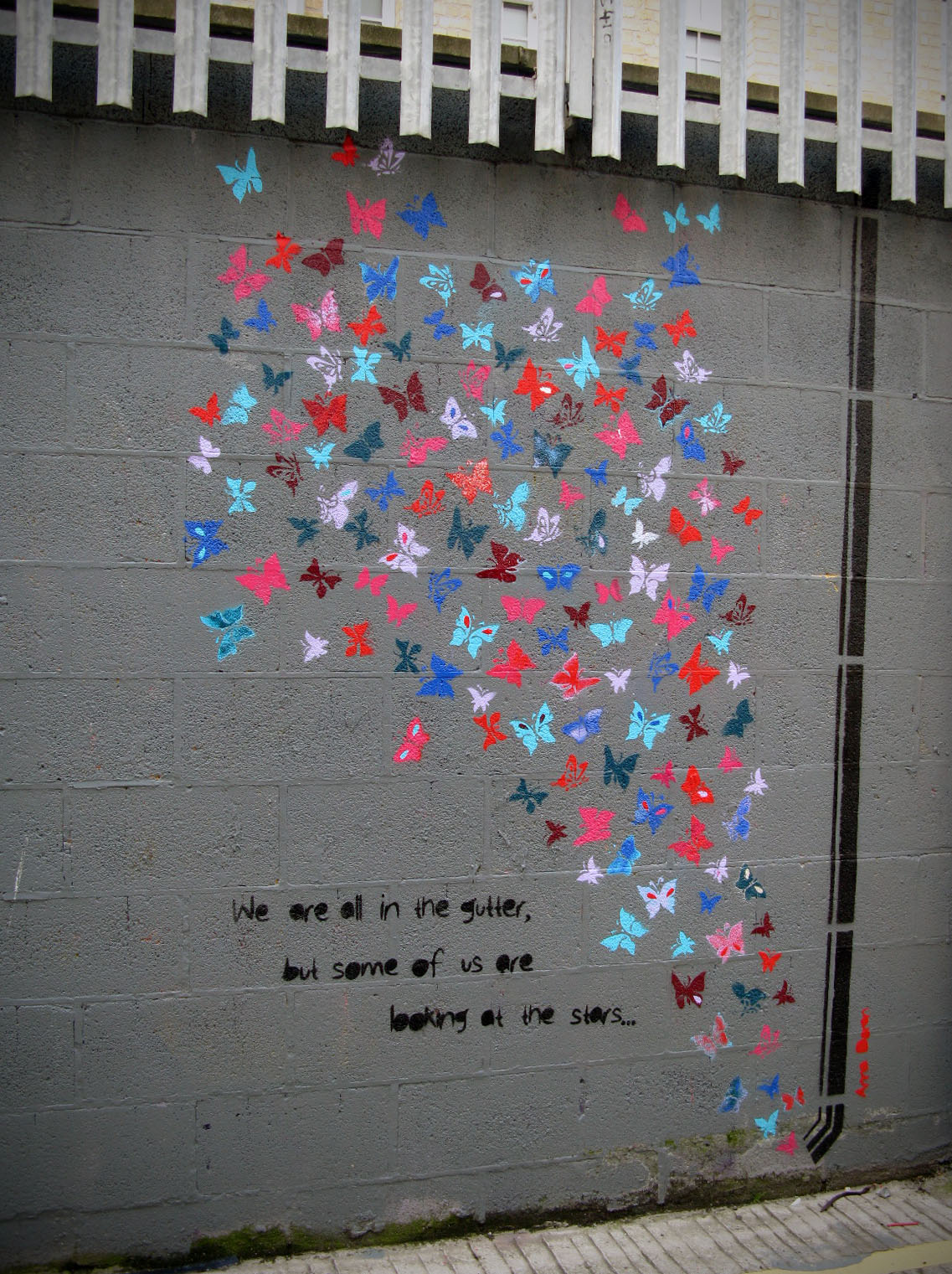
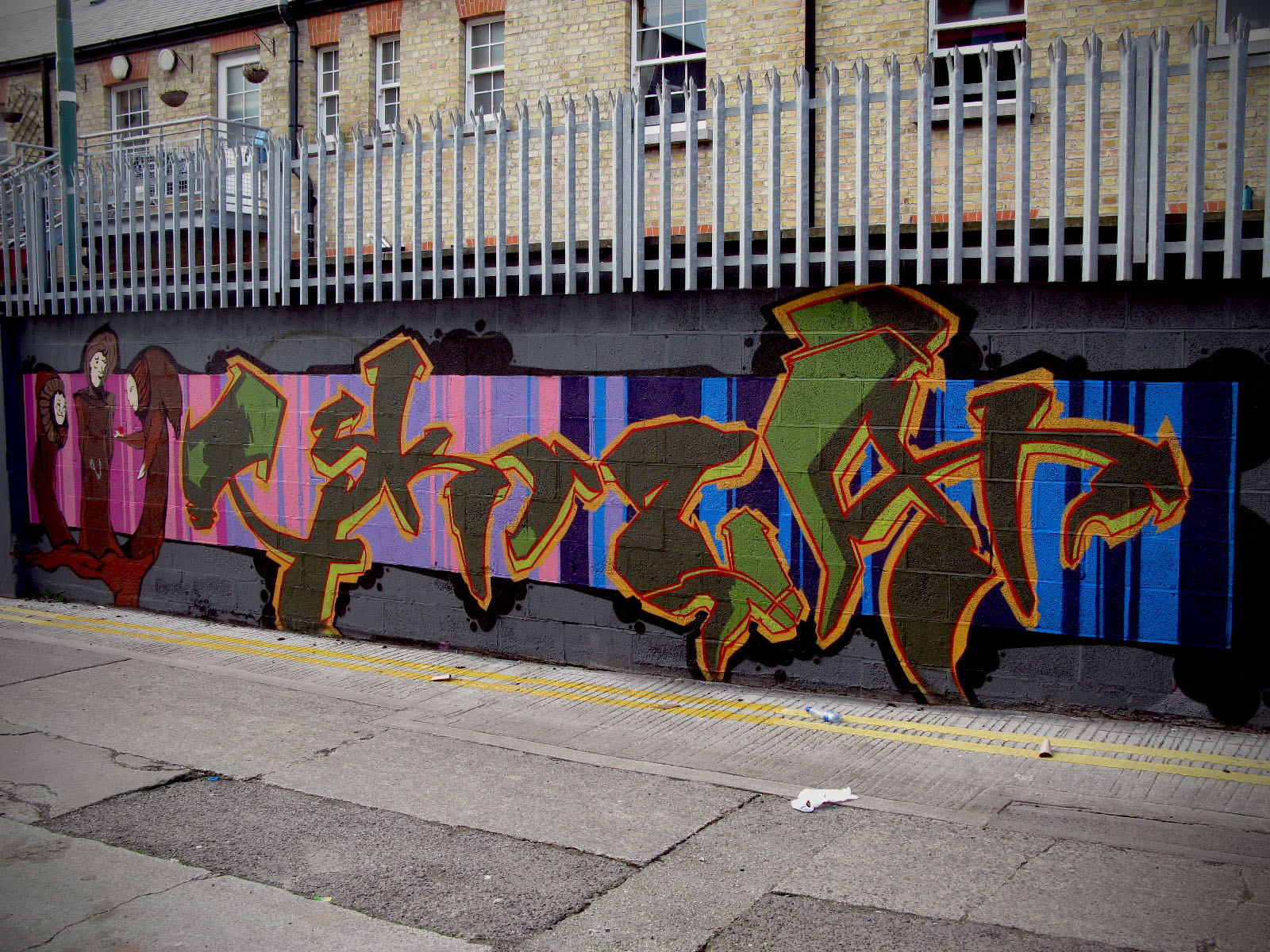
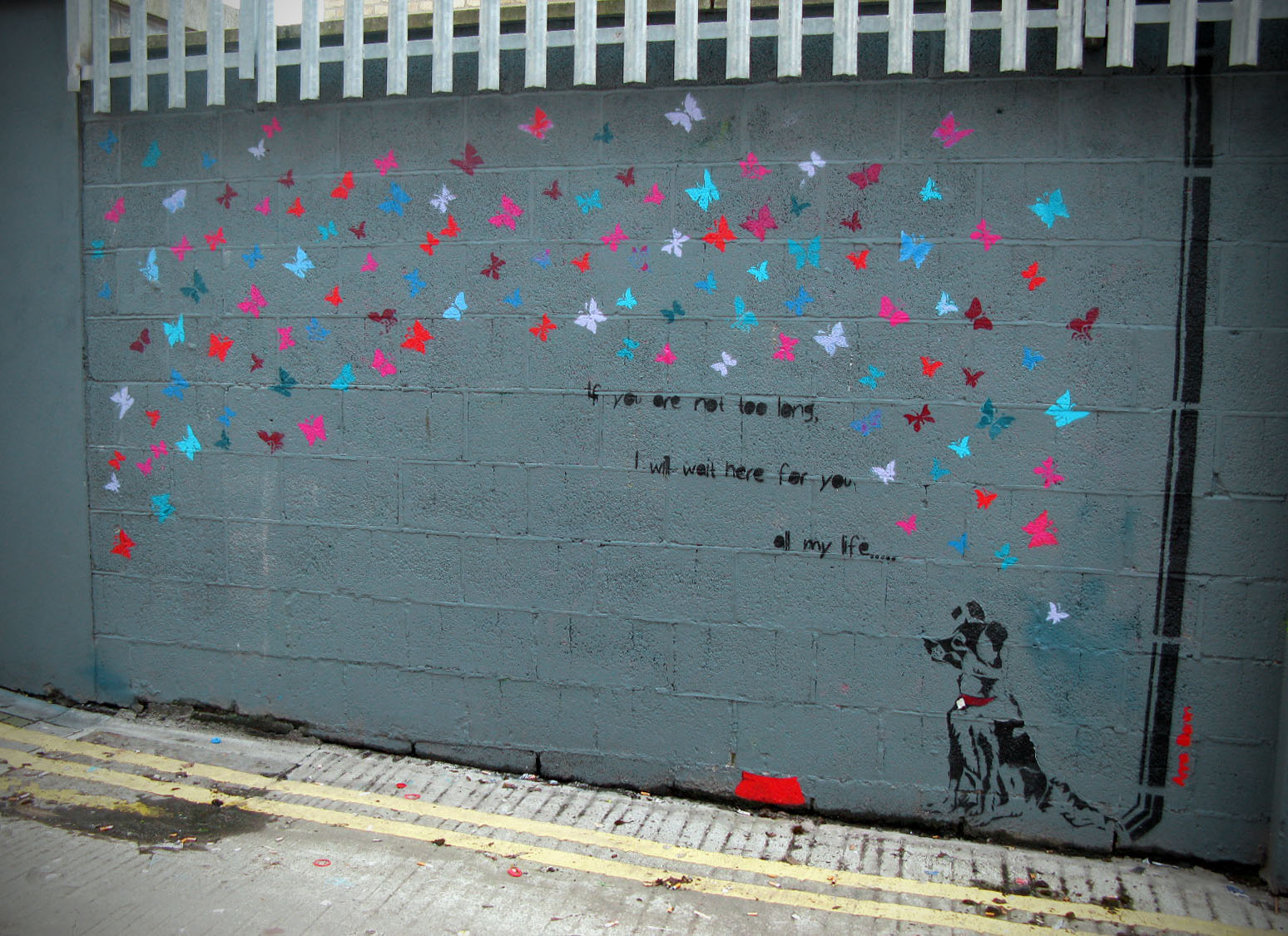
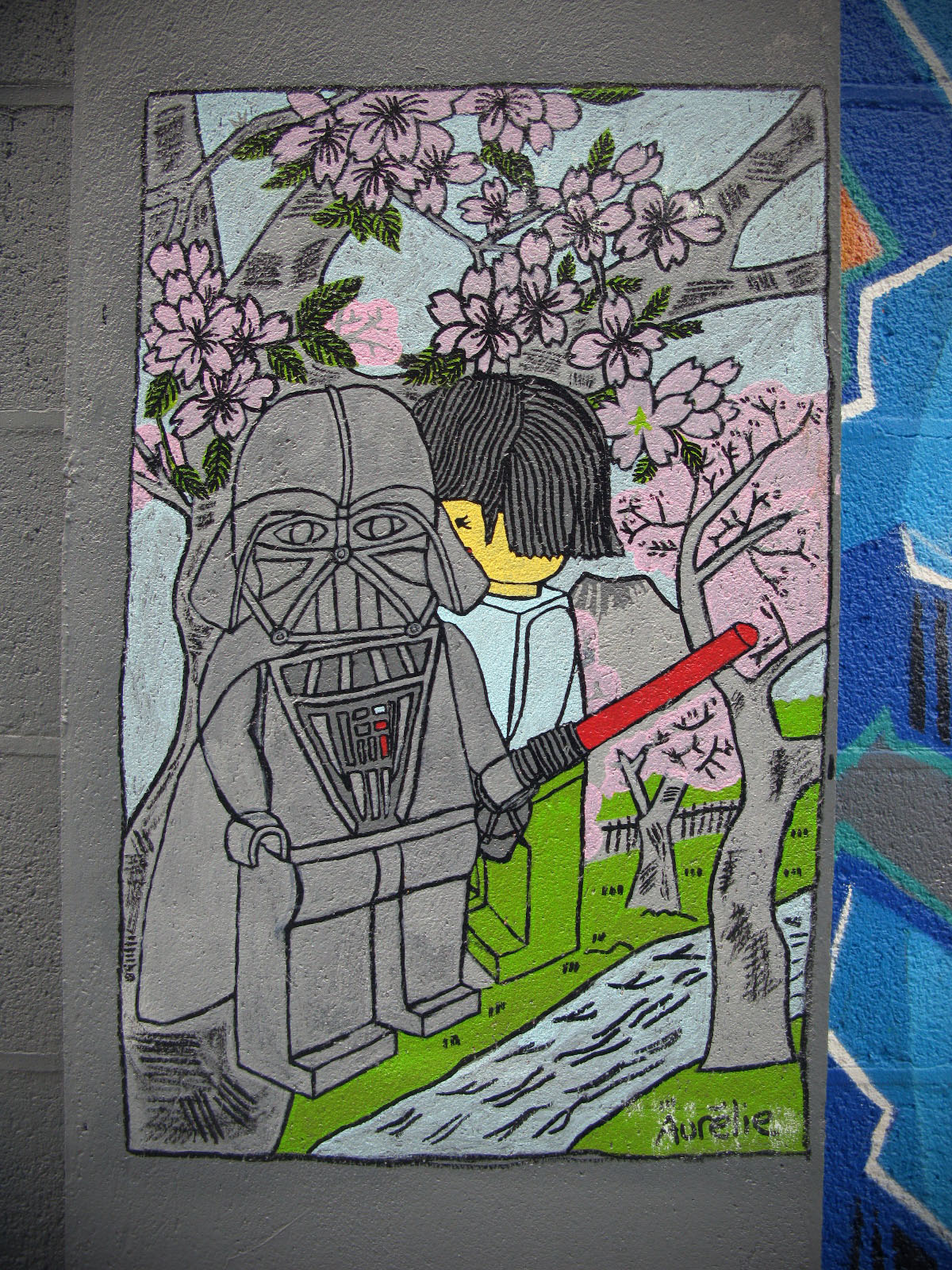
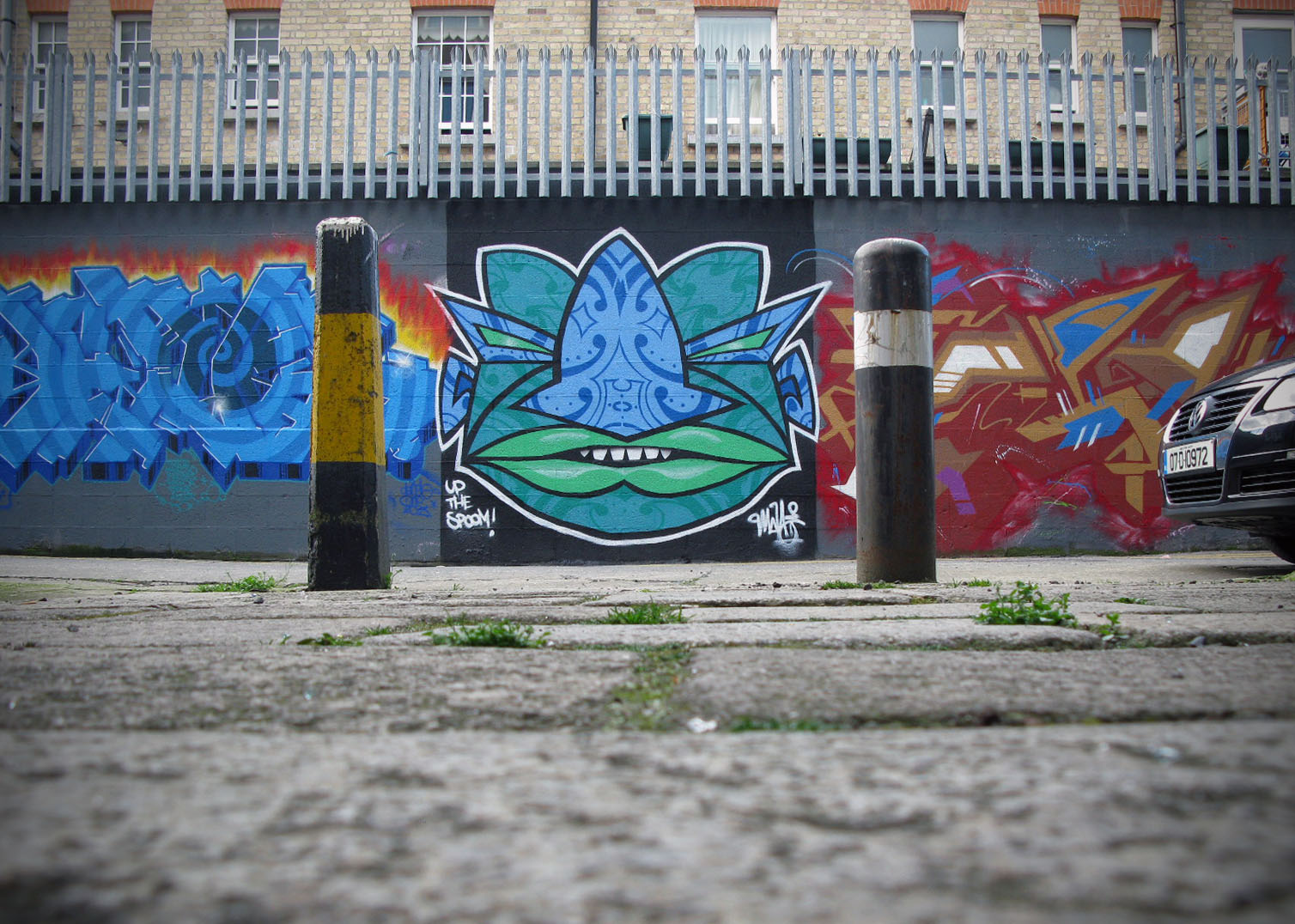
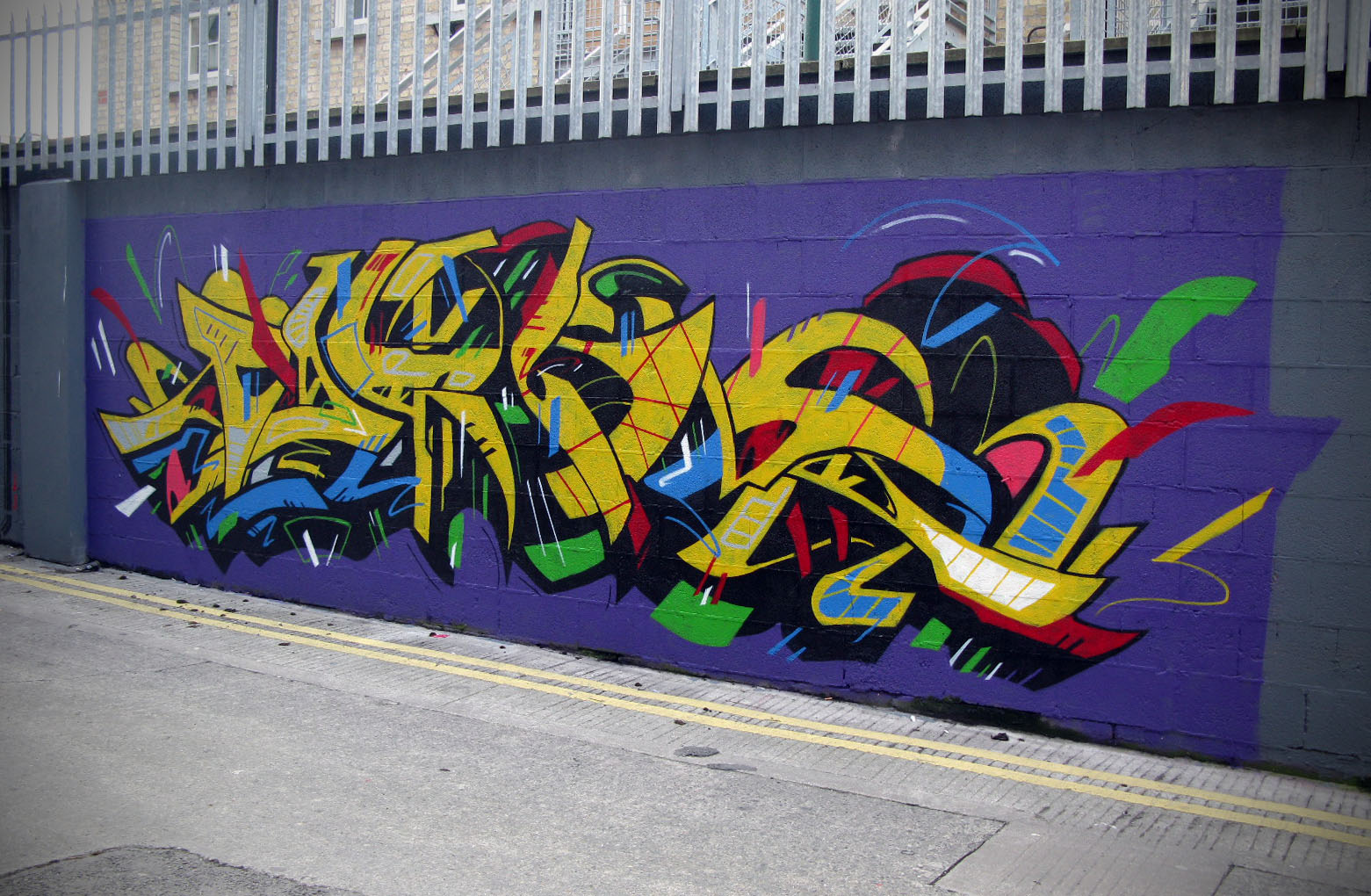
I always re-iterate the fact that there’s nowhere in the world I’d rather be when the sun is shining than Dublin City. So heading down to Ormond Place to check out the grafitti wall there, and seeing the skyline as it is in the image below, I couldn’t help but take the camera out for a shot. skyline Ormond Place (behind Fibber’s Rock Bar) is apparently a designated grafitti spot set up by the Dublin City Council, and there are some fantastic pieces on it. I’ve covered three other such spots, I’ll link to them at the bottom of this set. Dublin is lucky to be home to some absolutely amazing artists, and say what you like about tagging, beautiful street art brightens up a city. 026

040

028

043

036

034

041

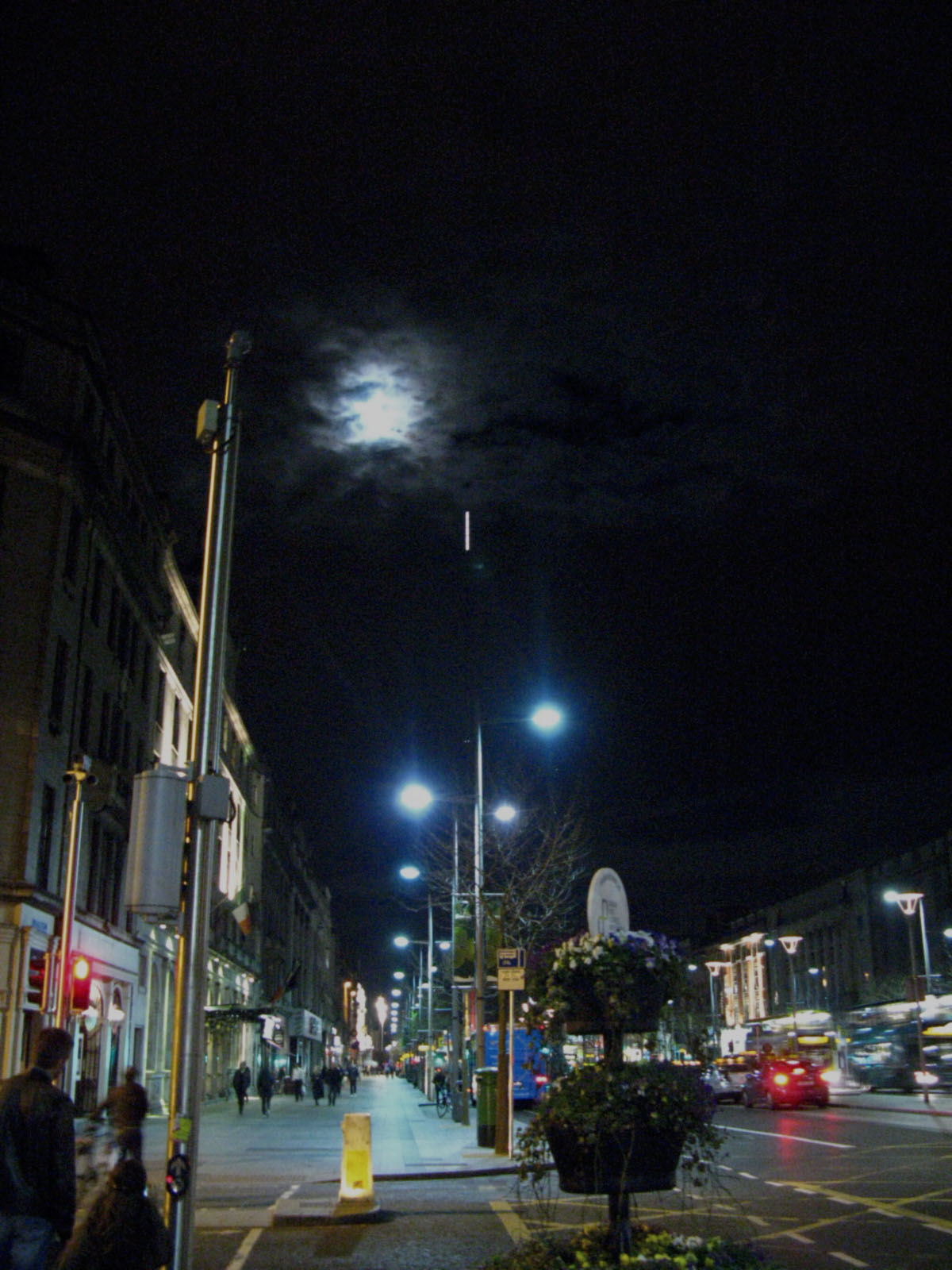
I opened with a moody sunshine snap, so I’ll close with a moody night-time one. O’Connell Street came to a stand-still, with the backdrop of a near full-moon peeking out from the clouds behind the Spire. 010

—–

Other “Writings on the wall” sets:

https://comeheretome.com/2012/11/01/the-writings-on-the-wall/

https://comeheretome.com/2012/11/07/the-writings-on-the-wall-part-ii/

https://comeheretome.com/2012/11/22/the-writings-on-the-wall-part-iii/

My last article looked at the morbid tale of the soldier who got lost in the crypts of Christchurch and was eaten alive by rats. This story is often told in connection with the alleged tunnel that ran from Christchurch to the area where the Four Courts is today.

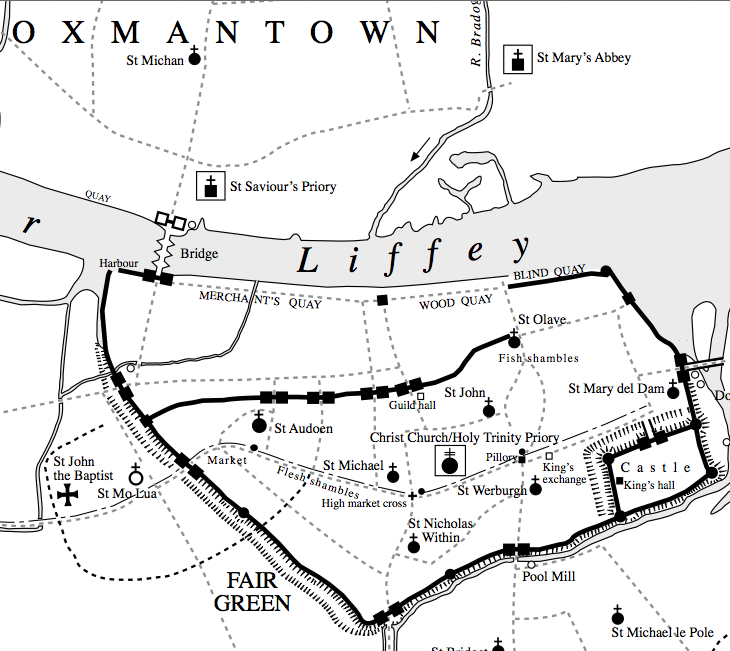
In 1224 the Dominicans (the Black Friars) established St Saviour’s Priory by the present location of Inns Quay on the Northside of the Liffey. They took over possession a small chapel which had been built four years previously. The priory’s extensive grounds reached to the corner of Cuckoo Lane and George’s Hill.
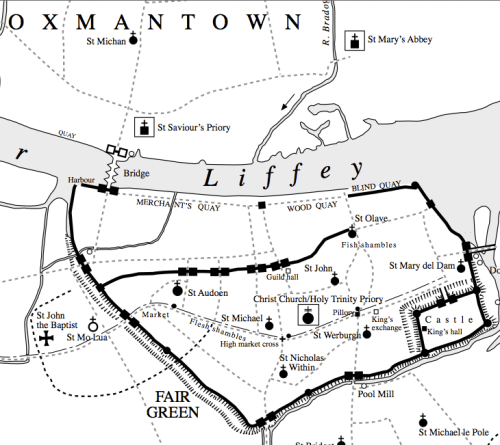
Dublin, c. 1300. Saint Saviour's Priory can be seen clearly on the map. From 'Dublin to 1610: Irish Historic Towns Atlas'

Dublin, c. 1300. Saint Saviour’s Priory can be seen clearly on the map. From ‘Dublin to 1610: Irish Historic Towns Atlas’

They built a bigger, more suitable church in 1238 but this fell victim in 1304 to one of Dublin’s periodic fires.

The priory buildings were taken over in 1539 under Henry VIII for use at first as courts of law, and then as a hostel for lawyers under the title of “King’s Inns”. The lawyers retained a chapel within the former priory for their private use. In later years, apart from its brief restoration to the friars in the time of James II, the priory was used in turn as a barracks, a theatre, a publishing centre.

In 1786 the present Four Courts building was erected on the site.

In 1860 it was reported in an article, ‘On the Wells in or near Dublin, Attributed to or Named after St. Patrick’, published in Proceedings of the Royal Irish Academy (1836-69) that:

It was in Mr Bailie’s Timber Yard, corner of George’s Hill and Cuckoo-Lane, in a vault, approached by a great flight of stairs, also leading to a vaulted chamber which appears to have been an ancient church.

The local tradition leads to the conclusion that these vaults extend to a great distance, south to the Liffey, and westwards to Thief’s Hole, near the Park Gate, which was opened about thirty years ago, when it was examined by the police, in consequence of a report that the body of a murdered female had been hid therin.

Another source (The Annals of Dublin, 1987) suggests that it was in 1890 that workmen found the 150 feet long tunnel heading for the Liffey. This was alleged to have been the ancient passage which ran under the river to connect with the crypt of Christ Church.
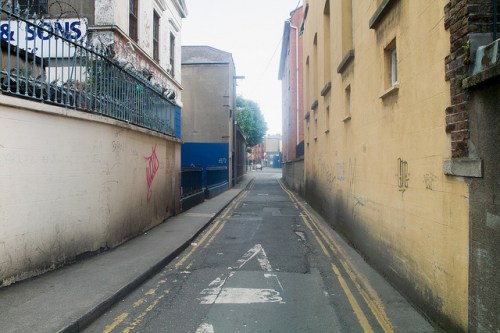
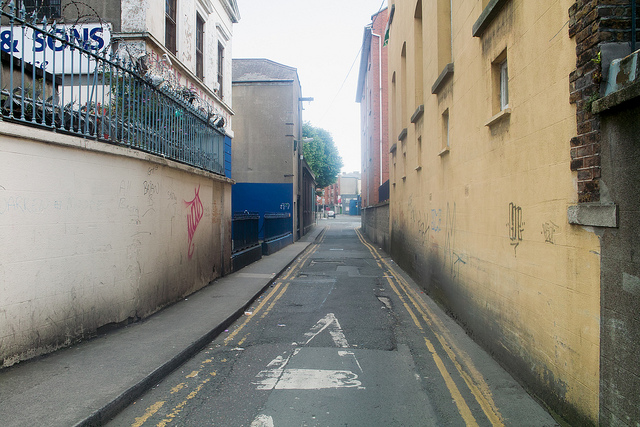
Cuckoo Lane where at the corner of George's Hill, the entrance to the tunnel was found. Credit - 'infomatique'

Cuckoo Lane where at the corner of George’s Hill, the entrance to the tunnel was found. Credit – ‘infomatique’

In the fantastic Life in old Dublin, historical associations of Cook street (1913), James Collins wrote:

The building of the Four Courts … has removed all traces of the Dominican Priory … save (those) still under ground, several of which are known to exist in the locality starting from North King Street towards the river.

One of the most interesting was up to some years ago in a good state of preservation, after a lapse of 700 years. It consisted of a series of lofty semi-circular and round arches, built on massive piers, which are approached by a descent of large steps built in what was, up to a short time ago, known as Bailey’s timber yard, George’s Hill.

Opposite to the steps and in the first vault is a deeply arched recess in which there is a well of the purest water, said to be dedicated to St. Anne, from whom the adjoining street derives its name. On the left of the entrance vault is a built-up opening, which closes a vaulted passage, and tradition tells us that this passage extended to Christ Church, being tunneled under the river, and used at a remote period by the monks for the purpose of attending the ceremonials of the Cathedral.

Here’s where the story converges:

It is said that fifty years ago a workman procured a large ball of twine and some candles, and proceeded to explore the passage. He tied the end of the twine at the entrance, unwinding it as he went along, until he reached, as he considered, as far as Ormond Quay, when he was obliged to return, being driven back by foul air. The entrance was closed up in consequence of this exploit.

So, while the dates are varying, there are three sources pointing to a tunnel being found at the corner of Cuckoo Lane and George’s Hill sometime between 1830 and 1890.
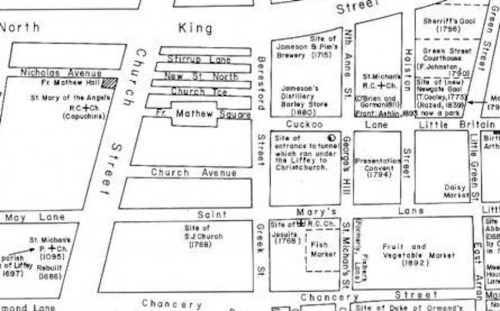
Map pinpointing location of tunnel. Source - Unknown. (If anyone knows where this map was first printed, please let us know)

Map pinpointing location of tunnel. Source – Unknown. (If anyone knows where this map was first printed, please let us know)

Interestingly, there is a similar story about an underground tunnel from St. Mary’s Abbey to Christ Church. Richard Robert Madden, historian of the United Irishmen, wrote in 1843 about vaults in St. Mary’s Abbey where:

…there is some traditional record of their leading by a tunnel passage under the Liffey, to the vaults of Christ Church, a tradition which I believe was the subject of some inquiry about two years ago on the part of Earl de Grey.

In The Transactions of the Royal Irish Academy (1855) the “well-known tradition of an ancient communication between (the) Abbey and Christ Church” was mentioned in pasing

However, there is certainly a bit more evidence to suggest there certainly was a tunnel found in the grounds of St Saviour’s Priory (Four Cours area). Whether it ran all the way up to Christ Church is another matter.

Of the ‘Sixteen Dead Men’ W.B Yeats immortalised, the average Dubliner can name many. In our street names and train stations, hospitals and memorials their names are found across the city and county. Some like Pearse and Connolly are very familiar figures, and have been subject to much study. Others however have managed to escape the same level of evaluation. Incredibly, almost a century on from the event, some of the executed leaders are only now becoming the subject of biographies. One such biography has just recently been released by O’Brien Press, looking at Sean Heuston. It forms a part of their ambitious Sixteen Lives series, and comes from historian and Dubliner John Gibney.

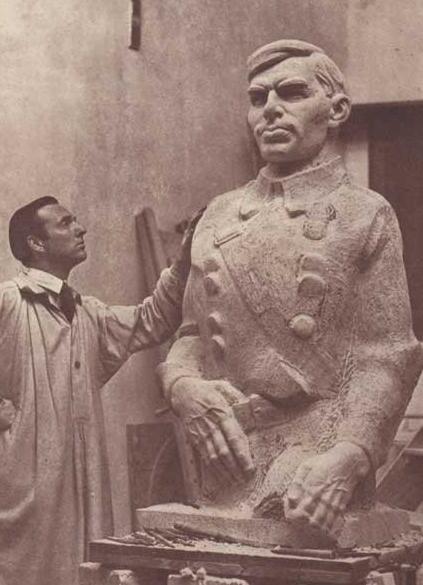
Laurance Campbell at work on his great statue for Sean Heuston, which today sits in the Phoenix Park near the zoo.

Laurance Campbell at work on his great statue for Seán Heuston, which today sits in the Phoenix Park near the zoo.

Among the youngest of the executed, Heuston was born in 1891 into Dublin’s inner-city, known as Jack to his siblings and baptised John Joseph. Gibney notes that six of the sixteen executed were Dublin men, with Heuston joined by the Pearse brothers, Michael Mallin, Roger Casement and Joseph Plunkett. Heuston’s working class background is worth pointing out, in a rebellion too often spoken of as a middle class insurrection. Born at 24 Lower Gloucester Street, it is known today as Seán MacDermott street to inner-city Dubliners. This area of the city captures the rise and demise of Dublin better than any other for me. It’s fashionable eighteenth-century existence is very much at odds with what would follow, and as Gibney writes “Dublin has presented a number of faces to the world, but two of the best known go hand in hand, as the splendor of the eighteenth century gave way to the squalor of the nineteenth.” Thirty-two people died of tuberculosis between 1894 and 1897 on this once highly respectable street, and the family moved to Jervis Street, and later to Dominick Street, yet another tenement area. The search for employment was to take Seán out of the city however, and to Limerick, where he succeeded in gaining employment as a clerk with the Great Southern and Western Railway. This offered all kinds of benefits, not least an eight hour day, when compared and contrasted with the precarious nature of work for most young men in Dublin at the time.

Undoubtedly the most recognisable image of Heuston, this photo appears on the front cover of the book. It was popularised after the Easter Rising and his execution.

Undoubtedly the most recognisable image of Heuston, this photo appears on the front cover of the book. It was popularised after the Easter Rising and his execution.

Continue Reading »

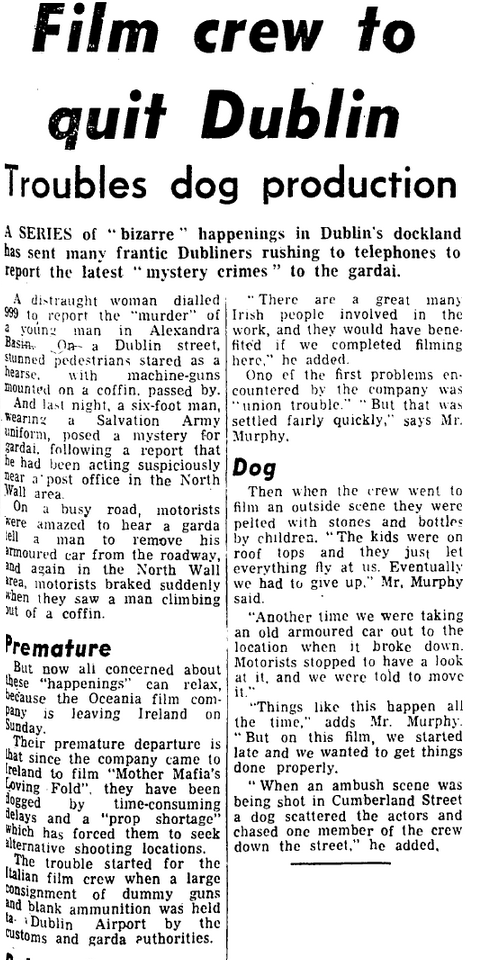
This brilliant story appeared in the Irish Press in December 1972. It has everything. A visiting film crew decided to pack a job in owing to numerous incidents in Dublin, ranging from local youths flinging stones to the locals calling the Gardaí terrified, and some of the cast were even reported to have been ‘acting suspiciously’by worried locals!

FilmQuits

In addition to all this, a huge number of prop guns were seized from the production team at Dublin Airport upon arrival! What became of Mother Mafia’s Loving Fold? I’m unable to find any reference to the film online. John Murphy, producer of the film, described it in newspapers at the time as a send up of The Godfather and Hollywood gangster films of the 1930s.

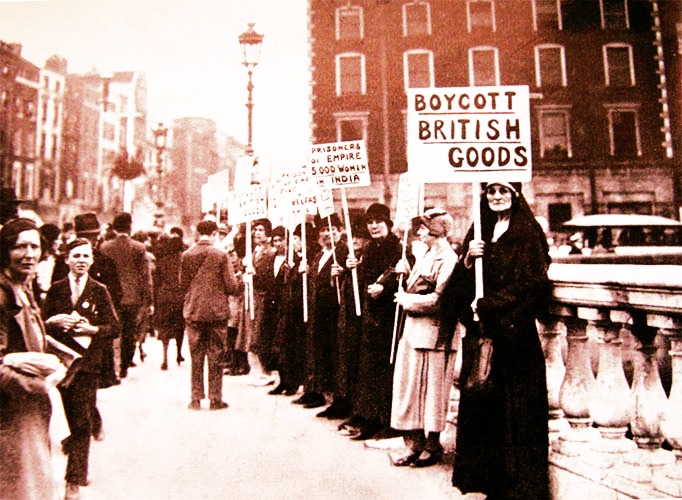
Maud Gonne photographed around the time of the dispute, clutching a 'Boycott British Goods' placard on O'Connell Bridge.

Maud Gonne MacBride photographed around the time of the dispute, clutching a ‘Boycott British Goods’ placard on O’Connell Bridge.

In the early 1930s, republicans in Dublin and elsewhere waged a campaign of intimidation against publicans who sold Bass ale, which involved violent tactics and grabbed headlines at home and further afield. This campaign occurred within a broader movement calling for the boycott of British goods in Ireland, spearheaded by the IRA. Bass was not alone a British product, but republicans took issue with Colonel John Gretton, who was chairman of the company and a Conservative politician in his day.

In Britain,Ireland and the Second World War, Ian Woods notes that the republican newspaper An Phoblacht set the republican boycott of Bass in a broader context , noting that there should be “No British ales. No British sweets or chocolate. Shoulder to shoulder for a nationwide boycott of British goods. Fling back the challenge of the robber empire.”

In late 1932, Irish newspapers began to report on a sustained campaign against Bass ale, which was not strictly confined to Dublin. On December 5th 1932, The Irish Times asked:

Will there be free beer in the Irish Free State at the end of this week? The question is prompted by the orders that are said to have been given to publicans in Dublin towards the end of last week not to sell Bass after a specified date.

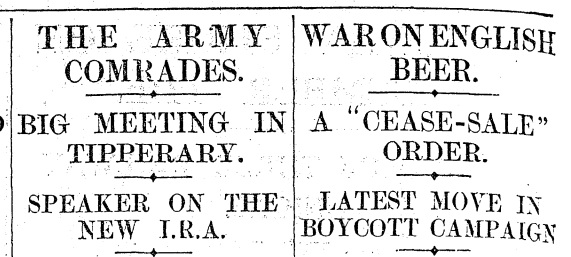
The paper went on to claim that men visited Dublin pubs and told publicans “to remove display cards advertising Bass, to dispose of their stock within a week, and not to order any more of this ale, explaining that their instructions were given in furtherance of the campaign to boycott British goods.” The paper proclaimed a ‘War on English Beer’ in its headline. The same routine, of men visiting and threatening public houses, was reported to have happened in Cork.

It was later reported that on November 25th young men had broken into the stores owned by Bass at Moore Lane and attempted to do damage to Bass property. When put before the courts, it was reported that the republicans claimed that “Colonel Gretton, the chairman of the company, was a bitter enemy of the Irish people” and that he “availed himself of every opportunity to vent his hate, and was an ardent supporter of the campaign of murder and pillage pursued by the Black and Tans.” Remarkably, there were cheers in court as the men were found not guilty, and it was noted that they had no intention of stealing from Bass, and the damage done to the premises amounted to less than £5.

119rt5j

A campaign of intimidation carried into January 1933, when pubs who were not following the boycott had their signs tarred, and several glass signs advertising the ale were smashed across the city. ‘BOYCOTT BRITISH GOODS’ was painted across several Bass advertisements in the city.

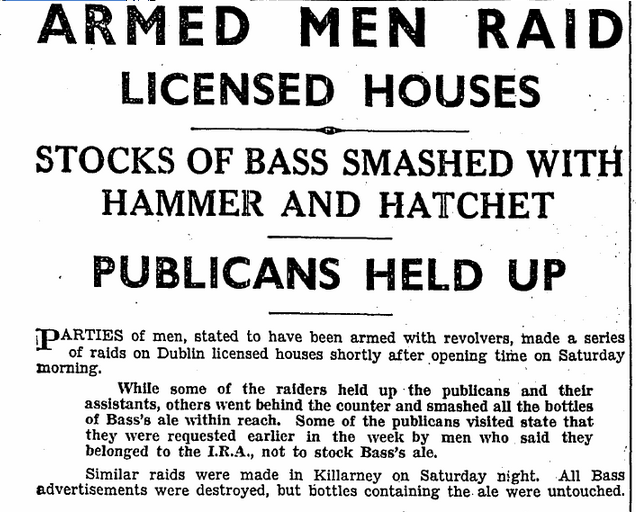
Throughout 1933, there were numerous examples of republicans entering pubs and smashing the supply of Bass bottles behind the counter. This activity was not confined to Dublin,as this report from late August shows. It was noted that the men publicly stated that they belonged to the IRA.

Irish Press. 28 August 1933.

Irish Press. 28 August 1933.

Continue Reading »

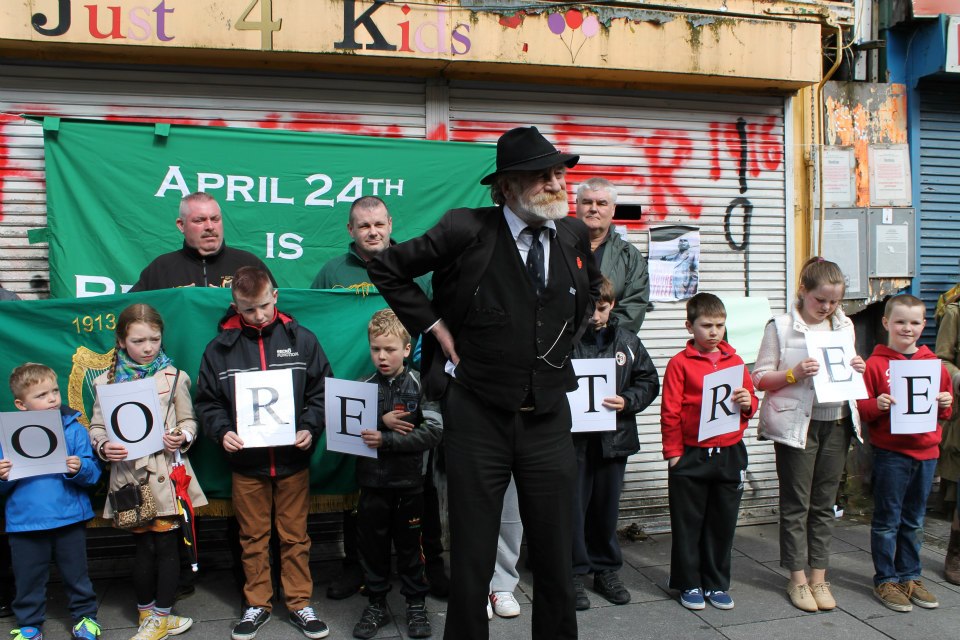
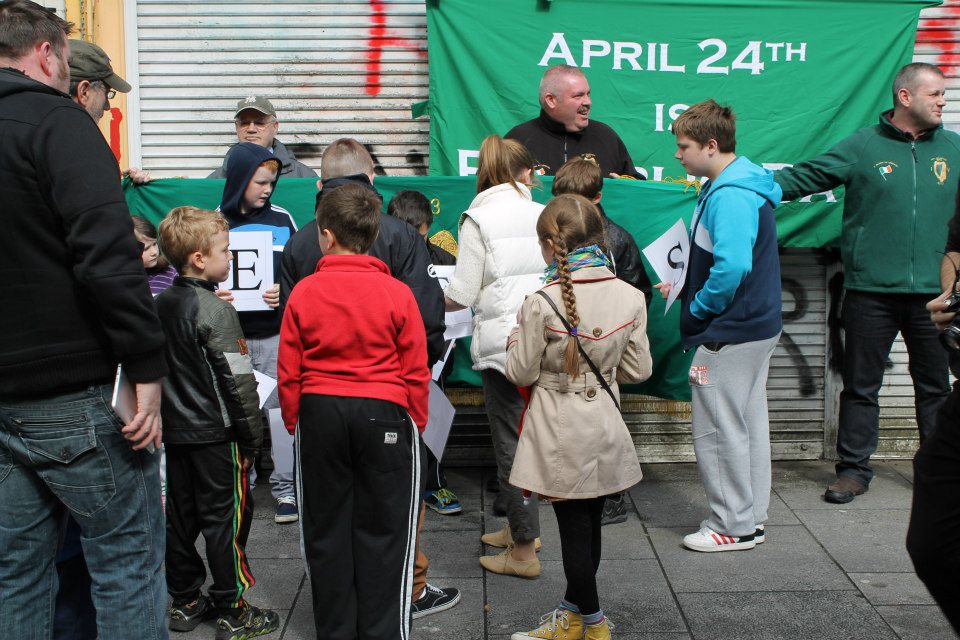
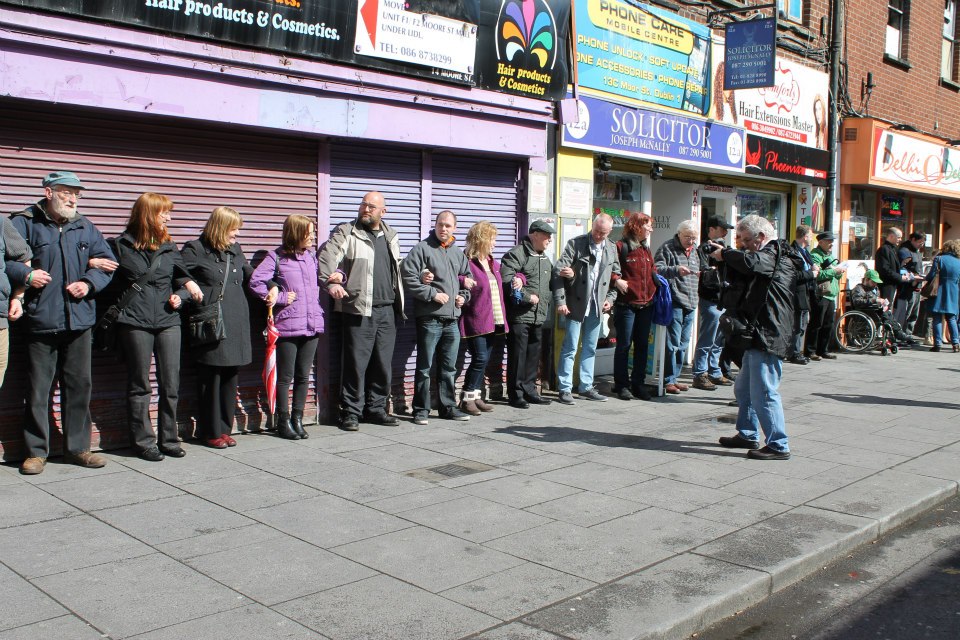
Hundreds gathered on Moore Street today to demand that the hugely important street be preserved. In recent times campaigners have been split over the issue of just what should be saved, with some relatives of 1916 leaders seeming happy for a small terrace of houses to be preserved within a new development, while the majority of the relatives and others argue that the entire terrace of houses, and the laneways around it, should be designated a national monument. Personally, I think another shopping centre is the last thing the city needs, and I feel we’re not using Moore Street and the area around it to its full potential.

To me, the streets contemporary life as a market area with a strong multicultural atmosphere is also worth preserving. Below are a series of images from the protest today, and my thanks to Bas Ó Curraoin for permission to post them here.

With the year that is in it, Jer O’Leary performed his Jim Larkin routine before the crowd. Those who haven’t can see him do the same at the launch of a comic in honour of Jim this Thursday.

Bas3

Bas2

Bas1

Continue Reading »

A 1922 advertisement for ‘useful cycling accessories’. No mention of a bike lock…

Twice now in recent weeks I’ve witnessed people frantically searching for a bike that just isn’t there any more in Dublin. Like any major city, the robbing of bicycles is somewhat commonplace in Dublin, and many cyclists will have lost a bicycle to more opportunistic Dubliners. There is nothing new about bicycles vanishing on their owners in Dublin of course.

Digging into the archives, I found that the theft of bicycles featured heavily in the Irish media in the early twentieth century. This was a time of course when there were many more bicycles in the city. In October 1919, the Irish Independent bemoaned the fact that Dublin was not a city in which a mans bicycle was safe, warning that:

Dublin is getting a bad reputation for the larceny of motors and cycles, in respect of some of which, at all events, the accused have come from across the channel.

“No man”, said the Right Hon. Recorder, “can leave his bicycle without keeping his hand on it in this city.”

The paper was reporting on a court case involving a seaman by the name of John A. Johnson, caught in the act. In court, he gave an address in Liverpool as his own. A seemingly endless cycle (pun intended) of court cases involving stolen bicycles appear in the newspapers of the period, with harsh sentences handed out.

Bicycles enjoying a beautiful day in Howth (Image by Ciaran)

Bicycles enjoying a beautiful day in Howth (Image by Ciaran)


Throughout the 1920s, many Dublin youths were sent to industrial schools for robbing bicycles, with a judge claiming in 1924 that “there would be none of this nefarious robbing of bicycles in Dublin if it were not for ‘receiving merchants'”. A massive black market existed for bicycles in the Dublin of the day, and quite simply the process involved “young lads stealing bicycles which were handed over to other people, changed and disposed of.”

In February 1936, it was claimed in The Irish Times that “hundreds of bicycles were disappearing daily in the city.” The paper claimed that they were “being taken morning after morning from outside churches.” The attitude of authorities was that this was a longstanding problem in Dublin, with six months hard labour seeming a standard punishment at the time for the offence. One judge remarked that “it seems easy to take bicycles, and just as easy to get rid of the stolen bicycles. I would be very happy to have any person charged with receiving stolen bicycles before me, as I consider that the only sentence for these offenders is imprisonment.”

Continue Reading »

At the minute, I’m slowly but surely working on a brief article looking at a riot that broke out in Dublin in 1759. A rumour of an impending ‘Act of Union’ with Britain was enough to bring a mob of hundreds to the Irish Parliament, where scenes of madness broke out, with claims that the mob had first assembled in the Liberties and that the infamous ‘Liberty Boys’ were in their midst.

An eighteenth century map of Dublin's liberties, from the excellent http://dublin1798.com

An eighteenth century map of Dublin’s liberties, from the excellent http://dublin1798.com

In the course of it all, I stumbled across a great account of the Liberty Boys and the Ormond Boys, which was in J.D Herbert’s exciting Irish Varieties, for the Last Fifty Years: Written from Recollections. Published in 1836, it’s an interesting if slightly over the top account of Irish characters in the late eighteenth and early nineteenth century.

Below is his account of the faction fighting that occurred between the Liberty Boys and the Ormond Boys. These gangs were infamous in their day, and have certainly entered Dublin folklore.

——————-

As I have got into a view of subjects so vile and low, that it would, perhaps, never have occurred to any person to record them had had they not been so annoying and offensive to the citizens of Dublin, that it was a risk of life to fall in their way when they were prepared for their abominable sacrifices; and, therefore, I having them strongly before me in recollection, could not, in truth, omit giving a hasty sketch of their actions.

A set of fellows of the lowest description, frequenting Ormond Market, assistants and carriers from slaughter-houses, joined by cattle drivers from Smithfield, stable-boys, helpers, porters, and idle drunken vagabonds in the neighbourhood of Ormond Quay, formed a body of fighting men, armed with falchions as they called them- oak staves of casks hardened by smoking in chimnies, sharpened on one side, and a hole cut in one end to admit a hand to answer for a handle – some preferred shilelahs- but all armed for combat, were prepared to meet the Liberty Boys, a set of lawless desperadoes, residing in the opposite side of the town, called the Liberty. Those were of a different breed, being chiefly unfortunate weavers without employment: some were habitual and wilful idlers, slow to labour, but quick at riot and uproar.

Continue Reading »

Big Jim

LarkinComic

People make kings and people can unmake them; but what has the King of England to do with stopping a meeting in Dublin? If they like to stop the meeting at the order of Mr. Murphy, Mr. Wm. Murphy will take the responsibility; and, as I have previously told you, for every man that falls on our side two will fall on the other. We have a perfect right to meet in O’Connell Street. We are going to meet in O’Connell Street, and if the police or soldiers are going to stop or try to stop us, let them take the responsibility. If they want a revolution, well then, God be with them.

– Jim Larkin speaking on the eve of a banned demonstration on O’Connell Street, August 1913

I’m delighted to have been asked to say a few words at the launch of a new comic book on Big Jim Larkin, which comes from O’Brien Press. Following on from their graphic novels exploring the Easter Rising and the War of Independence, this new work looks at the Dublin Lockout of 100 years ago. Sharing a stage with Jer O’Leary is always a bit daunting, the last time I done that was in a school in Ringsend, where I saw him captivate an audience of kids with his Larkin performance. Also speaking is Stephen Mooney, a well-established comic book artist and illustrator.

Larkin understood the power of cartoons, which were a constant presence in his Irish Worker newspaper, but he was also ridiculed in the pages of the mainstream media. This great little cartoon comes from the conservative Daily Express in England, who believed politicians in Britain were bowing before the ‘Larking’.
Larking

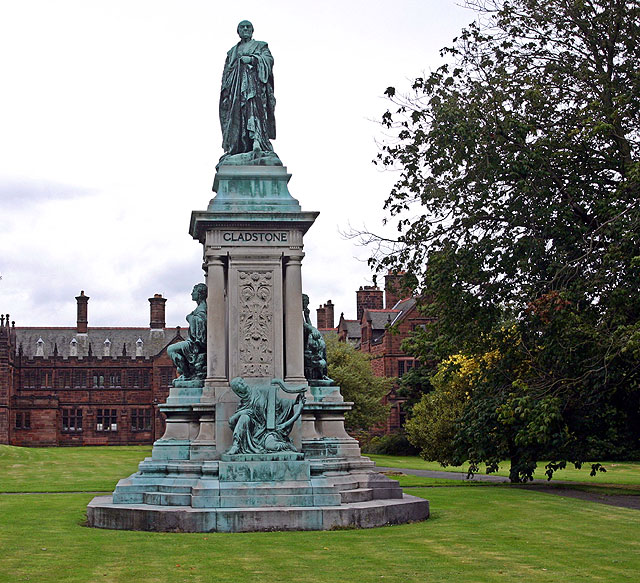
A visitor to Hawarden in Wales might stumble across a statue in honour of William Ewart Gladstone, the four-time prime minister of Britain. A hugely important figure in nineteenth century Irish political history, Gladstone’s political career spanned over sixty years, with him first taking the office of prime minister in 1868. Gladstone had tried and failed to introduce Home Rule to Ireland, but he was also instrumental in introducing coercion laws into Ireland which allowed for people to be imprisoned without trial, in an attempt to establish “law and order” in Ireland.

Gladstone statue in Hawarden, Wales: http://www.geograph.org.uk/

Gladstone statue in Hawarden, Wales: http://www.geograph.org.uk/

In 1898, the Gladstone National Memorial Fund proposed that statues in honour of Gladstone be erected in London, Edinburgh and Dublin. John Hughes was the sculptor chosen for the job at hand. Dubliners will be familiar with Hughes’ statue to controversial Trinity College provost George Salmon, while his monument in honour of Queen Victoria has long been removed from Leinster House. A discussion around acceptance of the statue took place at a meeting of the Dublin Corporation in August 1898, and ultimately the elected members of the Corporation decided against acceptance of the statue, which infuriated the Freeman’s Journal newspaper:

Under the circumstances, it is clear that it is the duty of self-respecting Irishmen to step into the breach, to form a representative committee, to accept the offer of the Duke of Westminster on behalf of the nation, and by the force of public opinion to override the ill-considered and ill-conditioned resolution adopted yesterday. There is no other course open unless Irishmen are to hang their heads in shame for all time at the name of Gladstone.

The actual motion passed by Dublin Corporation is interesting, as it seems the primary cause of concern to the Corporation was the absence of a statue to Charles Stewart Parnell in the city, with their motion stating that “that no statue should be erected in Dublin in honour of any Englishman until as least the Irish people have raised a fitting monument to the memory of Charles Stewart Parnell….”

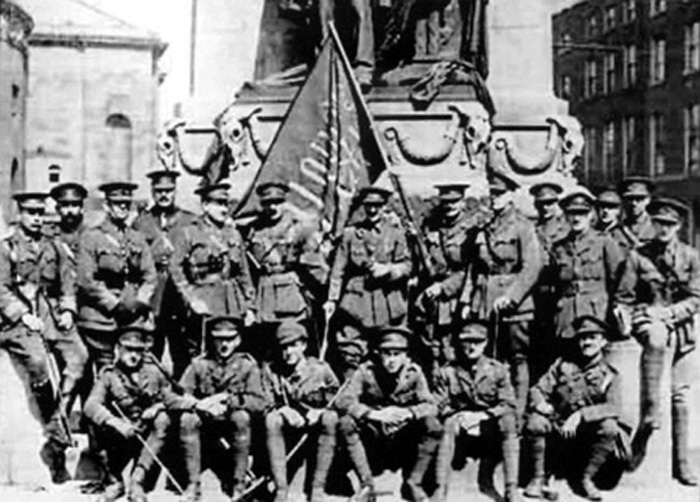
It was not until 1911 that Parnell’s monument was put in place, the work of the reknowned sculptor Augustus Saint-Gaudens. John Redmond had served as secretary to the Parnell Monument Committee, and huge crowds came to see the unveiling of the statue in October of that year. Poor Parnell, like Daniel O’Connell, was to take a number of bullets in Easter Week. It was there that British Army officers would pose with the captured flag of the Irish Republic, less than five years after the statue had been unveiled.

Parnell

Ultimately, Hawarden on the Welsh/English border would claim the statue to Gladstone. Far from the city of Dublin, the total population for the greater community of Hawarden was 13,539 at the time of the 2001 census. While the Freeman’s Journal may have felt Dublin had disgraced itself in refusing such a statue, history had shown it may not have stood much of a change in a newly independent state, where symbols of the British state and establishment were routinely targeted in Dublin.