Feeds:
Posts
Comments

Posts Tagged ‘dublin’

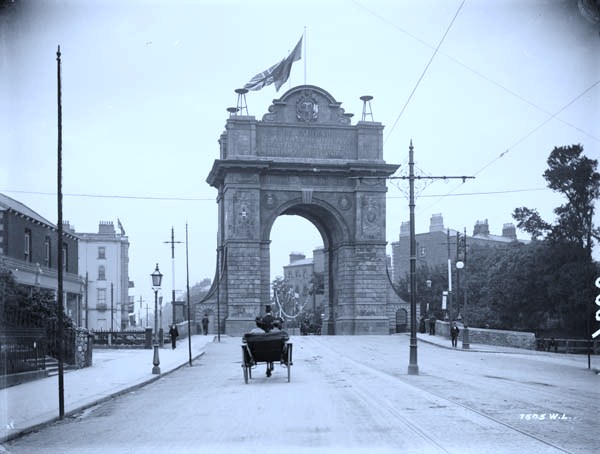
A bit of a mystery post this. On going through the National Libraries excellent online collection of photographs (which can be found here) I found the glass plate below. And while there were a set of mock gates erected on Leeson Street Bridge for the visit of Queen Victoria in 1900, they don’t fit the description that follows and besides, the scene looks much older than 1900.

Dublin City Gates?

The large mock medieval castle gate and tower erected at the bridge echoed the more ancient gate to the walled city of Dublin. The 70 foot high tower made of wood, covered in canvas and painted to imitate the 16th century stonework of medieval Baggotrath Castle. A number of beefeaters in their tradition costumes flanked the gate and a stand was erected nearby to seat various dignitaries…

 An image of the above gates can be seen below, as found here.

Leeson Gates, as from Chapters of Dublin

 As you can see the two gates look very different- but the top one definitely looks like Leeson Street Bridge if you were heading towards town from the UCD direction. The visit of Queen Victoria to Dublin was a momentous one. An estimated 200, 000 lined the streets of Dublin and the occasion was marked by declaration of a public holiday. The Queen was presented with the keys of the city from the Lord Mayor and was given a rapturous welcome from the students of Trinity College as she passed by on her way to the Phoenix Park.

If anyone could shed any light on the first gate, an e-mail to ci_murray@hotmail.com would be much obliged. Alternatively, you can comment on here.

Read Full Post »

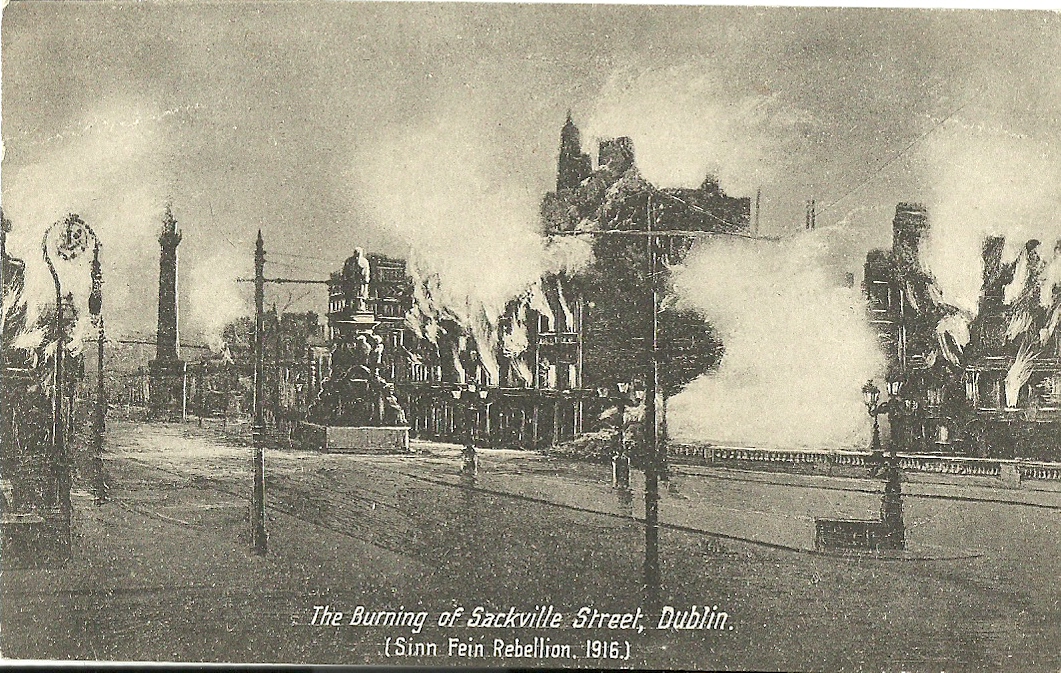
This is a nice little land, and what I like most about it is that it’s one of the ‘Sinn Féin Rebellion’ postcards I’d not seen before. Printed in Scotland, it’s from the famous Valentine Company.

Read Full Post »

With RTÉ currently running a weekly programme geared towards finding Ireland’s greatest ever citizen, its nice to see SIPTU getting in on the act in calling for James Connolly to be voted number one. And who wouldn’t, considering the remaining top five contains none less than, as Donal recently called them, the “Freestate Prick” Michael Collins and the “Northside Dick” Bono. Lucky enough we are I suppose that Stephen Gately and Adi Roche missed the cut (no offense to either of course…)

Do what the ominous big building tells you to

I can say with a good deal of confidence that the other two lads on here would be with me in calling readers to vote Connolly, and never mind the biters who try and say “sure he’s not Irish…” Take half an hour out of your time and watch TG4’s newest “Seachtar na Casca” programme on the man, then try and listen to someone tell you that James Connolly is not Irish…

Read Full Post »

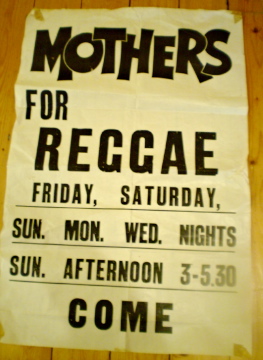
I’m hoping to write a piece on the history of reggae in Dublin, similar to what I’ve done so far on the Mod scene in Dublin and the Rockabilly scene.

From anecdotal evidence, I’ve heard the first places to play reggae in Dublin was Mothers nightclub on Mary Street and the Osibisa on King Street South both in the early to mid 1970s. (The Cimarons playing Cork in c. 1978/9 was the gig that really put reggae on the map in Ireland. Probably similar enough to what it did for punk in the city when The Clash played the exam hall in TCD in 1978.)

There was of course Zebra, Ireland’s first reggae band, and their 1979 single Repression.

Does anyone have any more information on these clubs, the DJs, the people who went  or anything else on the history of reggae in the city? Please email me directly at matchgrams(at)gmail.com

Mothers poster (C.Fisher, personal collection)

Read Full Post »

Unless you’ve been hiding under a rock for the last 16 years, you will most definitely have heard about the annual Absolut Fringe Festival. In those 16 years, it has grown from humble begininnings to become Ireland most exciting multidisciplinary festival covering all walks of culture; music, art, literature and performance.

Spanning over two- and- a- bit weeks, and visiting over twenty venues, the festival is ambitious in it’s enormity, but then again, why shouldn’t it be going on the successes of the last couple of years.  While it would be close to impossible to list a full programme here ( you can check that out on the official website @ www.fringefest.com , or alternatively pick up the free guide from cafés and bookshops citywide,) below are some of the events I hope to attend, and suprise suprise, they’re Dublin-centric.

As You Are Now, So Once Were We

As You Are Now So Once Were We, The Company

Blurb from the fringefest site:

“Why haven’t you read Ulysses? Ulysses is Dublin. You live in Dublin. So do we. Four actors in a city we don’t really know pick up the most important and unread book in Irish history and follow James Joyce as he invents a whole city and its people. Returning to this year’s Festival with the Spirit of the Fringe 2009 award for ‘Who is Fergus Kilpatrick?’, The Company are back to delve into Joyce’s seminal work and ask – where are you in this story? Join us as we rediscover what it means to be Irish. By the way, we haven’t read Ulysses either… yet. The Company are part of Project Catalyst, an initiative of Project Arts Centre.”

—-

Having laboured my way through Ulysees in my UCD days, I’m interested to see what the good folks from The Company make of it. The questions of nationhood and identity always stood out in the book, and this show looks set to examine both.

The Project Arts  Centre Space Upstairs, Sat 11th – Wed 15th, 9pm, €14/12

World’s End Lane

World's End Lane, Anu Productions

Blurb from the fringefest site:

“For over 100 years, Monto was the most notorious red light district in Europe. Presided over by infamous Madams and fortune-tellers, lost strangers sought sex, guidance and the divine. You and I will be the strangers. Immerse yourself in a fragile and intimate encounter, exhuming an area of Dublin that no longer exists, as presented by the multi-award winning company that brought you last year’s festival favourite, ‘Basin’. Presented in association with The Lab. Supported by Rough Magic Hub.”

—-

Monto; An area sung about in a thousand songs and the backdrop for a hundred thousand stories of woe and debauchery, lonliness and violence, intrigue and legend. Some say that a branch of the current Monarchy flourishes in Dublin City due a night on the town by a British prince here in the late 19th Century. It is written into revolutionary lore as it’s many brothels and slums were used as safehouses in the period 1916- 22. In World’s End Lane, we get a unique look at this unique period in Dublin’s past.

The Lab,  Foley Street, Mon 13th- Sat 25th, (times can be found here ,) €15.

The Hidden Garden

The Hidden Garden, Garvan Gallagher Photography

Blurb from the fringefest site:

“‘It’s like going to mass’ is how one local resident describes her time in one of the most charming and unlikely secret retreats in the city. This uplifting film maps the transformation of an urban dumping ground in the North Inner City into a vibrant community growing space. Winter surrenders to spring as the characters and the space come to life while the goodwill and honest nature of the local residents spill out like the cups of tea poured in their hundreds. As informative as it is inspirational, don’t miss the chance to see this heart-warming film screened in The Hidden Garden. Arrive early if you’d like to potter around the garden!”

—-

Whilst over the last couple of years, developers have tried to rid us of any green spaces we have in the inner city, there has been a struggle within some local communities to take back some peace and tranquility. With inner- city community spirit diminishing as office and retail developments push people into the suburbs, projects like the Summer Row Community Garden are to be applauded.

Summer Row Community Garden, Summer St. North. Thurs 23rd – Sat 25th, 8.30pm, €8.

——

All details, blurbs and pictures (apart from my own interjections of course) are taken from the excellently informative www.fringefest.com . For up to date information, tickets and more details, check it out.

Read Full Post »
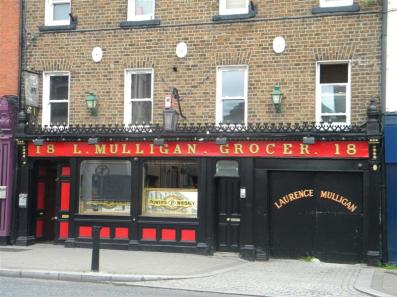
Not the best of evenings to go for a pint to be honest, with the future of the team I’m about to go shout for hanging severely in the balance. But still, pre- match pints are part of the ritual of going to games, and where better for five supporters to mourn and lament about Bohemian FC than in the heartland of Stoneybatter, half way between the clubs birthplace in the Phoenix Park and its current residence in Phibsboro.

Mulligan's of Stoneybatter, from The Tale of Ale Blog.

Mulligan’s of Stoneybatter is certainly not to be confused with Mulligan’s of Poolbeg Street fame.  Whereas the latter has been discussed about in length around these parts, having one of the best pints in Dublin, you can’t get a pint of Guinness in the former. A pub in Dublin without Guinness? Yes, even though this place is a stone’s throw away from the Guinness brewery, it’s a “brewery pub” in the line of the Porterhouse. And yet what did I stump up for? A pint of… Becks.  All the fancy lagers and stout on show and I went for the drink only there to service the plebians…

Apparently one time the haunt of those who couldn’t get served anywhere else in the locality, the proprietors did well to clean the place up and present drinkers with a nicely laid out bar area, stretching way back with nooks and crannies in which a solitary drinker can hide. The bar staff, well presented in pinstripe aprons and with a colossal knowledge of the wares they ply from behind a bar that harks back to the establishments past as a green grocers store. While the pint of Becks was, admittedly great (icy cold, with a head that kept to the bottom of the glass- something you don’t get much in Dublin pubs…) there was not much the staff could tell me about it. But when one of our Bohs comrades bought a fancy bottle of 7% stout, served to him in what looked like a trifle dish, the barman was able to tell him what temperature it should be stored at and what angle it should be poured at… Mad stuff.

And with that, we were off to witness arguably the worst Bohs game I’ve been to in my time. A 2-0 loss to a Galway Utd. reduced to nine men. I wish I could say the couple of beers stifled the blow, but, as nice as they were, they didn’t!

Read Full Post »

Last week, I got a mysterious text from a good friend who said they had something to show me. The instructions were to meet on Grattan Bridge at 16:45, and that it should only take an hour or so. Intrigued, I showed up at the alotted time, and after a ten minute walk, we ended up in the carpark of the Tivoli Theatre, off Thomas Street. Adorning the walls are hundreds of pieces of the finest in Dublin Graffiti, some of which can be seen below. Full set can be found here.

Huge piece, this must have been over 20ft tall.

Sek II - Maser 2010

From the great Maser.

Anywhere is Paradise with you...

When I do good, no one remembers. When I do bad, no one forgets.

As I said, follow the link above for the full set, theres 34 pictures in total, all available for re-use under the Creative Commons License. But best if you go visit it for yourselves; The Tivoli Theatre is on Francis Street, just off Thomas Street. Just ask the nice man on the gate, you’ll be sorted.

Read Full Post »

(Hopefully this will be the first of a series on movies set or filmed in Dublin.)

Though set in Liverpool, Willy Russell’s Educating Rita about a young working class girl (Julie Waters) hoping to better herself by studying literature, was filmed in Ireland. TCD, UCD, Maynooth, Phoenix Park, Connolly Station and Ringsend all make appearances.

Various shots of Trinity College. Byrant’s (Michael Caine) office was filmed in the rooms of the College Historical Society and the University Philosophical Society respectively, and while the building was considerably refurnished, the production chose to leave portraits of Douglas Hyde and Isaac Butt and committee photographs in the former and a bust of John Pentland Mahaffy in the latter.

02:13 – Southside quays opposite Liberty Hall. 02:48 – Rathgar. 10:15 – South Lotts, Ringsend.

01:31 – Pub, Exterior. The Dame Tavern. 01:54 – Pub, Interior. The Stags Head. 06:24 – Church of the Holy Family, Aughrim Street.

04:33 – 04:44 – Belfield, UCD. 04:45 – 04:57: Maynooth College. 05:01 – Library. UCD? NUIM? TCD? 05:35 – NUIM? 07:37 – The old Connolly DART station. 08:22 – People’s Gardens, Phoenix Park. 09:35 – Crosthwaite Park, Dublin.

04:04 – Dobbin’s Wine Bistro – 15 Stephens Lane.

05:40 – “Flamingo, Parkes Hotel” Stillorgan Park Hotel, Stillorgan Road, Dublin. 08:29 – Ringsend

Read Full Post »

Orange Dublin

(Note: As an atheist and socialist, I have no time for the Orange Order but as a Dubliner and student of history, it is important to cover all parts of our city’s culture and past.)

Click to listen.

In case you missed it, RTE Radio 1 had a very interesting radio documentary on the Orange Order in Dublin. You can listen to it here. (It’s rare to hear self-described “working class” Dublin men talking about their allegiance to the British crown!)

In 1795, the Orange Order was founded in Dublin, where the Grand Lodge was first opened on Dawson Street in 1798. Today, the Dublin and Wicklow District LOL 1313 meets at their hall on the Northumberland Road. The lodge’s website has a number of fascinating bits of information, including this on the Civil War and 1930s period:

“Dublin was therefore, as the administrative Capital of the Island, the natural headquarters for the Orange Institution and remained such until the Headquarters Buildings, the Fowler Memorial Hall in Rutland Square, was severely damaged in the Civil War. The Headquarters, situated in what is now Parnell Square, at the top of O’Connell Street, had been seized by the IRA, and in conjunction with the Rotunda, used as their headquarters.

Following its evacuation by the IRA all the books and documents which had survived the siege were removed to Belfast where they were safely stored. The last public parade in Dublin was in 1936, when the Brethren were attacked as they walked from the Fowler Hall to Amiens St Station to travel by train to Belfast, for the annual 12th of July celebrations.”

Read Full Post »

Anyone who’s been following the Blog for a while might remember this post from JayCarax about a great piece of street art done just off the Luas tracks. I’m actually suprised it stayed there that long, but eventually someone realised it’s existence and did a hack job in covering it up…

Controversial Elephant replaced by existential nothingness...

And a couple more snaps of some Dublin graffiti taken on the same day…..

Brings to mind a certain Scary Éire track..!

Located around the back of the historic Smithfield Fruit and Vegetable Markets  is this piece:

This is not a photo oppurtunity...

Read Full Post »

I recently did a wonderful module in college which took in early Dublin life, and the walled viking town. After any degree of research into Viking Dublin, one can’t help but see the Civic Offces at Wood Quay as perhaps the greatest defeat of Irish historians and archaeologists.

Today, I stumbled across this gem on YouTube from 1979.

Excellent, and a YouTube gem providing interesting insight into long and hard fought political campaign.
For anyone interested in this period of history, you could do worse than to check out the Irish History Podcast homepage, where you’ll find a series of podcasts on the Vikings.

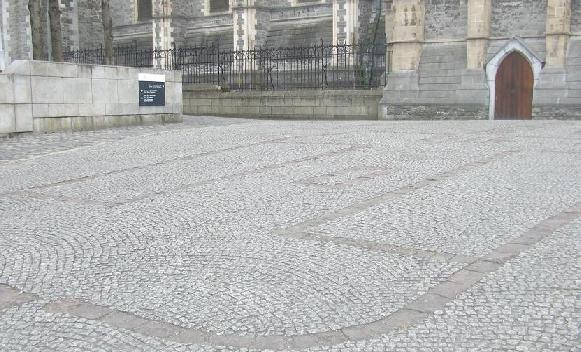
Outline of a viking plot today, beside Christchurch at Wood Quay.

Read Full Post »

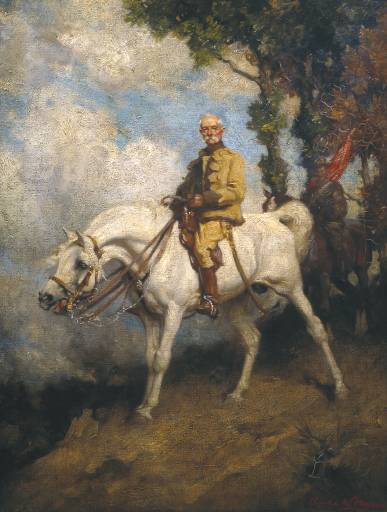
Field-Marshal Earl Roberts on his Charger 'Vonolel', from the Tate Collection.

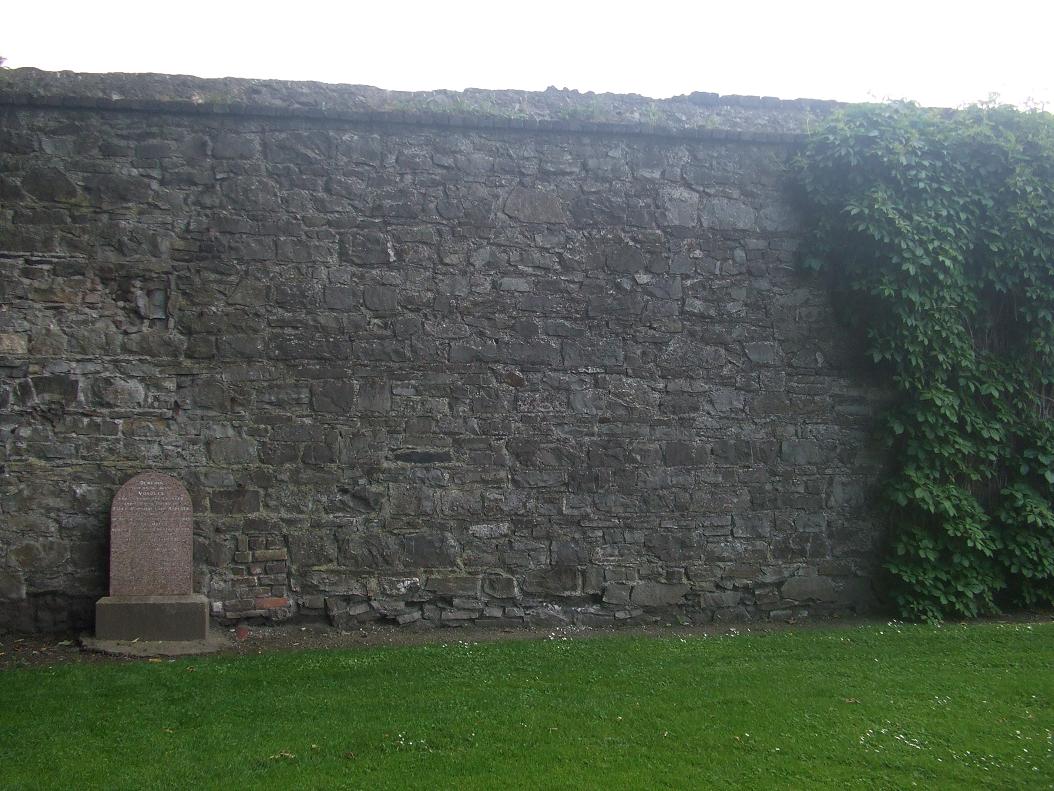
Many people walking the grounds of the Royal Hospital in Kilmainham will pass a small grave without noticing, and yet this grave is perhaps the most unusual grave in Dublin itself. In the grounds of the Hospital, one finds the final resting place of ‘Vonolel’, twenty-nine years old on passing, but a veteran of conflict.

“When the Queen awarded medals to her officers and men who has taken part in the Afghan campaign and in the expedition to Kandahar, she did not forget Vonolel. Lord Roberts hung round the animals neck the Kabul medal, with four clasps, and the bronze Kandahar star. The gallant horse wore these medals on that day in June when the nation celebrated the Queen’s Diamond Jubilee”

So read The Irish Times of October 21, 1899.

Much more information on the horse can be gathered from an earlier piece however, dating from January of the same year, when Vonolel was still living. In it, it was noted that Vonolel had come to England “having been practically all over the world with his master”. He was described as “..a type of the highest class of Arab charger” and it was noted that “he traces his descent from the best blood of the desert” It was also noted that his medals were only worn on special occasions!

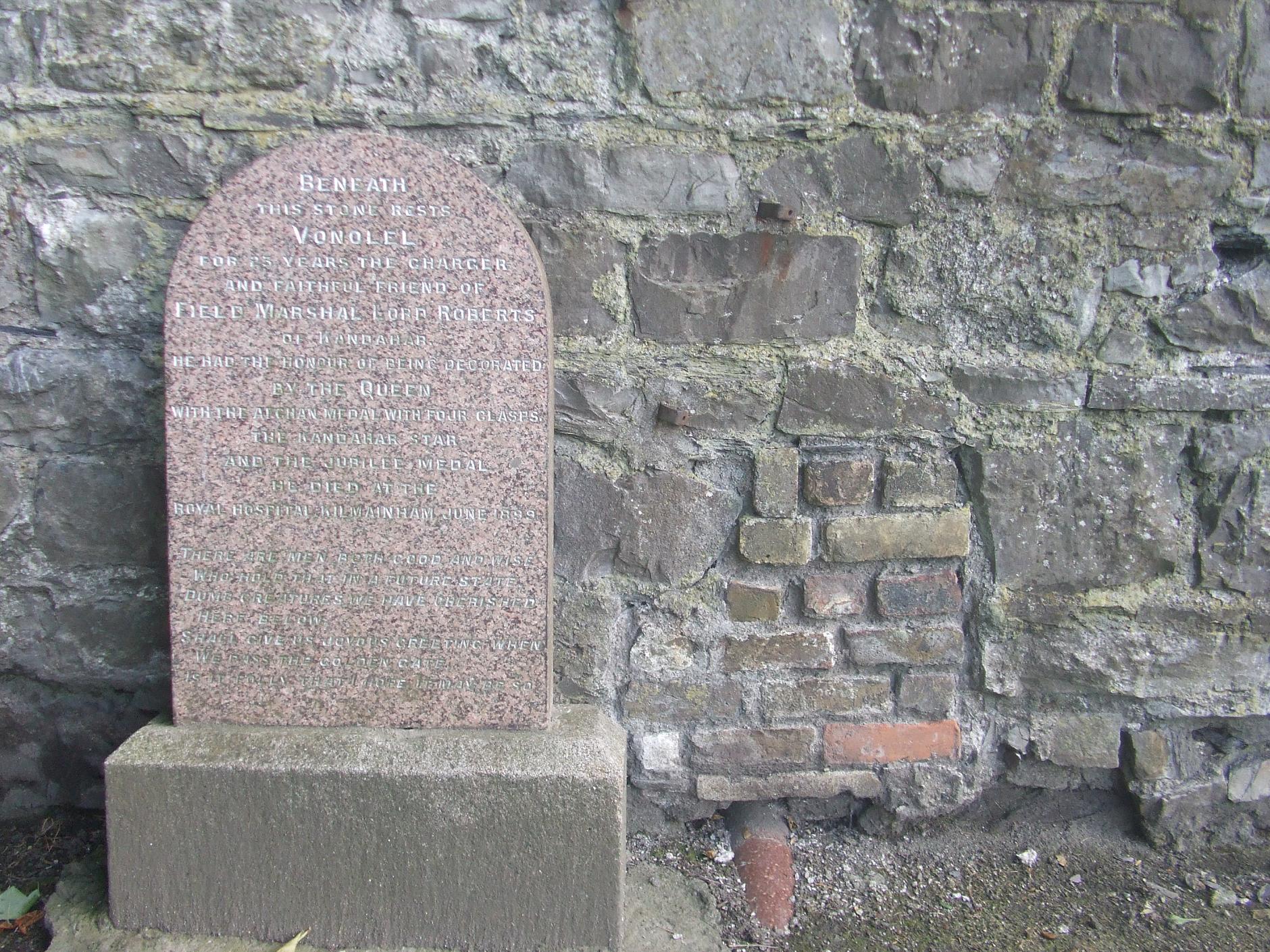
The grave of Vonolel, in the Royal Hospital Kilmainham.

It was 1877 when Vonolel was purchased from a horse dealer in Bombay, at the age of four. He was named after a great Lushai chief. He would become closely associated with Field Marshal Frederick Sleigh Roberts, a man with family links to the city of Waterford. It is perhaps with the Battle of Kandahar, the last serious engagement of the Anglo-Afghan war, that Roberts (and by extension Vonolel) is most closely associated. For victory in the Battle of Kandahar, Roberts received the thanks of Parliament.

Vonolel was retired to the Curragh in Kildare, and his grave notes that he passed away while at the Royal Hospital in Kilmainham, in June 1899. Roberts was said to be heartbroken, and Vonolel was buried in the rose gardens of the Royal Hospital Kilmainham. His military exploits are acknowledged, as is his character.

Included on the headstone are the lines:

There are men both good and wise
Who hold that in a future state
Dumb creatures we have cherished here below
Shall give us joyous greeting when
We pass the golden gate
Is it folly that I hope it may be so?

Why not stop by the grave of Vonolel the next time you find yourself in Kilmainham, and see for yourself what must surely be one of Dublin’s most unusual graves.

Read Full Post »
« Newer Posts - Older Posts »