Feeds:
Posts
Comments

Archive for 2013

The Spanish Civil War occurred at a time of intense political conflict between the Left and the Right across Europe, and many Irishmen would partake in the war, both in defence of the Spanish Republic and on the side of Franco and the fascist coup. The majority of those from this island who fought in the conflict fought with Eoin O’Duffy and the Irish Brigade, though in excess of 300 Irishmen did fight with the International Brigades. A quarter of those Irishmen who fought against fascism in this war would die on the battlefields of Spain.

Perhaps the most unusual group to travel to Spain were the St. Mary’s Pipe Band, who set off from Dublin for the frontiers of Spain on a mission: to ensure that O’Duffy’s men could march to and from the frontlines to the sound of Irish airs. At the time they were widely refered to as the ‘St. Mary’s Anti-Communist Pipe Band’. A contemporary newspaper report on the arrival of the band in Spain noted that their “kilts and bagpipes caused more excitement on their arrival than a bombardment by Government aeroplanes.”
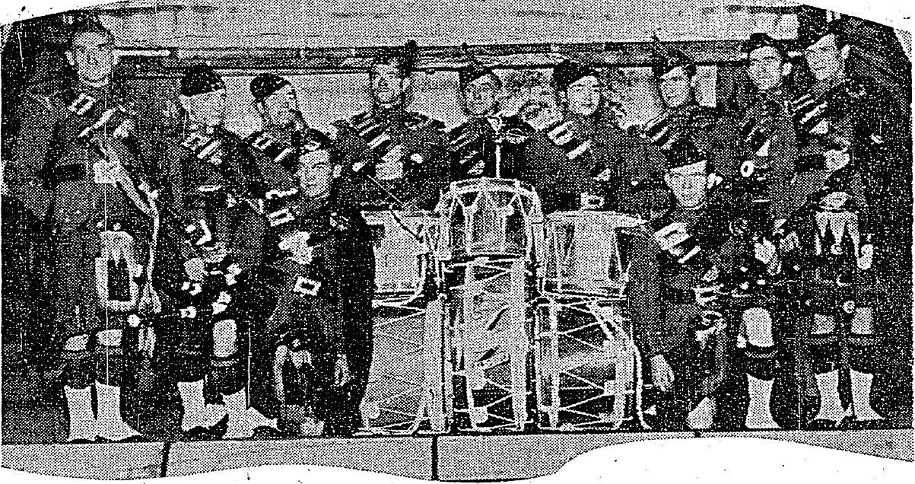
The band just prior to departing Ireland (Irish Independent)

The band just prior to departing Ireland (Irish Independent)

The St. Mary’s band took their name from St.Mary’s Pro-Cathedral, at the heart of Dublin city centre. The church features prominently in anti-communist street agitation in 1930s Dublin. It was a particularly heated sermon in this church in March 1933 that would lead to hundreds of Dubliners laying siege to Connolly House on Great Strand Street, the headquarters of the communist movement in Ireland, starting three nights of anti-communist violence in the city. Bob Doyle, a young Dubliner who would later fight on the republican side of the Spanish Civil War, remembered being in the Pro-Cathedral on that night:

I had attended the evening mission on Monday 27 March 1933 at the Pro-Cathedral, during the period of Lent where the preacher was a Jesuit. The cathedral was full. He was standing in the pulpit talking about the state of the country, I remember him saying – which scared me – “Here in this holy Catholic city of Dublin, these vile creatures of Communism are within our midst.” Immediately after the sermon everybody then began leaving singing and gathered in a crowd outside, we must have been a thousand singing “To Jesus Heart All Burning” and “Faith of our Fathers, Holy Faith”. We marched down towards Great Strand Street, to the headquarters of the socialist and anti-Fascist groups in Connolly House. I was inspired, if you could use that expression, by the message of the Jesuit. There was no attempt by the police to stop us.

Gardaí inside Connolly House after it was attacked by a mob. March 1933. (Authors collection)

Gardaí inside Connolly House after it was attacked by a mob. March 1933. (Authors collection)

The St. Mary’s band were a feature at several anti-communist demonstrations in Dublin, appearing for example at a huge Irish Christian Front demonstration at College Green in October 1936. At that meeting Desmond Bell told the crowd that “if Spain fell to communism today, Europe would fall to it tomorrow” and that “the frontiers for Irish Christianity today are the trenches around Madrid”. The St. Mary’s band were joined by several others at that meeting including the Postal Workers’ Band, O’Connell Fife and Drum and a band from Maynooth.

In February 1937 it was reported in the Irish Independent that “a chaplain, two nurses and the members of the St.Mary’s Pipers Band, Dublin, left Dublin last night for Spain, via London. In Spain they will join the Irish Brigade, of which General O’Duffy is the leader.” The paper also named the members of the band who had gone to Spain as follows:

Irish Independent. 20 February 1937.

Irish Independent. 20 February 1937.

(more…)

Read Full Post »

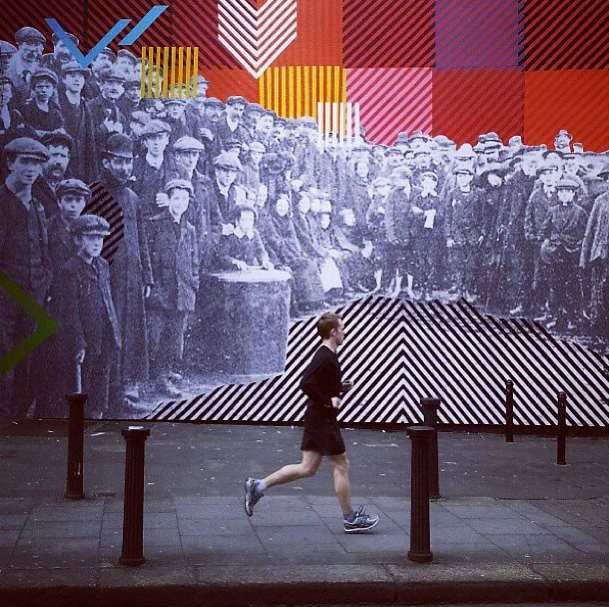
Dubliners await the arrival of the S.S Hare (Art project by Maser/Jr on The Sugar Club, Image: 'MASER ART')

Dubliners await the arrival of the S.S Hare (Art project by Maser/Jr on The Sugar Club, Image: ‘MASER ART’)

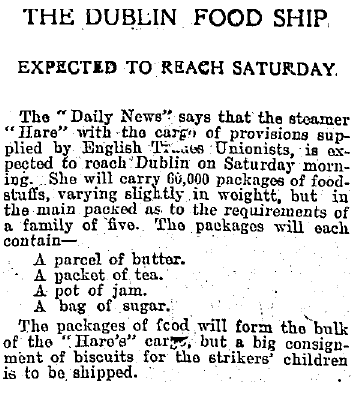
On 27 September 1913, the S.S Hare arrived in Dublin from Salford, loaded with food and supplies intended to assist the families of those locked-out by William Martin Murphy and other Dublin employers.

The food ship provided desperately needed relief to many Dublin families, and the “60,000 packages of butter, sugar, jam, potatoes, fish and biscuits” were very welcome assistance. As Joseph O’Brien noted in the classic Dear,Dirty Dublin, this ship would be “the first of a dozen or so such T.U.C [Trade Union Congress] sponsored operations over the next four months.”

Dublin was a city of intense poverty even prior to the Lockout, as the precarious jobs situation ensured that for many families labour was often casual and irregular, thus creating uncertainty for families with regards income. Johnston Birchall, in his history of the Co-op movement in Britain, states rightly that Dublin was a city “that was already the poorest and most slum-ridden in the kingdom”, and with the dispute having begun in late August, by the end of September people were in dire need of assistance.

An undated image of the S.S Hare.

An undated image of the S.S Hare.

The Co-operative Wholesale Society in Britain celebrated its fiftieth anniversary in September 1913, and it was thanks to the sizeable financial backing of the Trade Union Congress, to the tune of £5,000, that it began the task of making up thirty thousand food parcels for the Dublin poor.

The S.S Hare was built in Glasgow in 1886, but was owned by George Lowen of Manchester at the time of the Dublin dispute. Ironically, the Hare was involved in a labour dispute of its own at the time, and as Padraig Yeates notes in his study of the Lockout, the Pomona Docks where the ship sat ready to sail to Dublin was entangled in a dispute involving the right to union recognition. The ship had just arrived from Dublin carrying a consignment of Guinness stout. Guinness feature in the story of the 1913 Lockout, as the company sent £500 to the employers’ fund during the dispute. While refusing to ‘lock out’ unionised workers initially, it did take action against certain workers who did engage in sympathetic strike action.

Incredibly, trade union leaders in Manchester convinced the men at the docks to break their own strike temporarily, and “a deal was struck: the ship would be released with its return consignment of empty Guinness tasks, provided it also took the food for the city’s strikers. By 5 p.m. on Friday the Hare had left Salford on its historic voyage.” Shortly after noon, she would arrive along the south wall of the River Liffey. Huge crowds had gathered by that point, believing the ship would arrive earlier, but weather conditions had delayed its journey. On board were leading British trade unionists, one of whom would inform the crowd that “we recognise that your fight is your fight and we are going to stand by you until it is won.”

William Martin Murphy's Irish Independent reports on the Hare.

William Martin Murphy’s Irish Independent reports on the Hare.

On the day following the arrival of the foodship, a disgusting report in the Sunday Independent attacked the “unfortunate dupes” of Larkinism who had gathered at the South Wall for the food distribution. The paper claimed that the scenes “sounded a note of degradation that must always ring in the ears of Dublin”, and went on to claim that the scenes made “a pitiable sight.” A journalist with The Irish Times noted that there were varying degrees of poverty evident in the crowd, ranging from “the wan dweller in some noisome tenement” to “the carter’s wide, who had a bonnet as well as a shawl.” Food was distributed to all who had union issued vouchers, and sadly many poor Dubliners who were not entitled to any assistance had come down to the ship too, perhaps in the expectation or hope there would be additional food.

The arrival of the Hare (Image:UCC Multitext)

The arrival of the Hare (Image:UCC Multitext)

Padraig Yeates has noted that this vital assistance was not alone important for those living in Dublin city centre, but those beyond the city, writing that:

It took until 8 p.m to unload the Hare and until 9 p.m to finish distribution at the South Wall. More workers’ families were supplied from carts that took consignments of food for distribution in Kingstown, Clondalkin, Swords, Lucan and other parts of County Dublin. By the end of the day nine thousand workers and their dependants had received provisions.

What became of the Hare? In December 1917, as the ship was sailing from Manchester to Dublin once more, it was torpedoed and sunk seven miles east of the Kish lighthouse. This attack was carried out by the German submarine, U62. Sadly, twelve lives were lost in this attack. Five of those killed were born in Dublin.

Read Full Post »

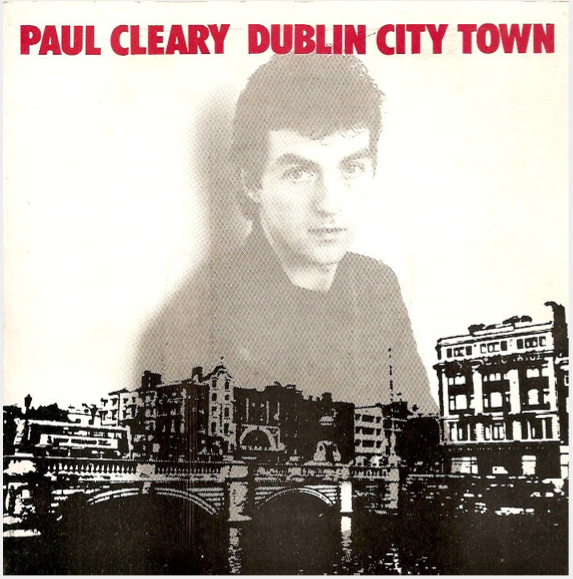
Paul Cleary - Dublin City Town (1986). 7" single cover.

Paul Cleary – Dublin City Town (1986). 7″ single cover.

The Blades are set to play together for the first time in 27 years on Friday, 13th December in the Olympia Theatre. Tickets, €26 including booking fee, go on sale next Friday 4th October at 9am via Ticketmaster.

So it is as good an opportunity as any to post the lyrics and audio from lead singer Paul Cleary’s 1986 solo single ‘Dublin City Town’. It was released on ‘Raytown Records’ (I assume this was Cleary himself?) just after the break up of the band.

The song deals with wealth inequality, the gombeen political class, the developers destruction of city architecture, youth unemployment, emigration and alcoholism. All with a catchy melody.

The rich get richer the poor get lost
They’re given coloured sweets
to sample at no cost.
But we can change things
if we’re not afraid
of careerist politicians overpaid.

We’ve still got a sense of humour
poverty is an ugly rumour
The planners try to pull it down
Dublin City Town
This ship is sinking
but we won’t drown
here in Dublin City Town.

Don’t hang your head down
or feel ashamed
’cause if you haven’t got a
job you’re not to blame.
And how many young girls
just out of school
Are forced to taking a slow boat
boat to Liverpool.
We’ve a liquid black solution
For a dodgy constitution
The planners try to pull it down
Dublin City Town
This ship is sinking
but we won’t drown
here in Dublin City Town.

You can’t put a million people down
come with me to Dublin
Some people try to drag us down
Dublin City town
This ship is sinking
but we won’t drown
here in Dublin City Town.

(Note: the lyrics on the back of the 7″ single are a bit over the place with a couple of key lines missing and the two verses printed in the wrong order)

The b-side was a live recording of ‘Revelations of Heartbreak’ recorded in Mountjoy Prison.

We’ve covered The Blades several times before on this blog:
Still sounding sharp, looking back at The Blades (March 2012)
The Blades Live (December 2011)
The Blades singles (September 2011)
os Blades? (June 2011)
The Bride Wore White video (January 2011)
Hot For You single (March 2010)
Revelations (Of 45s) (February 2010)

Read Full Post »

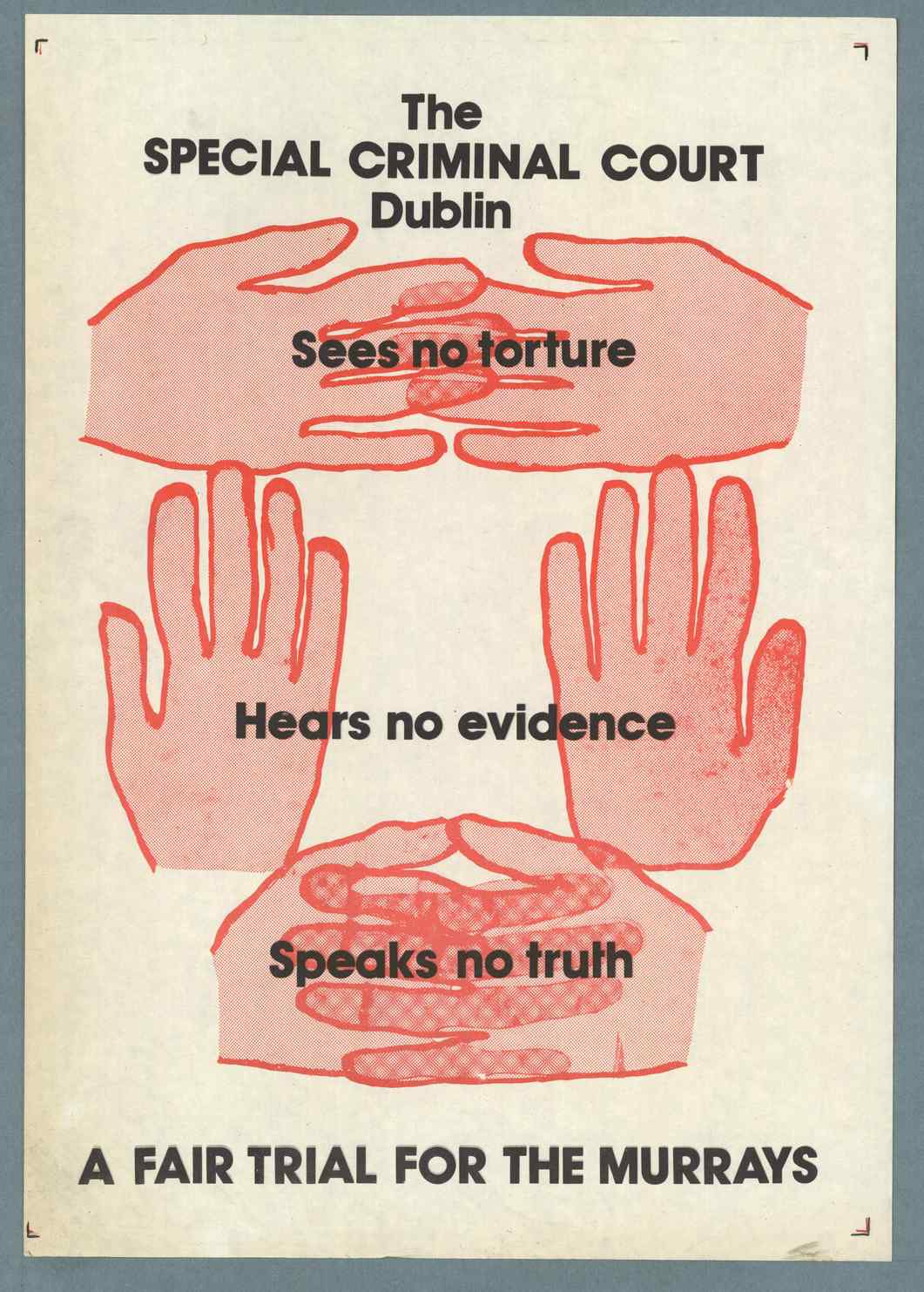
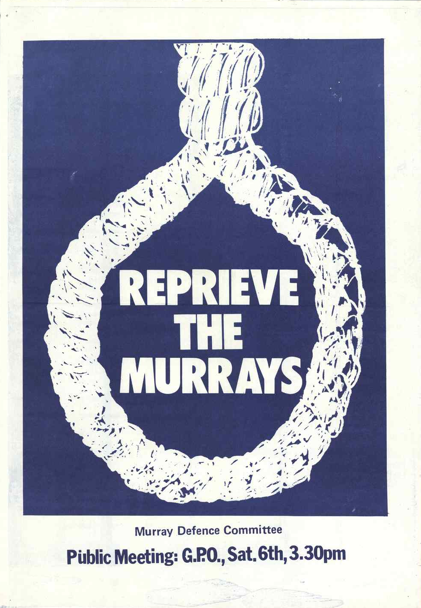
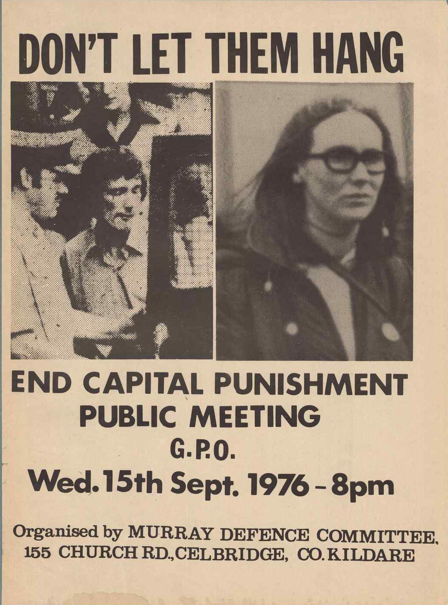
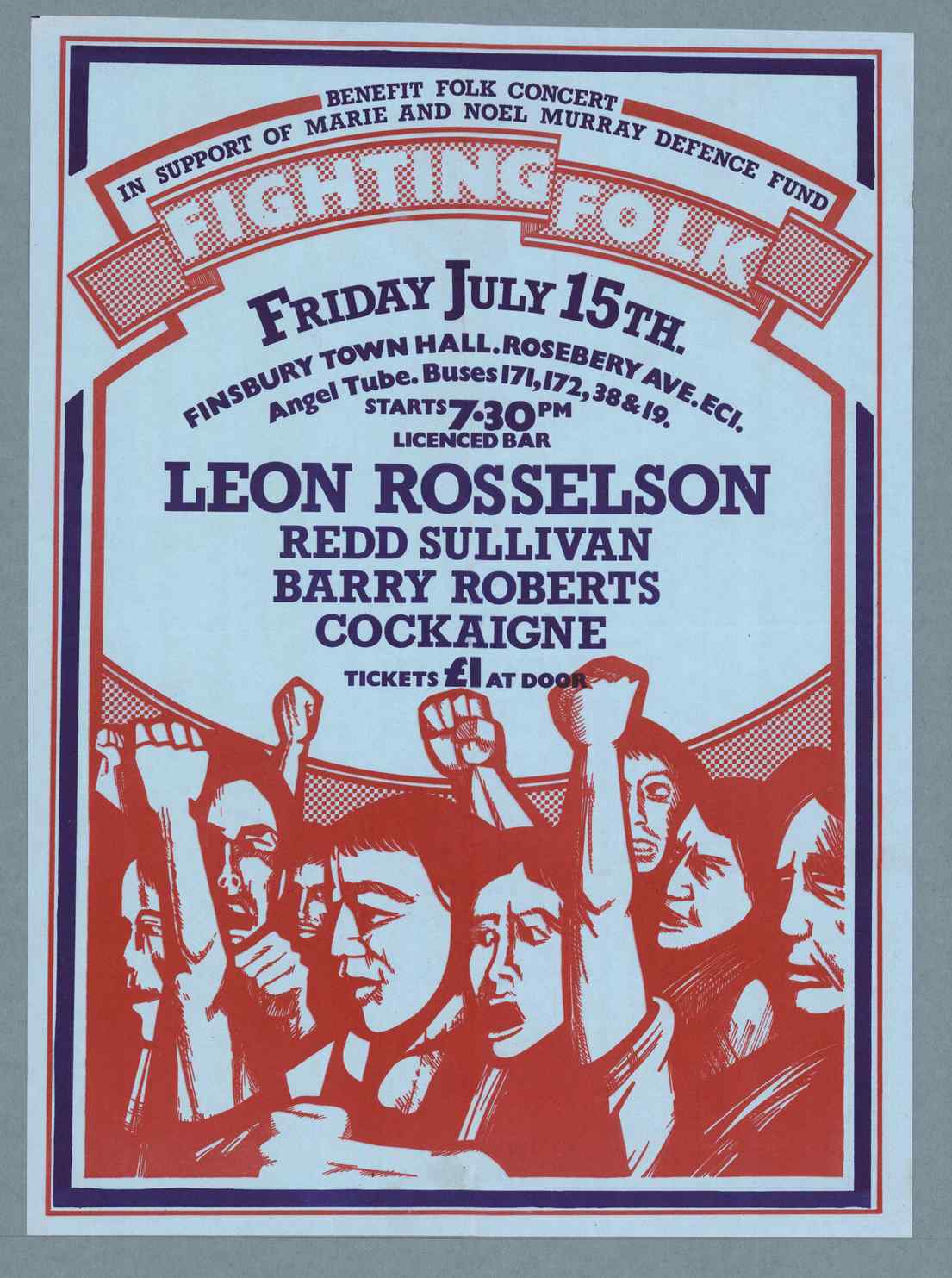
All of the following posters are from the Dutch International Institute of Social History (IISH) website.

They are related to the international defence campaign to save the Murrays from death penalty in the late 1970s. Noel and Marie Murray, former members of Official Sinn Fein, were sentenced to death in June 1976 for the killing of an off-duty Garda during a bank raid as part of a group called the armed ‘anarchist’ group.

From Cedar Lounge Revolution:

Noel Murray had been a member of Sinn Féin from 1966 and had gone with Official Sinn Féin in 1970. Marie Murray had been active in the Housing Action Committee in Dublin in 1969 from which she had joined OSF the following year. Both had left OSF in 1973 but remained politically active…

On appeal and retrial they were convicted of murder and received the lesser sentence of life imprisonment.

Posters from the Irish campaign:

Irish Murrays poster, 1976

Irish campaign poster, 1976

Irish Murrays campaign, 1976

‘Murray Defence Committee’ poster , 1976

Irish Murrays 1976

‘Murray Defence Committee’, 1976

Murrays defence 1976

‘Murray Defence Committee’ poster, September 1976

Irish Murrays Campaign, c. 1975

‘Murrays Campaign for Conjugal Rights in Irish Prisons’, c. 1976

Posters from the English campaign:

England Murrays campaign, 1976

Poster from the English campaign, 1976

England Murrays campaign, 1977

Murrays support gig in London, 1977

(more…)

Read Full Post »

Meeting Room is a recent and powerful documentary concerning the Concerned Parents Against Drugs movement, looking at those who stood up to drug dealers in the inner-city in the early 1980s. The film includes interviews with the late Tony Gregory, John ‘Whacker’ Humphries, Bernie Howard, Mick Rafferty, Padraig Yeates, Chris McCarthy and Fr Jim Smyth. This is a very important historical documentary which deserves a larger audience.

Christy Moore also features in the documentary, performing his song in honour of ‘Whacker’ Humphries.

Whacker Humphries took the dealers on
And he fought them tooth and nail
A squad of well armed soldiers brought him to the Portlaoise Jail
He tried to protect his children, found guilty of a crime
One man gets a pension, another man gets time

Read Full Post »

Merrion Square Park, surrounded by beautiful Georgian houses, is one of my favourite of Dublin’s city centre parks. Known until recently as Archbishop Ryan Park, the heavy criticism of that Archbishop in a recent report on the abuse of children by the Catholic Church led to the renaming of the park.

This park was historically open only on a private basis to residents of the square, much like St. Stephen’s Green was prior to its opening to the public in 1880, at the expense of Lord Ardilaun of the Guinness family.

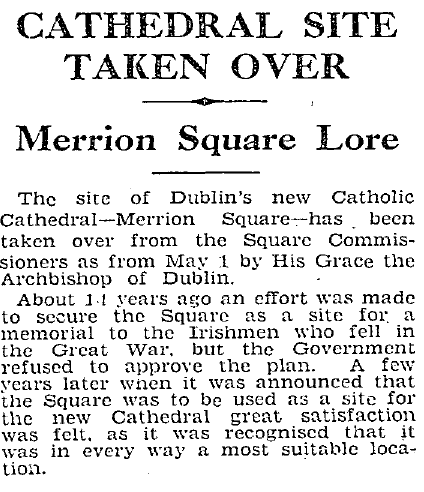
In the 1920s Merrion Square Park was considered as a location for the construction of the War Memorial Gardens, in honour of Irishmen who had died fighting in the First World War. Its proximity to the Dáil was one factor that stood in the way of any such plan however, with one Senator asking at the time if ‘the very heart of Dublin, under the very walls of the seat of Government’ was a suitable location for such a memorial, in the still-volatile political environment of the day. The site was later considered as a location for the construction of a new Catholic Cathedral in Dublin. It was reported in the media in May 1938 that the site had been “taken over” by the Archbishop of Dublin, with the Irish Independent referring to it in a report as “the site of Dublin’s new Catholic Cathedral”. It had been purchased some years previously by the church, for the tidy sum of £100,000. The Cathedral project never materialised however, leading to decades of debate on the future of the park. In 1944 for example Jim Larkin Jnr, son of the 1913 leader, asked in the Dáil in the park could be “made available for the use and enjoyment of the public or as a children’s playground”, but no attempts were made by the government to bring about such a situation.

1938 report on the park.

1938 report on the park.

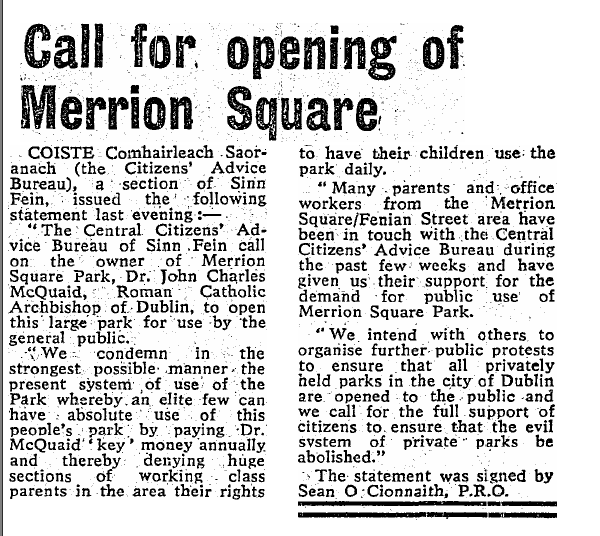
In 1970, Sinn Féin and others launched protests against the status of the park, claiming that it was still open only to residents of the square who rented keys at the price of £10 per annum from Archbishop John Charles McQuaid. This fee was later disputed by the Catholic Church, who claimed the fee was just over £4 per annum. Archbishop McQuaid had strongly backed the original proposals to build a Cathedral on the site, but with that plan long scrapped and the park still in the ownership of the Catholic Church, the Archbishop’s decision to grant access only to those willing to pay for the pleasure of strolling through the park proved controversial. The first occupation of the park saw over 50 activists, including residents from the nearby Fenian Street and Merrion Square, breaching the gates of the park and proclaiming it a “People’s Park”. Boldly, Sinn Féin also distributed keys to the park from their offices at 30 Gardiner Place, leading to the locks of Merrion Square being changed on occasion, a costly annoyance for authorities as new keys had to be distributed.

Sinn Féin statement in the Sunday Independent, July 1970.

Sinn Féin statement in the Sunday Independent, July 1970.


Sinn Féin were heavily involved in the Dublin Housing Action Committee, active in the same period, a militant campaign against the inadequate housing on offer to working class Dubliners at the time. This movement had been involved in many political occupations, as well as squatting actions. The action around Merrion Square can be seen as part of a broader campaign over the ownership of the city. In July 1970, the same month the actions at Merrion Square Park began, 500 people attended a protest at the G.P.O on O’Connell Street against proposed legislation which would aim to tackle “forcible entry and occupation”. There was a widespread belief that the actions of housing activists in the city motivated the government to consider such legislation.

Archbishop McQuaid, targeted by Sinn Féin protests in 1970 over Merrion Square Park.

Archbishop McQuaid, targeted by Sinn Féin protests in 1970 over Merrion Square Park.

One resident of the park complained in a newspaper after the protest that “When Sinn Féin entered Merrion Square…they immediately began to play football across the tennis courts, thereby destroying the surface which has taken months of preparation for the tennis season.”

Beyond Sinn Féin, the private nature of the park attracted protest from others, including young messenger boys employed by the nearby E.S.B, who claimed that a letter had been sent by MacQuaid to their employer informing them they were no longer permitted to play football in the park! The boys mounted a protest outside of the park. The Labour Party also succeeded in gathering thousands of signatures for a petition calling for the parks opening.

A year on from the protests, it was reported that An Taisce were in discussion with the Archbishop of Dublin regarding the parks future, and the possibility of opening it to the broader public. The Catholic Church went to great lengths to insist this was of their own deciding, and not influenced by any protest.

Merrion Square itself saw very significant political violence in 1972 when a crowd laid siege to the British Embassy following Bloody Sunday. In The Lost Revolution: The Story of the Official IRA and the Workers’ Party, a story is recounted by one OIRA member at the time who remembered attempting to blow the doors off the building, by placing explosives inside of coffins that students had carried to the embassy. After two further days of protest and disturbances outside the embassy, it was eventually burnt on 2 February 1972.

In April 1974 the park was handed over, and it was reported in the newspapers on the day after the opening of the park that “hundreds of children cheered when, for the first time in 200 years, the padlocks were removed from the gates of Merrion Square Park yesterday.” Today, the park is open to the public throughout the year, with several festivals hosted within it annually for the public to enjoy.

Read Full Post »

A 1793 illustration of the Tholsel, Dublin. (Malton)

A 1793 illustration of the Tholsel, Dublin. (Malton)

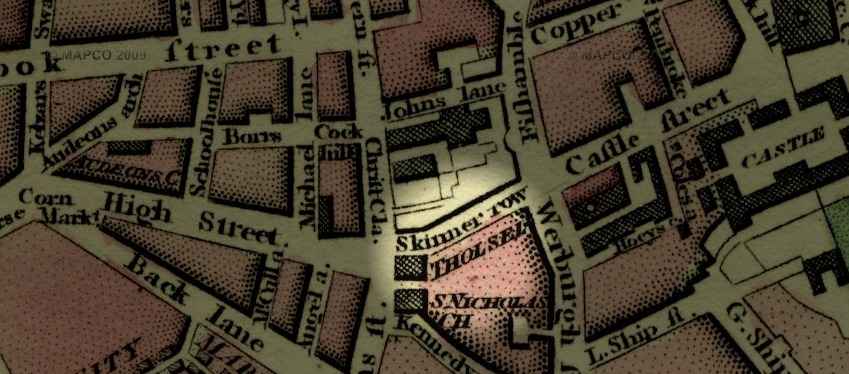
The Tholsel was an important administrative building in Dublin historically, which stood on the junction of Skinner’s Row, Nicholas Street and High Street. It occupied the site where Jury’s Hotel stands today, opposite Christchurch Cathedral. The building was demolished in 1820, with no trace of it remaining at its original location. Essentially, its name meant ‘toll-gatherer’s stall’, and it would have served as a sort of City Hall, meeting chamber and exchange. The initial Tholsel was built in the fourteenth century, though the building portrayed in the illustration above was constructed between 1673 and 1683. While the building is long gone, this post will look at a piece of it which remains on public view, below the city.

The location of the Tholsel historically in Dublin. From 1798 map of Dublin. Credit: http://dublin1798.com/

The location of the Tholsel historically in Dublin. From 1798 map of Dublin. Credit: http://dublin1798.com/

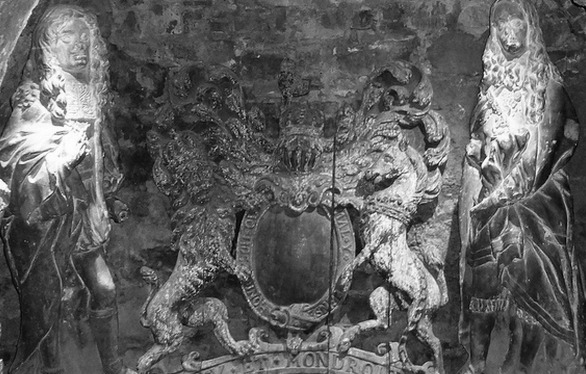
In his study of Protestant Dublin in the seventeenth and eighteenth centuries, Robin Usher writes that ‘the building was roughly square in plan and abutted on one side by houses. The elevations consisted of an arcaded ground storey, open to the elements on the north and western sides’, and that ‘The city assembly and the board of alderman met in richly ornamented rooms over the ground floor loggia, itself fitted out as the merchants’ exchange.’ Upon the building were two statues, honouring King Charles II., and his brother, James Duke of York, along with the Royal Coat of Arms. J.T Gilbert in his classic history of the city noted:

The two statues above referred to were executed by William De Keysar, and in the Acts of Assembly for 1684 appears his petition for payment of ” twenty-nine pounds, due him on contract for cutting the statues set upon the front of the Tholsel, and for finishing the pedestals under the said statues.

This statues are clearly visible in an image from The History and Antiquities of the City of Dublin (1776), hosted online by Dublin City Public Libraries.

Gilbert notes in his history of Dublin that following the victory of King William of Orange at the Battle of the Boyne ‘the Roman Catholic citizens were obliged, by proclamation, to deposit their arms in the Tholsel’. Dublin historian Frank Hopkins has stated that the Tholsel had also hosted a huge banquet in honour of General Ginkel, an officer of King William of Orange, following the Siege of Limerick. On occasion, the festivities were not limited to the wealthy and powerful, and ‘at certain times of the year, the exterior of the building was lit with candles, and free beer was dispensed to the citizens, who gathered outside around large bonfires.’ In 1718 the absolutely huge sum of £1,000 was offered to anyone who could detect and identify those who had broken into the Tholsel and defaced and cut the portrait of King George I. that was on display inside of it. The Tholsel also featured in the punishment of criminals, who were ‘whipped at a cart’s tail from the Tholsel to the Parliament House’, the distance between Jury’s Hotel and College Green today.

Incorrigible malefactors or offenders were usually sentenced in the Lord Mayor’s Court to be whipped at a cart’s tail from the Tholsel to the Parliament House, to be placed in the stocks, or to be scourged at the “whipping post” erected here for the purpose. Libellous publications condemned by Parliament, gaming tables, and fraudulent goods seized by the Lord Mayor, were publicly burned at the Tholsel

Those who wish to see a piece of the Tholsel for themselves do not have to go far in Dublin. In the crypt of Christchurch Cathedral the statues that once adorned the building are still on public display, along with the Royal Coat of Arms. They serve as a brilliant and often overlooked reminder of what was once a central building in the running of the city.

The statues on display today at Christchurch.

The statues on display today at Christchurch.

Read Full Post »

Andrew O'Neill.

Andrew O’Neill.

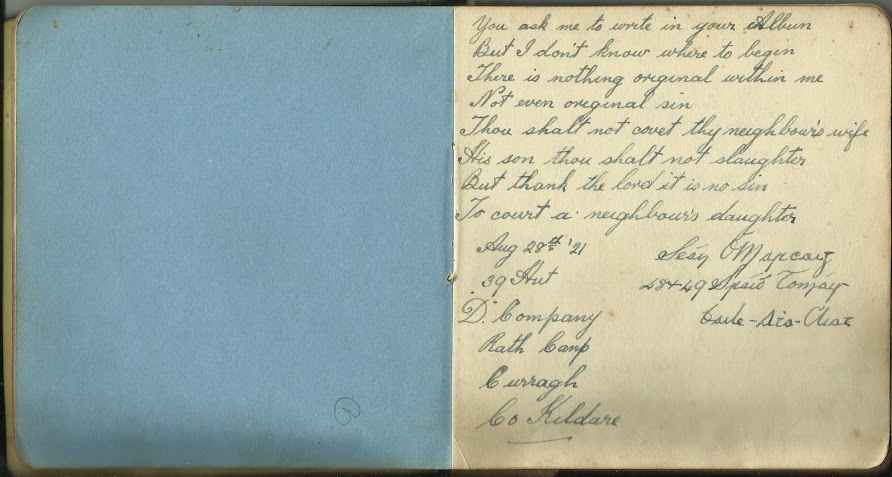
These brilliant scans below are a selection of pages from a 1921 autograph book belonging to Andrew O’Neill. Born in Dublin in 1897, O’Neill hailed from Asylum Yard, in the heart of working class Dublin. Andrew would see action during the Easter Rising at Boland’s Mills as a member of the Irish Volunteers, serving with the 3rd Battalion. Andrew would also partake in the War of Independence which followed the rebellion, and was interned during this period. Later, with the foundation of the Irish Free State, O’Neill would join its new emerging armed forces, although he would leave the Free State Army in 1924, going on to work a number of other jobs including a period as a porter in the Customs House, one of the symbols of the Irish revolution owing to the IRA attack upon it during the War of Independence.O’Neill left a wife and three children behind him at the time of his death, and among his personal items was a priceless collection of autographs from other republicans he had been interned with.

The first page of Andrew's book, giving his own name and address.

The first page of Andrew’s book, giving his own name and address.

The entries I have posted here are a selection of entries from fellow republican internees. Some have penned poems in tribute, while others have drawn illustrations of life inside and outside of the camp. The most striking entry in the autograph book for me is this one, showing prisoners and guards inside of the camp. It appears to be signed ‘P.C’:

Auto Book 20 (1)

This scan shows another drawn illustration, this time showing two figures in discussion about the status of the prisoners. On the other page Liam O’Reilly, giving an address in Tuam, has signed Andrew’s book:

Auto Book  18

One further drawing appears in the autograph book, this time coming from “P.Byrne”.

Auto Book 17 (1)

In addition to the drawings, the autograph book contains several poems, including a poem in honour of Irish republicans who were executed at Mountjoy Prison in Dublin.

Man do you hear them shooting
The women moan and sigh
But the lads themselves are laughing
God that’s the way to die

Auto Book 16

In another poem, one fellow Dublin republican writes

You ask me to write in your album
But I don’t know where to begin
There is nothing original within me
Not even original sin

Auto Book 7 (1)

These kind of brilliant family mementos are to be found across Dublin, and with so much emphasis on historical commemoration and the business of centenaries, these are the kind of items that have great value to young historians and those with an interest in the past.

My sincere thanks to the O’Neill family, Una Wogan, Tom Geraghty and others who have assisted with getting this selection of pages from Andrew’s autograph book here online. The book remains in family ownership.

Read Full Post »

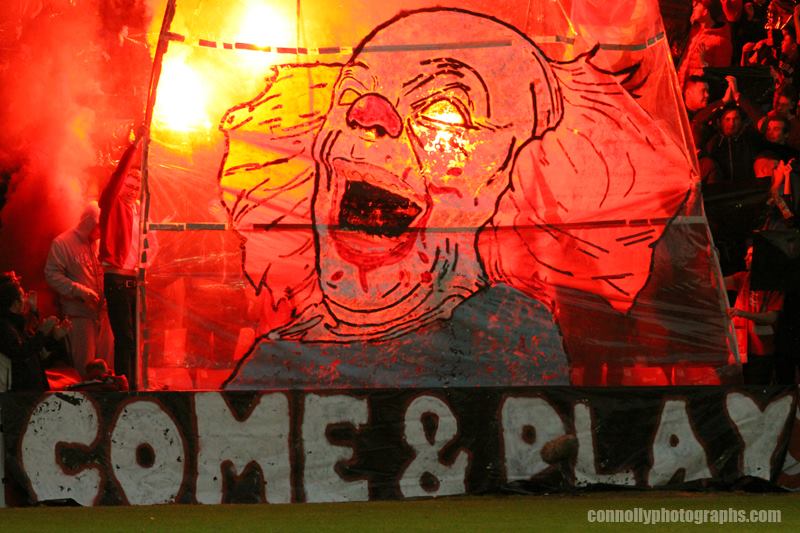
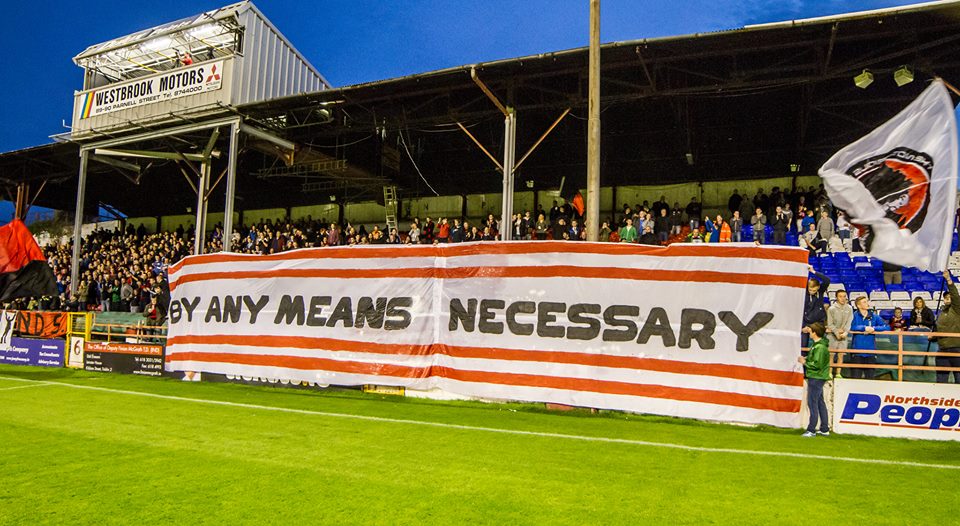
Last night was an absolutely huge night in Irish football terms, at both ends of the table. Saint Patrick’s Athletic managed to go three points clear of a seemingly unstoppable Dundalk, while at the other end, Bohs took a very vital three points from Shelbourne, in a game many saw as a northside relegation scrap between the two. There were massive travelling supports in both Inchicore and Tolka Park, and these two images below capture the colour and the passion of the night differently.

In Inchicore, both sets of supporters lit up Emmet Road, with Dundalk squeezed into the shed behind the goal. In a brilliant coincidence, the Dundalk banner featured Jigsaw from the film series ‘Saw’ asking Saint Patrick’s if they “want to play a game”. The Patrick’s banner invited Dundalk to “come and play”. The game was at times lacklustre but at other times thrilling, regardless however I think the colour and noise made it a good one for the television cameras.

Saint Patrick's Athletic supporters invite Dundalk to 'Come and Play'. IMAGE: Darragh Connolly Photography

Saint Patrick’s Athletic supporters invite Dundalk to ‘Come and Play’. IMAGE: Darragh Connolly Photography

At Tolka Park, Bohs captured the importance of the clash with a banner on the importance of remaining in the top tier ‘by any means neccessary’.

Bohs supporters at Tolka Park. IMAGE: Paul Reynolds.

Bohs supporters at Tolka Park. IMAGE: Paul Reynolds.

While Giovanni Trapattoni stating that Ireland had no football league may have been a case of something getting lost in translation,and was deeply ironic giving the fact so many of his own starting eleven have played in the domestic league, the next five weeks will see some brilliant battles at both ends of the table, in a league which deserves the support of Irish people.

Read Full Post »

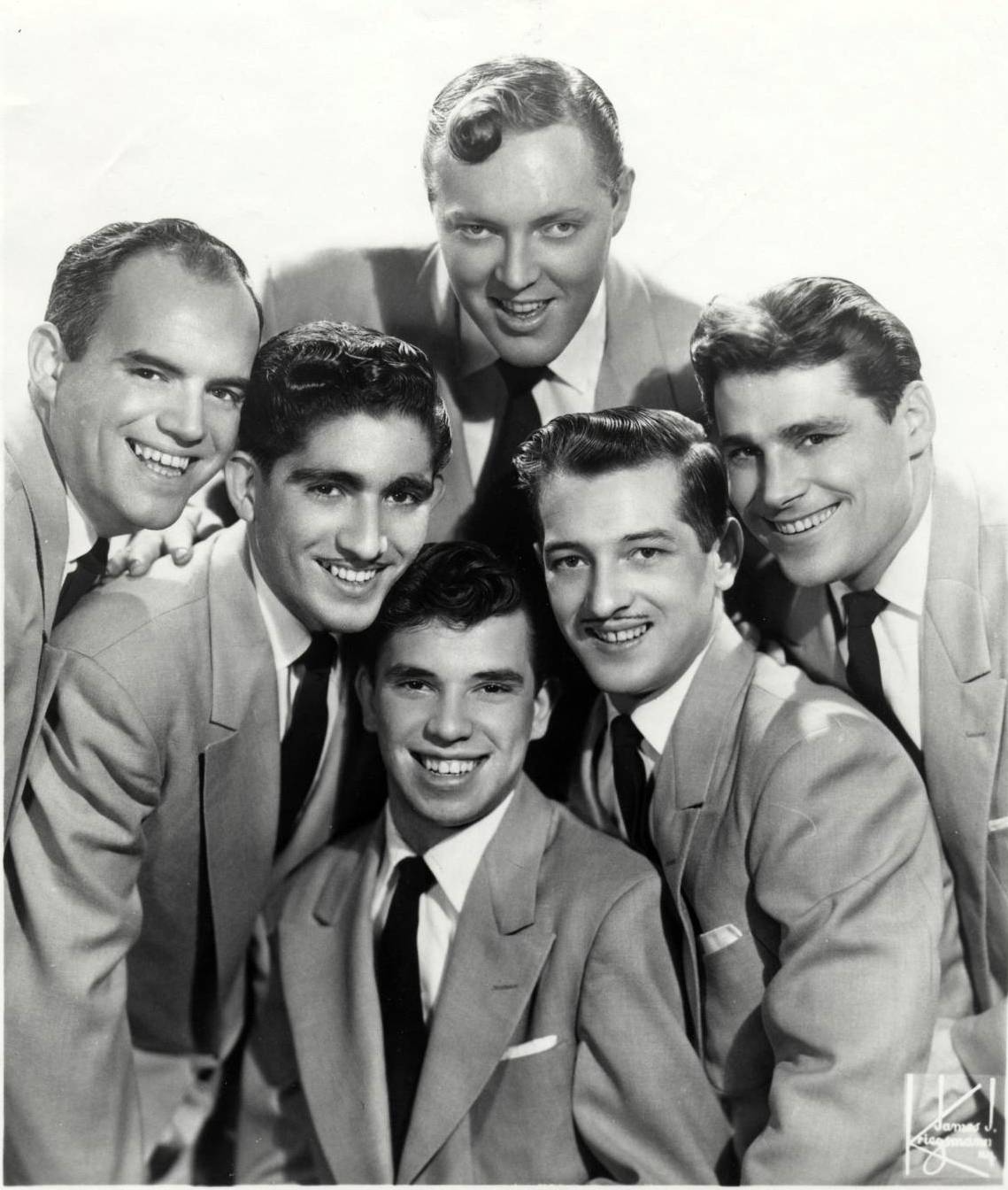
Bill Haley and his Comets, stars of 'Rock Around the Clock'. Via www.fanpop.com

Bill Haley and his Comets, stars of ‘Rock Around the Clock’, discussed below. Via http://www.fanpop.com

When researching Dublin’s ‘Animal Gangs’ of the 1930s and 40s recently, the story and mythology of Garda James ‘Lugs’ Branigan came into play, with Dubliners of a certain age not only considering Lugs the downfall of the ‘Animal Gangs’, but also crediting him with taking the fight to the Teddy Boys of the 1950s. Like so many youth subcultures which would take hold in twentieth century Ireland, the Teddy Boys had originated in Britain, where working class youths took to dressing in a style which had been popular with dandies in the Edwardian period, and taking to rock and roll as their music of choice. Much of the reputation of the Teddy Boys in Dublin came from the hugely popular film screenings of Rock Around the Clock in 1957, a film Branigan would claim to have seen almost sixty times, though not voluntarily!

In Bernard Neary’s biography of the famous Garda, he claims that:

When the film Rock Around the Clock, commenced showing in Dublin cinemas, it hit the headlines and remained there during much of 1957…. not the film itself, but the antics of the Teddy Boys, who flocked, en masse and often, to see their very own movie. The Teddy Boys would riot in the cinemas, ripping up seats with flick knives,throwing bottles and other missiles from the balconies and engaging in fist and sometimes chain fights, causing great consternation.

Garda James Branigan. In Dublin folklore, Branigan is said to have battled the Teddy Boys.

Garda James Branigan. In Dublin folklore, Branigan is said to have battled the Teddy Boys.

The common perception was that these young Irish men were not alone being influenced by British fashion and trends, but were also “returned Irish emigrants from Britain”, according to Gardaí. One Dublin tailor told The Irish Times that “no reputable Irish tailoring establishment would undertake to make an Edwardian costume”, but one suburban Garda brilliantly told the paper that “if I had to be going around investigating all the outlandishly dressed young people in this area to see if they were Teddy Boys when would I ever get time to be a policeman!”

“Eccentrically dressed” youngsters were denounced in the same newspaper for causing a row at a disco in Malahide in 1954, one of the earliest references to the youths in Irish media. Noting that the Dublin youths are “said to be more peaceful than their London counterparts”, the paper still reported that their “extreme” jitterbug dancing and attitude had resulted in local young men in Malahide taking it upon themselves to inform the youths that they were not welcome.

One columnist in The Irish Times blamed the Teddy Boys for spoiling New Years’ Eve leading into 1955, when trouble in the city saw a police baton charge near Christchurch Cathedral. Six people were injured and shop windows broken by Dublin youths, but high spirits and even violence on the night was nothing new in the city. The newspaper columnist defended the Gardaí, and noted that

Knowing the Guards as I do, I don’t believe that either the older ones or the younger ones are baton happy. Having seen some of the Teddy Boys I feel they are just the type that would provoke a riot. The Teddy Boys are all for liberty, their kind of liberty.

Denunciation of the youths was particularly strong in the Dáil, though like today the hysteric language of politicians seemed a million miles removed from the realities of life at the time. P.J Bourke, a longstanding Fianna Fáil TD, rose in July of 1956 to condemn the Teddy Boys, claiming that “lack of parental control is the whole cause of the trouble; parents let these boys out to make a disgrace of themselves.”

I hold that the Department should put 40 or 50 policemen into plain clothes to clean up the city and county of these brats and bring them under control. There is no use in using plámás when dealing with these people. It is a terrible thing that a decent boy and girl cannot go to a dance hall without having a knife or bottle pulled on them by people going around in gangs. These youths are now going into the country because they have been banished from a lot of places in the city. They have a special haircut and a kind of uniform.

(more…)

Read Full Post »

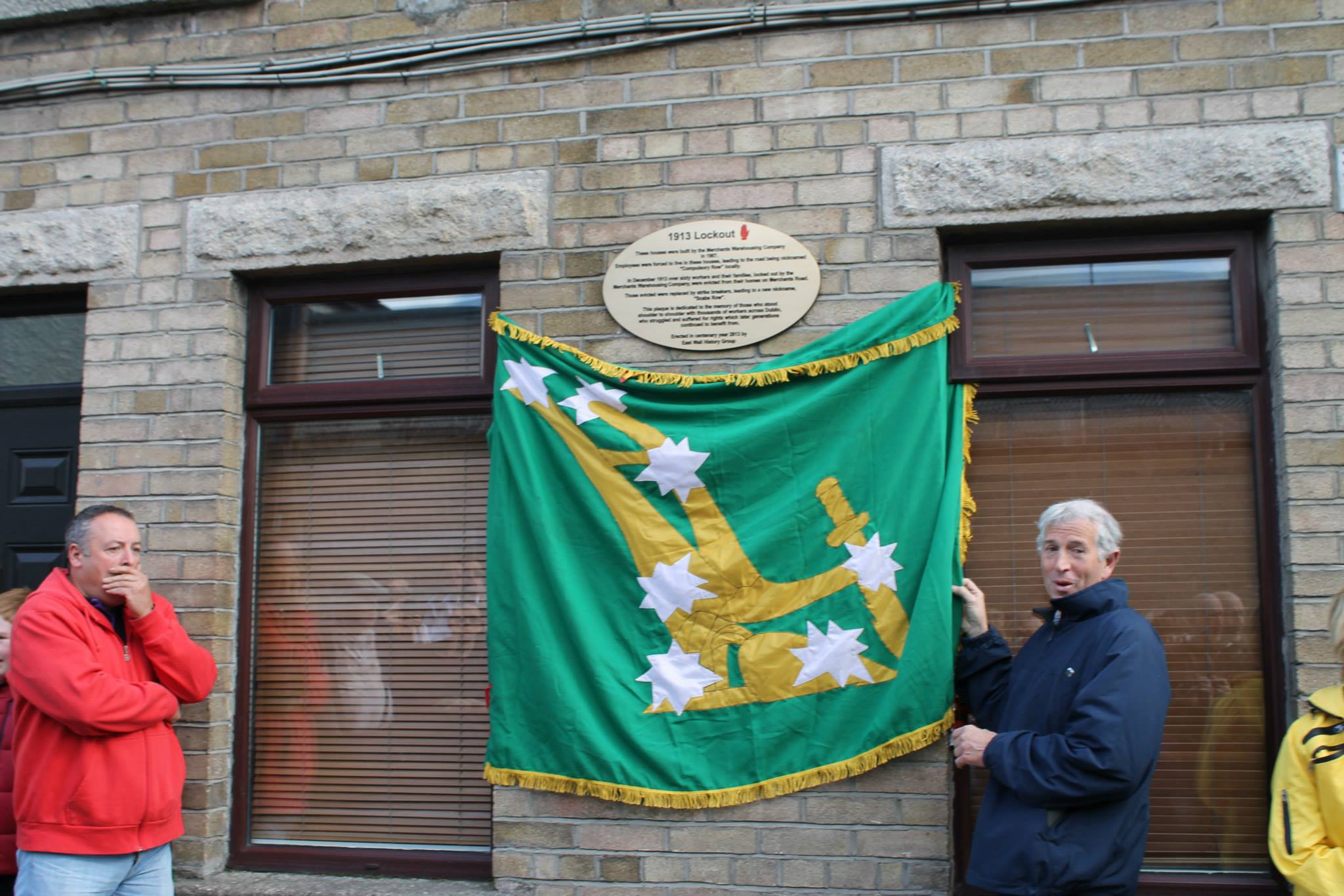
Today saw the unveiling of a plaque and historical mural in honour of East Wall residents who found themselves evicted during the 1913 Lockout a century ago. 62 workers and their families were evicted from company owned houses on Merchants Road in December 1913, with their only crime being their commitment to their union and their class.

Those evicted were replaced by scab labourers and their families, leading to the street becoming known as ‘Scabs Road’ in local lore. Many local people and others from across the city came together today for a moving and important commemorative event. Our thanks to Bas Ó Curraoin for permission to reproduce the images below on Come Here To Me. All images are his.

The mural commemorating the evictions. This mural is based on a real newspaper image from the time.

The mural commemorating the evictions. This mural is based on a real newspaper image from the time.

Joe Mooney of the local historical society spoke of the symbolism and imagery of this powerful mural, highlighting the lyrics which come from New York band Black 47. Joe noted the importance of the symbolism of the red hand, though hijacked by sectarian and reactionary loyalist elements, this symbol was proudly worn a hundred years ago by ITGWU and Irish Citizen Army members.
The plaque in honour of the evicted families.

The plaque in honour of the evicted families.

The plaque gives great detail on the story of the evictions, and indeed the construction of the houses on the street. Workers were forced to move into the homes at the time they were constructed, leading James Connolly and others to label the street “Compulsory Row.” Far from the Iveagh Trust and other such schemes, it is important to stress that while these houses were superior to much of the substandard housing in Dublin at the time, they were still built with profit in mind and were imposed on families.

Bas3

A nice feature of the event today was the fact it began and ended at the nearby St Joseph’s Co-Ed School. Children from this school had gone on strike in 1911, demanding shorter hours, cheaper books and an end to canings, with the influence of the emerging militant trade union movement obvious in their campaign. The presence of so many relatives of the evicted today really made the event, and reminded us that in the context of history a century really isn’t that long.

Marching back to the school.

Marching back to the school.

Congratulations to the East Wall History Group who organised the events today. You can learn more about them here.

Read Full Post »

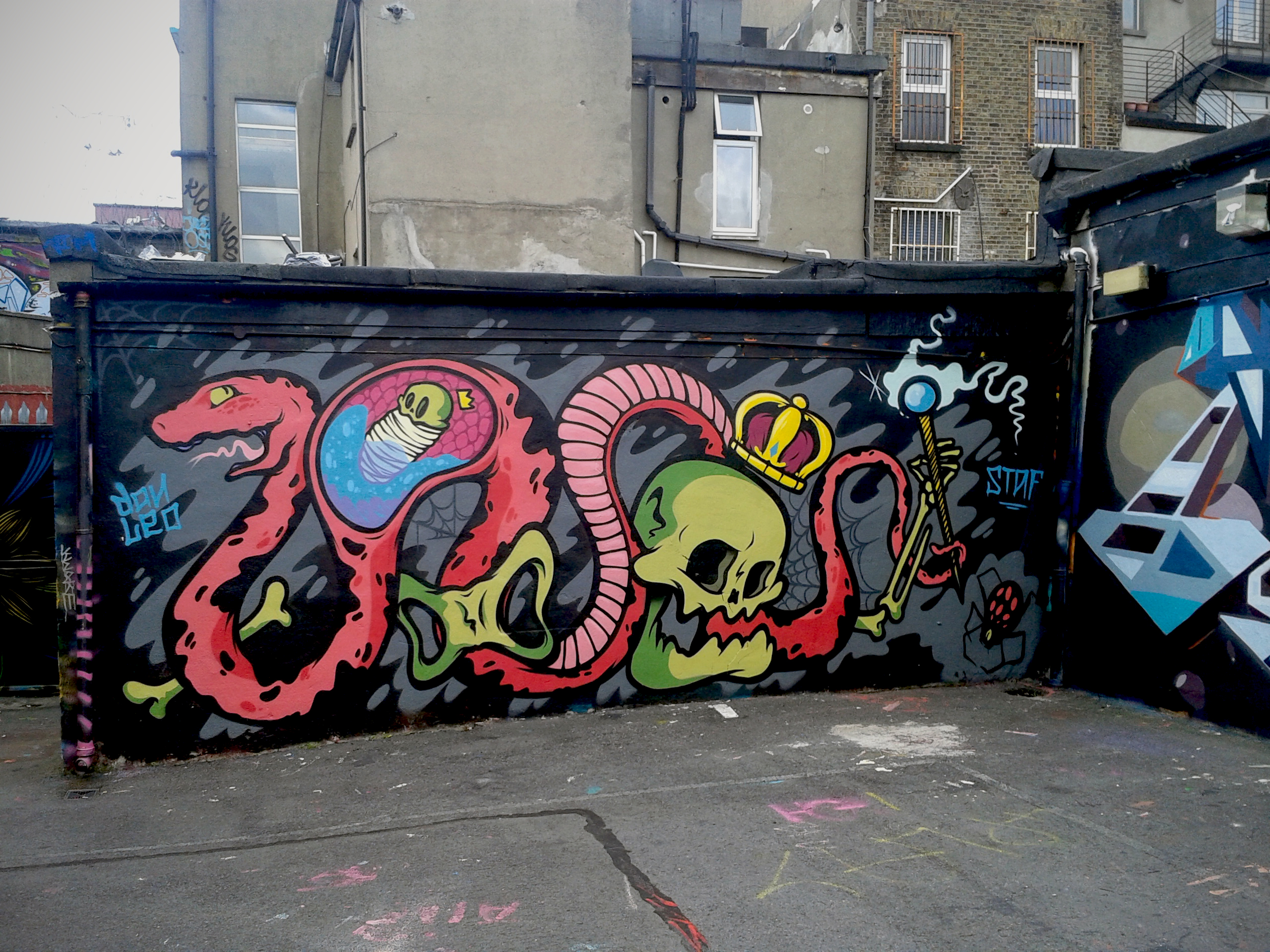
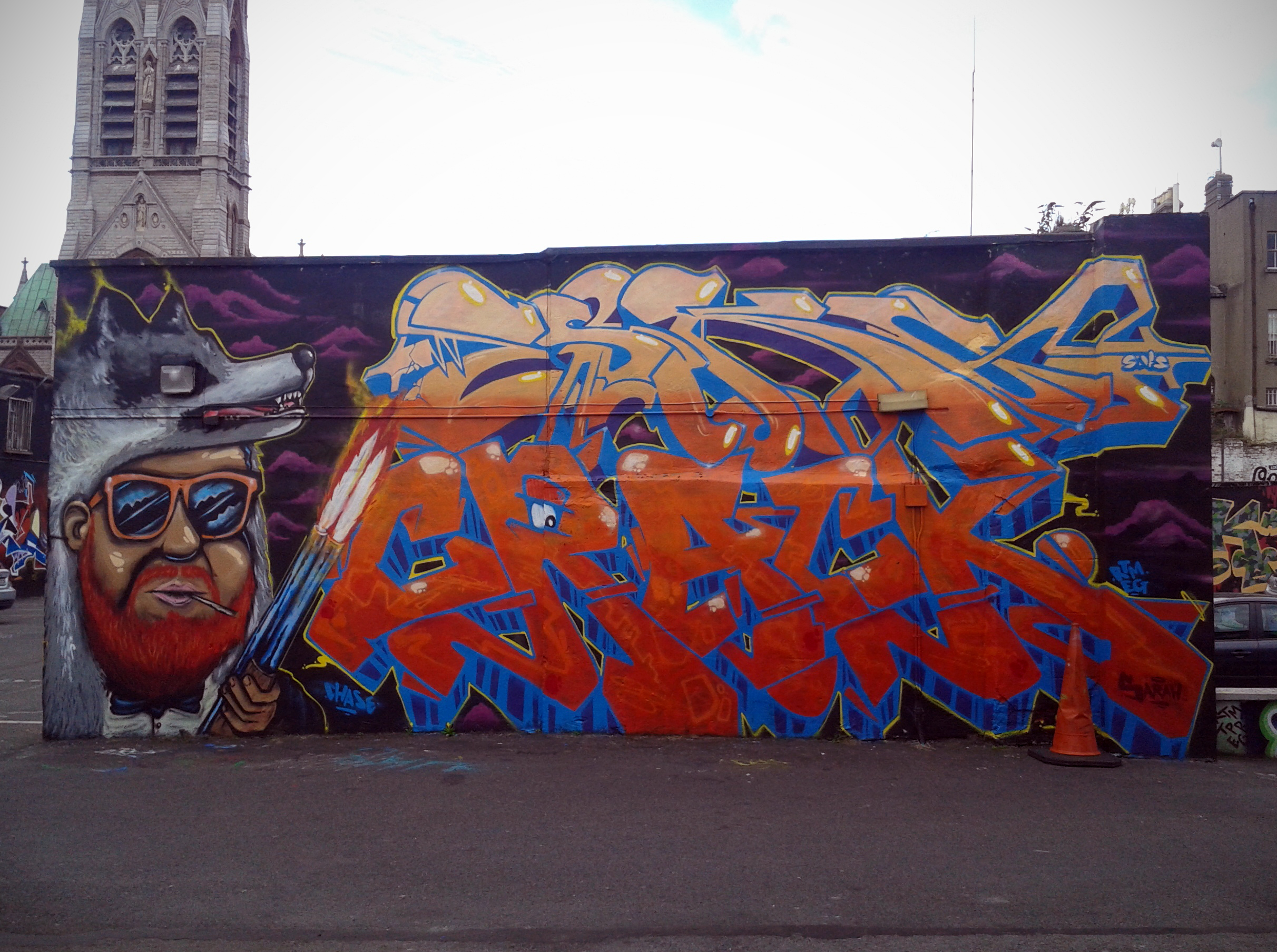
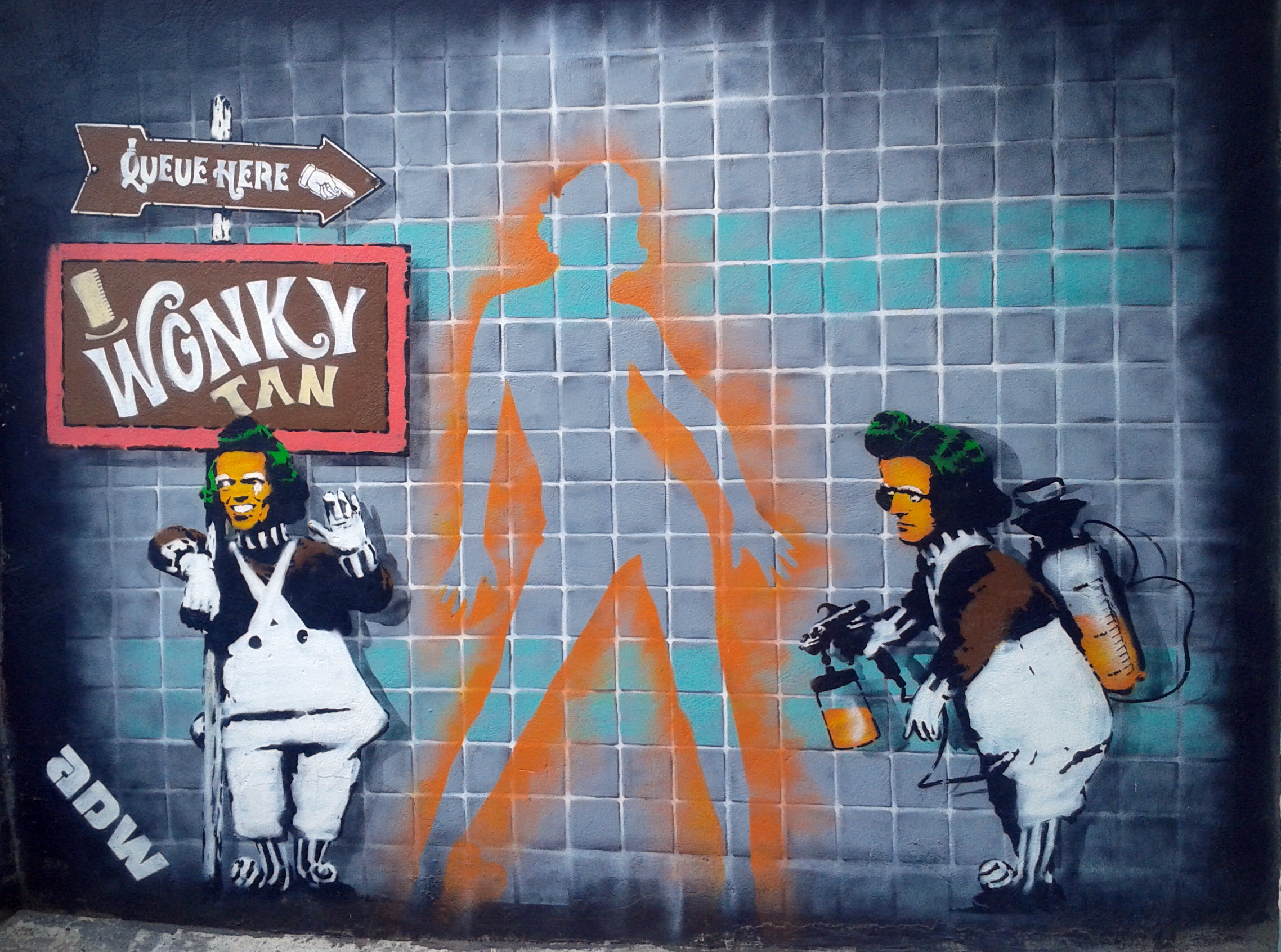
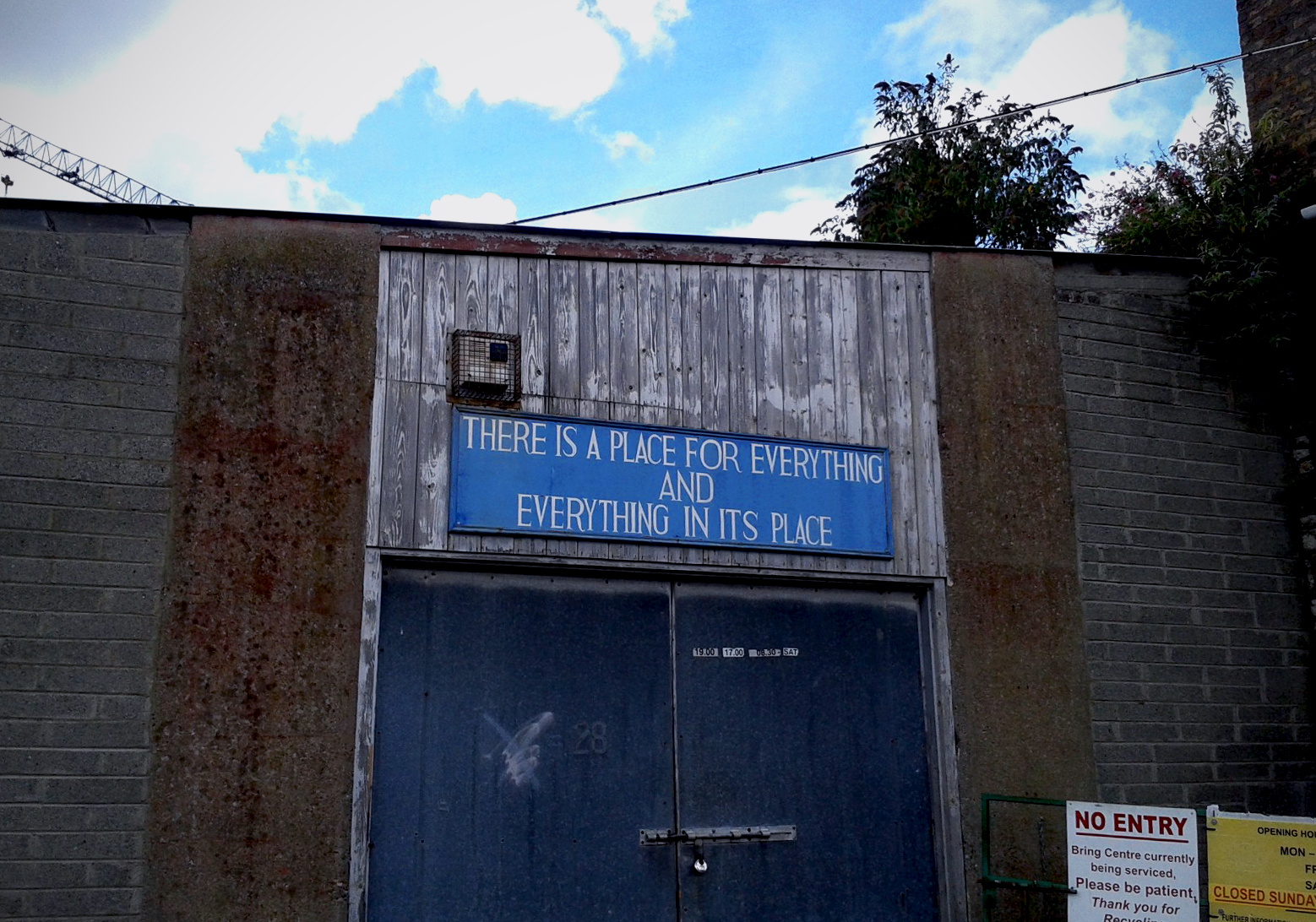
The first post from me in a while this, and a bit of a mixed bag. The first four are from the Tivoli carpark, post-this years grafitti/ skate jam. The second two are dropped in to break up the post, the first a sign  spotted at the council offices in Rathmines, and the second, a group of workers abseiling down the side of Liberty Hall. The second lot of graf pictures is from the back of the Bernard Shaw, easily the best spot in Dublin for ever changing talent. Inside and out, the walls are covered with pieces from Dublin’s best artists, including our good friend Maser; the “Swim” piece is his, and was a work in progress at the time the below was snapped.

WP_000318 (2)

WP_000338 (2)

WP_000323 (2)

WP_000320 (2)


place


(more…)

Read Full Post »

« Newer Posts - Older Posts »