Feeds:
Posts
Comments

Archive for the ‘Dublin History’ Category

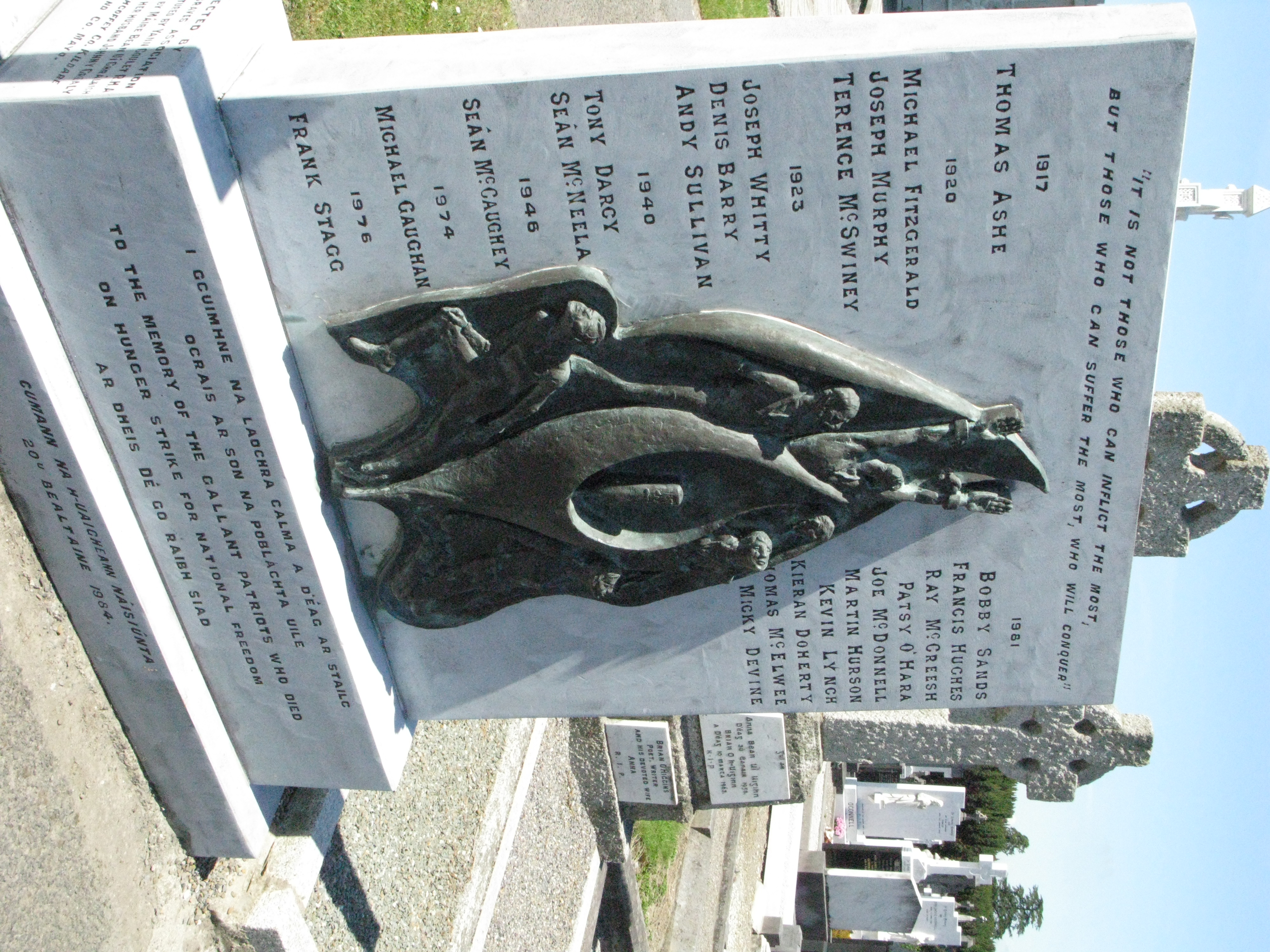
Memorial to Irish Hunger Strikers

I’ve been up around Glasnevin before in a vain attempt to find Brendan Behan’s grave; I don’t know what possessed me, it was a beautiful day, I’d just finished reading The Hostage and it seemed like a good idea at the time. Of course, I failed in the attempt, but promised myself I’d come back some day and have another look. So, given the oppurtunity this weekend, the three CHTM heads, accompanied by LukeF (of LukeF Comics,) took a walk to Irelands largest necropolis where we hooked up with the official tour- led by Shane MacThomáis, son of  the great Dublin historian Eamonn MacThomáis, a man who I personally have a lot of time for, and I’m sure the other two lads here are the same. Some of his documentaries can be found here.
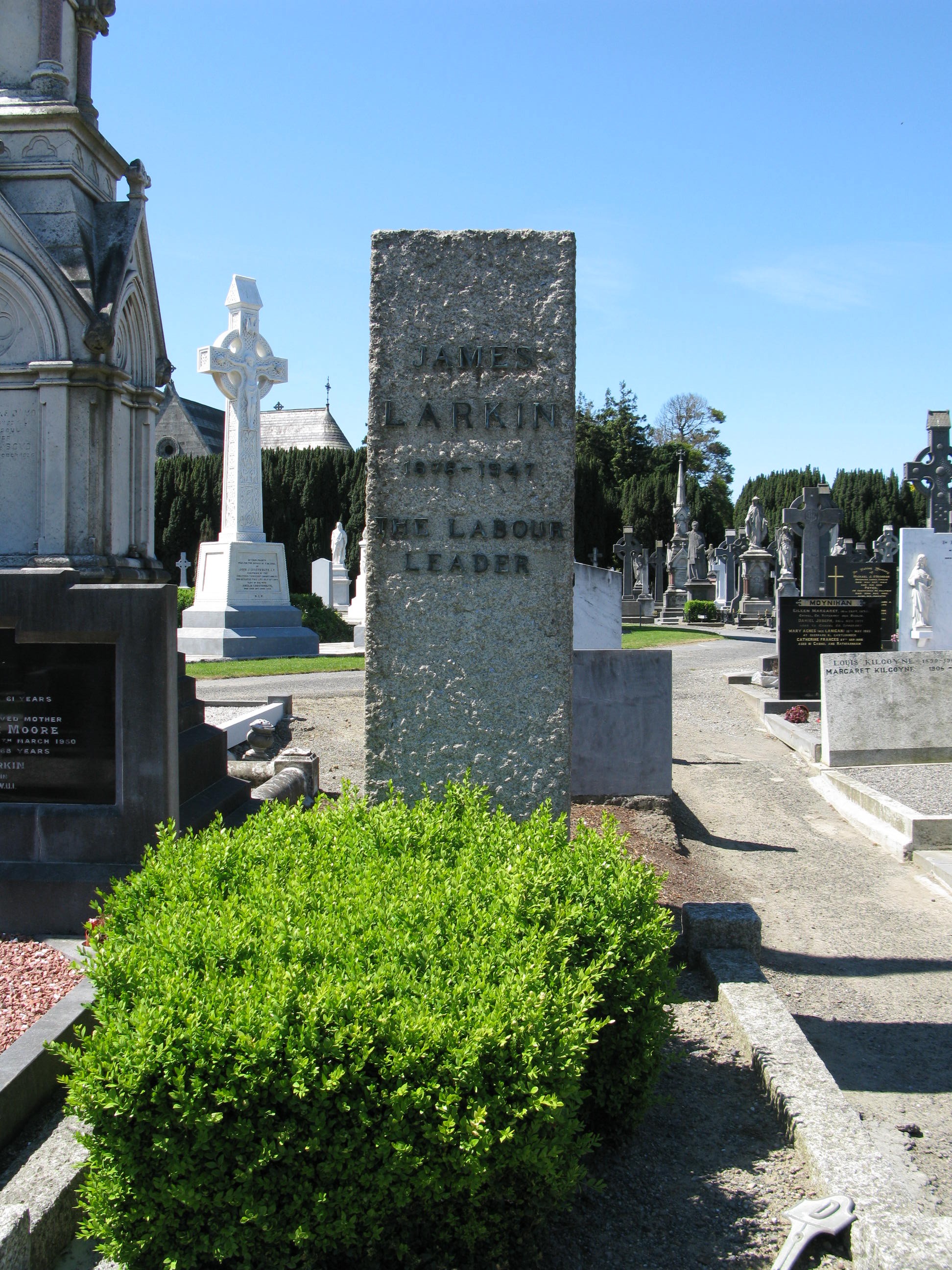
A modest grave for a big character; Jim Larkin

The cemetary is home to the graves of approximately 1.2 million people; A far cry from the nine acres it started out with in 1832,the area now stands at over 120 acres on one side of the road and a further 40 acres on the other, where the body of Luke Kelly now rests. It came into being initially due to reforms pushed through by Daniel O’Connell, whose tomb sits at the entrance to the cemetary. Prior to it’s existence, death was an expensive thing to endure, there being no Catholic burial grounds in Dublin and it costing a small fortune to bury a Catholic in a Protestant one. O’Connells tomb is of course marked by a 170ft tall round tower, which tends to stand out a wee bit! The tomb was the target of a loyalist bomb attack in the seventies, which shook the tomb itself, and blew up the stairs encircling the inside of the tower, closing it to the public. The Cemetary is surrounded on all sides by high stone walls, with towers on each corner. Not there to keep the dead in, they were built to keep grave robbers out. Grave robbing was a lucrative business in the 19th Century, corpses fetching £2, quite a sum in those days. Guards manned the towers from dusk to dawn, armed with muskets and pistols.
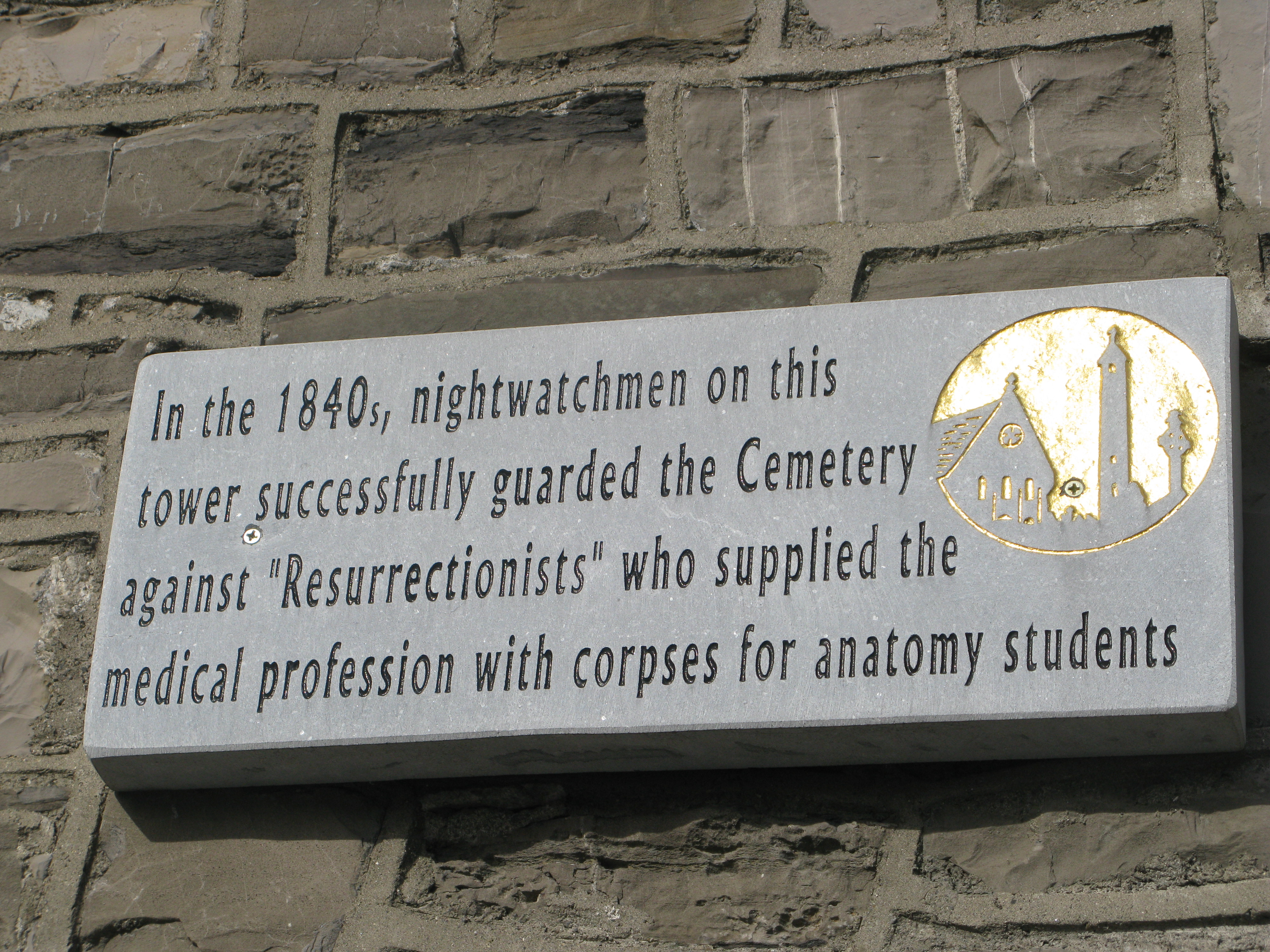
Plaque Commemorating the Cemetary Watchmen

JayCarax said it on the way up here and he was right: It isn’t a case of who is buried here, it’s easier to say who isn’t. For within a stones throw of the gate, you have Daniel O’Connell, as mentioned above, Eamonn DeValera, Michael Collins, Michael Malone, Maud Gonne, Jim Larkin, Roger Casement, Cathal Brugha, The O’Raghallaigh and Frank Ryan, amongst any number of important historical figures. The virtual map on the Glasnevin Trust site gives you a better of who is buried, and where, and is definitely worth having a look at.
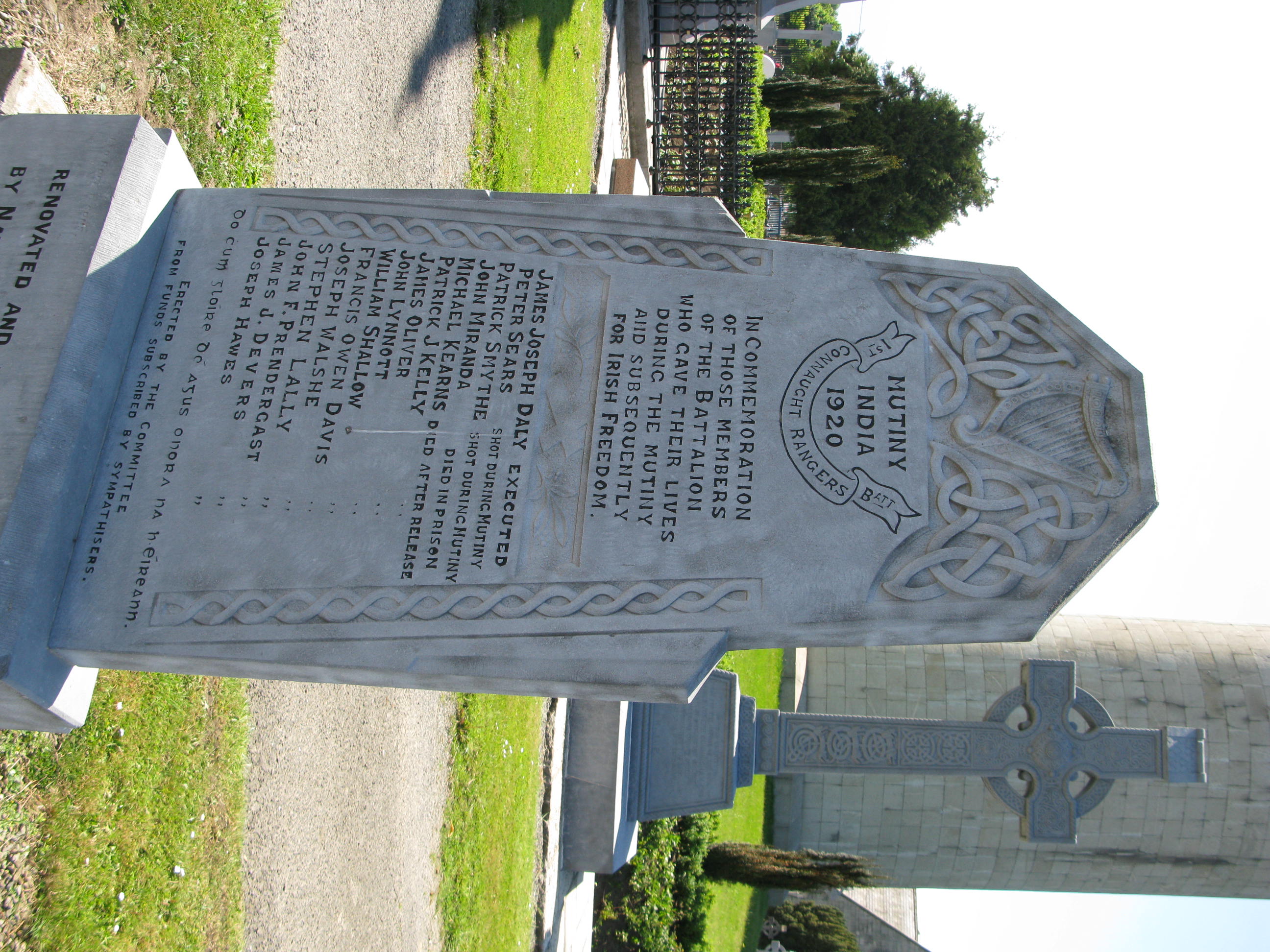
One of the more interesting gravestones; The Indian Mutineers

Whilst amongst the masses of graves friends and comrades lay side by side, mortal enemies are often not within spitting distance of each other either. For while Big Jim Larkin turns to dust beneath the Glasnevin soil, likewise does William Martin Murphy whose palatial tomb is within sight of the modest grave Jim and his family are buried in. While Frank Ryan is buried within sight of the gate, Eoin O’Duffy is also. Glasnevin is, and has always been, a multi-denominational cemetary. Buried and cremated here are Catholic and Protestant, Sikhs and Jews. Rich and poor also, the cemetary is home to the Millenium Plot (what would have formerly been known as a “paupers plot.”) This is looked after by the charity “Alone” who maintain the plot and make sure people buried there are buried with dignity, giving them a full funeral, headstone and flowers. Fair play due there. In one of the older paupers plots, up to 25,000 bodies are buried in a relatively tiny area, not far from Parnell’s grave. Many of the dead were victims of a cholera outbreak in the late 19th century. A couple of years after their burial, fresh outbreaks of Cholera were reported in the Drumcondra / Ballybough area. For not far beneath the soil where their bodies lay is a maze of underground streams, all emtying into the Tolka River- the disease had assimilated into the soil and on into the water, making its way back into circulation. Nasty times.

Above is a stone that caught my attention the first time I visited, and again on our visit on Monday, a memorial to the Indian Mutineers of 1920. Theres is an interesting story. Upon hearing of the uprising in their homeland, hundreds of Irish Soldiers fighting in the British army in India turned their guns on their generals. Though close to 400 men took part, the mutiny was quickly  suppressed and eighty-eight of those men were court martialled. Fourteen were sentenced to death and the rest given up to 15 years in jails in Dagshai and Solan. Two died in the mutiny, Pte Sears and Pte Smyth. Thirteen of the men sentenced to die had their sentences commuted to life imprisonment, though one man, James Daly was shot dead by firing squad. He was considered the leader of the mutiny at just 21 years old.
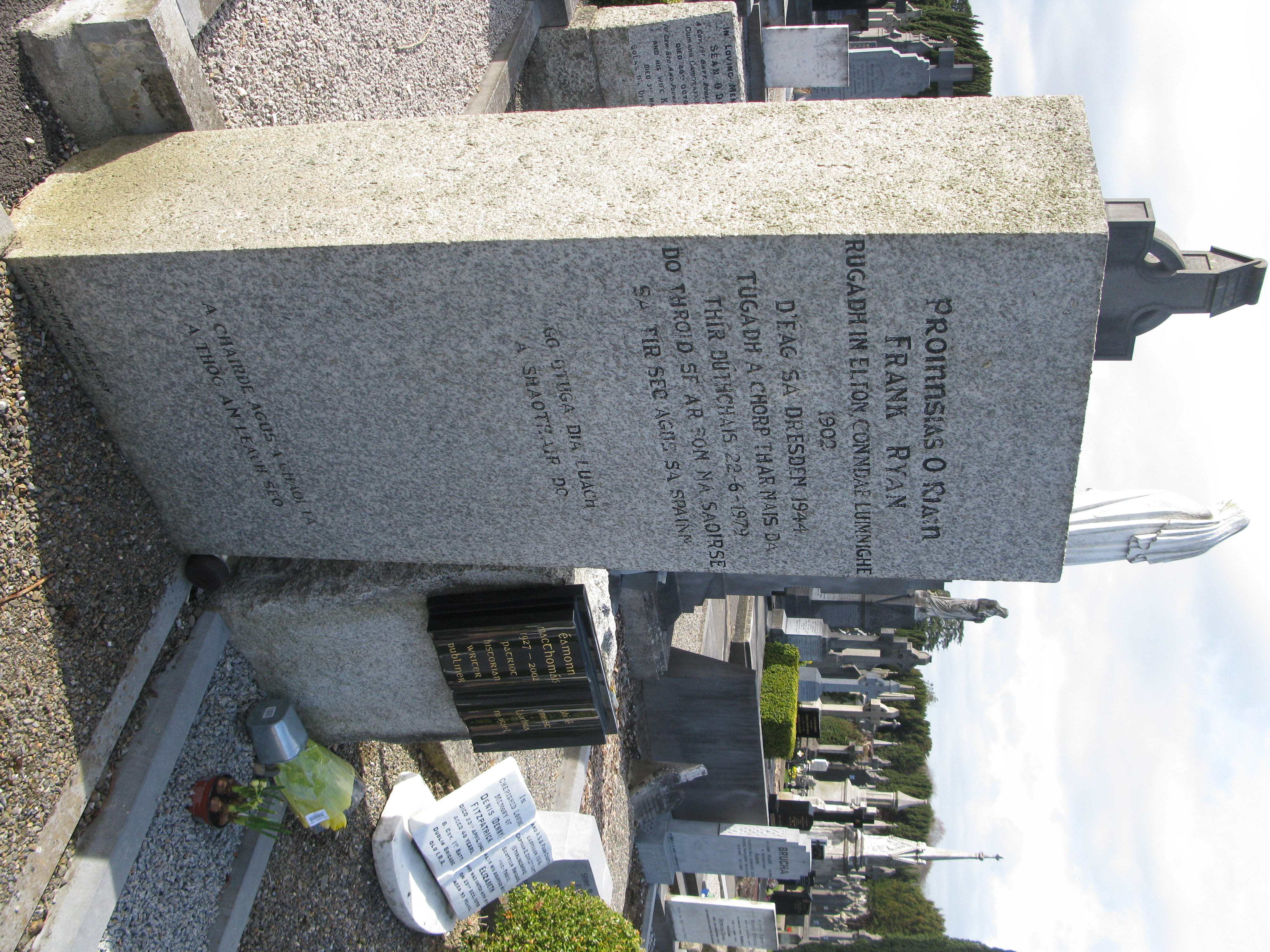
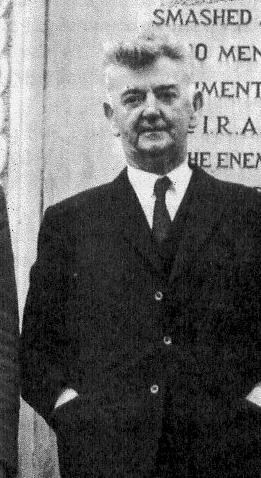
Frank Ryan & next to him, the great Eamonn Mac Thomais

The tour eventually took us to the grave of Brendan Behan in the end, and my search was over. Not far from him lies the burial place of Francis Sheehy- Skeffington, brutally murdered by an Anglo-Irish officer of the 3rd battalion Royal Irish Rifles, Captain J.C. Bowen-Colthurst. Another sad story, one of 1.2 million sad stories you might say. You get the sense when walking around here that each grave has a history attached, each person buried here has had trials and tribulations of their own. And while visitors come here to see the burial sites of the famous and influential, there are others here whose personal struggles surely matched the struggles of those marked on their maps.

The new Glasnevin Visitors Centre opens this Friday. There are daily tours of the cemetary, led by Shane MacThomáis, costing €5. A bargain, tours last approx. 2 hours. Without donations and support, Glasnevin would be forced to close its gates as a national monument. Be sure to visit and support it however you can. Check out http://www.glasnevintrust.ie for more details.

Read Full Post »

I’ve been irregularly updating my blog ‘Hidden History of UCD’ with pieces related to the radical and social history of the college. Some CHTM! readers might be interested in some of my recent posts:

– In 1962, Anthony Clare wrote an article for the T.C.D. Miscellany about the censorship regime in UCD at that time.

– In 1967, Joseph Matthews wrote an article for Hibernia about Student Politics in UCD at the time (it includes a picture of a very young Vincent Browne, Chairman of Young Fine Gael)

– In the early 1970s, an Oz like radical paper was published in Belfield called Instead.

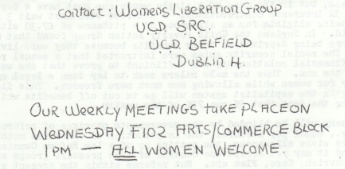
– In the mid 1970s, a Womens Lib. fanzine was published in Belfield called Bread and Roses.
In the late 1980s, Belfield enjoyed a healthy rave scene. I’ve interviewed François Pittion (Ents Officer 1988/89) about the period.

Taken from Bread and Roses (Issue 2, c. 1974) Click to read full issue.

Read Full Post »

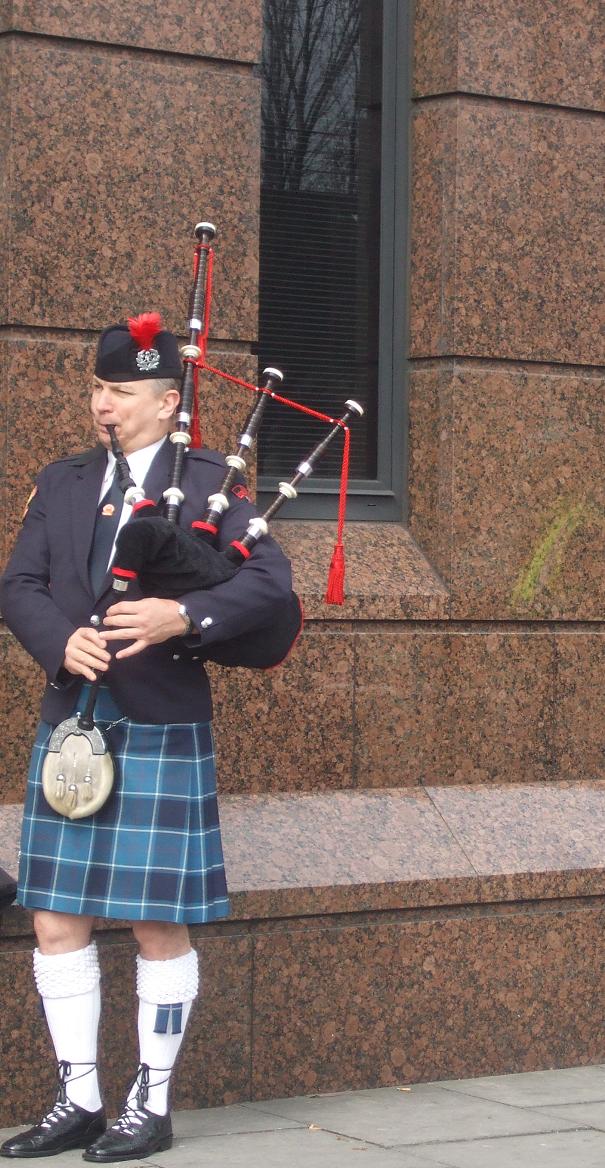
Dublin Fire Brigade Piper Bernard Mulhall at Liberty Hall

“O branch that withered without age!
Would we could see you where you’re missed
Step airy on the Abbey stage
Play there ‘The Revolutionist’
Or fill with laughter pit and stalls
With Bartley Fallon’s croak and cry
What led you to those castle walls?
We mourn you Sean Connolly”

Lady Gregory.

Another plaque in place, another important part of working class Dublin history marked.

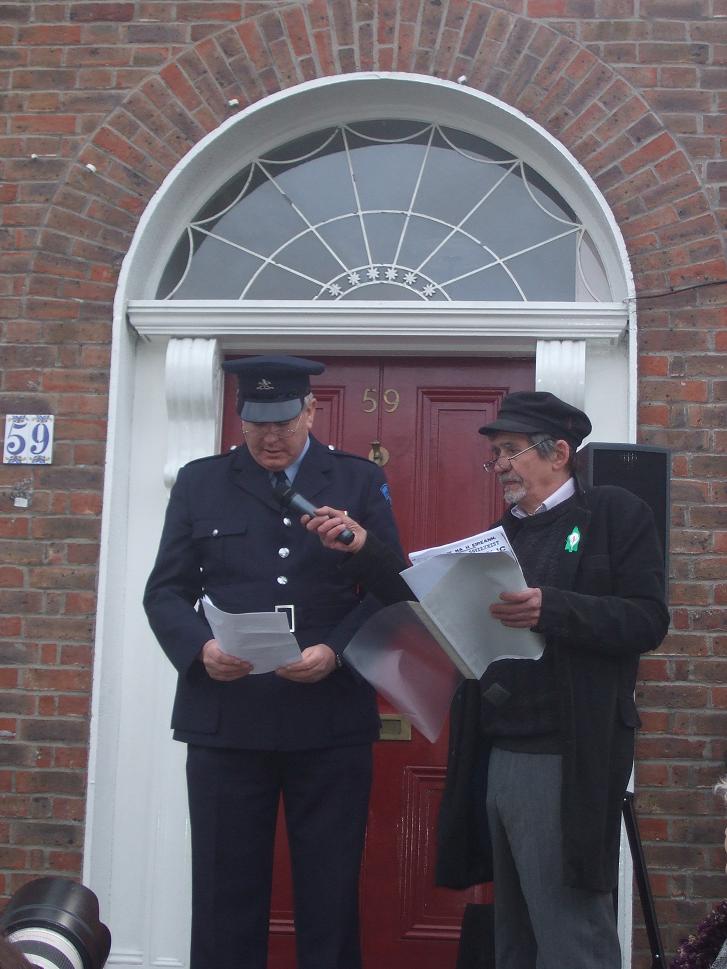
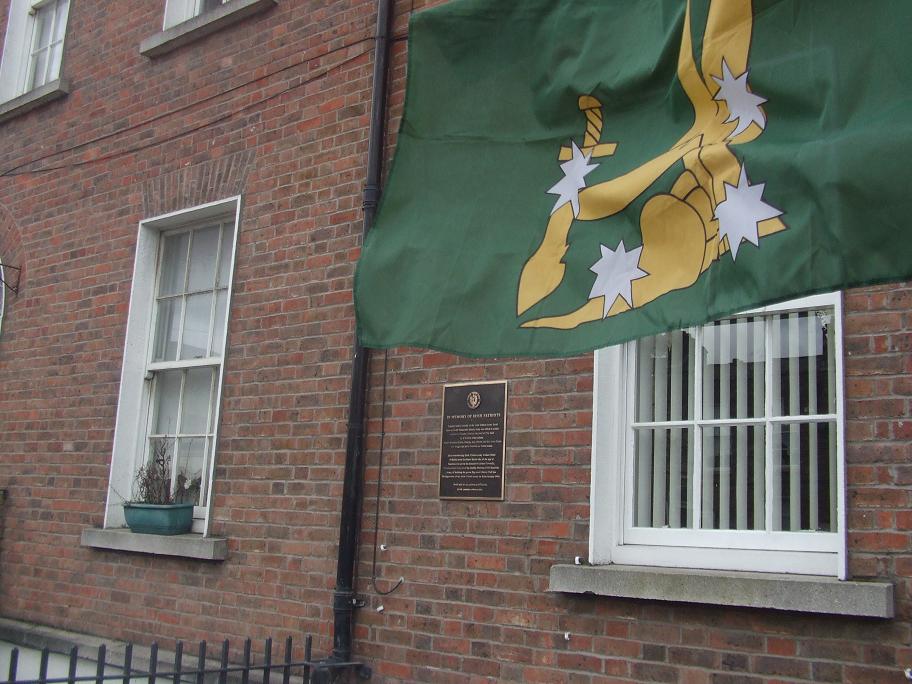
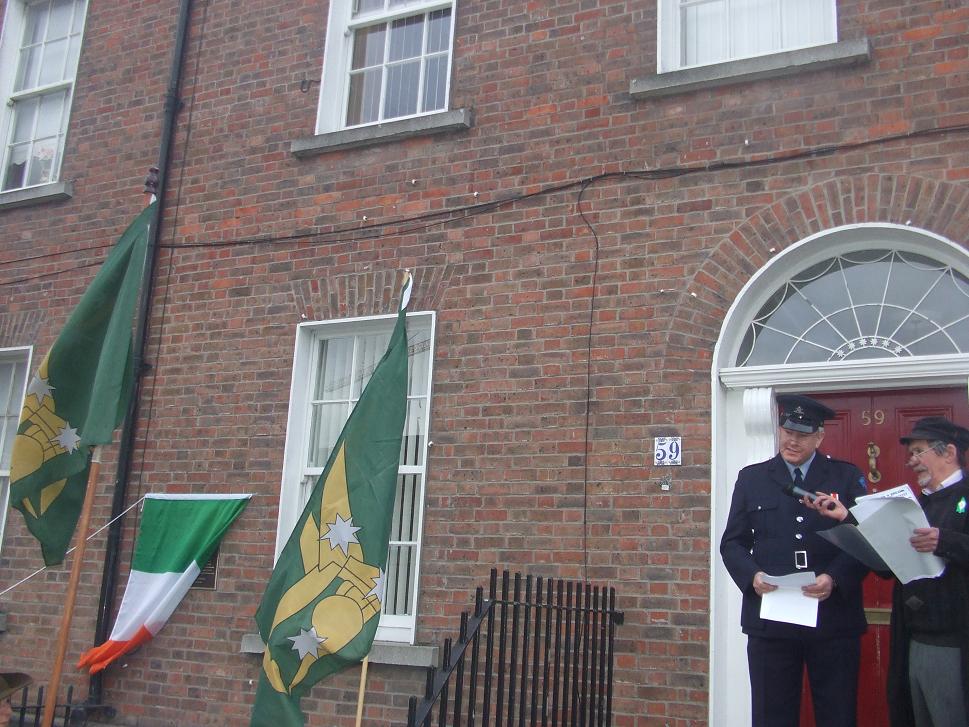
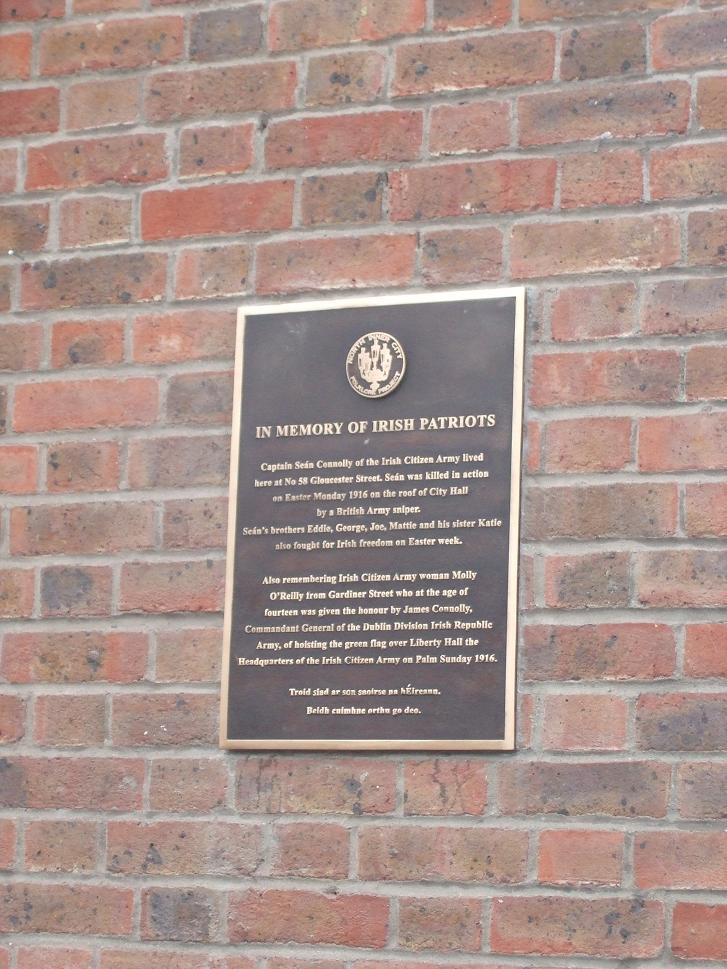
The home of the Connolly siblings, at 58/59 Sean McDermott Street Lower, now boasts a new plaque from the North Inner City Folklore Project. Captain Sean Connolly and his siblings Katie, Joseph, George, Eddie and Mattie all fought with the Irish Citizen Army during the Easter rebellion. The plaque also pays tribute to young Molly O’ Reilly, who raised the green flag over Liberty Hall in 1916.

Among the crowd were historians, trade unionists, activists,relatives of members of the City Hall Garrison and members of the local community. The Dublin Fire Brigade were represented too, due to Joseph and George Connolly serving within its ranks. Joseph was a firefighter at the time of the insurrection. The Fire Brigade can therefore boast something very few others in the city can, in the form of a real connection to the Easter Rising.

Conor McCabe at Dublin Opinion has some more images worth a look over at their blog.

Speeches and audio

James Connolly Heron speaks at the site of the plaque. His speech covers not alone Sean Connolly and his siblings, but the campaign to save 16 Moore Street.

Las Fallon, of the Dublin Fire Brigade Museum, speaks of Joseph and George Connolly.

Dublin Fire Brigade piper plays outside 58/59 Sean McDermott Street Lower.

Wind, coughing, and all the other things nature/people can whip up when you’re trying to record something, but still….

Images

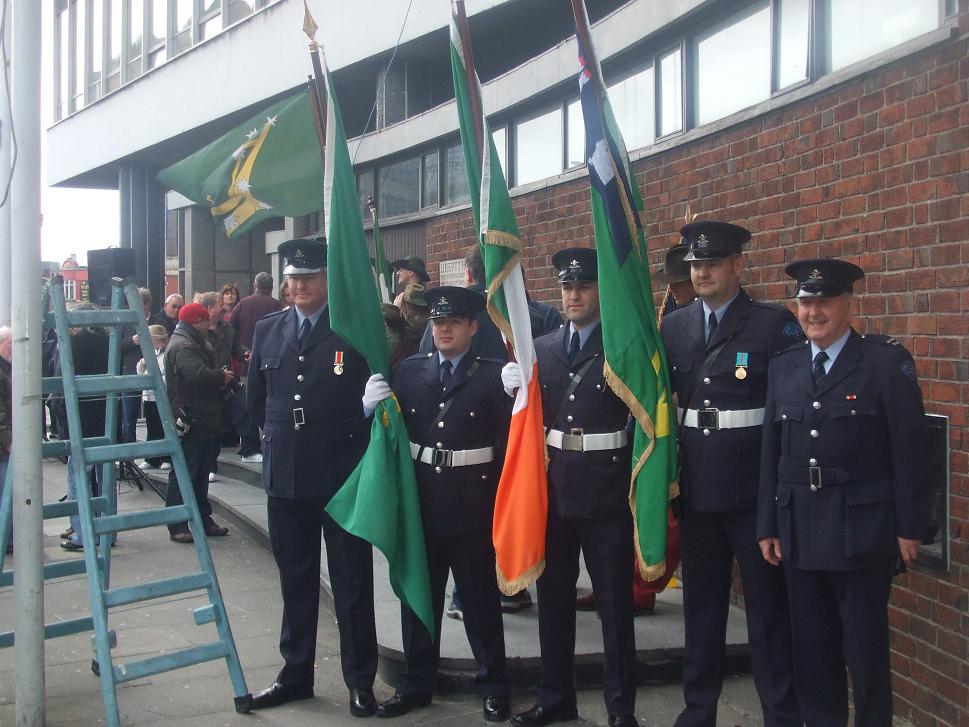
Dublin Fire Brigade members at Liberty Hall

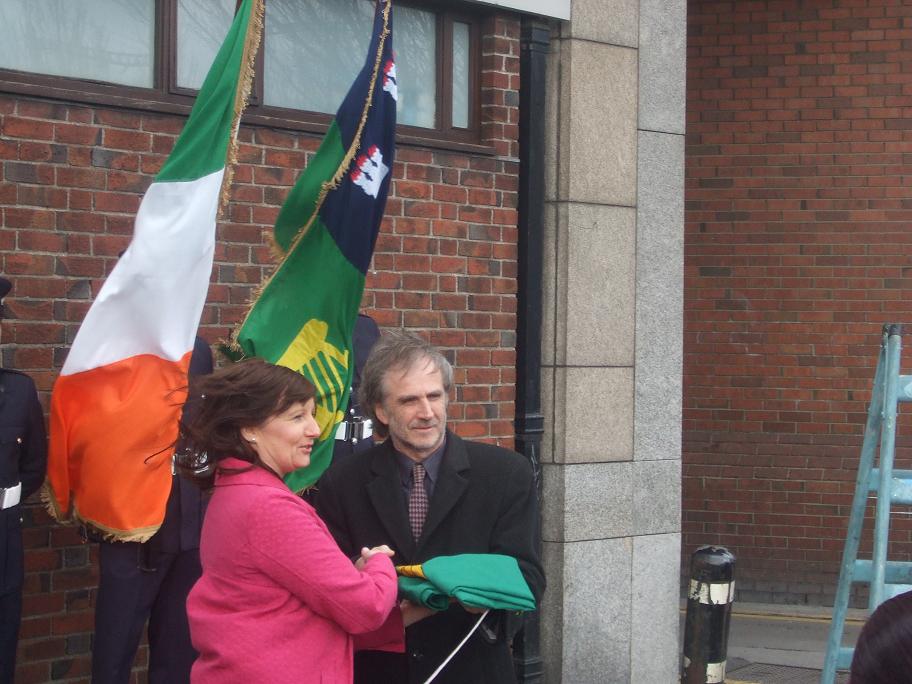
Fittingly, a relative of James Connolly presents a relative of Molly O' Reilly with the green flag to raise.

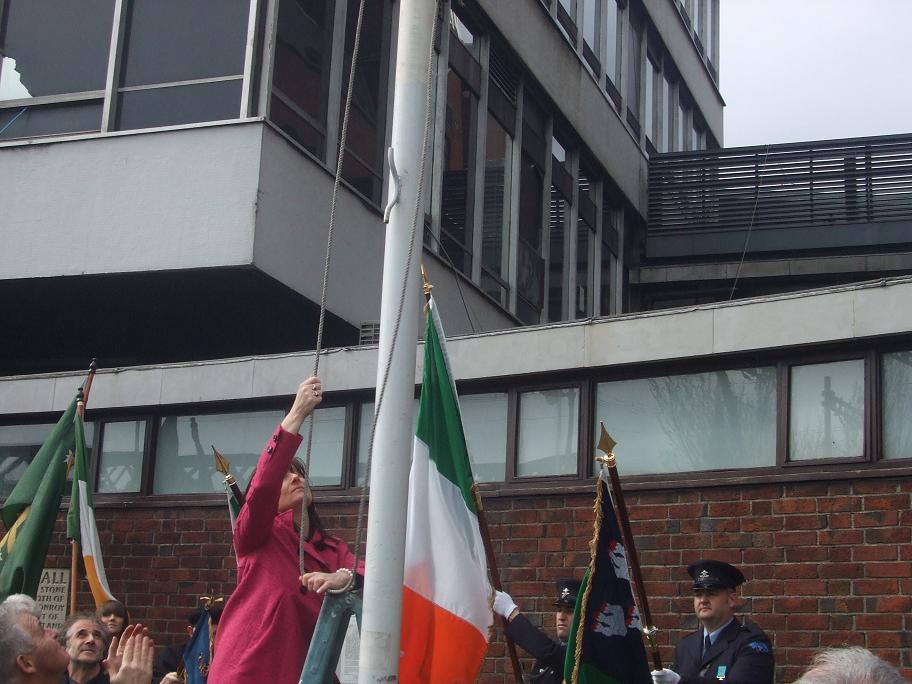
The raising of the flag

The flag is raised.

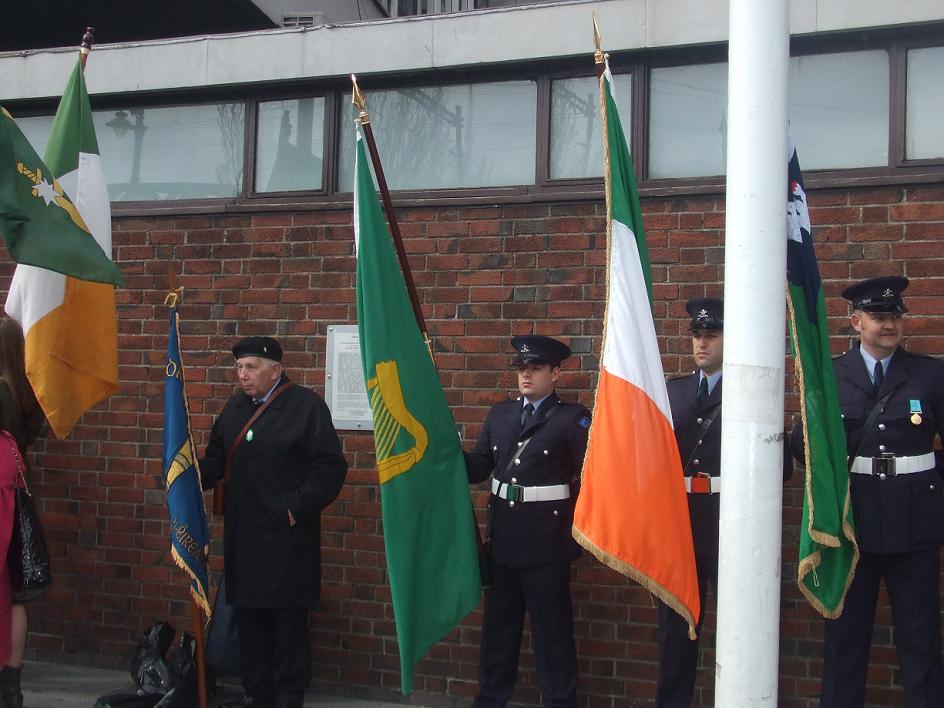
Dublin Fire Brigade colour party

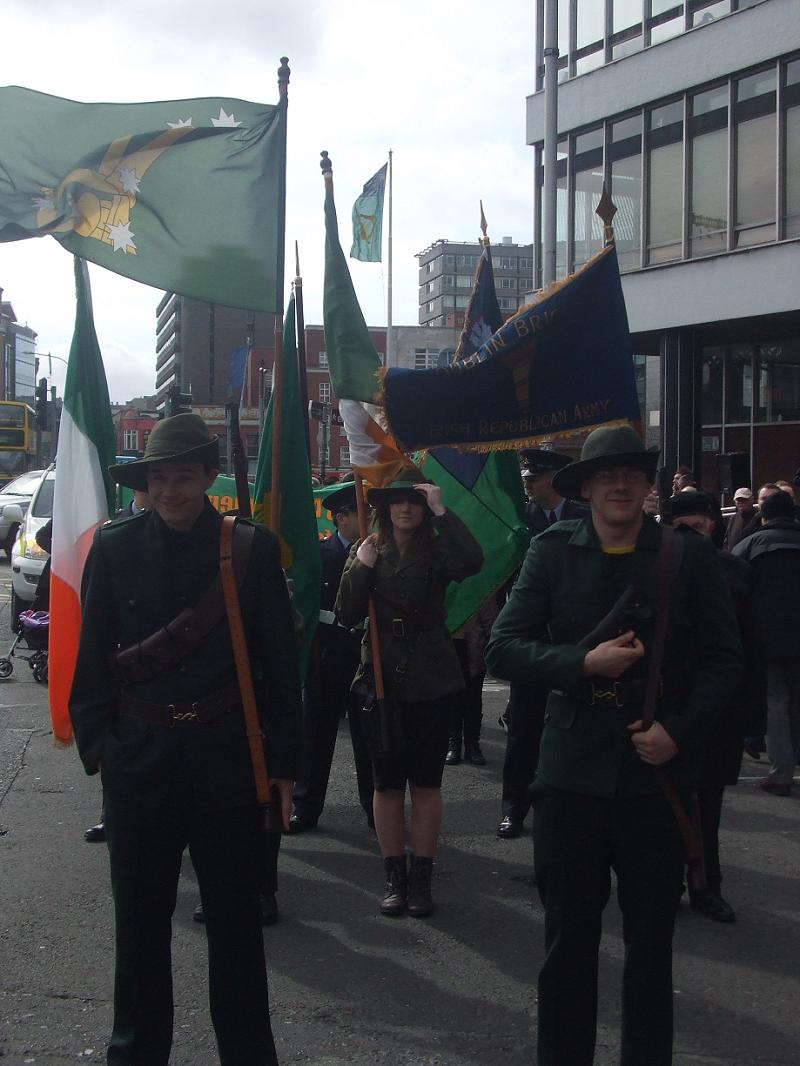
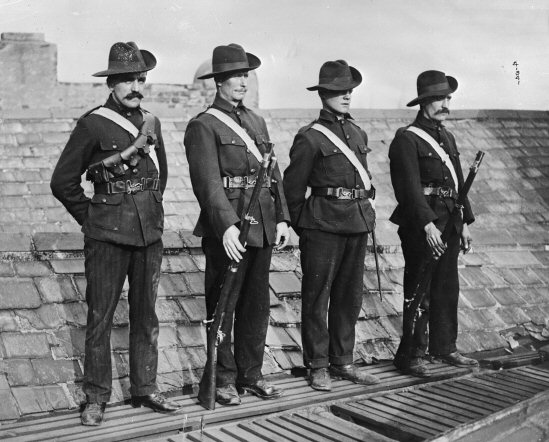
Citizen Army uniforms today, spot on right down to the red hand!

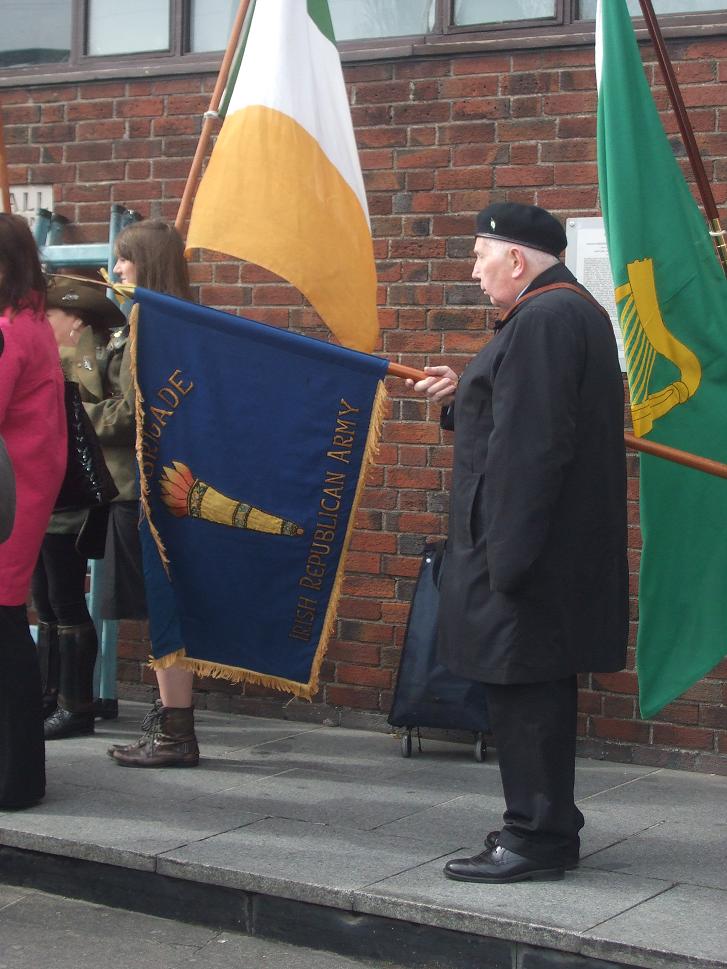
Dublin Brigade- Irish Republican Army

Las Fallon, Dublin Fire Brigade, speaks of George and Joseph Connolly.

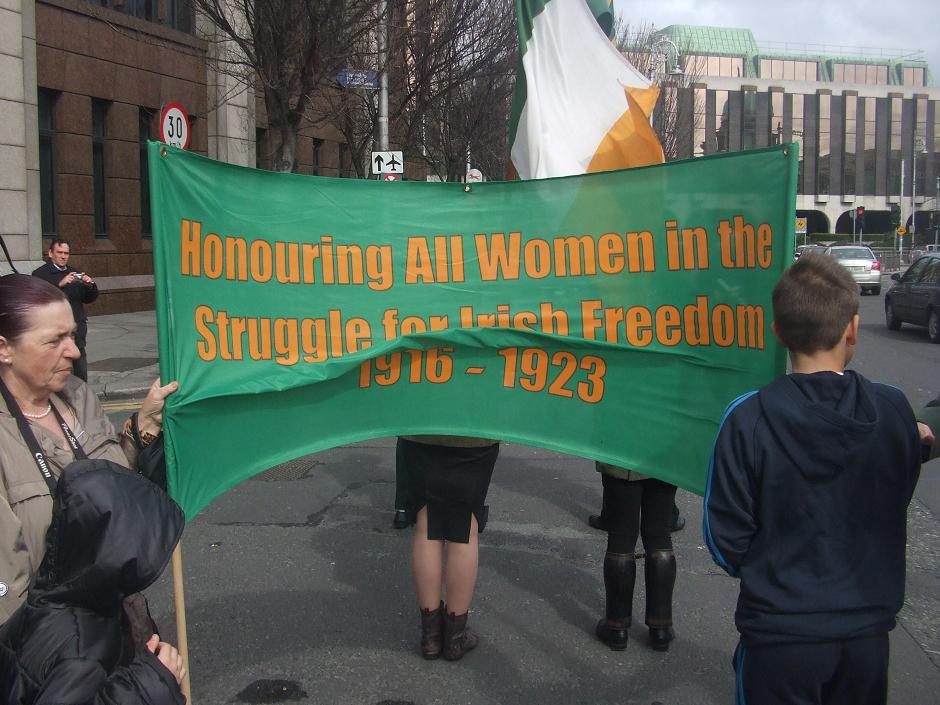
Banner marking the role of women in the revolutionary years

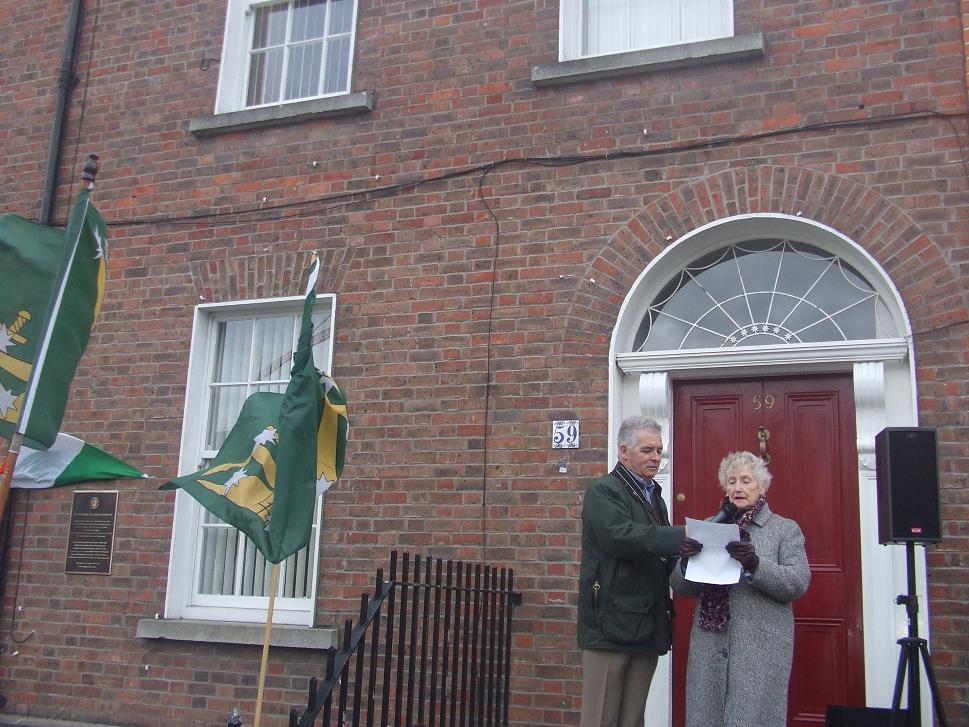
A poem is read prior to the unveiling

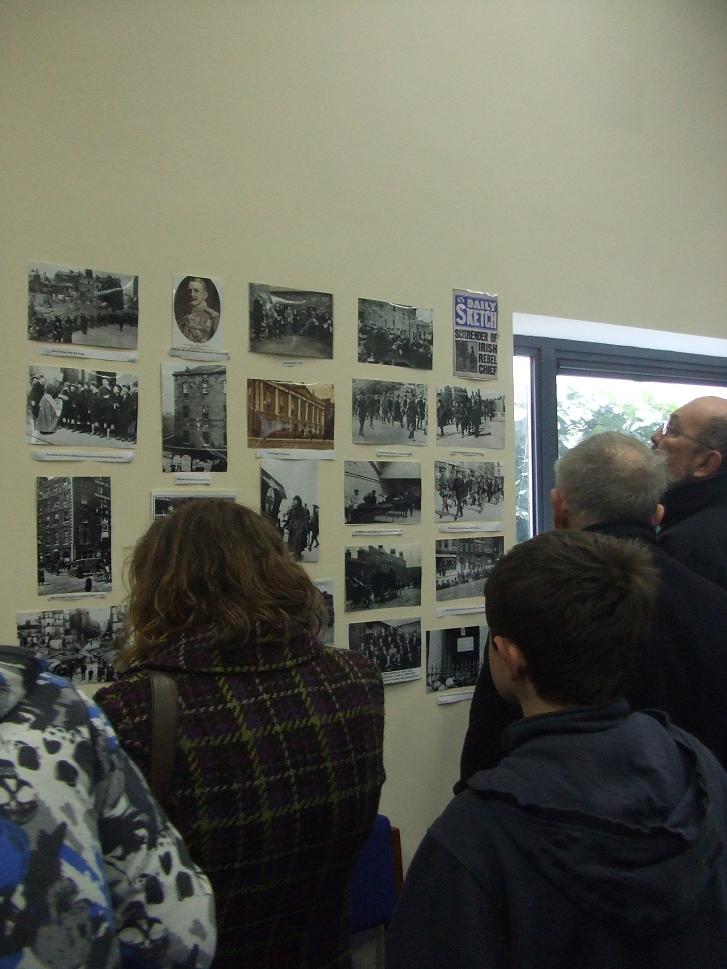
A small selection of the fantastic collection of images from the period on display afterwards

The Starry Plough blows in the wind with the new plaque behind it.

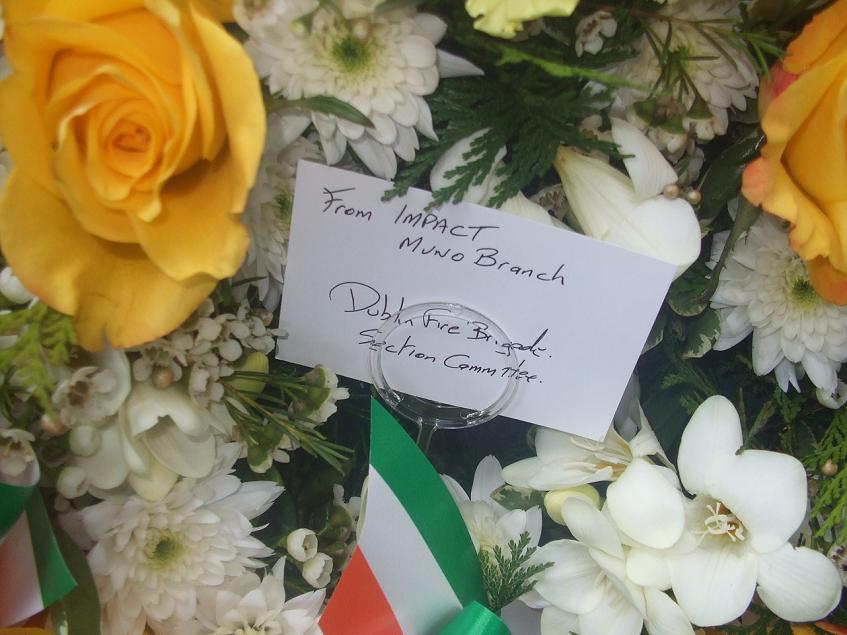
Dublin Fire Brigade trade unionists pay respect. Firefighter Russ McCobb laid this on behalf of Impact workers.

Another snap of the brief talk on the Connolly connection to the Dublin Fire Brigade

The plaque itself

After the ceremony, we decided to visit Glasnevin Cemetery. There, we thought it only fitting to undertake a search for a particular grave with the day that was in it.

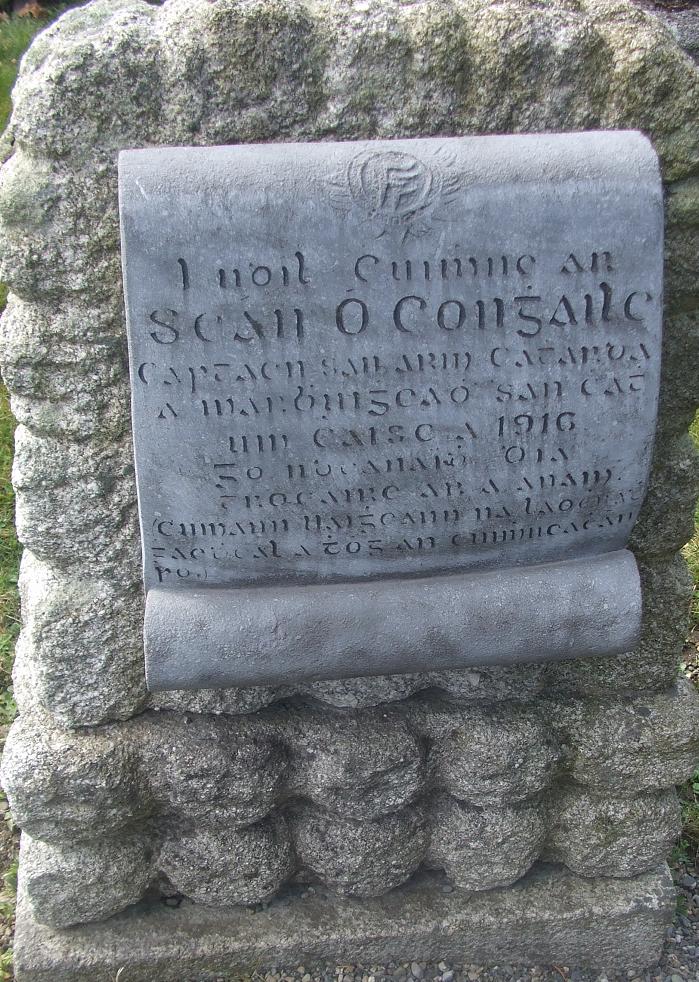
The grave was that of Captain Sean Connolly, Irish Citizen Army.

Read Full Post »

Tomorrow I hope to have the audio and photos from the launch of the new Connolly siblings/Molly O’ Reilly plaque launch up. For now, here are some unusual photos captured today in Dublin city centre.

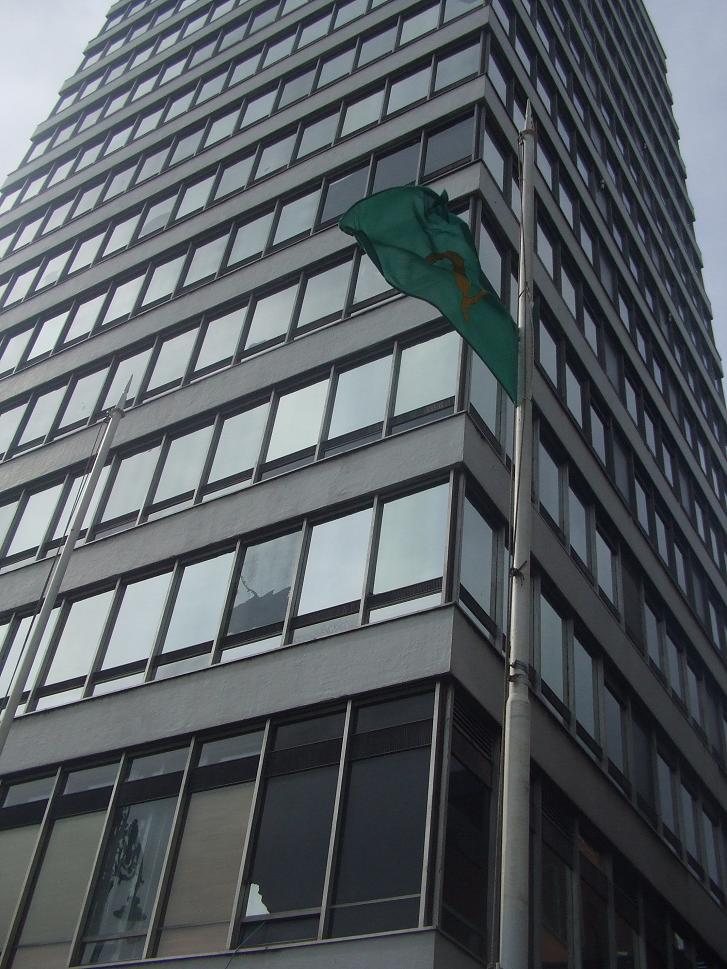
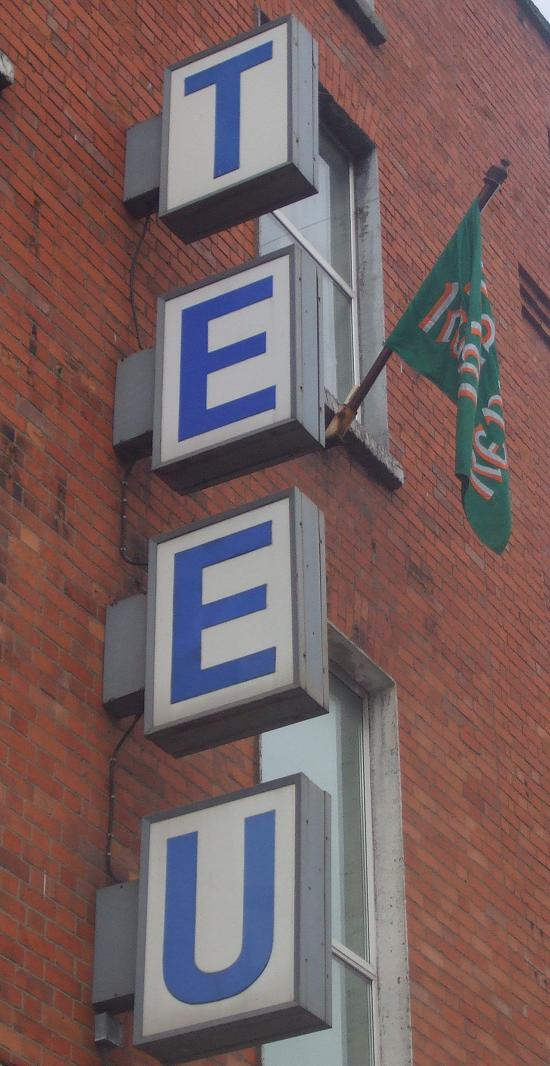
The 'Irish Republic' flag at the offices of the T.E.E.U Union.

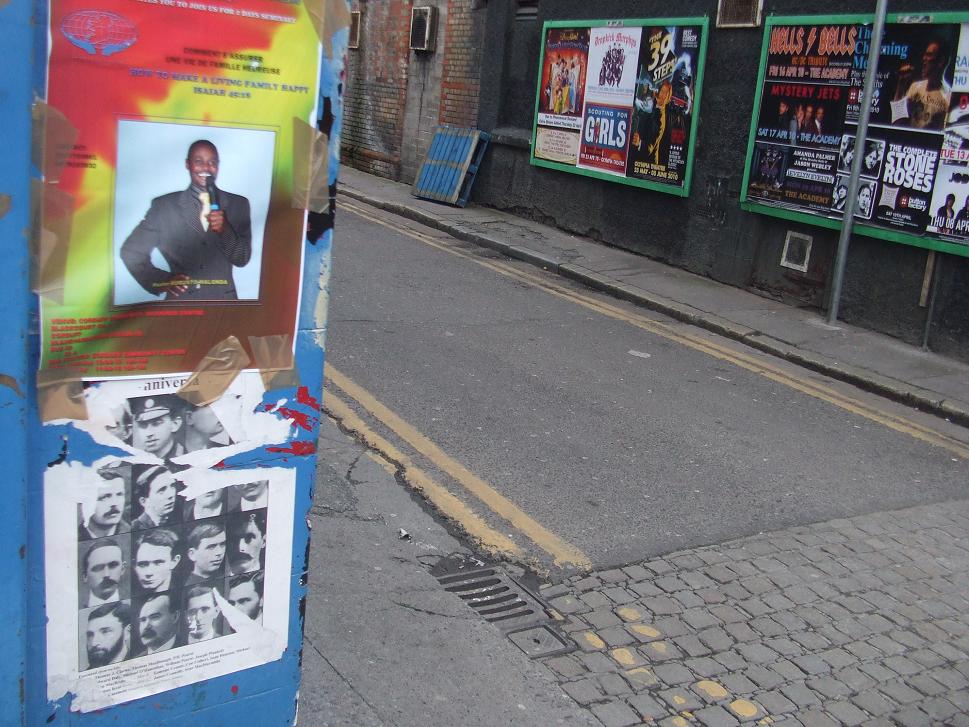
2006 poster on Moore Street, still up.

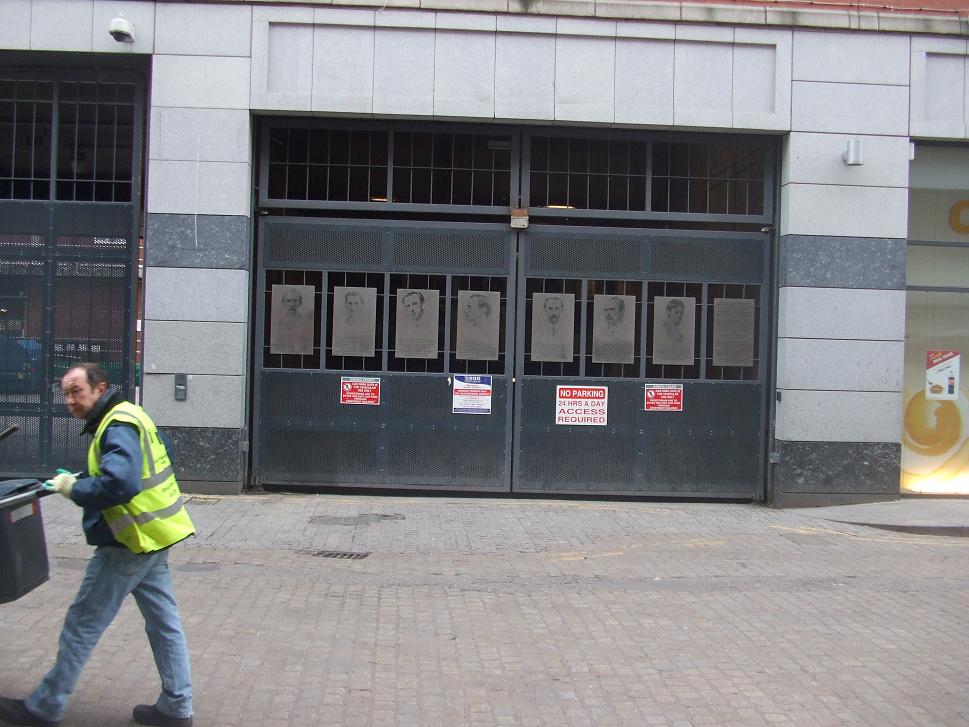
A city council worker passes by the faces of the 1916 leaders, Moore Street.

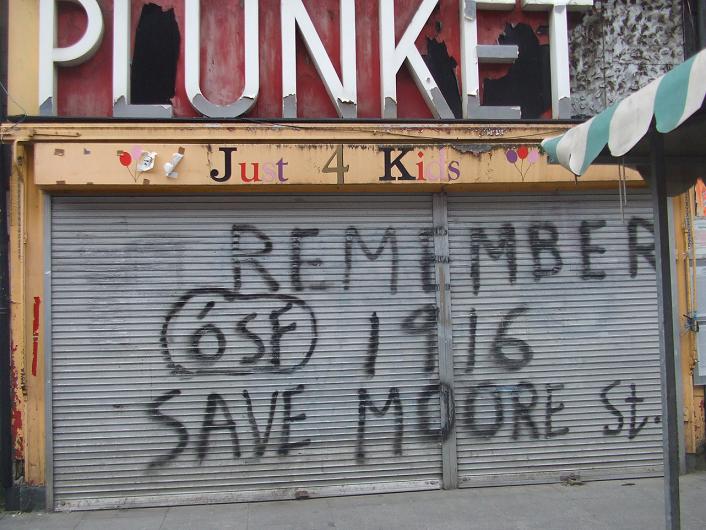
Fresh graffiti on 16 Moore Street

Read Full Post »

“What was this Republic of which I now heard for the first time? Who were the leaders the British had executed after taking them prisoners, Tom Clarke, Padraic Pearse, James Connolly and all the others, none of whose names I had ever heard? What did it all mean?”

So wrote a young British soldier serving in Mesopotamia, or Iraq to you and me. Bemused by what had occured in Dublin, this one soldier had gone to war not lured by the recruitment posters featuring small nations (often personified in the form of female characters) but in his own words “..for no other reason than that I wanted to see what war was like, to get a gun, to see new countries and to feel like a grown man”. This young soldier would continue to serve that army afterwards, but in 1920 became a member of the 3rd Cork Brigade of the Irish Republican Army, rising through the ranks to become a flying column leader who inflicted terror on Auxiliary forces at Kilmichael and the Essex Regiment of the British Army and the Royal Irish Constabulary at Crossbarry. The young man, of course, was Tom Barry.

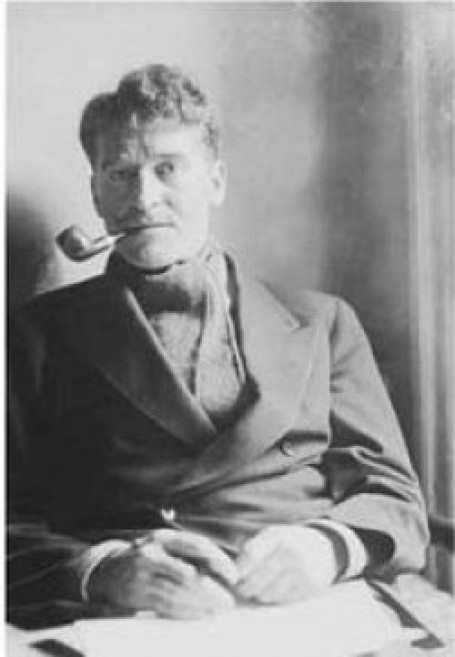
Tom Barry

Barry was not the only Republican leader who saw the Rising in an unusual manner. In Dublin,a young medical student named Ernie O’ Malley was taken aback by events, and vivdly described events on Sackville Street.

“Other shops had just been looted: Lawrence’s toy bazaar and some jewellers. Diamond rings and pocketsful of gold watches were selling for sixpence and a shilling, and one was cursed if one did not buy…. Ragged boys wearing old boots, brown and black, tramped up and down with air rifles on their shoulders or played cowboys and Indians, armed with black pistols supplied with long rows of paper caps. Little girls hugged teddy bears and dolls as if they could hardly believe their good fortune”

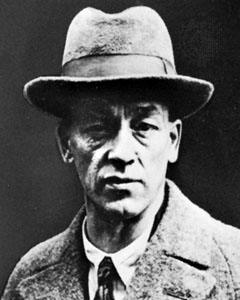
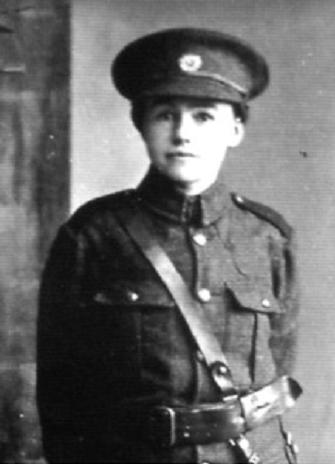
Ernie O' Malley

While literally seeing the outbreak of the rebellion, O’ Malley would also encounter a student he knew who told him they were arming themselves in case Trinity College would be attacked. O’ Malley informed the student that while he was off home, he would return later(The fact O’ Malley was a UCD Student would no doubt lead to cries of ‘Sacrilege!’ from some even today). Largely indifferent at first to what was occuring, O’ Malley would quickly turn towards the rebels, even making his way down Moore Street and towards Nelsons Pillar one night, where he discussed the rising so far with a uniformed officer of the Irish Citizen Army. Amazingly, O’ Malley and a schoolboy friend would take it upon themselves to assist the rebels, through taking potshots at soldiers with a rifle his friends father had been given “as a present by a soldier who brought it back from the Front”

In his memoir, On Another Man’s Wound he went on to note that after the rebellion he purchased a copy of James Connolly’s Labour In Irish History. History would see Ernie O’ Malley remembered as a leading republican anti-treatyite, and a key intellectual within the movement.

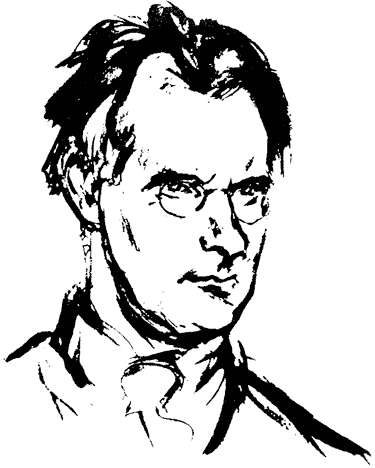
James Stephens

In Dublin, James Stephens was surprised by the outbreak of the insurrection, in fact to the extent that he did not notice at first and went about his business. A novelist and poet, his account of the week, The Insurrection in Dublin, is well written and oft-humourous.

“This has taken everyone by surprise. It is possible, that with the exception of their staff, it has taken the Volunteers themselves by surprise; but,today, our peaceful city is no longer peaceful; guns are sounding or rolling and cracking from different directions, and, although rarely, the rattle of machine guns can be heard also.

Two days ago war seemed very far away- so far, that I have convenated with myself to learn the alphabet of music”

Stephens would seek confirmation of the Risings continuation from his own window, and the Republican flag flying over the Jacob’s Garrison, under the command of Thomas MacDonagh, but including a diverse band of individuals like Peadar Kearney (author of The Soldiers Song), Major John MacBride and the actress Máire Ní Shiubhlaigh, a member of Cumann na mBán, the womens auxiliary force to the Irish Volunteers.

“It is half-past three o’clock, and from my window the Republican flag can still be seen flying over Jacob’s factory. There is occasional shooting, but the city as a whole is quiet. At a quarter to five o’clock
a heavy gun boomed once. Ten minutes later there was heavy machine gun firing and much rifle shooting. In another ten minutes the flag at Jacob’s was hauled down.

Many had believed that the country would rise after Dublin, and create a national uprising out of a regional one. This was not to be, with contradictory orders from national leadership leading to mass confusion. Liam Mellows mustered a force of several hundred in Galway who were involved in several attacks on police barracks’ yet did not have the capability to sustain any sort of campaign in the region. Men of the ‘Fingal Batallion’ of the Irish Volunteers would find themselves active in Ashbourne, County Meath with Thomas Ashe, where they inflicted real damage on local Royal Irish Constabulary forces. Still, the significant forces available to the Volunteers nationwide were not used, as many had obeyed the order of Eoin MacNeill and word did not travel from Dublin at a speed to allow for a nationwide insurrection.

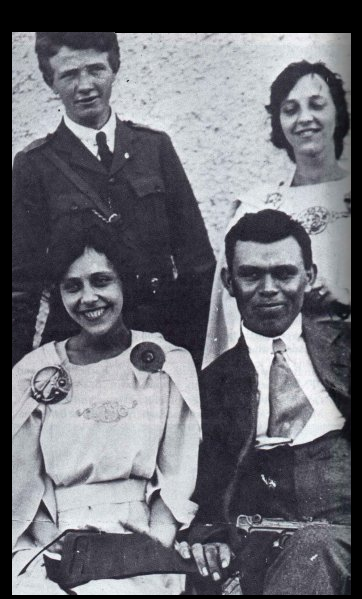
Dan Breen, front row.

The frustration of some Volunteers outside Dublin can be clearly felt in Dan Breen’s account of news reaching him in Tipperary, and his attempts to establish contact with Sean Treacy, a leading figure of the Third Tipperary Brigade and a close friend.

“Sean had left his home on the first news of the Rebellion and cycled from one centre to another, urging the Tipperary Volunteers to take action….

…We were bitterly dissapointed that the fighting had not extended to the country. We swore that, should the fighting ever be resumed, we would be in the thick of it, no matter where it took place”

Perhaps fittingly, on the 21st of January, 1919, Sean and Dan would play no small part in resuming the fighting with the Soloheadbeg Ambush, an action that has found a place in Irish history as the event which essentially kick-started the War of Independence. Anyone new to the period should seek out the ‘Wanted’ poster for Dan Breen, which is sure to raise a chuckle, highlighting his “sulky bulldog appearance” among other things.

Events in Dublin would have a ricochet effect far beyond the city or even Irish countryside. In Wales, Captain Jack White would find himself arrested too.

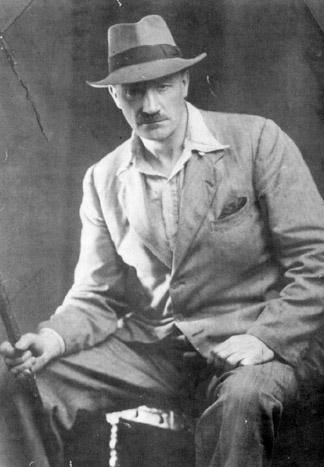
Captain Jack White

White had drilled, and in fact dressed (disagreeing with Sean O’ Casey on the matter of uniforming such a workers militia), the Citizen Army long before the insurrection.

In his memoir, Misfit, White noted that “In short, I am arrested in the South Wales coalfield for trying to get the Welsh miners out on strike. Why? To save Jim Connolly being shot for his share in the Easter Rising in command of the Citizen Army. Had I succeeded I would have crippled the coal supply for the British Fleet”

Years after the insurrection, White would find himself an anarchist in Spain,and in an article published on November 11th 1936 titled “A Rebel In Barcelona: Jack White’s First Spanish Impressions” White would once again speak of the Easter Rising.

“You will have heard no doubt about the Dublin Rising of 1916. That rising is now thought of as purely a national one, of which the aims went no further than the national independence of Ireland. It is conveniently forgotten that not only was the manifesto published by the “bourgeois” leaders concieved in a spirit of extreme liberal democracy, but, associated with the “bourgeois” leaders was James Connolly, the international socialist, who some regarded as the great revolutionary fighter and organiser of his day. In command of the Irish Citizen Army, which I had drilled, he made common cause with the Republican separatists against the common Imperial enemy.”

The article was printed in the CNT-AIT Boletin de Informacion, and White concluded by stating he greeted the working class revolution with “..the voice of revolutionary Ireland”

Not all former comrades of James Connolly and the Irish Citizen Army were as kind. Sean O’Casey had walked from the Citizen Army (where he held the situation of Honorary Secretary) with maintained a belief that the Citizen Army had aligned itself too closely with what he saw as reactionary nationalist forces.

Sean O' Casey

In his ‘Story of the Irish Citizen Army’ (available to read free online over at Libcom) O’Casey wrote of the raising of the green flag over Liberty Hall, stating that in his opinion “Labour had laid its precious gift of Independence on the altar of Irish Nationalism…”

Concluding Book 3 of his own autobiography, Drums under the Windows, published in 1945, it becomes clear he did not change his views with regards the new and secondary role the Irish labour movement had taken to Irish nationalism:

“But Cathleen, the daughter of Houlihan, walks firm now, a flush on her haughty cheek. She hears the murmur in the people’s hearts. Her lovers are gathered around her, for things are changed, changed utterly.

A terrible beauty is born.

Poor, dear, dead men. Poor W.B. Yeats”

Lastly, it is worth taking a brief look at a story that is personal and not political. In Portrait of a Rebel Father , Nora Connolly O’ Brien, daughter of James Connolly, describes the initial reaction of the family to their fathers execution.

Nora Connolly O' Brien

“Mama, we must go back to the Castle and ask for daddy’s body”
“They won’t give it to us”
“We must ask”
It was refused.
“Mrs. Connolly”- a nurse came to them as they stood in the hall not knowing what to do- “before Mr. Connolly left us I cut this off for you” On her hand was a lock of daddy’s hair. Mama took it and held to her cheek all that was left of him.

Of course, the above opinions and reactions are just a small sample of what is out there. This Easter Week, we should look at the event not just as a week long insurrection, but as an event that would ricochet on through the troubles that followed and continue to spark debate long after the last bullets whizzed through the Dublin sky.

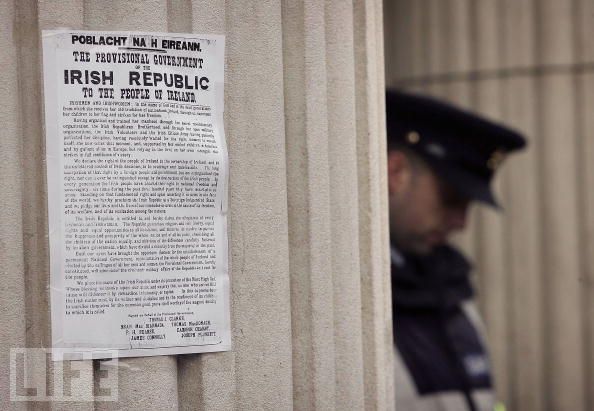
A fantastic snap from life.com from one of the the 2006 commemorations at the GPO,Dublin.

Read Full Post »

Thanks to Rashers for uploading another gem.

Eamonn Mac Thomais takes you around by Dublin Port, City Quay Church, Spencer Dock and St. Laurence O’Toole’s school in Seville Place (where Joe Clarke who fought in the Battle of Mount Street Bridge was educated).

Read Full Post »

I’m about fifteen minutes in the door from my first trip to a Union of Students in Ireland conference. (Maynooth are back in, you see)

Quite an experience, and a productive field trip.

Anyway, a friend of mine was discussing his search for the lyrics to this one-off Christy Moore number about University College Dublin and the L&H there.

I remember raking my brains trying to think of songs which deal with Irish students, and this one was, in truth, the only one that came to mind. Phil Ochs odd tune, “I’m Gonna Say It Now” is the only other song about students that came to mind (cheers Luke) but eh…he mentioned Chairman Mao in that. That and it is a pretty rubbish song.

Here are the words to The Auditor Of The L&H (In the words of Christy “..the launching pad for many an illustrious reactionary career”) which he performed in Theatre L of UCD on the 25th of November, 1982. Next door in Theatre M a debate was raging from which an elected Sinn Féin representative (Danny Morrison) had been excluded.

Justice Thomas Higgins is a man you all should know
Sitting in the Specials he runs a nasty show
Dispering Irish Justice in a way that makes me rage,
And once he was the Auditor of the College L&H

Mr. Patrick Connolly is a man of great renown.
Recently he was the talk of every pub in town.
As attorney general thought it wise to disengage
And once he was the Auditor of the College L&H

Patrick snide smug Cosgrave is Maggie Thatcher’s right-hand man.
In a national University his illusions they began.
To mould her vicious strategy he joined the entourage
And once he was the Auditor of the College L&H

This year’s young incumbant was barely off the train.
Seeking power and prejudice he joined Young Fine Gael.
To be like Higgins, Connolly, Cosgrave, Cormac Lacey craved,
And he is this year’s Auditor of the College L&H

To celebrate elections his first debate he planned.
To feature Conor Cruise O’ Brien, a once respected man.
A Unionist called Millar, and also Liam de Paor
With the Tyrone people’s mandate- Danny Morrison was there.

Cruiser and the Loyalist, they did collaborate.
Free speech for Republicans they could not tolerate.
Morrison was banished, Cormac Lacey sealed his faith
That’s why he is the Auditor of the College L&H

Read Full Post »

Who was the first man shot that day?
The player Connolly,
Close to the City Hall he died;
Carriage and voice had he;
He lacked those years that go with skill,
But later might have been
A famous, a brilliant figure
Before the painted scene.

From mountain to mountain ride the fierce horsemen.

W.B Yeats.

This Easter Monday sees a new plaque unveiled in Dublin, a plaque to the memory of Sean Connolly and his siblings ( Joe, Mattie, George, Eddie and Katie, who all served with the Irish Citizen Army during the Easter Rising) and young Molly O’ Reilly who raised the green flag over Liberty Hall in April, 1916.

In The History of the Irish Citizen Army, by R.M Fox, he wrote that:

In front of the hall itself the Citizen Army cleared a space and formed up on three sides of the square. Inside this square was the women’s section, the boys scouts’ corps under Captain W. Carpenter, and the Fintan Lalor Pipe Band. Captain C. Poole and a Colour Guard of sixteen men escorted the colour bearer, Miss Molly O’ Reilly of the Women Workers’ Union who was also a member of the Citizen Army.

….. “I noticed” said a member of the Colour Guard, “That some men, old and middle aged,and a great number of women were crying. and I knew then that this was not in vain and that they all realised what was meant by the hoisting of the flag

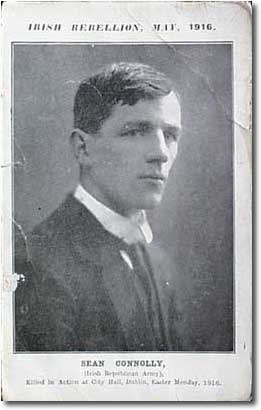
Sean Connolly famously starred in a play by James Connolly entitled ‘Under Which Flag?’ a week before the insurrection, which went hand in hand with the symbolic raising of the green flag over the hall. He was shot on the roof of City Hall on Easter Monday by a British Sniper who had taken up position in Dublin Castle. His brother, Mattie, was with him as he died. Sean is remembered not only as a captain within the Citizen Army but also as an actor at the Abbey, with Lady Gregory writing a poem in his memory after 1916.

James Connolly himself wrote in an article titled The Irish Flag published on the 8th April 1916 in the Workers Republc newspaper, that

For centuries the green flag of Ireland was a thing accurst and hated by the English garrison in Ireland, as it is still in their inmost hearts. But in India, in Egypt, in Flanders, in Gallipoli, the green flag is used by our rulers to encourage Irish soldiers of England to give up their lives for the power that denies their country the right of nationhood. Green flags wave over recruiting offices in Ireland and England as a bait to lure on poor fools to dishonourable deaths in England’s uniform.

On Easter Monday, April 5th the flag will be raised at Liberty Hall by a relative of Molly O’ Reilly. This flag will be presented by the great grandson of James Connolly. This ceremony will begin at 12 noon. After this, the crowd will move on to Sean McDermott Street where the plaque will be unveiled on 58/59 Sean McDermott Lower, where the home of Sean Connolly once stood.

There will be a photographic exhibition of images from the revolutionary years in the nearby Community Hall at Killarney Court.

This is all being carried out by the North Inner City Folk Project, the people behind fantastic events like the commemoration of the forgotten women of 1916, and promises to be a good one. I look forward to it!

Update: Images and audio from the launch can be found here

Read Full Post »

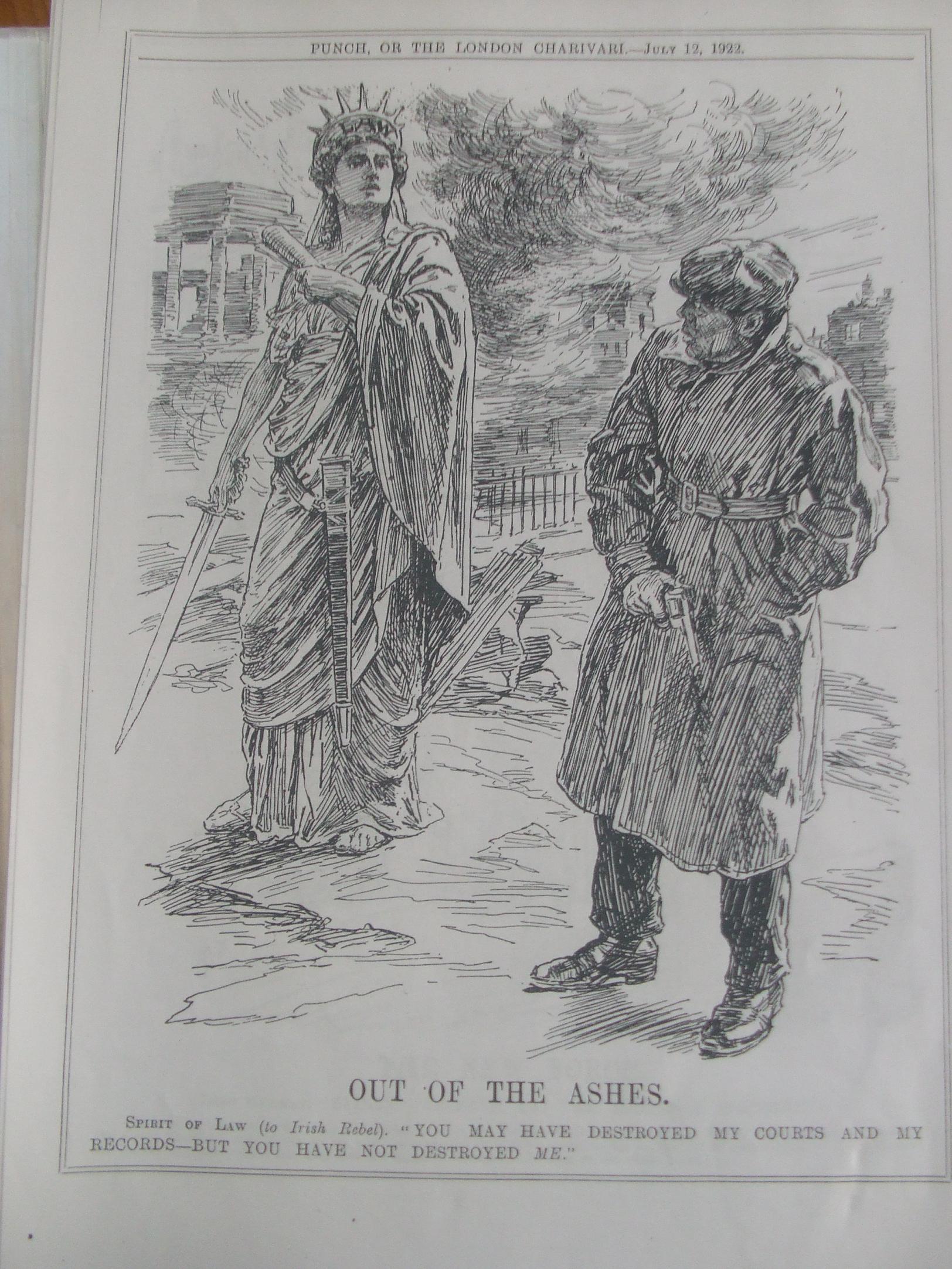
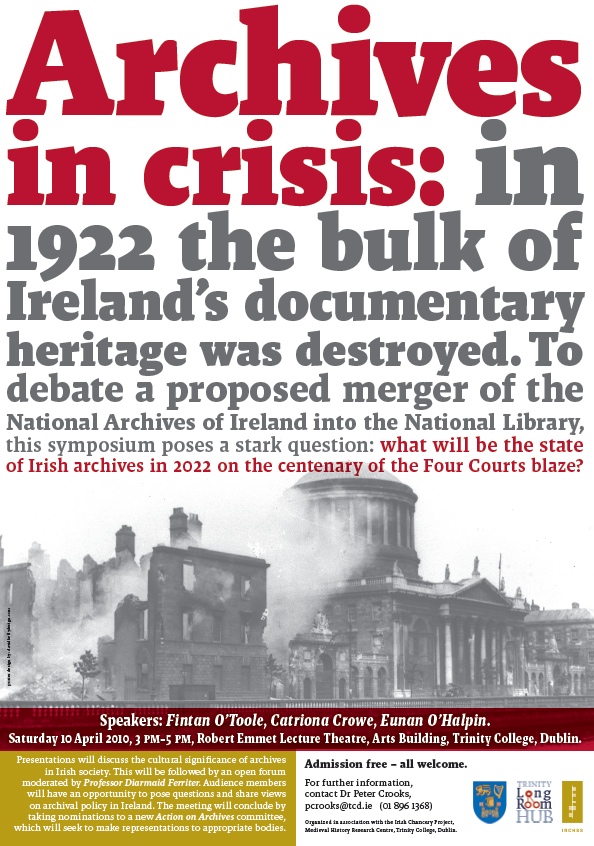
The poster in a recent post on archives and the burning of the Four Courts reminded me to root out this old punch cartoon upstairs.

Taken from the July 12th 1922 edition of Punch, or the London Charivari, it shows the ‘Spirit of the Law’ in discussion with a menacing looking republican figure, with the smouldering remains of the Four Courts in the background.

OUT OF THE ASHES.
Spirit of Law (To Irish Rebel): “You may have destroyed my courts and my records, but you have not destroyed me!”

At least two thirds of Come Here To Me will be at this, feel free to say hello.

Here is that poster one more time, as posted by jaycarax

Read Full Post »

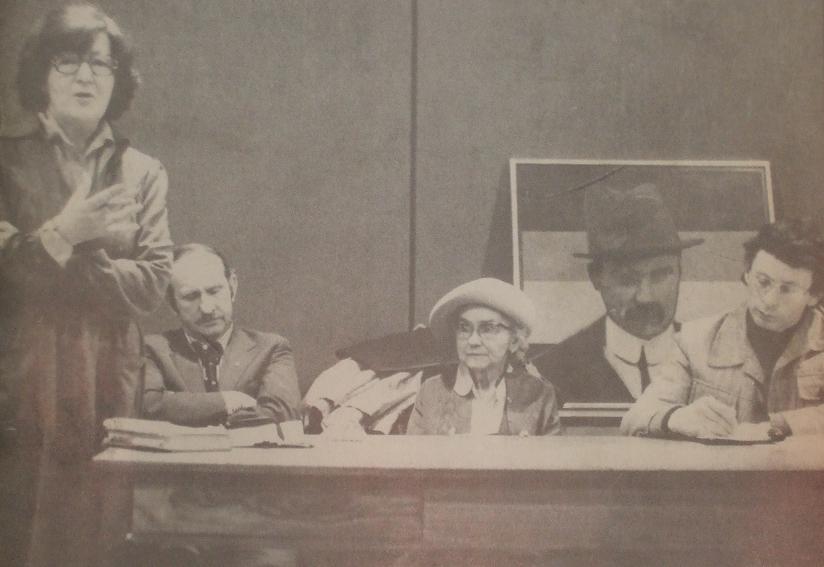
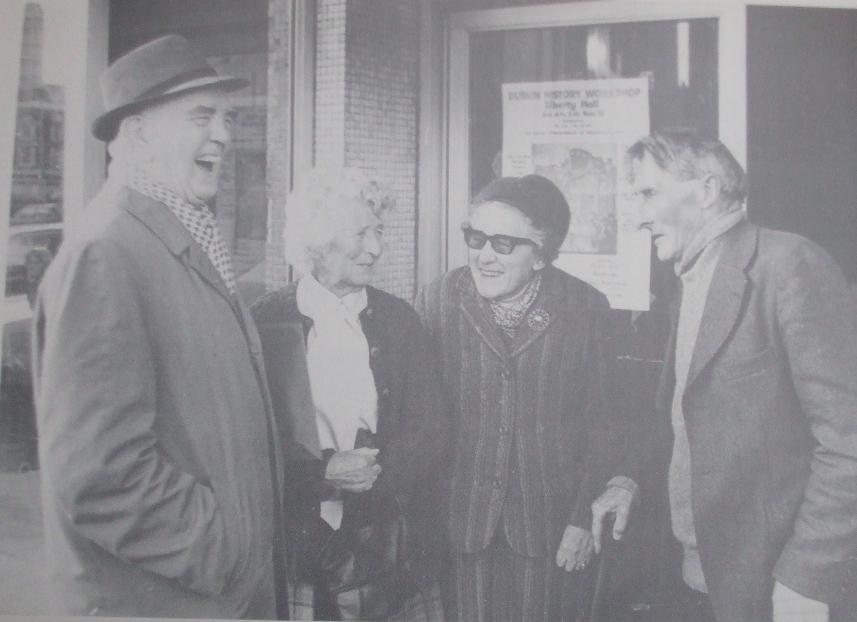
Just a quick post, two fantastic images from an Irish History Workshop/ Saotharlann Staire Éireann workshop report dealing with a Dublin History Workshop at Liberty Hall between the tenth and the twelfth of March, 1978. The workshop report was found hiding in the wrong section at the recent Trinity College Dublin booksale. It includes the text of varied reports given at the conference such as Dr O’ Connor Lysaght’s talk on ‘The Munster Soviet Creameries’ and Margaret Ward’s presentation on ‘The Ladies Land League’

(l-r: Miriam Daly, Matt Merrigan, Nora Connolly O’ Brien, Jack Gannon)

The inside page notes that Miriam Daly was “the victim of a sectarian assasination” between the time of the conference and the time of publication, and that Nora Connolly O’ Brien, daughter of James Connolly, had passed away since the conference.

From the symposium ‘The Relevance of Connolly’

Chair:
Matt Merrigan (Dist. Sec. ATGWU, Socialist Labour Party)
Speakers:
Dr. Noel Browne T.D
Miriam Daly (Queens University and Irish Republican Socialist Party)
Nora Connolly O’ Brien
Michael O’ Riordan (Gen. Sec. Communist Party of Ireland)

An interesting photo this, from page 54 of the report.

4/5.11.1978 Dublin. Dublin History Workshop

(l-r: Michael McInerney, Sheila Humphries (Sighle Bean Ui Dhonnchada), Babs O’ Donoghue, George Gilmore)

Snapped outside Liberty Hall, this is just a great shot.

Sheila Humphries of course was a key member of Cumann na mBán at the time of (and long before) the Republican Congess who, along with Eithne Coyle, had become involved with the new venture before leaving due to unease within CnamB with their involvement.

George Gilmore was a key player in the foundation of the Republican Congress, who resigned from the IRA at the same time as Frank Ryan and Peadar O’ Donnell.

I would welcome information on Michael and Babs, who complete this fantastic shot.

Read Full Post »

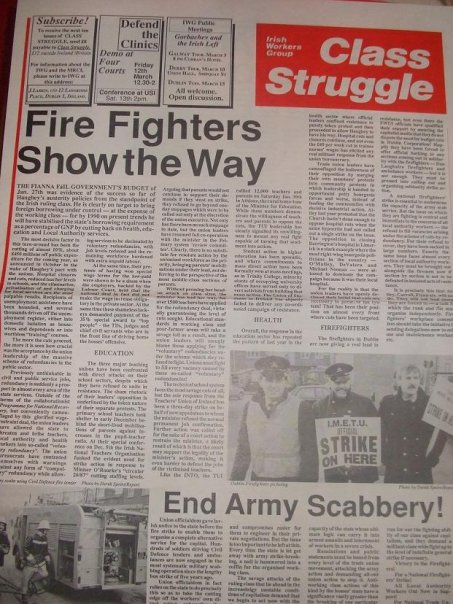
Front page article End Army Scabbery reproduced in full below introduction.

A nice find this, a copy of Class Struggle (the paper of the Irish Workers Group) from 1988, during the Dublin Fire Brigade strike. Up top there is an ad for a public meeting on the subject of ‘Gorbachev and the Irish Left’ and those wishing to subscribe to the paper are told to address their envelopes to a certain ‘J.Larkin’. The paper also features a lengthy piece on the situation in Palestine at the time.

The Irish Workers Group (Workers Power) emerged out of the Socialist Workers Movement in the 1970s.

” It was formed as a separate organisation after being expelled from that group in 1976. It affiliated to the League for the Fifth International (L5I). By the 2000s, it had ceased producing Class Struggle, its publication, instead distributing the publications of the Workers Power group in Britain. The group was active in several places in Ireland, notably Dublin, Derry and Galway, and, amongst others, published a book on James Connolly”
(sourced from Wikipedia)

This newspaper was handed to my father on route to a Union meeting in Liberty Hall during the dispute. I’ve always been intrigued by the strike for a variety of reasons. While troubles raged in the North for example, firemen from Derry stood outside Dublin firestations with signs proclaiming ‘Londonderry FBU Support Dublin Firefighters’. Despite media smear campaigns, the workers managed to hold some degree of popular support, and perhaps nothing was more poignant than the sight of relatives of Stardust fire victims supporting the Brigades workforce.

(Article from front page, on Fire Brigade strike)

End Army Scabbery!

Union officialdom gave lavish notice to the state before the fire strike to enable them to organise a complete alternative service for the capital. Hundreds of soldiers driving Civil Defence tenders and ambulances are now engaged in the most systematic military scabbing operation since the lengthy bus strike of five years ago.

Union officialdom in fact relies on the state to do precisely this so as to take the cutting edge off the workers’ own direct action, exhausting the strikes and making sellouts and compromises eaiser for them to engineer in their private negotiations. But the issue is too important to be left at this. Every time the state is let get away with army strike-breaking, a nail is hammered into the coffin for the organised working class.

The savage attacks of the ruling class that lie ahead in the increasingly unstabble conditions of capitalism demand that we begin to act now with the sharpest possible response to neutralise the strike breaking capacity of the state whose ultimate logic can carry it into armed assaults and internment of workers in severe cases.

Resolutions and public statements must be issued from every level of the trade union movement, attacking the army action and demanding all out union action to stop it. Anti working class actions of the kind by the bosses state have a significance vastly greater than the breaking of one particular strike. They add up to a question of life and death in the long run for the fighting ability of our class against capitalism, and they demand a militant class wide fight up to the level of indefinite general strike if neccessary.

Victory to the Firefighters!

For A National Firefighters Strike!

All Local Authority Workers Out Now In Support!

For National Trade Union Action To Break The Army Scabbery!

Read Full Post »

The Charge of the Light Brigade (1854) at the Battle of Balaclava during the Crimean War remains one of the most infamous events in military history.

It may come as a surprise to some people to learn that the fabled bugle that sounded the charge was not only made in Dublin but was sounded by a Dubliner.

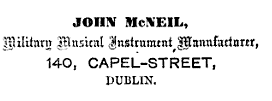
The bugle was made at J.McNeill’s on Capel Street. McNeill’s was a celebrated music shop that started off operating from 148 Capel Street in 1834. Six years later, the business moved to number 137 before settling in a couple of doors down at number 140 in 1842. It traded from this spot for 162 years before relocating to Kilrush Co. Clare in 2004. (The premises is now a pub named McNeills)

From the 'Official Catalogue: Dublin International Exhibition of Arts and Manufactures 1865'

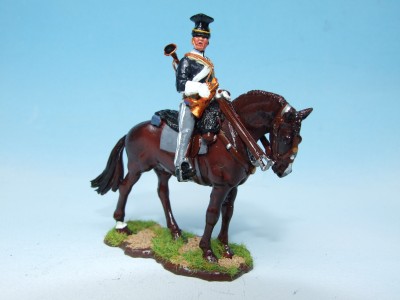
The man believed to have sounded the charge was Dubliner William ‘Billy’ Brittain of the 17th Lancers, Orderly Bugler to Lord Cardigan, the commander of the Light Brigade. Though it is agreed that Billy sounded the “walk”, “trot” and “gallop”, it should be noted that there has been ongoing debate whether the final order of “charge” was actually sounded. Brittain was mortally wounded during the charge and died, still clutching the bugle, in Florence Nightingale’s Hospital in Scutari, Istanbul a few months later.

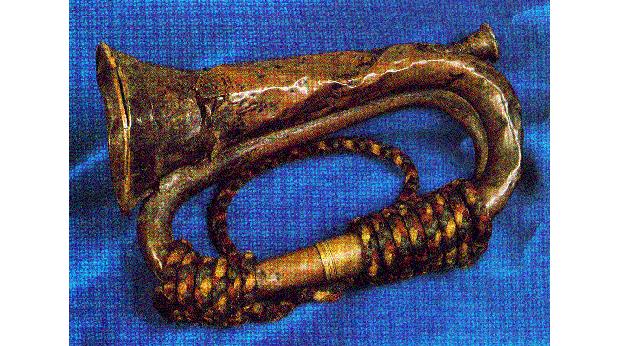
Brittain's Bugle

The battered bugle remained in possession of Brittain’s family until 1905 when it sold to a publican, James Baker, in Newscastle to be displayed in his pub, The Percy Arms. In 1964, it turned up for action at Sotheby’s in London and fetched £1600. The buyers were Ed Sullivan, the American TV showman and Laurence Harvey, the Lithuanian born English actor.

After repairs and restoration, the pair presented the bugle to the Queen’s Royal Lancers – formed from the original 17th Lancers – to be placed on display at their regimental museum in Belvoir Castle, Leicestershire where it remains to this day.

Alexanders Toy Soldiers are selling a miniature, hand painted figurine of William 'Billy' Brittain for £39.99

References:
– Dutton, Roy. Forgotten Heroes: The Charge of the Light Brigade. Wirral, 2007.
– McNeills Music Shop, Facebook page

Read Full Post »

« Newer Posts - Older Posts »